Overview
Service Overview
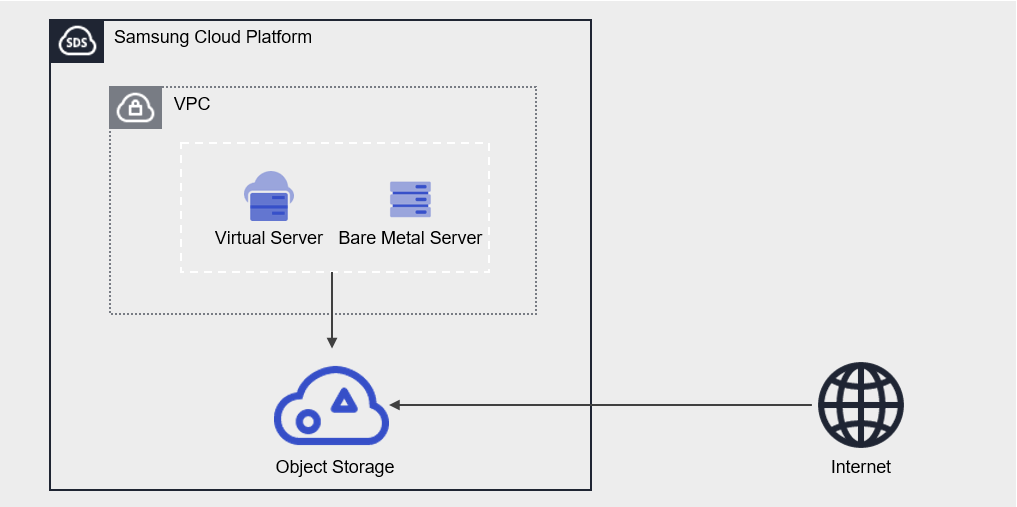
Object Storage is an object storage that allows users to easily store and use the data they want and enables URL-based access, making data management very convenient. It enables searching and retrieving large-scale data, and you can leverage features such as encryption and version control. Provides public and private URLs, and the public URL can be accessed over the internet.
Features
- S3 API utilization: Through a Restful API, applications can access it easily and quickly, and because it is compatible with Amazon S3, it can be used effortlessly in applications integrated with Amazon S3.
- Secure Use: Encryption (SSE‑S3), access control, and Public/Private access features are provided, making it suitable for securely storing user data or backup data for service recovery.
- Cost Efficiency: Users do not predefine the bucket’s capacity and are provided storage space with an efficient pricing model that charges fees based on usage.
- Replication: You can perform replication to a bucket in a different location or the same location. * You can configure multiple replication policies, and if the source bucket becomes unavailable due to a failure or disaster, you can provide the service through the replica bucket.
Configuration diagram
Provided features
Object Storage provides the following features.
- Storage Management: Provides Object Storage creation, folder creation, folder deletion, file upload, file download, and file deletion functions.
- Version control: When you use version control, all versions of the uploaded files are managed. * You can easily download previous files by viewing the version list.
- Encryption: If you enable encryption, encryption is provided via the SSE‑S3 method.
- Access Control: By using access control, you can directly enter the Public IP allowed to access Object Storage, or select resources (Virtual Server, Bare Metal Server, VPC Endpoint, etc.) within the same Account that are permitted to access.
- Replication: You can perform replication to a bucket in a different location or the same location.
- Multiple replication policies can be configured
- Permission Management: It is provided with Private permission by default, and offers Public permission and permission management features.
- Private permission: Allow file access and download only to users who know the authentication key
- Public permission: If accessed via the file’s URL, the file is made public and downloadable to anyone worldwide.
- Monitoring: You can view monitoring information such as total file count, data size (Bytes), HTTP Method request count, etc., through the Cloud Monitoring service.
- ServiceWatch Service Integration Offering: You can monitor data through the ServiceWatch service.
Component
Authentication key
The authentication key is a required element that must be created in advance for using Object Storage.
The purpose of using the authentication key is as follows.
- To create an Object Storage service in the Samsung Cloud Platform Console and access it, an authentication key is required.
- The API provided by Object Storage is compatible with Amazon S3, and you can use the same tools that leverage Amazon S3. * At this point, an authentication key input is required, and it is used as a tool to identify whether the user has the appropriate permissions. For detailed instructions on creating and verifying authentication keys, refer to How-to guides > Creating Authentication Keys.
Bucket
A bucket (Bucket) is the top-level folder, and all folders and files reside under the bucket. When you create an Object Storage service in the Samsung Cloud Platform Console, a bucket is created, and you can subsequently upload folders or files.
The bucket name creation rules are as follows.
- Bucket names must be at least 3 characters and at most 63 characters.
- Bucket names can consist only of lowercase English letters, numbers, periods
.and hyphens-. - Bucket names must start with a lowercase English letter or a digit.
- Bucket names must not contain two consecutive periods.
- Bucket names cannot end with a period or hyphen.
- Bucket names cannot have a period and a hyphen adjacent to each other.
- Bucket names do not use IP address format (e.g., 192.168.x.x).
- The bucket name cannot be admin.
- Bucket names must be unique within an Account/Region.
- The bucket name previously used will be available after 1 hour.
| Example of a valid bucket name | Example of an invalid bucket name |
|---|---|
The following bucket names can be used
| The following bucket names cannot be used
|
Folder
A folder (Folder) is used to logically group files.
The folder name generation rules are as follows.
- Folder names can consist of Korean characters, English letters, numbers, and special characters.
- The special characters that cannot be entered are as follows.
| Special characters that cannot be used in folder names |
|---|
|
File
A file (File) refers to data stored in Object Storage and is the same as a regular file.
The filename generation rules are as follows.
- Filenames can consist of Korean characters, English letters, numbers, and special characters.
- The special characters that cannot be entered are as follows.
| Special characters that cannot be used in file names |
|---|
|
Folder names and file names are separated by a slash/. The following are examples of valid folder names and file names.
| Example of using folder and file names interchangeably |
|---|
|
/) is limited to within 1,024 bytes (based on UTF-8 encoding).URL
You can access the Object Storage bucket via URL. By providing public and private URLs, access is possible not only within the same Samsung Cloud Platform environment but also from external internet environments.
The URL structure is composed as follows.
| URL without an Account ID | URL that uses the Account ID |
|---|---|
| https://[representative URL]/[bucket name]/[folder name]/[file name] | https://[BaseURL]/[accountId]:[bucketName]/[folderName]/[fileName] |
| Category | Explanation | Example |
|---|---|---|
| Main URL | You can find the Representative URL in the Object Storage 상세 정보 확인하기 URL
| - |
| accountId | Account ID
| c2ef8be0481d4094af3c6d046e536d25 |
| bucket name | User-created bucket name | bucketname |
| Folder name | Folder name where the file is located | folder/folder01/folder02/ |
| filename | File name | Filename02 |
The full URL information for the file can be found at View File Information.
Constraints
The limitations of Object Storage are as follows.
| Category | Explanation |
|---|---|
| Number of creatable Object Storage services | Up to 1,000 per region |
| Filename length (including path) | Up to 1,024 Bytes |
| File upload size |
|
| Number of files in the bucket | 200 million or fewer |
- We recommend storing no more than 200 million files per bucket. * If the number of files exceeds 200 million, performance may degrade sharply, so manage the file count.
- S3 Backend Filesystem solution (ex. * When using s3fs, objectivefs, etc., we recommend not using version control. * Performance degradation may occur when using version control.
- After changing IAM permissions, performing an Amazon S3 API call may take up to 30 seconds.
- Access between Object Storage and Samsung Cloud Platform resources is supported only through the access control on the Object Storage detail screen.
- Please note that when using IP access control in IAM policies, access between Object Storage and SCP resources is not allowed.
- To use the service, you must set Applicable IP to All IPs, and Excluded IP to Not used in the IAM policy.
- Korea South 3 (kr-south3) region constraints
- File upload and download functions are limited through the Samsung Cloud Platform Console.
- Using the S3 API/CLI with a public URL is restricted.
- However, private URL access is possible through resources (such as Virtual Server) created in the Samsung Cloud Platform Console.
- Korea South 1 (kr-south1), Korea South 2 (kr-south2) region constraints
- To access the public URL, you must allow a separate firewall setting.
- The public URL can be found on the Object Storage detail page. * Please refer to Check detailed Object Storage information.
Pre-service
Object Storage has no prerequisite services.