Overview
Service Overview
File Storage allows servers connected via the network to easily store and share data, making it a storage solution suitable for application environments that use multiple servers.
You can select the disk type based on performance requirements, and it will automatically expand or shrink according to the user’s data volume without any capacity limits.
Features
- Free volume usage: The volume size automatically expands or contracts based on data creation and deletion without user configuration. * There is no cost for creating a volume; only usage fees for the stored data capacity are incurred.
- Various disk types offered: You can select a disk type based on the user’s intended use. * You can use HDDs that enable cost‑effective storage of large amounts of data, SSDs that provide reduced response times and high IOPS performance, and high‑performance SSDs.
- Snapshot Backup: The image snapshot feature enables recovery of changed or deleted data, and during disk backup you can store snapshots in a location different from the original. * The user selects a snapshot created at the desired recovery point from the list and performs the recovery.
- Replication: creates an identical replica volume at another location, and the user can set the data replication schedule. * If the original volume cannot be used due to failures or disasters, service can be provided through a replica volume.
Configuration
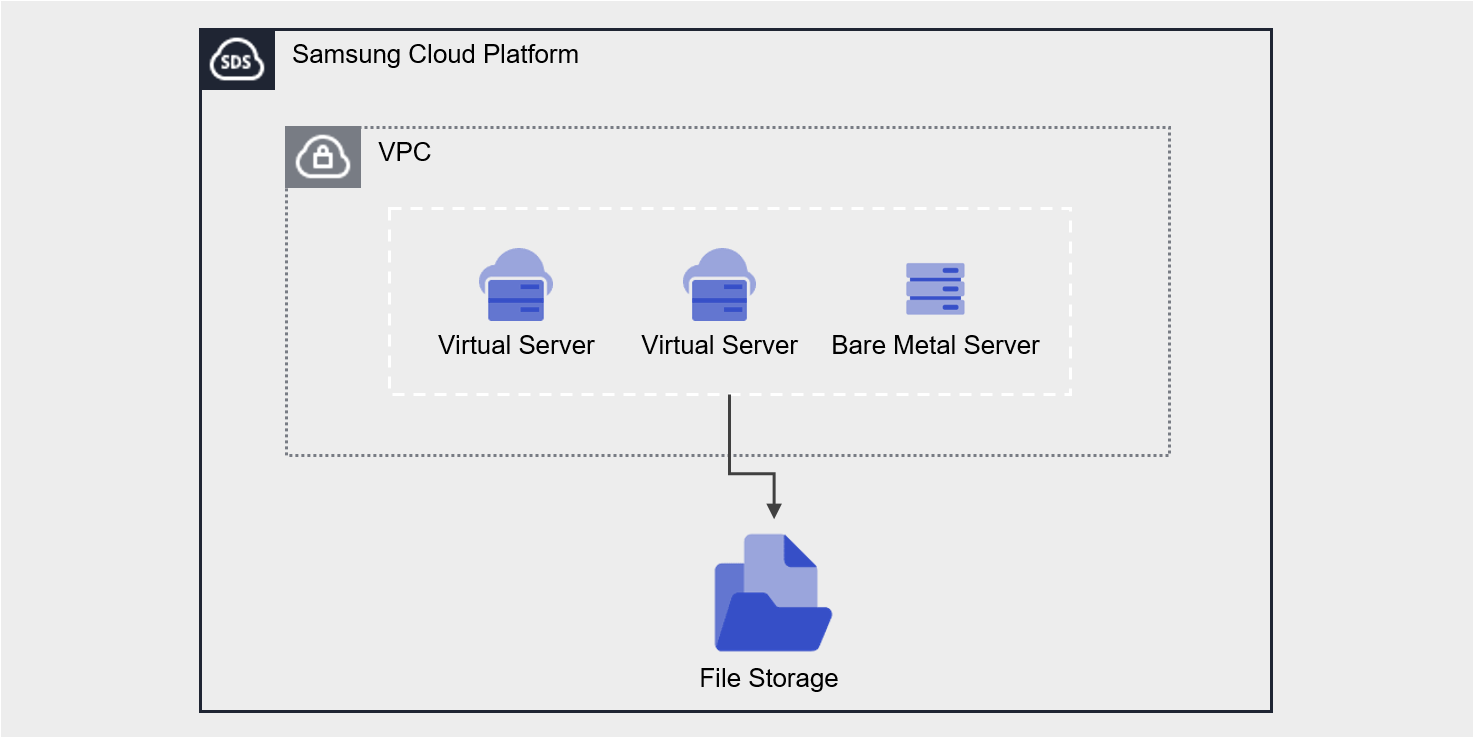
Provided features
File Storage provides the following features.
- Volume Name: You can set a name for each volume.
- Volume type: You can select a volume type.
- Single-AZ: Create a volume in a single location (AZ)
- Select an Availability Zone to specify the volume creation location.
- Single-AZ: Create a volume in a single location (AZ)
- Volume type: You can select a volume type.
- Disk Type: You can select the disk type based on performance requirements.
- HDD: General volume
- SSD: High‑Performance General Volume
- High‑Performance SSD: Performance‑optimized volume that can be connected to a Multi-node GPU Cluster
- Protocol: You can select the protocol based on the user’s OS Image.
- NFS: Primarily used on Linux operating systems
- CIFS: Primarily used on Windows operating systems
- Free Volume Usage: Provides flexible volume size based on the amount of stored data without setting a capacity.
- Connected Resources: Virtual Server, Bare Metal Server, GPU Server, Multi-node GPU Cluster can be connected and used.
- Encryption: Regardless of disk type, all volumes are encrypted with the XTS-AES-256 algorithm.
- Snapshot: The image snapshot feature enables immediate or scheduled snapshot creation.
- Retention Count: The number of snapshots retained that are automatically created by the schedule
- Schedule: Snapshot auto-creation interval
- Recovery: Recover the original volume to the latest snapshot, select a snapshot at a specific point in time to create a recovery volume
- Replication: Replicates the volume to another location, and the user can set the replication schedule.
- Disk Backup: Stores snapshots on a backup-dedicated HDD storage and allows you to select the backup location.
- VPC Endpoint connection: File Storage is available through a Private Network connection from an external network.
- Volume Transfer: You can transfer a volume to another Account using the volume transfer feature.
- ServiceWatch Service Integration Provided: You can monitor data using the ServiceWatch service.
Component
You can create a volume by selecting the disk type and protocol based on the user’s service environment and performance requirements.
When using the snapshot feature, you can restore data to the desired point in time.
Volume
A volume (Volume) is the basic creation unit of the File Storage service and is used as data storage space. The user selects a name, disk type, and protocol (CIFS/NFS) to create a volume, then connects it to one or more servers for use.
The volume name creation rules are as follows.
- It must start with a lowercase English letter and can be set to 3-21 characters using lowercase letters, numbers, and special characters (
_).
Snapshot
A snapshot (Snapshot) is an image backup of a specific point in time. Using the image snapshot feature, you can recover changed or deleted data, or store snapshots in a different location from the original when performing disk backups. The user selects the snapshot created at the desired recovery point from the snapshot list and performs the recovery.
The following are notes to consider when using snapshots.
- The snapshot creation time is based on Asia/Seoul (GMT +09:00). Snapshots can be created up to 800, and snapshots generated by schedule are not included. (Automatic generation via schedule is limited to a maximum of 128)
- Select the snapshot recovery button to restore the File Storage volume to the latest snapshot.
- If you select a specific snapshot from the snapshot list, you can recover by creating a new volume based on that snapshot.
- Automatic creation is possible through snapshot schedule settings.
- Snapshot storage is included in File Storage usage and incurs charges, so adjust the storage capacity by setting the snapshot retention period.
Preceding Service
This is a list of services that must be pre-configured before creating the service. For detailed information, refer to the guide provided for each service and prepare in advance.
| Service Category | service | Detailed description |
|---|---|---|
| Compute | Virtual Server | Virtual server optimized for cloud computing |
| Compute | Bare Metal Server | High-performance physical server used without virtualization |