This is the multi-page printable view of this section. Click here to print.
VPC
- 1: Overview
- 1.1: ServiceWatch Metrics
- 2: How-to guides
- 2.1: Subnet
- 2.2: Port
- 2.3: Internet Gateway
- 2.4: NAT Gateway
- 2.5: Public IP
- 2.6: Private NAT
- 2.7: VPC Endpoint
- 2.8: VPC Peering
- 2.9: Transit Gateway
- 2.10: PrivateLink Service
- 2.11: PrivateLink Endpoint
- 2.12: NAT Logging
- 3: API Reference
- 4: CLI Reference
- 5: Release Note
1 - Overview
Service Overview
Samsung Cloud Platform provides VPC services to support the use of logically separated, customer-dedicated private network spaces in the cloud environment.
VPC (Virtual Private Cloud) is a service that provides a logically isolated, customer-dedicated private network space in a cloud environment. Depending on the usage purpose, you can create a General Subnet and a Local Subnet for communication between servers, and you can freely select NAT Gateway and Internet Gateway to configure various networks. You can create multiple VPCs and operate them independently. VPC Peering allows configuration of connections between VPCs.
Service Architecture Diagram
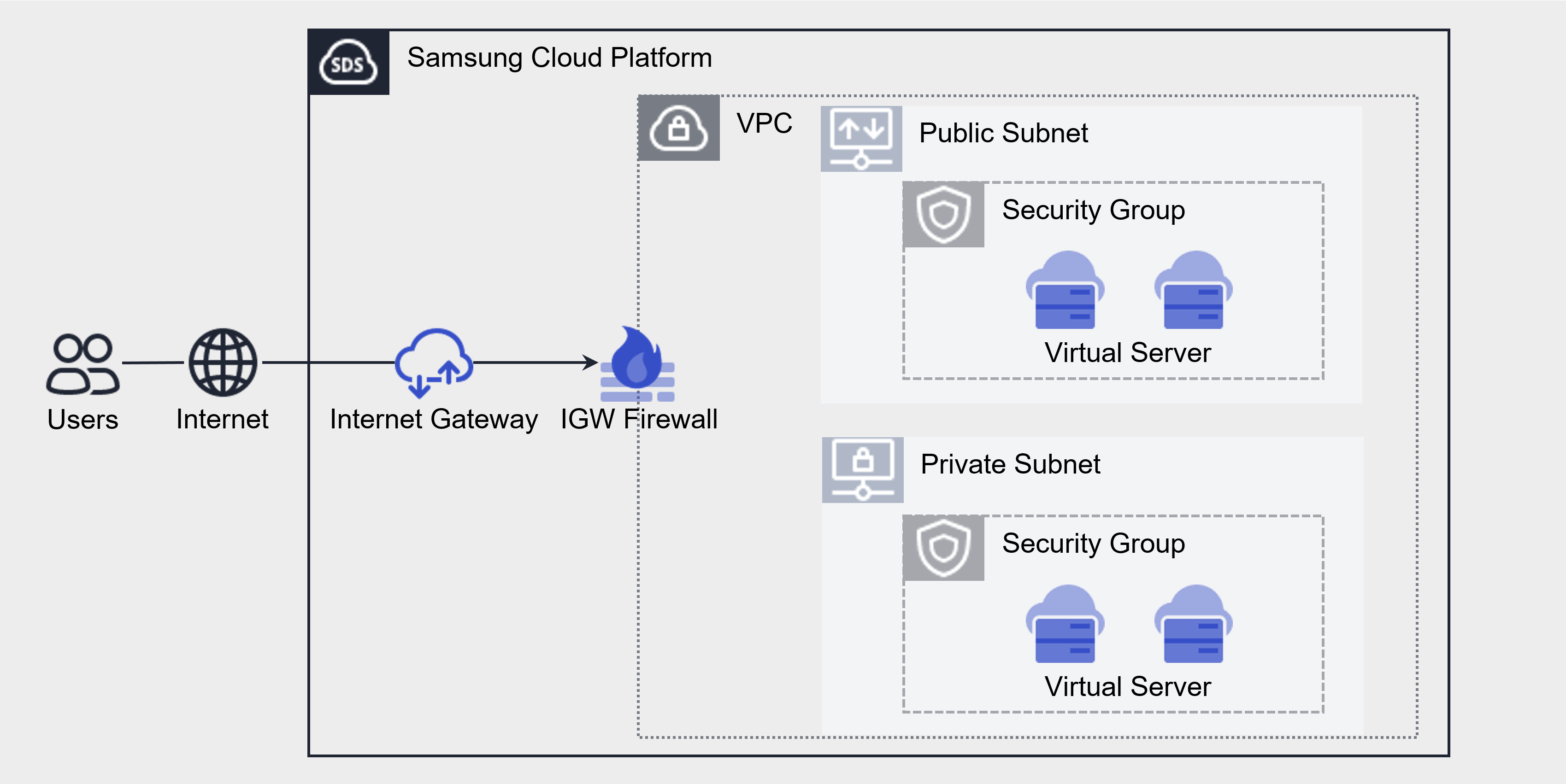
Components
Subnet
Subnet means the IP address range of a VPC. Depending on the purpose, use a General Subnet to create a Subnet for Public or Private use. It is a service that allows users to segment the network within a VPC according to their purpose/scale. Subnet provides a Local Subnet for communication between a regular Subnet and a server.
General Subnet Create/Read/Delete: When creating a VPC, the Subnet that is created by default is used according to purpose. For example, it can be used by distinguishing between a Public Subnet that can use the Internet and a Private Subnet that cannot use the Internet.
VPC Endpoint Subnet Create/Read/Delete: It is possible to access the Samsung Cloud Platform via a private connection from an external network connected to the VPC, allowing entry to the VPC.
Local Subnet creation/query/deletion: It does not allow connections to other Subnets or external access, and is a Subnet that only permits direct connections between Virtual Server-Virtual Server or Bare Metal Server-Bare Metal Server, so only settings between Virtual Server-Virtual Server within the VPC are possible.
Subnet types
It means Sub_network and is an IP address space subdivided into small units for use in IP networks. Subnet types are divided according to how routing for the Subnet is configured.
| Type | Detailed Description |
|---|---|
| Public Subnet | Subnet can be configured to use the internet as a General Subnet |
| Private Subnet | Can configure a Subnet where internet usage is not possible using General Subnet |
| VPC Endpoint Subnet | Subnet configuration that can be used as VPC Endpoint |
| Local Subnet | Possible to configure a Subnet that does not connect to other Subnets or external access |
Internet Gateway
You can create an Internet Gateway to connect to a VPC, view detailed information, or delete an unused Internet Gateway. You can use an Internet Gateway to connect VPC resources to the internet.
You can assign a public IP to instances and load balancers that can be connected to the internet, allowing access from outside.
NAT Gateway
Create a NAT Gateway, connect it to a subnet, view detailed information, or delete an unused NAT Gateway.
To create a NAT Gateway for a subnet, you must first create an Internet Gateway and attach it to the VPC. Creating a NAT Gateway allows internet access for all resources in the subnet. To restrict internet access, apply firewall rules.
A NAT Gateway can be created when it is of the General type, and it is a service that maps a single representative public IP for a Virtual Server without a public IP NAT, for outbound internet usage.
Public IP
If you want to use the same IP address each time you stop and start an instance, you reserve a Public IP and use it.
This is a service that creates a desired public IP within the available Public IP Pool of Samsung Cloud Platform and assigns it to compute resources for use.
Compute resources assigned with the designated public IP will not have their IP changed even if they are rebooted.
Port
Provides a connection point to connect a single device such as a server’s NIC to the network. This allows addition beyond the default provided NIC.
VPC Endpoint
Provides an entry point of the VPC that can access the Samsung Cloud Platform via a Private connection from an external network connected to the VPC.
VPC Peering
Through a 1:1 private route between VPCs, IP communication is possible. By default, peering is provided between VPCs in the same Account, and only one connection is allowed between different Accounts.
Private NAT
You can map and connect the customer’s IP using Direct Connect from compute resources within the VPC.
Transit Gateway
Transit Gateway connects the customer’s network and Samsung Cloud Platform’s network easily and serves as a gateway service that acts as a connection hub for multiple VPCs within the cloud environment.
Through Transit Gateway, customers can configure various network topologies they desire. Additionally, it provides independent firewall configuration and routing functions for each connected network segment, allowing thorough security management.
PrivateLink
It is a service that connects internal data of Samsung Cloud Platform to a private path between VPC and SCP services without exposing it to the internet.
- PrivateLink Service is for service providers, and PrivateLink Endpoint is for service users.
Constraints
The VPC of Samsung Cloud Platform limits the number of VPCs and Subnets created as follows.
| Category | Default Quota | Detailed Description |
|---|---|---|
| VPC | 5 | Number of default VPC creation limit per Account |
| VPC Peering | 5 | Number of VPC Peering creation limit per account |
| Subnet | 3 | Default Subnet creation limit per VPC |
| Private NAT | 3 | Default number of Private NATs that can be created per VPC |
| Transit Gateway | 3 | Number of Transit Gateways creation limit per account |
| Transit Gateway connection from VPC | 5 | Maximum number of VPC connections per Transit Gateway (only same account can connect) |
Prior Service
VPC has no preceding service.
1.1 - ServiceWatch Metrics
VPC - Internet Gateway sends metrics to ServiceWatch. The metrics provided by basic monitoring are data collected at a 5-minute interval.
Basic Indicators
Internet Gateway
The following are the basic metrics for the Internet Gateway namespace.
| Performance Item | Detailed Description | Unit | Meaningful Statistics |
|---|---|---|---|
| Network In Total Bytes_Internet | Cumulative traffic from Internet Gateway to VPC | Bytes |
|
| Network Out Total Bytes _Internet | Cumulative traffic volume towards VPC → Internet Gateway | Bytes |
|
| Network In Total Bytes _Internet_Delta | Internet Gateway → Cumulative traffic over 5 minutes towards VPC (Internet) | Bytes |
|
| Network Out Total Bytes _Internet_Delta | Cumulative traffic amount (Internet) over 5 minutes from VPC to Internet Gateway | Bytes |
|
2 - How-to guides
The user can enter the essential information of the VPC service and create the service by selecting detailed options through the Samsung Cloud Platform Console.
Create VPC
You can create and use VPC services on the Samsung Cloud Platform Console.
To create a VPC, follow the following procedure.
- All services > Networking > VPC menu is clicked. It moves to the Service Home page of VPC.
- Service Home page, click the VPC creation button. It moves to the VPC creation page.
- Service Information Input area, please enter or select the required information.
Classification MandatoryDetailed Description VPC name required name of the VPC to be created - enter within 3~20 characters using English letters and numbers
IP range required IP range to be used - In IP range format, enter within the range of
/16 ~ /24- Example:
192.168.0.0/16 ~ /24
- Example:
Description Selection Enter a description of the VPC Table. VPC Service Information Input Items - Additional Information Input area, please enter or select the required information.
Classification MandatoryDetailed Description Tag Selection Add Tag - Up to 50 can be added per resource
- Click the Add Tag button and enter or select Key, Value
Table. VPC Additional Information Input Items
- Summary panel where you created detailed information and estimated billing amount, and click the Complete button.
- Once creation is complete, check the created resource on the VPC list page.
VPC detailed information check
VPC service is a service that can check and modify the entire resource list and detailed information. The VPC details page consists of details, tags, and operation history tabs.
To check the VPC details, follow the next procedure.
- All services > Networking > VPC menu is clicked. It moves to the Service Home page of VPC.
- Service Home page, click the VPC menu. It moves to the VPC list page.
- VPC list page, click on the resource to check the detailed information. It moves to the VPC details page.
- VPC Details page displays status information and additional feature information, and consists of Details, Tags, Task History tabs.
Classification Detailed Description Status VPC’s status - Active: normal operation in progress
- Deleting: deletion in progress
- Creating: creation in progress
- Error: current status cannot be confirmed
- <li;if it occurs continuously, contact the registered administrator
Service Cancellation Button to cancel the service - To cancel the VPC, there should be no connected services.
- When the service is canceled, the operating service may be stopped immediately, so proceed with the cancellation work after fully considering the impact that occurs when the service is stopped
Table. VPC Status Information and Additional Features
Detailed Information
VPC List page where you can check the detailed information of the selected resource and modify the information if necessary.
| Classification | Detailed Description |
|---|---|
| Service | Service Name |
| Resource Type | Resource Type |
| SRN | Unique resource ID in Samsung Cloud Platform
|
| Resource Name | VPC Name |
| Resource ID | VPC’s unique resource ID |
| Creator | The user who created the VPC |
| Creation Time | The time when VPC was created |
| Modifier | User who modified VPC information |
| Revision Time | Time when VPC information was revised |
| VPC name | VPC resource name |
| VPC ID | VPC Unique ID |
| External Link | Information connected to the outside |
| IP range | Service IP range |
| Description | VPC Description |
Tag
VPC List page where you can check the tag information of the selected resource, and add, change or delete it.
| Classification | Detailed Description |
|---|---|
| Tag list | Tag list
|
Work History
VPC list page where you can check the work history of the selected resource.
| Classification | Detailed Description |
|---|---|
| Work history list | Resource change history
|
VPC Cancellation
You can cancel the unused VPC to reduce operating costs. However, when canceling the service, the operating service may be stopped immediately, so you should consider the impact of stopping the service sufficiently before proceeding with the cancellation work.
To cancel the VPC, follow the following procedure.
- All services > Networking > VPC menu is clicked. It moves to the Service Home page of VPC.
- Service Home page, click the VPC menu. It moves to the VPC list page.
- VPC list page, select the resource to be canceled and click the service cancellation button.
- Once the cancellation is complete, check if the resource has been cancelled on the VPC list page.
2.1 - Subnet
Subnet creation
You can create and use the VPC Subnet service on the Samsung Cloud Platform Console.
To create a subnet, follow the following procedure.
- All services > Networking > VPC menu is clicked. It moves to the Service Home page of VPC.
- Service Home page, click the Subnet creation button. It moves to the Subnet creation page.
- Service Information Input area, please enter or select the required information.
Classification NecessityDetailed Description Subnet type required Select the Subnet type. - General: Public and Private configuration possible
- Local: Can be specified by selecting either Virtual Server or Bare Metal Server
- VPC Endpoint: VPC Endpoint configuration possible
- Local Subnet is a Subnet for communication between servers only, and external communication is not possible
VPC name required select a VPC to connect the subnet from the list of currently created VPCs Subnet name required name of the Subnet to be created - enter within 3-20 characters using English uppercase and lowercase letters, and numbers
IP range required IP range to be used - In the format of IP range, enter within the range of
/16 ~ /28- Example:
192.168.0.0/22 ~ /27
- Example:
- The IP range cannot be duplicated with the IP range (other subnets) currently in use within the VPC
Gateway Selection The Subnet’s Gateway address is displayed - If you enter the IP range, the corresponding IP will be automatically displayed
Table. VPC Subnet service information input items - Additional Information Input area, please enter or select the required information.
Classification MandatoryDetailed Description Description Selection Enter a description for the Subnet IP allocation range selection range setting possible within the IP range to be used - default: entire IP range
- Subnet sub-resources are assigned an IP within the entire IP range or the range individually specified by the user
DNS Name Server Select Use Select and then enter DNS Name Server IP host path selection use select and enter the host path after selection - destination IP ranges should not overlap with each other
Tag Selection Add Tag - Up to 50 can be added per resource
- Click the Add Tag button and enter or select Key, Value
Table. Subnet Additional Information Input Items
- Summary panel where you created detailed information and estimated billing amount, and click the Complete button.
- Once creation is complete, check the created resource on the Subnet list page.
Subnet detailed information check
Subnet service can check and modify the entire resource list and detailed information. The Subnet detail page consists of detailed information, tags, and operation history tabs.
To check the subnet detailed information, follow the next procedure.
- All services > Networking > VPC menu is clicked. It moves to the Service Home page of VPC.
- Service Home page, click the Subnet button. It moves to the Subnet list page.
- Subnet list page, click on the resource to check the detailed information. It moves to the Subnet details page.
- Subnet details page displays status information and additional feature information, and consists of details, tags, operation history tabs.
Classification Detailed Description Status Status of Subnet - Active: normal operation in progress
- Creating: creation in progress
- Deleting: deletion in progress
- Failed: failed to create
- Error: current status unknown
- if it occurs continuously, contact the registered administrator
Subnet deletion Button to delete subnet Table. Subnet status information and additional functions
Detailed Information
Subnet list page where you can check the operation history of the selected resource.
| Classification | Detailed Description |
|---|---|
| Service | Service Name |
| Resource Type | Resource Type |
| SRN | Unique resource ID in Samsung Cloud Platform
|
| Resource Name | Subnet Resource Name |
| Resource ID | Unique resource ID in the service |
| Creator | Subnet created user |
| Creation Time | Subnet Creation Time |
| Modifier | User who modified Subnet information |
| Revision Time | Time when Subnet information was revised |
| Subnet type | Subnet type |
| VPC name | VPC that subnet belongs to |
| Subnet name | Subnet title |
| Subnet ID | Subnet Unique ID |
| IP range | Used IP range |
| Gateway IP | Subnet’s Gateway IP address |
| IP assignment range | IP assignment range |
| DNS Name Server | Whether to use DNS Name Server |
| Host Path | Host path (destination IP range, Next Hop IP address) information |
Tag
Subnet list page where you can check the tag information of the selected resource, and add, change or delete it.
| Classification | Detailed Description |
|---|---|
| Tag List | Tag List
|
Work History
Sunnet list page where you can check the work history of the selected resource.
| Classification | Detailed Description |
|---|---|
| Work history list | Resource change history
|
Subnet cancellation
You can delete unused Subnet. However, since Subnet cannot be recovered once deleted, you should consider the impact of deleting the Subnet sufficiently before proceeding with the deletion work.
- If there are connected resources, you cannot cancel the service. Please delete the connected resources first.
- The service can only be deleted when the service status is Active or Error.
- After deleting the service, you cannot recover the data, so please be careful.
To delete a subnet, follow these procedures.
- All services > Networking > VPC menu is clicked. It moves to the Service Home page of VPC.
- Service Home page, click the Subnet menu. It moves to the Subnet list page.
- Subnet list page, click the resource to be deleted. It moves to the Subnet details page.
- Subnet details page, click the delete button.
- After deletion is complete, it checks if the resource has been deleted from the Subnet list.
Preceding service
This is a list of services that must be pre-configured before creating the service. Please refer to the guide provided for each service and prepare in advance for more details.
| Service Category | Service | Detailed Description |
|---|---|---|
| Networking | VPC | a service that provides an independent virtual network in a cloud environment |
2.2 - Port
Port creation
You can create and use the Port service on the Samsung Cloud Platform Console.
To create a port, follow the following procedure.
- All services > Networking > VPC menu is clicked. It moves to the Service Home page of VPC.
- Service Home page, click the Port creation button. Move to the Port creation page.
- Service Information Input area, please enter or select the required information.
Classification NecessityDetailed Description VPC Name Required Select a VPC to create a port Subnet name required Select the Subnet to create a Port Port name required A name that can easily identify the port - Enter within 3-20 characters using English uppercase and lowercase letters, and numbers
IP allocation method required IP allocation method selection - automatic allocation: IP is automatically allocated within the IP allocation range of Subnet
- direct input: The input IP is allocated within the subnet range
- fixed IP address Enter the IP address to be used for the Port
Description Selection Enter a description of the Port Security Group Selection Use Select up to 5 Security Groups when selected Table. Port Service Information Input Items - Additional Information Input area, please enter or select the required information.
Classification MandatoryDetailed Description Tag Selection Add Tag - Up to 50 can be added per resource
- Click the Add Tag button and enter or select Key, Value
Table. Additional Port Information Input Items
- Summary panel where you created detailed information and estimated billing amount, and click the Complete button.
- Once creation is complete, check the created resource on the Port list page.
Port detailed information check
Port service allows you to check and modify the entire resource list and detailed information. Port details page consists of detailed information, tags, work history tabs.
Port detailed information to confirm, please follow the next procedure.
- All services > Networking > VPC menu is clicked. It moves to the Service Home page of VPC.
- Service Home page, click the Port menu. It moves to the Port list page.
- Port list page, click the resource (Port name) to check the detailed information. It moves to the Port details page.
- Port Details page displays status information and additional feature information, and consists of Details, Tags, Work History tabs.
Classification Detailed Description Status Port’s status - Active: normal operation in progress
- Down: not connected to a resource, or connected but not operating
- Build: being created
- Error: current status cannot be confirmed
- if it occurs continuously, contact the registered administrator
Port deletion Button to delete the port Table. Port Status Information and Additional Functions
Detailed Information
Port list page where you can check the detailed information of the selected resource and modify the information if necessary.
| Classification | Detailed Description |
|---|---|
| Service | Service Name |
| Resource Type | Resource Type |
| SRN | Unique resource ID in Samsung Cloud Platform
|
| Resource Name | Port Resource Name |
| Resource ID | Unique resource ID in the service |
| Resource ID | Port’s unique resource ID |
| Creator | The user who created the Port |
| Creation Time | The time when the Port was created |
| Editor | User who modified the Port information |
| Revision Time | Time when Port information was revised |
| Port name | Port resource name |
| Port ID | Port Resource ID |
| Subnet name | Connected Subnet name |
| Connected Resources | Connected Device Information |
| Fixed IP | Fixed IP Information |
| MAC address | MAC address information |
| Description | Description of the Port |
| Security Group | Connected Security Group information
|
Tag
Port list page where you can check the tag information of the selected resource, and add, change or delete it.
| Classification | Detailed Description |
|---|---|
| Tag List | Tag List
|
Work History
Port list page where you can check the work history of the selected resource.
| Classification | Detailed Description |
|---|---|
| Work history list | Resource change history
|
Port deletion
You can release unused Port to reduce operating costs. However, if you delete the Port, the service in operation may be stopped immediately, so you should consider the impact of stopping the service sufficiently and proceed with the cancellation work.
To delete a Port, follow the following procedure.
- All services > Networking > VPC menu is clicked. It moves to the Service Home page of VPC.
- Service Home page, click the Port menu. It moves to the Port list page.
- Port list page, click the resource (Port name) to be deleted. It moves to the Port details page.
- Port details page, click the delete button.
- After deletion is complete, it checks if the resource has been deleted from the Port list.
Preceding service
This is a list of services that must be pre-configured before creating the service. Please refer to the guide provided for each service and prepare in advance for more details.
| Service Category | Service | Detailed Description |
|---|---|---|
| Networking | VPC | a service that provides an independent virtual network in a cloud environment |
2.3 - Internet Gateway
Internet Gateway creation
You can create and use the Internet Gateway service on the Samsung Cloud Platform Console.
To create an Internet Gateway, follow the next procedure.
- All services > Networking > VPC menu is clicked. It moves to the Service Home page of VPC.
- Service Home page, click the Create Internet Gateway button. It moves to the Create Internet Gateway page.
- Service Information Input area, please enter or select the required information.
Classification MandatoryDetailed Description VPC name required Select a VPC connected to the Internet Gateway classification essential Select Internet Gateway type Internet Gateway name selection automatically generated as IGW_{VPC name} Description Selection Enter a description for the Internet Gateway Firewall use selection Firewall usage selection Firewall log storage option Select Select whether to store the Firewall log - Store access logs when using the Firewall
- For more information, see How to use Firewall log storage
Table. Internet Gateway service information input items - Additional Information Input area, please enter or select the required information.
Classification NecessityDetailed Description Tag Selection Add Tag - Up to 50 can be added per resource
- Click the Add Tag button and enter or select Key, Value
Table. Additional Information Input Items for Internet Gateway
- Summary panel where you can check the detailed information generated and the expected billing amount, and click the Complete button.
- Once creation is complete, check the created resource on the Internet Gateway list page.
Internet Gateway detailed information check
Internet Gateway 서비스는 전체 자원 목록과 상세 정보를 확인하고 수정할 수 있습니다. Internet Gateway 상세 페이지에서는 상세 정보, 태그, 작업 이력 탭으로 구성되어 있습니다. -> Internet Gateway service can check and modify the entire resource list and detailed information. The Internet Gateway details page consists of details, tags, and operation history tabs.
Internet Gateway detailed information to confirm, please follow the next procedure.
- All Services > Networking > VPC menu is clicked. It moves to the Service Home page of VPC.
- Service Home page, click the Internet Gateway menu. It moves to the Internet Gateway list page.
- Internet Gateway list page, click on the resource to check the detailed information. It moves to the Internet Gateway details page.
- Internet Gateway details page displays status information and additional feature information, and consists of details, tags, operation history tabs.
Classification Detailed Description Status Internet Gateway Status - Creating: Resource creation in progress
- Active: Connected
- Deleting: Deletion in progress
- Error: Current status cannot be confirmed
- If this occurs continuously, please contact the registered administrator
Internet Gateway deletion Internet Gateway delete button Table. Internet Gateway Status Information and Additional Functions
Detailed Information
Internet Gateway list page where you can check the detailed information of the selected resource and modify the information if necessary.
| Classification | Detailed Description |
|---|---|
| Service | Service Name |
| Resource Type | Resource Type |
| SRN | Unique resource ID in Samsung Cloud Platform
|
| Resource Name | Internet Gateway Resource Name |
| Resource ID | Unique resource ID in the service |
| Creator | The user who created the Internet Gateway |
| Creation Time | The time when the Internet Gateway was created |
| Editor | User who modified the Internet Gateway information |
| Modified Time | Time when Internet Gateway information was modified |
| Internet Gateway name | Internet Gateway title |
| Internet Gateway ID | Internet Gateway resource ID |
| VPC name | VPC title |
| VPC name | VPC ID |
| Classification | Internet Gateway Type |
| Description | Description of the Internet Gateway |
| Firewall name | Move to the Firewall detail page |
| Firewall use | Whether to use Firewall |
| NAT Gateway | Move to NAT Gateway detailed page |
| NAT log storage status | NAT log storage status
|
Tag
Internet Gateway list page where you can check the tag information of the selected resource, and add, change or delete it.
| Classification | Detailed Description |
|---|---|
| tag list | tag list
|
Work History
Internet Gateway list page where you can check the operation history of the selected resource.
| Classification | Detailed Description |
|---|---|
| Work history list | Resource change history
|
Internet Gateway resource management
Internet Gateway log storage usage, etc. can be managed to manage resources.
NAT log storage usage
To save NAT logs, you must first create a bucket in Object Storage to save the logs, and then set the bucket as the log repository in NAT Logging settings, then after setting log saving in NAT detail inquiry, NAT logs will be saved in the Object Storage bucket, log repository settings can be checked in NAT Logging settings, for more information, please refer to NAT Logging.
- When you set up a log storage, you will be charged for Object Storage fees for log storage.
To use NAT log saving, follow the next procedure.
- All services > Networking > VPC menu is clicked. It moves to the Service Home page of VPC.
- Service Home page, click the Internet Gateway menu. It moves to the Internet Gateway list page.
- Internet Gateway list page, click the resource to check the detailed information. It moves to the Internet Gateway details page.
- Modify NAT log storage button, click. Modify NAT log storage popup window will move to.
- NAT log storage modification In the popup window, select use for the log storage and click the confirm button.
Do not use NAT log storage
To use NAT log saving, follow the next procedure.
- All services > Networking > VPC menu is clicked. It moves to the Service Home page of VPC.
- Service Home page, click the Internet Gateway menu. It moves to the Internet Gateway list page.
- Internet Gateway list page, click on the resource to check the detailed information. It moves to the Internet Gateway details page.
- Modify NAT log storage status button, click. Modify NAT log storage status popup window will move to.
- NAT log storage modification In the popup window, uncheck use of the log storage and click the confirm button.
- Notification Check the message in the popup window and click the Confirm button.
Internet Gateway deletion
To delete the Internet Gateway, follow the next procedure.
- All services > Networking > VPC menu is clicked. It moves to the Service Home page of VPC.
- Service Home page, click the Internet Gateway menu. It moves to the Internet Gateway list page.
- Internet Gateway list page, click the resource to be deleted. It moves to the Internet Gateway details page.
- Internet Gateway details page, click the Delete button.
- After the deletion is complete, it checks if the resource has been deleted from the Internet Gateway list.
Preceding service
This is a list of services that must be pre-configured before creating the service. Please refer to the guide provided for each service and prepare in advance for more details.
| Service Category | Service | Detailed Description |
|---|---|---|
| Networking | VPC | a service that provides an independent virtual network in a cloud environment |
2.4 - NAT Gateway
NAT Gateway creation
You can create and use the NAT Gateway service on the Samsung Cloud Platform Console.
To create an NAT Gateway, follow the next procedure.
- All services > Networking > VPC menu, click. It moves to the Service Home page of VPC.
- Service Home page, click the Create NAT Gateway button. It moves to the Create NAT Gateway page.
- Service Information Input area where you can input or select the necessary information.
Classification MandatoryDetailed Description VPC name required Select the VPC to be connected Subnet name required select the connected Subnet NAT Gateway name selection created as NAT_GW_{subnet name} IP for NAT Gateway required Select Public IP for NAT Gateway Description Selection Enter a description for the NAT Gateway Table. NAT Gateway service information input items - Additional Information Input area, please enter or select the required information.
Classification MandatoryDetailed Description Tag Selection Add Tag - Up to 50 can be added per resource
- Click the Add Tag button and enter or select Key, Value
Table. NAT Gateway Additional Information Input Items
- Summary panel where you created detailed information and estimated billing amount, and click the Complete button.
- Once creation is complete, check the created resource on the NAT Gateway list page.
NAT Gateway detailed information check
NAT Gateway 서비스는 전체 자원 목록과 상세 정보를 확인하고 수정할 수 있습니다. NAT Gateway details 페이지에서는 details, tags, operation history 탭으로 구성되어 있습니다.
- All services > Networking > VPC menu is clicked. It moves to the Service Home page of VPC.
- Service Home page, click the NAT Gateway menu. It moves to the NAT Gateway list page.
- NAT Gateway list page, click the resource to check the detailed information. It moves to the NAT Gateway details page.
- NAT Gateway details page displays status information and additional feature information, and consists of details, tags, operation history tabs.
Classification Detailed Description Status NAT Gateway’s status - Creating: Creating in progress
- Active: Operating normally
- Deleting: Deleting in progress
- Error: Current status cannot be confirmed
- If it occurs continuously, contact the registered administrator
NAT Gateway deletion a button to cancel the service - In the case of no connected service, the NAT Gateway is canceled
- If the service is canceled, the operating service may be stopped immediately, so proceed with the cancellation work after fully considering the impact that occurs when the service is stopped
Table. NAT Gateway Status Information and Additional Functions
Detailed Information
NAT Gateway List page where you can check the detailed information of the selected resource and modify the information if necessary.
| Classification | Detailed Description |
|---|---|
| Service | Service Name |
| Resource Type | Resource Type |
| SRN | unique resource ID in Samsung Cloud Platform
|
| Resource Name | NAT Gateway Resource Name |
| Resource ID | Unique resource ID in the service |
| Creator | The user who created the NAT Gateway |
| Creation Time | The time when the NAT Gateway was created |
| Modifier | User who modified the NAT Gateway information |
| Modified Time | The time when NAT Gateway information was modified |
| NAT Gateway name | NAT Gateway title |
| NAT Gateway ID | NAT Gateway resource ID |
| VPC Name | VPC name connected to NAT Gateway |
| VPC ID | VPC resource ID connected to the NAT Gateway |
| Subnet name | NAT Gateway connected subnet name |
| Subnet name | NAT Gateway connected subnet resource ID |
| Subnet IP Range | Subnet IP Range Information |
| NAT Gateway IP | NAT Gateway IP information |
| Description | Description of the NAT Gateway |
Tag
NAT Gateway List page where you can check the tag information of the selected resource, and add, change or delete it.
| Classification | Detailed Description |
|---|---|
| Tag list | Tag list
|
Work History
NAT Gateway list page where you can check the operation history of the selected resource.
| Classification | Detailed Description |
|---|---|
| Work history list | Resource change history
|
NAT Gateway deletion
To delete an NAT Gateway, follow these procedures.
- All services > Networking > VPC menu is clicked. It moves to the Service Home page of VPC.
- Service Home page, click the NAT Gateway menu. It moves to the NAT Gateway list page.
- NAT Gateway list page, click the resource to check the detailed information. It moves to the NAT Gateway details page.
- NAT Gateway details page, click the delete button.
- After deletion is complete, it checks if the resource has been deleted from the NAT Gateway list.
Preceding service
This is a list of services that must be pre-configured before creating the service. Please refer to the guide provided for each service and prepare in advance for more details.
| Service Category | Service | Detailed Description |
|---|---|---|
| Networking | VPC | a service that provides an independent virtual network in a cloud environment |
2.5 - Public IP
Public IP creation
You can create and use the Public IP service on the Samsung Cloud Platform Console.
To create a public IP, follow the following procedure.
- All services > Networking > VPC menu is clicked. It moves to the Service Home page of VPC.
- Service Home page, click the Public IP Reservation button. It moves to the Public IP Reservation page.
- Service Information Input area, please enter or select the required information.
Classification NecessityDetailed Description Classification Essential Select a gateway to reserve a Public IP - Default: Internet Gateway
Description Selection Enter a description for the Public IP Table. Public IP service information input items - Additional Information Input area, please enter or select the necessary information.
Classification MandatoryDetailed Description Tag Select Add Tag - Up to 50 can be added per resource
- Click the Add Tag button and enter or select Key, Value
Table. Public IP Additional Information Input Items
- Summary panel where you can check the detailed information generated and the estimated billing amount, and click the Complete button.
- Once creation is complete, check the created resource on the Public IP list page.
Public IP detailed information check
Public IP service can check and modify the entire resource list and detailed information. The Public IP details page consists of details, tags, work history tabs.
Public IP detailed information to check, please follow the following procedure.
- All services > Networking > VPC menu is clicked. It moves to the Service Home page of VPC.
- Service Home page, click the Public IP menu. It moves to the Public IP list page.
- Public IP list page, click on the resource to check the detailed information. It moves to the Public IP details page.
- Public IP details page displays status information and additional feature information, and consists of details, tags, operation history tabs.
Classification Detailed Description Status Public IP Status - Attached: Attached Status
- Reserved: Reserved Status
- Error: Current status unknown
- If it occurs continuously, contact the registered administrator
Public IP Return Public IP Return Button Table. Public IP Status Information and Additional Features
Detailed Information
Public IP list page where you can check the detailed information of the selected resource and modify the information if necessary.
| Classification | Detailed Description |
|---|---|
| Service | Service Name |
| Resource Type | Resource Type |
| SRN | Unique resource ID in Samsung Cloud Platform
|
| Resource Name | Public IP Resource Name |
| Resource ID | Unique resource ID in the service |
| Creator | The user who created the Public IP |
| Creation Time | The time when Public IP was created |
| Editor | User who modified the Public IP information |
| Revision time | Time when public IP information was revised |
| IP address | Designated (reserved) IP address |
| Classification | Information of Gateway that reserved Public IP |
| Public IP ID | Public IP resource ID |
| Description | Description of Public IP |
| Connected Resource Type | Information of the resource connected to the designated (reserved) IP address |
| Connected Resource Name | Name of the resource connected to the designated (reserved) IP address |
Tag
Public IP list page where you can check the tag information of the selected resource, and add, change or delete it.
| Classification | Detailed Description |
|---|---|
| tag list | tag list
|
Work History
Public IP list page where you can check the operation history of the selected resource.
| Classification | Detailed Description |
|---|---|
| Work history list | Resource change history
|
Public IP Return
To delete a public IP, follow the following procedure.
- All services > Networking > VPC menu is clicked. It moves to the Service Home page of VPC.
- Service Home page, click the Public IP button. It moves to the Public IP list page.
- Public IP list page, click on the resource to check the detailed information. It moves to the Public IP details page.
- Public IP details page, click the return button.
- When the return is complete, Public IP list is checked to see if the resource has been deleted.
Preceding service
This is a service that must be installed beforehand to create the service, please refer to the user guide provided in advance and prepare accordingly.
| Service Category | Service | Detailed Description |
|---|---|---|
| Networking | VPC | a service that provides an independent virtual network in a cloud environment. |
2.6 - Private NAT
The user can enter the required information for the Private NAT service through the Samsung Cloud Platform Console, select detailed options, and create the service.
Private NAT Create
You can create and use a Private NAT service from the Samsung Cloud Platform Console.
To create a Private NAT, follow the steps below.
- All Services > Networking > VPC Click the menu. Navigate to the VPC’s Service Home page.
- Click the Private NAT creation button on the Service Home page. You will be taken to the Private NAT creation page.
- Service Information Input Please enter or select the required information in the area.
Category RequiredDetailed description Private NAT name Required Enter Private NAT name - Enter using letters and numbers, 3 to 20 characters
Direct Connect name Required Select Direct Connect to connect Private NAT - Click + New in the list to create Direct Connect
Connected VPC Name Required Display VPC connected to Direct Connect NAT IP range Required Enter the NAT IP range to use - Enter in CIDR format, e.g., 192.168.2.0/23
- Cannot be used overlapping with connected VPCs or other Private NAT IP ranges
Description Select Enter description for Private NAT Table. Private NAT Detailed Information Tab Items - Additional Information Input Enter or select the required information in the area.
Category RequiredDetailed description Tag Select Add Tag - Up to 50 can be added per resource
- After clicking the Add Tag button, enter or select Key, Value values
Table. Private NAT additional information input items
- Service Information Input Please enter or select the required information in the area.
- Summary Check the detailed information and estimated billing amount generated in the panel, and click the Complete button.
- When creation is complete, check the created resources on the Private NAT List page.
Private NAT Check detailed information
Private NAT 서비스 can view and edit the full resource list and detailed information. Private NAT 상세 페이지 consists of 상세 정보, IP 관리, 태그, 작업 이력 tabs.
Private NAT To view detailed information, follow the steps below.
- All Services > Networking > VPC Click the menu. Navigate to the VPC’s Service Home page.
- Click the Private NAT menu on the Service Home page. Go to the Private NAT list page.
- Click the resource to view detailed information on the Private NAT List page. It navigates to the Private NAT Details page.
- Private NAT Details page displays status information and additional feature information, and consists of Details, IP Management, Tags, Operation History tabs.
Category Detailed description Status Private NAT Status - Active: Running
- Creating: Creating
- Deleting: Deleting
- Error: Error occurred
Private NAT Delete Button to delete Private NAT Table. Private NAT status information and additional features
Detailed Information
Private NAT List page allows you to view detailed information of the selected resource and, if necessary, edit the information.
| Category | Detailed description |
|---|---|
| Service | Service Name |
| Resource Type | Resource Type |
| SRN | Unique resource ID in Samsung Cloud Platform |
| Resource Name | Private NAT resource name |
| Resource ID | Unique resource ID in the service |
| Creator | User who created Private NAT |
| Creation time | Time when Private NAT was created |
| Editor | User who modified the Private NAT information |
| Modification date/time | Date/time when Private NAT information was modified |
| Private NAT name | Private NAT resource name |
| Direct Connet name | Information of Direct Connet connected with Private NAT, click the Direct Connet name to go to the detail information page |
| NAT IP range | Information on the NAT IP range in use |
| Connected VPC Name | VPC information connected to Private NAT, click the VPC name to go to the detail information page |
| Description | Description of Private NAT
|
IP Management
Private NAT list page, you can check the Private NAT IP, and reserve or return it.
| Category | Detailed description |
|---|---|
| Private NAT IP list | Used Private NAT list
|
Tag
Private NAT list page allows you to view the tag information of the selected resource, and you can add, modify, or delete it.
| Category | Detailed description |
|---|---|
| Tag List | Tag List
|
Work History
Private NAT List You can view the operation history of the selected resource on the page.
| Category | Detailed description |
|---|---|
| Work History List | Resource Change History
|
Private NAT IP Management
You can reserve or release a private NAT IP.
Reserve Private NAT IP
To reserve Private NAT IP, follow the steps below.
- All Services > Networking > VPC Click the menu. Go to the VPC’s Service Home page.
- Click the Private NAT menu on the Service Home page. You will be taken to the Private NAT List page.
- Private NAT List page, click the resource to reserve an IP. Private NAT Details page will be opened.
- Private NAT Details on the page, click the IP Management tab. Navigate to the IP Management tab page.
- IP Management on the tab page, click the Private NAT IP Reservation button. The IP reservation window appears.
- Enter the Private NAT IP to be used in the IP reservation window and click the Confirm button. A notification confirmation window appears.
- Click the Confirm button in the notification dialog. Verify that the resource entry has been added to the IP list.
Private NAT IP Return
To return the Private NAT IP, follow the steps below.
- All Services > Networking > VPC Click the menu. Navigate to the VPC Service Home page.
- Click the Private NAT menu on the Service Home page. Navigate to the Private NAT List page.
- Private NAT List page, click the resource to reserve an IP. Move to the Private NAT Details page.
- Private NAT Details on the page, click the IP Management tab. Navigate to the IP Management tab page.
- IP Management on the tab page, click the Return button for the IP item to be returned. The IP return window appears.
- Verify that the selected resource from the IP list has been deleted.
Private NAT Delete
You can cancel the unused Private NAT to reduce operating costs.
To cancel Private NAT, follow the steps below.
- Click the All Services > Networking > VPC menu. Navigate to the VPC’s Service Home page.
- Click the Private NAT menu on the Service Home page. Navigate to the Private NAT List page.
- Click the resource to delete on the Private NAT List page. It moves to the Private NAT Details page.
- Click the Delete Private NAT button on the Private NAT Details page.
- When termination is complete, check whether the resource has been deleted from the Private NAT list.
Preliminary Service
This is a service that must be installed in advance before creating this service. Please refer to the user guide provided in advance and prepare.
| Service Category | Service | Detailed Description |
|---|---|---|
| Networking | VPC | A service that provides an independent virtual network in a cloud environment |
| Networking | Direct Connect | A service that safely and quickly connects the customer’s network with the Samsung Cloud Platform environment |
2.7 - VPC Endpoint
Create VPC Endpoint
You can create and use the VPC Endpoint service on the Samsung Cloud Platform Console.
To create a VPC Endpoint, follow the following procedure.
- All services > Networking > VPC menu is clicked. It moves to the Service Home page of VPC.
- Service Home page, click the VPC Endpoint creation button. It moves to the VPC Endpoint creation page.
- Service Information Input area, please enter or select the required information.
Classification MandatoryDetailed Description VPC Name Required Select the VPC to create the Endpoint Usage > Target Service Required Select the target service to create a VPC Endpoint usage purpose > connection resource essential Select the resource to create a VPC Endpoint VPC Endpoint name required Enter the VPC Endpoint name - Enter 3-20 characters using English and numbers
VPC Endpoint IP > Subnet name required Select VPC Endpoint Subnet VPC Endpoint IP > IP required Enter the IP to be used for VPC Endpoint - (example)
192.168.x.x
Description Selection Enter a description for the VPC Endpoint Table. VPC Endpoint details tab items - Additional Information Input area, please enter or select the required information.
Classification MandatoryDetailed Description Tag Select Add Tag - Up to 50 can be added per resource
- Click the Add Tag button and enter or select Key, Value
Table. VPC Endpoint Additional Information Input ItemsReferenceAfter registering the VPC Endpoint, to connect to internal services of the Samsung Cloud Platform, you must set up the Direct Connect firewall settings. Refer to the port information for each service and register the firewall rules.
Service Port Information DNS TCP 53, UDP 53 Object Storage TCP 8080, 8443, 80, 443, 4430 File Storage (NFS) TCP/UDP common 111, 300, 302, 304, 2049, 635, 4045, 4046, 4049
(CIFS) UDP 135, 137, 138, 389 / TCP 135, 139, 445, 40001Container Registry (authentication server, Registry) TCP 443 Table. Allowed port information by target service
- Summary panel where you created detailed information and estimated billing amount, and click the Complete button.
- Once creation is complete, check the created resource on the VPC Endpoint list page.
VPC Endpoint detailed information check
VPC Endpoint service can check and modify the entire resource list and detailed information. The VPC Endpoint details page consists of details, tags, operation history tabs.
Endpoint detailed information can be checked by following the next procedure.
- All services > Networking > VPC menu is clicked. It moves to the Service Home page of VPC.
- Service Home page, click the VPC Endpoint menu. It moves to the VPC Endpoint list page.
- VPC Endpoint list page, click the resource to check the detailed information. It moves to the VPC Endpoint details page.
- VPC Endpoint details page displays status information and additional feature information, and consists of details, tags, operation history tabs.
Classification Detailed Description Status VPC Endpoint status - Active: normal operation in progress
- Creating: creation in progress
- Deleting: deleting resource connection
- Deleted: resource connection deleted
VPC Endpoint deletion VPC Endpoint connection resource deletion button Table. VPC Endpoint Status Information and Additional Features
Detailed Information
VPC Endpoint List page where you can check the detailed information of the selected resource and modify the information if necessary.
| Classification | Detailed Description |
|---|---|
| Service | Service Name |
| Resource Type | Resource Type |
| SRN | unique resource ID in Samsung Cloud Platform
|
| Resource Name | VPC Endpoint Resource Name |
| Resource ID | Unique resource ID in the service |
| Creator | The user who created the VPC Endpoint |
| Creation Time | The time when the VPC Endpoint was created |
| Modifier | User who modified the VPC Endpoint information |
| Modified Time | Time when VPC Endpoint information was modified |
| VPC Endpoint name | VPC Endpoint title |
| VPC name | Connected VPC name |
| VPC ID | Connected VPC ID |
| Target Service | Connected Target Information |
| Linked Resource Information | Information of Linked Resources |
| Subnet name | Endpoint subnet information |
| VPC Endpoint IP | VPC Endpoint IP information |
| Description | Description of the VPC Endpoint |
Tag
VPC Endpoint list page where you can check the tag information of the selected resource, and add, change or delete it.
| Classification | Detailed Description |
|---|---|
| Tag List | Tag List
|
Work History
VPC Endpoint list page where you can check the operation history of the selected resource.
| Classification | Detailed Description |
|---|---|
| Work history list | Resource change history
|
VPC Endpoint deletion
You can release unused Endpoints to reduce operating costs. However, deleting an Endpoint may immediately stop the service in operation, so you should consider the impact of the service stoppage sufficiently before proceeding with the cancellation work.
To cancel the VPC Endpoint, follow the following procedure.
- All services > Networking > VPC menu is clicked. It moves to the Service Home page of VPC.
- Service Home page, click the VPC Endpoint menu. It moves to the VPC Endpoint list page.
- VPC Endpoint list page, click the resource to be deleted. It moves to the VPC Endpoint details page.
- VPC Endpoint details page, click the Delete Endpoint button.
- Once the cancellation is complete, VPC Endpoint list is checked to see if the resource has been deleted.
Preceding service
This is a list of services that must be pre-configured before creating the service. Please refer to the guide provided for each service and prepare in advance for more details.
| Service Category | Service | Detailed Description |
|---|---|---|
| Networking | VPC | a service that provides an independent virtual network in a cloud environment |
| Networking | Direct Connect | A service that securely and quickly connects the customer network and Samsung Cloud Platform |
2.8 - VPC Peering
The user can enter the essential information of the VPC Peering service and select detailed options through the Samsung Cloud Platform Console to create the service.
VPC Peering creation
You can create and use the VPC Peering service on the Samsung Cloud Platform Console.
To create VPC Peering, follow the following procedure.
- All services > Networking > VPC menu is clicked. It moves to the Service Home page of VPC.
- Service Home page, click the VPC Peering creation button. It moves to the VPC Peering creation page.
- Service Information Input area, please enter or select the required information.
Classification MandatoryDetailed Description VPC Peering name required Enter the VPC Peering name - Enter 3-20 characters using English and numbers
Request VPC name Mandatory Select the VPC to request VPC Peering - Clicking + New Creation in the list allows VPC creation
Approval Account Required Select the account to approve the VPC Peering and then select the corresponding VPC or enter the information - Same account selection: Select the approval VPC name
- Clicking + New Creation in the list allows VPC creation
- Different account selection: Enter the approval account ID and approval VPC ID
Description Selection Enter a description for VPC Peering Table. VPC Peering detailed information tab items - Additional Information Input area, please enter or select the required information.
Classification MandatoryDetailed Description Tag Select Add Tag - Up to 50 can be added per resource
- Click the Add Tag button and enter or select Key, Value
Table. VPC Peering Additional Information Input Items
- Summary panel where you created detailed information and estimated billing amount, and click the Complete button.
- When connecting to a different Account’s VPC, the peering process is performed after going through an approval process, so it may take time for the connection work to be completed.
- Once creation is complete, check the created resource on the VPC Peering list page.
VPC Peering detailed information check
VPC Peering service allows you to check and modify the entire resource list and detailed information. The VPC Peering details page consists of details, rules, tags, and operation history tabs.
VPC Peering detailed information to confirm, please follow the following procedure.
- All services > Networking > VPC menu is clicked. It moves to the Service Home page of VPC.
- Service Home page, click the VPC Peering menu. It moves to the VPC Peering list page.
- VPC Peering list page, click the resource to check the detailed information. It moves to the VPC Peering details page.
- VPC Peering Details page displays status information and additional feature information, and consists of Details, Rules, Tags, Operation History tabs.
Classification Detailed Description Status VPC Peering status - Active: in operation
- Requesting: connecting or deleting request in progress
- Creating Requesting: connecting request in progress
- Deleting Requesting: deletion request in progress
- Editing: being modified
- Rejected: approval rejected
- Canceled: request canceled
- Error: error occurred
- if it occurs continuously, contact the registered administrator
VPC Peering deletion/VPC Peering deletion request VPC Peering resource deletion request button - Cancel connection request: Possible to cancel if a VPC Peering connection is requested
- Approve connection: Possible to approve if a VPC Peering connection request is received
- Reject connection can be clicked to refuse the connection
- Cancel deletion request: Possible to cancel if a VPC Peering deletion is requested
- Approve deletion: Possible to approve if a VPC Peering deletion request is received
- Reject deletion can be clicked to refuse the deletion
- Re-approval request: Re-approval request if VPC approval is rejected
Table. VPC Peering Status Information and Additional Features
Detailed Information
VPC Peering List page where you can check the detailed information of the selected resource and modify the information if necessary.
| Classification | Detailed Description |
|---|---|
| Service | Service Name |
| Resource Type | Resource Type |
| SRN | Unique resource ID in Samsung Cloud Platform |
| Resource Name | VPC Peering Resource Name |
| Resource ID | Unique resource ID in the service |
| Creator | The user who created the VPC Peering |
| Creation Time | The time when VPC Peering was created |
| Modifier | The user who modified the VPC Peering information |
| Modified Time | Time when VPC Peering information was modified |
| VPC Peering name | VPC Peering title |
| Request Information | VPC Peering request VPC name and VPC ID information, click VPC name to move to detailed information page
|
| Approval Information | VPC Peering approval VPC name and VPC ID information, click the VPC name to move to the detailed information page
|
| Description | Description of VPC Peering
|
Rule
VPC Peering List page where you can check the rules connected to the selected resource, and add or delete them.
| Classification | Detailed Description |
|---|---|
| Rule List | Connected Rule List
|
Tag
VPC Peering list page where you can check the tag information of the selected resource, and add, change or delete it.
| Classification | Detailed Description |
|---|---|
| Tag List | Tag List
|
Work History
VPC Peering List page where you can check the operation history of the selected resource.
| Classification | Detailed Description |
|---|---|
| Work history list | Resource change history
|
VPC Peering rule management
You can add or delete rules to VPC Peering.
Adding rules
- VPC Peering status must be Active in order to add rules.
- If you enter the destination IP incorrectly in the routing settings, communication failures may occur. Please check the destination IP information again before creating the rule.
To add rules to VPC Peering, follow the following procedure.
- All services > Networking > VPC menu is clicked. It moves to the Service Home page of VPC.
- Service Home page, click the VPC Peering menu. It moves to the VPC Peering list page.
- VPC Peering list page, click the resource to be deleted. It moves to the VPC Peering details page.
- VPC Peering details page, click the Rules tab. It moves to the Rules tab page.
- Rule tab page where you click the Add Rule button. The add rule window appears.
- Enter the starting point and destination in the rule addition window and click the confirm button. A notification confirmation window appears.
- It must not overlap with the already entered rules.
- It can be entered within the IP address range of the destination VPC.
- Subnet range must be entered identically.
- Destination IP range 0.0.0.0/0 cannot be used.
- In the notification confirmation window, click the confirm button. Check if a resource item has been added to the rules list.
Deleting rules
- VPC Peering service status is Active, you can only delete the connected rules in this case.
- The state of the connected rule is Creating, Deleting, in which case it cannot be deleted.
To delete VPC Peering rules, follow the following procedure.
- All services > Networking > VPC menu is clicked. It moves to the Service Home page of VPC.
- Service Home page, click the VPC Peering menu. It moves to the VPC Peering list page.
- VPC Peering list page, click the resource to be deleted. It moves to the VPC Peering details page.
- VPC Peering details page, click the Rules tab. It moves to the Rules tab page.
- Rule tab page where you want to delete the item, click the Delete button. A notification confirmation window appears.
- Click the Confirm button in the notification confirmation window. Check if the selected resource has been deleted from the rule list.
VPC Peering cancellation
You can terminate unused VPC Peering to reduce operating costs.
- If VPC Peering has rules attached, you cannot cancel the service. Please cancel the service after deleting all attached rules.
- VPC Peering service status is Creating, Editing, Deleting, in this case, you cannot cancel the service.
To terminate VPC Peering within the same Account, follow the following procedure.
- All services > Networking > VPC menu is clicked. It moves to the Service Home page of VPC.
- Service Home page, click the VPC Peering menu. It moves to the VPC Peering list page.
- VPC Peering list page, click the resource to be deleted. It moves to the VPC Peering details page.
- VPC Peering details page, click the Delete VPC Peering button.
- Once the deletion is complete, VPC Peering list is checked to see if the resource has been deleted.
Disconnect VPC Peering connected to another Account
To disconnect VPC Peering connected to a different Account, follow the following procedure.
- All services > Networking > VPC menu is clicked. It moves to the Service Home page of VPC.
- Service Home page, click the VPC Peering menu. It moves to the VPC Peering list page.
- VPC Peering list page, click the resource to be deleted. It moves to the VPC Peering details page.
- VPC Peering details page, click the VPC Peering deletion request button.
- When the cancellation is complete, VPC Peering list is checked to see if the resource has been deleted.
- It will be normally terminated if the deletion request from the relative Account is approved.
Preceding service
This is a service that must be pre-installed before creating the service, please refer to the user guide provided in advance and prepare accordingly.
| Service Category | Service | Detailed Description |
|---|---|---|
| Networking | VPC | a service that provides an independent virtual network in a cloud environment |
2.9 - Transit Gateway
The user can enter the essential information of the Transit Gateway service through the Samsung Cloud Platform Console and create the service by selecting detailed options.
Creating Transit Gateway
You can create and use the Transit Gateway service on the Samsung Cloud Platform Console.
To create a Transit Gateway, follow the next procedure.
- All services > Networking > VPC menu is clicked. It moves to the Service Home page of VPC.
- Service Home page, click the Create Transit Gateway button. It moves to the Create Transit Gateway page.
- Service Information Input area, please enter or select the required information.
Classification MandatoryDetailed Description Transit Gateway name required Enter the Transit Gateway name - Enter 3-20 characters using English and numbers
Description Selection Enter a description for the Transit Gateway Table. Transit Gateway details tab items - Additional Information Input area, please enter or select the required information.
Classification MandatoryDetailed Description Tag Select Add Tag - Up to 50 can be added per resource
- Click the Add Tag button and enter or select Key, Value
Table. Input Items for Adding Transit Gateway Information
- Summary panel where you created detailed information and estimated billing amount, and click the Complete button.
- Once creation is complete, check the created resource on the Transit Gateway list page.
Transit Gateway detailed information check
The Transit Gateway service can view and modify the entire resource list and detailed information. The Transit Gateway details page consists of details, connected VPC management, rules, tags, and operation history tabs.
To check the Transit Gateway details, follow the next procedure.
- All services > Networking > VPC menu is clicked. It moves to the Service Home page of VPC.
- Service Home page, click the Transit Gateway menu. It moves to the Transit Gateway list page.
- Transit Gateway list page, click the resource to check the detailed information. It moves to the Transit Gateway details page.
- Transit Gateway details page displays status information and additional feature information, and consists of details, connected VPC management, rules, tags, task history tabs.
Classification Detailed Description Status Transit Gateway status - Active: in operation
- Creating: being created
- Editing: being modified
- Deleting: being deleted
- Error: error occurred
Transit Gateway deletion Transit Gateway resource deletion button Table. Transit Gateway Status Information and Additional Features
Detailed Information
Transit Gateway list page where you can check the detailed information of the selected resource and modify the information if necessary.
| Classification | Detailed Description |
|---|---|
| Service | Service Name |
| Resource Type | Resource Type |
| SRN | Unique resource ID in Samsung Cloud Platform |
| Resource Name | Transit Gateway Resource Name |
| Resource ID | Unique resource ID in the service |
| Creator | The user who created the Transit Gateway |
| Creation Time | The time when the Transit Gateway was created |
| Modifier | User who modified the Transit Gateway information |
| Modified Time | Time when Transit Gateway information was modified |
| Transit Gateway name | Transit Gateway resource name |
| Uplink use | Information about Uplink connected to Transit Gateway
|
| Description | Description of the Transit Gateway
|
| Firewall name | Firewall information applied as a linked service, clicking on the Firewall name will move to the detailed page |
Managing Connected VPC
Transit Gateway list page where you can check the VPC connected to the selected resource, and add or delete it.
| Classification | Detailed Description |
|---|---|
| VPC list | Connected VPC list
|
Rule
Transit Gateway list page where you can check the rules connected to the selected resource, and add or delete them.
| Classification | Detailed Description |
|---|---|
| Rule List | Linked Rule List
|
Tag
Transit Gateway list page where you can check the tag information of the selected resource, and add, change or delete it.
| Classification | Detailed Description |
|---|---|
| tag list | tag list
|
Work History
Transit Gateway list page where you can check the operation history of the selected resource.
| Classification | Detailed Description |
|---|---|
| Work history list | Resource change history
|
Transit Gateway associated service management
You can apply for, modify, and cancel the necessary Uplink, Firewall connection services to use the Transit Gateway service.
To apply for the associated services of Transit Gateway, follow the following procedure.
- All services > Networking > VPC menu, click. It moves to the Service Home page of VPC.
- Service Home page, click the Transit Gateway menu. It moves to the Transit Gateway list page.
- Transit Gateway list page, click the resource to be deleted. It moves to the Transit Gateway details page.
- Transit Gateway details page, click Connected Service (IGW, FW) line application/modification/cancellation request shortcut, it will move to the service request page.
- Service Request page, enter or select the corresponding information in the required input field.
Input Item Detailed Description Title Enter the title of the service request content - Example: TGW Uplink line application
Region Select the location of the Samsung Cloud Platform - Automatically entered as the region corresponding to the account
Service Service category and service selection - Service category: Networking
- Service: Transit Gateway
Work classification Select the type you want to request - Uplink line application/modification/cancellation: Enter detailed contents in the service request classification item after selecting the work classification
Content Write detailed items of the service application form - Service request classification: Directly enter the application / modification / cancellation
- Account name/ID: Enter the account name and ID
- Transit Gateway name/ID: Enter the created Transit Gateway name and ID
- Applicant information: Enter the applicant’s email, phone number, etc.
- Service request work classification: Select and enter Uplink line connection/BM VPC Firewall connection
- Firewall usage: Enter whether to use the firewall
attachment file if you have additional files you want to share, upload them - attached files can be up to 5 files, each within 5MB
- only doc, docx, xls, xlsx, ppt, ppts, hwp, txt, pdf, jpg, jpeg, png, gif, tif files can be attached
Table. Associated Service Creation Request Items - 서비스 요청 페이지에서 request 버튼을 클릭하세요. should be translated to: 6. On the service request page, click the request button.
- Once the application is completed, Support Center > Service Request List page will show the details of your application.
- When the service request task is completed, you can check the requested resource on the Transit Gateway details page.
Managing VPC connections for Transit Gateway
You can add or remove VPCs from the Transit Gateway.
VPC Connection Addition
To add a VPC connection to Transit Gateway, follow these procedures.
- All Services > Networking > VPC menu is clicked. It moves to the Service Home page of VPC.
- Service Home page, click the Transit Gateway menu. It moves to the Transit Gateway list page.
- Transit Gateway list page, click the resource to be deleted. It moves to the Transit Gateway details page.
- Transit Gateway details page, click the Connected VPC management tab. It moves to the Connected VPC management tab page.
- Connected VPC Management tab page, click the Add VPC Connection button. The Add VPC Connection window appears.
- VPC 연결 추가창에서 VPC를 선택하고 confirm 버튼을 클릭하세요. notification confirmation window appears.
- Clicking +Create New on the list allows you to create and select a VPC.
- In the notification confirmation window, click the Confirm button. Check if a resource item has been added to the VPC connection list.
VPC Connection Deletion
To delete a VPC attachment from Transit Gateway, follow these procedures.
- All services > Networking > VPC menu is clicked. It moves to the Service Home page of VPC.
- Service Home page, click the Transit Gateway menu. It moves to the Transit Gateway list page.
- Transit Gateway list page, click the resource to be deleted. It moves to the Transit Gateway details page.
- Transit Gateway details page, click the Connected VPC management tab. Move to the Connected VPC management tab page.
- Connected VPC Management tab page, click the Delete button of the item to be deleted. A notification confirmation window appears.
- Click the Confirm button in the notification confirmation window. Check if the selected resource has been deleted from the VPC connection list.
Managing Transit Gateway’s rule management
You can add or delete rules to the Transit Gateway.
Adding rules
- Transit Gateway service status must be Active in order to add rules.
- If you enter the destination IP incorrectly in the routing settings, communication failures may occur. Please check the destination IP information again before creating the rule.
To add rules to Transit Gateway, follow these procedures.
- All services > Networking > VPC menu, click. It moves to the Service Home page of VPC.
- Service Home page, click the Transit Gateway menu. It moves to the Transit Gateway list page.
- Transit Gateway list page, click the resource to be deleted. It moves to the Transit Gateway details page.
- Transit Gateway details page, click the rules tab. It moves to the rules tab page.
- Rules tab page, click the Add Rule button. The add rule window appears.
- Enter the starting point and destination in the rule addition window and click the confirm button. A notification confirmation window appears.
- It must not overlap with the already entered rules.
- x.x.x.x/28 range can be entered.
- In case the destination is VPC
- The destination VPC IP range can be entered within the range.
- Subnet range must be entered identically.
- Destination IP range 0.0.0.0/0 cannot be used.
- In case the destination is Transit Gateway
- Some IP ranges are for management purposes, so they cannot be used.
- VPC IP address range cannot be entered.
- In the notification confirmation window, click the confirm button. Check if a resource item has been added to the rules list.
Deleting rules
- Transit Gateway service status must be Active in order to delete the rule.
- In case the rule status is Creating, Deleting, you cannot delete the rule.
To delete Transit Gateway rules, follow these procedures.
- All services > Networking > VPC menu, click. It moves to the Service Home page of VPC.
- Service Home page, click the Transit Gateway menu. It moves to the Transit Gateway list page.
- Transit Gateway list page, click the resource to be deleted. It moves to the Transit Gateway details page.
- Transit Gateway details page, click the rules tab. It moves to the rules tab page.
- Rule tab page click the Delete button of the item to be deleted. A notification confirmation window appears.
- Click the Confirm button in the notification confirmation window. Check if the selected resource has been deleted from the rule list.
Transit Gateway cancellation
You can cancel the unused Transit Gateway to reduce operating costs.
- You cannot cancel the service if the Uplink connected to the Transit Gateway is in use or the Firewall is connected. Cancel the service after completing the cancellation request for the connected resources.
- If VPC resources or rules are connected to Transit Gateway, the service cannot be terminated. Please terminate the service after deleting all connected resources and rules.
- Transit Gateway service status is Creating, Deleting, in this case, you cannot cancel the service.
To cancel the Transit Gateway, follow the following procedure.
- All services > Networking > VPC menu is clicked. It moves to the Service Home page of VPC.
- Service Home page, click the Transit Gateway menu. It moves to the Transit Gateway list page.
- Transit Gateway list page, click the resource to be deleted. It moves to the Transit Gateway details page.
- Transit Gateway details page, click the Delete Transit Gateway button.
- Once the deletion is complete, Transit Gateway list is checked to see if the resource has been deleted.
Preceding service
This is a service that must be installed before creating this service, please refer to the user guide provided in advance and prepare.
| Service Category | Service | Detailed Description |
|---|---|---|
| Networking | VPC | a service that provides an independent virtual network in a cloud environment. |
2.10 - PrivateLink Service
The user can enter the required information for the PrivateLink Service through the Samsung Cloud Platform Console, select detailed options, and create the service.
PrivateLink Service Create
You can create and use a PrivateLink Service in the Samsung Cloud Platform Console.
To create a PrivateLink Service, follow these steps.
- All Services > Networking > VPC Click the menu. Navigate to the VPC’s Service Home page.
- Service Home page, click the Create PrivateLink Service button. Navigate to the Create PrivateLink Service page.
- Service Information Input area, please enter or select the required information.
Category RequiredDetailed description PrivateLink Service name required Enter PrivateLink Service name Approval Method Required Select PrivateLink Service approval method - Automatic: Automatic approval when a PrivateLink Service connection request is received
- Manual: Manual approval after verification when a PrivateLink Service connection request is received
- The approval method cannot be changed after creation
High-speed Data Transfer Select By default, it is in an unused state and not displayed in the Samsung Cloud Platform Console - To use High-speed Data Transfer, submit a service usage request in Support Center > Contact Us, and once processing is complete, it can be selected on the screen
VPC name required Select VPC to connect Subnet name Required Select the Subnet of the VPC to connect PrivateLink Service IP Required Select the Subnet to connect and enter the PrivateLink Service IP - IP addresses already in use within the Subnet cannot be entered, and the first/last IP of the Subnet IP range cannot be used
Connected Resources Required Select resources to connect to the selected VPC - Load Balancer: Select Load Balancer to connect (cannot select LB when using Local subnet)
- IP: Enter Compute resource IP of the selected VPC
Security Group Select Select button click to select the Security Group to connect - You can select up to 5
- If no Security Group is selected, all connections will be blocked
Description Select Enter description for PrivateLink Service Table. PrivateLink Service Detailed Information Tab Items - Additional Information Input Enter or select the required information in the area.
Category RequiredDetailed description Tag Select Add Tag - Up to 50 can be added per resource
- After clicking the Add Tag button, enter or select Key, Value values
Table. PrivateLink Service Additional Information Input Items
- Service Information Input area, please enter or select the required information.
- Summary Check the detailed information and estimated billing amount generated in the panel, and click the Complete button.
- Once creation is complete, check the created resource on the PrivateLink Service List page.
The PrivateLink product is a service that provides a one-way private path (a kind of tunnel). The PrivateLink product is used by creating a PrivateLink Service (exit) in the service provider account, creating a PrivateLink Endpoint (entry) in the user account, and then connecting to the PrivateLink Service.
The connection conditions of the PrivateLink product are as follows.
- When creating per PrivateLink Endpoint, it can only be connected to the single designated PrivateLink Service. (Only one pair of entrance and exit exists)
- Cannot attempt to connect a session to the PrivateLink Endpoint via the PrivateLink Service. (One-way)
- In the provider account, when creating a PrivateLink Service, you can provide a connection with a single IP by selecting one LB or entering directly.
- In a user account, all clients that the user account has allowed to access the PrivateLink Endpoint can use the PrivateLink Endpoint.
- General / Local Subnet can be used everywhere.
PrivateLink Service Check detailed information
PrivateLink Service can view and edit the full resource list and detailed information. PrivateLink Service Detail page consists of Detailed Information, Connection Management, Tags, Operation History tabs.
To view detailed information of the PrivateLink Service, follow the steps below.
- All Services > Networking > VPC Click the menu. Navigate to the VPC’s Service Home page.
- Click the PrivateLink Service menu on the Service Home page. Navigate to the PrivateLink Service list page.
- Click the resource on the PrivateLink Service List page to view detailed information. You will be taken to the PrivateLink Service Detail page.
- PrivateLink Service Details page displays status information and additional feature information, and consists of Details, Connection Management, Tags, Activity History tabs.
Category Detailed description Status PrivateLink Service status - Active: Operating
- Creating: Being created
- Deleting: Being deleted
- Error: Error occurred
PrivateLink Service Delete Button to delete the PrivateLink Service resource Table. PrivateLink Service status information and additional features
- PrivateLink Service Details page displays status information and additional feature information, and consists of Details, Connection Management, Tags, Activity History tabs.
Detailed Information
On the PrivateLink Service List page, you can view detailed information of the selected resource and, if necessary, edit the information.
| Category | Detailed description |
|---|---|
| Service | Service Name |
| Resource Type | Resource Type |
| SRN | Unique resource ID in Samsung Cloud Platform |
| Resource Name | PrivateLink Service Resource Name |
| Resource ID | Unique resource ID in the service |
| Creator | User who created the PrivateLink Service |
| Creation Time | Creation Time of PrivateLink Service |
| Editor | User who modified the PrivateLink Service information |
| Modification Time | Time when PrivateLink Service information was modified |
| PrivateLink Service name | PrivateLink Service resource name |
| PrivateLink Service ID | PrivateLink Service ID information |
| Connection Resource | Connection resources of PrivateLink Service
|
| PrivateLink Service IP | PrivateLink Service IP address |
| VPC name | Connected VPC information |
| Subnet name | Connected Subnet information |
| Port name | PrivateLink Service’s port information
|
| Security Group | Configured Security Group information
|
| Approval method | Configured PrivateLink Service approval method |
| High-speed data transfer | Whether to use high-speed data transfer for the configured PrivateLink Service |
| Description | Description of PrivateLink Service
|
Connection Management
PrivateLink Service List page, you can view the connection information of the selected resource. You can review connection requests and approve or reject them.
| Category | Detailed description |
|---|---|
| PrivateLink Service List | PrivateLink Service Connection List
|
Tag
On the PrivateLink Service List page, you can view the tag information of the selected resource, and you can add, modify, or delete it.
| Category | Detailed description |
|---|---|
| Tag List | Tag List
|
Work History
You can view the operation history of the selected resource on the PrivateLink Service List page.
| Category | Detailed description |
|---|---|
| Work History List | Resource Change History
|
PrivateLink Service Cancel
You can cancel unused PrivateLink Service to reduce operating costs.
After setting the Private Endpoint connection to block or deny, delete the PrivateLink Service.
To cancel the PrivateLink Service, follow the steps below.
- All Services > Networking > VPC Click the menu. Navigate to the Service Home page of VPC.
- Click the PrivateLink Service menu on the Service Home page. Navigate to the PrivateLink Service list page.
- Click the resource to delete on the PrivateLink Service List page. Navigate to the PrivateLink Service Details page.
- Click the Delete PrivateLink Service button on the PrivateLink Service Details page.
- When termination is complete, check whether the resource has been deleted from the PrivateLink Service list.
Preliminary Service
This is a service that must be pre-installed before creating this service. Please refer to the user guide provided in advance and prepare.
| Service Category | Service | Detailed Description |
|---|---|---|
| Networking | VPC | It is a service that provides an independent virtual network in a cloud environment. |
| Networking | Load Balancer | It is a service that distributes server traffic load in a cloud environment. |
2.11 - PrivateLink Endpoint
The user can enter the required information for the PrivateLink Endpoint service through the Samsung Cloud Platform Console, select detailed options, and create the service.
PrivateLink Endpoint Create
You can create and use a PrivateLink Endpoint service from the Samsung Cloud Platform Console.
To create a PrivateLink Endpoint, follow these steps.
- All Services > Networking > VPC Click the menu. Navigate to the VPC’s Service Home page.
- Click the Create PrivateLink Endpoint button on the Service Home page. You will be taken to the Create PrivateLink Endpoint page.
- Service Information Input Enter or select the required information in the area.
Category RequiredDetailed description PrivateLink Endpoint name Required Enter PrivateLink Endpoint name VPC name required Select VPC to connect Subnet name Required Select the Subnet of the VPC to connect PrivateLink Endpoint IP Required Select the Subnet to connect and enter the PrivateLink Endpoint IP - IP addresses already in use within the Subnet cannot be entered, and the first/last IP of the Subnet IP range cannot be used
PrivateLink Endpoint ID Required Enter the PrivateLink Service ID to connect - Enter using English letters and numbers, within 3-60 characters
- Before applying for the service, you need to verify the Service ID of the PrivateLink Service to connect; after creating the Endpoint, you must provide the Endpoint ID to the service provider
Security Group Select Select button click to select the Security Group to connect - You can select up to 5
- If no Security Group is selected, all connections will be blocked
Description Select Enter description for PrivateLink Endpoint Table. PrivateLink Endpoint Detailed Information Tab Items - Additional Information Input Enter or select the required information in the area.
Category RequiredDetailed description Tag Select Add Tag - Up to 50 can be added per resource
- After clicking the Add Tag button, enter or select Key, Value values
Table. PrivateLink Endpoint Additional Information Input Items
- Service Information Input Enter or select the required information in the area.
- Summary Check the detailed information and estimated billing amount generated in the panel, and click the Complete button.
- When creation is complete, check the created resource on the PrivateLink Endpoint List page.
- When connection approval is required in PrivateLink Service
- To request a connection to the service provider via PrivateLink, you must go through an approval process.
- When applying for a service connection, you must check the PrivateLink Service ID of the target in advance.
- Before applying for the service, an agreement on usage with the service provider must be completed.
- After the user creates a PrivateLink Endpoint, they must deliver the Endpoint ID to the service provider. The service provider can verify the user’s Endpoint ID and quickly proceed with usage approval.
PrivateLink Endpoint Check Detailed Information
PrivateLink Endpoint service can view and edit the full list of resources and detailed information. PrivateLink Endpoint Details page consists of Details, Tags, Activity History tabs.
To view detailed information of the PrivateLink Endpoint, follow the steps below.
- All Services > Networking > VPC Click the menu. Navigate to the VPC’s Service Home page.
- Click the PrivateLink Endpoint menu on the Service Home page. Navigate to the PrivateLink Endpoint List page.
- Click the resource to view detailed information on the PrivateLink Endpoint List page. It navigates to the PrivateLink Endpoint Details page.
- PrivateLink Endpoint Details The page displays status information and additional feature information, and consists of Details, Connection Management, Tags, Activity History tabs.
Category Detailed description Status PrivateLink Endpoint status - Requesting: Connection request/approval pending, Cancel request button displayed
- Active: Creation completed, operating
- Creating: Creating
- Deleting: Deleting
- Disconnected: Connection blocked
- Rejected: Connection rejected, Re-request approval button displayed
- Error: Error occurred
- Canceled: Connection request canceled, Re-request approval button displayed
PrivateLink Endpoint Delete PrivateLink Endpoint Button to delete the resource Table. PrivateLink Endpoint status information and additional features
- PrivateLink Endpoint Details The page displays status information and additional feature information, and consists of Details, Connection Management, Tags, Activity History tabs.
Detailed Information
PrivateLink Endpoint List page allows you to view detailed information of the selected resource and, if necessary, edit the information.
| Category | Detailed description |
|---|---|
| Service | Service Name |
| Resource Type | Resource Type |
| SRN | Unique resource ID in Samsung Cloud Platform |
| Resource Name | PrivateLink Endpoint resource name |
| Resource ID | Unique resource ID in the service |
| Creator | User who created the PrivateLink Endpoint |
| Creation time | Time when the PrivateLink Endpoint was created |
| Editor | User who modified the PrivateLink Endpoint information |
| Modification time | Time when PrivateLink Endpoint information was modified |
| PrivateLink Endpoint name | PrivateLink Endpoint resource name |
| PrivateLink Endpoint ID | PrivateLink Endpoint ID information |
| PrivateLink Service ID | Connected PrivateLink Service ID information |
| PrivateLink Endpoint IP | PrivateLink Endpoint IP address |
| VPC name | Connected VPC information |
| Subnet name | Connected Subnet information |
| Port name | PrivateLink Endpoint’s port information
|
| Security Group | Configured Security Group information
|
| Description | Description of PrivateLink Endpoint
|
Tag
PrivateLink Endpoint List page allows you to view the tag information of the selected resource, and you can add, modify, or delete it.
| Category | Detailed description |
|---|---|
| Tag List | Tag List
|
Work History
You can view the operation history of the selected resource on the PrivateLink Endpoint List page.
| Category | Detailed description |
|---|---|
| Work History List | Resource Change History
|
PrivateLink Endpoint Cancel
You can cancel unused PrivateLink Endpoints to reduce operating costs.
To cancel a PrivateLink Endpoint, follow the steps below.
- All Services > Networking > VPC Click the menu. Navigate to the VPC’s Service Home page.
- Service Home page, click the PrivateLink Endpoint menu. Navigate to the PrivateLink Endpoint List page.
- Click the resource to delete on the PrivateLink Endpoint List page. It navigates to the PrivateLink Endpoint Details page.
- Click the Delete PrivateLink Endpoint button on the PrivateLink Endpoint Details page.
- When the termination is complete, check whether the resource has been deleted from the PrivateLink Endpoint list.
Prior Service
This is a service that must be pre-installed before creating this service. Please refer to the user guide provided in advance and prepare.
| Service Category | Service | Detailed Description |
|---|---|---|
| Networking | VPC | It is a service that provides an independent virtual network in a cloud environment. |
2.12 - NAT Logging
To save NAT logs, you must first create a bucket in Object Storage to save the logs, and then set the bucket as the log repository in NAT Logging, after that, by setting log saving in NAT detail inquiry, NAT logs will be saved in the Object Storage bucket.
NAT log saving requires settings in the following order.
- To save NAT logs, you can create a bucket in Object Storage or use an existing bucket. To create a bucket, refer to Creating Object Storage.
- To set this bucket as the log repository for NAT Logging, refer to Using NAT Logging log repository.
- To set the log storage to use in the NAT detailed inquiry, please refer to NAT log storage usage.
NAT Logging Using the log storage
To set the NAT log storage to use, you must first set the log storage setting in NAT Logging.
- All services > Management > Network Logging > NAT Logging menu, click. It moves to the NAT Logging list page.
- NAT Logging List page, click the Log Storage Settings button at the top, it moves to the Log Storage Settings popup window.
- Log Storage Settings popup window, select the Log Storage Bucket. When you select a bucket, the Log Storage Path will be displayed.
- Log Storage Settings popup window, check the Log Storage Bucket and Log Storage Path, then click the Confirm button.
- Notification Confirm the message in the popup window, then click the Confirm button.
NAT Logging list
NAT Logging log storage bucket is set, then the NAT Logging list is retrieved.
- All services > Management > Network Logging > NAT Logging menu is clicked. It moves to the NAT Logging list page.
Division RequiredDetailed Description Resource ID Required NAT Resource ID Save target Required NAT resource name Save Registration Time Required NAT Log Storage Registration Time Table. NAT Logging list items
NAT Logging content check
Please refer to the contents below and check the saved Log contents.
Saved log example: 2024-10-11T11:19:03,accept,259,17,192.168.2.173,46937,192.168.0.53,53,100.100.14.52,26937
| Division | Description |
|---|---|
| 2024-10-11T11:19:03 | The date and time when the log occurred (2024-10-11, 11:19:03) |
| accept | action (deny / accept) |
| 259 | Log occurrence firewall Rule ID (Policy ID) |
| 17 | IP Protocol ID
|
| 192.168.2.173 | source IP |
| 46937 | Departure Port |
| 192.168.0.53 | Destination IP |
| 53 | Destination Port |
| 100.100.14.52 | NAT translated IP |
| 26937 | NAT translated Port |
NAT Logging do not use log storage
NAT Logging allows you to set the log repository to not be used.
- All services > Management > Network Logging > NAT Logging menu should be clicked. It moves to the NAT Logging list page.
- NAT Logging list page, click the top Log Storage Settings button. It moves to the Log Storage Settings popup window.
- Log Storage Settings popup window, select Log Storage Bucket as Not Used, and click the OK button.
3 - API Reference
4 - CLI Reference
5 - Release Note
VPC
- You can connect internal data of Samsung Cloud Platform to a private path between VPC and SCP services without exposing it to the internet.
- Add Transit Gateway feature
- Easily connect the customer network with the Samsung Cloud Platform network and serve as a connection hub for multiple VPCs within the cloud environment.
- VPC Peering feature added
- You can communicate via IP through a 1:1 private path between VPCs.
- Privagte NAT feature addition
- Compute resources within the VPC can use Direct Connect to map the customer’s dead IP and connect.
- Add VPC feature
- Provides an endpoint (entry point) that can access the Samsung Cloud Platform via a private connection from an external network connected to the VPC.
- Samsung Cloud Platform Common Feature Change
- Account, IAM and Service Home, tags, etc. have been updated to reflect common CX changes.
- A feature to save NAT logs has been added.
- Decide whether to store NAT logs and you can store logs in Object Storage.
- The VPC service that provides an isolated virtual network space has been launched.
- Independent virtual network space-providing VPC service has been launched.