Service Overview
Samsung Cloud Platform’s Load Balancer (LB) service automatically distributes traffic to available servers in case of unpredictable traffic spikes or server failures, ensuring the stability and continuity of customer services.
Load Balancer is deployed in a VPC Subnet as the service endpoint provided to clients, depending on the service type (L4 / L7), and you can configure multiple services by adding a Listener to the created Load Balancer.
Listener receives client requests through the service port and processes traffic according to routing rules. L4 supports TCP/UDP/TLS protocols, L7 supports HTTP/HTTPS protocols, and in L7 you can specify LB server groups per routing condition or set a redirect response for request URLs.
The LB server group forwards requests received by the Listener to specific servers based on load balancing and health checks. The server receives client requests from the Load Balancer’s Source NAT IP through the port set on the member, and the server status is periodically monitored by the Load Balancer’s health check IP.
LB health check defines the member health check method registered in the LB server group. You can select the LB health check resource provided by default in the LB server group, or create a new one to configure monitoring suitable for the application.
Features
- Various load balancing methods: Round Robin, Least Connection, IP Hash etc. provides various load balancing methods.
- SSL authentication encryption and Offloading: Supports SSL offloading and allows selection of encryption level.
- Enhanced Security: Use a firewall to manage Load Balancer communication and view connection logs through log storage.
Service Diagram
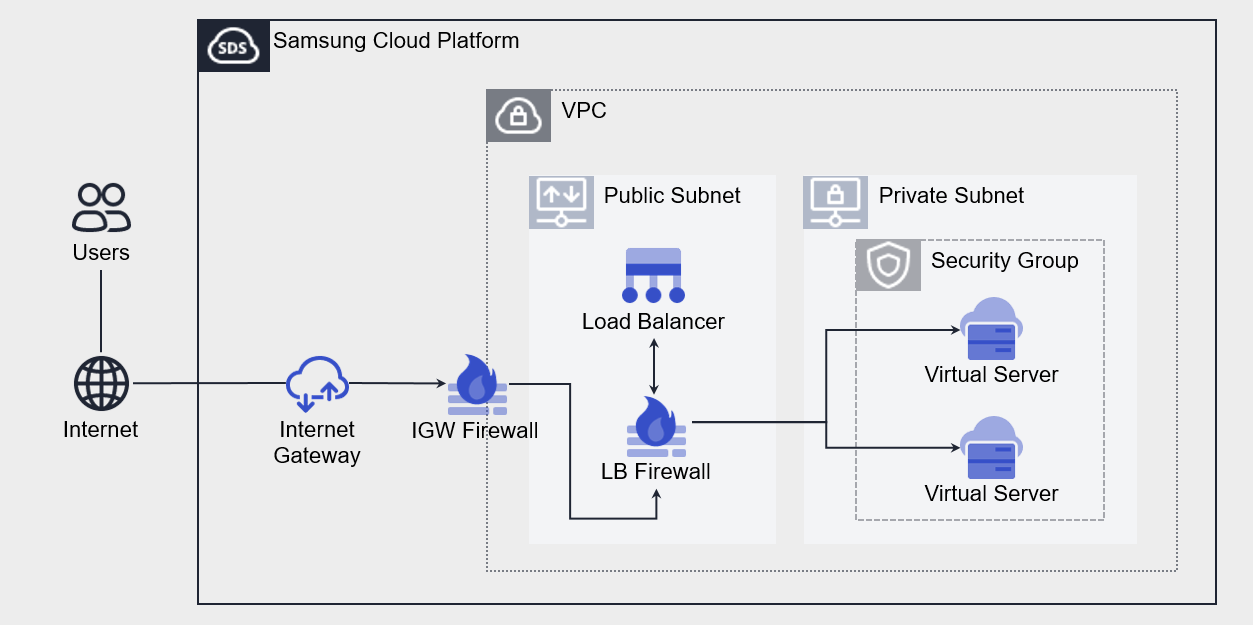
Provided Features
- Load Balancer: Choose the service type and set the IP to be used in the Load Balancer.
- Listener: Set the protocol, port, and routing rules. You can add multiple Listeners to a single Load Balancer.
- LB server group: Set the load balancing method. LB server group can be connected to a single Load Balancer.
- Member: Select the server to add to the LB server group. You can select Virtual Server or Bare Metal Server resources created in the same VPC as the Load Balancer, or directly enter an IP.
- LB Health Check: Set the member health check method. LB health check can be registered and used in multiple LB server groups.
Components
Load Balancer consists of Load Balancer(Listener), LB server group(member), LB health check.
Load Balancer
The components that make up a Load Balancer are as follows. Depending on the settings for each component, you can configure load balancing suitable for the customer’s workload.
| Component | Detailed Description |
|---|---|
| Service Classification | Load Balancer Service Type
|
| Service Sunbet | VPC Subnet where the Load Balancer will be deployed
|
| Service IP | Service IP that the client will access |
| Source NAT IP | IP to be used for delivering server traffic from the Load Balancer |
| Health Check IP | IP to be used for health check in Load Balancer |
| Listener | Resources connected to Load Balancer
|
LB Server Group
The elements that make up the LB server group are as follows. Traffic is delivered to members of the LB server group according to the settings of each component.
| Component | Detailed Description |
|---|---|
| Protocol | LB server group forwarding protocol |
| Load Balancing | Traffic Distribution Method
|
| LB Health Check | Member Health Check Method
|
| Member | Server to handle client requests
|
LB Health Check
LB health check components are as follows. Member health checks are performed according to settings for each component.
| Component | Detailed Description |
|---|---|
| Protocol | Health Check Protocol |
| Health Check Port | Port used for health check |
| Period | Health check execution period |
| Waiting Time | Server response waiting time for health check |
| Detection Count | Criteria for determining member health check status (Healthy / Unhealthy) |
Constraints
Samsung Cloud Platform’s Load Balancer has a default quota applied, which imposes restrictions on the number of Load Balancers, Listeners, LB server groups, and members that can be created. Through the console, you can manage current usage and request additional quota for items that can be expanded.
| Item | Default Quota | Detailed Description |
|---|---|---|
| LOAD_BALANCER.SERVICE_SUBNET.DEFAULT.COUNT | 3 | Number of Service Subnets that can create Load Balancers per VPC |
| LOAD_BALANCER.DEFAULT.COUNT | 50 | Number of Load Balancers created per Region |
| LOAD_BALANCER.LISTENER.DEFAULT.COUNT | 1000 | Number of Listeners created per Region |
| LOAD_BALANCER.SERVER_GROUP.DEFAULT.COUNT | 1000 | Number of LB server groups created per Region |
| LOAD_BALANCER.MEMBER.DEFAULT.COUNT | 1000 | Number of members that can be registered in the entire LB server group per Region |
| LOAD_BALANCER.HEALTH_CHECK.DEFAULT.COUNT | 500 | Number of LB health checks created per Region |
Preceding Service
Before creating the Load Balancer service, this is the list of services that must be pre-configured. Please refer to the guide provided for each service for detailed information and prepare in advance.
| Service Category | Service | Detailed Description |
|---|---|---|
| Networking | VPC | Service that provides an independent virtual network in a cloud environment |