This is the multi-page printable view of this section. Click here to print.
DNS
- 1: Overview
- 1.1: TLD List
- 2: How-to guides
- 2.1: Private DNS
- 2.2: Hosted Zone
- 2.3: Public Domain Name
- 3: Release Note
1 - Overview
Service Overview
The DNS service is a service that allows access to services by converting human-recognizable domain names into numerical IP addresses that the system can identify, making it convenient for people to access services.
Through the DNS service, users can easily register their desired domain and manage their domain records by themselves.
Features
- Easy Domain Registration: New domain registration and change management are possible in a web-based console. You can easily create and manage domains through the web without building a separate DNS infrastructure or installing a DNS solution.
- Support for various records: A, AAAA, CNAME, TXT, MX, SPF, etc. various resource record types can be set, and it can automatically scale to handle large query volumes without user intervention.
- Convenient hosting environment management: You can choose and use public domain names that are exposed to the internet and provide web services, and private domain names that can only be used by designated internal users without an internet connection, according to the usage environment and purpose.
Composition
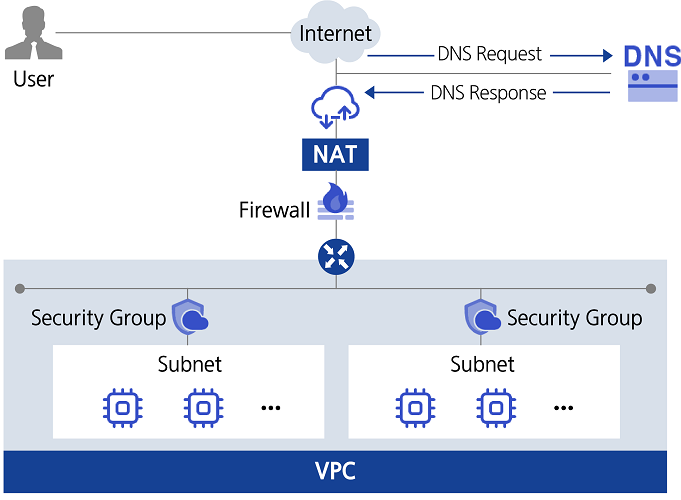
Provided Features
The DNS service provides the following functions.
- 호스팅 영역 생성/관리: You can create and manage Public Hosted Zones that can be accessed from anywhere via the internet and Private Hosted Zones that can only be accessed within a designated network environment without exposing them to the internet.
- Public Domain Name Application: You can apply for a Public Domain Name that allows access from anywhere on the internet.
- Support for various resource records: You can choose and use the record type according to the usage environment and purpose.
| Record Type | Detailed Description |
|---|---|
| A | Specify the IPv4 address corresponding to the domain name so that the IP address can be found with the domain name |
| Specifies the IPv6 address corresponding to the domain name so that the IP address can be found with the domain name as | AAAA |
| Set text information for the domain | |
| CNAME | Specify an alias (Alias) for the domain name |
| MX | Specifies the mail server of the domain and subdomain owned by the user |
| SPF | To prevent spam mail, verify the IP address or domain name of the mail transmission server (Sender Policy Framework) |
| NS | Name server responsible for the domain (automatically generated) |
| SOA | Domain’s starting information (starting point of authority) is defined (automatically generated) |
Component
Private DNS
To manage private domain names for use only in a specified network environment without exposing them to the internet, you must first create a Private DNS. Private DNS names are commonly used in all regions within an Account. It can be created for the first time in any region within the Account, and then activated with the same Private DNS name in other regions from the Private DNS list. You can select the VPC you want to connect to Private DNS by region. By using a common Private DNS name, you can share and manage the information of the Private Hosted Zone across all regions.
Hosted Zone
Private Hosted Zone allows you to create and manage domain names that can only be used in a specified network environment targeting VPCs connected to Private DNS. Public Hosted Zone can manage Public Domain Name created through Samsung Cloud Platform. You can register and modify records suitable for your purpose through the Hosted Zone.
Public Domain Name
You can apply for a Public Domain Name in conjunction with the Whois company, a Public Domain Name management company. The Public Domain Name can be purchased on a yearly basis, and the automatic renewal (on a yearly basis) can be set or changed up to 7 days before the end of the purchase period.
Constraints
The limitations of the DNS service are as follows.
| Classification | Description |
|---|---|
| Number of Private DNS that can be created in Account | 1 |
| Number of Hosted Zones that can be created in Accoutn | 20 |
| Number of records that can be registered per Hosted Zone | 100 |
- The use of Public Domain Name and Public Hosted Zone in the kr-south region of southern Korea is restricted.
Preceding Service
The DNS service has no preceding service.
1.1 - TLD List
TLD (Top-Level Domain) list
You can use the TLD below. When applying for a Public Domain Name, different annual usage fees occur for each TLD type.
| TLD Type | Public Domain Name Registration Cost (KRW/year, excluding tax) |
|---|---|
| .COM | 20,000 |
| .NET | 20,000 |
| .ORG | 20,000 |
| Korean | 24,000 |
| Business Registration Number of Korea | 16,000 |
| .BIZ | 20,000 |
| .INFO | 20,000 |
| .CN | 65,000 |
| Television | 90,000 |
| .IN | 65,000 |
| .EU | 80,000 |
| .AC | 286,000 |
| .TW | 100,000 |
| .MOBI | 44,000 |
| Name | 30,000 |
| Credit Card | 90,000 |
| .JP | 198,000 |
| .ASIA | 55,000 |
| .ME | 44,000 |
| Phone | 44,000 |
| .PRO | 44,000 |
| .SO | 103,000 |
| .SX | 90,000 |
| .CO | 100,000 |
| .XXX | 200,000 |
| .PW | 44,000 |
| .PH | 100,000 |
| .io | 91,000 |
| .app | 42,500 |
| .co.kr | 24,000 |
2 - How-to guides
The user can enter the essential information of the DNS service through the Samsung Cloud Platform Console and create the service by selecting detailed options.
Private Domain Name management precautions before use
- To manage private domain names for use only in a specified network environment without exposing them to the internet, you must first create a Private DNS.
- The defined Private DNS name is commonly used in all regions within the account. It can be created for the first time in any region within the account, and then activated and used with the same Private DNS name in other regions from the Private DNS list.
- You can selectively set the VPC to be connected to Private DNS by region. There are no VPCs connected by default when first created or activated.
- Private DNS names may have been pre-used within Samsung Cloud Platform, and you can check their availability through duplicate checks when entering domain names.
- Hosted Zone information will be shared across all regions. However, some detailed information (SRN, creator, modifier information) can only be confirmed in the initial creation region.
General usage examples are as follows. For detailed usage instructions, please refer to the How-to guides of the corresponding sub-service.
| Order | Sub-service | Main Procedure |
|---|---|---|
| STEP 1 | Private DNS | Create Private DNS (A region) → Connect VPC within A region → Activate Private DNS (B region) → Connect VPC within B region |
| STEP 2 | Hosted Zone | Create Private Hosted Zone → Register records |
| STEP 3 | - | Detailed information inquiry, modification, cancellation |
Note before using Public Domain Name management
- In the internet environment, the Public Domain Name can only be managed through Hosted Zone for the domain name applied through Samsung Cloud Platform.
- The list of available top-level domains may change.
Here is an example of a general usage procedure. For detailed usage instructions, please refer to the How-to guides of the corresponding sub-service.
| Division | Sub-service | Main Procedure |
|---|---|---|
| STEP 1 | Public Domain Name | Check the availability and apply for the Public Domain Name to be used |
| STEP 2 | Hosted Zone | Create a Hosted Zone for the applied Public Domain Name → Register records |
| STEP 3 | - | Detailed information inquiry, modification, cancellation |
2.1 - Private DNS
Users can enter the essential information of the DNS service and select detailed options through the Samsung Cloud Platform Console to create the service.
Create Private DNS
You can create and use the DNS service in the Samsung Cloud Platform Console.
To request the creation of a Private DNS service, follow these steps.
Click All Services > Networking > DNS menu. It moves to the Service Home page.
Service Home page, click the Create Private DNS button in the drop-down menu. It moves to the Create Private DNS page.
Create Private DNS page, enter the information required for service creation, and select detailed options.
Enter Service Information Enter or select the required information in the area.
Classification NecessityDetailed Description Private DNS name required Enter the Private DNS name to use - Enter within 3-20 characters, including lowercase letters, numbers, and special characters (-)
- Cannot be used with the same name as the one currently in use
VPC Connection Select Register VPC to connect with Private DNS - Select button to choose VPC
- Up to 5 VPCs can be registered
Table. Private DNS service information input itemsAdditional Information Input area, please enter or select the necessary information.
Classification MandatoryDetailed Description Enter additional information and description for Private DNS Description Selection Tag Selection Add Tag - Up to 50 can be added per resource
- Click the Add Tag button and enter or select Key, Value
Table. DNS Additional Information Input Items
Check the application history and click the Complete button.
- Once creation is complete, check the created resource on the Private DNS list page.
Check Private DNS details
The Private DNS service allows you to view and modify the full list of resources and detailed information. The Private DNS details page consists of Details, VPC connections, Tags, Operation history tabs.
To check the Private DNS details, follow the next procedure.
- Click All Services > Networking > DNS menu. It moves to the Service Home page of DNS.
- Service Home page, click the Private DNS menu. Move to the Private DNS list page.
- Click on the resource to view detailed information on the Private DNS list page. It moves to the Private DNS details page.
- Private DNS details page displays the status information and detailed information of Private DNS, and consists of details, VPC connection, tags, operation history tabs.
Division Detailed Description Service Status Private DNS status - Creating: being created
- Activating: being activated
- Active: in operation
- Inactive: out of operation
- Editing: being edited
- Deleting: being deleted
- Error: error occurred
Service Cancellation Button to cancel Private DNS Table. Status Information and Additional Functions
- Private DNS details page displays the status information and detailed information of Private DNS, and consists of details, VPC connection, tags, operation history tabs.
Detailed Information
On the Private DNS list page, you can check the detailed information of the selected resource and modify the information if necessary.
| Classification | Detailed Description |
|---|---|
| Service | Service Name |
| Resource Type | Resource Type |
| SRN | Unique resource ID in Samsung Cloud Platform |
| Resource Name | Resource Title |
| Resource ID | Unique resource ID in the service |
| Creator | User who created the service |
| Creation Time | The time when the service was created |
| Modifier | Service information modified user |
| Modified Date | Date when service information was modified |
| Initial Creation Location | Private DNS Initial Creation Location |
| VPC Connection | VPC information connected to Private DNS
|
| Description | Private DNS description
|
VPC Connection
On the Private DNS List page, you can check the connected VPC information and add, change, or delete it.
| Classification | Detailed Description |
|---|---|
| VPC Name | Name of the VPC connected to the service
|
| Location | VPC location connected to the service |
| Connection Registration Date | Connection registration date of VPC connected to the service |
| Delete | Delete VPC peering connection connected to the service |
Tag
On the Private DNS List page, you can check the tag information of the selected resource, and add, change, or delete it.
| Classification | Detailed Description |
|---|---|
| Tag List | Tag list
|
Work History
You can check the operation history of the selected resource on the Private DNS list page.
| Classification | Detailed Description |
|---|---|
| Work history list | Resource change history
|
Private DNS activation from a location that is not the initial creation location
Private DNS is activated and used in a different location (region) than where it was first created (region).
To enable Private DNS service, follow these procedures.
- Click All Services > Networking > DNS menu. It moves to the Service Home page of DNS.
- Service Home page, click the Private DNS menu. It moves to the Private DNS list page.
- Private DNS list where you want to activate the resource, click the activation button. A notification window will appear.
- Inactive status of Private DNS items only shows the activation button.
- Click Confirm in the notification window.
Managing VPC connections for Private DNS
You can add or delete VPC information connected to the Private DNS service.
Add VPC Connection
To add a connection to the VPC of Private DNS, follow these steps.
- All Services > Networking > DNS menu is clicked. It moves to the Service Home page of DNS.
- Service Home page, click the Private DNS menu. It moves to the Private DNS list page.
- Click on a resource to view detailed information on the Private DNS list page. It moves to the Private DNS details page.
- Click the Private DNS details page VPC connections tab. Move to the VPC connections tab page.
- VPC Connection tab page, click the Add VPC Connection button. The VPC connection window appears.
- In the VPC connection window, select the location and VPC item and click Confirm.
- Check if the added item is displayed in the VPC connection list.
Deleting VPC Connection
To delete a connection to a VPC from Private DNS, follow these steps.
- Click All services > Networking > DNS menu. It moves to the Service Home page of DNS.
- Service Home page, click the Private DNS menu. It moves to the Private DNS list page.
- Click on the resource to view detailed information on the Private DNS List page. It moves to the Private DNS Details page.
- Private DNS details page, click the VPC connection tab. Move to the VPC connection tab page.
- VPC Connection tab page, click the Delete button of the VPC item to be deleted. A deletion confirmation window appears.
- Click Confirm in the deletion confirmation window.
Disable Private DNS
You can apply for cancellation of the Private DNS service in the Samsung Cloud Platform Console.
To request the cancellation of Private DNS service, follow the procedure below.
- All Services > Networking > DNS menu should be clicked. It moves to the Service Home page of DNS.
- Service Home page, click the Private DNS menu. It moves to the Private DNS list page.
- Click on the resource to view detailed information on the Private DNS List page. It moves to the Private DNS Details page.
- Private DNS details page, click the cancel service button.
- When the cancellation is complete, please check the cancellation status in the Private DNS list.
2.2 - Hosted Zone
The user can enter the required information for the Hosted Zone service through the Samsung Cloud Platform Console, select detailed options, and create the service.
Create Hosted Zone
You can create and use the Hosted Zone service from the Samsung Cloud Platform Console.
To request Hosted Zone service creation, follow the steps below.
All Services > Networking > DNS Click the menu. Service Home page will be displayed.
Click the Create Hosted Zone button in the drop‑down of the Service Home page. You will be taken to the Create Hosted Zone page.
Hosted Zone creation On the page, enter the information required to create the service, and select detailed options.
- Service Information Input area, input or select the required information.
Category RequiredDetailed description Purpose Classification Required Select domain appropriate for the purpose of the Hosted Zone - Private: Domain that can only be used within Samsung Cloud Platform
- Public: Domain accessible from outside (Internet)
Private DNS name to register Required Select from previously created Private DNS - Set only when Private is selected in the usage classification
Hosted Zone name to register Required Enter the name of the Hosted Zone to use - Enter within 2-63 characters, including lowercase letters, numbers, and hyphens (-)
- When applying for a new domain, click the Check Availability button to verify duplication
Table. Hosted Zone Service Information Input Items - Additional Information Input Enter or select the required information in the area.
Category Required statusDetailed description Description Select Enter additional information and description for Hosted Zone Tag Select Add Tag - Up to 50 per resource can be added
- After clicking the Add Tag button, enter or select Key, Value values
Table. DNS additional information input items
- Service Information Input area, input or select the required information.
Check the creation history and click the Complete button.
- When creation is complete, check the created resources on the Hosted Zone list page.
Hosted Zone Check detailed information
The Hosted Zone service allows you to view and edit the full resource list and detailed information. Hosted Zone Details page consists of Details, Records, Tags, Activity History tabs.
To view detailed information of the Hosted Zone, follow these steps.
- All Services > Networking > DNS Click the menu. Service Home Navigate to the page.
- Click the Hosted Zone menu on the Service Home page. It navigates to the Hosted Zone List page.
- Hosted Zone List Click the resource to view detailed information on the page. Hosted Zone Details Navigate to the page.
- Hosted Zone Details page displays the status information and detailed information of the Hosted Zone, and consists of Details, Records, Tags, Activity History tabs.
Category Detailed description Service Status Hosted Zone status - Creating: Creating
- Active: Active
- Editing: Editing
- Deleting: Deleting
- Error: Error
Delete Hosted Zone Button to delete Hosted Zone Table. Status Information and Additional Functions
- Hosted Zone Details page displays the status information and detailed information of the Hosted Zone, and consists of Details, Records, Tags, Activity History tabs.
Detailed Information
Hosted Zone list page, you can view detailed information of the selected resource and, if necessary, edit the information.
| Category | Detailed description |
|---|---|
| service | service name |
| Resource Type | Resource Type |
| SRN | Unique resource ID in Samsung Cloud Platform |
| resource name | resource name |
| Resource ID | Unique resource ID in the service |
| Creator | User who created the service |
| Creation Time | Time the service was created |
| Editor | User who modified the service information |
| Modification Date/Time | Date/Time the service information was modified |
| Hosted Zone name | Hosted Zone domain name |
| Usage Category | Display Selected Usage |
| Private DNS name | Selected Private DNS name |
| Description | Hosted Zone description
|
Record
Hosted Zone list page, you can view the registered record information, and add, modify, or delete it. A record is an item that configures communication with the DNS server, informing the server of the IP address associated with the domain and how to handle requests sent to the domain.
| Category | Detailed description |
|---|---|
| Name | Registered record name |
| Type | Record Type
|
| value | IP address of the record |
| TTL | Time for DNS response servers to temporarily store records |
| Auto generation | Display auto generation status |
| Status | Service status display |
| Detailed menu | Record edit, delete possible |
Tag
On the Hosted Zone List page, you can view the tag information of the selected resources, and you can add, modify, or delete them.
| Category | Detailed description |
|---|---|
| Tag List | Tag List
|
Work History
You can view the operation history of the selected resource on the Hosted Zone list page.
| Category | Detailed description |
|---|---|
| Work History List | Resource Change History
|
Managing Hosted Zone records
You can add or delete records in the Hosted Zone service.
Add Record
To add a record to the Hosted Zone, follow these steps.
- All Services > Networking > DNS Click the menu. Navigate to the DNS Service Home page.
- Click the Hosted Zone menu on the Service Home page. Navigate to the Hosted Zone list page.
- Click the resource to view detailed information on the Hosted Zone list page. It moves to the Hosted Zone details page.
- Click the Record tab on the Hosted Zone Details page. You will be taken to the Record tab page.
- Record on the tab page, click the Add Record button. The Add Record window appears.
- In the add record window, select the Type, Name, Value, and TTL items and click Confirm. A notification confirmation window appears.
Category Detailed description A Enter an IP address in IPv4 format - Click the Add button to add an IP address, up to 8 can be registered
AAAA Enter an IPv6 format IP address - Click the Add button to add an IP address, up to 8 can be registered
SPF Enter the IP of the server that sent the spam mail - If registering multiple servers, enter in the format v=spf1 ip4:211.214.160.28 ip4:211.214.16.29 ~all
CNAME Enter a record alias in domain name format - Registration is not possible if entered the same as a record value of another type
MX Enter priority and mail server address - Click the Add button to add a server address, up to 8 can be registered
- When entering priority, input within the range 0 - 65,535; the smaller the value, the higher the priority
TXT String input - Enter up to 250 characters
Table. Detailed items by record type - Click Confirm in the notification dialog.
- Verify that the added item is displayed in the record list.
Edit Record
To modify the records of a Hosted Zone, follow the steps below.
- Click the All Services > Networking > DNS menu. Go to the DNS Service Home page.
- Click the Hosted Zone menu on the Service Home page. Navigate to the Hosted Zone list page.
- Click the resource to view detailed information on the Hosted Zone List page. It navigates to the Hosted Zone Detail page.
- Hosted Zone Details page, click the Record tab. Record tab page moves.
- Record on the tab page, click the detailed menu of the list and click Edit. A notification confirmation window appears.
- In the record edit window, modify the desired items and click OK.
- In the notification confirmation window, click Confirm.
Delete Record
To delete a record in the Hosted Zone, follow these steps.
- Click the All Services > Networking > DNS menu. Go to the DNS Service Home page.
- Click the Hosted Zone menu on the Service Home page. Navigate to the Hosted Zone list page.
- Hosted Zone List page, click the resource to view detailed information. Navigate to the Hosted Zone Details page.
- Click the Record tab on the Hosted Zone Details page. You will be taken to the Record tab page.
- Record tab page, click the detailed menu of the list and click Delete. A notification confirmation window appears.
- Click Confirm in the notification confirmation window.
Hosted Zone Cancel
You can apply for termination of the Hosted Zone service in the Samsung Cloud Platform Console.
To request cancellation of the Hosted Zone service, follow the steps below.
- All Services > Networking > DNS Click the menu. Go to DNS’s Service Home page.
- Click the Hosted Zone menu on the Service Home page. It navigates to the Hosted Zone List page.
- Hosted Zone list On the page, click the resource to view detailed information. Hosted Zone details You will be taken to the page.
- Click the Delete Hosted Zone button on the Hosted Zone Details page.
- When the termination is complete, check the service termination status in the Hosted Zone list.
2.3 - Public Domain Name
The user can enter the required information for the Public Domain Name service through the Samsung Cloud Platform Console, select detailed options, and create the service.
Public Domain Name Create
You can create and use the Public Domain Name service in the Samsung Cloud Platform Console.
To request the creation of a Public Domain Name service, follow the steps below.
- All Services > Networking > DNS Click the menu. Go to the Service Home page.
- Click the Public Domain Name Creation button in the dropdown of the Service Home page. You will be taken to the Public Domain Name Creation page.
- Public Domain Name creation On the page, enter the information required to create the service, and select detailed options.
- Service Information Input Enter or select the required information in the area.
Category RequiredDetailed description Domain name to register Required Enter the name of the Public Domain Name to use - Enter within 2-63 characters, including lowercase letters, numbers, and special characters (-)
- When applying for a new domain, click the Check Availability button to verify duplication
Purchase Period Required Automatically selected as 1 year Auto Renewal Required Set whether to auto-renew when the domain usage period expires - Enter detailed information when Use is selected
- Registrant Name (Business Name): Enter the registrant name or business name within 30 characters
- Registrant Email: Enter the registrant’s email address
- Registrant Address: Enter the registrant’s company address, click the Find Postal Code button to search and then enter the address
- Phone Number: Enter the registrant’s phone number
Table. Public Domain Name Service Information Input Items
- Service Information Input Enter or select the required information in the area.
- Additional Information Input area, please enter or select the required information.
Category Required statusDetailed description Description Select Enter additional information and description about the Public Domain Name Tag Select Add Tag - Up to 50 can be added per resource
- After clicking the Add Tag button, enter or select Key, Value values
Table. DNS Additional Information Input Items
- Check the generation history and click the Complete button.
- Once creation is complete, check the created resource on the Public Domain Name list page.
Public Domain Name Check Detailed Information
Public Domain Name service can view and edit the full resource list and detailed information. Public Domain Name detail page consists of Detail Information, Registration Information, Tags, Action History tabs.
Public Domain Name to view detailed information, follow the steps below.
- Click the All Services > Networking > DNS menu. You will be taken to the Service Home page.
- Click the Public Domain Name menu on the Service Home page. Navigate to the Public Domain Name list page.
- Click the resource to view detailed information on the Public Domain Name list page. It moves to the Public Domain Name details page.
- Public Domain Name Details page displays the status information and detailed information of the Public Domain Name, and consists of Details, Registration Information, Tags, Action History tabs.
Category Detailed description Service Status Status of Public Domain Name - Creating: In creation
- Active: Operating
- Editing: Changing settings
- Registered: Period extension registration
- Transfer Requesting: Domain transfer request completed
- Expired: Usage period expired
Domain Transfer Between Accounts Domain Transfer Request Button Between Accounts - Cancel Transfer Request: Can cancel domain transfer request after transfer request is completed
- Approve Transfer Request: If a domain transfer request is received, can approve the transfer request
- Reject Transfer Request: If a domain transfer request is received, can reject the transfer request
Table. Status Information and Additional Functions
- Public Domain Name Details page displays the status information and detailed information of the Public Domain Name, and consists of Details, Registration Information, Tags, Action History tabs.
Detailed Information
Public Domain Name List page lets you view detailed information of the selected resource and, if needed, edit the information.
| Category | Detailed description |
|---|---|
| service | service name |
| Resource Type | Resource Type |
| SRN | Unique resource ID in Samsung Cloud Platform |
| Resource Name | Resource Name |
| Resource ID | Unique resource ID in the service |
| Creator | User who created the service |
| Creation time | Service creation time |
| Editor | User who modified the service information |
| Modification DateTime | Date and time when service information was edited |
| Domain Name | Public Domain Name Domain Name |
| Registration Date | Public Domain Name Domain Registration Date |
| Usage classification | Display selected usage |
| Expiration Date | Public Domain Name Domain usage expiration date |
| Automatic Extension | Display whether automatic extension feature is used
|
| Description | Public Domain Name description
|
Registration Information
You can view and edit domain registration information on the Public Domain Name List page.
| Category | Detailed description |
|---|---|
| Registrant Name (Business Name) | Name of registrant or business name entered when applying for service |
| Registrant Email | Registrant email address entered when applying for the service |
| Registrant Address | Company address of the registrant entered when applying for the service |
| Phone Number | Phone number of the registrant entered when applying for service |
Tag
Public Domain Name List page allows you to view the tag information of the selected resource, and you can add, modify, or delete it.
| Category | Detailed description |
|---|---|
| Tag List | Tag List
|
Work History
You can view the operation history of the selected resource on the Public Domain Name list page.
| Category | Detailed description |
|---|---|
| Work History List | Resource Change History
|
Public Domain Request transfer between accounts
You can transfer the registered Public Domain to another account user.
- If the domain you want to transfer is being used as a Hosted Zone, you cannot request a transfer. Please delete the existing Hosted Zone first and then request a transfer.
- The automatic renewal of the domain you want to transfer must be set to Unused in order to make the transfer request. After the domain transfer, you can set automatic renewal to be used in the account that received the transfer.
- You can only request a domain transfer up to one month before the registration period expiration date of the domain you want to transfer.
To transfer Public Domain information to another account user, follow the steps below.
- All Services > Networking > DNS Click the menu. Go to the DNS Service Home page.
- Click the Public Domain Name menu on the Service Home page. Navigate to the Public Domain Name List page.
- Click the resource to view detailed information on the Public Domain Name List page. It moves to the Public Domain Name Details page.
- Public Domain Name Details page, click the Inter-account domain transfer button. The Inter-account domain transfer popup appears.
- Domain Transfer Between Accounts In the popup window, enter the account ID to transfer and click the Confirm button.
- When the domain transfer request is completed, it changes to Transfer requesting status, and the applicant can click the Cancel transfer request button to cancel the transfer request.
- After a domain transfer request, if a user of another account approves the transfer, the domain information is deleted from the requesting account.
- If the user who received the previous request does not approve within 7 days after the approval request, the previous request will be automatically canceled.
Public Domain Manage Information Transfer Requests
If another account user transfers the Public Domain, you can approve or reject the request.
Public Domain Approve request for information transfer
To approve a request to move to the Public Domain, follow these steps.
- All Services > Networking > DNS Click the menu. Navigate to the DNS Service Home page.
- Click the Public Domain Name menu on the Service Home page. Navigate to the Public Domain Name list page.
- Public Domain Name List page, click the resource to view detailed information. It will navigate to the Public Domain Name Details page.
- Click the Approve Previous Request button on the Public Domain Name Details page. Click the Confirm button in the alert.
Public Domain Refuse information transfer request
To reject a request for public domain transfer, follow these steps.
- All Services > Networking > DNS Click the menu. Navigate to DNS’s Service Home page.
- Click the Public Domain Name menu on the Service Home page. You will be taken to the Public Domain Name List page.
- Click the resource to view detailed information on the Public Domain Name list page. It moves to the Public Domain Name details page.
- On the Public Domain Name Details page, click the Reject Previous Request button. In the alert, click the OK button.
Edit registration information of Public Domain Name
You can edit the registration information of the Public Domain Name.
To modify the registration information of the Public Domain Name, follow the steps below.
- All Services > Networking > DNS menu, click it. Go to DNS’s Service Home page.
- Click the Public Domain Name menu on the Service Home page. Navigate to the Public Domain Name list page.
- Click the resource to view detailed information on the Public Domain Name list page. It navigates to the Public Domain Name details page.
- Click the Public Domain Name Details page Registration Information tab. It will navigate to the Registration Information tab page.
- Click the Edit button on the Registration Information tab page. You will be taken to the Registration Information Edit page.
- Go to the Edit Registration Information page. Modify the desired items and click the Save button.
3 - Release Note
DNS
- You can transfer a registered Public Domain Name through Samsung Cloud Platform to another user account within the allowed period.
- We have officially launched DNS services that can be used in private networks and internet environments. You can manage Private DNS and Private Hosted Zone for limited networks, and apply for Public Domain Name registration and manage Public Hosted Zone for internet environments.
- We have launched a beta DNS service that provides new domain registration application and management functions based on user requests.