We provide services that enable easy and convenient management of the Samsung Cloud Platform, including user credential and access permission management, activity log collection/analysis, and real-time monitoring of resource status.
This is the multi-page printable view of this section. Click here to print.
Management
- 1: Architecture Diagram
- 1.1: Overview
- 1.2: How-to Guides
- 1.3: Release Note
- 2: Cloud Control
- 2.1: Overview
- 2.2: How-to guides
- 2.2.1: Managing Guardrails
- 2.2.2: Managing Organizations
- 2.2.3: Managing Accounts
- 2.3: API Reference
- 2.4: CLI Reference
- 2.5: Release Note
- 3: Cloud Monitoring
- 3.1: Overview
- 3.2: How-to guides
- 3.2.1: Using Monitoring Dashboards
- 3.2.2: Performance Analysis
- 3.2.3: Log Analysis
- 3.2.4: Managing Events
- 3.2.5: Using Custom Dashboards
- 3.2.6: Managing Agents
- 3.2.7: Appendix A. Service-specific Monitoring Targets
- 3.2.8: Appendix B. Service-specific Performance Metrics
- 3.2.9: Appendix C. Service-specific Status Checks
- 3.3: API Reference
- 3.4: Release Note
- 4: IAM
- 4.1: Overview
- 4.2: How-to Guides
- 4.2.1: User Group
- 4.2.2: User
- 4.2.3: Policy
- 4.2.4: Role
- 4.2.5: Credential Providers
- 4.2.6: My Info.
- 4.2.7: JSON Writing Guide
- 4.3: API Reference
- 4.4: CLI Reference
- 4.5: Release Note
- 5: ID Center
- 5.1: Overview
- 5.2: How-to guides
- 5.2.1: ID Center User Management
- 5.2.2: Managing ID Center User Groups
- 5.2.3: Assigning ID Center Account
- 5.2.4: Managing ID Center Permission Sets
- 5.2.5: Using the ID Center Access Portal
- 5.3: Release Note
- 6: Logging&Audit
- 6.1: Overview
- 6.2: How-to guides
- 6.2.1: Trail management
- 6.3: API Reference
- 6.4: CLI Reference
- 6.5: Release Note
- 7: Notification Manager
- 7.1: Overview
- 7.2: How-to Guides
- 7.2.1: Notification Policy
- 7.3: Release Note
- 8: Organization
- 8.1: Overview
- 8.2: How-to guides
- 8.3: API Reference
- 8.4: CLI Reference
- 8.5: Release Note
- 9: Resource Explorer
- 9.1: Overview
- 9.2: How-to Guides
- 9.3: Release Note
- 10: Resource Groups
- 10.1: Overview
- 10.2: How-to Guides
- 10.3: Release Note
- 11: ServiceWatch
- 11.1: Overview
- 11.1.1: Indicator
- 11.1.2: Alert
- 11.1.3: Log
- 11.1.4: Event
- 11.1.5: ServiceWatch integration service
- 11.1.6: Custom metrics and logs
- 11.2: How-to guides
- 11.2.1: Managing Dashboards and Widgets
- 11.2.2: Alert
- 11.2.3: indicator
- 11.2.4: Log
- 11.2.5: Event
- 11.2.6: Using ServiceWatch Agent
- 11.3: API Reference
- 11.4: CLI Reference
- 11.5: ServiceWatch Event Reference
- 11.5.1: ServiceWatch Event
- 11.5.1.1: Multi-node GPU Cluster
- 11.5.1.2: MySQL(DBaaS)
- 11.5.1.3: Global CDN
- 11.5.1.4: Data Flow
- 11.5.1.5: GSLB
- 11.5.1.6: Cloud Control
- 11.5.1.7: Cloud WAN
- 11.5.1.8: Object Storage
- 11.5.1.9: VPC
- 11.5.1.10: GPU Server
- 11.5.1.11: Virtual Server
- 11.5.1.12: Firewall
- 11.5.1.13: ID Center
- 11.5.1.14: Microsoft SQL Server(DBaaS)
- 11.5.1.15: Block Storage(BM)
- 11.5.1.16: Resource Groups
- 11.5.1.17: Cloud Functions
- 11.5.1.18: AI&MLOps Platform
- 11.5.1.19: Event Streams
- 11.5.1.20: Security Group
- 11.5.1.21: Archive Storage
- 11.5.1.22: API Gateway
- 11.5.1.23: Simple AI Inference
- 11.5.1.24: Load Balancer
- 11.5.1.25: Data Ops
- 11.5.1.26: Scalable DB(DBaaS)
- 11.5.1.27: Cloud LAN-Campus
- 11.5.1.28: EPAS(DBaaS)
- 11.5.1.29: PostreSQL(DBaaS)
- 11.5.1.30: Logging&Audit
- 11.5.1.31: Search Engine
- 11.5.1.32: DNS
- 11.5.1.33: VPN
- 11.5.1.34: Secrets Manager
- 11.5.1.35: Quick Query
- 11.5.1.36: File Storage
- 11.5.1.37: CacheStore(DBaaS)
- 11.5.1.38: Secret Vault
- 11.5.1.39: Queue Service
- 11.5.1.40: Kubernetes Engine
- 11.5.1.41: Config Inspection
- 11.5.1.42: Cloud LAN-Datacenter
- 11.5.1.43: Identity Access Management
- 11.5.1.44: Simple AI Training
- 11.5.1.45: Bare Metal Server
- 11.5.1.46: ServiceWatch
- 11.5.1.47: MariaDB(DBaaS)
- 11.5.1.48: Container Registry
- 11.5.1.49: Vertica(DBaaS)
- 11.5.1.50: Backup
- 11.5.1.51: Organization
- 11.5.1.52: Cloud ML
- 11.5.1.53: Certificate Manager
- 11.5.1.54: Key Management Service
- 11.5.1.55: Direct Connect
- 11.5.1.56: Support Center
- 11.6: Release Note
- 12: Support Center
- 12.1: Overview
- 12.2: How-to Guides
- 12.2.1: Contact Us
- 12.2.2: Support Plan
- 12.2.3: Knowledge Center
- 12.3: Release Note
- 13: Quota Service
- 13.1: Overview
- 13.2: How-to guides
- 13.2.1: Organization Quota Template
- 13.3: Release Note
1 - Architecture Diagram
1.1 - Overview
Service Overview
Architecture Diagram provides a diagram format that allows you to grasp the relationships between resources at a glance. You can verify connections between resources and examine relationships between components.
Provided Features
The Architecture Diagram provides the following functions.
- Resource Configuration Overview: We provide a diagram that makes it easy to see the relationships between configured resources.
- Resource Main Information Check: You can view a resource’s main information from the Architecture Diagram without moving to the resource detail screen.
Constraints
The constraints of Architecture Diagrame are as follows.
We provide services only for certain resources of the Samsung Cloud Platform. * The provided resources are as follows.
Category Resource Built-in - VPC (if you have VPC permissions)
- Subnet
Optional provision - Port
- Security Group
- Load Balancer
- Database
- EPAS, PostgreSQL, Maria DB, MySQL, Microsoft SQL Server, CacheStore
- Data Analysis
- Event Streams, Search Engine, Vertica
- Storage
- Block Storage(VM), File Storage
Table. Architecture Diagram provided resourcesUp to 100 items are displayed per resource.
The types of provided resources may vary depending on the offering.
To use the Architecture Diagrame service, user permissions for the resource are required.
If resources are hierarchical, permission for a lower-level resource also requires permission for the upper-level resource.
Preceding Service
The Architecture Diagram has no preceding services.
1.2 - How-to Guides
Users can intuitively grasp the relationships and key information of the resource configuration generated by the Architecture Diagram.
Architecture Diagram Getting Started
To start the Architecture Diagram of the Samsung Cloud Platform, refer to the following.
- Click the All Services > Management > Architecture Diagram menu. 1. Architecture Diagram Go to the page.
- You can also navigate by clicking the Architecture Diagram widget on the Console Home page of Samsung Cloud Platform.
- Check the resource configuration information and relationships in the Architecutre Diagram.
- VPC, Subnet, Virtual Server, Database, Data Analysis, Storage, etc., depict the annual relationships among various resources in a diagram.
information
- If you do not have view (View) permission for the topmost hierarchy in the resource hierarchy, the Diagram will not be displayed.
- Resources without diagram position information are displayed separately at the bottom of the diagram. * You can view the detailed status of the resource on its individual detail page.
Architecture Diagram Add Item
You can add items to the Architecture Diagram’s component diagram.
- All Services > Management > Architecture Diagram click the menu. 1. Go to the Architecture Diagram page.
- You can also navigate by clicking the Architecture Diagram widget on the Console Home page of Samsung Cloud Platform.
- Click the Search Filter button at the top right of the Diagram. 2. Configurable items in the Architecture Diagram open as a popup menu.
- VPC, Subnet, Virtual Server items are provided by default and cannot be disabled.
- You can choose which of the Port, Security Group, Load Balancer, Database, Data Analysis, and Storage items to add to the Diagram.
Resource Selection status Support Service VPC Default (cannot be disabled) - Only displayed when you have VPC permissions
- Subnet Default (cannot be disabled) - Virtual Server Default (cannot be disabled) - Port Selection - Security Group Selection - Load Balancer Selection - Database Selection EPAS, PostgreSQL, Maria DB, MySQL, Microsoft SQL Server, CacheStore Data Analysis Selection Event Streams, Search Engine, Vertica File Storage Selection - Table. Architecture Diagram search filter items
Architecture Diagram Check detailed resource information
You can view detailed information for each resource in the architecture diagram’s composition.
information
- If the user does not have permission for the resource, detailed information cannot be viewed.
- If a resource has a hierarchical structure, even if you have permission for a lower-level resource, you cannot view detailed information without permission for the upper-level resource.
To view detailed information, follow these steps.
- Click the All Services > Management > Architecture Diagram menu. 1. Architecture Diagram Go to the page.
- You can also navigate by clicking the Architecture Diagram widget on the Console Home page of Samsung Cloud Platform.
- Click the resource to view detailed information in the Architecture Diagram. 2. The detailed information popup for each resource opens.
- Click the control button at the top right of the Diagram to expand or collapse the Diagram, or to zoom in/out.
- When you place the mouse cursor over a resource, the resource’s status and name are displayed.
Resource Detailed information VPC VPC name, resource status, IP range - Click the VPC name to view the corresponding VPC Details page
- Create VPC button, when clicked, allows creation of Virtual Server, Cloud Functions, and VPC services via Copilot
Subnet VPC name, Subnet name, resource status, IP range, Subnet type - Click the Subnet name to go to the corresponding Subnet Details page
- When clicking the Virtual Server connection line, you can view the IP information of the connected Port
Virtual Server VPC name, Subnet name, server name, resource status, IP, Security Group, Block Storage - Click the server name to navigate to the corresponding Virtual Server Details page
- Virtual Server Control: Create Virtual Server resources via Copliot
- Click the Subnet connection line to view the IP information of the connected Port
- If a Security Group is attached, you can view the list of Ports and the list of Block Storage
Port VPC name, Subnet name, Port name, fixed IP address Security Group Security Group name, resource status, Security Group rule count - Click the Security Group name to navigate to the corresponding Security Group details page
Load Balancer VPC name, Subnet name, Load Balancer name, Resource status, Service IP, Firewall name - Click the Load Balancer name to go to the corresponding Load Balancer details page
Database VPC name, Subnet name, cluster name, resource status, cluster type, Block Storage status Data Analysis VPC name, Subnet name, cluster name, resource status, cluster type, Block Storage status File Storage Volume name, resource status, disk type, protocol, connected resource Table. Architecture Diagram Resource Detailed Information Items
information
If the relationship between resources cannot be determined, it will not be displayed in the diagram. Click the resource item shown in the alarm to navigate to each resource’s detail page and review it.
Reference
- Only the relationships for the nine resource types (VPC, Subnet, Virtual Server, Port, Security Group, Load Balancer, Database, Data Analysis, Filestorage) are shown.
- When you select a Subnet, Virtual Servert, or Security Group resource, information about that resource and its related resources is displayed with dotted lines.
- Each resource displays up to 100 items.
1.3 - Release Note
Architecture Diagram
2026.05.21
FEATURE
Add support resources and improve UX- A new resource has been added.
- Database: EPAS, PostgreSQL, Maria DB, MySQL, Microsoft SQL Server, CacheStore
- Data Analysis:Event Streams, Search Engine, Vertica
- Improved CX by adjusting the search filter size and position, icons within diagrams, and other elements.
2025.10.23
FEATURE
Add support resources- Load Balancer resource has been added.
2025.07.01
FEATURE
Add Architecture Diagram feature- The relationships between resources are indicated with dotted lines for easy identification.
- In the resource detail information popup, you can click the name of the resource to go to its detail page.
- Through Copilot, you can create VPC and Security Group services or manage Virtual Server.
- From the Diagram filter, you can easily add the Architecture Diagram item.
2025.02.27
NEW
Architecture Diagram release- The Architecture Diagram service has been newly launched.
- We provide a service that allows you to check relationships between resources.
2 - Cloud Control
2.1 - Overview
Service Overview
Cloud Control service is a managed service that supports building, operating, and managing a multi‑account environment easily and securely on the Samsung Cloud Platform.
The Cloud Control service automates an organization’s cloud governance (security, compliance, standardization, etc.) and provides consistent, centralized account and resource management based on Samsung Cloud Platform best practices.
Features
The Cloud Control service offers the following advantages.
- Landing Zone (Landing Zone) Automatic Provisioning: Automatically configures essential infrastructure such as Samsung Cloud Platform accounts, organizational units (OU), guardrails, logging, etc. * In a standardized environment, you can create new accounts and invite existing accounts.
- Centralized Governance and Policy Enforcement: Automatically apply security, compliance, and operational policies (guardrails) across the entire organization. * Provides policy violation detection and monitoring capabilities.
- Multi-Region and Scalability: You can apply the same governance and policies across multiple Samsung Cloud Platform regions.
Provided features
The Cloud Control service provides the following features.
- Automated Landing Zone (Landing Zone) Setup: Security, logging, and account structures based on Samsung Cloud Platform best practices are automatically configured.
- Guardrail applied
- Preventive guardrail: block the creation of resources that violate policy
- Detective Guardrail: Automatically detect and alert on policy‑violating resources
- Integrate with ACP of Samsung Cloud Platform Organization, Samsung Cloud Platform Config Inspection, etc.
- Dashboard Provision: You can visually monitor the accounts, OUs, guardrail implementation status, and compliance status of the entire organization.
- Centralized logging and auditing
- Provide centralized log storage and audit accounts for all accounts through Logging&Audit, Object Storage, Config Inspection, etc.
- ID and Permission Management Integration: By integrating with Samsung Cloud Platform ID Center, you can manage account-specific access control and permission groups.
- Monitoring and Notification (Notification) Feature: Provides real-time alerts for policy violations, Cloud Control configuration changes, etc.
Components
Landing Zone (Landing Zone)
The basic architecture of a standardized Samsung Cloud Platform environment, including governance, security, networking, and logging, is as follows.
| Category | Detailed description |
|---|---|
| Admin account |
|
| Log account |
|
| audit account |
|
Table. Cloud Control Landing Zone
Guardrails
The guardrails that automatically apply policy violation detection and prevention (detection/prevention type) rules and security/compliance standards are as follows.
| Category | Detailed description |
|---|---|
| Preventive guardrail | Preemptive blocking role to prevent policy violations
|
| Detection guardrail | Continuously monitor for policy violations or abnormal configurations, and provide alerts when violations occur
|
Table. Cloud Control Guardrail
Baseline (Baseline)
The essential resources and configuration sets, such as security, logging, and networking, that are automatically deployed per account are as follows.
| Category | Detailed description |
|---|---|
| AuditBaseline |
|
| LogArchiveBaseline |
|
| IDCenterBaseline |
|
Table. Cloud Control baseline
Provision status by region
The Cloud Control service is available in the environments below.
| Region | Provision status |
|---|---|
| Korea West 1 (kr-west1) | Provide |
| Korea East1 (kr-east1) | Provide |
| South Korea 1 (kr-south1) | Provide |
| South Korea South 2 (kr-south2) | Provide |
| South Korea South 3 (kr-south3) | Provide |
Table. Cloud Control regional availability status
Preceding Service
This is a list of services that must be pre‑configured before creating the service. Please refer to the guide provided for each service and prepare in advance.
| Service Category | Service | Detailed description |
|---|---|---|
| Storage | Object Storage | Object storage that simplifies data storage and retrieval |
| Management | Logging&Audit | A service that collects and analyzes user activity data |
| Management | Organization | A service that organizes accounts by organizational units, manages them hierarchically, and controls resource access permissions. |
| Management | ID Center | A service that enables easy centralized management of access permissions for resources by account |
Table. Cloud Control Preliminary Service
2.2 - How-to guides
Using Cloud Control
The user must first create a landing zone to use the Cloud Control service. When a landing zone is created, you can use the management features of Cloud Control.
Caution
There is no charge for the Cloud Control service, but services used within Cloud Control such as Logging&Audit, Object Storage, Config Inspection, etc., may incur costs based on usage.
Create Landing Zone
To use Cloud Control in the Samsung Cloud Platform Console, you must first create a landing zone.
Follow these steps to create a landing zone.
All Services > Management > Cloud Control Click the menu. 1. Navigate to the Service Home page of Cloud Control.
Click the Create Landing Zone button on the Service Home page. 2. Go to the Create Landing Zone page.
After setting the configuration items in the Rate Review and Organizational Unit Configuration area, click the Next button.
Category required statusDetailed description Home region - Home region of Cloud Control - Cloud Control designates the default region as the home region and cannot be changed
- All regions except the default region are managed by Cloud Control
Basic organizational unit Required Enter the primary organizational unit within the landing zone - Case-sensitive English letters, up to 128 characters
- The primary organizational unit includes shared Accounts (Log Account, Audit Account)
- Security: Name of the primary organizational unit for the shared Account
- Can be modified after the landing zone is created
Additional organizational unit Required Enter additional organizational unit within the landing zone - Case-sensitive English letters, enter up to 128 characters
- Can be added after the landing zone is created
Table. Landing zone creation - cost review and organizational unit configuration itemsAfter setting the configuration items in the Shared Account Configuration area, click the Next button.
Category Required statusDetailed description Management Account - The Management Account name is displayed and cannot be edited. Log Account Required Enter Log Account information - Account name: Korean, English, numbers, spaces, special characters(
+=-_@[](),.) using them, enter within 3 to 30 characters
- Email: Enter up to 60 characters in a valid email address format
- Email confirmation: Re-enter the email address entered in Email
Audit Account Required Enter Log Account information - Account name: Korean characters, English letters, numbers, spaces, and special characters (
+=-_@[](),.) using 3 to 30 characters
- Email: Enter up to 60 characters in a valid email address format
- Email Confirmation: Re-enter the email address entered in Email
- The same email as Log Account cannot be used
Table. Landing Zone Creation - Shared Account Configuration ItemsReference- Log Account is a repository of logs for API activity and resource configurations collected from all Accounts. * Log Account cannot be changed.
- The Audit Account is a restricted account, and the security and compliance team can obtain access to all accounts within the organization through the Audit Account.
- Account name: Korean, English, numbers, spaces, special characters(
After setting the configuration items in the Additional Configuration area, click the Next button.
Category Required statusDetailed description Account access configuration Required Select a method to manage access to the Account - Account access via ID Center
- Configure users who perform specific tasks in the Account by creating pre-configured groups and permission sets
- Automatically assign users when provisioning an Account with Account Factory or registering an existing Account
- Selectable only when using ID Center’s own directory
- Self-managed Account access
- Cloud Control does not create directory groups or permission sets for the landing zone
- Automatically assign users when provisioning an Account with Account Factory or registering an existing Account
- Manage access to the Account via ID Center or other Account access methods
Trail configuration - Proceed with automatic configuration Detection guardrail Selection Select whether to enable the detective guardrail - When the detective guardrail is enabled, it applies only to the default organizational unit
- Even after creating a landing zone, you can change settings on the Landing Zone Settings page
- For more information about the detective guardrail, see 탐지 가드레일
Table. Create Landing Zone - Additional Configuration Items- Account access via ID Center
In the Check Input Information area, after reviewing the landing zone configuration information and Service Permissions, check the agreement regarding permissions and guidelines.
Click the Create button. 5. A popup window announcing the creation of a landing zone opens.
After checking the information about creating a landing zone, click the Confirm button. 6. The landing zone creation request has been completed.
- Creating a landing zone takes some time, and a notification is sent when the task is completed.
- Once the landing zone creation is complete, you can view the full menu of Cloud Control and the organization status on the Service Home page.
Caution
- You cannot cancel while creating a landing zone.
- If creating the landing zone fails, delete the landing zone and then create it again.
- When Account Access Configuration is selected as Self-Managed Account Access, the Access Portal URL and User Credentials information cannot be viewed.
Reference
When a landing zone is created, you can verify the following in Cloud Control.
- Two organizational units: shared Account, an organizational unit for the Account that the user will provision.
- Two shared Accounts: isolated Account for log archiving and security auditing
- Selected IAM management configuration
- 10 preventive guardrails: settings for policy enforcement
- Enable control policies for the Organization service
Check detailed landing zone information
Landing Zone Settings page allows you to view detailed information about the landing zone.
information
After creating a landing zone, you can view and edit its details.
To view detailed information about the landing zone, follow these steps.
- All Services > Management > Cloud Control Click the menu. 1. Navigate to the Service Home page of Cloud Control.
- Service Home on the page, click the Landing Zone Settings menu. 2. Navigate to the Landing Zone Settings page.
| Category | Detailed description |
|---|---|
| Service | Service name |
| Resource Type | Resource Type |
| SRN | Unique resource ID in Samsung Cloud Platform
|
| Resource name | Resource Name |
| Resource ID | Unique resource ID in the service |
| Constructor | User who created the service |
| Creation date and time | Service creation date and time |
| Modifier | User who edited the service information |
| Modification date and time | Date and time the service information was modified |
| Home region | Landing zone home region information |
| Account access configuration | How to manage access to an Account |
| Trail configuration | Trail configuration enablement
|
| Detection guardrail | Detection guardrail activation status
|
| Delete landing zone | Delete the landing zone
|
Table. Landing zone configuration items
Delete Landing Zone
If you fail to create a landing zone or do not use it, you can delete the landing zone.
Caution
- Deleted resources cannot be recovered.
- Organization units, Account, buckets, ID Center resources are not deleted automatically.
- When recreating a landing zone, to use the same name as an existing, non‑deleted resource, you must first delete the existing resource before creating the landing zone.
- Existing resources can be deleted individually from the Organization, Object Storage, and ID Center services.
To delete a landing zone, follow these steps.
- Click the All Services > Management > Cloud Control menu. 1. Go to the Service Home page of Cloud Control.
- On the Service Home page, click the Landing Zone Settings menu. 2. Navigate to the Landing Zone Settings page.
- On the Landing Zone Settings page, click the Delete Landing Zone button. 3. Delete Landing Zone popup opens.
- Landing Zone Deletion After entering the Cloud Contorl ID displayed in the popup into the deletion confirmation area, click the Confirm button. 4. The landing zone deletion request has been completed.
- While deleting a landing zone, an explanation regarding the landing zone deletion process is displayed on the Service Home page.
Managing organizational units and Accounts
You can view the list of organizational units and accounts, register them in Cloud Control, and manage them.
To view and manage organizational units and the Account list, follow the steps below.
- Click the All Services > Management > Cloud Control menu. 1. Navigate to the Service Home page of Cloud Control.
- On the Service Home page, click the Organization menu. 2. Navigate to the Organization Unit and Account Management page.
- Select the view mode at the top right of the Organization Unit and Account Management page.
- Click the View Hierarchy button to view and manage organizational units and Accounts in a hierarchical structure.
Category Detailed description Create a sub-organization unit Add a new organizational unit under the selected organizational unit - Enabled only when a single organizational unit is selected in the hierarchy
- Refer to 조직 단위 생성하기 for more details
More You can manage organization units or register a new Account - Organization Unit: Deletion/registration/re-registration of organization units, and application/removal of detective guardrails possible
- For detailed information on managing organization units, see 조직 단위 관리하기
- For detailed information on detective guardrails, see 탐지 가드레일
- Account: Account registration/deregistration possible
- For detailed information on Account registration and deregistration, see Account 관리하기
Organization Unit/Account Name Display the names of organizational units and Accounts in a measurement-structure format - +, - buttons can be clicked to expand or collapse the hierarchy
- Clicking an organizational unit/Account name navigates to the detail page
ID/email Organization units display the ID, and Account displays the ID and email status Cloud Control registration status for organization units or Accounts - Registered, Not registered, Registering, Registration failed
- No status displayed when Root
Register organization unit Cloud Control registration status of sub‑organization units - Number of registered organization units / total organization units displayed
Register Account Sub Account’s Cloud Control registration status - registered Account count / total Account count displayed
Detection guardrail Detection guardrail application status for organizational units or sub-units Table. Hierarchy view items - View Account List: You can view and manage the list of Accounts that constitute Cloud Control.
Category Detailed description Account registration Register the selected Account from the Account list to Cloud Control - When you select an Account in the Account list that is Unregistered, Registration Failed status, it becomes active
- For detailed information about Account registration, see Account 등록하기
More > Unregister Account Deregister the selected Account from the Account list - When you select an Account in the Account list that is in registered, registration failed status, it becomes active
- Shared Accounts cannot be deregistered
- For more details on Account deregistration, see Account 등록 해제하기
Account name Account name Account ID Account ID email Account user email status Cloud Control registration status of an organization unit or Account - Registered, Not registered, Registering, Registration failed
- When Root, no status is displayed
Table. Account list view item - Create Account button click allows you to create a new Account. * For more details, refer to Account 생성하기.
- Click the View Hierarchy button to view and manage organizational units and Accounts in a hierarchical structure.
Check organization and Account detailed information
You can view and edit the detailed information of organizational units and Account. To view detailed information of the organization unit and Account, follow these steps.
- All Services > Management > Cloud Control Click the menu. 1. Go to the Service Home page of Cloud Control.
- On the Service Home page, click the Organization menu. 2. Navigate to the Organization Unit and Account Management page.
- Click the View Hierarchy button on the Organization Unit and Account Management page.
- Click the resource name in the hierarchical list to view its details. 4. Navigate to the detailed page of the resource.
- Root: Root Details page. * For detailed information, see Root 상세 정보.
- Organization unit name: Organization unit details Navigate to the page. * For detailed information, see 조직 단위 상세 정보.
- Account name: Go to the Account details page. * For more details, see the Account 상세 정보.
Root detailed information
On the Root Details page, you can view and manage the detailed information of the organization Root and the list of subordinate Accounts. The Root Details page consists of Basic Information, Sub Account tabs.
Basic Information
You can view basic information about the Root organization and the number of organizational units and Accounts registered in Cloud Control.
| Category | Detailed description |
|---|---|
| Service | Service name |
| Resource Type | Service type |
| SRN | Unique resource ID in Samsung Cloud Platform |
| Resource name | Resource Name |
| Resource ID | Unique resource ID in the service |
| Constructor | User who created the service |
| Creation date and time | Service creation date and time |
| Modifier | User who edited the service information |
| Modification date and time | Date and time the service information was modified |
| Register organization unit | Cloud Control registration status of sub-organizations under Root
|
| Register Account | Cloud Control registration status of Accounts under Root
|
Table. Root Details - Basic Information Tab Items
Sub Account
You can view and manage the list of Accounts under the Root and the registration status of Cloud Control.
| Category | Detailed description |
|---|---|
| Account registration | Register the selected Account from the Account list to Cloud Control
|
| Account name | Account name |
| Account user email | |
| status | Cloud Control registration status of an organization unit or Account
|
Table. Root Details - Sub Account Tab Items
Organization Unit Detailed Information
On the Organization Unit Details page, you can view and manage the detailed information of the organization unit, its subordinate Accounts, and the applied preventive guardrails and detection guardrails. Organization Unit Details page consists of Basic Information, Sub Account, Preventive Guardrails, Detection Guardrails tabs.
Basic Information
You can view basic and detailed information about the organizational unit.
| Category | Detailed description |
|---|---|
| Service | Service name |
| Resource Type | Service type |
| SRN | Unique resource ID in Samsung Cloud Platform |
| Resource name | Resource Name |
| Resource ID | Unique resource ID in the service |
| Constructor | User who created the service |
| Creation date and time | Service creation date and time |
| Modifier | User who edited the service information |
| Modification date and time | Date and time the service information was modified |
| Organization Unit Name | Name of the organizational unit |
| Apply guardrails | Number of guardrail types applied to the current organizational unit
|
| Register organization unit | Current organization unit’s Cloud Control registration status of sub-units
|
| Register Account | Current Cloud Control registration status of sub-accounts under the organization unit
|
| Higher-level organization unit | Hierarchy of the parent organizational units for the current unit |
| Apply detection guardrail / Remove detection guardrail | Change the detection guardrail application status at the organizational unit level
|
| Re-registration | Re-register the current organization unit in Cloud Contorl
|
Table. Organization Unit Details - Basic Information Tab Items
Sub Account
You can view and manage the list of subordinate Accounts for an organizational unit.
Information
For Security organizational units, Accounts cannot be registered.
| Category | Detailed description |
|---|---|
| Account registration | Register the selected Account from the Account list to Cloud Control
|
| Account name | Account name |
| Account user email | |
| status | Cloud Control registration status of an organization unit or Account
|
Table. Organization Unit Details - Sub Account Tab Items
Preventive Guardrail
You can view and manage the list of preventive guardrails applied at the organizational level.
Information
For Security organizational units, guardrails cannot be applied or removed.
| Category | Detailed description |
|---|---|
| Target Service Name | Name of the service to which the guardrail applies |
| Guardrail name | Guardrail name
|
| type | Application method |
| Application method | Guardrail application method display
|
| Disable | Disable the selected guardrail from the guardrail list
|
| Apply preventive guardrails | New preventive guardrails can be applied to organizational units
|
Table. Organization Unit Details - Prevention Guardrail Tab Items
Detection Guardrail
You can view and manage the diagnostic results of detection guardrails applied at the organizational level.
Reference
Accounts with diagnostic history in Cloud Control are provided with the latest diagnostic results regardless of whether detection guardrails are applied.
| Category | Detailed description |
|---|---|
| Account name | Account name to be diagnosed |
| Diagnosis name | Diagnosis Name |
| PASS | Number of checklist items with a PASS (normal) diagnosis result |
| FAIL | Number of checklist items with a diagnosis result of FAIL (vulnerable) |
| CHECK | Number of checklist items with a diagnosis result of CHECK (verification required) |
| ERROR | Number of items in the checklist whose diagnosis result is ERROR (diagnosis not possible) |
| N/A | Number of checklist items with a diagnosis result of N/A (not applicable) |
| All | Total number of checklist items |
| Diagnosis Result | Diagnosis request result
|
| Diagnosis date and time | Diagnosis request date and time |
Table. Diagnosis result list items
Check detailed information of Account
Account Details page allows you to view the account’s detailed information and the list of applied preventive guardrails. Account Details page consists of Basic Information, Preventive Guardrails tabs.
Basic Information
You can view basic and detailed information about the organization unit.
| Category | Detailed description |
|---|---|
| Service | Service name |
| Resource Type | Service type |
| SRN | Unique resource ID in Samsung Cloud Platform |
| Resource name | Resource Name |
| Resource ID | Unique resource ID in the service |
| Constructor | User who created the service |
| Creation date and time | Service creation date and time |
| Modifier | User who edited the service information |
| Modification date and time | Date and time the service information was modified |
| Account user email | |
| Apply Guardrails | Number of guardrail types applied to the current organizational unit
|
| ID Center username | ID Center user email |
| Higher-level organization unit | Current account’s parent organizational unit hierarchy |
| Register | The organization unit of the current Account can be changed
|
Table. Account Details - Basic Information Tab Items
Preventive Guardrail
You can view the list of preventive guardrails applied to the Account.
| Category | Detailed description |
|---|---|
| Target Service Name | Name of the service to which the guardrail applies |
| Guardrail name | Guardrail name
|
| type | Application method |
| Application method | Guardrail application method display |
Table. Account Details - Preventive Guardrail Tab Items
Check Access Portal Connection Information
User and Access page allows you to view the Access Portal connection URL and connection methods (password, SSO, MFA).
information
User and Access information is not displayed when creating a landing zone if Account Access Configuration is set to Self-managed Account Access. Select Account access via ID Center to create a landing zone.
To check the Access Portal connection information, follow these steps.
- Click the All Services > Management > Cloud Control menu. 1. Go to the Service Home page of Cloud Control.
- On the Service Home page, click the User and Access menu. 2. Navigate to the User and Access page.
- Check the information in the User and Access page’s Integrated Access Management area.
| Category | Detailed description |
|---|---|
| Access type | Method for accessing the Access Portal |
| Access Portal URL | Access Portal connection URL
|
| Permission set | A collection of administrator policies used by ID Center to determine the valid permissions of users who can access a specific account |
Table. Shared Account item
Reference
For detailed information about credential sources and ID Center, see ID Center.
Guide
If the landing zone is configured with a self-managed Account access, see the following.
- Cloud Control does not automatically create directory groups or permission sets.
- When provisioning an Account with the Account factory or registering an existing Account, the user is assigned automatically.
- You can manage access to an Account via ID Center or other Account access methods.
Check user credential information
User and Access page lets you view the user credential source type and the ID Center ID.
Information
User and Access information is not displayed when creating a landing zone if Account Access Configuration is set to Self-Managed Account Access. Select Account access via ID Center to create a landing zone.
To verify user credential information, follow the steps below.
- All Services > Management > Cloud Control Click the menu. 1. Navigate to the Service Home page of Cloud Control.
- On the Service Home page, click the User and Access menu. 2. Navigate to the User and Access page.
- Check the information in the User Credential Management area of the User and Access page.
| Category | Detailed description |
|---|---|
| Credential source | Credential source types configured in ID Center
|
| ID Center ID | Clicking the ID Center’s ID
|
| User Group | A group formed to classify workers who perform specific tasks within an organization. |
Table. User Credential Management Items
2.2.1 - Managing Guardrails
The guardrails that are automatically applied for policy violation detection and prevention (detect/prevent type) rules, and security/compliance standards are as follows.
Preventive Guardrail
You can apply preventive guardrails to proactively block policy violations from occurring.
Applying preventive guardrails
It can be applied to preventive guardrails at the organizational level. To apply preventive guardrails at the organizational level, follow these steps.
Click the All Services > Management > Cloud Control menu. 1. Navigate to the Service Home page of Cloud Control.
On the Service Home page, click the Guardrail > Preventive Guardrail menu. 2. Go to the Preventive Guardrail List page.
From the Preventive Guardrail List, select the preventive guardrails to apply to the organization unit, then click the Apply to Organization Unit button. 3. Navigate to the Apply to organization unit page.
- Multiple preventive guardrails can be selected and applied simultaneously.
After selecting the organizational unit to which you want to apply the preventive guardrail, click the Complete button.
Category required statusDetailed description Preventive guardrails to apply - Preventive guardrails list to be applied at the organizational level Organizational unit name Essential Select the organizational unit to apply the preventive guardrail - Only organizational units with Registered, Registration Failed status can be selected
- Click the organizational unit name or parent organizational unit name to view detailed information
Table. Preventive guardrail application itemsWhen the pop‑up window notifying that the preventive guardrail has been applied opens, click the Confirm button.
View detailed information of preventive guardrail
You can view detailed information about preventive guardrails, the organizational units to which they are applied, and the list of Accounts. To disable the preventive guardrail, follow these steps.
- Click the All Services > Management > Cloud Control menu. 1. Navigate to the Service Home page of Cloud Control.
- On the Service Home page, click the Guardrail > Preventive Guardrail menu. 2. Go to the Preventive Guardrail List page.
- Click the preventive guardrail name to view detailed information in the Preventive Guardrail List. 3. Preventive Guardrail Details page
- Preventive Guardrail Details page consists of Basic Information, Applicable Organizational Unit, Account tab.
Basic Information
You can view basic and detailed information about the preventive guardrail.
| Category | Detailed description |
|---|---|
| service | Service Name |
| Resource Type | Service type |
| SRN | Unique resource ID in Samsung Cloud Platform |
| Resource Name | Resource Name |
| Resource ID | Unique resource ID in the service |
| Constructor | User who created the service |
| Creation date and time | Service creation date and time |
| Modifier | User who edited the service information |
| Modification date and time | Date and time the service information was modified |
| Guardrail name | Name of the guardrail |
| type | Guardrail type |
| Target service name | Guardrail target service name |
| status | Whether guardrails are applied |
| Explanation | Description of guardrails |
Table. Guardrail Details - Basic Information Tab Items
Applicable organization unit
You can view the list of organizational units where preventive guardrails are applied.
| Category | Detailed description |
|---|---|
| Organizational unit name | Organizational unit name
|
| Parent organization unit name | Name of the parent organizational unit of the organizational unit
|
| status | Cloud Control registration status for organizational units
|
Table. Root Details - Sub Account Tab Items
Account
You can view the list of sub‑Accounts under the organizational unit where preventive guardrails are directly applied.
| Category | Detailed description |
|---|---|
| Account name | Account name |
| Account user email | |
| Organizational unit name | Organization unit name
|
| status | Cloud Control registration status for an organization unit or Account
|
Table. Root Details - Sub Account Tab Items
Reference
Preventive guardrails are inherited and applied from all higher-level organizational units, so preventive guardrails can also be applied to Accounts that are not in the Account list.
Disable preventive guardrail
You can disable the preventive guardrail applied at the organization level. To disable the preventive guardrail, follow these steps.
Click the All Services > Management > Cloud Control menu. 1. Navigate to the Service Home page of Cloud Control.
On the Service Home page, click the Guardrail > Preventive Guardrail menu. 2. Navigate to the Preventive Guardrail List page.
From the Preventive Guardrail List, select the preventive guardrail for which you want to disable organization-level enforcement, then click the More > Remove Organization-Level Enforcement button. 3. Navigate to the Remove organization unit application page.
- Multiple preventive guardrails can be selected simultaneously to disable them.
After selecting the organizational unit to disable the preventive guardrail, click the Complete button.
Category Whether requiredDetailed description Guardrails to apply - List of preventive guardrails to be disabled Organizational unit name Essential Select the organizational unit to disable the preventive guardrail - Only organizational units with Registered, Registration Failed status can be selected
- Click the organizational unit name or parent organizational unit name to view detailed information
Table. Preventive Guardrail Deactivation ItemsWhen a pop‑up notifying the deactivation of the preventive guardrail opens, click the Confirm button.
Detection Guardrail
When detection guardrails are enabled, Config Inspection diagnostics are automatically run for Accounts within the default organizational unit, performing checks daily.
Apply detection guardrails
You can apply detection guardrails on the Landing Zone Settings page.
information
Detection guardrails can also be enabled when creating a landing zone.
To apply detection guardrails, follow the steps below.
- All Services > Management > Cloud Control Click the menu. 1. Navigate to the Service Home page of Cloud Control.
- On the Service Home page, click the Landing Zone Settings menu. 2. Navigate to the Landing Zone Settings page.
- On the Landing Zone Settings page, click the Edit button for the Detection Guardrail item. 3. Detection Guardrail Settings The popup window opens.
- Detection Guardrail Settings In the popup window, after checking Enable Cloud Control Detection Guardrail, click the Confirm button.
- When activation is checked, Plan, Check List, Diagnosis Cycle, Start Time are displayed.
- When the pop-up indicating that the detection guardrail is active opens, click the Confirm button.
Check detection guardrail diagnostic results
You can view the Config Inspection diagnostic results via detection guardrails. To view the diagnostic results, follow these steps.
- Click the All Services > Management > Cloud Control menu. 1. Navigate to the Service Home page of Cloud Control.
- On the Service Home page, click the Guardrail > Detection Guardrail menu. 2. Navigate to the Detection Guardrail List page.
- Click the diagnosis name of the Account for which you want to view diagnostic results from the Detection Guardrail List. 3. Go to the Diagnostic Results List page.
- In the search area of the Diagnosis Result List page, you can enter a diagnosis name or click the Advanced Search button to search.
- On the Diagnosis Result List page, click the diagnosis result for the diagnosis name to view detailed diagnostic items. 4. Navigate to the Diagnostic Result Details page.
- Completed: The diagnostic request has been successfully completed, when Completed is clicked, navigate to the detail page
- Error: The diagnostic request was not completed successfully, and the error status item cannot view detailed information.
- Diagnosis Result Details on the page
Category Detailed description Checklist Set of diagnostic items that serve as the basis for diagnostic results Area Scope of Diagnosis (services of Samsung Cloud Platform) Diagnostic Items Security standards recommended for each service configuration - Click the diagnostic item name to view detailed information about that diagnostic item
- Diagnostic item details: area, diagnostic item, result, diagnostic criteria, diagnostic method, remediation guide, detailed result
Result Diagnostic Item Baseline Check Results - PASS: Number of items in the checklist with a diagnostic result of PASS (normal)
- FAIL: Number of items in the checklist with a diagnostic result of FAIL (vulnerable)
- CHECK: Number of items in the checklist with a diagnostic result of CHECK (needs verification)
- ERROR: Number of items in the checklist with a diagnostic result of ERROR (diagnosis not possible)
- N/A: Number of items in the checklist with a diagnostic result of N/A (not applicable)
Table. Detailed Diagnosis Result Items
Reference
For detailed information about the diagnosis results, see Config Inspection’s Check Diagnosis Results.
Managing detection guardrail diagnostic results
You can view the results of the Config Inspection diagnosis request via the detection guardrail.
Reference
In Cloud Control, you cannot delete or modify inspection results.
To view the diagnostic request results, follow these steps.
- All Services > Management > Cloud Control Click the menu. 1. Navigate to the Service Home page of Cloud Control.
- On the Service Home page, click the Guardrail > Detection Guardrail menu. 2. Go to the Detection Guardrail List page.
- In the Detection Guardrail List, click the diagnosis name of the Account that will manage the diagnostic results. 3. Go to the Diagnostic Results List page.
- On the Diagnosis Result List page, you can enter a diagnosis name in the search area or click the Advanced Search button to search.
- On the Diagnostic Result List page, click the Diagnostic Result Management button. 4. Diagnosis Result Management Navigate to the detail page.
- Diagnostic Result Management View the diagnostic results on the detail page.
Category Detailed description Checklist Collection of diagnostic items that serve as the basis for diagnostic results Area Scope of Diagnosis (services of Samsung Cloud Platform) Diagnostic Items Security standards recommended for each service configuration - Click the diagnostic item name to view detailed information about that diagnostic item
- Diagnostic details: area, diagnostic item, result, diagnostic criteria, diagnostic method, remediation guide, detailed result
Result Diagnostic Item Baseline Check Results - PASS: Number of items in the checklist with a diagnostic result of PASS (normal)
- FAIL: Number of items in the checklist with a diagnostic result of FAIL (vulnerable)
- CHECK: Number of items in the checklist with a diagnostic result of CHECK (needs verification)
- ERROR: Number of items in the checklist with a diagnostic result of ERROR (diagnosis not possible)
- N/A: Number of items in the checklist with a diagnostic result of N/A (not applicable)
Result check / Result change - Result Verification: Detailed information can be viewed in the result verification popup
- Registrant, validity period, change status, detailed reason, attachment, inspection result
- Attachments can only be viewed in Config Inspection
- Inspection results cannot be deleted in Cloud Control
- Result Modification: Inspection results cannot be modified in Cloud Control
Table. Diagnosis Result Management Items
Reference
For detailed information about the diagnostic results, see Config Inspection’s Managing Diagnostic Results.
Disable detection guardrail
On the Landing Zone Settings page, you can disable the detection guardrail. To disable the detection guardrail, follow these steps.
- All Services > Management > Cloud Control menu, click it. 1. Navigate to the Service Home page of Cloud Control.
- On the Service Home page, click the Landing Zone Settings menu. 2. Go to the Landing Zone Settings page.
- On the Landing Zone Settings page, click the Edit button of the Detection Guardrail item. 3. Detection Guardrail Settings The popup window opens.
- Detection Guardrail Settings in the popup window, uncheck Cloud Control Detection Guardrail Active.
- When a popup that notifies the removal of detection guardrails opens, click the Confirm button.
2.2.2 - Managing Organizations
When a landing zone is created, you can use Cloud Control’s organization-level management features.
Caution
- The user must first create a landing zone to use the Cloud Control service.
- There is no charge for the Cloud Control service, but services used within Cloud Control such as Logging&Audit, Object Storage, and Config Inspection may incur costs based on usage.
Manage Organizational Units
You can register and manage the organizational units that constitute an Organization in Cloud Control.
Create Organization Unit
You can create a new organizational unit and register it with Cloud Control.
To create an organizational unit and register it with Cloud Control, follow these steps.
Click the All Services > Management > Cloud Control menu. Go to the Service Home page of Cloud Control.
Service Home page, click the Organization menu. Navigate to the Organization unit and Account management page.
On the top right of the Organizational Unit and Account Management page, click the View Hierarchy button.
After selecting the location in the hierarchical list where you want to add an organizational unit, click the Create Organizational Unit Under button. The Create Organizational Unit popup opens.
- Root or only one organizational unit can be selected.
- You can create organizational units up to five levels below Root.
Create Organizational Unit After entering the organizational unit information to add in the popup window, click the Create button.
Category RequiredDetailed description Parent organization unit name - Name of the parent organizational unit for the organizational unit to be created Organizational unit name Required Enter the name of the organizational unit to be created within 128 characters - Organizational names distinguish between uppercase and lowercase English letters
Explanation Selection Enter a description of the organizational unit within 1,000 characters. Table. Organization unit creation itemsWhen the popup that notifies the creation of an organizational unit opens, click the Confirm button.
- It may take more than tens of minutes depending on the number of accounts under the organizational unit.
- A notification will be sent when the organization unit creation is complete.
Register Organizational Unit
You can register organizational units that are not registered in Cloud Control or that failed to register, into Cloud Control.
Information
- When registering an organizational unit, all parent units of the unit to be registered must be in a registered state.
- If an organizational unit in the registering state exists under the organizational unit you are trying to register, you cannot register.
- The sub-units of the organizational unit you are registering must be registered separately.
To register an organizational unit in Cloud Control, follow these steps.
Click the All Services > Management > Cloud Control menu. You will be taken to the Service Home page of Cloud Control.
Service Home page, click the Organization menu. Navigate to the Organization unit and Account management page.
On the top right of the Organizational Unit and Account Management page, click the View Hierarchy button.
After selecting the organizational unit to register from the hierarchical list, click the More > Register Organizational Unit button. You will be taken to the Register Organizational Unit page.
On the Organization Unit Registration page, verify the information of the organization unit to be registered.
Category Whether requiredDetailed description Sub Account - List of Accounts included under the organizational unit to be registered - Automatically register in Cloud Control when registering the organizational unit
Applicable preventive guardrails - List of guardrails inherited from higher-level organizational units and guardrails directly applied to the organization unit - Click the guardrail name to view detailed information about that guardrail
Table. Organization Unit Registration ItemsReference- Preventive guardrails are inherited from higher-level organizational units.
- To remove an inherited guardrail, disable its application in the parent organizational unit.
After reviewing the Terms of Service, check the checkbox and click the Complete button.
When the popup notifying the registration of an organizational unit opens, click the Confirm button. The organizational unit registration request is completed.
- Depending on the number of accounts under the organizational unit, it can take several tens of minutes.
- A notification will be sent once the organization unit registration is complete.
Re-register organizational unit
You can re-register an organizational unit that is already registered in Cloud Control.
Information
- You cannot register if there is an organization unit in the registration state under the organization unit you are trying to register.
- Sub-units of the organizational unit you are registering must be registered separately.
To re-register an organizational unit in Cloud Control, follow these steps.
Click the All Services > Management > Cloud Control menu. Navigate to the Service Home page of Cloud Control.
Service Home page, click the Organization menu. Navigate to the Organization unit and Account management page.
Organizational Unit and Account Management page, click the View Hierarchy button in the top right corner.
In the hierarchical list, select the organizational unit to re‑register, then click the More > Re‑register Organizational Unit button. You will be taken to the Re‑register Organizational Unit page.
On the Organizational Unit Re-registration page, check the information of the organizational unit to be re-registered.
Category Required statusDetailed description Sub Account - List of Accounts included under the organizational unit to be re-registered - Automatically register in Cloud Control when registering the organizational unit
Applicable preventive guardrails - List of guardrails inherited from higher organizational units and guardrails directly applied to the organization unit - Clicking a guardrail name allows you to view detailed information about that guardrail
Table. Organization Unit Re-registration ItemsReference- Preventive guardrails are inherited from higher-level organizational units.
- To remove an inherited guardrail, disable its application at the parent organizational unit.
After reviewing the Terms of Service, check the checkbox and click the Complete button.
When the popup notifying re-registration of the organization unit opens, click the Confirm button. The organization unit re-registration request is completed.
- Depending on the number of accounts under the organizational unit, it can take several tens of minutes.
- A notification will be sent once the organization unit re-registration is complete.
Delete organization unit
You can delete an organizational unit.
Information
- Only organizational units that are in an unregistered state in Cloud Control can be deleted.
- Before deleting an organizational unit, remove all its subordinate elements.
To delete an organizational unit, follow these steps.
- Click the All Services > Management > Cloud Control menu. Go to the Service Home page of Cloud Control.
- On the Service Home page, click the Organization menu. You will be taken to the Organization unit and Account management page.
- On the top right of the Organizational Unit and Account Management page, click the View Hierarchy button.
- After selecting the organizational unit to delete from the hierarchical list, click the More > Delete Organizational Unit button.
- When the popup notifying that the organizational unit will be deleted opens, click the Confirm button.
2.2.3 - Managing Accounts
Create Account
You can create an Account with the Account factory and apply Cloud Control directly without any additional steps.
Caution
An Account cannot be created if it exceeds the maximum number of Accounts that can be added to the organization.
To create an Account, follow these steps.
Click the All Services > Management > Cloud Control menu. You will be taken to the Service Home page of Cloud Control.
On the Service Home page, click the Account Factory menu. You will be taken to the Account Factory page.
On the Account Factory page, click the Account Creation button. You will be taken to the Account Creation page.
On the Account creation page, enter the required information to create an Account and select an organizational unit, then click the Create button.
Category Required statusDetailed description Account information Required Enter the account name and email information - Account name: Use Korean, English, numbers, spaces, and special characters (
+=-_@[](),.) to enter between 3 ~ 30 characters
- Email: Enter up to 60 characters in a valid email address format
- Cannot duplicate the root user email
- Enter the same value in Email confirmation
ID Center information Required Enter ID Center user information that can access the Account to be created - Username: Use English letters, numbers, and special characters(
+=-_@,.) within 128 characters
- User’s real name: Enter the user’s actual name (surname and given name)
- If the Account access configuration uses self-managed Account access, ID Center information cannot be set
Select organization unit Required Select the parent organization unit that will contain the Account to be created - Only organization units with registered status can be selected
- Clicking the organization unit name navigates to its detailed page
Table. Landing zone creation - cost review and organizational unit configuration itemsCautionAn Excel file containing Access Portal user login information will be sent to the email entered in the ID Center. Be sure to verify that the email address is correct.- Account name: Use Korean, English, numbers, spaces, and special characters (
When a popup notifying Account creation opens, click the Confirm button. The Account creation request is completed.
- Creating an account takes some time, and a notification is sent when the process is complete.
Manage Account
You can register and manage the accounts that comprise the organization in Cloud Control.
Register Account
You can register organizational units that are not registered in Cloud Control or that failed to register, into Cloud Control.
Information
- Only accounts of the organizational unit registered in Cloud Control can be registered.
- You cannot register if there is an organizational unit or Account in registering status under the organizational unit you are trying to register.
- If you select a different organizational unit from the current one and register, the corresponding ACcount will be moved to the newly selected organizational unit.
To register an Account, follow these steps.
Click the All Services > Management > Cloud Control menu. You will be taken to Cloud Control’s Service Home page.
Service Home page, click the Organization menu. Navigate to the Organization unit and Account management page.
In the top right corner of the Organization Unit and Account Management page, click the View Account List button.
From the Account list, select the Account to register in Cloud Control, then click the Account registration button. You will be taken to the Account registration page.
- After clicking the Account name of the Account to be registered, you can also register by clicking the Register button on the Account Details page.
Category Required statusDetailed description Current organizational unit - The organizational unit to which the Account belongs Register organization unit - Select the organizational unit to register the Account - Only organizational units with registration status can be selected
- Current organizational unit: Register directly to the current organizational unit
- Other organizational unit: Manually select a different organizational unit
Table. Account registration items
- After clicking the Account name of the Account to be registered, you can also register by clicking the Register button on the Account Details page.
When a popup notifying the Account registration opens, click the Confirm button.
Move Account
You can change the organizational unit of an Account registered in Cloud Control and move it.
Information
- You cannot move if there is an organizational unit or Account in the registering state under the organizational unit you are trying to register.
- If you select a different organizational unit from the current one and register, the corresponding ACcount will be moved to the newly selected organizational unit.
To move the Account, follow the steps below.
- Click the All Services > Management > Cloud Control menu. You will be taken to the Service Home page of Cloud Control.
- On the Service Home page, click the Organization menu. You will be taken to the Organization Units and Account Management page.
- On the Organization Unit and Account Management page, click the View Account List button in the top right corner.
- In the Account list, click the Account name whose organizational unit you want to change. You will be taken to the Account Details page.
- On the Account Details page, click the Register button. You will be taken to the Account Register page.
- From the Registered organization unit list, select the organization unit to which the Account will be moved, then click the Complete button.
- Only organizational units with registered status can be selected.
- When the popup notifying the Account registration opens, click the Confirm button.
Unregister Account
You can deregister an Account that is registered in the Organization.
Information
In the following cases, the Account cannot be deactivated.
- Account with no registered payment method
- When there is credit assigned to the account
- When the exclusion point is the cost settlement date (the 1st of each month, Asia/Seoul GMT +09:00)
- Click the All Services > Management > Organization menu. Go to the Service Home page of Organization.
- On the Service Home page, click the Organization Configuration menu. You will be taken to the Organization Configuration page.
- On the Organization Structure page, click the View Account List button.
- After selecting the Account to exclude from the Organization, click the More > Unregister Account button.
- After clicking the Account name of the Account to be deregistered, you can also deregister by clicking the Deregister button on the Account Details page.
- When a popup that notifies the Account deregistration opens, click the Confirm button.
Delete Account
You can delete the account.
information
- When deleting from the Account list, you must select only one Account to delete.
- All resources in the Account must be deleted before deletion.
- Management Account and accounts that joined via invitation cannot be deleted.
- Click the All Services > Management > Organization menu. Go to the Service Home page of Organization.
- On the Service Home page, click the Organizational Structure menu. You will be taken to the Organizational Structure page.
- On the Organization Structure page, click the View Account List button.
- After selecting the Account to delete from the Account list, click the More > Delete Account button. The Delete Account popup opens.
- After clicking the Account name of the Account to be deleted, you can also delete it by clicking the Delete Account button on the Account Details page.
- After entering the Account name to delete, click the Confirm button.
Reference
When you delete the Account, an Account deletion notification email will be sent to the next user.
- Administrator who created the Organization
- Root user of the created account
- User who has delegation for the created Account
–>
Check Shared Account
You can view the shared Account information in Cloud Control. To check shared account information, follow these steps.
- Click the All Services > Management > Cloud Control menu. Navigate to the Service Home page of Cloud Control.
- On the Service Home page, click the Shared Account menu. You will be taken to the Shared Account page.
- The Shared Account page consists of the Management Account, Log Account, and Audit Account widgets.
- Each widget displays the Account name, Account ID, and email information, and clicking the widget name takes you to that Account’s detail page.
Category Detailed description Management Account Account that creates new Accounts and manages billing and access for all Accounts in the organization Log Account The account used as the repository for API activity and resource configuration logs collected from all accounts. Audit Account A restricted account that enables the security and compliance team to obtain read and write access to all accounts. Table. Shared Account items
2.3 - API Reference
API Reference
2.4 - CLI Reference
CLI Reference
2.5 - Release Note
Cloud Control
2026.05.21
CHANGED
Detection guardrail diagnostic inspection result improvement- The detection guardrail results management screen has been added.
- On the result management screen of the detection guardrail, you can view the diagnostic request result information.
2026.03.19
FEATURE
Provide detection guardrail feature- The detection guardrail feature has been added.
- For accounts within the default organizational unit, Config Inspection diagnostics are run automatically every day.
- You can easily view diagnostic results even within the Cloud Control service.
2025.10.23
NEW
Official service version release- The official version of the Cloud Control service has been released.
- You can easily and securely build, operate, and manage a multi‑account environment on Samsung Cloud Platform.
- The organization’s cloud governance (security, compliance, standardization, etc.) can be automated and managed through policy violation detection and monitoring functions.
3 - Cloud Monitoring
3.1 - Overview
Cloud Monitoring service termination notice
According to Samsung Cloud Platform’s policy, the Cloud Monitoring service is scheduled to be discontinued.
Accordingly, after the September 2026 release, resource monitoring of the Samsung Cloud Platform via Cloud Monitoring will no longer be possible.
With the new alternative service, you can continuously perform resource monitoring by using ServiceWatch, released in October 2025.
ServiceWatch provides more modern and powerful features, replacing Cloud Monitoring to deliver a smooth monitoring environment.
Detailed information about ServiceWatch is in the ServiceWatch Overview. Please refer to it.
※ For some Database and Data Analytics services, refer to the user guide of the respective service for the service watch implementation schedule.
| service | User Guide |
|---|---|
| EPAS(DBaaS) | EPAS(DBaaS) > How-to guides |
| PostgreSQL(DBaaS) | PostgreSQL(DBaaS) > How-to guides |
| MariaDB(DBaaS) | MariaDB(DBaaS) > How-to guides |
| MySQL(DBaaS) | MySQL(DBaaS) > How-to guides |
| Microsoft SQL Server(DBaaS) | Microsoft SQL Server(DBaaS) > How-to guides |
| CacheStore(DBaaS) | CacheStore(DBaaS) > How-to guides |
| Event Streams | Event Streams > How-to guides |
| Search Engine | Search Engine > How-to guides |
| Vertica(DBaaS) | Vertica(DBaa) > How-to guides |
Table. Database, Data Analytics User Guide List
Service Overview
The Cloud Monitoring service collects usage status, change information, and logs of operational infrastructure resources, and generates an event to notify when a configured threshold is exceeded. Through this, users can respond quickly to performance degradation and failures, and can conveniently develop resource capacity expansion plans to configure a stable computing environment.
Provided Features
Cloud Monitoring provides the following features.
- Stable computing resource management: You can easily view metrics such as CPU usage, disk usage, and memory usage. When an event occurs in the resources being used, an automatic notification is sent to the designated recipients, enabling rapid fault analysis and response, so computing resources can be operated reliably.
- Convenient Monitoring: Status information about resources can be easily monitored by creating a dashboard. * Provides default and custom dashboards, enabling you to configure various widget types and easily and quickly create dashboards yourself.
- Event Metric Management: Through the web-based Console, you can easily set event metrics with just a few clicks. The event metric settings for the monitoring target (such as event patterns, trigger conditions, occurrence frequency, performance metrics, operational status, etc.) can be varied to suit the usage environment, and threshold and alarm configurations can be managed conveniently.
- Resource Log Management: Collects and stores log data of resources, and allows searching the target logs when needed. Additionally, we metricize events for major keywords and automatically notify the designated person when pre‑set conditions are met, providing a more stable usage environment.
Component
Dashboard
In the monitoring dashboard, you can view the operational status and event status of monitored services and resources, as well as the top usage items.
| Item | Explanation |
|---|---|
| Region | Resource location |
| Data reference time | Reference time of the data displayed on the dashboard |
| Refresh | Refresh the dashboard based on the current time |
| Period setting | Set data query period and refresh interval |
| Monitoring status | Number and status of monitoring targets for each service used in the Account |
| Event History | Display events that occurred in the past 7 days as a graph by risk level. |
| Top 5 usage rates by performance | Display the top five monitoring targets with the highest usage for each major performance metric |
| Event map | Display the number of events per service by severity |
| Event status | Display the list of unprocessed events among the occurred events |
Table. Cloud Monitoring dashboard configuration
Performance Analysis
In performance analysis, you can identify the main performance metrics of the monitoring target and view the current data and historical records within the period for each metric. Users can view the performance status of the monitoring targets they manage by service or by period, and compare specific performance metrics to analyze the results.
Log Analysis
In log analysis, you collect the logs of the monitoring target, examine their contents, and convert them into metrics—structured data—for monitoring. Each monitoring target provides a default collection log, and users can create custom logs to collect and view additional logs as needed.
Event Management
An event is a configuration that notifies the user when a monitoring target’s performance value meets a specific condition. By configuring events, you can capture essential monitoring information that users need to know without missing it. For example, if you configure events to trigger whenever a performance metric related to overload exceeds a certain threshold, users will receive notifications each time there is a risk of overload during resource operation. Users can proactively respond before problems arise based on this. In event management, you can create such events and configure them to notify designated users whenever a specific value occurs during monitoring.
Preceding Service
Cloud Monitoring has no prerequisite services.
3.2 - How-to guides
Cloud Monitoring service termination notice
According to Samsung Cloud Platform’s policy, the Cloud Monitoring service is scheduled to be discontinued.
Accordingly, starting after the September 2026 release, monitoring of Samsung Cloud Platform resources through Cloud Monitoring will no longer be possible.
With a new alternative service, you can continuously perform resource monitoring by leveraging ServiceWatch released in October 2025.
ServiceWatch provides more modern and powerful features, replacing Cloud Monitoring to deliver a seamless monitoring environment.
Detailed information about ServiceWatch can be found in the ServiceWatch Overview.
※ For some Database and Data Analytics services, refer to the user guide of the respective service for the service watch implementation schedule.
| service | User Guide |
|---|---|
| EPAS(DBaaS) | EPAS(DBaaS) > How-to guides |
| PostgreSQL(DBaaS) | PostgreSQL(DBaaS) > How-to guides |
| MariaDB(DBaaS) | MariaDB(DBaaS) > How-to guides |
| MySQL(DBaaS) | MySQL(DBaaS) > How-to guides |
| Microsoft SQL Server(DBaaS) | Microsoft SQL Server(DBaaS) > How-to guides |
| CacheStore(DBaaS) | CacheStore(DBaaS) > How-to guides |
| Event Streams | Event Streams > How-to guides |
| Search Engine | Search Engine > How-to guides |
| Vertica(DBaaS) | Vertica(DBaa) > How-to guides |
Table. Database, Data Analytics User Guide List
Samsung Cloud Platform Monitoring is a resource management system that can monitor and analyze the resource operation status within an account operated in the Samsung Cloud Platform Console. Users can efficiently manage resources by using the dashboard page, widgets, and chart features.
reference
- The user can monitor resources created on an Account with permissions in the Samsung Cloud Platform Console.
- The user can log in to the Samsung Cloud Platform Console and navigate to Samsung Cloud Platform Monitoring to monitor.
Cloud Monitoring Getting Started
To start Samsung Cloud Platform Monitoring, follow these steps.
- All Services > Management > Cloud Monitoring Click the menu. 1. Navigate to the Service Home page of Cloud Monitoring.
- On the Service Home page, click the Open Cloud Monitoring button. 2. Go to the Cloud Monitoring Console page.
Explore Cloud Monitoring Console
The top and left menus of the Cloud Monitoring Console are organized as follows.
| Category | Detailed description |
|---|---|
| Custom Dashboard Management | Custom Dashboard
|
| Support | Support
|
| Region List | Region list
|
| User Information | You can view user information and log out from Samsung Cloud Platform Monitoring. |
| Side menu | Displays the main features of Samsung Cloud Platform Monitoring. Clicking each menu takes you to the corresponding page.
|
Table. Monitoring page overview
Stop Monitoring
To exit the Cloud Monitoring Console, click the User Info > Logout button at the top right.
reference
The session timeout for the Cloud Monitoring Console is set to 30 minutes.
Using Common Features
This explains the frequently used features when using the Cloud Monitoring Console.
View detailed information of the monitoring target
If you access Cloud Monitoring Console > Performance Analysis or Cloud Monitoring Console > Log Analysis > Log Overview, you can view the list of monitoring targets. At this point, to view detailed information for a monitoring target, click the desired target in the monitoring target list.
Reference
- Detailed information of the monitoring target varies depending on the service type.
- If the operating system (OS information) of the monitoring target is RHCOS (Redhat Core OS), detailed information about the monitoring target is not provided.
| Item | Explanation |
|---|---|
| Basic Information | Display basic information about the monitoring target
|
| Performance | Display the primary performance of the monitoring target in a graph |
| log | Show the log collection volume for the monitoring target in a graph. |
| event | Display the list of events that occurred in the monitoring target. |
| Agent | Provides the agent’s install, start, stop, delete, update commands |
| Set query period | Displays the reference date/time for data retrieval
|
| Monitoring status area | Displays performance, log, and event monitoring status. |
Table. Detailed information of the monitoring target
Reference
- The services that provide agent management commands are Virtual Server, GPU Server, and Bare Metal Server.
- For detailed information on installing and managing the agent, see Agent Management.
Sorting data
You can organize and view information such as event monitoring, performance, and log analysis results in descending or ascending order. To sort the data, follow these steps.
- Display the information to be verified on the page.
- Click the Sort button next to the Category name. 2. Each click toggles the sorting order between descending and ascending.
Check real-time data
You can configure the dashboard or detail page data to automatically refresh at a set interval.
Reference
- In the Cloud Monitoring Console, you can configure whether to enable refresh and set the refresh interval so that the monitoring page refreshes periodically.
- Click the refresh button to manually refresh based on the current time.
To set the data refresh interval, follow these steps.
- Click the Settings button at the top right of the data display area.
- After selecting the refresh interval, click the Confirm button.
- You can turn the refresh feature on or off.
Configure the query period
By setting the query period, you can limit the query scope to the specified range of performance, logs, and events, making it easy to find only the information you need. To set the query period, follow these steps.
- Click the Settings button in the upper right of the data display area.
- Select a date range or enter it manually.
Caution
- If you manually enter the query period, you must set the period to at least 30 minutes.
- If each widget’s data query range is fixed, the widget’s query range takes precedence.
3.2.1 - Using Monitoring Dashboards
In the monitoring dashboard, you can view the operational status and event status of monitored services and resources, as well as the top usage items.
Getting Started with Monitoring Dashboard
When you navigate from the Samsung Cloud Platform Console to the Cloud Monitoring Console page, the monitoring dashboard is displayed. If you are on a different page, click Cloud Monitoring Console > Monitoring Dashboard to go to the Monitoring Dashboard page.
The monitoring dashboard is structured as follows.
| Item | description |
|---|---|
| Data reference time | Display the reference time for the data shown on the dashboard |
| Refresh | Refresh the dashboard based on the current time |
| Automatic refresh | You can enable or disable the dashboard refresh feature. |
| Period setting | Set the data retrieval period or change the refresh interval |
| Monitoring Status | Display the number of monitoring targets and monitoring status for each service |
| Event History | Display the number of events that occurred in the last 7 days as a graph by severity. |
| Top 5 usage rates by performance | Display the usage rates of the five monitoring targets with the highest usage for each major performance metric as a usage graph. |
| Event map | Display the number of events per service by severity |
| Event status | Display the list of unprocessed events among the occurred events. |
Table. Monitoring dashboard configuration
reference
- The monitoring dashboard is automatically created when an Account is created in the Samsung Cloud Platform Console and cannot be deleted arbitrarily.
- Configuration widgets on the monitoring dashboard cannot be modified arbitrarily.
- To create a dashboard with a specific widget, use a custom dashboard. For more information about custom dashboards, refer to Using Custom Dashboards.
Explore Common Dashboard Features
This describes the functions available on the dashboard.
Download widget image
Click the download button at the top right of the widget area to download the widget as an image file (*.png).
View graph details
When you place the mouse cursor over the graph, detailed information appears as a popup.
Monitoring Status
Shows the number of monitoring targets and their monitoring status for each service in use.
| Item | description |
|---|---|
| Service Category | Display the monitoring target service categories per service and the quantity of monitoring targets included in each service category
|
| Service List | Display the list and quantity of services included in the monitoring target service category
|
| Monitoring status | Displays the number of monitoring targets and their current status
|
| Event status | Displays the number of current events by grade (Fetal, Warning, Inform). |
Reference
- Performance collection in monitoring mode aggregates and displays the number of performance metrics from both Agent and Agentless approaches.
Event History
Displays the number of events that occurred in the last 7 days as a graph by severity.
When you place the mouse cursor over the graph, a popup shows the number of occurrences of events corresponding to the selected date’s event risk level, along with active/inactive information.
- Occurrence: total number of event occurrences
- Activation: The state where an event that has occurred by meeting the event trigger conditions continues to be maintained.
- Deactivation: The event that occurred no longer meets the event trigger conditions and has returned to a normal state
You can click the risk legend area to hide or unhide the corresponding graph.
Top 5 Usage by Performance
Displays a usage graph for the five monitoring targets with the highest utilization rates across major performance categories.
- When you place the mouse cursor over the graph, a popup displays the full name of the selected item and its current performance metrics.
- When you click the graph, a Monitoring Target Details popup window for the corresponding item opens.
Item description CPU Usage/Core [Basic] Percentage of CPU time used, excluding Idle and IOWait states Memory Used [Basic] Current memory usage Disk Read Bytes [Basic] Disk read byte count Disk Write Bytes [Basic] Disk write byte count
Reference
- The monitoring dashboard only displays the performance of Virtual Server. To show the Top 5 performance of other service types, you need to select and configure them in a custom dashboard.
Event Map
Displays the number of events per service by severity.
- When you place the mouse cursor over the rectangle, the name of the monitoring target appears as a popup.
- When you click a service item on the event map, the Monitoring Target Details popup window opens.
The risk level for each item is as follows.
| Item | description |
|---|---|
| No Rule | The condition cannot be classified as normal or abnormal. This indicates that the status cannot be assessed due to the absence of a threshold setting. |
| NORMAL | It is in a normal state. This means the threshold did not meet the configured value, so no event was generated. |
| INFORM | This is the lowest level of risk status, including information at a simple notification level. |
| WARNING | It is a moderate risk condition. |
| FATAL | This is the most dangerous stage. |
Event Status
Displays a list of events that are in an active state among the generated events.
- Events are displayed in order of most recent occurrence.
3.2.2 - Performance Analysis
In performance analysis, you can view the key performance metrics of the monitoring target and check both the current data and historical data within the period for each metric. Users can view the performance status of the monitored targets they manage by service or by period, and compare specific performance metrics to analyze the results.
Getting Started with Performance Analysis
You can start performance analysis by directly selecting the monitoring target or entering search criteria. To search for the monitoring target and analyze performance, follow these steps.
- Click Cloud Monitoring Console > Performance Analysis. You will be taken to the Performance Analysis page.
- After entering the search criteria for the monitoring target to be analyzed in the search area, click Search.
Item description Search area The detailed search filters displayed in the search area vary according to the service type - To perform Detailed Search, click the Detailed Search button.
- Each detailed search filter condition can be selected with one or more items
Number of monitoring targets displayed Display the number of performance items that can be viewed at once in the search results and list - The default number of performance items shown in the list is 20 per page.
- Change the list display count to 10, 20, 30, 40, 50, or 100 per page.
Search information Display search result values for the search criteria items - Monitoring target, service status, event grade
- Clicking the risk icon displayed for event risk opens a detailed popup of the most recent event corresponding to that risk level.
Performance metrics Information Displays key performance indicators according to the service type of the monitoring target - The list of key performance indicators per service refers to the service-specific key performance indicators and the collected information by instance type and status of the DB service
View Details View detailed information of the relevant monitoring target Performance Comparison Select a monitoring target and compare performance Table. Performance analysis
Check detailed performance information
To view detailed performance information of the monitoring target, follow these steps.
- Click the monitoring target for which you want to view detailed information in the performance analysis list. Monitoring Details popup window opens.
- Click the Performance tab.
- When you place the mouse cursor over the graph, the values of each performance metric appear in a popup window.
- Click the icon in the upper right corner to set the query period or change the refresh interval.
- You can click the Details, Summary buttons located at the top left of the performance chart to select the graph display method.
Item description Basic Information Display basic information about the monitoring target Details Performance charts of the monitoring target are expanded and displayed - View a single chart in detail
Summary Performance charts of the monitoring target are displayed in a grid layout - View multiple charts at a glance
Set query period - Date/Time: Displays the reference date and time for data retrieval.
- Refresh: Manually refresh to the current time.
- Start/Stop: Turns the automatic refresh feature off or on.
- Settings: Set the data query period or change the automatic refresh interval
Performance Comparison Generate a chart that compares the performance of monitoring targets, allowing each performance to be compared. Performance chart Performance charts of the monitoring target are displayed as graphs - When there is a single graph, the most recent collected value is shown in the upper right corner with its unit.
- When multiple graphs are present, an ⓘ appears in the upper right corner, and hovering the mouse cursor displays the latest collected value for each graph in a popup.
- Hovering the mouse cursor over a graph shows the performance metric value at the specified time in a popup.
Table. Monitoring Target Details
Reference
- The collection interval of performance metrics may vary depending on the service.
- The chart displays data at 30 points, and the data collection interval based on the data query range (time) is as follows. (The displayed points may vary due to collection time errors.)
30 minutes: approximately 1‑minute intervals
60 minutes: approximately 2‑minute intervals
3 hours: approximately 6‑minute intervals
6 hours: approximately 12‑minute intervals
12 hours: approximately 24‑minute intervals
24 hours: approximately 48‑minute intervals
- Day 3: approximately 144-minute interval (2 hours 24 minutes) 7 days: approximately 336-minute interval (5 hours 36 minutes)
- Day 14: approximately 672‑minute interval (11 hours 12 minutes) Custom: value obtained by dividing the custom range (minutes) by 30
- The data for each point represents the maximum value within the query range (time), and you can change the statistical type in the detailed chart.
Compare performance
You can view the performance metrics of each monitoring target and select the desired metrics for comparison.
Getting Started with Performance Comparison
Generate a chart that compares the performance of monitoring targets, allowing you to compare each performance.
Reference
- Only performance metrics of the same service type can be compared.
- Performance items may be added based on the detailed attributes of the service type.
- Performance of Windows OS on a VM
- Search Engine’s Kibana-related performance
To begin the performance comparison, follow these steps.
Click Cloud Monitoring Console > Performance Analysis. You will be taken to the Performance Analysis page.
After entering the search criteria for the monitoring target to be analyzed in the search area, click Search.
After selecting all monitoring targets to compare performance, click Compare Performance. A popup window that allows performance comparison will open.
Item description Monitoring target Display the service type of the monitoring target to compare and click to change the service - Changing the service will remove all charts created so far.
- Click Add to search for monitoring targets of the currently selected service and add
- The selected monitoring target is displayed on the page, and you can delete the monitoring target by clicking X or Delete All
Performance items Display all performance metrics collected from the currently selected service - Check the items you want to compare performance for, and those performance items will be included in the chart.
Chart display method Select display method for performance comparison chart - Detailed: The performance comparison chart is displayed in detail. (default)
- Summary: The performance comparison chart is displayed in summary
Set query period - Date/Time: Displays the reference date and time for data retrieval
- Refresh: Refreshes directly to the current time.
- Start/Stop: Turns the automatic refresh feature off or on.
- Settings: Set the data query period or change the automatic refresh interval
Chart area Compare the performance of monitoring targets based on the selected performance metric and display it as a chart. Click Add. A popup window opens where you can add a monitoring target.
After selecting the monitoring target to compare performance, click the Confirm button. If you select Kubernetes Engine, you must also select the sub-type of that service.
Select the performance metrics to compare. The selected metrics will be added to the chart.
Explore the chart
The performance comparison results are displayed as a chart. Users can modify the shape of the generated chart or download it as an image or Excel file.
- When you place the mouse cursor over the graph, the performance metric value for the specified time appears as a popup.
- Click a target item in the legend area to hide or unhide the corresponding graph.
Item description Statistical methods Set the statistical method to display in the graph - Statistics are displayed in a graph for a period ranging from a minimum of 5 minutes to a maximum of 6 hours.
- Default, Maximum, Minimum, Average, Total can be selected. Multiple methods can be selected simultaneously, and the selected items are shown in the legend area
Chart format Select the type of graph to display on the chart - Line: line graph
- Stacked Area: area graph
- Scatter: scatter plot
Download chart Check and download the chart’s Raw Data - Chart PNG File: Download the chart as an image file (PNG).
- Chart Excel File: Download the performance item data displayed in the chart as an Excel file. The chart’s displayed data is a dataset automatically collected based on the query range.
- Raw Excel File: Collect the entire performance item data shown in the chart within the query period and download it as an Excel file.
Add time series graph widget Add the chart to the custom dashboard as a time series graph widget - When you click, a popup window for adding a time series graph widget opens.
Delete Delete the performance comparison result chart Performance Comparison Status Display performance comparison results as a graph - When you place the mouse cursor over the graph, the performance comparison status for that time period is shown in a popup window.
3.2.3 - Log Analysis
In log analysis, you collect the logs of the monitoring target, review their contents, and convert them into structured metrics for monitoring. Each monitoring target provides default collected logs, and users can create custom logs to collect and view additional logs as needed.
Reference
- To use log analysis, you must first install and operate a log collection agent. For detailed information on installing and operating the log agent, see Managing the Agent.
- To collect logs from Kubernetes Engine, you must configure log collection in the Samsung Cloud Platform Console.
Getting Started with Log Analysis
You can view the log status list or search for logs to be monitored to check them. To view the log status list, follow these steps.
- Cloud Monitoring Console > Log Analysis > Log Overview. Click Log Overview to navigate to the Log Overview page.
- After entering the search criteria for the service to be analyzed in the search area, click Log Search.
- The list of services that match the search criteria and the search information are displayed at the bottom.
- Click the View Details button for each service to display that service’s detailed log information.
Item description Search area The displayed search filters in the search area vary depending on the service type - Advanced Search to perform Advanced Search, click the Advanced Search button.
- You can select one or more condition items for each advanced search filter
Number of monitoring targets displayed Search results quantity and the number of items displayed at once in the list - The default is 20 items per page.
- The list display count can be changed to 10, 20, 30, 40, 50, or 100 items per page
Search information Display the search result values for the search criteria items. View Details View detailed information of the relevant monitoring target Log Search Combine keywords and queries to search logs and view detailed information
reference
- If a Virtual Server or Node is connected to the monitoring target, the corresponding status is also displayed in the search information area.
- The name of the monitoring target can include Korean characters, English letters (both uppercase and lowercase), numbers, and special symbols (
-,_,.), and can be up to 100 characters long. - When the monitoring target does not have permission, information about the unauthorized target and a permission verification message are displayed in a popup.
Check detailed log information
You can view detailed log entries and log graphs of the monitoring target.
Check log list
You can view detailed log information in the monitoring detail popup window. To view detailed monitoring information for a log, follow these steps.
- Cloud Monitoring Console > Log Analysis > Log Overview. Click Log Overview. Log Overview page will open.
- Click the log you want to view detailed information for on the Log Status page. The Monitoring Details popup window opens.
- Click the Log tab.
- When you place the mouse cursor over the graph, the values of each log entry appear in a popup window.
- Click the icon in the upper right corner to set the query period or change the refresh interval.
- You can select the graph display method by clicking the Details, Summary buttons located at the top left of each log chart.
Item Explanation Basic Information Display basic information about the monitoring target Details Charts for each log of the monitoring target are expanded and displayed - View a single chart in detail
Summary Performance charts of the monitoring target are displayed in a grid layout - View multiple charts at a glance
Set query period - Date/Time: Displays the reference date and time for data retrieval.
- Refresh: Manually refreshes to the current time.
- Start/Stop: Turns the automatic refresh feature off or on.
- Settings: Sets the data query period or changes the automatic refresh interval
Performance Comparison Combine keywords and queries to search logs and view detailed information. Performance chart Charts for each log of the monitoring target are displayed as graphs - When you place the mouse cursor over the graph, the log entry value at the specified time appears in a popup window.
Search logs to verify
You can combine keywords and queries to search logs and view detailed information.
Reference
The presence and frequency of keywords can be converted into metrics, displayed as charts on the dashboard page, or used to set up related events to receive notifications.
To search the logs, follow these steps.
Cloud Monitoring Console > Log Analysis > Log Overview. Click Log Overview. You will be taken to the Log Overview page.
On the Log Overview page, click Log Search. You will be taken to the Log Search page.
Item Explanation Monitoring target Display the service type of the monitoring target to compare - Click the monitoring target list to change the service
- Changing the service will cause all charts created so far to disappear.
- Add button to search for and add monitoring targets of the currently selected service
- The selected monitoring targets are displayed on the page, and you can delete a monitoring target by clicking X or Delete All.
Search criteria Set conditions for the logs to be searched Set query period - Date/Time: Displays the reference date and time for data retrieval.
- Refresh: Manually refresh to the current time.
- Start/Stop: Turns the automatic refresh feature off or on.
- Settings: Set the data query period or change the automatic refresh interval
Log volume graph When you search the logs, the log entries that match the entered criteria are displayed as a chart. Generated log message Log messages from the monitoring target are displayed by time. Click the Add button. A popup window opens where you can add a monitoring target.
After clicking the monitoring target, select the log file you want to add.
After selecting the log file, click the Confirm button.
After entering the search criteria, click the Search button. The search results will be displayed on the log volume graph and the log messages.
Item description Add indicator Add metrics to log search results - Use after searching logs
Execution History Check the list of search criteria that were recently executed - The execution history displays up to the last 20 executed search criteria
- You can select the desired search history and input it as the current search criteria
Search field Select the search field Condition Select search criteria like,!like,=,!=,<=,>=,>,<can be selected
search value Enter the keyword to search Log Search Select the operator (AND, OR) for the newly added search condition - Displayed only when a new search condition is added
Add condition Add a new search condition When you search the logs, the log entries that match the entered criteria are displayed as a chart.
- Log entries are displayed in seconds.
Item Explanation Log volume graph The log volume over the selected period is displayed as a graph - When you hover the mouse cursor over the graph, the values of each log entry appear in a popup window.
- Clicking a bar in the graph displays the list of logs for that point in time.
Set query period - Date/Time: Displays the reference date and time for data lookup
- Refresh: Manually refresh to the current time.
- Start/Stop: Turn the automatic refresh feature off or on.
- Settings: Set the data query period or change the automatic refresh interval
Monitoring target The monitoring target list is displayed - When you select a monitoring target to view log messages, the log list shows the content
Log list Log messages generated from the monitoring target are displayed by time - Click the button in the log list to view the full message of that log
- Click Download to save the currently displayed log messages in Excel and TXT file formats
- Log entries are displayed in seconds.
Check log collection status
You can view the main log collection information for the past 7 days as a chart.
- When you place the mouse cursor over the graph, detailed information appears in a popup window.
- Only collected logs are aggregated, and logs that have not been collected are not displayed in the status.
Reference
- When you create an Account, we provide a default virtual capacity of 1 GB to store the collected logs.
- All logs can be stopped and restarted as needed.
To check the log collection status, click Cloud Monitoring Console > Log Analysis > Log Collection Dashboard.
| Item | description |
|---|---|
| Cumulative log volume | Display the amount of logs collected from the 1st of each month in GB
|
| Log collection volume for the past 7 days | Display the amount of logs collected over the past 7 days by service type in a graph
|
| Log occurrence rate by service | Display logs collected over the past 7 days, categorized by service
|
| Log Collection Top 10 | Display a graph of the top 10 monitoring targets that collected the most logs in the past 7 days within the selected service, based on log occurrence rates by service
|
reference
To perform monitoring related to logs, you must first install and operate a log collection agent. For detailed information on installing and operating the log agent, refer to 에이전트 관리하기.
- Accumulated logs are stored up to a maximum of 1 GB. If it exceeds 1 GB, older logs are automatically deleted.
Check indicator configuration status
You can create a metric to display the occurrence count of log patterns as a time series. To view the metric list, click Cloud Monitoring Console > Log Analysis > Metric Configuration Status.
Reference
Metrics converted to time-series data can be set as events or added to a dashboard for real-time monitoring.
| Item | description |
|---|---|
| Search area | The displayed search filters in the search area vary depending on the service type
|
| Number of monitoring targets displayed | Display search results
|
| Search information | Display the search result values for the search criteria items. |
| Add | Add a new metric |
| Delete | Select the metric in the search information and delete it. |
Check detailed indicator information
Follow these steps to view detailed information about the indicator.
- Cloud Monitoring Console > Log Analysis > Metric Configuration Status. Click Metric Configuration Status. You will be taken to the Metric Configuration Status page.
- Indicator Setting Status Click the indicator name to view detailed information on the page. Indicator Details popup window opens.
Add indicator
You can add a new metric to display the desired log data as a time series.
Reference
- Log metrics can only be set for monitoring targets where the log agent is installed or logs are being collected. For detailed information on installing and operating the log agent, refer to 에이전트 관리하기.
To add a new metric, follow these steps.
Cloud Monitoring Console > Log Analysis > Click Metric Configuration Status. You will be taken to the Metric Configuration Status page.
Indicator Settings Status on the page, click the Add button. Add Indicator popup will open.
Enter indicator name.
- Metric names can only use English uppercase and lowercase letters, underscores (_), periods (.), and hyphens (-).
- To distinguish metrics from general performance, the prefix
metricfilter.is automatically added and cannot be removed or changed.Item Explanation Indicator Name Enter the name of the metric to create Monitoring Target Display the service type of the monitoring target to compare - Click the monitoring target list to change the service
- Changing the service will cause all charts created so far to disappear.
- Click the Add button to search for and add the monitoring target of the currently selected service
- The selected monitoring target is displayed on the page, and you can delete the monitoring target by clicking X or Delete All
Search Criteria Set conditions for the logs to be searched Set Query Period - Date/Time: Displays the reference date and time for data retrieval
- Refresh: Refreshes directly to the current time.
- Start/Stop: Turns the automatic refresh feature off or on.
- Settings: Allows you to set the data query period or change the automatic refresh interval.
Log volume graph When you search the logs, the log entries that match the entered criteria are displayed as a chart Generated log message Log messages from the monitoring target are displayed by time.
Click the Add button. A popup window opens where you can add a monitoring target.
After clicking the monitoring target, select the log file you want to add.
After selecting the log file, click the Confirm button.
After entering the search criteria, click the Search button. The search results will be displayed on the log volume graph and the generated log messages.
Item description Add indicator Add metrics to log search results - Use after searching logs
Execution History Check the list of search criteria that were recently executed - The execution history displays up to the last 20 executed search criteria
- You can select the desired search history and input it as the current search criteria
Search field Select the search field Condition Select search criteria like,!like,=,!=,<=,>=,>,<can be selected
search value Enter the keyword to search operator Select the operator (AND, OR) for the newly added search condition - Displayed only when a new search condition is added
Add condition Add a new search condition Click the Confirm button. A new metric will be added with a toast popup message.
Modify indicator search criteria
To modify the indicator’s search criteria, follow these steps.
- Cloud Monitoring Console > Log Analysis > Click Metric Configuration Status. Metric Configuration Status page will open.
- Indicator Settings Overview On the page, click the indicator name of the metric you want to edit. The Indicator Details popup will open.
- In the Indicator Details popup, click the Edit button. The Edit Indicator popup opens.
- Metric Update After modifying the search criteria in the popup window, click the Confirm button. The metric will be updated along with a toast popup message.
Delete indicator
To delete the indicator, follow these steps.
reference
- If there are charts or event policies that use the metric you want to delete, you cannot delete that metric.
- Cloud Monitoring Console > Log Analysis > Metric Configuration Status. Click it. You will be taken to the Metric Configuration Status page.
- On the Indicator Settings page, select the indicator to delete, then click the Delete button. The indicator will be removed along with a toast popup message.
3.2.4 - Managing Events
An event is a setting that notifies the user when a performance metric of the monitored target meets a specific condition. By configuring events, users can capture essential monitoring information without missing it. For example, if you set an event to trigger whenever a performance value related to overload exceeds a certain threshold, a notification is sent to the user each time there is a risk of overload during resource operation. Users can respond proactively before problems occur based on this.
In event management, you can create such events and configure them to notify designated users whenever a specific value occurs during monitoring.
Check Event Status
In the Event Status, you can view information about all generated events, related performance metrics, and the history of event notifications delivered to users. To view the Event Status list, follow these steps.
- Click Cloud Monitoring Console > Event Management > Event Status. You will be taken to the Event Status page.
- On the Event Status page, enter the search criteria for the service whose event status you want to check in the search area, then click the Search button.
Item description Search area The search filters displayed in the search area differ according to the service type - To perform an Advanced Search, click the Advanced Search button.
- You can select one or more condition items for each advanced search filter
Number of monitoring targets displayed Display the quantity of search results and the number of items that can be viewed at once in the list - The default number of items shown in the list is 20 per page.
- The list display count can be changed to 10, 20, 30, 40, 50, or 100 items per page
Search information Display search result values for the search criteria items - Clicking the message content of each service allows you to view detailed event information
View Details View detailed information of the relevant monitoring target Table. Event List
Reference
- If a Virtual Server or Node is connected to the monitoring target, the corresponding status is also displayed in the search information area.
- The name of the monitoring target can include Korean characters, English letters (both uppercase and lowercase), numbers, and special symbols (
-,_,.), and can be up to 100 characters long.
View event status list
In the monitoring detail popup, you can view the event information, occurrence time, and duration in the event list. To check the event occurrence status, follow these steps.
- Click Cloud Monitoring Console > Event Management > Event Status. You will be taken to the Event Status page.
- On the Event Status page, click the Event tab.
Item description Event status Check event message and occurrence time active Show only events that are currently active All Show all events Event Details Check the detailed information of the selected message in the event status Table. Event tab
Check event details
To view the event details, follow these steps.
- Click Cloud Monitoring Console > Event Management > Event Status. You will be taken to the Event Status page.
- On the Event Status page, click the Event tab.
- On the Event Status page, after selecting the event for which you want to view detailed information, click Event Details to view the event publishing conditions, performance items, and notification history.
Item Explanation Monitoring target Display the name of the monitoring target Occurrence condition Display the condition under which the event occurs Performance items Displays a chart for performance items. - Hovering the mouse cursor over the graph shows detailed performance values for each time period.
Notification History Display the full alarm occurrence history Event Settings Details View the configuration information of the event Table. Event Details
Manage Event Settings
You can configure event details such as the monitoring target, performance metrics that define the event trigger, event severity level, and event notification recipients. When data collected from the monitoring target meets the conditions set in the event policy, notifications are delivered to the user via email, SMS, or messages.
Reference
- Event policies can be set only when a monitoring target is specified, and policies for each Auto-Scaling Group can be configured at the group level.
Check Event Settings
To verify the event settings, follow these steps.
- Click Cloud Monitoring Console > Event Management > Event Settings. Navigate to the Event Settings page.
- On the Event Settings page, enter the search criteria for the service whose event policy you want to check in the search area, then click the Search button.
Item Explanation Search area The search filters displayed in the search area vary depending on the service type - To perform Advanced Search, click the Advanced Search button.
- You can select one or more condition items for each advanced search filter
Number of monitoring targets displayed Display search results - The default is to show 20 items per page.
- Change the number of items displayed in the list to 10, 20, 30, 40, 50, or 100 per page.
Monitoring target Display the name of the monitoring target - When the checkbox is selected, the Delete, Activate, and Notification Recipient buttons become enabled.
Performance items Display performance items for the event configuration target Individual item Display individual performance items under the performance category - If there are no individual items, nothing is displayed.
Type/Unit Display the value type and unit of the performance item Event rating Display the risk level of the event - The risk level is set manually by the user when adding an event
- Fatal: The highest risk level.
- Warning: A medium-level risk.
- Information: The lowest risk level, for reference.
threshold Display the reference value for comparing performance values. Notification recipients Display the recipients of the event notification - When the mouse cursor is placed over the name, the full list is displayed on the page
Policy status Indicates whether the event is active View Details Check and edit event details - Click ‘View Details’ to open the detailed information popup for the event.
Add Add event Delete Delete event Enable Enable or disable the event Notification recipients Check and manage event notification recipients Table. Event Settings
Reference
- The name of the monitoring target can include Korean characters, English letters (both uppercase and lowercase), numbers, and special symbols (
-,_,.), and can be up to 100 characters long. - When the monitoring target does not have permission, information about the unauthorized target and a permission verification message are displayed in a popup.
Check detailed event settings
You can view detailed information about the monitoring target and event conditions, and modify the event conditions and notification information.
Add Event Settings
To add an event setting, follow these steps.
Reference
- Event policies can only be set when a monitoring target is specified.
- Auto-Scaling Group policies can be applied on a per-group basis.
Click Cloud Monitoring Console > Event Management > Event Settings. Navigate to the Event Settings page.
Click the Add button on the Event Settings page. The Add Event Settings popup opens.
Item description Target Name Select the monitoring target to add an event setting - Click the monitoring target list to change the service
- Changing the service will delete all event conditions created so far.
- Click the Add button to search for and add the monitoring target of the currently selected service
- The selected monitoring target is displayed on the page, and you can delete the monitoring target by clicking X or Delete All
Event Settings Area Set the performance and occurrence conditions for the event Notification information area Set the notification recipients and method when an event occurs. Table: Description of the Add Event Settings PopupAfter selecting the service type in the monitoring target area, click the Add button. The add monitoring target popup window will open.
After selecting the monitoring target, click the Confirm button.
- You can select multiple monitoring targets simultaneously.
- If there are multiple monitoring targets, the configured event is added identically to each monitoring target.
- If you select Kubernetes, you must also select the sub-type of that service.
In the performance items, click the item where you want to add an event, then enter the event trigger condition.
- The added performance items display the count of additions next to the performance name.
- If you select multiple performance items, you must enter the event occurrence condition for each performance item.
Item explanation Load Event Policy Template Select and apply an existing event policy template. Performance items Click the performance metric for which you want to set the event trigger condition and add it to the event condition configuration area. Event rating Set the event severity level - Fatal: the most dangerous level.
- Warning: a medium-level risk.
- Information: the lowest level of risk and for reference.
Performance type Select the reference value for determining whether an event occurs - Collected value: Use the current value.
- Delta value: Use the difference between the previous and current values.
threshold Set the reference value to compare with the collected performance values - It serves as the criterion for determining whether an event occurs.
- Only numbers and decimal points can be entered
Comparison method Select a method that compares the monitoring value of the performance item with the threshold to determine whether an event occurs - Range: Check whether the performance value is within the range specified by the threshold
- Match: Check whether the performance value equals the threshold
- Different: Check whether the performance value differs from the threshold
- At least: Check whether the performance value is greater than or equal to the threshold
- Greater than: Check whether the performance value exceeds the threshold
- At most: Check whether the performance value is less than or equal to the threshold
- Less than: Check whether the performance value is less than the threshold
Individual item Specify an individual performance item under the performance items as an event condition - It is enabled only when the performance item can collect the individual item.
Prefix You can add a prefix to the event message. - Event Status page uses this as a keyword to search for the event.
Statistics Set the statistical method to apply to the collected performance values - When statistics are configured, the performance value calculated using the selected statistical method is compared against the threshold when evaluating event trigger conditions. If not selected, the most recent performance value is compared to the threshold.
- Statistical Method: Choose one of maximum, minimum, average, or sum to compute the collected performance values.
- Statistical Period: Set the time span over which the statistical method is applied. It is the period measured from the most recently collected performance value.
Sustained occurrence count Set the number of consecutive monitoring values that satisfy the event occurrence condition - This value is used as a sensitivity to determine whether the event is a momentary outlier or a real event.
Event occurrence notification time zone Timezone setting feature when configuring event policies Table. Add Event Settings - Event Settings Area
Notification area allows you to set notifications.
Item description Notification recipient selection area Select notification recipients - After selecting the notification recipients, click the Delete button to remove the selected recipient.
Notification recipients / group The list of recipients to receive the notification when an event occurs is displayed. Event risk level The risk level of the configured event is displayed. Notification method The method of delivering notifications to the recipient is displayed. Add Select and add a new notification recipient from the address book. Delete Delete a notification recipient from the notification recipient/group Table. Add event settings - notification info areaCheck the notification recipients, select them, and click the Confirm button.
reference
- Only the account’s root user or an IAM user can be added as a notification recipient.
- You can select multiple items simultaneously.
- Set the notification method for each recipient according to the event risk level.
- The notification method can be selected from email, SMS, and messenger, and multiple methods can be selected simultaneously.
- When the notification method setup is complete, click the Confirm button.
Modify Event Settings
To edit the event’s conditions and notification recipient information, follow the steps below.
- Click Cloud Monitoring Console > Event Management > Event Settings. You will be taken to the Event Settings page.
- Event Settings page, enter the search criteria for the service whose event settings you want to modify in the search area, then click the Search button.
- From the event policy list, click the View Details button of the event policy you want to edit. You will be taken to the Event Settings Details page.
- On the Event Settings Detail page, click the Edit button. You will be taken to the Event Settings Edit page.
- On the Edit Event Settings page, enter the information to be modified, then click the Confirm button.
- You can edit the event conditions and notification information.
Delete Event Settings
To delete the event configuration, follow these steps.
- Click Cloud Monitoring Console > Event Management > Event Settings. You will be taken to the Event Settings page.
- On the Event Settings page, enter the search criteria for the service whose event policy you want to delete in the search area, then click the Search button.
- After checking the event policy to delete in the event policy list, click the Delete button.
- In the confirmation popup, click the Confirm button.
Change Event Settings Activation
You can easily change whether the event policy is enabled.
- Click Cloud Monitoring Console > Event Management > Event Settings. Go to the Event Settings page.
- On the Event Settings page, enter the search criteria for the service whose event policy you want to delete in the search area, then click the Search button.
- In the event policy list, check the event policy whose activation you want to change, then click the Activate button. The Policy Activation popup window will open.
- After selecting the activation status, click the Confirm button.
- Enable All, Disable All buttons can be clicked to change them in bulk.
Reference
If you disable the event policy, all active events generated by the selected event policy will be disabled.
Change Event Notification Recipients
You can verify the recipients of notifications when an event occurs and change them in bulk.
Reference
- The event notification recipient change feature is intended to modify event notification recipients in bulk. Consequently, the existing recipients are removed and replaced with the new recipient settings.
- To view and modify the notification recipients for each policy, click the Edit button on the policy’s detail page, then make the changes.
- Click Cloud Monitoring Console > Event Management > Event Settings. Go to the Event Settings page.
- On the Event Settings page, enter the search criteria for the service whose event policy you want to delete in the search area, then click the Search button.
- After checking the event policy to edit in the event policy list, click the Notification Recipients button. You will be taken to the Notification Recipients page.
- On the Notification Recipients page, after selecting the user to add as a notification recipient, click the Confirm button.
Item description Event policy list The list of event policies for changing the notification recipients is displayed - Click Add to add the policy to be changed
- Click the Delete button in the policy list to remove that policy.
User search area Enter name, email, mobile phone, and company name to search Notification address book Use the notification address book to verify and add users. Search User List The list of users included in the notification address book or search results is displayed - If you check the users to add as notification recipients, they will be added to the notification recipient list.
Notification recipient list The list of users to be added as notification recipients for the event displayed in the event policy list is shown - After checking a user, click the Delete button to remove that user from the list.
Table. Change Event Notification Recipients
Managing Event Templates
You can set the monitoring target, performance values that define event occurrence criteria, and the event risk level, then create and use a template. When adding or modifying an event, you can import an event policy template to easily enter the event conditions.
Check the list of event policy templates
To view the list of event policy templates, follow these steps.
- Click Cloud Monitoring Console > Event Management > Event Settings. Navigate to the Event Settings page.
- On the Event Settings page, click Event Policy Template. You will be taken to the Event Policy Template page.
- On the Event Policy Template page, enter the search criteria for the service whose template you want to check in the search area, then click Search.
Item description Search area Enter the conditions of the event policy template to search. Add event policy template Add event policy template Template List Event policy templates that match the search criteria are displayed. Table. Event Policy Template List
Add event policy template
To add an event policy template, follow these steps.
Click Cloud Monitoring Console > Event Management > Event Settings. Navigate to the Event Settings page.
On the Event Settings page, click the Event Policy Template button. You will be taken to the Event Policy Template page.
On the Event Policy Template page, click the Add Event Policy Template button. The Add Event Policy Template popup opens.
Add Event Policy Template In the popup window, set the service type and template information for adding the event policy template.
*Items marked with * are required fields and must be entered.Item description Service Type Select the service type to set the event policy - Click the service type list to change the service
- If you change the service, all event conditions created so far will be lost.
Template name Enter the name of the template to create Template description Enter a description for the template to be created Table. Add event policy template – set service type and template nameIn the performance items, click the item where you want to add an event, then enter the event trigger condition.
- The added performance items display the count of additions next to the performance name.
- If you select multiple performance items, you must enter the event trigger condition for each item.
*Items marked with * are required fields and must be entered.Item description Load Event Policy Template Select and apply an existing event policy template - When you load the template, the event conditions and notification recipients are replaced with the information set in the template.
Performance items Click the performance metric to set the event trigger condition and add it to the event condition configuration area. Event rating Set the event severity - Fatal: The most dangerous level.
- Warning: A medium-level risk.
- Information: The lowest risk level, for reference only.
Performance type Select the reference value to determine whether an event occurs - Collected value: Use the current value.
- Delta value: Use the difference between the previous and current values.
threshold Set the reference value to compare with the collected performance values - It serves as the criterion for determining whether an event occurs.
- Only numbers and decimal points can be entered
Comparison method To determine whether an event occurs, select the method that compares the monitoring value of the performance item with the threshold. - Range: Check if the performance value is within the range specified by the threshold.
- Match: Check if the performance value matches the threshold.
- Different: Check if the performance value differs from the threshold.
- AtLeast: Check if the performance value is greater than or equal to the threshold.
- Exceeds Check if the performance value exceeds the threshold.
- AtMost: Check if the performance value is less than or equal to the threshold.
- LessThan: Check if the performance value is less than the threshold.
Individual item Specify an individual performance item under the performance items as an event condition - It is enabled only when the performance item can collect the individual item.
Prefix Add an event message prefix - It is used as a keyword to search for this event on the event status page.
Statistics Set the statistical method to apply to the collected performance values - When statistics are set, the performance value calculated using the configured statistical method is compared to the threshold when determining event trigger conditions. If not selected, the most recent performance value is compared to the threshold.
- Statistical Method: Choose one among maximum, minimum, average, sum to calculate the collected performance values.
- Statistical Period: Set the period over which the statistical method calculation is applied. It is the period from the most recently collected performance value.
Number of occurrences Set the number of consecutive monitoring values that satisfy the event trigger condition - This value is used as a sensitivity to determine whether the event is a transient anomaly or a genuine event.
Event occurrence notification time window Timezone setting feature when configuring event policies Table. Add event policy template – performance item
Set the recipients and delivery method for the information when a notification occurs.
Item description Add Select and add a new notification recipient from the address book. Delete Delete the selected notification recipient(s) from the notification recipients/group Notification recipients / groups The list of recipients to receive the notification content is displayed when an event occurs - After selecting a notification recipient, clicking the Delete button removes that recipient.
Event risk level The risk level of the event to be delivered is displayed Notification method The method of delivering notifications to the recipient is displayed - you can choose among email, SMS, and messenger, and you can select multiple methods simultaneously
Table. Add event policy template – set notification recipients
Reference
- Only Account members and the notification address book registered in the Account can be added as recipients.
- You can select multiple items simultaneously.
- Click the Confirm button. The event policy template will be added along with a toast popup message.
Edit and delete event policy templates
To modify or delete an event policy template, follow the steps below.
- Click Cloud Monitoring Console > Event Management > Event Settings. You will be taken to the Event Settings page.
- On the Event Settings page, click the Event Policy Template button. You will be taken to the Event Policy Template page.
- On the Event Policy Template page, enter the search criteria for the service whose template you want to view in the search area, then click the Search button.
- Click the More button at the top right of the template you want to edit or delete, and then click Edit or Delete.
- Edit: The template edit popup window opens. After editing the template, click the Confirm button.
- Delete: The template will be deleted along with a toast popup message.
- Click the Confirm button. The template will be deleted along with a toast popup message.
Share event policy template
To share the event policy template, follow these steps.
- Click Cloud Monitoring Console > Event Management > Event Settings. Navigate to the Event Settings page.
- On the Event Settings page, click the Event Policy Template button. You will be taken to the Event Policy Template page.
- On the Event Policy Template page, enter the search criteria for the service whose template you want to view in the search area, then click the Search button.
- Click the More > Share button located at the top right of the template you want to share.
- After selecting the user to share with, click the > button. The selected user will be added to the sharing target.
- Click the Confirm button. The template will be shared with a toast popup message.
Filtering events
You can filter notifications for events that occur during a specific period. While event filtering is applied, notifications will not be delivered even if events occur.
To view the event filtering list, follow these steps.
- Cloud Monitoring Console > Event Management > Event Filtering click. You will be taken to the Event Filtering page.
Item description Filtering Timeline Display the timeline of registered filters by date - Registered filters are displayed on the timeline as bars. Clicking a bar shows the filter’s detailed information.
- The numbers from 00 on the left to 23 on the right represent the hour of the day.
- The blue vertical line below the time indicates the current time.
<,>Click to change the displayed date
Filtering list Displays a list of information and operational status of registered filters - Running: The filter is registered and currently operating
- Ended: The filter’s operation has ended after the set period has passed.
- Scheduled: The filter registration is complete and is pending. The filter will operate when the set period arrives.
- Disabled: The filter is in a stopped state. It is displayed when ‘Use’ is not selected in the detailed settings
Add Add new event filtering Delete Delete the selected event filter from the filter list Search area Search for event filtering or monitoring targets Table. Event Filtering List
Reference
The filtering timeline chart is displayed based on the time zone set in the logged-in user’s account.
Add event filtering
To add event filtering, follow these steps.
- Click Cloud Monitoring Console > Event Management > Event Filtering. Navigate to the Event Filtering page.
- Click the Add button on the Event Filtering page. The Add Event Filtering popup opens.
- Add Event Filtering Enter the filtering information in the popup window.
Item Explanation Event filtering Enter the name of the event filter Usage status Set whether event filtering is used - If set to Not Used, it will be displayed as Disabled until changed to Enabled, and filtering will not operate.
Time zone Set the reference time zone for applying event filtering Iteration type Set the repeat application of event filtering - No repeat: Enter the start and end year, month, day, hour, minute. Filtering occurs only once without repetition.
- Daily, weekdays: Enter only the start time and end time. Filtering repeats daily at the specified times.
Period Set the period during which event filtering is applied - Applied Time: For recurring tasks, it is active and displays the elapsed time from the start time to the end time
- Conversion Period: The event filtering period is converted and displayed based on the time zone set by the user
Event filtering target Select the service type and monitoring target to apply event filtering, then add. Table. Add event filtering - Click the Confirm button. Event filtering will be added with a toast popup message.
Reference
You can change whether event filtering is enabled by editing the filter.
Modify Event Filtering
To modify event filtering, follow these steps.
- Click Cloud Monitoring Console > Event Management > Event Filtering. Proceed to the Event Filtering page.
- Event Filtering page, click the name of the filter you want to edit. Event Filtering Details popup window opens.
- Event Filtering Details in the popup window, click the Edit button. The Edit Event Filtering popup window opens.
- Edit Event Filtering After entering the changes in the popup window, click the Confirm button. The event filtering will be updated with a toast popup message.
Delete event filtering
To delete event filtering, follow these steps.
- Click Cloud Monitoring Console > Event Management > Event Filtering. Navigate to the Event Filtering page.
- On the Event Filtering page, select the event filter you want to delete, then click the Delete button. The event filter will be deleted along with a toast popup message.
- You can select multiple event filters simultaneously.
Managing Notification Groups
You can group the recipients who receive notifications when an event occurs into a single group for management. Notification Group allows you to efficiently manage notification recipients and configure notification settings easily and quickly.
To check the notification group, follow the steps below.
- Click Cloud Monitoring Console > Event Management > Alert Group. Go to the Alert Group page.
- Notification Group page allows you to view and manage notification groups.
Item description Add notification group Add a new notification group. Notification Group Displays a list of all notification group created by the user. - When a notification group is clicked, the notification group details popup opens.
- Click the Edit button to modify the notification group
Advanced Search You can search the address book by entering the notification group name. Keyword search You can search by selecting the notification group, user name, creation timestamp, and last modified timestamp.
Reference
Notification Group is only valid within an Account, so it can be composed only of users who have access rights to that Account. Users whose access rights have been removed are automatically excluded from the address book.
Add Notification Group
To add a notification group, follow these steps.
- Cloud Monitoring Console > Event Management > Add Alert Group Click.
- Add Notification Group page allows you to enter the notification group name and description, then add users.
- Click the Save button to add the notification group.
Edit Notification Group
You can add a user to a notification group or delete a user registered in the notification group.
Add User
To add a user to the notification group, follow these steps.
- Click Cloud Monitoring Console > Event Management > Alert Group.
- In the All Notification Groups, click the notification group to which you want to add a user, then click Edit.
- Please select the user to add.
- Only users registered in the Account can be added to the address book.
- You can quickly find the desired members using the real-time search GUI.
- Click the Save button. The user address will be added with a toast popup message.
Delete Notification Group
To delete a notification group, follow these steps.
- Click Cloud Monitoring Console > Event Management > Alert Group.
- Click the notification group you want to delete from the overall notification groups.
- After selecting the notification group to delete, click Delete.
- You can select multiple addresses simultaneously.
- Click the Confirm button. The address will be deleted along with the toast popup message.
3.2.5 - Using Custom Dashboards
Custom dashboards are personalized dashboards that users configure by selecting the widgets they want. Users can use custom dashboards to arrange monitoring information as they wish, and they can share the created custom dashboards with other users.
The content covered in Using Custom Dashboards is as follows.
reference
Custom dashboards are created separately from the Account dashboard and can display monitoring information from multiple Accounts at once.
Getting Started with Custom Dashboard
After creating a custom dashboard, the user can add desired widgets to view monitoring information.
Create a custom dashboard
To create a custom dashboard, follow these steps.
- From the top‑right menu, click Custom Dashboard Management. You will be taken to the Custom Dashboard Management page.
- Click Add Dashboard. The Add Dashboard popup window opens.
- Enter the dashboard name to create and click the Save button.
- The custom dashboard you created appears in the My Dashboard list.
Add widget
Custom dashboards provide widgets in various formats such as performance statistics, comparison charts, and event lists. Users can add the information they want to monitor as widgets and freely configure the custom dashboard.
Reference
- You can change the position and size of a created widget, or edit, copy, and delete its content. For more details, see Custom Widget Management.
To add a widget, follow these steps.
- From the top‑right menu, click Custom Dashboard Management. You will be taken to the Custom Dashboard Management page.
- From the My Dashboard list, select the custom dashboard to add a widget.
- Click the + button or the Add Widget button at the top right of the dashboard. The Add Widget popup window opens.
- Add Widget In the popup window, select the widget to use on the dashboard and add it.
- When you select a widget, detailed settings and a preview are displayed.
- For explanations and configuration methods for each chart, refer to Custom Widget.
- Click the Confirm button.
Reference
A widget is added to the dashboard at its default size.
Custom widget
The types of widgets that can be added to a custom dashboard are as follows.
| Widget Name | Explanation |
|---|---|
| Title Box | Display the title box on the custom dashboard. |
| Event status | Displays the event that occurred. |
| Monitoring Status | Displays the number of monitoring targets and the monitoring status. |
| Top 5 Key Performance | Displays the top 5 monitoring targets with the highest utilization for a specific performance metric. |
| Event map | Displays the number of events per service by severity level. |
| Event History | Displays the count of events per date by severity. |
| time series graph | Displays the performance metrics of the selected monitoring target as a time-series graph. |
| Current status indicator | Displays the performance value statistics and risk levels of the selected monitoring targets. |
| Instance map | Displays the performance values of the selected monitoring targets using colors of varying intensity. |
Table. Types of widgets that can be added to a custom dashboard
Title Box
Displays a title box on the custom dashboard.
- You can create up to 10 title boxes.
- You can add multiple title boxes at the same time.
| Item | description |
|---|---|
| Title | Enter the text to display in the title box. |
| Add | Add a new text box. |
| Delete | Delete the corresponding text box. |
Table. Custom Dashboard Title Box
Event status
Displays the occurred event.
- You can configure it to display all events that have occurred, or only the active events.
| Item | description |
|---|---|
| Widget name | Enter the name of the widget. |
| Query range | Select the range of events to display in the widget
|
Table. Event Status
Monitoring Status
Displays the number of monitoring targets and the monitoring status.
| Item | explanation |
|---|---|
| Widget name | Enter the name of the widget. |
Table. Monitoring Status
Key Performance Top 5
Shows the top five monitoring targets with the highest usage rate for a specific performance metric within the Account.
| Item | description |
|---|---|
| Widget name | Enter the name of the widget. |
| Service | Select the service to check performance. |
| Performance metrics | Select the performance metric that serves as the basis for displaying the monitoring target
|
Table. Top 5 Key Performance
Event map
Displays the number of events per service by severity level.
| Item | description |
|---|---|
| Widget name | Enter the name of the widget. |
Table. Event Map
Event History
Displays the number of events per date, grouped by severity.
| Item | description |
|---|---|
| Widget name | Enter the name of the widget. |
Table. Event History
Time Series Graph
Displays the performance metrics of the selected monitoring target as a time-series graph.
- You can change the period displayed by the time series graph using the dashboard’s date range setting feature.
- When you place the mouse cursor over the graph, you can view the time and performance values for each target at that point.
| Item | description |
|---|---|
| Widget name | Enter the name of the widget. |
| Service | Select the service to check performance. |
| Monitoring target | Select the monitoring target to display as a graph. |
| Performance items | Select the performance metric to display as a graph. |
| Add option | You can display a danger zone.
|
Table. Time series graph
Reference
You can click the icon at the top right of the preview to change the graph type.
- Linear graph
- area chart
- stacked bar chart
- scatter plot
Current Indicator
Displays statistical figures and risk levels for the performance values of monitored entities.
In the monitoring dashboard, if you place the mouse cursor over a status indicator value, you can view detailed information for that item.
| Item | description |
|---|---|
| Widget name | Enter the name of the widget. |
| Service | Select the service to check performance. |
| Monitoring target | Select the monitoring target to display as a graph. |
| Performance metrics | Select the performance items to display as a graph. |
| Statistics | Select the statistical method to display the performance values of the monitoring target
|
| Add option | You can display a danger zone.
|
Table. Status Indicator
Instance Map
Display the performance values of monitoring targets using colors of varying intensity.
- When you position the mouse cursor over each heatmap, you can view detailed information about the item.
| Item | description |
|---|---|
| Widget name | Enter the name of the widget. |
| Service | Select the service to check performance. |
| Monitoring target | Select the monitoring target to display as a graph. |
| Performance metrics | Select the performance metric to display as a graph. |
Table. Instance Map
Check Custom Dashboard
To view the custom dashboard, follow these steps.
- From the top‑right menu, click Custom Dashboard Management. You will be taken to the Custom Dashboard Management page.
- From the My Dashboard list, select the Custom Dashboard.
Item description Dashboard List Displays the list of custom dashboards. Click a list item to change the dashboard to view. - My Dashboards: Displays the list of dashboards you created yourself.
- Shared Dashboards: Displays the list of dashboards shared with you.
Dashboard name The name of the user dashboard is displayed. Dashboard Settings - Date/Time: Displays the reference date and time for the analysis information.
- Refresh: Refreshes to the current time.
- Stop/Start: Turns the automatic refresh feature off or on.
- Settings: You can set the data query period or change the automatic refresh interval. (See “Setting the query period” for reference)
Add widget Add a new widget to the dashboard. Dashboard editing You can edit the currently configured custom dashboard. - Dashboard Edit: Modify the name of the currently selected dashboard.
- Dashboard Copy: Copy the currently selected dashboard to create a custom dashboard with the same widgets.
- Dashboard Delete: Delete the currently selected dashboard.
- Dashboard Share: Share the dashboard so that specific users can view it. For more information, see Sharing Custom Dashboards.
Custom widget Displays the widgets that make up the dashboard. - You can change the widget’s position and size, or edit and delete it. For more information, see Managing Custom Widgets
- You can download graphic widgets as image files.
Table. Custom dashboard information
Reference
You can click the star icon next to the dashboard name to add it to favorites. Dashboards added to favorites are displayed at the top of the dashboard list.
Download widget
Graphic widgets can be downloaded as image files (*.png).
When you hover the mouse over a graph widget, a download button appears in the upper right corner. Clicking the download button downloads the widget as an image file.
Share Custom Dashboard
You can share a custom dashboard and configure it so that other users can view it.
Reference
Dashboard recipients remain as shared recipients even if they are later removed from the current account.
To share a custom dashboard, follow these steps.
- From the top‑right menu, click Custom Dashboard Management. You will be taken to the Custom Dashboard Management page.
- From the My Dashboard list, select the Custom Dashboard.
- Click Dashboard More at the top right, then click Dashboard Share. The Dashboard Share popup opens.
- After selecting the user to share the dashboard with, click the > button and verify that the selected user moves to the shared target.
- Click the Confirm button.
Managing Custom Dashboards
You can edit, copy, or delete a custom dashboard.
- From the top-right menu, click Custom Dashboard Management. You will be taken to the Custom Dashboard Management page.
- From the My Dashboard list, select the Custom Dashboard.
- Click the Dashboard top-right more button, then select the desired command.
- Edit Dashboard: Edit the dashboard name.
- Dashboard Copy: Copy the dashboard to create a new dashboard.
- Dashboard Sharing: Share the dashboard with other users.
- Delete Dashboard: Deletes the dashboard.
Managing custom widgets
You can change the widget’s position and size, or edit and duplicate the widget.
Change Widget Position
Click the widget’s name, then drag to change its position.
Changing Widget Size
To change the size of the widget, follow these steps.
- Place the mouse cursor over the widget. The size adjustment button appears in the lower right corner of the widget.
- Size Adjustment button, click and hold while dragging to adjust to the desired size.
Edit, copy, delete widget
To modify, copy, or delete a widget, follow these steps.
- Place the mouse cursor over the widget. The More button appears in the top right corner of the widget.
- After clicking the More button, click the desired command.
- Widget Edit: Modify the widget’s chart settings.
- Widget Copy: Copies the widget to create a widget with identical content.
- Delete Widget: Deletes the widget.
3.2.6 - Managing Agents
The agent is a module that collects performance metrics, logs, and Windows events from the monitoring target. Users must verify the agent’s installation status and operate and manage it in order to use the monitoring functionality.
Caution
- If IP access control is configured for the monitoring target, you cannot use agent management. If agent management cannot be used, check the IP access control configuration status of the selected monitoring target.
- The agent management feature uses the sudo command, so the sudo package must be installed in advance.
Agent Management Overview
The agents include a performance collection agent, a log collection agent, and a Windows event log collection agent.
- The agent must be manually installed by the user on each monitoring target according to the user’s requirements.
Manage Agents
Managing Performance Agents
To install and manage the agent, follow these steps.
- Cloud Monitoring Console > Performance Analysis Click the button. You will be taken to the Performance Analysis page.
- On the Performance Analysis page, select a monitoring target and click the View Details button. The Monitoring Target Details popup window opens.
- Monitoring Target Details In the popup window, click the Agent tab. It navigates to the Agent tab.
- Click the Performance button in the Agent tab.
- Click the Copy icon on the right side of the installation command to copy the command.
- Paste the copied command into the monitoring target resource.
- Execute the command copied to the monitoring target resource.
Reference
The command uses sudo, so the sudo package must be installed.
| Item | description |
|---|---|
| Installation | Download the script file required for agent installation and execute it. |
| Start | Execute the agent start command. |
| Stop | Execute the agent stop command. |
| Delete | Execute the agent deletion command. |
| Update | Download the script file required for the agent update and execute it. |
Table. Managing Performance Agents
Reference
To check the agent service status, use the method below.
- linux: $ sudo systemctl status metricbeat
- windows: Task Manager → service → metricbeat → Status(Running)
Managing Log Agents
To install and manage the agent, follow these steps.
- Click Cloud Monitoring Console > Performance Analysis. You will be taken to the Performance Analysis page.
- On the Performance Analysis page, select a monitoring target and click the View Details button. The Monitoring Target Details popup window opens.
- Monitoring Target Details Click the Agent tab in the popup window. It navigates to the Agent tab.
- Click the Log button.
- Click the Copy icon on the right side of the installation command to copy the command.
- Paste the copied command into the monitoring target resource.
- Execute the command copied to the monitoring target resource.
Reference
Since the command uses sudo, the sudo package must be installed.
| Item | Explanation |
|---|---|
| Installation | Download the script file required for agent installation and execute it. |
| Start | Execute the agent start command. |
| Stop | Execute the agent stop command. |
| Delete | Execute the agent deletion command. |
| Update | Download the script file required for the agent update and execute it. |
Table. Managing Log Agents
Reference
To check the agent service status, use the method below.
- linux: $ sudo systemctl status filebeat
- windows: Task Manager → service → filebeat → Status(Running)
To add a log for monitoring, select the log addition action, enter the log name and log path correctly, and then click the Generate Command button. Paste the generated command into the monitored resource and then execute it.
Managing Event Agents
To install and manage the agent, follow the steps below.
- Click Cloud Monitoring Console > Performance Analysis. You will be taken to the Performance Analysis page.
- On the Performance Analysis page, select a monitoring target and click the View Details button. The Monitoring Target Details popup window opens.
- Monitoring Target Details In the popup window, click the Agent tab. It navigates to the Agent tab.
- Click the Event button.
- Click the Copy icon on the right of the installation command to copy the command.
- Paste the copied command into the monitoring target resource.
- Execute the command copied to the monitoring target resource.
Reference
The event agent is a target for Windows instance provisioning.
| Item | Explanation |
|---|---|
| Installation | Download the script file required for agent installation and execute it. |
| Start | Execute the agent start command. |
| Stop | Execute the agent stop command. |
| Delete | Execute the agent deletion command. |
| Update | Download and run the script file required for the agent update. |
Table. Managing Event Agents
Reference
To check the agent service status, use the method below.
- windows: Task Manager → service → winlogbeat → Status(Running)
Caution
Agent command provision is offered independently of the Instance status of the Virtual Server (Bare Metal Server).
3.2.7 - Appendix A. Service-specific Monitoring Targets
Compute type
Virtual Server
| Category | Monitoring target | Collection method | Collection interval |
|---|---|---|---|
| Performance | OS | Agent Agentless | 1m |
| log | OS | Agent | When a log occurs |
| Status | OS | Agentless | 1m |
Table. Virtual Server Monitoring Information
Reference
If you change the Virtual Server’s server type, monitoring performance metric data may not be collected correctly for a short period. Normal performance metrics will be collected in the next collection cycle (1 minute).
GPU Server
| Category | Monitoring target | Collection method | Collection interval |
|---|---|---|---|
| Performance | OS | Agent Agentless | 1m |
| log | OS | Agent | When a log occurs |
| status | OS | Agentless | 1m |
Table. GPU Server Monitoring Information
Bare Metal Server
| Category | Monitoring target | Collection method | Collection interval |
|---|---|---|---|
| Performance | OS | Agent | 1m |
| log | OS | Agent | When a log occurs |
| status | OS | N/A | - |
Table. Bare Metal Server Monitoring Information
Multi-node GPU Cluster [Cluster Fabric]
| Category | Monitoring target | Collection method | Collection interval |
|---|---|---|---|
| Performance | OS | Agent | 1m |
| log | OS | Agent | When a log occurs |
| status | OS | N/A | - |
Table. Multi-node GPU Cluster [Cluster Fabric] Monitoring Information
Multi-node GPU Cluster [Node]
| Category | Monitoring target | Collection method | Collection interval |
|---|---|---|---|
| Performance | OS | Agent | 1m |
| log | OS | Agent | When a log occurs |
| Status | OS | N/A | - |
Table. Multi-node GPU Cluster [Node] Monitoring Information
Storage type
The monitoring targets, collection methods, and collection intervals are the same for all storage-type services.
- File Storage
- Object Storage
- Block Storage(BM)
- Block Storage(VM)
| Category | Monitoring target | Collection method | Collection interval |
|---|---|---|---|
| Performance | Storage | Agentless | 1m |
| log | Storage | N/A | - |
| status | Storage | Agentless | 1m |
Table. Storage type monitoring information
Database type
The monitoring targets, collection methods, and collection intervals are the same for all Database-type services.
- PostgreSQL(DBaaS)
- MariaDB(DBaaS)
- MySQL(DBaaS)
- Microsoft SQL Server
- EPAS
- CacheStore(DBaaS)
- Redis
- Valkey
| Category | Monitoring target | Collection method | Collection interval |
|---|---|---|---|
| Performance | Database Process, OS | Agent | 1m |
| log | Database Process, OS | Agent | When a log occurs |
| status | Database Process | Agent | 1m |
| OS | Agentless | 1m |
Table. Database type monitoring information
Data Analytics type
| Category | Monitoring target | Collection method | Collection interval |
|---|---|---|---|
| Performance | Data Analytics Process, OS | Agent | 1m |
| log | Data Analytics Process, OS | Agent | When a log occurs |
| status | Data Analytics Process | Agent | 1m |
| OS | Agentless | 1m |
Table. Data Analytics type monitoring information
Container type
Kubernetes Engine
| Category | Monitoring target | Collection method | Collection interval |
|---|---|---|---|
| Performance | Cluster, Namespace, Node, ReplicaSet, Deployment, StatefulSet, DaemonSet, Job, CronJob, Pod | Agentless | 5m |
| log | Cluster, Namespace, Node, ReplicaSet, Deployment, StatefulSet, DaemonSet, Job, CronJob, Pod | Agentless | When a log occurs |
| status | Cluster, Namespace, Node, ReplicaSet, Deployment, StatefulSet, DaemonSet, Job, CronJob, Pod | Agentless | 5m |
Table. Kubernetes Engine Monitoring Information
Container Registry
| Category | Monitoring target | Collection method | Collection interval |
|---|---|---|---|
| Performance | Container Registry | Agentless | 5m |
| log | Container Registry | Agentless | When a log occurs |
| status | Container Registry | Agentless | 5m |
Table. Container Registry monitoring information
Networking type
VPC
| Category | Monitoring target | Collection method | Collection interval |
|---|---|---|---|
| Performance | Internet Gateway | Agentless | 5m |
| log | Internet Gateway | N/A | - |
| status | Internet Gateway | N/A | - |
Table. Internet Gateway Monitoring Information
Caution
Performance monitoring is only possible when an Internet Gateway has been created.
Load Balancer(OLD)
Load Balancer(OLD)
| Category | Monitoring target | Collection method | Collection interval |
|---|---|---|---|
| Performance | Load Balencer | Agentless | 5m |
| log | Load Balencer | N/A | - |
| status | Load Balencer | Agentless | 5m |
Table. Load Balancer Monitoring Information
Load Balancer Listener(OLD)
| Category | Monitoring target | Collection method | Collection interval |
|---|---|---|---|
| Performance | Load Balencer Listener | Agentless | 5m |
| log | Load Balencer Listener | N/A | - |
| status | Load Balencer Listener | Agentless | 5m |
Table. Load Balancer Listener Monitoring Information
Load Balancer
Load Balancer
| Category | Monitoring target | Collection method | Collection interval |
|---|---|---|---|
| Performance | Load Balencer | Agentless | 5m |
| log | Load Balencer | N/A | - |
| status | Load Balencer | Agentless | 5m |
Table. Load Balancer Monitoring Information
Load Balancer Listener
| Category | Monitoring target | Collection method | Collection interval |
|---|---|---|---|
| Performance | Load Balencer Listener | Agentless | 5m |
| log | Load Balencer Listener | N/A | - |
| status | Load Balencer Listener | Agentless | 5m |
Table. Load Balancer Listener Monitoring Information
Load Balancer Server Group
| Category | Monitoring target | Collection method | Collection interval |
|---|---|---|---|
| Performance | Load Balencer Server Group | Agentless | 5m |
| log | Load Balencer Server Group | N/A | - |
| status | Load Balencer Server Group | Agentless | 5m |
Table. Load Balancer Server Group Monitoring Information
Direct Connect
| Category | Monitoring target | Collection method | Collection interval |
|---|---|---|---|
| Performance | Direct Connect | Agentless | 5m |
| log | Direct Connect | N/A | - |
| status | Direct Connect | N/A | - |
Table. Direct Connect Monitoring Information
Cloud WAN
| Category | Monitoring target | Collection method | Collection interval |
|---|---|---|---|
| Performance | Cloud WAN | Agentless | 10m |
| log | Cloud WAN | N/A | - |
| status | Cloud WAN | Agentless | 10m |
Table. Cloud WAN Monitoring Information
Global CDN
| Category | Monitoring target | Collection method | Collection interval |
|---|---|---|---|
| Performance | Global CDN | Agentless | 5m |
| log | Global CDN | N/A | - |
| status | Global CDN | Agentless | 5m |
Table. Global CDN Monitoring Information
3.2.8 - Appendix B. Service-specific Performance Metrics
Compute type
Virtual Server
Agentless (basic metrics)
| Performance Item Group Name | Performance item name | collection unit | Collection interval | description |
|---|---|---|---|---|
| CPU | CPU Usage/Core [Basic] | % | 1m | Percentage of CPU time used, excluding Idle and IOWait states (normalized by the number of cores; 100% when all four cores are fully utilized) |
| CPU | CPU Cores [Basic] | cnt | 1m | Number of virtual processor cores allocated to the virtual machine |
| Memory | Memory Total [Basic] | bytes | 1m | Memory capacity available for use in the domain |
| Memory | Memory Used [Basic] | bytes | 1m | Current memory usage |
| Memory | Memory Swap In [Basic] | bytes | 1m | Swap In memory in bytes |
| Memory | Memory Swap Out [Basic] | bytes | 1m | Swap Out memory in bytes |
| Memory | Memory Free [Bytes] | bytes | 1m | Unused memory capacity in the system |
| Memory | Memory Usage [Basic] | % | 1m | Current memory usage rate |
| Disk | Disk Read Bytes [Basic] | bytes | 1m | Read byte count |
| Disk | Disk Read Requests [Basic] | cnt | 1m | Read request count |
| Disk | Disk Write Bytes [Basic] | bytes | 1m | Write byte count |
| Disk | Disk Write Requests [Basic] | cnt | 1m | Number of write requests |
| State | Instance State [Basic] | enum | 1m | VM status |
| Network | Network In Bytes [Basic] | bytes | 1m | Received bytes |
| Network | Network In Dropped [Basic] | cnt | 1m | Incoming packet drop |
| Network | Network In Errors [Basic] | cnt | 1m | Receive error |
| Network | Network In Packets [Basic] | cnt | 1m | Received packet |
| Network | Network Out Bytes [Basic] | bytes | 1m | Transmit bytes |
| Network | Network Out Dropped [Basic] | cnt | 1m | Transmit packet drop |
| Network | Network Out Errors [Basic] | cnt | 1m | Transmission error |
| Network | Network Out Packets [Basic] | cnt | 1m | Transmit packet |
| Network | Network In Bytes [Delta Basic] | bytes | 1m | Received bytes (delta value) |
| Network | Network In Dropped [Delta Basic] | cnt | 1m | Received packet drop (delta value) |
| Network | Network In Errors [Delta Basic] | cnt | 1m | Receive error (delta value) |
| Network | Network In Packets [Delta Basic] | cnt | 1m | Received packet (delta value) |
| Network | Network Out Bytes [Delta Basic] | bytes | 1m | Transmitted bytes (delta value) |
| Network | Network Out Dropped [Delta Basic] | cnt | 1m | Transmit packet drop (delta value) |
| Network | Network Out Errors [Delta Basic] | cnt | 1m | Transmission error (delta value) |
| Network | Network Out Packets [Delta Basic] | cnt | 1m | Transmitted packet (delta value) |
Table. Virtual Server (Agentless) Performance Metrics
Reference
- For Windows OS, you must install the monitoring performance Agent to provide memory performance metrics.
Agent (Detailed Metrics)
| Performance Item Group Name | Performance item name | collection unit | Collection interval | description |
|---|---|---|---|---|
| CPU | Core Usage [IO Wait] | % | 1m | Ratio of CPU time spent in wait state (disk wait) |
| CPU | Core Usage [System] | % | 1m | Proportion of CPU time spent in kernel space |
| CPU | Core Usage [User] | % | 1m | Proportion of CPU time spent in user space |
| CPU | CPU Cores | cnt | 1m | The number of CPU cores on the host. The maximum value of the unnormalized ratio is 100%* of a core. The unnormalized ratio already incorporates this value, and the maximum value is 100%* of a core. |
| CPU | CPU Usage [Active] | % | 1m | Percentage of CPU time used excluding Idle and IOWait states (when all 4 cores are used at 100%: 400%) |
| CPU | CPU Usage [Idle] | % | 1m | It is the proportion of CPU time spent in idle state. |
| CPU | CPU Usage [IO Wait] | % | 1m | It is the proportion of CPU time spent in a waiting state (disk wait). |
| CPU | CPU Usage [System] | % | 1m | Percentage of CPU time used by the kernel (when all 4 cores are used at 100%: 400%) |
| CPU | CPU Usage [User] | % | 1m | Percentage of CPU time used in user space. (If all four cores are used at 100%, it is 400%) |
| CPU | CPU Usage/Core [Active] | % | 1m | Percentage of CPU time used excluding Idle and IOWait states (value normalized by the number of cores; 100% when all four cores are fully utilized) |
| CPU | CPU Usage/Core [Idle] | % | 1m | It is the proportion of CPU time spent in idle state. |
| CPU | CPU Usage/Core [IO Wait] | % | 1m | It is the proportion of CPU time spent in a waiting state (disk wait). |
| CPU | CPU Usage/Core [System] | % | 1m | Percentage of CPU time used by the kernel (value normalized by the number of cores; 100% when all four cores are fully utilized) |
| CPU | CPU Usage/Core [User] | % | 1m | Percentage of CPU time used in user space. (Value normalized by the number of cores; using all four cores at 100% equals 100%) |
| Disk | Disk CPU Usage [IO Request] | % | 1m | It is the proportion of CPU time during which I/O requests for the device were executed (device bandwidth utilization). If this value approaches 100%, the device becomes saturated. |
| Disk | Disk Queue Size [Avg] | num | 1m | The average queue length of requests executed on the device. |
| Disk | Disk Read Bytes | bytes | 1m | The number of bytes per second read from the device. |
| Disk | Disk Read Bytes [Delta Avg] | bytes | 1m | Average of system.diskio.read.bytes_delta for individual disks |
| Disk | Disk Read Bytes [Delta Max] | bytes | 1m | Maximum system.diskio.read.bytes_delta of individual disks |
| Disk | Disk Read Bytes [Delta Min] | bytes | 1m | Minimum of system.diskio.read.bytes_delta for individual disks |
| Disk | Disk Read Bytes [Delta Sum] | bytes | 1m | Sum of system.diskio.read.bytes_delta for individual disks |
| Disk | Disk Read Bytes [Delta] | bytes | 1m | Delta of the system.diskio.read.bytes value for each disk |
| Disk | Disk Read Bytes [Success] | bytes | 1m | Total number of bytes successfully read. On Linux, assuming a sector size of 512, it is the number of sectors read multiplied by 512. |
| Disk | Disk Read Requests | cnt | 1m | Number of read requests to the disk device per second |
| Disk | Disk Read Requests [Delta Avg] | cnt | 1m | Average of system.diskio.read.count_delta for individual disks |
| Disk | Disk Read Requests [Delta Max] | cnt | 1m | Maximum of system.diskio.read.count_delta for individual disks |
| Disk | Disk Read Requests [Delta Min] | cnt | 1m | Minimum of system.diskio.read.count_delta for individual disks |
| Disk | Disk Read Requests [Delta Sum] | cnt | 1m | Sum of system.diskio.read.count_delta for individual disks |
| Disk | Disk Read Requests [Success Delta] | cnt | 1m | Delta of system.diskio.read.count for each disk |
| Disk | Disk Read Requests [Success] | cnt | 1m | Total number of reads successfully completed |
| Disk | Disk Request Size [Avg] | num | 1m | Average size of requests executed on the device (unit: sectors). |
| Disk | Disk Service Time [Avg] | ms | 1m | Average service time (ms) of input requests executed on the device. |
| Disk | Disk Wait Time [Avg] | ms | 1m | Average time taken for requests executed on the supported device. |
| Disk | Disk Wait Time [Read] | ms | 1m | Average disk wait time |
| Disk | Disk Wait Time [Write] | ms | 1m | Disk average wait time |
| Disk | Disk Write Bytes [Delta Avg] | bytes | 1m | Average of system.diskio.write.bytes_delta for individual disks |
| Disk | Disk Write Bytes [Delta Max] | bytes | 1m | Maximum system.diskio.write.bytes_delta of individual disks |
| Disk | Disk Write Bytes [Delta Min] | bytes | 1m | Minimum of system.diskio.write.bytes_delta for individual disks |
| Disk | Disk Write Bytes [Delta Sum] | bytes | 1m | Sum of system.diskio.write.bytes_delta for individual disks |
| Disk | Disk Write Bytes [Delta] | bytes | 1m | Delta of the system.diskio.write.bytes value for each individual disk |
| Disk | Disk Write Bytes [Success] | bytes | 1m | Total number of bytes successfully written. On Linux, assuming a sector size of 512, it is the number of sectors written multiplied by 512. |
| Disk | Disk Write Requests | cnt | 1m | Number of write requests to the disk device per second |
| Disk | Disk Write Requests [Delta Avg] | cnt | 1m | Average of system.diskio.write.count_delta for individual disks |
| Disk | Disk Write Requests [Delta Max] | cnt | 1m | Maximum of system.diskio.write.count_delta for individual disks |
| Disk | Disk Write Requests [Delta Min] | cnt | 1m | Minimum of system.diskio.write.count_delta for individual disks |
| Disk | Disk Write Requests [Delta Sum] | cnt | 1m | Sum of system.diskio.write.count_delta for individual disks |
| Disk | Disk Write Requests [Success Delta] | cnt | 1m | Delta of system.diskio.write.count for each disk |
| Disk | Disk Write Requests [Success] | cnt | 1m | Total number of successful writes |
| Disk | Disk Writes Bytes | bytes | 1m | The number of bytes per second written to the device. |
| FileSystem | Filesystem Hang Check | state | 1m | filesystem (local/NFS) hang check (normal:1, abnormal:0) |
| FileSystem | Filesystem Nodes | cnt | 1m | Total number of file nodes in the file system. |
| FileSystem | Filesystem Nodes [Free] | cnt | 1m | It is the total number of available file nodes in the file system. |
| FileSystem | Filesystem Size [Available] | bytes | 1m | Disk space (bytes) that an unauthorized user can use. |
| FileSystem | Filesystem Size [Free] | bytes | 1m | Available disk space (bytes) |
| FileSystem | Filesystem Size [Total] | bytes | 1m | Total disk space (bytes) |
| FileSystem | Filesystem Usage | % | 1m | Used disk space percentage |
| FileSystem | Filesystem Usage [Avg] | % | 1m | Average of individual filesystem.used.pct |
| FileSystem | Filesystem Usage [Inode] | % | 1m | inode usage |
| FileSystem | Filesystem Usage [Max] | % | 1m | max among individual filesystem.used.pct |
| FileSystem | Filesystem Usage [Min] | % | 1m | minimum among individual filesystem.used.pct |
| FileSystem | Filesystem Usage [Total] | % | 1m | - |
| FileSystem | Filesystem Used | bytes | 1m | Used disk space (bytes) |
| FileSystem | Filesystem Used [Inode] | bytes | 1m | inode usage |
| Memory | Memory Free | bytes | 1m | Total amount of available memory (bytes). Memory used by system cache and buffers is not included (see system.memory.actual.free). |
| Memory | Memory Free [Actual] | bytes | 1m | Actual usable memory (bytes). The calculation method varies by OS; on Linux, it uses MemAvailable from /proc/ meminfo, or if meminfo cannot be used, it calculates from available memory plus cache and buffers. On OSX, it is the sum of usable memory and inactive memory. On Windows, it is a value such as system.memory.free. |
| Memory | Memory Free [Swap] | bytes | 1m | Available swap memory. |
| Memory | Memory Total | bytes | 1m | total memory |
| Memory | Memory Total [Swap] | bytes | 1m | Total swap memory. |
| Memory | Memory Usage | % | 1m | Percentage of used memory |
| Memory | Memory Usage [Actual] | % | 1m | Percentage of memory actually used |
| Memory | Memory Usage [Cache Swap] | % | 1m | cached swap usage |
| Memory | Memory Usage [Swap] | % | 1m | Percentage of used swap memory |
| Memory | Memory Used | bytes | 1m | used memory |
| Memory | Memory Used [Actual] | bytes | 1m | Actual memory used (bytes). The value obtained by subtracting used memory from total memory. Available memory is calculated differently for each OS (see system.actual.free). |
| Memory | Memory Used [Swap] | bytes | 1m | Used swap memory. |
| Network | Collisions | cnt | 1m | Network collision |
| Network | Network In Bytes | bytes | 1m | Number of received bytes |
| Network | Network In Bytes [Delta Avg] | bytes | 1m | Average of system.network.in.bytes_delta for individual networks |
| Network | Network In Bytes [Delta Max] | bytes | 1m | Maximum of system.network.in.bytes_delta for each network |
| Network | Network In Bytes [Delta Min] | bytes | 1m | Minimum of system.network.in.bytes_delta for each network |
| Network | Network In Bytes [Delta Sum] | bytes | 1m | Sum of system.network.in.bytes_delta for each network |
| Network | Network In Bytes [Delta] | bytes | 1m | Delta of received byte count |
| Network | Network In Dropped | cnt | 1m | Number of deleted packets among incoming packets |
| Network | Network In Errors | cnt | 1m | Number of errors during reception |
| Network | Network In Packets | cnt | 1m | Number of received packets |
| Network | Network In Packets [Delta Avg] | cnt | 1m | Average of system.network.in.packets_delta for each network |
| Network | Network In Packets [Delta Max] | cnt | 1m | Maximum of system.network.in.packets_delta for each network |
| Network | Network In Packets [Delta Min] | cnt | 1m | Minimum of system.network.in.packets_delta for each network |
| Network | Network In Packets [Delta Sum] | cnt | 1m | Sum of system.network.in.packets_delta for each network |
| Network | Network In Packets [Delta] | cnt | 1m | Delta of received packet count |
| Network | Network Out Bytes | bytes | 1m | Number of transmitted bytes |
| Network | Network Out Bytes [Delta Avg] | bytes | 1m | Average of system.network.out.bytes_delta for each network |
| Network | Network Out Bytes [Delta Max] | bytes | 1m | Maximum of system.network.out.bytes_delta for each network |
| Network | Network Out Bytes [Delta Min] | bytes | 1m | Minimum system.network.out.bytes_delta for each network |
| Network | Network Out Bytes [Delta Sum] | bytes | 1m | Sum of system.network.out.bytes_delta of individual networks |
| Network | Network Out Bytes [Delta] | bytes | 1m | Delta of transmitted byte count |
| Network | Network Out Dropped | cnt | 1m | Number of packets deleted among outgoing packets. This value is not reported by the operating system, so it is always 0 on Darwin and BSD. |
| Network | Network Out Errors | cnt | 1m | Number of errors during transmission |
| Network | Network Out Packets | cnt | 1m | Number of transmitted packets |
| Network | Network Out Packets [Delta Avg] | cnt | 1m | Average of system.network.out.packets_delta for each network |
| Network | Network Out Packets [Delta Max] | cnt | 1m | Maximum of system.network.out.packets_delta for each network |
| Network | Network Out Packets [Delta Min] | cnt | 1m | Minimum of system.network.out.packets_delta for each network |
| Network | Network Out Packets [Delta Sum] | cnt | 1m | Sum of system.network.out.packets_delta for each network |
| Network | Network Out Packets [Delta] | cnt | 1m | Delta of transmitted packet count |
| Network | Open Connections [TCP] | cnt | 1m | All open TCP connections |
| Network | Open Connections [UDP] | cnt | 1m | All open UDP connections |
| Network | Port Usage | % | 1m | Usage rate of connectable ports |
| Network | SYN Sent Sockets | cnt | 1m | Number of sockets in SYN_SENT state (when connecting from local to remote) |
| Process | Kernel PID Max | cnt | 1m | kernel.pid_max value |
| Process | Kernel Thread Max | cnt | 1m | kernel.threads-max value |
| Process | Process CPU Usage | % | 1m | The percentage of CPU time consumed by the process since the last update. This value is similar to the %CPU value shown for the process by the top command on Unix systems. |
| Process | Process CPU Usage/Core | % | 1m | The percentage of CPU time used by the process since the last event. Normalized by the number of cores, with a value between 0 and 100%. |
| Process | Process Memory Usage | % | 1m | Proportion of main memory (RAM) occupied by the process |
| Process | Process Memory Used | bytes | 1m | Resident Set size. The amount of memory a process occupies in RAM. In Windows, it is the current working set size. |
| Process | Process PID | PID | 1m | process pid |
| Process | Process PPID | PID | 1m | PID of the parent process |
| Process | Processes [Dead] | cnt | 1m | Number of dead processes |
| Process | Processes [Idle] | cnt | 1m | Number of idle processes |
| Process | Processes [Running] | cnt | 1m | running processes count |
| Process | Processes [Sleeping] | cnt | 1m | sleeping processes count |
| Process | Processes [Stopped] | cnt | 1m | stopped processes count |
| Process | Processes [Total] | cnt | 1m | Total number of processes |
| Process | Processes [Unknown] | cnt | 1m | Number of processes with an unknown or unsearchable status |
| Process | Processes [Zombie] | cnt | 1m | Number of zombie processes |
| Process | Running Process Usage | % | 1m | process usage |
| Process | Running Processes | cnt | 1m | running processes count |
| Process | Running Thread Usage | % | 1m | Thread usage rate |
| Process | Running Threads | cnt | 1m | Total number of threads running in running processes |
| System | Context Switches | cnt | 1m | context switch count (per second) |
| System | Load/Core [1 min] | cnt | 1m | The load over the last 1 minute divided by the number of cores |
| System | Load/Core [15 min] | cnt | 1m | The load over the last 15 minutes divided by the number of cores |
| System | Load/Core [5 min] | cnt | 1m | The load over the last 5 minutes divided by the number of cores |
| System | Multipaths [Active] | cnt | 1m | External storage connection path state = active count |
| System | Multipaths [Failed] | cnt | 1m | External storage connection path state = failed count |
| System | Multipaths [Faulty] | cnt | 1m | External storage connection path state = faulty count |
| System | NTP Offset | num | 1m | the measured offset of the last sample (time difference between the NTP server and the local environment) |
| System | Run Queue Length | num | 1m | Execution queue length |
| System | Uptime | ms | 1m | OS uptime (milliseconds). |
| Windows | Context Switchies | cnt | 1m | CPU context switch count (per second) |
| Windows | Disk Read Bytes [Sec] | cnt | 1m | Bytes read per second on a Windows logical disk |
| Windows | Disk Read Time [Avg] | sec | 1m | Average data read time (seconds) |
| Windows | Disk Transfer Time [Avg] | sec | 1m | Disk average wait time |
| Windows | Disk Usage | % | 1m | Disk usage |
| Windows | Disk Write Bytes [Sec] | cnt | 1m | Number of bytes written in one second on a Windows logical disk |
| Windows | Disk Write Time [Avg] | sec | 1m | Average data write time (seconds) |
| Windows | Pagingfile Usage | % | 1m | Paging file usage |
| Windows | Pool Used [Non Paged] | bytes | 1m | Nonpaged Pool usage in kernel memory |
| Windows | Pool Used [Paged] | bytes | 1m | Paged Pool usage in kernel memory |
| Windows | Process [Running] | cnt | 1m | Number of processes currently running |
| Windows | Threads [Running] | cnt | 1m | Number of threads currently running |
| Windows | Threads [Waiting] | cnt | 1m | Number of threads waiting for processor time |
Table. Virtual Server (Agent) Performance Items
GPU Server
Agentless (basic metrics)
| Performance Item Group Name | Performance item name | collection unit | Collection interval | description |
|---|---|---|---|---|
| CPU | CPU Usage/Core [Basic] | % | 1m | Percentage of CPU time used, excluding Idle and IOWait states (normalized by the number of cores; 100% when all four cores are fully utilized) |
| CPU | CPU Cores [Basic] | cnt | 1m | Number of virtual processor cores allocated to the virtual machine |
| Memory | Memory Total [Basic] | bytes | 1m | Memory capacity available in the domain |
| Memory | Memory Used [Basic] | bytes | 1m | The amount of memory currently in use |
| Memory | Memory Swap In [Basic] | bytes | 1m | Swap In memory in bytes |
| Memory | Memory Swap Out [Basic] | bytes | 1m | Swap Out memory in bytes |
| Memory | Memory Free [Bytes] | bytes | 1m | Unused memory capacity in the system |
| Memory | Memory Usage [Basic] | % | 1m | Current memory usage rate |
| Disk | Disk Read Bytes [Basic] | bytes | 1m | Read byte count |
| Disk | Disk Read Requests [Basic] | cnt | 1m | Read request count |
| Disk | Disk Write Bytes [Basic] | bytes | 1m | Write byte count |
| Disk | Disk Write Requests [Basic] | cnt | 1m | Number of write requests |
| State | Instance State [Basic] | enum | 1m | VM status |
| Network | Network In Bytes [Basic] | bytes | 1m | Received bytes |
| Network | Network In Dropped [Basic] | cnt | 1m | Incoming packet drop |
| Network | Network In Errors [Basic] | cnt | 1m | Receive error |
| Network | Network In Packets [Basic] | cnt | 1m | Received packet |
| Network | Network Out Bytes [Basic] | bytes | 1m | Transmit bytes |
| Network | Network Out Dropped [Basic] | cnt | 1m | Transmit packet drop |
| Network | Network Out Errors [Basic] | cnt | 1m | Transmission error |
| Network | Network Out Packets [Basic] | cnt | 1m | transmitted packet |
| Network | Network In Bytes [Delta Basic] | bytes | 1m | Received bytes (delta value) |
| Network | Network In Dropped [Delta Basic] | cnt | 1m | Received packet drop (delta value) |
| Network | Network In Errors [Delta Basic] | cnt | 1m | Receive error (delta value) |
| Network | Network In Packets [Delta Basic] | cnt | 1m | Received packet (delta value) |
| Network | Network Out Bytes [Delta Basic] | bytes | 1m | Transmitted bytes (delta value) |
| Network | Network Out Dropped [Delta Basic] | cnt | 1m | Transmit packet drop (delta value) |
| Network | Network Out Errors [Delta Basic] | cnt | 1m | Transmission error (delta value) |
| Network | Network Out Packets [Delta Basic] | cnt | 1m | Transmitted packet (delta value) |
Table. GPU Server (Agentless) Performance Metrics
Agent (Detailed Metrics)
| Performance Item Group Name | Performance item name | collection unit | Collection interval | description |
|---|---|---|---|---|
| GPU | GPU Count | cnt | 1m | GPU count |
| GPU | GPU Memory Usage | % | 1m | Memory usage |
| GPU | GPU Memory Used | bytes | 1m | Memory usage |
| GPU | GPU Temperature | ℃ | 1m | GPU temperature |
| GPU | GPU Usage | % | 1m | Total GPU utilization sum (800% when all 8 GPUs are used at 100%) |
| GPU | GPU Usage [Avg] | % | 1m | Overall average GPU utilization (%) |
| GPU | GPU Power Cap | W | 1m | Maximum power capacity of the GPU |
| GPU | GPU Power Usage | W | 1m | Current GPU power usage |
| GPU | GPU Memory Usage [Avg] | % | 1m | GPU Memory Uti. AVG |
| GPU | GPU Count in use | cnt | 1m | Number of GPUs currently utilized by jobs on the node |
| GPU | Execution State for nvidia-smi | state | 1m | Result of running the nvidia-smi command |
| CPU | Core Usage [IO Wait] | % | 1m | Ratio of CPU time spent in wait state (disk wait) |
| CPU | Core Usage [System] | % | 1m | Proportion of CPU time spent in kernel space |
| CPU | Core Usage [User] | % | 1m | Proportion of CPU time spent in user space |
| CPU | CPU Cores | cnt | 1m | The number of CPU cores on the host. The maximum value of the unnormalized ratio is 100%* of a core. The unnormalized ratio already incorporates this value, and the maximum value is 100%* of a core. |
| CPU | CPU Usage [Active] | % | 1m | Percentage of CPU time used excluding Idle and IOWait states (when all four cores are used at 100%: 400%) |
| CPU | CPU Usage [Idle] | % | 1m | It is the proportion of CPU time spent in idle state. |
| CPU | CPU Usage [IO Wait] | % | 1m | It is the proportion of CPU time spent in a waiting state (disk wait). |
| CPU | CPU Usage [System] | % | 1m | CPU time usage percentage in the kernel (when all 4 cores are used at 100%: 400%) |
| CPU | CPU Usage [User] | % | 1m | Percentage of CPU time used in user space. (If all 4 cores are used at 100%, it is 400%) |
| CPU | CPU Usage/Core [Active] | % | 1m | Percentage of CPU time used excluding Idle and IOWait states (value normalized by the number of cores; 100% when all four cores are fully utilized) |
| CPU | CPU Usage/Core [Idle] | % | 1m | It is the proportion of CPU time spent in idle state. |
| CPU | CPU Usage/Core [IO Wait] | % | 1m | It is the proportion of CPU time spent in a waiting state (disk wait). |
| CPU | CPU Usage/Core [System] | % | 1m | Percentage of CPU time used by the kernel (value normalized by the number of cores; 100% when all four cores are utilized at 100%) |
| CPU | CPU Usage/Core [User] | % | 1m | Percentage of CPU time used in user space. (Value normalized by the number of cores; using all four cores at 100% equals 100%) |
| Disk | Disk CPU Usage [IO Request] | % | 1m | The proportion of CPU time during which I/O requests to the device were executed (device bandwidth utilization). If this value approaches 100%, the device becomes saturated. |
| Disk | Disk Queue Size [Avg] | num | 1m | The average queue length of requests executed for the device. |
| Disk | Disk Read Bytes | bytes | 1m | The number of bytes read per second from the device. |
| Disk | Disk Read Bytes [Delta Avg] | bytes | 1m | Average of system.diskio.read.bytes_delta for individual disks |
| Disk | Disk Read Bytes [Delta Max] | bytes | 1m | Maximum system.diskio.read.bytes_delta of individual disks |
| Disk | Disk Read Bytes [Delta Min] | bytes | 1m | Minimum of system.diskio.read.bytes_delta for individual disks |
| Disk | Disk Read Bytes [Delta Sum] | bytes | 1m | Sum of system.diskio.read.bytes_delta for individual disks |
| Disk | Disk Read Bytes [Delta] | bytes | 1m | Delta of the system.diskio.read.bytes value for each disk |
| Disk | Disk Read Bytes [Success] | bytes | 1m | Total number of bytes successfully read. On Linux, assuming a sector size of 512, it is the number of sectors read multiplied by 512. |
| Disk | Disk Read Requests | cnt | 1m | Number of read requests to the disk device per second |
| Disk | Disk Read Requests [Delta Avg] | cnt | 1m | Average of system.diskio.read.count_delta for individual disks |
| Disk | Disk Read Requests [Delta Max] | cnt | 1m | Maximum system.diskio.read.count_delta of individual disks |
| Disk | Disk Read Requests [Delta Min] | cnt | 1m | Minimum of system.diskio.read.count_delta for individual disks |
| Disk | Disk Read Requests [Delta Sum] | cnt | 1m | Sum of system.diskio.read.count_delta for individual disks |
| Disk | Disk Read Requests [Success Delta] | cnt | 1m | Delta of system.diskio.read.count for each disk |
| Disk | Disk Read Requests [Success] | cnt | 1m | Total number of successful reads |
| Disk | Disk Request Size [Avg] | num | 1m | Average size of requests executed on the device (unit: sectors). |
| Disk | Disk Service Time [Avg] | ms | 1m | Average service time (ms) of input requests executed on the device. |
| Disk | Disk Wait Time [Avg] | ms | 1m | Average time taken for requests executed on the supported device. |
| Disk | Disk Wait Time [Read] | ms | 1m | Average disk wait time |
| Disk | Disk Wait Time [Write] | ms | 1m | Average disk wait time |
| Disk | Disk Write Bytes [Delta Avg] | bytes | 1m | Average of system.diskio.write.bytes_delta for individual disks |
| Disk | Disk Write Bytes [Delta Max] | bytes | 1m | Maximum system.diskio.write.bytes_delta of individual disks |
| Disk | Disk Write Bytes [Delta Min] | bytes | 1m | Minimum of system.diskio.write.bytes_delta for individual disks |
| Disk | Disk Write Bytes [Delta Sum] | bytes | 1m | Sum of system.diskio.write.bytes_delta for individual disks |
| Disk | Disk Write Bytes [Delta] | bytes | 1m | Delta of the system.diskio.write.bytes value for each disk |
| Disk | Disk Write Bytes [Success] | bytes | 1m | Total number of bytes successfully written. On Linux, assuming a sector size of 512, it is the number of sectors written multiplied by 512. |
| Disk | Disk Write Requests | cnt | 1m | Number of write requests to the disk device per second |
| Disk | Disk Write Requests [Delta Avg] | cnt | 1m | Average of system.diskio.write.count_delta for individual disks |
| Disk | Disk Write Requests [Delta Max] | cnt | 1m | Maximum of system.diskio.write.count_delta for individual disks |
| Disk | Disk Write Requests [Delta Min] | cnt | 1m | Minimum of system.diskio.write.count_delta for individual disks |
| Disk | Disk Write Requests [Delta Sum] | cnt | 1m | Sum of system.diskio.write.count_delta for individual disks |
| Disk | Disk Write Requests [Success Delta] | cnt | 1m | Delta of system.diskio.write.count for each disk |
| Disk | Disk Write Requests [Success] | cnt | 1m | Total number of successful writes |
| Disk | Disk Writes Bytes | bytes | 1m | The number of bytes per second written to the device. |
| FileSystem | Filesystem Hang Check | state | 1m | filesystem(local/NFS) hang check (normal:1, abnormal:0) |
| FileSystem | Filesystem Nodes | cnt | 1m | Total number of file nodes in the file system. |
| FileSystem | Filesystem Nodes [Free] | cnt | 1m | Total number of available file nodes in the file system. |
| FileSystem | Filesystem Size [Available] | bytes | 1m | Disk space (bytes) that an unauthorized user can use. |
| FileSystem | Filesystem Size [Free] | bytes | 1m | Available disk space (bytes) |
| FileSystem | Filesystem Size [Total] | bytes | 1m | Total disk space (bytes) |
| FileSystem | Filesystem Usage | % | 1m | Used disk space percentage |
| FileSystem | Filesystem Usage [Avg] | % | 1m | Average of individual filesystem.used.pct |
| FileSystem | Filesystem Usage [Inode] | % | 1m | inode usage |
| FileSystem | Filesystem Usage [Max] | % | 1m | max among individual filesystem.used.pct |
| FileSystem | Filesystem Usage [Min] | % | 1m | minimum among individual filesystem.used.pct |
| FileSystem | Filesystem Usage [Total] | % | 1m | - |
| FileSystem | Filesystem Used | bytes | 1m | Used disk space (bytes) |
| FileSystem | Filesystem Used [Inode] | bytes | 1m | inode usage |
| Memory | Memory Free | bytes | 1m | Total amount of available memory (bytes). Does not include memory used by system cache and buffers (see system.memory.actual.free). |
| Memory | Memory Free [Actual] | bytes | 1m | Actual usable memory (bytes). The calculation method varies by OS; on Linux, it is MemAvailable from /proc/meminfo, or if meminfo is unavailable, it is calculated from available memory plus cache and buffers. On macOS, it is the sum of usable memory and inactive memory. On Windows, it is a value such as system.memory.free. |
| Memory | Memory Free [Swap] | bytes | 1m | Available swap memory. |
| Memory | Memory Total | bytes | 1m | total memory |
| Memory | Memory Total [Swap] | bytes | 1m | Total swap memory. |
| Memory | Memory Usage | % | 1m | Percentage of used memory |
| Memory | Memory Usage [Actual] | % | 1m | Percentage of memory actually used |
| Memory | Memory Usage [Cache Swap] | % | 1m | Cached swap usage |
| Memory | Memory Usage [Swap] | % | 1m | Percentage of used swap memory |
| Memory | Memory Used | bytes | 1m | used memory |
| Memory | Memory Used [Actual] | bytes | 1m | Actual memory used (bytes). The value obtained by subtracting used memory from total memory. Available memory is calculated differently for each OS (see system.actual.free). |
| Memory | Memory Used [Swap] | bytes | 1m | Used swap memory. |
| Network | Collisions | cnt | 1m | Network collision |
| Network | Network In Bytes | bytes | 1m | Number of received bytes |
| Network | Network In Bytes [Delta Avg] | bytes | 1m | Average of system.network.in.bytes_delta for individual networks |
| Network | Network In Bytes [Delta Max] | bytes | 1m | Maximum of system.network.in.bytes_delta for each network |
| Network | Network In Bytes [Delta Min] | bytes | 1m | Minimum of system.network.in.bytes_delta for each network |
| Network | Network In Bytes [Delta Sum] | bytes | 1m | Sum of system.network.in.bytes_delta for each network |
| Network | Network In Bytes [Delta] | bytes | 1m | Delta of received byte count |
| Network | Network In Dropped | cnt | 1m | Number of deleted packets among incoming packets |
| Network | Network In Errors | cnt | 1m | Number of errors during reception |
| Network | Network In Packets | cnt | 1m | Number of received packets |
| Network | Network In Packets [Delta Avg] | cnt | 1m | Average of system.network.in.packets_delta for each network |
| Network | Network In Packets [Delta Max] | cnt | 1m | Maximum of system.network.in.packets_delta for each network |
| Network | Network In Packets [Delta Min] | cnt | 1m | Minimum of system.network.in.packets_delta for each network |
| Network | Network In Packets [Delta Sum] | cnt | 1m | Sum of system.network.in.packets_delta for each network |
| Network | Network In Packets [Delta] | cnt | 1m | Delta of received packet count |
| Network | Network Out Bytes | bytes | 1m | Number of transmitted bytes |
| Network | Network Out Bytes [Delta Avg] | bytes | 1m | Average of system.network.out.bytes_delta for each network |
| Network | Network Out Bytes [Delta Max] | bytes | 1m | Maximum of system.network.out.bytes_delta for each network |
| Network | Network Out Bytes [Delta Min] | bytes | 1m | Minimum of system.network.out.bytes_delta for each network |
| Network | Network Out Bytes [Delta Sum] | bytes | 1m | Sum of system.network.out.bytes_delta for individual networks |
| Network | Network Out Bytes [Delta] | bytes | 1m | Delta of transmitted byte count |
| Network | Network Out Dropped | cnt | 1m | Number of packets deleted among outgoing packets. This value is not reported by the operating system, so it is always 0 on Darwin and BSD. |
| Network | Network Out Errors | cnt | 1m | Number of errors during transmission |
| Network | Network Out Packets | cnt | 1m | Number of transmitted packets |
| Network | Network Out Packets [Delta Avg] | cnt | 1m | Average of system.network.out.packets_delta for each network |
| Network | Network Out Packets [Delta Max] | cnt | 1m | Maximum of system.network.out.packets_delta for each network |
| Network | Network Out Packets [Delta Min] | cnt | 1m | Minimum of system.network.out.packets_delta for each network |
| Network | Network Out Packets [Delta Sum] | cnt | 1m | Sum of system.network.out.packets_delta for each network |
| Network | Network Out Packets [Delta] | cnt | 1m | Delta of transmitted packet count |
| Network | Open Connections [TCP] | cnt | 1m | All open TCP connections |
| Network | Open Connections [UDP] | cnt | 1m | All open UDP connections |
| Network | Port Usage | % | 1m | Connectable port utilization |
| Network | SYN Sent Sockets | cnt | 1m | Number of sockets in SYN_SENT state (when connecting from local to remote) |
| Process | Kernel PID Max | cnt | 1m | kernel.pid_max value |
| Process | Kernel Thread Max | cnt | 1m | kernel.threads-max value |
| Process | Process CPU Usage | % | 1m | The percentage of CPU time consumed by the process since the last update. This value is similar to the %CPU value shown for the process by the top command on Unix systems. |
| Process | Process CPU Usage/Core | % | 1m | The percentage of CPU time used by the process since the last event. Normalized by the number of cores, with a value between 0 and 100%. |
| Process | Process Memory Usage | % | 1m | The proportion of main memory (RAM) occupied by the process |
| Process | Process Memory Used | bytes | 1m | Resident Set size. The amount of memory a process occupies in RAM. In Windows, it is the current working set size. |
| Process | Process PID | PID | 1m | process pid |
| Process | Process PPID | PID | 1m | Parent process PID |
| Process | Processes [Dead] | cnt | 1m | Number of dead processes |
| Process | Processes [Idle] | cnt | 1m | Number of idle processes |
| Process | Processes [Running] | cnt | 1m | running processes count |
| Process | Processes [Sleeping] | cnt | 1m | sleeping processes count |
| Process | Processes [Stopped] | cnt | 1m | stopped processes count |
| Process | Processes [Total] | cnt | 1m | Total number of processes |
| Process | Processes [Unknown] | cnt | 1m | Number of processes with an unknown or unsearchable status |
| Process | Processes [Zombie] | cnt | 1m | Number of zombie processes |
| Process | Running Process Usage | % | 1m | process usage rate |
| Process | Running Processes | cnt | 1m | running processes count |
| Process | Running Thread Usage | % | 1m | Thread usage rate |
| Process | Running Threads | cnt | 1m | Total number of threads running in running processes |
| System | Context Switches | cnt | 1m | context switch count (per second) |
| System | Load/Core [1 min] | cnt | 1m | The load over the last 1 minute divided by the number of cores |
| System | Load/Core [15 min] | cnt | 1m | The load over the last 15 minutes divided by the number of cores |
| System | Load/Core [5 min] | cnt | 1m | The load over the last 5 minutes divided by the number of cores |
| System | Multipaths [Active] | cnt | 1m | External storage connection path state = active count |
| System | Multipaths [Failed] | cnt | 1m | External storage connection path state = failed count |
| System | Multipaths [Faulty] | cnt | 1m | External storage connection path state = faulty count |
| System | NTP Offset | num | 1m | the measured offset of the last sample (time difference between the NTP server and the local environment) |
| System | Run Queue Length | num | 1m | Execution queue length |
| System | Uptime | ms | 1m | OS uptime (uptime). (milliseconds) |
| Windows | Context Switchies | cnt | 1m | CPU context switch count (per second) |
| Windows | Disk Read Bytes [Sec] | cnt | 1m | Number of bytes read in one second from a Windows logical disk |
| Windows | Disk Read Time [Avg] | sec | 1m | Average data read time (seconds) |
| Windows | Disk Transfer Time [Avg] | sec | 1m | Disk average wait time |
| Windows | Disk Usage | % | 1m | Disk usage |
| Windows | Disk Write Bytes [Sec] | cnt | 1m | Bytes written per second on a Windows logical disk |
| Windows | Disk Write Time [Avg] | sec | 1m | Average data write time (seconds) |
| Windows | Pagingfile Usage | % | 1m | Paging file usage |
| Windows | Pool Used [Non Paged] | bytes | 1m | Nonpaged Pool usage in kernel memory |
| Windows | Pool Used [Paged] | bytes | 1m | Paged Pool usage in kernel memory |
| Windows | Process [Running] | cnt | 1m | Number of processes currently running |
| Windows | Threads [Running] | cnt | 1m | Number of threads currently running |
| Windows | Threads [Waiting] | cnt | 1m | Number of threads waiting for processor time |
Table. GPU Server (Agent) Performance Metrics
Bare Metal Server
Agent (detailed metrics)
| Performance Item Group Name | Performance item name | collection unit | Collection interval | Explanation |
|---|---|---|---|---|
| CPU | Core Usage [IO Wait] | % | 1m | Proportion of CPU time spent waiting (disk wait) |
| CPU | Core Usage [System] | % | 1m | Proportion of CPU time spent in kernel space |
| CPU | Core Usage [User] | % | 1m | Proportion of CPU time spent in user space |
| CPU | CPU Cores | cnt | 1m | The number of CPU cores on the host. The maximum value of the unnormalized ratio is 100%* of a core. The unnormalized ratio already incorporates this value, and its maximum is 100%* of a core. |
| CPU | CPU Usage [Active] | % | 1m | Percentage of CPU time used excluding Idle and IOWait states (when all 4 cores are used at 100%: 400%) |
| CPU | CPU Usage [Idle] | % | 1m | It is the proportion of CPU time spent in idle state. |
| CPU | CPU Usage [IO Wait] | % | 1m | It is the proportion of CPU time spent in a waiting state (disk wait). |
| CPU | CPU Usage [System] | % | 1m | Percentage of CPU time used by the kernel (when all 4 cores are used at 100%: 400%) |
| CPU | CPU Usage [User] | % | 1m | Percentage of CPU time used in user space. (If all 4 cores are used at 100%, it is 400%) |
| CPU | CPU Usage/Core [Active] | % | 1m | Percentage of CPU time used excluding Idle and IOWait states (value normalized by the number of cores; 100% when all four cores are fully utilized) |
| CPU | CPU Usage/Core [Idle] | % | 1m | It is the proportion of CPU time spent in idle state. |
| CPU | CPU Usage/Core [IO Wait] | % | 1m | It is the proportion of CPU time spent in a waiting state (disk wait). |
| CPU | CPU Usage/Core [System] | % | 1m | Percentage of CPU time used by the kernel (value normalized by the number of cores; 100% when all 4 cores are fully utilized) |
| CPU | CPU Usage/Core [User] | % | 1m | Percentage of CPU time used in user space. (Value normalized by the number of cores; using all four cores at 100% each equals 100%) |
| Disk | Disk CPU Usage [IO Request] | % | 1m | The proportion of CPU time during which I/O requests to the device were executed (device bandwidth utilization). If this value approaches 100%, the device becomes saturated. |
| Disk | Disk Queue Size [Avg] | num | 1m | The average queue length of requests executed for the device. |
| Disk | Disk Read Bytes | bytes | 1m | The number of bytes read per second from the device. |
| Disk | Disk Read Bytes [Delta Avg] | bytes | 1m | Average of system.diskio.read.bytes_delta for individual disks |
| Disk | Disk Read Bytes [Delta Max] | bytes | 1m | Maximum system.diskio.read.bytes_delta of individual disks |
| Disk | Disk Read Bytes [Delta Min] | bytes | 1m | Minimum of system.diskio.read.bytes_delta for individual disks |
| Disk | Disk Read Bytes [Delta Sum] | bytes | 1m | Sum of system.diskio.read.bytes_delta for individual disks |
| Disk | Disk Read Bytes [Delta] | bytes | 1m | Delta of the system.diskio.read.bytes value for each disk |
| Disk | Disk Read Bytes [Success] | bytes | 1m | Total number of bytes successfully read. On Linux, the sector size is assumed to be 512, and the value is the number of sectors read multiplied by 512. |
| Disk | Disk Read Requests | cnt | 1m | Number of read requests to the disk device per second |
| Disk | Disk Read Requests [Delta Avg] | cnt | 1m | Average of the system.diskio.read.count_delta for individual disks |
| Disk | Disk Read Requests [Delta Max] | cnt | 1m | Maximum system.diskio.read.count_delta of individual disks |
| Disk | Disk Read Requests [Delta Min] | cnt | 1m | Minimum of system.diskio.read.count_delta for individual disks |
| Disk | Disk Read Requests [Delta Sum] | cnt | 1m | Sum of system.diskio.read.count_delta for individual disks |
| Disk | Disk Read Requests [Success Delta] | cnt | 1m | Delta of system.diskio.read.count for each disk |
| Disk | Disk Read Requests [Success] | cnt | 1m | Total number of successful reads |
| Disk | Disk Request Size [Avg] | num | 1m | It is the average size of requests executed on the device (unit: sectors). |
| Disk | Disk Service Time [Avg] | ms | 1m | Average service time (ms) of input requests executed on the device. |
| Disk | Disk Wait Time [Avg] | ms | 1m | Average time taken for requests executed on the supported device. |
| Disk | Disk Wait Time [Read] | ms | 1m | Average disk wait time |
| Disk | Disk Wait Time [Write] | ms | 1m | Average disk wait time |
| Disk | Disk Write Bytes [Delta Avg] | bytes | 1m | Average of system.diskio.write.bytes_delta for individual disks |
| Disk | Disk Write Bytes [Delta Max] | bytes | 1m | Maximum system.diskio.write.bytes_delta of individual disks |
| Disk | Disk Write Bytes [Delta Min] | bytes | 1m | Minimum of system.diskio.write.bytes_delta for individual disks |
| Disk | Disk Write Bytes [Delta Sum] | bytes | 1m | Sum of system.diskio.write.bytes_delta for individual disks |
| Disk | Disk Write Bytes [Delta] | bytes | 1m | Delta of the system.diskio.write.bytes value for each disk |
| Disk | Disk Write Bytes [Success] | bytes | 1m | Total number of bytes successfully written. On Linux, the sector size is assumed to be 512, and the value is the number of sectors written multiplied by 512. |
| Disk | Disk Write Requests | cnt | 1m | Number of write requests to the disk device per second |
| Disk | Disk Write Requests [Delta Avg] | cnt | 1m | Average of system.diskio.write.count_delta for individual disks |
| Disk | Disk Write Requests [Delta Max] | cnt | 1m | Maximum of system.diskio.write.count_delta for individual disks |
| Disk | Disk Write Requests [Delta Min] | cnt | 1m | Minimum of system.diskio.write.count_delta for individual disks |
| Disk | Disk Write Requests [Delta Sum] | cnt | 1m | Sum of system.diskio.write.count_delta for individual disks |
| Disk | Disk Write Requests [Success Delta] | cnt | 1m | Delta of system.diskio.write.count for each disk |
| Disk | Disk Write Requests [Success] | cnt | 1m | Total number of successful writes |
| Disk | Disk Writes Bytes | bytes | 1m | The number of bytes per second written to the device. |
| FileSystem | Filesystem Hang Check | state | 1m | filesystem(local/NFS) hang check (normal:1, abnormal:0) |
| FileSystem | Filesystem Nodes | cnt | 1m | Total number of file nodes in the file system. |
| FileSystem | Filesystem Nodes [Free] | cnt | 1m | Total number of available file nodes in the file system. |
| FileSystem | Filesystem Size [Available] | bytes | 1m | Disk space (bytes) that an unauthorized user can use. |
| FileSystem | Filesystem Size [Free] | bytes | 1m | Available disk space (bytes) |
| FileSystem | Filesystem Size [Total] | bytes | 1m | Total disk space (bytes) |
| FileSystem | Filesystem Usage | % | 1m | Used disk space percentage |
| FileSystem | Filesystem Usage [Avg] | % | 1m | Average of individual filesystem.used.pct |
| FileSystem | Filesystem Usage [Inode] | % | 1m | inode usage |
| FileSystem | Filesystem Usage [Max] | % | 1m | max among individual filesystem.used.pct |
| FileSystem | Filesystem Usage [Min] | % | 1m | minimum among individual filesystem.used.pct |
| FileSystem | Filesystem Usage [Total] | % | 1m | - |
| FileSystem | Filesystem Used | bytes | 1m | Used disk space (bytes) |
| FileSystem | Filesystem Used [Inode] | bytes | 1m | inode usage |
| Memory | Memory Free | bytes | 1m | Total amount of available memory (bytes). Does not include memory used by system cache and buffers (see system.memory.actual.free). |
| Memory | Memory Free [Actual] | bytes | 1m | Actual usable memory (bytes). The calculation method varies by OS; on Linux, it is MemAvailable from /proc/ meminfo, or if meminfo cannot be used, it is calculated from available memory plus cache and buffers. On macOS, it is the sum of usable memory and inactive memory. On Windows, it is a value such as system.memory.free. |
| Memory | Memory Free [Swap] | bytes | 1m | Available swap memory. |
| Memory | Memory Total | bytes | 1m | total memory |
| Memory | Memory Total [Swap] | bytes | 1m | Total swap memory. |
| Memory | Memory Usage | % | 1m | Percentage of used memory |
| Memory | Memory Usage [Actual] | % | 1m | Percentage of memory actually used |
| Memory | Memory Usage [Cache Swap] | % | 1m | Cached swap usage |
| Memory | Memory Usage [Swap] | % | 1m | Percentage of used swap memory |
| Memory | Memory Used | bytes | 1m | used memory |
| Memory | Memory Used [Actual] | bytes | 1m | Actual memory used (bytes). The value obtained by subtracting used memory from total memory. Available memory is calculated differently for each OS (see system.actual.free). |
| Memory | Memory Used [Swap] | bytes | 1m | Used swap memory. |
| Network | Collisions | cnt | 1m | Network collision |
| Network | Network In Bytes | bytes | 1m | Number of received bytes |
| Network | Network In Bytes [Delta Avg] | bytes | 1m | Average of system.network.in.bytes_delta for individual networks |
| Network | Network In Bytes [Delta Max] | bytes | 1m | Maximum of system.network.in.bytes_delta for each network |
| Network | Network In Bytes [Delta Min] | bytes | 1m | Minimum of system.network.in.bytes_delta for each network |
| Network | Network In Bytes [Delta Sum] | bytes | 1m | Sum of system.network.in.bytes_delta for each network |
| Network | Network In Bytes [Delta] | bytes | 1m | Delta of received byte count |
| Network | Network In Dropped | cnt | 1m | Number of deleted packets among incoming packets |
| Network | Network In Errors | cnt | 1m | Number of errors during reception |
| Network | Network In Packets | cnt | 1m | Number of received packets |
| Network | Network In Packets [Delta Avg] | cnt | 1m | Average of system.network.in.packets_delta for each network |
| Network | Network In Packets [Delta Max] | cnt | 1m | Maximum of system.network.in.packets_delta for each network |
| Network | Network In Packets [Delta Min] | cnt | 1m | Minimum of system.network.in.packets_delta for each network |
| Network | Network In Packets [Delta Sum] | cnt | 1m | Sum of system.network.in.packets_delta for each network |
| Network | Network In Packets [Delta] | cnt | 1m | Delta of received packet count |
| Network | Network Out Bytes | bytes | 1m | Number of transmitted bytes |
| Network | Network Out Bytes [Delta Avg] | bytes | 1m | Average of system.network.out.bytes_delta for each network |
| Network | Network Out Bytes [Delta Max] | bytes | 1m | Maximum of system.network.out.bytes_delta for each network |
| Network | Network Out Bytes [Delta Min] | bytes | 1m | Minimum of system.network.out.bytes_delta for each network |
| Network | Network Out Bytes [Delta Sum] | bytes | 1m | Sum of system.network.out.bytes_delta for individual networks |
| Network | Network Out Bytes [Delta] | bytes | 1m | Delta of transmitted byte count |
| Network | Network Out Dropped | cnt | 1m | Number of deleted packets among outgoing packets. This value is not reported by the operating system, so it is always 0 on Darwin and BSD. |
| Network | Network Out Errors | cnt | 1m | Number of errors during transmission |
| Network | Network Out Packets | cnt | 1m | Number of transmitted packets |
| Network | Network Out Packets [Delta Avg] | cnt | 1m | Average of system.network.out.packets_delta for each network |
| Network | Network Out Packets [Delta Max] | cnt | 1m | Maximum of system.network.out.packets_delta for each network |
| Network | Network Out Packets [Delta Min] | cnt | 1m | Minimum of system.network.out.packets_delta for each network |
| Network | Network Out Packets [Delta Sum] | cnt | 1m | Sum of system.network.out.packets_delta for each network |
| Network | Network Out Packets [Delta] | cnt | 1m | Delta of transmitted packet count |
| Network | Open Connections [TCP] | cnt | 1m | All open TCP connections |
| Network | Open Connections [UDP] | cnt | 1m | All open UDP connections |
| Network | Port Usage | % | 1m | Connectable port utilization |
| Network | SYN Sent Sockets | cnt | 1m | Number of sockets in SYN_SENT state (when connecting from local to remote) |
| Process | Kernel PID Max | cnt | 1m | kernel.pid_max value |
| Process | Kernel Thread Max | cnt | 1m | kernel.threads-max value |
| Process | Process CPU Usage | % | 1m | The percentage of CPU time consumed by the process since the last update. This value is similar to the %CPU value shown for the process by the top command on Unix systems. |
| Process | Process CPU Usage/Core | % | 1m | The percentage of CPU time used by the process since the last event. Normalized by the number of cores, with a value between 0 and 100%. |
| Process | Process Memory Usage | % | 1m | The proportion of main memory (RAM) occupied by the process |
| Process | Process Memory Used | bytes | 1m | Resident Set size. The amount of memory a process occupies in RAM. In Windows, it is the current working set size. |
| Process | Process PID | PID | 1m | process pid |
| Process | Process PPID | PID | 1m | Parent process PID |
| Process | Processes [Dead] | cnt | 1m | Number of dead processes |
| Process | Processes [Idle] | cnt | 1m | Number of idle processes |
| Process | Processes [Running] | cnt | 1m | running processes count |
| Process | Processes [Sleeping] | cnt | 1m | sleeping processes count |
| Process | Processes [Stopped] | cnt | 1m | stopped processes count |
| Process | Processes [Total] | cnt | 1m | Total number of processes |
| Process | Processes [Unknown] | cnt | 1m | Number of processes with an unknown or unsearchable status |
| Process | Processes [Zombie] | cnt | 1m | Number of zombie processes |
| Process | Running Process Usage | % | 1m | process usage rate |
| Process | Running Processes | cnt | 1m | running processes count |
| Process | Running Thread Usage | % | 1m | Thread usage rate |
| Process | Running Threads | cnt | 1m | Total number of threads running in running processes |
| System | Context Switches | cnt | 1m | context switch count (per second) |
| System | Load/Core [1 min] | cnt | 1m | The load over the last 1 minute divided by the number of cores |
| System | Load/Core [15 min] | cnt | 1m | The load over the last 15 minutes divided by the number of cores |
| System | Load/Core [5 min] | cnt | 1m | The load over the last 5 minutes divided by the number of cores |
| System | Multipaths [Active] | cnt | 1m | External storage connection path state = active count |
| System | Multipaths [Failed] | cnt | 1m | External storage connection path state = failed count |
| System | Multipaths [Faulty] | cnt | 1m | External storage connection path state = faulty count |
| System | NTP Offset | num | 1m | the measured offset of the last sample (time difference between the NTP server and the local environment) |
| System | Run Queue Length | num | 1m | Execution queue length |
| System | Uptime | ms | 1m | OS uptime (uptime). (milliseconds) |
| Windows | Context Switchies | cnt | 1m | CPU context switch count (per second) |
| Windows | Disk Read Bytes [Sec] | cnt | 1m | Number of bytes read in one second from a Windows logical disk |
| Windows | Disk Read Time [Avg] | sec | 1m | Average data read time (seconds) |
| Windows | Disk Transfer Time [Avg] | sec | 1m | Disk average wait time |
| Windows | Disk Usage | % | 1m | Disk usage |
| Windows | Disk Write Bytes [Sec] | cnt | 1m | Bytes written per second on a Windows logical disk |
| Windows | Disk Write Time [Avg] | sec | 1m | Average data write time (seconds) |
| Windows | Pagingfile Usage | % | 1m | Paging file usage |
| Windows | Pool Used [Non Paged] | bytes | 1m | Nonpaged Pool usage in kernel memory |
| Windows | Pool Used [Paged] | bytes | 1m | Paged Pool usage in kernel memory |
| Windows | Process [Running] | cnt | 1m | Number of processes currently running |
| Windows | Threads [Running] | cnt | 1m | Number of threads currently running |
| Windows | Threads [Waiting] | cnt | 1m | Number of threads waiting for processor time |
Table. Bare Metal Server (Agent) Performance Items
reference
To monitor performance metrics of a Bare Metal Server, please install the Agent. Refer to Manage Agents for the Agent installation guide.
Multi-node GPU Cluster [Cluster Fabric]
| Performance Item Group Name | Performance item name | collection unit | Collection interval | Explanation |
|---|---|---|---|---|
| Cluster GPU | Cluster GPU Count | cnt | 1m | Cluster GPU Count Sum. Sum of node GPU Count within the cluster: calculate the total GPU Count of each node within the same GPU cluster. |
| Cluster GPU | Cluster GPU Count In Use | cnt | 1m | Number of GPUs being used by Jobs in the cluster Number of GPUs used by Processes in the cluster: Parse the ‘Processes:’ section at the bottom of nvidia-smi output from nodes in the same GPU cluster and sum the number of GPUs held by processes |
| Cluster GPU | Cluster GPU Usage | % | 1m | GPU Utilization Average within the cluster. GPU Utilization Average value for nodes within the cluster: calculate the average of each node’s GPU Utilization values among nodes in the same GPU cluster. |
| Cluster GPU | Cluster GPU Memory Usage [Avg] | % | 1m | GPU Memory Utilization Average within the Song cluster. Cluster node Memory Utilization Average value: calculates the average of each node’s Memory Utilization values among nodes in the same GPU cluster. |
Table. Multi-node GPU Cluster [Cluster Fabric] Performance Items
Multi-node GPU Cluster [Node]
| Performance Item Group Name | Performance item name | collection unit | Collection interval | Explanation |
|---|---|---|---|---|
| GPU | GPU Count | cnt | 1m | Number of GPUs |
| GPU | GPU Memory Usage | % | 1m | Memory usage |
| GPU | GPU Memory Used | MB | 1m | Memory usage |
| GPU | GPU Temperature | ℃ | 1m | GPU temperature |
| GPU | GPU Usage | % | 1m | Utilization |
| GPU | GPU Usage [Avg] | % | 1m | Overall average GPU utilization (%) |
| GPU | GPU Power Cap | W | 1m | Maximum power capacity of the GPU |
| GPU | GPU Power Usage | W | 1m | Current GPU power usage |
| GPU | GPU Memory Usage [Avg] | % | 1m | GPU Memory Utilization Average |
| GPU | GPU Count in use | cnt | 1m | Number of GPUs in use by jobs on the node |
| GPU | Execution State for nvidia-smi | state | 1m | Result of running the nvidia-smi command |
Table. Multi-node GPU Cluster [Node] Performance Items
Reference
Refer to the Bare Metal Server’s performance items for OS performance metrics.
Storage type
File Storage
| Performance Item Group Name | Performance item name | collection unit | Collection interval | Explanation |
|---|---|---|---|---|
| Volume | Instance State | state | 1m | filestorage volume status |
| Volume | IOPS [Other] | iops | 1m | iops (other) |
| Volume | IOPS [Read] | iops | 1m | iops(read) |
| Volume | IOPS [Total] | iops | 1m | iops(total) |
| Volume | IOPS [Write] | iops | 1m | iops(write) |
| Volume | Latency Time [Other] | usec | 1m | Latency (Other) |
| Volume | Latency Time [Read] | usec | 1m | Read latency |
| Volume | Latency Time [Total] | usec | 1m | Total latency |
| Volume | Latency Time [write] | usec | 1m | Write latency |
| Volume | Throughput [Other] | bytes/s | 1m | Throughput (Other) |
| Volume | Throughput [Read] | bytes/s | 1m | Throughput (read) |
| Volume | Throughput [Total] | bytes/s | 1m | Throughput (total) |
| Volume | Throughput [Write] | bytes/s | 1m | Throughput (write) |
| Volume | Volume Total | bytes | 1m | Total byte count |
| Volume | Volume Usage | % | 1m | Usage rate |
| Volume | Volume Used | bytes | 1m | Usage |
Table. File Storage performance items
Object Storage
| Performance Item Group Name | Performance item name | collection unit | Collection interval | Explanation |
|---|---|---|---|---|
| Request | Requests [Delete] | cnt | 1m | Number of HTTP DELETE requests executed on objects in the bucket |
| Request | Requests [Download Avg] | bytes | 1m | Download usage per bucket |
| Request | Requests [Get] | cnt | 1m | Number of HTTP GET requests executed on objects in the bucket |
| Request | Requests [Head] | cnt | 1m | Number of HTTP HEAD requests executed on objects in the bucket |
| Request | Requests [List] | cnt | 1m | Number of LIST requests executed for objects in the bucket |
| Request | Requests [Post] | cnt | 1m | Number of HTTP POST requests executed on objects in the bucket |
| Request | Requests [Put] | cnt | 1m | Number of HTTP PUT requests executed on objects in the bucket |
| Request | Requests [Total] | cnt | 1m | Total number of HTTP requests executed on the bucket |
| Request | Requests [Upload Avg] | bytes | 1m | Upload usage per bucket |
| Usage | Bucket Used | bytes | 1m | Amount of data stored in the bucket (bytes) |
| Usage | Objects | cnt | 1m | Number of objects stored in the bucket |
Table. Object Storage performance items
Block Storage(BM)
| Performance Item Group Name | Performance item name | collection unit | Collection interval | Explanation |
|---|---|---|---|---|
| State | Instance State | state | 1m | Blockstorage volume status |
| Volume | IOPS [Total] | iops | 1m | iops(total) |
| Volume | IOPS [Read] | iops | 1m | iops(read) |
| Volume | IOPS [Write] | iops | 1m | iops(write) |
| Volume | IOPS [Other] | iops | 1m | iops (other) |
| Volume | Latency Time [Total] | usec | 1m | Total latency |
| Volume | Latency Time [Read] | usec | 1m | Read latency |
| Volume | Latency Time [Write] | usec | 1m | Write latency |
| Volume | Latency Time [Other] | usec | 1m | Latency (Other) |
| Volume | Throughput [Total] | MB/s | 1m | Throughput (total) |
| Volume | Throughput [Read] | MB/s | 1m | Throughput (read) |
| Volume | Throughput [Write] | MB/s | 1m | Throughput (write) |
| Volume | Throughput [Other] | MB/s | 1m | Throughput (Other) |
| Volume | Volume Bytes | bytes | 1m | Total byte count |
Table. Block Storage (BM) performance items
Block Storage(VM)
| Performance Item Group Name | Performance item name | collection unit | Collection interval | Explanation |
|---|---|---|---|---|
| State | Instance State | state | 1m | Blockstorage volume status |
| Volume | IOPS [Read] | iops | 1m | iops(read) |
| Volume | IOPS [Write] | iops | 1m | iops(write) |
| Volume | Latency Time [Read] | usec | 1m | Read latency |
| Volume | Latency Time [Write] | usec | 1m | Write latency |
| Volume | Throughput [Read] | MB/s | 1m | Throughput (read) |
| Volume | Throughput [Write] | MB/s | 1m | Throughput (write) |
| Volume | Volume Bytes | bytes | 1m | Total byte count |
Table. Block Storage (VM) performance items
Database type
PostgreSQL(DBaaS)
| Performance Item Group Name | Performance item name | collection unit | Collection interval | Explanation |
|---|---|---|---|---|
| Activelock | Active Locks | cnt | 1m | Number of activelocks |
| Activelock | Active Locks [Access Exclusive] | cnt | 1m | accessexclusive lock count |
| Activelock | Active Locks [Access Share] | cnt | 1m | Number of accessshare locks |
| Activelock | Active Locks [Total] | cnt | 1m | - |
| Activelock | Exclusive Locks | cnt | 1m | exclusive lock count |
| Activelock | Row Exclusive Locks | cnt | 1m | row exclusive lock count |
| Activelock | Row Share Locks | cnt | 1m | row share lock count |
| Activelock | Share Locks | cnt | 1m | share lock count |
| Activelock | Share Row Exclusive Locks | cnt | 1m | Number of sharerowexclusive locks |
| Activelock | Share Update Exclusive Locks | cnt | 1m | Number of share update exclusive locks |
| ActiveSession | Active Sessions | cnt | 1m | Number of active sessions |
| ActiveSession | Active Sessions [Total] | cnt | 1m | - |
| ActiveSession | Idle In Transaction Sessions | cnt | 1m | Number of sessions in idle_in_transaction state |
| ActiveSession | Idle In Transaction Sessions [Total] | cnt | 1m | - |
| ActiveSession | Idle Sessions | cnt | 1m | Number of idle sessions |
| ActiveSession | Idle Sessions [Total] | cnt | 1m | - |
| ActiveSession | Waiting Sessions | cnt | 1m | Number of sessions in waiting state |
| ActiveSession | Waiting Sessions [Total] | cnt | 1m | - |
| Connection | Connection Usage | % | 1m | - |
| Connection | Connection Usage [Total] | % | 1m | DB connection usage rate (%) |
| DB Age | DB Age Max | age | 1m | database age (frozen XID) value |
| Lock | Wait Locks | cnt | 1m | Number of lock-waiting sessions (by DB) |
| Lock | Wait Locks [Long Total] | cnt | 1m | Number of sessions with long (300 seconds) lock waiting |
| Lock | Wait Locks [Long] | cnt | 1m | - |
| Lock | Wait Locks [Total] | cnt | 1m | Number of sessions waiting due to lock occurrence |
| Long Transaction | Transaction Time Max [Long] | sec | 1m | - |
| Long Transaction | Transaction Time Max Total [Long] | sec | 1m | Long-running transaction time (minutes) |
| Replica | Apply Lag Time | sec | 1m | apply_lag time |
| Replica | Check No Replication | cnt | 1m | check_no_replication value |
| Replica | Check Replication | state | 1m | check_replication_state value |
| Slowquery | Slowqueries | cnt | 1m | Number of SQL queries running for a long time (over 5 minutes) |
| State | Instance State [PID] | PID | 1m | postgres process pid |
| Tablespace | Tablespace Used | bytes | 1m | Tablespace size |
| Tablespace | Tablespace Used [Total] | bytes | 1m | - |
| Tablespace | Tablespace Used Bytes [MB] | bytes | 1m | filesystem directory usage (MB) |
| Tablespace | Tablespaces [Total] | cnt | 1m | - |
Table. PostgreSQL (DBaaS) performance items
Reference
For the DB Instance performance items, refer to the Virtual Server performance items.
MariaDB(DBaaS)
| Performance Item Group Name | Performance item name | collection unit | Collection interval | Explanation |
|---|---|---|---|---|
| Activelock | Active Locks | cnt | 1m | Number of activelocks |
| Activesssion | Active Sessions | cnt | 1m | Number of activesession |
| Activesssion | Connection Usage [Total] | % | 1m | DB connection session usage rate |
| Activesssion | Connections | cnt | 1m | number of connections |
| Activesssion | Connections [MAX] | cnt | 1m | max connected threads count |
| Datafile | Binary Log Used [MB] | bytes | 1m | binary log usage (MB) |
| Datafile | Data Directory Used [MB] | bytes | 1m | datadir usage (MB) |
| Datafile | Open Files | cnt | 1m | Number of DB files in open state |
| Datafile | Open Files [MAX] | cnt | 1m | Number of DB files that can be opened |
| Datafile | Open Files Usage | % | 1m | DB file maximum count utilization |
| Datafile | Relay Log Used [MB] | bytes | 1m | Relay log usage (MB) |
| State | Instance State [PID] | PID | 1m | mariadbd process pid mysqld process pid(pre‑v10.5.2 version) |
| State | Safe PID | PID | 1m | mariadbd_safe process pid mysqld_safe process pid (prior to v10.5.2) |
| State | Slave Behind Master seconds | sec | 1m | Time difference of Data between Master and Slave (run only on slave) |
| Tablespace | Tablespace Used | bytes | 1m | Tablespace usage |
| Tablespace | Tablespace Used [Total] | bytes | 1m | - |
| Transaction | Running Threads | cnt | 1m | running thread count |
| Transaction | Slowqueries | cnt | 1m | Number of long-running SQL queries (over 5 minutes) (by DB) |
| Transaction | Slowqueries [Total] | cnt | 1m | Number of SQL queries running for a long time (over 5 minutes) (total) |
| Transaction | Transaction Time [Long] | sec | 1m | Transaction maximum execution time (seconds) |
| Transaction | Wait Locks | cnt | 1m | Number of sessions blocked for more than 60 seconds by lock |
Table. MariaDB (DBaaS) performance items
Reference
For DB Instance performance metrics, refer to the performance metrics of Virtual Server.
MySQL(DBaaS)
| Performance Item Group Name | Performance item name | collection unit | Collection interval | Explanation |
|---|---|---|---|---|
| Activelock | Active Locks | cnt | 1m | Number of activelocks |
| Activesssion | Active Sessions | cnt | 1m | connected threads count |
| Activesssion | Connection Usage [Total] | % | 1m | DB connection session usage rate |
| Activesssion | Connections | cnt | 1m | number of connections |
| Activesssion | Connections [MAX] | cnt | 1m | max connected threads count |
| Datafile | Binary Log Used [MB] | bytes | 1m | binary log usage (MB) |
| Datafile | Data Directory Used [MB] | bytes | 1m | datadir usage (MB) |
| Datafile | Open Files | cnt | 1m | Number of DB files in open state |
| Datafile | Open Files [MAX] | cnt | 1m | Number of DB files that can be opened |
| Datafile | Open Files Usage | % | 1m | DB file maximum count utilization |
| Datafile | Relay Log Used [MB] | bytes | 1m | Relay log usage (MB) |
| State | Instance State [PID] | PID | 1m | mysqld process pid |
| State | Safe PID | PID | 1m | safe program PID |
| State | Slave Behind Master seconds | sec | 1m | Time difference with master node (sec) |
| Tablespace | Tablespace Used | bytes | 1m | Tablespace usage |
| Tablespace | Tablespace Used [Total] | bytes | 1m | Tablespace usage (total) |
| Transaction | Running Threads | cnt | 1m | running thread count |
| Transaction | Slowqueries | cnt | 1m | Number of long-running SQL queries (over 5 minutes) (by DB) |
| Transaction | Slowqueries [Total] | cnt | 1m | Number of SQL queries running for a long time (over 5 minutes) (total) |
| Transaction | Transaction Time [Long] | sec | 1m | Transaction maximum execution time (seconds) |
| Transaction | Wait Locks | cnt | 1m | Number of sessions blocked for more than 60 seconds by lock |
Table. MySQL(DBaaS) performance items
Reference
Refer to the Virtual Server performance metrics for DB Instance performance items.
Microsoft SQL Server(DBaaS)
| Performance Item Group Name | Performance item name | collection unit | Collection interval | Explanation |
|---|---|---|---|---|
| Activelock | Active Locks | cnt | 1m | Number of activelocks |
| Activesssion | Active Sessions | cnt | 1m | Number of activesession |
| Activetransaction | Active Transactions [Total] | cnt | 1m | Number of active transactions |
| Connection | Connected Users | cnt | 1m | Number of users connected to the system |
| Datafile | Datavolume Size [Free] | bytes | 1m | available space |
| Datafile | DBFiles [Not Online] | cnt | 1m | Run a query to verify that all data files are in the ONLINE state. |
| Datafile | Tablespace Used | bytes | 1m | Data volume size |
| Lock | Lock Processes [Blocked] | cnt | 1m | Number of SQL processes blocked by other processes |
| Lock | Lock Waits [Per Second] | cnt | 1m | Lock wait count per second |
| Slowquery | Blocking Session ID | ID | 1m | Number of SQL queries running for a long time (over 5 minutes) |
| Slowquery | Slowqueries | cnt | 1m | Number of SQL queries running for a long time (over 5 minutes) |
| Slowquery | Slowquery CPU Time | ms | 1m | CPU time consumed by SQL execution that runs for a long time (over 5 minutes) |
| Slowquery | Slowquery Execute Context ID | ID | 1m | Context ID associated with the execution task of a SQL that runs for a long time (5 minutes or more) |
| Slowquery | Slowquery Memory Usage | bytes | 1m | Memory usage consumed by the execution of SQL that runs for a long time (over 5 minutes) |
| Slowquery | Slowquery Session ID | ID | 1m | Session ID of SQL queries running for a long time (over 5 minutes) |
| Slowquery | Slowquery Wait Duration Time | ms | 1m | Total wait time for wait type |
| State | Instance State [Cluster] | state | 1m | Status during MSSQL cluster configuration |
| State | Instance State [PID] | PID | 1m | sqlservr.exe process pid |
| State | Page IO Latch Wait Time | ms | 1m | Page IO latch waits average wait time |
| Transaction | Transaction Time [MAX] | cnt | 1m | Long-running (5 minutes or more) transaction |
Table. Microsoft SQL Server (DBaaS) performance metrics
EPAS(DBaaS)
| Performance Item Group Name | Performance item name | collection unit | Collection interval | Explanation |
|---|---|---|---|---|
| Activelock | Access Exclusive Locks | cnt | 1m | accessexclusive lock count |
| Activelock | Access Share Locks | cnt | 1m | Number of accessshare locks |
| Activelock | Active Locks | cnt | 1m | Number of activelocks |
| Activelock | Active Locks [Total] | cnt | 1m | activelock count (total) |
| Activelock | Exclusive Locks | cnt | 1m | exclusive lock count |
| Activelock | Row Exclusive Locks | cnt | 1m | row exclusive lock count |
| Activelock | Row Share Locks | cnt | 1m | row share lock count |
| Activelock | Share Locks | cnt | 1m | share lock count |
| Activelock | Share Row Exclusive Locks | cnt | 1m | Number of share row exclusive locks |
| Activelock | Share Update Exclusive Locks | cnt | 1m | Number of share update exclusive locks |
| Activesession | Active Sessions | cnt | 1m | Number of active sessions |
| Activesession | Active Sessions [Total] | cnt | 1m | Total number of active sessions |
| Activesession | Idel In Transaction Sessions | cnt | 1m | Number of sessions in idle_in_transaction state |
| Activesession | Idle In Transaction Sessions [Total] | cnt | 1m | Total number of sessions in idle_in_transaction state |
| Activesession | Idle Sessions | cnt | 1m | Number of idle sessions |
| Activesession | Idle Sessions [Total] | cnt | 1m | Total number of idle sessions |
| Activesession | Waiting Sessions | cnt | 1m | Number of sessions in waiting state |
| Activesession | Waiting Sessions [Total] | cnt | 1m | Total number of sessions in waiting state |
| Connection | Connection Usage | % | 1m | DB connection usage rate (%) |
| Connection | Connection Usage [Total] | % | 1m | Overall DB connection usage (%) |
| Connection | Connection Usage Per DB | % | 1m | DB connection usage rate (%) by DB |
| DB Age | DB Age Max | age | 1m | database age (frozen XID) value |
| Lock | Wait Locks | cnt | 1m | Number of sessions with long (300 seconds) lock waiting |
| Lock | Wait Locks [Long Total] | cnt | 1m | Total number of lock-waiting sessions (300 seconds) |
| Lock | Wait Locks [Long] | cnt | 1m | Number of sessions waiting due to lock occurrence |
| Lock | Wait Locks [Total] | cnt | 1m | Total number of sessions waiting due to lock occurrence |
| Lock | Wait Locks Per DB [Total] | cnt | 1m | Total number of sessions waiting due to lock occurrences per DB |
| Long Transaction | Transaction Time Max [Long] | sec | 1m | Long-running transaction time (minutes) |
| Long Transaction | Transaction Time Max Total [Long] | sec | 1m | Long-running transaction time (minutes) |
| Replica | Apply Lag Time | sec | 1m | apply_lag time |
| Replica | Check No Replication | cnt | 1m | check_no_replication value |
| Replica | Check Replication | state | 1m | check_replication_state value |
| Slowquery | Slowqueries | cnt | 1m | Number of SQL queries running for a long time (over 5 minutes) |
| State | Instance state [PID] | PID | 1m | edb-postgres process pid |
| Tablespace | Tablespace Used Bytes [MB] | bytes | 1m | filesystem directory usage (MB) |
| Tablespace | Tablespaces [Total] | cnt | 1m | Total Tablespace size |
| Tablespace | Tablespace Used | bytes | 1m | Size of the tablespace in use |
| Tablespace | Tablespace Used [Total] | bytes | 1m | Total size of the Tablespace in use |
Table. EPAS (DBaaS) performance items
CacheStore(DBaaS)
Redis
| Performance Item Group Name | Performance item name | collection unit | Collection interval | Explanation |
|---|---|---|---|---|
| Stats | Active Defragmentation Keys [Hits] | cnt | 1m | Number of keys after defragmentation |
| Stats | Active Defragmentation Keys [Miss] | cnt | 1m | Number of keys skipped in the active defragmentation removal process |
| Stats | Active Defragmentationd [Hits] | cnt | 1m | Number of value reassignments performed by the active defragmentation removal process |
| Stats | Active Defragmentations [Miss] | cnt | 1m | Number of value reallocations that were stopped, starting with the active defragmentation removal process |
| Memory | Allocated Bytes [OS] | bytes | 1m | Number of bytes allocated by Redis and recognized by the operating system (resident set size) |
| Memory | Allocated Bytes [Redis] | bytes | 1m | Total bytes allocated by Redis |
| Persistence | AOF Buffer Size | bytes | 1m | AOF buffer size |
| Persistence | AOF File Size [Current] | bytes | 1m | AOF current file size |
| Persistence | AOF File Size [Lastest Startup] | bytes | 1m | AOF file size on recent start or rewrite |
| Persistence | AOF Rewrite Buffer Size | bytes | 1m | AOF rewrite buffer size |
| Persistence | AOF Rewrite Current Time | sec | 1m | If applicable, the time of the ongoing AOF rewrite operation |
| Persistence | AOF Rewrite Last Time | sec | 1m | Final AOF rewrite operation time (seconds) |
| Commandstats | Calls | cnt | 1m | Number of calls that reached command execution (not rejected) |
| Commandstats | Calls [Failed] | cnt | 1m | Number of failed calls |
| Commandstats | Calls [Rejected] | cnt | 1m | Number of rejected calls |
| Persistence | Changes [Last Saved] | cnt | 1m | Number of changes after the final dump |
| Clients | Client Output Buffer [MAX] | cnt | 1m | Current longest output list for client connections |
| Clients | Client Input Buffer [MAX] | cnt | 1m | Maximum input buffer for the current client connection |
| Sentinel | Clients [Sentinel] | cnt | 1m | Number of client connections (sentinel) |
| Replication | Connected Slaves | cnt | 1m | Number of connected slaves |
| Clients | Connections [Blocked] | cnt | 1m | Number of clients pending blocking calls (BLPOP, BRPOP, BRPOPLPUSH) |
| Clients | Connections [Current] | cnt | 1m | Number of client connections (excluding slave connections) |
| Persistence | Copy On Write Allocated Size [AOF] | bytes | 1m | COW allocation size during final RBD save operation |
| Persistence | Copy On Write Allocated Size [RDB] | bytes | 1m | COW allocation size during final RBD save operation |
| Commandstats | CPU Time [Average] | cnt | 1m | Average CPU used per command execution |
| Commandstats | CPU Time [Total] | usec | 1m | Total CPU time used by these commands |
| CPU | CPU Usage [System Process] | % | 1m | System CPU used by background processes |
| CPU | CPU Usage [System] | % | 1m | System CPU used by the Redis server |
| CPU | CPU Usage [User Process] | % | 1m | User CPU used by background processes |
| CPU | CPU Usage [User] | % | 1m | System CPU used by background processes |
| Memory | Dataset Used | bytes | 1m | Dataset size |
| Disk | Disk Used | bytes | 1m | datadir usage |
| Stats | Evicted Keys | cnt | 1m | Number of evicted keys caused by the maxmemory limit |
| Persistence | Fsyncs [Delayed] | cnt | 1m | Delayed fsync counter |
| Persistence | Fsyncs [Pending] | cnt | 1m | Number of pending fsync operations in the background I/O queue (format: bytes) |
| Stats | Full Resyncs | cnt | 1m | Number of full resynchronizations with the slave |
| Stats | Keys [Expired] | cnt | 1m | Total number of key expiration events |
| Keyspace | Keys [Keyspace] | cnt | 1m | Number of keys in the key space |
| Stats | Lastest Fork Duration Time | usec | 1m | Recent fork operation time (microseconds) |
| Stats | Lookup Keys [Hit] | cnt | 1m | Number of successful key lookups in the main dictionary |
| Stats | Lookup Keys [Miss] | cnt | 1m | Number of failed key lookups in the main dictionary |
| Memory | Lua Engine Memory Used | bytes | 1m | Memory used by the Lua engine |
| Replication | Master Last Interaction Time Ago | sec | 1m | Elapsed time (seconds) since the final interaction with the master |
| Replication | Master Last Interaction Time Ago [Sync] | sec | 1m | Elapsed time (seconds) since the final interaction with the master |
| Replication | Master Offset | pid | 1m | Current replication offset of the server |
| Replication | Master Second Offset | pid | 1m | Offset until the replica ID is accepted |
| Replication | Master Sync Left Bytes | bytes | 1m | Remaining bytes before synchronization completes |
| Memory | Memory Fragmentation Rate | % | 1m | used_memory_rss and used_memory ratio |
| Memory | Memory Fragmentation Rate [Allocator] | % | 1m | fragmentation ratio |
| Memory | Memory Fragmentation Used | bytes | 1m | Bytes between used_memory_rss and used_memory |
| Memory | Memory Fragmentation Used [Allocator] | bytes | 1m | resident byte |
| Memory | Memory Max Value | bytes | 1m | Memory limit |
| Memory | Memory Resident [Allocator] | bytes | 1m | resident memory |
| Memory | Memory RSS Rate [Allocator] | % | 1m | resident ratio |
| Memory | Memory Used [Active] | bytes | 1m | Active memory |
| Memory | Memory Used [Allocated] | bytes | 1m | Allocated memory |
| Memory | Memory Used [Resident] | bytes | 1m | resident byte |
| Stats | Network In Bytes [Total] | bytes | 1m | Total network input |
| Stats | Network Out Bytes [Total] | bytes | 1m | Total network output |
| Stats | Network Read Rate | cnt | 1m | Network read speed (KB/sec) |
| Stats | Network Write Rate | cnt | 1m | Network write speed (KB/sec) |
| Stats | Partial Resync Requests [Accepted] | cnt | 1m | Number of accepted partial resynchronization requests |
| Stats | Partial Resync Requests [Denied] | cnt | 1m | Number of re-sync requests for rejected parts |
| Memory | Peak Memory Consumed | bytes | 1m | Maximum memory used by Redis |
| Stats | Processed Commands | cnt | 1m | Number of commands processed per second |
| Stats | Processed Commands [Total] | cnt | 1m | Total number of processed commands |
| Stats | Pub/Sub Channels | cnt | 1m | Global count of pub/sub channels with client subscriptions |
| Stats | Pub/Sub Patterns | cnt | 1m | Global count of publish/subscribe pattern with client subscriptions |
| Persistence | RDB Saved Duration Time [Current] | sec | 1m | If applicable, the time of the ongoing RDB save operation |
| Persistence | RDB Saved Duration Time [Last] | sec | 1m | Final RDB save operation time (seconds) |
| Stats | Received Connections [Total] | cnt | 1m | Total number of received connections |
| Stats | Rejected Connections [Total] | cnt | 1m | Total number of rejected connections |
| Replication | Replication Backlog Actove Count | cnt | 1m | Replication backlog enable flag |
| Replication | Replication Backlog Master Offset | cnt | 1m | Master offset of the replication backlog buffer |
| Replication | Replication Backlog Size | bytes | 1m | Data size of the replication backlog buffer (bytes) |
| Replication | Replication Backlog Size [Total] | bytes | 1m | Total size of the replication backlog buffer (bytes) |
| Replication | Slave Priority | cnt | 1m | Priority of instances as a fault handling target |
| Replication | Slave Replication Offset | pid | 1m | Replication offset of the slave instance |
| Slowlog | Slow Operations | cnt | 1m | Number of slow tasks |
| Stats | Sockets [MIGRATE] | cnt | 1m | Number of sockets opened for migration |
| Stats | Tracked Keys [Expiry] | cnt | 1m | Number of keys tracked for expiration (applicable only to writable slaves) |
| State | Instance Status [PID] | PID | 1m | redis-server process pid |
| State | Sentinel Status [PID] | PID | 1m | sentinel process pid |
Table. Redis performance metrics
Reference
For DB Instance performance metrics, see the Virtual Server performance metrics.
Valkey
| Performance Item Group Name | Performance item name | collection unit | Collection interval | Explanation |
|---|---|---|---|---|
| Stats | Active Defragmentation Keys [Hits] | cnt | 1m | Number of keys after defragmentation |
| Stats | Active Defragmentation Keys [Miss] | cnt | 1m | Number of keys skipped in the active defragmentation removal process |
| Stats | Active Defragmentationd [Hits] | cnt | 1m | Number of value reassignments performed by the active defragmentation removal process |
| Stats | Active Defragmentations [Miss] | cnt | 1m | Number of value reallocations that were stopped, starting with the active defragmentation removal process |
| Memory | Allocated Bytes [OS] | bytes | 1m | Number of bytes allocated by Valkey and recognized by the operating system (resident set size) |
| Memory | Allocated Bytes [Valkey] | bytes | 1m | Total bytes allocated by Valkey |
| Persistence | AOF Buffer Size | bytes | 1m | AOF buffer size |
| Persistence | AOF File Size [Current] | bytes | 1m | AOF current file size |
| Persistence | AOF File Size [Lastest Startup] | bytes | 1m | AOF file size on recent start or rewrite |
| Persistence | AOF Rewrite Buffer Size | bytes | 1m | AOF rewrite buffer size |
| Persistence | AOF Rewrite Current Time | sec | 1m | If applicable, the time of the ongoing AOF rewrite operation |
| Persistence | AOF Rewrite Last Time | sec | 1m | Final AOF rewrite operation time (seconds) |
| Commandstats | Calls | cnt | 1m | Number of calls that reached command execution (not rejected) |
| Commandstats | Calls [Failed] | cnt | 1m | Number of failed calls (Valkey 6.2-rc2) |
| Commandstats | Calls [Rejected] | cnt | 1m | Rejected call count (Valkey 6.2-rc2) |
| Persistence | Changes [Last Saved] | cnt | 1m | Number of changes after the final dump |
| Clients | Cleint Output Buffer [MAX] | cnt | 1m | Current longest output list for client connections |
| Clients | Client Input Buffer [MAX] | cnt | 1m | Maximum input buffer for current client connections (Valkey 5.0) |
| Sentinel | Clients [Sentinel] | cnt | 1m | Number of client connections (sentinel) |
| Replication | Connected Slaves | cnt | 1m | Number of connected slaves |
| Clients | Connections [Blocked] | cnt | 1m | Number of clients pending blocking calls (BLPOP, BRPOP, BRPOPLPUSH) |
| Clients | Connections [Current] | cnt | 1m | Number of client connections (excluding slave connections) |
| Persistence | Copy On Write Allocated Size [AOF] | bytes | 1m | COW allocation size during final RBD save operation |
| Persistence | Copy On Write Allocated Size [RDB] | bytes | 1m | COW allocation size during final RBD save operation |
| Commandstats | CPU Time [Average] | cnt | 1m | Average CPU used per command execution |
| Commandstats | CPU Time [Total] | usec | 1m | Total CPU time used by these commands |
| CPU | CPU Usage [System Process] | % | 1m | System CPU used by background processes |
| CPU | CPU Usage [System] | % | 1m | System CPU used by the Valkey server |
| CPU | CPU Usage [User Process] | % | 1m | User CPU used by background processes |
| CPU | CPU Usage [User] | % | 1m | System CPU used by background processes |
| Memory | Dataset Used | bytes | 1m | Dataset size |
| Disk | Disk Used | MB | 1m | datadir usage |
| Stats | Evicted Keys | cnt | 1m | Number of evicted keys caused by the maxmemory limit |
| Persistence | Fsyncs [Delayed] | cnt | 1m | Delayed fsync counter |
| Persistence | Fsyncs [Pending] | cnt | 1m | Number of pending fsync operations in the background I/O queue (format: bytes) |
| Stats | Full Resyncs | cnt | 1m | Number of full resynchronizations with the slave |
| Stats | Keys [Expired] | cnt | 1m | Total number of key expiration events |
| Keyspace | Keys [Keyspace] | cnt | 1m | Number of keys in the key space |
| Stats | Lastest Fork Duration Time | usec | 1m | Recent fork operation time (microseconds) |
| Stats | Lookup Keys [Hit] | cnt | 1m | Number of successful key lookups in the main dictionary |
| Stats | Lookup Keys [Miss] | cnt | 1m | Number of failed key lookups in the main dictionary |
| Memory | Lua Engine Memory Used | bytes | 1m | Memory used by the Lua engine |
| Replication | Master Last Interaction Time Ago | sec | 1m | Elapsed time (seconds) since the final interaction with the master |
| Replication | Master Last Interaction Time Ago [Sync] | sec | 1m | Elapsed time (seconds) since the final interaction with the master |
| Replication | Master Offset | pid | 1m | Current replication offset of the server |
| Replication | Master Second Offset | pid | 1m | Offset until the replica ID is accepted |
| Replication | Master Sync Left Bytes | bytes | 1m | Remaining bytes before synchronization completes |
| Memory | Memory Fragmentation Rate | % | 1m | used_memory_rss and used_memory ratio |
| Memory | Memory Fragmentation Rate [Allocator] | % | 1m | fragmentation ratio |
| Memory | Memory Fragmentation Used | bytes | 1m | Bytes between used_memory_rss and used_memory |
| Memory | Memory Fragmentation Used [Allocator] | bytes | 1m | resident byte |
| Memory | Memory Max Value | bytes | 1m | Memory limit |
| Memory | Memory Resident [Allocator] | bytes | 1m | resident memory |
| Memory | Memory RSS Rate [Allocator] | % | 1m | resident ratio |
| Memory | Memory Used [Active] | bytes | 1m | Active memory |
| Memory | Memory Used [Allocated] | bytes | 1m | Allocated memory |
| Memory | Memory Used [Resident] | bytes | 1m | resident byte |
| Stats | Network In Bytes [Total] | bytes | 1m | Total network input |
| Stats | Network Out Bytes [Total] | bytes | 1m | Total network output |
| Stats | Network Read Rate | kbps | 1m | Network read speed (KB/sec) |
| Stats | Network Write Rate | kbps | 1m | Network write speed (KB/sec) |
| Stats | Partial Resync Requests [Accepted] | cnt | 1m | Number of accepted partial resynchronization requests |
| Stats | Partial Resync Requests [Denied] | cnt | 1m | Number of re-sync requests for rejected parts |
| Memory | Peak Memory Consumed | bytes | 1m | Maximum memory used by Valkey |
| Stats | Processed Commands | cnt | 1m | Number of commands processed per second |
| Stats | Processed Commands [Total] | cnt | 1m | Total number of processed commands |
| Stats | Pub/Sub Channels | cnt | 1m | Global count of pub/sub channels with client subscriptions |
| Stats | Pub/Sub Patterns | cnt | 1m | Global count of publish/subscribe pattern with client subscriptions |
| Persistence | RDB Saved Duration Time [Current] | sec | 1m | If applicable, the time of the ongoing RDB save operation |
| Persistence | RDB Saved Duration Time [Last] | sec | 1m | Final RDB save operation time (seconds) |
| Stats | Received Connections [Total] | cnt | 1m | Total number of received connections |
| Stats | Rejected Connections [Total] | cnt | 1m | Total number of rejected connections |
| Replication | Replication Backlog Active Count | cnt | 1m | Replication backlog enable flag |
| Replication | Replication Backlog Master Offset | cnt | 1m | Master offset of the replication backlog buffer |
| Replication | Replication Backlog Size | bytes | 1m | Data size of the replication backlog buffer |
| Replication | Replication Backlog Size [Total] | bytes | 1m | Total size of the replication backlog buffer |
| Replication | Slave Priority | cnt | 1m | Priority of instances as a fault handling target |
| Replication | Slave Replication Offset | pid | 1m | Replication offset of the slave instance |
| Slowlog | Slow Operations | cnt | 1m | Number of slow tasks |
| Stats | Sockets [MIGRATE] | cnt | 1m | Number of sockets opened for migration |
| Stats | Tracked Keys [Expiry] | cnt | 1m | Number of keys tracked for expiration (applicable only to writable slaves) |
| State | Instance State [PID] | PID | 1m | Valkey-server process PID |
| State | Sentinel State [PID] | PID | 1m | Sentinel process PID |
Table. Valkey performance metrics
reference
Refer to the Virtual Server performance items for DB Instance performance metrics.
Data Analytics type
Event Streams
| Performance Item Group Name | Performance item name | collection unit | Collection interval | Explanation |
|---|---|---|---|---|
| Broker | Connections [Zookeeper Client] | cnt | 1m | Number of ZooKeeper connections |
| Broker | Failed [Client Fetch Request] | cnt | 1m | Client fetch request processing failure count |
| Broker | Failed [Produce Request] | cnt | 1m | Procucer request processing failure count |
| Broker | Incomming Messages | cnt | 1m | Number of messages received by the broker |
| Broker | Leader Elections | cnt | 1m | Leader Election occurrence count |
| Broker | Leader Elections [Unclean] | cnt | 1m | Number of Unclean Leader Election occurrences |
| Broker | Log Flushes | cnt | 1m | Number of log flush occurrences |
| Broker | Network In Bytes | bytes | 1m | Total bytes received by the Topic |
| Broker | Network Out Bytes | bytes | 1m | Total bytes transmitted by the Topic |
| Broker | Rejected Bytes | bytes | 1m | Total bytes rejected by the Topic |
| Broker | Request Queue Length | cnt | 1m | Request queue size |
| Broker | Zookeeper Sessions [Closed] | cnt | 1m | ZooKeeper closed sessions per second |
| Broker | Zookeeper Sessions [Expired] | cnt | 1m | ZooKeeper expired sessions per second |
| Broker | Zookeeper Sessions [Readonly] | cnt | 1m | ZooKeeper read‑only sessions per second |
| Broker | Incomming Messages Rate [Topic] | cnt | 1m | Number of received messages per topic |
| Broker | Incomming Byte Rate [Second] | bytes | 1m | per second Incomming data |
| Broker | Outgoing Byte Rate [Second] | bytes | 1m | Outgoing data per second |
| Broker | Rejected Byte Rate [Second] | bytes | 1m | Bytes rejected per second |
| Disk | Disk Used | bytes | 1m | Datadir usage |
| State | AKHQ State [PID] | PID | 1m | akhq process pid |
| State | Instance State [PID] | PID | 1m | kafka process pid |
| State | Zookeeper State [PID] | PID | 1m | zookeeper process pid |
Table. Event Streams performance metrics
Search Engine
Elasticsearch
| Performance Item Group Name | Performance item name | collection unit | Collection interval | Explanation |
|---|---|---|---|---|
| Cluster | Shards | cnt | 1m | Number of cluster shards |
| Cluster | Shards [Primary] | cnt | 1m | Number of primary shards in the cluster |
| Cluster | Index [Total] | cnt | 1m | Number of clustered indexes |
| Cluster | License Expiry Date [ms] | ms | 1m | License expiration date [milisecond] |
| Cluster | License Status | state | 1m | License status |
| Cluster | License Type | type | 1m | License type |
| FileSystem | Disk Usage | bytes | 1m | datadir usage |
| Node | Documents [Deleted] | cnt | 1m | Total number of deleted documents |
| Node | Documents [Existing] | cnt | 1m | Total number of existing documents |
| Node | Filesystem Bytes [Available] | bytes | 1m | Available file systems |
| Node | Filesystem Bytes [Free] | bytes | 1m | Available file system |
| Node | Filesystem Bytes [Total] | bytes | 1m | Total file system |
| Node | JVM Heap Used [Init] | bytes | 1m | Heap init used by JVM (bytes) |
| Node | JVM Heap Used [MAX] | bytes | 1m | Heap max used by JVM (bytes) |
| Node | JVM Non Heap Used [Init] | bytes | 1m | init(bytes) excluding the heap used by the JVM |
| Node | JVM Non Heap Used [MAX] | bytes | 1m | max (bytes) excluding the heap used by the JVM |
| Node | Segments | cnt | 1m | Total number of segments |
| Node | Segments Bytes | bytes | 1m | Total size of the segment |
| Node | Store Bytes | bytes | 1m | Total size of the repository |
| State | Instance state [PID] | PID | 1m | Elasticsearch process pid |
| Task | Queue Time | ms | 1m | Queue time |
| Kibana | Kibana state [PID] | PID | 1m | Kibana process pid |
| Kibana | Kibana Connections | cnt | 1m | connection |
| Kibana | Kibana Memory Heap Allocated [Limit] | bytes | 1m | Maximum old space size allocated to the Node.js process |
| Kibana | Kibana Memory Heap Allocated [Total] | bytes | 1m | Memory |
| Kibana | Kibana Memory Heap Used | bytes | 1m | Memory |
| Kibana | Kibana Process Uptime | ms | 1m | Process |
| Kibana | Kibana Requests [Disconnected] | cnt | 1m | Request count metric |
| Kibana | Kibana Requests [Total] | cnt | 1m | Request count metric |
| Kibana | Kibana Response Time [Avg] | ms | 1m | Response time metric |
| Kibana | Kibana Response Time [MAX] | ms | 1m | Response time metric |
Table. Elasticsearch performance metrics
Opensearch
| Performance Item Group Name | Performance item name | collection unit | Collection interval | Explanation |
|---|---|---|---|---|
| State | Cluster state | state | 1m | Cluster status |
| Cluster | Nodes | cnt | 1m | Number of nodes in the cluster |
| Cluster | Data nodes | cnt | 1m | Number of data nodes in the cluster |
| Cluster | Pending tasks | cnt | 1m | Number of pending tasks |
| Shard | Shards [active] | cnt | 1m | Active piece count |
| Shard | Shards [active_primary] | cnt | 1m | Number of active primary fragments |
| Shard | Shards [initializing] | cnt | 1m | Initial shard count |
| Shard | Shards [relocating] | cnt | 1m | Previous piece count |
| Shard | Shards [unassigned] | cnt | 1m | Number of unallocated fragments |
| Thread | Thread Queue Count [search] | cnt | 1m | Number of search tasks in the queue |
| Thread | Thread Queue Count [refresh] | cnt | 1m | Number of refresh tasks in the queue |
| Thread | Thread Queue Count [write] | cnt | 1m | Number of write operations in the queue |
| Thread | Thread Queue Count [get] | cnt | 1m | Number of jobs fetched from the queue |
| Thread | Thread Queue Count [snapshot] | cnt | 1m | Number of snapshot jobs in the queue |
| Thread | Thread Queue Count [flush] | cnt | 1m | Number of flush operations in the queue |
| Thread | Thread Queue Count [force_merge] | cnt | 1m | Number of force_merge tasks in the queue |
| System | CPU usage | % | 1m | CPU usage |
| System | Memory usage | bytes | 1m | Used memory |
| System | Disk available | bytes | 1m | Disk Available |
| Documents | Documents indexing rate | cnt | 1m | Number of indexed documents |
| Documents | Documents indexing rate [Delta] | cnt | 1m | Number of indexed documents (delta value) |
| Documents | Indexing latency | sec | 1m | Time taken to index documents |
| Documents | Indexing latency [Delta] | sec | 1m | Time taken to index the document (delta value) |
| Documents | Search rate | cnt | 1m | Number of search queries |
| Documents | Search rate [Delta] | cnt | 1m | Number of search queries (delta value) |
| Documents | Search latency | sec | 1m | Time taken during the query |
| Documents | Search latency [Delta] | sec | 1m | Time taken during the query (delta value) |
| Documents | Document count (with replicas) | cnt | 1m | Total number of documents |
| Documents | Document deleting rate | cnt | 1m | Number of deleted documents |
| Documents | Document deleting rate [Delta] | cnt | 1m | Number of deleted documents (delta value) |
| Documents | Document merging rate | cnt | 1m | Number of merged documents |
| Documents | Document merging rate [Delta] | cnt | 1m | Number of merged documents (delta value) |
| JVM | Heap used | bytes | 1m | Memory used in the heap |
| JVM | GC count [young] | cnt | 1m | Number of young GC collections |
| JVM | GC count [young] [Delta] | cnt | 1m | Young GC collection count (delta value) |
| JVM | GC count [G1] | cnt | 1m | G1 GC collection count |
| JVM | GC count [G1] [Delta] | cnt | 1m | G1 GC collection count (delta value) |
| JVM | GC count [old] | cnt | 1m | Number of previous GC collections |
| JVM | GC count [old] [Delta] | cnt | 1m | Previous GC collection count (delta value) |
| JVM | GC time [young] | cnt | 1m | Time spent on young GC collection |
| JVM | GC time [young] [Delta] | cnt | 1m | Time spent for young GC collection (delta value) |
| JVM | GC time [G1] | cnt | 1m | Time spent on G1 GC collection |
| JVM | GC time [G1] [Delta] | cnt | 1m | Time spent on G1 GC collection (delta value) |
| JVM | GC time [old] | cnt | 1m | Time spent on old GC collections |
| JVM | GC time [old] [Delta] | cnt | 1m | Time spent on old GC collections (delta value) |
| State | Instance state [PID] | PID | 1m | Opensearch process PID |
| State | Dashboard state [PID] | PID | 1m | Dashboard process PID |
Table. Opensearch performance items
Vertica(DBaaS)
| Performance Item Group Name | Performance item name | collection unit | Collection interval | Explanation |
|---|---|---|---|---|
| State | Instance State [PID] | state | 1m | Vertica process PID |
| Activelock | Active Locks | cnt | 1m | Active Locks count |
| Activesession | Active Sessions | cnt | 1m | Number of Active Sessions |
| Tablespace | Data Tablespace Used | MB | 1m | Data, Temp Tablespace usage |
| Tablespace | Catalog Tablespace Used | MB | 1m | Catalog Tablespace Usage |
Table. Vertica (DBaaS) performance metrics
Reference
Refer to the Virtual Server performance items for DB Instance performance metrics.
Container type
Kubernetes Engine
| Performance Item Group Name | Performance item name | collection unit | Collection interval | Explanation |
|---|---|---|---|---|
| Cluster | Cluster Namespaces [Active] | cnt | 5m | Number of namespaces in active state |
| Cluster | Cluster Namespaces [Total] | cnt | 5m | Total number of namespaces in the cluster |
| Cluster | Cluster Nodes [Ready] | cnt | 5m | Number of nodes in READY state |
| Cluster | Cluster Nodes [Total] | cnt | 5m | Total number of nodes in the cluster |
| Cluster | Cluster Pods [Failed] | cnt | 5m | Number of failed-state pods in the cluster |
| Cluster | Cluster Pods [Pending] | cnt | 5m | Number of pending pods in the cluster |
| Cluster | Cluster Pods [Running] | cnt | 5m | Number of pods in running state within the cluster |
| Cluster | Cluster Pods [Succeeded] | cnt | 5m | Number of succeeded pods in the cluster |
| Cluster | Cluster Pods [Unknown] | cnt | 5m | Number of pods in unknown state within the cluster |
| Cluster | Instance State | state | 5m | cluster status |
| Namespace | Namespace Pods [Failed] | cnt | 5m | Number of failed-state pods in a namespace |
| Namespace | Namespace Pods [Pending] | cnt | 5m | Number of pending pods in the namespace |
| Namespace | Namespace Pods [Running] | cnt | 5m | Number of running pods in a namespace |
| Namespace | Namespace Pods [Succeeded] | cnt | 5m | Number of succeeded pods in the namespace |
| Namespace | Namespace Pods [Unknown] | cnt | 5m | Number of unknown-state pods in the namespace |
| Namespace | Namespace GPU Clock Frequency | MHz | 5m | SM clock frequency in the Namespace |
| Namespace | Namespace GPU Memory Usage | % | 5m | Memory utilization in Namespace |
| Node | Node CPU Size [Allocatable] | cnt | 5m | Node allocatable CPU |
| Node | Node CPU Size [Capacity] | cnt | 5m | CPU capacity within the node |
| Node | Node CPU Usage | % | 5m | CPU usage on the node |
| Node | Node CPU Usage [Request] | % | 5m | CPU request_ratio within node |
| Node | Node CPU Used | state | 5m | CPU utilization within the node |
| Node | Node Filesystem Usage | % | 5m | FS usage within node |
| Node | Node Memory Size [Allocatable] | bytes | 5m | memory allocatable within the node |
| Node | Node Memory Size [Capacity] | bytes | 5m | Node memory utilization |
| Node | Node Memory Usage | % | 5m | Node memory utilization |
| Node | Node Memory Usage [Request] | % | 5m | memory request_ratio within the node |
| Node | Node Memory Workingset | bytes | 5m | memory working set within the node |
| Node | Node Network In Bytes | bytes | 5m | Node network rx bytes |
| Node | Node Network Out Bytes | bytes | 5m | Node network tx bytes |
| Node | Node Network Total Bytes | bytes | 5m | Node network total bytes |
| Node | Node Pods [Failed] | cnt | 5m | Number of pods in failed state within a node |
| Node | Node Pods [Pending] | cnt | 5m | Number of pending pods in the node |
| Node | Node Pods [Running] | cnt | 5m | Number of running pods per node |
| Node | Node Pods [Succeeded] | cnt | 5m | Number of succeeded pods in the node |
| Node | Node Pods [Unknown] | cnt | 5m | Number of pods in unknown state on the node |
| Pod | Pod CPU Usage [Limit] | % | 5m | CPU usage_limit_ratio within the pod |
| Pod | Pod CPU Usage [Request] | % | 5m | CPU request_ratio within the pod |
| Pod | Pod CPU Usage | mc | 5m | CPU usage within the pod |
| Pod | Pod Memory Usage [Limit] | % | 5m | memory usage_limit_ratio in the pod |
| Pod | Pod Memory Usage [Request] | % | 5m | memory request_ratio in pod |
| Pod | Pod Memory Usage | bytes | 5m | Memory usage within the pod |
| Pod | Pod Network In Bytes | bytes | 5m | network rx bytes in pod |
| Pod | Pod Network Out Bytes | bytes | 5m | network tx bytes in pod |
| Pod | Pod Network Total Bytes | bytes | 5m | Network total bytes in pod |
| Pod | Pod Restart Containers | cnt | 5m | container restart count in pod |
| Workload | Workload Pods [Running] | cnt | 5m | - |
Table. Kubernetes Engine performance items
Container Registry
| Performance Item Group Name | Performance item name | collection unit | Collection interval | Explanation |
|---|---|---|---|---|
| Container Registry | Image Pulls [Denied] | cnt | 1m | Number of rejected Image Tag (digest) Pulls |
| Container Registry | Image Pushs [Allowed] | cnt | 1m | Allowed Image Tag (digest) Push count |
| Container Registry | Image Pushs [Denied] | cnt | 1m | Number of rejected Image Tag (digest) Pushes |
| Container Registry | Image Scans[Allowed] | cnt | 1m | Allowed Image Tag (digest) Scan count |
| Container Registry | Image Scans [Denied] | cnt | 1m | Number of rejected Image Tag (digest) scans |
| Container Registry | Image Tags [Deleted] | cnt | 1m | Number of deleted Image Tag (digest) |
| Container Registry | Images [Created] | cnt | 1m | Number of generated images |
| Container Registry | Images [Deleted] | cnt | 1m | Number of deleted images |
| Container Registry | Logins [Allowed] | cnt | 1m | Number of allowed Registry Logins |
| Container Registry | Logins [Denied] | cnt | 1m | Number of denied Registry Logins |
| Container Registry | Repositories [Created] | cnt | 1m | Number of created repositories |
| Container Registry | Repositories [Deleted] | cnt | 1m | Number of deleted repositories |
| State | Instance State | state | 1m | Check status |
Table. Container Registry performance metrics
Networking type
Internet Gateway
| Performance Item Group Name | Performance item name | collection unit | Collection interval | Explanation |
|---|---|---|---|---|
| Internet Gateway | Network In Total Bytes [Internet Delta] | bytes | 5m | Internet Gateway → Cumulative traffic volume toward VPC for 5 minutes (Internet) ※ Traffic bps average conversion formula: cumulative traffic volume (bytes) / 300 (seconds) * 8 (bits) |
| Internet Gateway | Network In Total Bytes [Internet] | bytes | 5m | rx bytes total |
| Internet Gateway | Network Out Total Bytes [Internet Delta] | bytes | 5m | VPC → cumulative traffic volume toward the Internet Gateway over 5 minutes (Internet) ※ Traffic bps average conversion formula: cumulative traffic volume (bytes) / 300 (seconds) * 8 (bits) |
| Internet Gateway | Network Out Total Bytes [Internet] | bytes | 5m | tx bytes total |
Table. Internet Gateway performance metrics
Load Balancer(OLD)
| Performance Item Group Name | Performance item name | collection unit | Collection interval | Explanation |
|---|---|---|---|---|
| Load Balancer | Current Connection | cnt | 5m | Current number of connections |
| Load Balancer | Total Connection | cnt | 5m | Total number of connections |
| Load Balancer | Total Connection [Delta] | cnt | 5m | Total number of connections (delta value) |
| Load Balancer | Network In Bytes | bytes | 5m | in bytes |
| Load Balancer | Network In Bytes [Delta] | bytes | 5m | Client → Load Balancer cumulative traffic volume over 5 minutes ※ Traffic bps average conversion formula: cumulative traffic volume (bytes) / 300 (seconds) * 8 (bit) |
| Load Balancer | Network Out Bytes | bytes | 5m | out bytes |
| Load Balancer | Network Out Bytes [Delta] | bytes | 5m | Cumulative traffic volume over 5 minutes from Load Balancer to Client ※ Traffic bps average conversion formula: cumulative traffic volume (bytes) / 300 (seconds) * 8 (bits) |
| Load Balancer | Instance State | state | 5m | Load Balancer status |
Table. Load Balancer performance items
Load Balancer Listener(OLD)
| Performance Item Group Name | Performance item name | collection unit | Collection interval | Explanation |
|---|---|---|---|---|
| Listener | Connections [Current] | cnt | 5m | Current number of connections |
| Listener | Connections [Total Delta] | cnt | 5m | total connection count (delta value) |
| Listener | Connections [Total] | cnt | 5m | total connection count |
| Listener | Instance State | state | 5m | LB Listener status |
| Listener | Network In Bytes | bytes | 5m | in bytes |
| Listener | Network In Bytes [Delta] | bytes | 5m | Cumulative traffic volume over 5 minutes from Client to Load Balancer ※ Traffic bps average conversion formula: cumulative traffic volume (bytes) / 300 (seconds) * 8 (bits) |
| Listener | Network Out Bytes | bytes | 5m | out bytes |
| Listener | Network Out Bytes [Delta] | bytes | 5m | Load Balancer → Client cumulative traffic volume over 5 minutes ※ Traffic bps average conversion formula: cumulative traffic volume (bytes) / 300 (seconds) * 8 (bits) |
Table. Load Balancer Listener performance metrics
Direct Connect
| Performance Item Group Name | Performance item name | collection unit | Collection interval | Explanation |
|---|---|---|---|---|
| Direct Connect | Network In Bytes | bytes | 5m | Cumulative traffic volume from Direct Connect → VPC |
| Direct Connect | Network In Bytes [Delta] | bytes | 5m | Direct Connect → VPC cumulative traffic volume over 5 minutes ※ Traffic bps average conversion formula: Cumulative traffic volume (bytes) / 300 (seconds) * 8 (bits) |
| Direct Connect | Network Out Bytes | bytes | 5m | Cumulative traffic volume from VPC to Direct Connect |
| Direct Connect | Network Out Bytes [Delta] | bytes | 5m | VPC → Direct Connect cumulative traffic volume over 5 minutes ※ Traffic bps average conversion formula: cumulative traffic volume (bytes) / 300 (seconds) * 8 (bits) |
Table. Direct Connect performance items
Load Balancer
| Performance Item Group Name | Performance item name | collection unit | Collection interval | Explanation |
|---|---|---|---|---|
| State | Instance State | state | 5m | LB status |
| Load Balancer | Current Connection | cnt | 5m | Current number of connections |
| Load Balancer | Total L4 Connection | cnt | 5m | Total L4 Connection count |
| Load Balancer | Total L7 Connection | cnt | 5m | Total number of L7 connections |
| Load Balancer | Total TCP Connection | cnt | 5m | Total number of TCP connections |
| Load Balancer | Total Connection | cnt | 5m | Total number of connections |
| Load Balancer | Bytes processed in forward direction | bytes | 5m | Full‑duplex Network Byte |
| Load Balancer | Packets processed in forward direction | cnt | 5m | Bidirectional Network packet |
| Load Balancer | Bytes processed in reverse direction | bytes | 5m | Reverse Network Byte |
| Load Balancer | Packets processed in reverse direction | cnt | 5m | Reverse Network packet |
| Load Balancer | Total failure actions | cnt | 5m | Total number of failures |
| Load Balancer | Current Request | cnt | 5m | Current request count |
| Load Balancer | Current response | cnt | 5m | Current Response count |
| Load Balancer | Total Request | cnt | 5m | Total number of requests |
| Load Balancer | Total Request Success | cnt | 5m | Total number of successful requests |
| Load Balancer | Peak Connection | cnt | 5m | Maximum number of connections |
| Load Balancer | Current Connection Rate | % | 5m | Current SSL Connection rate |
| Load Balancer | Last response time | ms | 5m | Last response time |
| Load Balancer | Fastest response time | ms | 5m | Shortest response time |
| Load Balancer | Slowest response time | ms | 5m | Maximum response time |
| Load Balancer | Current SSL Connection | cnt | 5m | Current number of SSL connections |
| Load Balancer | Total SSL Connection | cnt | 5m | Total number of SSL connections |
| Load Balancer | Bytes processed in forward direction [Delta] | bytes | 5m | Forward Network Byte (delta value) |
| Load Balancer | Packets processed in forward direction [Delta] | cnt | 5m | Forward Network packet (delta value) |
| Load Balancer | Bytes processed in reverse direction [Delta] | bytes | 5m | Reverse Network Byte (delta value) |
| Load Balancer | Packets processed in reverse direction [Delta] | cnt | 5m | Reverse Network packet (delta value) |
Table. Load Balancer performance items
Load Balancer Listener
| Performance Item Group Name | Performance item name | collection unit | Collection interval | Explanation |
|---|---|---|---|---|
| State | Instance State | state | 5m | LB status |
| Load Balancer | Current Connection | cnt | 5m | Current number of connections |
| Load Balancer | Total L4 Connection | cnt | 5m | Total L4 Connection count |
| Load Balancer | Total L7 Connection | cnt | 5m | Total number of L7 connections |
| Load Balancer | Total TCP Connection | cnt | 5m | Total number of TCP connections |
| Load Balancer | Total Connection | cnt | 5m | Total number of connections |
| Load Balancer | Bytes processed in forward direction | bytes | 5m | Full‑duplex Network Byte |
| Load Balancer | Packets processed in forward direction | cnt | 5m | Bidirectional Network packet |
| Load Balancer | Bytes processed in reverse direction | bytes | 5m | Reverse Network Byte |
| Load Balancer | Packets processed in reverse direction | cnt | 5m | Reverse Network packet |
| Load Balancer | Total failure actions | cnt | 5m | Total number of failures |
| Load Balancer | Current Request | cnt | 5m | Current request count |
| Load Balancer | Current response | cnt | 5m | Current Response count |
| Load Balancer | Total Request | cnt | 5m | Total number of requests |
| Load Balancer | Total Request Success | cnt | 5m | Total number of successful requests |
| Load Balancer | Peak Connection | cnt | 5m | Maximum number of connections |
| Load Balancer | Current Connection Rate | % | 5m | Current SSL Connection rate |
| Load Balancer | Last response time | ms | 5m | Last response time |
| Load Balancer | Fastest response time | ms | 5m | Shortest response time |
| Load Balancer | Slowest response time | ms | 5m | Maximum response time |
| Load Balancer | Current SSL Connection | cnt | 5m | Current number of SSL connections |
| Load Balancer | Total SSL Connection | cnt | 5m | Total number of SSL connections |
| Load Balancer | Bytes processed in forward direction [Delta] | bytes | 5m | Forward Network Byte (delta value) |
| Load Balancer | Packets processed in forward direction [Delta] | cnt | 5m | Forward Network packet (delta value) |
| Load Balancer | Bytes processed in reverse direction [Delta] | bytes | 5m | Reverse Network Byte (delta value) |
| Load Balancer | Packets processed in reverse direction [Delta] | cnt | 5m | Reverse Network packet (delta value) |
Table. Load Balancer Listener performance metrics
Load Balancer Server Group
| Performance Item Group Name | Performance item name | collection unit | Collection interval | Explanation |
|---|---|---|---|---|
| Server Group | Instance State | state | 5m | LB Server Group status |
| Server Group | Peak Connection | cnt | 5m | Maximum connections per server group |
| Server Group | Healthy host | cnt | 5m | Number of healthy hosts in server group |
| Server Group | Unhealthy host | cnt | 5m | Number of abnormal hosts in server group |
| Server Group | Request Count | cnt | 5m | Number of requests |
| Server Group | Response Count | cnt | 5m | Response count |
| Server Group | 2xx Response Count | cnt | 5m | 2xx response count |
| Server Group | 3xx Response Count | cnt | 5m | Number of 3xx responses |
| Server Group | 4xx Response Count | cnt | 5m | 4xx response count |
| Server Group | 5xx Response Count | cnt | 5m | Number of 5xx responses |
Table. Load Balancer Server Group performance metrics
Cloud WAN
| Performance Item Group Name | Performance item name | collection unit | Collection interval | Explanation |
|---|---|---|---|---|
| State | Instance State | state | 10m | Attachment connection status |
| Attachment | Network in bytes | bytes | 10m | in bytes(Inbound traffic usage per interval) |
| Attachment | Network out bytes | bytes | 10m | Out bytes(Outbound traffic usage per interval) |
| Attachment | Network In Packets [Dropped] | cnt | 10m | in Dropped Packet count (number of dropped packets per interval) |
| Attachment | Network Out Packets [Dropped] | cnt | 10m | Out Dropped Packet count (number of dropped packets per interval) |
| Attachment | Network In Packets [Unicast] | cnt | 10m | in Unicast Packet count (number of Unicast packets per cycle) |
| Attachment | Network Out Packets [Unicast] | cnt | 10m | Out Unicast Packet count (Unicast packets per cycle) |
| Attachment | Network In Packets [Broadcast] | cnt | 10m | in Broadcast Packet count (number of Broadcast packets per cycle) |
| Attachment | Network Out Packets [Broadcast] | cnt | 10m | Out Broadcast Packet count (number of broadcast packets per cycle) |
| Attachment | Network In Packets [Multicast] | cnt | 10m | in Multicast Packet count (Multicast packets per cycle) |
| Attachment | Network Out Packets [Multicast] | cnt | 10m | Out Multicast Packet count (Multicast packet count per cycle) |
| Attachment | Network In Error Packets | cnt | 10m | in Error Packet count (number of received error packets per cycle) |
| Attachment | Network Out Error Packets | cnt | 10m | Out Error Packet count (number of transmitted error packets per cycle) |
Table. Cloud WAN performance metrics
Global CDN
| Performance Item Group Name | Performance item name | collection unit | Collection interval | Explanation |
|---|---|---|---|---|
| Global CDN | Instance State | state | 5m | Global CDN status |
| Global CDN | Data Transfer Bytes | bytes | 5m | Data transfer volume transmitted via CDN service (originBytes) |
| Global CDN | Requests [Total] | cnt | 5m | Number of service requests (cases) received by the CDN service (originHits) |
Table. Global CDN performance metrics
3.2.9 - Appendix C. Service-specific Status Checks
Compute type
Virtual Server
| Performance item name | Explanation | value |
|---|---|---|
| Instance State [Basic] | Instance status | NOSTATE, RUNNING, BLOCKED, PASUED, SHUTDOWN, SHUTOFF, CRASHED, PMSUSPENDED, LAST |
Table. Virtual Server status check
GPU Server
| Performance item name | description | value |
|---|---|---|
| Instance State [Basic] | Instance status | NOSTATE RUNNING, BLOCKED, PASUED, SHUTDOWN, SHUTOFF, CRASHED, PMSUSPENDED, LAST |
Table. GPU Server Status Check
Bare Metal Server
| Performance item name | description | value |
|---|---|---|
| N/A | N/A | N/A |
Table. Bare Metal Server status check
Caution
Bare Metal Server does not provide status information through Cloud Monitoring.
Multi-node GPU Cluster [Cluster Fabric]
| Performance item name | description | value |
|---|---|---|
| N/A | N/A | N/A |
Table. Multi-node GPU Cluster [Cluster Fabric] Status Check
Caution
Multi-node GPU Cluster [Cluster Fabric] does not provide status information through Cloud Monitoring.
Multi-node GPU Cluster [Node]
| Performance item name | description | value |
|---|---|---|
| N/A | N/A | N/A |
Table. Multi-node GPU Cluster [Node] Status Check
Caution
Multi-node GPU Cluster [Node] does not provide status information through Cloud Monitoring.
Storage type
File Storage
| Performance item name | description | value |
|---|---|---|
| Instance State | File Storage Volume Status | 1: When Online |
| 0: Other status values (Offline) |
Table. File Storage status check
Object Storage
| Performance item name | description | value |
|---|---|---|
| N/A | N/A | N/A |
Table. Object Storage status check
Caution
Object Storage does not provide status information through Cloud Monitoring.
Block Storage(BM)
| Performance item name | Explanation | value |
|---|---|---|
| Instance State | Blockstorage volume status | 1: running (normal) * 0: down (abnormal) |
Table. Block Storage (BM) status check
Block Storage(VM)
| Performance item name | description | value |
|---|---|---|
| Instance State | Blockstorage volume status | 1: running (normal) * 0: down (abnormal) |
Table. Block Storage(VM) status check
Database type
PostgreSQL(DBaaS)
| Performance item name | Explanation | value |
|---|---|---|
| Instance State [PID] | postgres process PID | PID: postgres when the process exists * -1: when the process does not exist |
Table. PostgreSQL (DBaaS) status check
MariaDB(DBaaS)
| Performance item name | description | value |
|---|---|---|
| Safe PID | mariadb_safe process PID | PID: mariadb_safe when the process exists -1: when the process does not exist |
| Instance State [PID] | mariadb process PID | PID: mariadb if the process exists * -1: if the process does not exist |
Table. MariaDB (DBaaS) status check
MySQL(DBaaS)
| Performance item name | description | value |
|---|---|---|
| Instance State [PID] | mysqld process PID | PID: mysqld process exists -1: process does not exist |
Table. MySQL(DBaaS) status check
Microsoft SQL Server(DBaaS)
| Performance item name | description | value |
|---|---|---|
| Instance State [Cluster] | MSSQL cluster configuration status | PID: mssql when the process exists -1: when the process does not exist |
| Instance State [PID] | sqlservr.exe process pid | For Microsoft SQL Server, the secondary server also has a PID running, so the status cannot be determined solely by the PID. |
Table. Microsoft SQL Server (DBaaS) status check
EPAS(DBaaS)
| Performance item name | description | value |
|---|---|---|
| Instance State [PID] | postgres process PID | PID: postgres if the process exists * -1: if the process does not exist |
Table. EPAS (DBaaS) status check
CacheStore(DBaaS)
Redis
| Performance item name | Explanation | value |
|---|---|---|
| Instance State [PID] | Redis-server process PID | -1: If the process does not exist |
| Sentinel State [PID] | Sentinel process PID | -1: when the process does not exist |
Table. Redis status check
Valkey
| Performance item name | description | value |
|---|---|---|
| Instance State [PID] | Valkey-server process PID | -1: If the process does not exist |
| Sentinel State [PID] | Sentinel process PID | -1: when the process does not exist |
Table. Valkey status check
Data Analytics type
Event Streams
| Performance item name | description | value |
|---|---|---|
| AKHQ State [PID] | akhq process PID | PID: akhq if the process exists * -1: if the process does not exist |
| Instance State [PID] | Kafka process PID | PID: when the kafka process exists * -1: when the process does not exist |
| Zookeeper State [Pid] | zookeeper process PID | PID: zookeeper if the process exists * -1: if the process does not exist |
Table. Event Streams status check
Search Engine
| Performance item name | Explanation | value |
|---|---|---|
| Instance State [PID] | Elasticsearch process PID | PID: if the Elasticsearch process exists * -1: if the process does not exist |
| Kibana State [PID] | Kibana process PID | PID: Kibana if the process exists * -1: if the process does not exist |
Table. Search Engine status check
Elasticsearch
| Performance item name | Explanation | value |
|---|---|---|
| Instance State [PID] | Elasticsearch process PID | -1: when the process does not exist |
| Kibana State [PID] | Dashboard process PID | -1: if the process does not exist |
Table. Elasticsearch status check
Opensearch
| Performance item name | description | value |
|---|---|---|
| Instance State [PID] | Opensearch process PID | -1: If the process does not exist |
| Dashboard State [PID] | Dashboard process PID | -1: when the process does not exist |
Table. Opensearch status check
Vertica(DBaaS)
| Performance item name | Explanation | value |
|---|---|---|
| Instance State [PID] | Vertica process PID | -1: if the process does not exist |
Table. Vertica (DBaaS) status check
Container type
Kubernetes Engine
| Performance item name | description | value |
|---|---|---|
| Instance State | cluster status | 1: If the health check query sum(up{job=““kubernetes-apiservers””}) returns a value greater than 0 |
- 0: If the health check query sum(up{job=““kubernetes-apiservers””}) returns a value less than or equal to 0 |
Table. Kubernetes Engine status check
Container Registry
| Performance item name | description | value |
|---|---|---|
| Instance State | Container Registry status | 1: running (normal) * 0: down (abnormal) |
Table. Container Registry status check
Networking type
Internet Gateway
| Performance item name | description | value |
|---|---|---|
| N/A | N/A | N/A |
Table. Internet Gateway status check
Caution
Internet Gateway does not provide status information through Cloud Monitoring.
Load Balancer(OLD)
| Performance item name | description | value |
|---|---|---|
| Instance State | Load Balancer status | Determine based on provisioning_status in the API response * 1: ACTIVE * 0: ETC |
Table. Load Balancer(OLD)
Load Balancer Listener(OLD)
| Performance item name | Explanation | value |
|---|---|---|
| Instance State | Load Balancer Listener status | Determine based on provisioning_status in the API response * 1: ACTIVE * 0: ETC |
Table. Load Balancer Listener(OLD)
Load Balancer
| Performance item name | description | value |
|---|---|---|
| Instance State | Load Balancer status | Determine based on provisioning_status in the API response * 1: ACTIVE * 0: ETC |
Table. Load Balancer
Load Balancer Listener
| Performance item name | description | value |
|---|---|---|
| Instance State | Load Balancer Listener status | Determine based on provisioning_status in the API response * 1: ACTIVE * 0: ETC |
Table. Load Balancer Listener
Load Balancer Server Group
| Performance item name | Explanation | value |
|---|---|---|
| Instance State | Status of Load Balancer Server Group | Determine based on provisioning_status in the API response * 1: ACTIVE * 0: ETC |
Table. Load Balancer Server Group
Direct Connect
| Performance item name | description | value |
|---|---|---|
| N/A | N/A | N/A |
Table. Direct Connect status check
Caution
Direct Connect does not provide status information through Cloud Monitoring.
Cloud WAN
| Performance item name | description | value |
|---|---|---|
| Instance State | Attachment connection status | 0: down * 1: up * 2: testing * 3: unknown |
Table. Cloud WAN status check
Global CDN
| Performance item name | description | value |
|---|---|---|
| Instance State | Global CDN status | 1: running (normal) * 0: down (abnormal) |
Table. Global CDN status check
3.3 - API Reference
API Reference
3.4 - Release Note
Cloud Monitoring
2026.07.16
DEPRECATED
Cloud Monitoring Service Termination Notice(2026.09)- According to Samsung Cloud Platform policy, the Cloud Monitoring service is scheduled to be discontinued in September 2026.
- You can continuously perform resource monitoring by utilizing the new alternative service, ServiceWatch, which was launched in October 2025. * ServiceWatch provides more modern and powerful features, replacing Cloud Monitoring to deliver a seamless monitoring environment.
- With the termination of the Cloud Monitoring service, the data and settings you were using are no longer accessible. * Therefore, if you need performance and log data from services integrated with the existing Cloud Monitoring, please download it in advance and store it separately.
- The existing Cloud Monitoring dashboard should be migrated to the ServiceWatch dashboard, and Cloud Monitoring events should be converted to ServiceWatch alert policies.
- You can continuously perform resource monitoring by utilizing the new alternative service, ServiceWatch, which was launched in October 2025. * ServiceWatch provides more modern and powerful features, replacing Cloud Monitoring to deliver a seamless monitoring environment.
| Category | Guide |
|---|---|
| Performance Data Download | User Guide > Management > Cloud Monitoring > How-to guides > Performance Analysis > Exploring Charts |
| Log Data Download | User Guide > Management > Cloud Monitoring > How-to guides > Log Analysis > Check by Searching Logs |
| Create ServiceWatch dashboard | User Guide > Management > ServiceWatch > How-to guides > Dashboard and Widget Management > Create Dashboard |
| Create ServiceWatch alert policy | User Guide > Management > ServiceWatch > How-to guides > Alert > Create Alert Policy |
Table. Cloud Monitoring → ServiceWatch conversion
Reference
※ For some Database and Data Analytics services, refer to the How‑to guides in the service’s User Guide for the ServiceWatch implementation schedule.
| service | User Guide |
|---|---|
| EPAS(DBaaS) | EPAS(DBaaS) > How-to guides |
| PostgreSQL(DBaaS) | PostgreSQL(DBaaS) > How-to guides |
| MariaDB(DBaaS) | MariaDB(DBaaS) > How-to guides |
| MySQL(DBaaS) | MySQL(DBaaS) > How-to guides |
| Microsoft SQL Server(DBaaS) | Microsoft SQL Server(DBaaS) > How-to guides |
| CacheStore(DBaaS) | CacheStore(DBaaS) > How-to guides |
| Event Streams | Event Streams > How-to guides |
| Search Engine | Search Engine > How-to guides |
| Vertica(DBaaS) | Vertica(DBaa) > How-to guides |
Table. Database, Data Analytics user guide list
2025.07.01
FEATURE
Add Cloud Monitoring integration service- In July 2025, we added an integration service with Cloud Monitoring.
- Additional integrated services: Compute(Multi-node GPU Cluster [Cluster Fabric], Multi-node GPU Clutser [Node]), Storage(Block Storage(BM), Block Storage(VM)), Networking(Cloud WAN, Global CDN), Database(Valkey), Data Analytics(Opensearch, Vertica(DBaaS))
2025.02.27
FEATURE
Add Cloud Monitoring integration service- In February 2025, we added an integration service with Cloud Monitoring.
- Additional integrated services: Container (Container Registry), Database (EPAS, Microsoft SQL Server), Data Analytics (Event Streams, Search Engine), Networking (Load Balancer, Load Balancer Listener, Load Balancer Server Group, VPN)
2024.10.01
NEW
Official release of Cloud Monitoring service- We have launched the Cloud Monitoring service. * It collects usage status and change information of operating infrastructure resources, and supports a stable cloud operating environment by generating and notifying events when configured thresholds are exceeded.
4 - IAM
4.1 - Overview
Service Overview
IAM(Identity and Access Management) is a service that controls the range of access to services and resources by verifying the identity of users registered on the Samsung Cloud Platform and granting access permissions. Administrators can create and manage users, permission groups, policies, and role items in detail through IAM.
Users can create new users if they are the Root user or have been granted user registration authority by the Root user. Policies cannot be assigned directly to users; instead, users are added to user groups, and policies are attached to those groups, granting specific users permission to access or manage resources. In other words, the tasks a user can perform within an account depend on which user group they belong to and which policies are attached to that group.
Provided features
IAM provides the following features.
- User Authentication: Provides multi-factor authentication (MFA; Multi-Factor Authentication) for Console and API access. Additionally, it blocks unauthorized access by allowing access only from permitted IP ranges.
- Permission Management: Add users to user groups based on tasks, limiting their access permissions to the parts required for the work. Administrators can manage and assign custom policies.
- Role Management: You can switch from your own account to another role to access the Account.
- Credential Provider Offering: You can access and use the Account within the Console via the credential provider.
- Access Control Policy Management: Create access control policies for each service regarding control/action/resource type and authentication method/IP. This enables the application of least‑privilege policies when granting access to cloud resources, allowing user‑based access control.
Component
Users can create and manage user groups, users, policies through Identity and Access Management(IAM).
User group
In the user group, you can register users and add policies. You can create user groups tailored to each task, register users, and attach appropriate policies to grant the same permissions to users and manage them.
User
Administrators can create users and add them to user groups. They can generate a user’s password automatically or manually, and provide the user with account-specific login information.
User Policy
You can create policies for the functions provided by each service. Access control can be managed based on control type, applied resources, and authentication type.
role
It is a virtual user account with separate permissions, not affected by the permissions of the original user account.
Preceding Service
Identity and Access Management(IAM) has no prerequisite service.
4.2 - How-to Guides
Users can create and manage User Groups, Users, Policies, My Info. through Identity and Access Management(IAM).
Getting Started with IAM
- Click the All Services > Management > IAM menu. Go to the Service Home page of IAM.
- On the Service Home page, My Info., Account information, Quick Link, and IAM status are provided as widgets.
Category Detailed description My Info. User name, email, and user group information accessed in the Samsung Cloud Platform Console. Click the More button to go to the My Info page. Account information Provides the user’s Account ID, Account alias, and IAM user login URL if the user is an IAM user - Account ID: User’s Account ID
- Account alias: A name assigned to the Account. It allows you to attach an alias for easier identification and management of the Account
- Edit: If you edit the Account alias, the IAM user login URL that uses the current alias will no longer be usable. See Edit Account Alias
- Delete: If you delete the Account alias, IAM users will no longer be able to log in using the Account alias. See Delete Account Alias
- IAM user login URL can be used to log in without entering Account information
- For more details related to the Account, see Account see
Quick Link Description of My Info. and My Info. button navigates to the page. - For more details about My Info., see My Info.
IAM status Counts of user groups, users, and policies Table. IAM Service Home widget items
Modify Account Alias
You can edit the Account alias in the Service Home > Account widget of IAM.
- Click the All Services > Management > IAM menu. Go to the Service Home page of IAM.
- On the Service Home page, in the Account widget, click the Edit button of the Account alias. You will be taken to the Edit Account Alias popup.
- Edit Account Alias After reviewing the instructions in the popup window, edit the Account alias and click the Confirm button.ReferenceWhen modifying an Account alias, the Console login URL that uses the current alias will no longer be usable.
After making changes, if the alias is not used by another account, you can reuse the alias you were previously using.
Delete Account Alias
You can delete an Account alias from the IAM Service Home > Account widget.
- Click the All Services > Management > IAM menu. Navigate to the Service Home page of IAM.
- On the Service Home page, in the Account widget, click the Delete button of the Account alias. You will be taken to the Delete Account alias popup.
- Account Alias Deletion After reviewing the instructions in the popup window, click the Confirm button.Caution
If you delete the account alias, IAM users can no longer log in using the account alias.
- The IAM login URL is also unavailable.
4.2.1 - User Group
Users can create the service by entering the required information for a user group and selecting detailed options through the Samsung Cloud Platform Console.
Create user group
To create a user group, follow these steps.
All Services > Management > IAM menu, click it. 1. Navigate to the Service Home page of Identity and Access Management (IAM).
On the Service Home page, click the User Group menu. 2. Navigate to the User Group List page.
On the User Group List page, click the Create User Group button. 3. Navigate to the Create User Group page.
- Enter the required information in the Basic Information Entry, Add User, Policy Connection, and Additional Information Entry areas.
Category Required statusDetailed description User group name Required Enter user group name - using Korean, English, numbers, and special characters (
+=,.@-_) as a value of 3 to 24 characters
Explanation Select Description of the user group name - Detailed description of the user group name, up to 1,000 characters allowed
User Select User to add to the user group - The list of users registered in the Account is displayed, and when a checkbox is selected, the selected user’s name appears at the top of the screen
- At the top of the screen, click the X button for each user, or uncheck the checkbox in the user list to cancel the selection of the selected user
- If there are no users to add, you can click User Creation at the bottom of the user list to first register a new user
- After user creation is complete, refresh the user list, and once the user appears, you can select the user
- For detailed information on creating a user group, see Create User for reference
policy Select Policy to attach to the user group - The list of policies registered in the Account is displayed, and when a checkbox is selected, the name of the selected policy appears at the top of the screen
- At the top of the screen, you can click the X button for each policy, or deselect the checkbox in the policy list to cancel the selection of a policy
- If there is no policy to attach, you can click Create Policy at the bottom of the policy list to first register a new policy
- After creating the policy, refresh the policy list; once the policy appears, you can select it
- For detailed information on creating policies, see Create Policy for reference
tag Select Tags to add to the user group - can be added up to a maximum of 50 per resource
Table. User group creation information input fields - using Korean, English, numbers, and special characters (
- Enter the required information in the Basic Information Entry, Add User, Policy Connection, and Additional Information Entry areas.
Create button, click it.
When the popup indicating creation opens, click the Confirm button. 5. Navigate to the User Group List page.
Check user group detailed information
In the user groups, you can view and edit the list of user groups and their detailed information. The User Group Detail page consists of Basic Information, Users, Policies, Tags tabs.
To view detailed information of the user group service, follow these steps.
- All Services > Management > IAM Click the menu. 1. Go to the Service Home page of Identity and Access Management(IAM).
- On the Service Home page, click the User Group menu. 2. Go to the User Group List page.
- User Group List page, click the user group name to view its details. 3. Go to the User Group Details page.
- User Group Detail page displays basic information, and consists of Basic Information, Users, Policies, Tags tabs.
Basic Information
User Group List page allows you to view the basic information of the selected user group and, if necessary, edit the user group name and description.
| Category | Detailed description |
|---|---|
| service | Service Name |
| Resource Type | Resource Type |
| SRN | Unique resource ID in Samsung Cloud Platform |
| Resource name | Resource name
|
| Resource ID | Unique Resource ID |
| Constructor | User who created the service |
| Creation date and time | Service creation date and time |
| Modifier | User who edited the service information |
| Modification date and time | Date and time the service information was modified |
| User group name | Name of the user group |
| Explanation | Description of the user group name |
Table. User group basic information tab items
User
User Group List page lets you view the users included in the selected user group and, if needed, add or delete users.
Reference
For detailed information about User, please refer to User.
| Category | Detailed description |
|---|---|
| Exclude | Exclude users from the user group
|
| Add user | Add another user to the user group
|
| Username | User’s name |
| User group | Number of user groups the user belongs to
|
| Creation date and time | User creation timestamp |
Table. User Group Details – User Tab Items
Policy
User Group List page allows you to view the policy attachment information of the selected user group, and, if necessary, modify the policy attachment information for the user group.
Reference
For detailed information about Policy, refer to Policy.
| Category | Detailed description |
|---|---|
| Disconnect | Disconnect the selected policy
|
| Policy connection | Connect a new policy to the user group
|
| Policy name | Policy name |
| Policy Type | Type of attached policy
|
| Explanation | Explanation of the policy |
| Creation date and time | Policy creation timestamp |
| Modification date and time | Policy modification date and time |
Table. User Group Details – Policy Tab Items
Tag
User Group List page allows you to view the tag information of the selected user group, and add, modify, or delete it.
| Category | Detailed description |
|---|---|
| Tag list | Tag list
|
Table. User group tag tab items
Manage user groups
You can rename a user group, add users, attach policies, or modify tags. If you need to manage user groups, you can perform tasks on the User Group List or User Group Details page.
Edit Basic Information
You can edit the name and description of a user group. To modify the name and description of a user group, follow the steps below.
- Click the All Services > Management > IAM menu. 1. Navigate to the Service Home page of Identity and Access Management (IAM).
- On the Service Home page, click the User Group menu. 2. Go to the User Group List page.
- On the User Group List page, click the user group name whose basic information you want to edit. 3. Navigate to the User Group Details page.
- After confirming the basic information to be edited on the User Group Details page, click the Edit button.
- User Group Name: You can change the user group name. * Edit button click opens the Edit User Group Name popup.
- Description: You can edit the description of a user group. * Edit button click opens the Edit Description popup window.
- After editing the content to be changed in the popup window, click the Confirm button.
Manage Users
You can add or remove users from a user group.
Add User
To add a user to a user group, follow the steps below.
Click the All Services > Management > IAM menu. 1. Go to the Service Home page of Identity and Access Management (IAM).
On the Service Home page, click the User Group menu. 2. Go to the User Group List page.
User Group List page, click the user group name to which you want to add a user. 3. Navigate to the User Group Details page.
On the User Group Details page, click the User tab. 4. Go to the User tab.
In the User tab, click the Add User button. 5. Go to the Add User page.
On the Add User page, select the user you want to add from the User list, then click the Complete button. 6. A popup window notifying the addition of a user opens.
Category Detailed description Added user Display users included in the user group User Select users to add to the user group from the list of users registered in the Account - When the checkbox is selected, the name of the selected user group is displayed at the top of the list
- You can remove the added user by clicking the X button next to the user’s name at the top of the list, or by unchecking the checkbox in the user list
- If the desired user is not present, you can click the Create User item at the bottom of the user list to register a new user first
- After creating the user, refresh the user list and then you can select the newly created user
- For detailed information on creating users, see Create User
Table. User addition detailed itemsIn the popup that notifies you of adding a user, click the Confirm button. 7. You can view the added user in the list of the User tab.
Exclude user
To exclude a user from a user group, follow these steps.
- Click the All Services > Management > IAM menu. 1. Navigate to the Service Home page of Identity and Access Management(IAM).
- On the Service Home page, click the User Group menu. 2. Navigate to the User Group List page.
- User Group List page, click the user group name to exclude the user. 3. Navigate to the User Group Details page.
- On the User Group Details page, click the User tab. 4. Go to the User tab.
- In the User tab, select the user to exclude from the displayed user list, then click the Exclude User button.
- The selected user is excluded and the user list is refreshed.
Manage Policies
You can attach a policy to a user group or detach an attached policy.
Connect Policy
To attach a policy to a user group, follow these steps.
Click the All Services > Management > IAM menu. 1. Go to the Service Home page of Identity and Access Management(IAM).
On the Service Home page, click the User Group menu. 2. Navigate to the User Group List page.
User Group List page, click the user group name to which you want to attach the policy. 3. Navigate to the User Group Details page.
On the User Group Details page, click the Policy tab. 4. Go to the Policy tab.
In the Policy tab, click the Attach Policy button. 5. Navigate to the Policy Attachment page.
After selecting the policy to attach to the user group, click the Complete button. 6. A popup window notifying the policy connection opens.
Category Detailed description Linked policy Display policies directly attached to the user group policy Select a policy to attach to the user group from the list of policies registered in the Account - When you select the checkbox, the selected policy name is displayed at the top of the list
- You can cancel the policy by clicking the X button of the added policy name at the top of the list, or by unchecking the checkbox in the policy list
- If there is no policy to attach, you can first create a new policy by clicking the Create Policy item at the bottom of the policy list
- After creating the policy, refresh the policy list and you can select the newly created policy
- For detailed information on creating policies, see Create Policy reference
Table. Policy Connection DetailsIn the popup that notifies about policy linking, click the Confirm button. 7. You can view the attached policy in the list of the policy tab.
Disconnect policy
To detach the policies linked to a user group, follow these steps.
- All Services > Management > IAM Click the menu. 1. Navigate to the Service Home page of Identity and Access Management(IAM).
- On the Service Home page, click the User Group menu. 2. Go to the User Group List page.
- On the User Group List page, click the user group name to detach its policy connection. 3. Navigate to the User Group Details page.
- On the User Group Details page, click the Policy tab. 4. Go to the Policy tab.
- In the Policy tab, select the policy to disconnect from the displayed policy list, then click the Disconnect button.
- The selected policy is disconnected and the policy list is refreshed.
Manage Tags
You can edit the tags of a user group. To modify tags in a user group, follow these steps.
- All Services > Management > IAM Click the menu. 1. Navigate to the Service Home page of Identity and Access Management(IAM).
- On the Service Home page, click the User Group menu. 2. Go to the User Group List page.
- Click the user group name whose tag information you want to edit on the User Group List page. 3. Go to the User Group Details page.
- On the User Group Detail page, click the Tag tab. 4. Navigate to the Tag tab.
- In the Tag tab, click the Edit Tag button.
- After adding or editing tags, click the Save button. 6. A popup window notifying tag editing opens.
- You can modify the Key and Value of an already registered tag.
- You can click the Add Tag button to add a new tag.
- Click the X button before the added tag to delete that tag.
- Click the Confirm button. 7. You can view the edited tag information in the list.
Delete user group
To delete a user group, follow the steps below.
- All Services > Management > IAM Click the menu. 1. Navigate to the Service Home page of Identity and Access Management(IAM).
- On the Service Home page, click the User Group menu. 2. Navigate to the User Group List page.
- User Group List page, click the user group name you want to delete. 3. Navigate to the User Group Details page.
- On the User Group Details page, click the Delete User Group button.
- The user group is deleted, and you are redirected to the User Group List page.
To delete multiple user groups simultaneously, follow these steps.
- All Services > Management > IAM Click the menu. 1. Navigate to the Service Home page of Identity and Access Management(IAM).
- On the Service Home page, click the User Group menu. 2. Go to the User Group List page.
- Check the user groups to delete from the user group list.
- Check the selected user groups, and click the Delete button.
- The selected user groups are deleted and the User Group List page is refreshed.
4.2.2 - User
Users can create the service by entering the required policy information and selecting detailed options through the Samsung Cloud Platform Console.
Create User
Follow the steps below to create a user.
Click the All Services > Management > IAM menu. 1. Go to the Service Home page of Identity and Access Management (IAM).
Service Home on the page, click the User menu. 2. Navigate to the User List page.
On the User List page, click the Create User button. 3. Go to the User Creation page.
On the User Creation page, after entering the required information in the Basic Information Input, Permission Settings, and Additional Information Input sections, click the Create button. 4. A popup window announcing user creation opens.
When the checkbox is selected, the selected user group name is displayed at the top of the listCategory RequiredDetailed description Username Required Using the user’s name - English letters, numbers, and special characters (
+=,.@-_), enter a value within 64 characters
Explanation Selection Description of the username - Enter a detailed description of the username, up to 1,000 characters
Password Required There are two ways to generate a password for user use. - Automatic generation: The password is generated automatically and can be viewed at the time of user creation
- Direct input: The password is created manually
Password change settings Selection Password change setting at first user login - If not set, the user cannot change the password at first login, but can reset it via Password Reset
- For details on password reset, see 비밀번호 수정하기 for reference
Permission configuration method Required - Add to User Group: Select a user group from the list of user groups registered in the Account to include the user
- Click the **X** button next to the added user group name at the top of the list, or uncheck the checkbox in the user group list to cancel that user group
- After creating a user group, refresh the user group list and then you can select the newly created user group
- **Copy Permissions**: Select a user to copy the policies attached to that user's user groups
- **Select User**: Choose one user from the list to copy policies
- **Permission Summary**: Displays the list of policies directly attached to the selected user or attached via user groups
- Tags can be added up to a maximum of 50 per resource
Table. User-generated information input itemsPassword creation rules- If you enter the password incorrectly five or more times, you will be automatically logged out.
- It must contain at least one each of uppercase letters (English), lowercase letters (English), digits, and special characters (
!@#$%&*^). - The length is 9 to 20 characters.
- You cannot use the ID as a password.
- You cannot use the same character more than three times.
- Passwords that are easy to guess cannot be used.
- Consecutive characters or numbers of four or more characters are not allowed.
- The password change cycle is 90 days.
- English letters, numbers, and special characters (
In the popup that notifies user creation, click the Create button. 5. IAM user login information The popup window opens.
After checking the IAM user login information, click the Confirm button. 6. Navigate to the User List page.
Category Detailed description Account ID Account ID value username Generated user name Password Generated user’s password - View icon can be clicked to check the password
IAM user login URL IAM user’s login URL information Excel download Download IAM user login information as an Excel file Email sending Send an Excel file containing IAM user login information via email - After clicking the button, enter the address to receive the email
Table. IAM user login information items
Check user detailed information
In the user section, you can view and edit the user list and detailed information. User Details page consists of Basic Information, User Groups, Permissions, API Keys, Tags tabs.
To view detailed information of the user service, follow the steps below.
- All Services > Management > IAM menu, click it. 1. Go to the Service Home page of Identity and Access Management (IAM).
- On the Service Home page, click the User menu. 2. User List page is opened.
- On the User List page, click the user name to view detailed information. 3. Navigate to the User Details page.
- User Details page displays basic information and consists of Basic Information, Users, Permissions, API Keys, Tags tabs.
Reference
In the user list, clicking the authentication key count allows you to view the authentication key information and its current status (active, disabled).
Basic Information
User List page allows you to view the basic information of the selected user and, if needed, modify the user’s description and options.
| Category | Detailed description |
|---|---|
| Service | Service name |
| Resource Type | Resource Type |
| SRN | Unique resource ID in Samsung Cloud Platform |
| Resource name | resource name
|
| Resource ID | Unique Resource ID |
| Constructor | User who created the service |
| Creation date and time | Service creation date and time |
| Modifier | User who edited the service information |
| Modification date and time | Date and time the service information was modified |
| username | User’s name |
| Last login | The date and time the user last logged in |
| Explanation | Description of the username |
| Password | The date and time the password was last changed
|
| Password reuse restriction | Prevent reuse of recently used passwords
|
| Email verification status | |
| mobile phone number | Mobile phone number verification status |
Table. User Details - Basic Information Tab Items
User group
User List page lets you check the user groups registered to the selected user, and, if necessary, add or remove user groups.
Reference
For detailed information about User Group, see the 사용자 그룹.
| Category | Detailed description |
|---|---|
| Exclude | Exclude the user from the user group
|
| Add user group | Add the user to another user group
|
| User group name | Name of the user group |
| Linked policy | Number of policies linked to the user group
|
| Explanation | Description of the user group |
| Modification date and time | Date and time the user group was modified |
Table. User Details - User Group Tab Items
Permission
User List page allows you to view the selected user’s policy information, and you can add, modify, or delete it.
| Category | Detailed description |
|---|---|
| Disconnect | Disconnect the selected policy
|
| More | Direct connection can be removed or excluded from user groups
|
| Add permission | Connect the new policy to the user
|
| Policy Name | Policy name
|
| type | Policy types |
| Explanation | Explanation of the policy |
| Connection method | Policy connection method
|
| Modification date and time | Last policy modification date and time |
Table. User Details – Permissions Tab Items
Authentication key
User List page allows you to view the authentication key information of the selected user.
| Category | Detailed description |
|---|---|
| Access Key | Authentication key information |
| Secret Vault | Whether to use encryption |
| Creation timestamp | Authentication key creation time |
| Expiration date and time | Authentication key expiration time |
| status | Authentication key usage (use/disable) |
Table. User Details - Authentication Key Tab Items
tag
On the User List page, you can view the selected user’s tag information, and you can add, modify, or delete it.
| Category | Detailed description |
|---|---|
| Tag List | Tag list
|
Table. User Details - Tag Tab Items
Manage Users
You can change a user’s basic information, add user groups, or edit tags. If user management is required, you can perform tasks on the User List or User Details page.
Edit basic information
You can edit the user’s basic information.
Caution
Usernames cannot be edited.
Edit description
Follow these steps to edit the user’s description.
- Click the All Services > Management > IAM menu. 1. Go to the Service Home page of Identity and Access Management (IAM).
- Click the User menu on the Service Home page. 2. User List page is opened.
- On the User List page, click the user name whose description you want to edit. 3. User Details page will be opened.
- User Details page, view the description and click the Edit button. 4. Edit description The popup window opens.
- Edit Description After modifying the description in the popup window, click the Confirm button.
Change Password
To change a user’s password, follow these steps.
- All Services > Management > IAM menu, click it. 1. Go to the Service Home page of Identity and Access Management(IAM).
- On the Service Home page, click the User menu. 2. User List page.
- On the User List page, click the username whose password you want to edit. 3. Navigate to the User Details page.
- On the User Details page, click the Edit password button. 4. Password Reset The popup window opens.
- After changing the password, click the Confirm button. 5. IAM user login information The popup window opens.
- Password has the following two settings.
- Automatic Generation: A random password is generated.
- Manual entry: It is generated with a password entered directly by the user. * It must contain at least one each of uppercase letters (English), lowercase letters (English), digits, and special characters (
!@#$%&*^). * Please refer to the password creation rules.
- Password Change Setting: It is recommended to change the password upon first login after resetting the password.
- Password has the following two settings.
Password creation rules
- It must contain at least one uppercase letter (English), one lowercase letter (English), one digit, and one special character (
!@#$%&*^). - The length is 9 to 20 characters.
- You cannot use the ID as a password.
- You cannot use the same character more than three times.
- You cannot use passwords that are easy to guess.
- You cannot use a password that was recently used.
- Consecutive characters or numbers of four or more characters are not allowed.
- The password change interval is 90 days.
- After checking the user-generated information, click the Confirm button. 6. Password change has been completed.
Category Detailed description Account ID Account ID value username Generated user name Password Generated user’s password - View icon can be clicked to check the password
IAM user login URL IAM user’s login URL information Excel download Download IAM user login information as an Excel file Email sending Send an Excel file containing IAM user login information via email - After clicking the button, enter the address to receive the email
Table. IAM user login information items
Restrict password reuse
Specify the number of password history entries to check so that recently used passwords cannot be reused. To restrict users from reusing passwords, follow the steps below.
- All Services > Management > IAM Click the menu. 1. Go to the Service Home page of Identity and Access Management (IAM).
- Click the User menu on the Service Home page. 2. Navigate to the User List page.
- User List page, click the username to modify the password reuse restriction. 3. Navigate to the User Details page.
- On the User Details page, click the Edit button for the secret password reuse restriction. 4. Password reuse restriction edit The popup window opens.
- Password reuse restriction: Select the number of recent password history entries as a number between 1 and 24.
- Click the Confirm button. 5. Password reuse restriction count has been changed.
User Group Management
You can add a user to a user group or remove a user from a user group.
Add user group
To add a user to a user group, follow the steps below.
All Services > Management > IAM click the menu. 1. Go to the Service Home page of Identity and Access Management (IAM).
Click the User menu on the Service Home page. 2. Go to the User List page.
On the User List page, click the user name to add to the user group. 3. Navigate to the User Details page.
On the User Details page, click the User Group tab. 4. Go to the User Group tab.
In the User Group tab, click the Add User Group button. 5. Navigate to the Add User Group page.
On the Add User Group page, select the user group you want to add from the User Group list, then click the Done button. 6. A popup window announcing the addition of a user group opens.
Category Detailed description Added user group Display user groups that contain the user Add to user group Select the user group to which you want to add a user from the list of user groups registered in the Account - When you select the checkbox, the name of the selected user group is displayed at the top of the list
- You can remove the user group by clicking the X button next to the added user group name at the top of the list, or by unchecking the checkbox in the user group list
- If the desired user group is not present, you can click the Create User Group item at the bottom of the user group list to register a new user group first
- After creating the user group, refresh the user group list and then you can select the newly created user group
- For detailed information on creating user groups, see 사용자 그룹 생성하기
Table. User Group Add Detailed ItemsIn the popup that notifies you of adding a user group, click the Confirm button. 7. You can view the added user group in the list of the User Group tab.
Exclude user group
To remove a user from a user group, follow these steps.
- Click the All Services > Management > IAM menu. 1. Go to the Service Home page of Identity and Access Management(IAM).
- Click the User menu on the Service Home page. 2. Navigate to the User List page.
- On the User List page, click the username to exclude from the user group. 3. Navigate to the User Details page.
- On the User Details page, click the User Group tab. 4. Navigate to the User Group tab.
- In the User Group tab, select the user group to exclude from the displayed list of user groups, then click the Exclude User Group button.
- The selected user group is excluded and the user group list is refreshed.
Manage Permissions
You can attach a policy or detach an attached policy to configure user permissions.
Add Permission
You can include users in a user group to attach a policy, or attach a policy directly to the user.
To add permissions to a user, follow the steps below.
All Services > Management > IAM Click the menu. 1. Go to the Service Home page of Identity and Access Management (IAM).
On the Service Home page, click the User menu. 2. Navigate to the User List page.
On the User List page, click the username to which you want to add permissions. 3. Navigate to the User Details page.
On the User Details page, click the Permissions tab. 4. Go to the Permissions tab.
Click the Add Permission button on the Permission tab. 5. Go to the Add Permission page.
After selecting the method to add permissions, enter the required information.
When you select the checkbox, the selected user group name is displayed at the top of the listCategory Required statusDetailed description Permission addition method Required - Add to user group: Select a user group from the list of user groups registered in the Account to include the user
- You can cancel the user group by clicking the **X** button of the added user group name at the top of the list, or by unchecking the checkbox in the user group list
- After creating the user group, refresh the user group list and you can select the newly created user group
- **Copy permissions**: Select a user to copy the policies attached to that user's user groups
- **User selection**: Choose one user from the list to copy policies
Table. Permission addition detailed items- Add to user group: Select a user group from the list of user groups registered in the Account to include the user
When you finish entering the information, click the Done button.
When the popup notifying that permission has been added opens, click the Confirm button. 8. You can view the attached policy in the list of the Permissions tab.
Revoke permission
You can detach policies attached to the user.
To detach the policy linked to a user, follow these steps.
- All Services > Management > IAM Click the menu. 1. Go to the Service Home page of Identity and Access Management(IAM).
- On the Service Home page, click the User menu. 2. Go to the User List page.
- On the User List page, click the username to revoke permissions. 3. Navigate to the User Details page.
- On the User Details page, click the Permissions tab. 4. Go to the Permissions tab.
- From the Policy list, select the policy to disconnect, then click the Disconnect button. 5. A popup window notifying of disconnection opens.
- After clicking the More button, you can either remove the directly linked policy or exclude only the user groups that include the user.
- After checking the policy information that is being disconnected, click the Confirm button. 6. The policy connection will be disconnected.
Information
Policies linked to a user group can be detached by removing the user from the group. If a user is removed from a user group, any policies linked only through that group will have their mode connections disabled.
Manage Tags
You can edit the user’s tags. To edit tags in the user, follow the steps below.
- Click the All Services > Management > IAM menu. 1. Go to the Service Home page of Identity and Access Management(IAM).
- Click the User menu on the Service Home page. 2. Go to the User List page.
- On the User List page, click the user name whose tag information you want to edit. 3. Go to the User Details page.
- On the User Details page, click the Tag tab. 4. Go to the Tag tab.
- In the Tag tab, click the Edit Tag button.
- After adding or editing tags, click the Save button. 6. A popup window notifying tag modification opens.
- You can modify the Key and Value of an existing tag.
- Click the Add Tag button to add a new tag.
- Click the X button in front of the added tag to delete that tag.
- Click the Confirm button. 7.
Delete User
To delete a user, follow the steps below.
- All Services > Management > IAM Click the menu. 1. Go to the Service Home page of Identity and Access Management (IAM).
- Service Home on the page, click the User menu. 2. Navigate to the User List page.
- On the User List page, click the username to delete. 3. Go to the User Details page.
- On the User Details page, click the Delete User button.
- The user is deleted, and you are taken to the User List page.
To delete multiple users simultaneously, follow these steps.
- Click the All Services > Management > IAM menu. 1. Go to the Service Home page of Identity and Access Management (IAM).
- On the Service Home page, click the User menu. 2. Navigate to the User List page.
- Check the users to be removed from the user list.
- Verify the selected users and click the Delete button.
- The selected users are deleted and the User List page is refreshed.
4.2.3 - Policy
Users can create the service by entering the required policy information and selecting detailed options through the Samsung Cloud Platform Console.
Create Policy
To create a policy, follow these steps.
Click the All Services > Management > IAM menu. You will be taken to the Service Home page of Identity and Access Management (IAM).
On the Service Home page, click the Policy menu. You will be taken to the Policy List page.
On the Policy List page, click the Create Policy button. You will be taken to the Create Policy page.
After entering the required information in the Basic Information Input and Additional Information Input sections, click the Next button. You will be taken to the Permission Settings section.
Category RequiredDetailed description Policy Name Required Enter policy name - using Korean, English, numbers, and special characters (
+=,.@-_) as a value of 3 to 128 characters
Explanation Select Description of the policy name - Enter a detailed description of the policy name, up to 1,000 characters
tag Selection Tags to add to the policy - Tags can be added up to a maximum of 50 per resource
Table. Policy creation information input fields - basic information and additional information- using Korean, English, numbers, and special characters (
Select the service for which you want to set permissions. The permission settings will be displayed below the selected service name.
- You can select a desired service or configure all services.
Enter the required information in the Permission Settings area.
Category Required statusDetailed description Control Type Required Select policy control type - Allow Policy: A policy that permits the defined permissions
- Deny Policy: A policy that denies the defined permissions
Action Required Select actions provided per service - Actions that can select individual resources are shown in purple
- Actions that target all resources are shown in black
- Add Action Directly: Use the wildcard
*to specify multiple actions at once
Applied resource Required Resources to which the action applies - All resources: Apply the selected action to all resources
- Individual resource: Apply the selected action only to the specified resources
- Individual resources are only available when selecting a purple action that allows individual resource selection
- Click the Add resource button to specify target resources by resource type
- For more information about Add resource, see Register individual resources as applied resources
Authentication Type Required Authentication method of the user target to which the policy will be applied - All authentication: Apply regardless of authentication method
- Authentication key authentication: Apply to users authenticated with an authentication key
- Temporary key authentication, Console login: Apply to users with temporary key authentication or Console login
Applied IP Required IP that allows policy application - Custom IP: Users directly register and manage the IP
- Applied IP: IP to which the policy is applied, which users can register directly as an IP address or range
- Excluded IP: IP to be excluded from Applied IP, which can be registered as an IP address or range
- All IP: No IP access restriction
- Access is allowed for all IPs, but if exceptions are required, you can register Excluded IP to restrict access for those IPs
Additional condition Selection Add conditions for attribute-based access control (ABAC) - Condition Key: Select from the list of Global condition keys and service condition keys
- Qualifier: Default value, arbitrary value in the request, all values in the request
- Operator: Bool, Null
- Value: True, False
Table. Policy creation information input fields - Permission settings
Caution
In permission settings, Basic Mode and JSON Mode are provided.
- In Basic Mode, after writing and entering JSON Mode or navigating the screen, services with identical conditions are merged into one, and services that have not completed configuration are deleted.
- If the content written in JSON mode does not conform to JSON format, you cannot switch to basic mode.
- In the Permission Settings area, first select the service for which you want to set permissions.
- You can load an existing registered policy and create a policy using Load Policy. For detailed information about Load Policy, refer to Load Policy.
- Click the Next button. It navigates to the Check Input Information page.
- After reviewing the input information, click the Create button.
- When the popup notifying policy creation opens, click the Confirm button. You will be redirected to the Policy List page.
Load Policy
You can load an existing policy to refer to when creating a new policy. To load an existing policy, follow these steps.
- Click the All Services > Management > IAM menu. You will be taken to the Service Home page of Identity and Access Management (IAM).
- On the Service Home page, click the Policy menu. You will be taken to the Policy List page.
- On the Policy List page, click the Create Policy button. You will be taken to the Create Policy page.
- Enter the required information in the Basic Information Input, Additional Information Input sections.
- Click the Next button. Go to the Permission Settings area.
- Load Policy button, click it. Load Policy popup opens.
- The list of policies registered in the Account is displayed. Select the policy you want to load and click Confirm.
- The loaded policy is entered into the Permission Settings area and can be edited.
Reference
When you execute Load Policy, all previously entered content will be deleted and replaced with the settings of the selected policy.
Register individual resources as applied resources
In the Permission Settings area, you can register individual resources as applied resources. To register an individual resource as an applied resource, follow these steps.
- Click the All Services > Management > IAM menu. Go to the Service Home page of Identity and Access Management (IAM).
- On the Service Home page, click the Policy menu. You will be taken to the Policy List page.
- On the Policy List page, click the Create Policy button. You will be taken to the Create Policy page.
- Basic Information Input, Additional Information Input Enter the required information in the area.
- Click the Next button. Navigate to the Permission Settings area.
- In the Permission Settings area, select the service to configure permissions.
- Select an Action that allows selecting individual resources in the Action selection.
- Actions that allow individual resource selection are displayed in purple.
- In Applied Resource, click Individual Resource.
- Click the Add Resource button. The Add Resource popup window opens.
- Add Resource In the Add Resource tab, add the resources to which the policy will be applied. Resource addition can be done in two ways: Select Resource, Direct Input.
- Resource Selection: Check the resources retrieved for each Resource Type and select them.
- Manual entry: Add the target resource by manually entering it for each resource type.
- Wildcard
*,?can be used. Checking Select All adds all resources of that resource type, and any resources added later are automatically included.
- Wildcard
Reference
When changing the addition method, the entered content will be deleted.
- Check the input information and click the Confirm button.
Check detailed policy information
In the policy, you can view and edit the policy list and detailed information. The Policy Details page consists of Basic Information, Permissions, Connected Targets, Tags tabs.
To view detailed information of the policy service, follow these steps.
- Click the All Services > Management > IAM menu. You will be taken to the Service Home page of Identity and Access Management (IAM).
- On the Service Home page, click the Policy menu. Navigate to the Policy List page.
- Click the policy name on the Policy List page to view its details. You will be taken to the Policy Details page.
- Policy Details page displays basic information and consists of Basic Information, Permissions, Connected Targets, Tags tabs.
Basic Information
Policy List page allows you to view the basic information of the selected policy and, if needed, edit the policy name and description.
| Category | Detailed description |
|---|---|
| Service | Service name |
| Resource Type | Resource Type |
| SRN | Unique resource ID in Samsung Cloud Platform |
| Resource name | Resource name
|
| Resource ID | Unique Resource ID |
| constructor | User who created the service |
| Creation date and time | Service creation date and time |
| Editor | User who edited the service information |
| Modification date and time | Date and time the service information was modified |
| Policy Name | Policy name |
| Policy type | Policy Types
|
| description | Description of the policy name |
Table. Policy Details - Basic Information Tab Items
Permission
On the Policy List page, you can view the permission information of the selected policy and modify the permissions if needed.
- Click the Expand button of the service name to view permission information, and the detailed policy information will be displayed.
Reference
In permission settings, both the default mode and JSON mode are provided.
| Category | Detailed description |
|---|---|
| Edit permissions | Permission editing is possible
|
| View mode | Policy control type
|
| Control Type | Policy control type
|
| Action | The functions provided by each service that are subject to the policy |
| Applied resource | Resources to which the action applies
|
| Authentication Type | Authentication method of the user target to which the policy will be applied
|
| Applied IP | IP that permits policy application
|
Table. Policy Details - Permissions Tab Items
Connection target
Policy List page allows you to view the user groups registered to the selected policy, and, if necessary, add or remove user groups.
- User Group for detailed information, please refer to User Group.
| Category | Detailed description |
|---|---|
| User | List of users connected to the policy
|
| User group | List of user groups linked to the policy
|
| role | Display list of roles attached to the policy
|
Table. Policy Details - Connected Target Tab Items
tag
Policy List page allows you to view the tag information of the selected policy, and you can add, modify, or delete it.
| Category | Detailed description |
|---|---|
| Tag list | Tag list
|
Table. Policy Details - Tag Tab Items
Manage Policies
You can change the policy name, as well as modify permissions, connection targets, and tags. If policy management is required, you can perform tasks on the Policy List or Policy Details page.
Edit Basic Information
You can edit the policy’s name and description. To modify the policy’s name and description, follow the steps below.
- Click the All Services > Management > IAM menu. You will be taken to the Service Home page of Identity and Access Management (IAM).
- On the Service Home page, click the Policy menu. You will be taken to the Policy List page.
- Policy List page, click the policy name whose basic information you want to edit. You will be taken to the Policy Details page.
- On the Policy Details page, after confirming the basic information to be edited, click the Edit button.
- Policy Name: You can change the policy name. Edit button click opens the Edit Policy Name popup.
- Description: You can edit the policy description. Edit button click opens the Edit Description popup.
- After editing the content to be changed in the popup window, click the Confirm button.
Managing Permissions
You can modify the policy’s permissions. To modify the policy’s permissions, follow the steps below.
- All Services > Management > IAM Click the menu. Navigate to the Service Home page of Identity and Access Management (IAM).
- On the Service Home page, click the Policy menu. You will be taken to the Policy List page.
- On the Policy List page, click the policy name whose permissions you want to edit. You will be taken to the Policy Details page.
- On the Policy Details page, click the Permissions tab. Navigate to the Connection Permissions tab.
- On the Policy Details page, click the Edit Permissions button. You will be taken to the Edit Permissions page.
- On the Permission Modification page, after modifying the required permissions, click the Next button. You will be taken to the Input Information Confirmation page.
- For detailed explanations of each item in the permission information, refer to Creating a Policy.
- On the Check Input Information page, verify the updated permission information and click the Done button. Then go to the Permissions tab.
Managing User Connections
- In the Policy > Connection Targets tab, you can view the users registered to the policy and, if necessary, connect or disconnect users.
- For detailed information about User, please refer to 사용자.
Connect User
To attach a user to the policy, follow these steps.
- All Services > Management > IAM menu, click it. Go to the Service Home page of Identity and Access Management (IAM).
- On the Service Home page, click the Policy menu. You will be taken to the Policy List page.
- Policy List page, click the policy name to link the user. You will be taken to the Policy Details page.
- On the Policy Details page, click the Connection Target tab. You will be taken to the Connection Target tab.
- In the Connection Target tab, click the User Connection button. Go to the User Connection page.
- On the User Connection page, select the user you want to connect from the User list, then click the Done button. A popup notifying the user connection will open.
Category Detailed description Connected user group Display users linked to the policy User group Select the user to attach the policy from the list of users registered in the Account - When you select the checkbox, the selected user’s name appears at the top of the list
- You can remove the user by clicking the X button next to the added user name at the top of the list, or by unchecking the checkbox in the user list
- If the desired user is not present, you can click the Create User item at the bottom of the user list to register a new user first
- After creating the user, refresh the user list and then you can select the newly created user
- For detailed information on creating users, see Create User
Table. User connection details - In the popup that notifies you of a user connection, click the Confirm button. You can view the connected user in the list on the User tab.
Disconnect User
To disconnect a user linked to the policy, follow these steps.
- Click the All Services > Management > IAM menu. You will be taken to the Service Home page of Identity and Access Management (IAM).
- On the Service Home page, click the Policy menu. You will be taken to the Policy List page.
- Policy List page, click the policy name to disconnect the user. You will be taken to the Policy Details page.
- On the Policy Details page, click the Target Connection tab. You will be taken to the Target Connection tab.
- In the Connection Target tab’s user group list, select the user to disconnect, then click the Disconnect button. A popup confirming the disconnection will appear.
- Click the Confirm button in the popup that notifies of disconnection. The selected user’s connection will be terminated and the user group list will be refreshed.
Manage user group connections
- In the Policy > Connection Targets tab, you can view the user groups registered to the policy and, if needed, connect or disconnect user groups.
- User Group for detailed information, please refer to User Group.
Connect User Group
To connect a user group to a policy, follow the steps below.
- Click the All Services > Management > IAM menu. You will be taken to the Service Home page of Identity and Access Management (IAM).
- On the Service Home page, click the Policy menu. You will be taken to the Policy List page.
- Policy List page, click the policy name to associate the user group. You will be taken to the Policy Details page.
- Policy Details page, click the Connection Target tab. You will be taken to the Connection Target tab.
- In the Connection Target tab, click the User Group Connection button. Navigate to the User Group Connection page.
- On the User Group Connection page, select the user group you want to connect from the User Group list, then click the Done button. A popup notifying the user group connection will open.
Category Detailed description Connected user group Display user groups linked to the policy User group Select the user group to which the policy will be attached from the list of user groups registered in the Account - When you select the check box, the selected user group’s name appears at the top of the list
- You can remove the added user group at the top of the list by clicking its X button or by unchecking the box in the user group list
- If the desired user group is not present, you can first register a new user group by clicking the Create User Group item at the bottom of the user group list
- After creating the user group, refresh the user group list and then select the newly created user group
- For detailed information on creating a user group, see 사용자 그룹 생성하기
Table. User Group Connection Details - Click the Confirm button in the popup that notifies you of the user group connection. You can view the connected user group in the list under the User Group tab.
Disconnect User Group
To disconnect the user groups linked to the policy, follow these steps.
- Click the All Services > Management > IAM menu. Then go to the Service Home page of Identity and Access Management (IAM).
- On the Service Home page, click the Policy menu. You will be taken to the Policy List page.
- Click the policy name to detach the user group connection on the Policy List page. You will be taken to the Policy Details page.
- On the Policy Details page, click the Target Connection tab. You will be taken to the Target Connection tab.
- In the user group list of the Connection Target tab, select the user group to disconnect, then click the Disconnect button. A popup confirming the disconnection will appear.
- Click the Confirm button in the popup that notifies of disconnection. The selected user group’s connection will be disconnected, and the user group list will be refreshed.
Manage Role Bindings
- Policy > Connected Targets tab, you can view the roles registered to the policy and, if needed, connect or disconnect roles.
- For detailed information about role, please refer to 역할.
Connect role
To attach a role to a policy, follow these steps.
- Click the All Services > Management > IAM menu. Navigate to the Service Home page of Identity and Access Management (IAM).
- On the Service Home page, click the Policy menu. You will be taken to the Policy List page.
- On the Policy List page, click the policy name to which you want to assign a role. You will be taken to the Policy Details page.
- On the Policy Details page, click the Connection Target tab. You will be taken to the Connection Target tab.
- In the Connection Target tab, click the Role Binding button. You will be taken to the Role Binding page.
- On the Role Connection page, select the role you want to connect from the Role list, then click the Complete button. A popup notifying you of the role connection will open.
Category Detailed description Linked role Display roles linked to the policy role Select the role to attach the policy from the list of roles registered in the Account - When you select the checkbox, the selected role appears at the top of the list
- You can cancel the role by clicking the X button next to the role name added at the top of the list, or by unchecking the checkbox for the role
- If the desired role is not available, you can click the Create Role item at the bottom of the role list to create a new role first
- After role creation is complete, refresh the role list and then you can select the newly created role
- For detailed information on creating roles, see Create Role
Table. Role Connection Detailed Items - In the popup that notifies role linking, click the Confirm button. You can view the linked role in the list under the Roles tab.
Unlink role
To detach the role linked to the policy, follow these steps.
- Click the All Services > Management > IAM menu. You will be taken to the Service Home page of Identity and Access Management (IAM).
- On the Service Home page, click the Policy menu. Navigate to the Policy List page.
- On the Policy List page, click the policy name to detach role connections. You will be taken to the Policy Details page.
- On the Policy Details page, click the Target Connection tab. You will be taken to the Target Connection tab.
- After selecting the role to disconnect from the list in the Connection Target tab, click the Disconnect button. A popup notifying the disconnection will open.
- Click the Confirm button in the popup that notifies you of the disconnection. The selected role’s connection will be removed and the role list will be refreshed.
Tag Management
You can edit the policy’s tags.
To modify tags in the policy, follow the steps below.
- All Services > Management > IAM Click the menu. Navigate to the Service Home page of Identity and Access Management (IAM).
- On the Service Home page, click the Policy menu. You will be taken to the Policy List page.
- On the Policy List page, click the policy name to add a user. You will be taken to the Policy Details page.
- On the Policy Details page, click the Tag tab. You will be taken to the Tag tab.
- Click the Edit Tag button in the Tag tab.
- After adding or editing a tag, click the Save button. A popup notifying you of the tag edit will open.
- You can modify the Key and Value of an already registered tag.
- You can add a new tag by clicking the Add Tag button.
- Click the X button in front of the added tag to delete that tag.
- Click the Confirm button. You can view the edited tag information in the list.
Delete Policy
To delete a policy, follow the steps below.
- Click the All Services > Management > IAM menu. You will be taken to the Service Home page of Identity and Access Management (IAM).
- On the Service Home page, click the Policy menu. You will be taken to the Policy List page.
- Policy List page, click the policy name to delete. You will be taken to the Policy Details page.
- On the Policy Details page, click the Delete Policy button.
- The policy is deleted, and you are taken to the Policy List page.
To delete multiple policies simultaneously, follow these steps.
- Click the All Services > Management > IAM menu. You will be taken to the Service Home page of Identity and Access Management (IAM).
- On the Service Home page, click the Policy menu. You will be taken to the Policy List page.
- Select the policy to delete from the policy list.
- Verify the selected policies and click the Delete Policy button.
- The selected policies are deleted and the Policy List page is reloaded.
4.2.4 - Role
Users can create a role with separate permissions and switch from their own account to another role to access the Account.
Create Role
To create a role, follow the steps below.
Click the All Services > Management > IAM menu. You will be taken to the Service Home page of Identity and Access Management (IAM).
On the Service Home page, click the Role menu. Navigate to the Role List page.
On the Role List page, click the Create Role button. You will be taken to the Create Role page.
On the Role Creation page, enter the information required to create a role, then click the Create button.
- Please enter Basic Information Input.
Category Whether requiredDetailed description Role Name Required Enter the role name - using English letters, numbers, and special characters (
+=-_@,.) within 64 characters
description Selection Enter a description of the role within 1,000 characters. Maximum session duration Required Enter the session time allowed for the user when switching roles in the console - Select duration: 1 hour, 2 hours, 4 hours, 8 hours, 12 hours
- Enter duration: can be entered in seconds from 3,200 seconds (1 hour) to 43,200 seconds (12 hours)
Table. Role Creation Basic Information Items - using English letters, numbers, and special characters (
- Connect performing entity.
Category Required statusDetailed description Category Required Select the execution entity - Current Account, Other Account, User SRN, Credential Provider, Service
Value Required Enter the Value for the principal - Current Account: display the current Account ID
- Other Account: enter the Account ID to use this role
- User SRN: enter the SRN of the user registered in the Console
- Credential Provider: select the credential provider name
- Service: API Gateway, Config Inspection can be selected
Add Select Button to add an executor - Up to 20 connections can be added
Table. Role creation execution subject connection items - Connect the policy.
Category RequiredDetailed description policy Required Select the policy to attach to the role - When you select the checkbox, the selected policy name is displayed at the top of the list
- You can cancel the policy by clicking the X button next to the policy name added at the top of the list, or by unchecking the checkbox in the policy list
- If there is no policy to attach, you can first register a new policy by clicking the Create Policy item at the bottom of the policy list
- After creating the policy, refresh the policy list and then you can select the created policy
- For detailed information on policy creation, refer to 정책 생성하기
Table. Role creation policy mapping items - Please enter Additional Information.
Category Required statusDetailed description tag Select Tags to add to the role - tags can be added up to a maximum of 50 per resource
Table. Role creation additional information items
- Please enter Basic Information Input.
When the popup notifying role creation opens, click the Confirm button.
View role details
On the Role List page, you can view and edit the detailed information of the selected role.
To view detailed information about the role, follow these steps.
- Click the All Services > Management > IAM menu. You will be taken to the Service Home page of Identity and Access Management (IAM).
- On the Service Home page, click the Role menu. You will be taken to the Role List page.
- On the Role List page, click the credential provider you want to view. You will be taken to the Credential Provider Details page.
- Role Details page displays basic information and consists of Basic Information, Responsible Entity, Policy, Tag tabs.
Basic Information
You can view and edit the basic information of the role.
| Category | Detailed description |
|---|---|
| Service | Service name |
| Resource Type | Resource Type |
| SRN | Unique resource ID in Samsung Cloud Platform |
| Resource name | Resource name
|
| Resource ID | Unique Resource ID |
| constructor | User who created the service |
| Creation date | Service creation timestamp |
| Editor | User who edited the service information |
| Modification date and time | Date and time the service information was modified |
| Role Name | Role name |
| description | Description of the role proof provider
|
| Maximum session duration | Role session duration allowed for IAM users who assume a role in the Console
|
Table. Role Details - Basic Information Tab Items
Executing entity
You can identify and manage the entity that performs the role.
| Category | Detailed description |
|---|---|
| Category | Executor name |
| Value | Value for the executing entity |
| Edit performer | Button to edit the performer
|
Table. Role Details – Responsible Party Tab Items
Policy
| Category | Detailed description |
|---|---|
| Disconnect | Detach the selected policy from the role
|
| Policy connection | Connect a new policy to a role
|
| Policy Name | Policy name
|
| type | Types of policies |
| description | Explanation of the policy |
| Modification date and time | Date and time of the last policy modification |
Table. Role Details - Policy Tab Items
tag
You can view, add, modify, or delete the tag information of a credential provider.
| Category | Detailed description |
|---|---|
| Tag list | Tag list
|
Table. Role Supervisor - Tag Tab Item
Manage Roles
You can change a role’s basic information, as well as edit or delete its principal, attached policies, and tag information.
Edit Basic Information
You can modify the maximum session duration and description in the role details. To edit the basic information, follow these steps.
- Click the All Services > Management > IAM menu. Navigate to the Service Home page of Identity and Access Management (IAM).
- On the Service Home page, click the Role menu. You will be taken to the Role List page.
- Role List page, click the user role name to edit its basic information. Role Details page will be opened.
- After confirming the basic information to edit on the Role Details page, click the Edit button.
- Maximum Session Duration: You can set the role session duration allowed for IAM users who switch roles in the Console. When you click the Edit button, the Edit Maximum Session Duration popup opens.
- Description: You can edit the description of the role. Edit button click opens the Edit Description popup window.
- After editing the content to be changed in the popup window, click the Confirm button.
Managing the execution entity
You can add, modify, or delete the role’s performer.
To manage the role’s performer, follow these steps.
Click the All Services > Management > IAM menu. Navigate to the Service Home page of Identity and Access Management (IAM).
On the Service Home page, click the Role menu. You will be taken to the Role List page.
On the Role List page, click the user name to edit the performer. You will be taken to the Role Details page.
Click the Performer tab on the Role Details page. Navigate to the Performer tab.
In the Executor tab, click the Edit Executor button. You will be taken to the Edit Executor page.
Edit Performer page, after editing the performer, click the Complete button. A popup notifying the performer edit will open.
Category RequiredDetailed description Category Required Select the execution entity - Current Account, Other Account, User SRN, Credential Provider, Service
Value Required Enter the Value for the principal - Current Account: Display the current Account ID
- Other Account: Enter the Account ID to use this role
- User SRN: Enter the user’s SRN registered in the Console
- Credential Provider: Select the credential provider name
- Service: API Gateway, Config Inspection selectable
Add Select Button to add a responsible party - You can add up to 20 connections
- You can delete an added responsible party by clicking its X button
Table. Execution subject modification itemsIn the popup that notifies you of a performer entity edit, click the Confirm button. You can verify the edited performer in the list on the Performer tab.
Manage Policies
You can attach a policy to a role or detach an attached policy.
Connect Policy
You can attach policies to a role.
To attach a policy to a role, follow these steps.
All Services > Management > IAM menu, click it. Navigate to the Service Home page of Identity and Access Management (IAM).
On the Service Home page, click the Role menu. You will be taken to the Role List page.
On the Role List page, click the role name to which you want to attach a policy. You will be taken to the User Details page.
On the Role Details page, click the Policy tab. Go to the Policy tab.
In the Policy tab, click the Policy Connection button. You will be taken to the Policy Connection page.
After selecting the policy to attach to the role, click the Complete button. A popup notifying the policy attachment will appear.
Category Detailed description Linked policy Display policies attached to the role policy Select a policy to attach to the role from the list of policies registered in the Account - When you select the checkbox, the selected policy name appears at the top of the list
- You can remove the policy by clicking the X button added at the top of the list or by unchecking the checkbox in the policy list
- If there is no policy to attach, you can first create a new policy by clicking the Create Policy item at the bottom of the policy list
- After creating the policy, refresh the policy list and then you can select the newly created policy
- For details on creating policies, see Create Policy reference
Table. Policy Connection DetailsClick the Confirm button in the popup that notifies you of the policy connection. You can view the connected policies in the list on the Policy tab.
Disconnect Policy
You can detach policies attached to a user.
To detach the policy linked to a user, follow these steps.
- Click the All Services > Management > IAM menu. Navigate to the Service Home page of Identity and Access Management (IAM).
- Service Home page, click the Role menu. You will be taken to the Role List page.
- On the Role List page, click the role name to detach the policy connection. You will be taken to the Role Details page.
- On the Role Details page, click the Policy tab. You will be taken to the Policy tab.
- After selecting the policy to disconnect from the policy list, click the Disconnect button. A popup notifying the disconnection will appear.
- After reviewing the policy information that will be disconnected, click the Confirm button. The policy connection will be terminated.
Managing Tags
You can add, edit, or delete tags for a role.
Follow the steps below to manage role tags.
- Click the All Services > Management > IAM menu. Navigate to the Service Home page of Identity and Access Management (IAM).
- On the Service Home page, click the Role menu. You will be taken to the Role List page.
- On the Role List page, click the role name to edit tag information. You will be taken to the Role Details page.
- On the Role Details page, click the Tag tab. You will be taken to the Tag tab.
- On the Tag tab, click the Edit Tag button.
- After adding or editing a tag, click the Save button. A popup notifying the tag edit will open.
- You can modify the Key and Value of an already registered tag.
- Click the Add Tag button to add a new tag.
- Click the X button in front of the added tag to delete that tag.
- Click the Confirm button. You can view the edited tag information in the list.
Switch role
To switch roles in the Samsung Cloud Platform Console, follow these steps.
Click the profile-shaped button at the top right of the Console. The My Menu popup window opens.
In the My menu popup, click the role switch button. The role switch popup opens.
Role Switch After entering the role switch information in the popup window, click the Confirm button.
Category required or notDetailed description Account ID Required Enter the Account ID the user wants to assume via role switching. Role Name Required Enter the role name the user wants to switch to. alias Select Name to use when a user enters through role switching Color Required Select the color to use as the Account background when entering a role - No selection: Apply the existing Account background color
Table. Role transition information itemsWhen the popup notifying a role change opens, click the Confirm button.
Check role
You can view the switched role information by clicking the profile-shaped button at the top right of the console.
| Provided features | explanation |
|---|---|
| Account ID | Account ID logged in to Samsung Cloud Platform Console |
| Role Name | Alias set when switching roles
|
| Time zone | User-set time zone
|
| Account | Account information
|
| Cost Management | You can view usage and billing details, payment history, and cost analysis, and manage Credit, budget, Account, and payment methods
|
| Login user information | IAM user name after role assumption and the user’s Account ID |
| Switch to my account | Switch to the IAM user account and go to the Console Home page
|
| Role Switching | Can switch to another role
|
| Logout | Log out from Samsung Cloud Platform Console |
Table: My Info item when switching roles
Delete role
To delete a role, follow these steps.
- Click the All Services > Management > IAM menu. You will be taken to the Service Home page of Identity and Access Management (IAM).
- Service Home page, click the Role menu. You will be taken to the Role List page.
- On the Role List page, click the role name to delete. Navigate to the Role Details page.
- On the Role Details page, click the Delete Role button.
- The role is deleted, and you are redirected to the Role List page.
To delete multiple roles at once, follow these steps.
- Click the All Services > Management > IAM menu. You will be taken to the Service Home page of Identity and Access Management (IAM).
- On the Service Home page, click the Role menu. You will be taken to the Role List page.
- Check the roles to delete from the role list.
- Verify the selected role and click the Delete Role button.
- The selected role is deleted and the Role List page is refreshed.
4.2.5 - Credential Providers
You can access and use the Account resource through a credential provider.
Create Credential Provider
To create a credential provider, follow these steps.
- Click the All Services > Management > IAM menu. You will be taken to the Service Home page of Identity and Access Management (IAM).
- On the Service Home page, click the Credential Provider menu. You will be taken to the Credential Provider List page.
- On the Credential Provider List page, click the Create Credential Provider button. You will be taken to the Create Credential Provider page.
- After entering information in the Enter basic information, Enter additional information areas, click the Generate button.
| Category | Whether required | Detailed description |
|---|---|---|
| Credential Provider Name | Required | Enter the credential provider name
|
| description | Selection | Enter a description of the credential provider within 1,000 characters |
| type | Required | Select the credential provider type
|
| metadata | Selection | Attach the metadata file provided by the IdP
|
| tag | Select | Tags to add to the credential provider group
|
Table. Credential Provider Creation Input Fields
Reference
credential provider will provide the OIDC type in 2026.
- When the popup notifying the creation of a credential provider opens, click the Confirm button.
Check credential provider details
You can view and edit the detailed information of a credential provider. The Credential Provider page consists of Basic Information, Tags tabs.
To view detailed information about the credential provider, follow these steps.
- All Services > Management > IAM Click the menu. Go to the Service Home page of Identity and Access Management (IAM).
- On the Service Home page, click the Credential Provider menu. You will be taken to the Credential Provider List page.
- Click the credential provider you want to view on the Credential Provider List page. You will be taken to the Credential Provider Details page.
- Credential Provider Details page displays basic information and consists of Basic Information tab, Tags tab.
Basic Information
You can view and edit the basic information of the credential provider.
| Category | Detailed description |
|---|---|
| Service | Service name |
| Resource Type | Resource Type |
| SRN | Unique resource ID in Samsung Cloud Platform |
| Resource name | Resource Name
|
| Resource ID | Unique Resource ID |
| constructor | User who created the service |
| Creation date | Service creation date and time |
| Editor | User who edited the service information |
| Modification date and time | Date and time the service information was modified |
| Credential Provider Name | Credential provider name
|
| type | Types of credential providers |
| description | Description of the credential provider
|
| Login URL | Login URL |
| metadata | Metadata
|
Table. Credential Provider Basic Information Tab Items
Reference
Credential provider information used in the ID Center cannot be modified.
tag
You can view, add, modify, or delete the tag information of a credential provider.
| Category | Detailed description |
|---|---|
| Tag list | Tag list
|
Table. Credential Provider Tag Tab Items
Delete Credential Provider
Information
Credential provider information used in the ID Center cannot be modified.
To delete a credential provider, follow these steps.
- All Services > Management > IAM menu, click it. Navigate to the Service Home page of Identity and Access Management (IAM).
- On the Service Home page, click the Credential Provider menu. You will be taken to the Credential Provider List page.
- On the Credential Provider List page, click the name of the credential provider you want to delete. You will be taken to the Credential Provider Details page.
- On the Credential Provider Details page, click the Delete Credential Provider button.
- The credential provider is deleted, and you are redirected to the Credential Provider List page.
To delete multiple credential providers simultaneously, follow these steps.
- Click the All Services > Management > IAM menu. You will be taken to the Service Home page of Identity and Access Management (IAM).
- On the Service Home page, click the Credential Provider menu. You will be taken to the Credential Provider List page.
- Select the credential provider to delete from the list of credential providers.
- Verify the selected credential provider and click the Delete Credential Provider button.
- The selected credential provider is deleted and the Credential Provider List page is refreshed.
4.2.6 - My Info.
My Info. provides basic user information and authentication key management functions.
My Info. # Check
User My Info On the screen, you can view and modify a user’s basic information, and manage authentication keys.
To view the information of My Info., follow these steps.
- Click the All Services > Management > IAM menu. 1. Go to the Service Home page of Identity and Access Management (IAM).
- On the Service Home page, click the My Info. menu. 2. My Info. Navigate to the page.
- My Info. The page displays basic information and consists of Basic Information, API Key Management, Access IP Control, Service Settings tabs.
Information
The My Info. page can also be accessed from the top of the Console screen My menu > My Info. and from Console Home’s My Info. as well.
Basic Information
My Info. > Basic Information tab allows you to view the user’s basic information and, if necessary, edit email, password, mobile phone number, password reuse restriction, and time zone.
| Category | Detailed description |
|---|---|
| Username | User’s name |
| SRN | User’s SRN |
| User’s email | |
| mobile phone number | User’s mobile phone number |
| Password | User’s password |
| Password reuse restriction | User password reuse limit count |
| Time zone | User’s time zone |
| Terms and Conditions | User’s name |
Table. Items in the Basic Information tab of My Info.
Information
Refer to 기본 정보 수정하기 for how to edit basic information.
Authentication key management
My Info. > Authentication Key Management tab, you can view the user’s authentication key information and, if needed, generate an authentication key.
| Category | Detailed description |
|---|---|
| Authentication key | User-generated authentication key
|
| Security Settings | Security settings for authentication keys
|
Table. My Info's authentication key management tab item
Access IP control
My Info. In the Access IP Control tab, you can register and manage IPs that are allowed to access.
| Category | Detailed description |
|---|---|
| Console access IP control | Whether to use the access IP control feature
|
| Access IP List | IP addresses that can access the console |
Table. Access IP control tab items
Guide
- The access IP control feature can be used only by the Root user and IAM users. * ID Center and role users cannot be used.
- Even if you do not use the access IP control feature, you can add and manage IPs.
Service Settings
My Info. > Service Settings tab, you can check the user’s authentication key information and generate an authentication key if needed.
| Category | Detailed description |
|---|---|
| AI Recommendation Floating Guide | When used, an AI recommendation floating guide is provided at the bottom of the screen
|
Table. My Info's Service Settings tab items
Edit basic information
My Info. > In the Basic Information tab, you can edit email, password, mobile phone number, password reuse restriction, and time zone.
Edit Email
You can edit the user’s email. To modify a user’s email, follow the steps below.
- All Services > Management > IAM Click the menu. 1. Go to the Service Home page of Identity and Access Management (IAM).
- On the Service Home page, click the My Info. menu. 2. Go to the My Info. page.
- On the Basic Information tab of the My Info. page, click Edit Email. 3. Edit Email The popup window opens.
- Email Edit In the popup window, enter the characters displayed for anti-automation and press the Confirm button.
- Enter email and click the verify button. 6. A verification code will be sent to the entered email.
- Enter the verification code sent to the entered email and click the Confirm button.
- Edit Email Click the Confirm button in the popup window. 8. Password Confirmation popup opens.
- Password Confirmation In the popup window, after entering the password, click the Confirm button. 9. Go to the Basic Information tab.
Caution
- If you enter the password incorrectly five or more times, you will be automatically logged out.
- Enter your email information accurately. * If you do not receive the verification code, check your spam folder.
Change Password
You can modify the user’s password. To change a user’s password, follow these steps.
- Click the All Services > Management > IAM menu. 1. Go to the Service Home page of Identity and Access Management(IAM).
- On the Service Home page, click the My Info. menu. 2. Navigate to the My Info. page.
- On the Basic Information tab of the My Info. page, click Change Password. 3. Change Password popup window opens.
- Change Password in the popup window, please enter Current Password, New Password, Confirm Password.
- Change Password in the popup window, click the Confirm button. 5. Go to the Basic Information tab.
Password creation rules
- If you enter the existing password incorrectly more than five times, you will be automatically logged out.
- It must contain at least one uppercase letter (English), one lowercase letter (English), one digit, and one special character (
!@#$%&*^). - The length is 9 to 20 characters.
- You cannot use the ID as a password.
- You cannot use the same character more than three times.
- Passwords that are easy to guess cannot be used.
- You cannot use a password that was recently used.
- Consecutive characters or numbers of four or more characters are not allowed.
- The password change cycle is 90 days.
Edit mobile phone number
You can edit the user’s mobile phone number. To modify the user’s mobile phone number, follow the steps below.
- Click the All Services > Management > IAM menu. 1. Go to the Service Home page of Identity and Access Management(IAM).
- Service Home page, click the My Info. menu. 2. My Info. Go to the page.
- On the Basic Information tab of the My Info. page, click the Change Mobile Phone Number button. 3. Change Mobile Phone Number the popup window opens.
- Change mobile phone number In the popup window, enter the characters displayed to prevent auto‑fill and press the Confirm button.
- Select the mobile phone number authentication method.
- SMS authentication: Send authentication code via mobile phone SMS
- Authenticate with Knox Teams: Send authentication code via Knox Teams
- After entering the mobile phone number to change, click the Verify button.
- After entering the verification code sent via SMS or Knox Teams, click the Confirm button.
- In the Change mobile phone number popup, click the Confirm button. 8. Password Confirmation popup window opens.
- Password Confirmation In the popup window, after entering the password, click the Confirm button. 9. Go to the Basic Information tab.
Information
Authentication with Knox Teams is only available when using a Knox email account.
Caution
- If you enter the password incorrectly five or more times, you will be automatically logged out.
- Please accurately enter your mobile phone number information. * If you do not receive the verification code, check your spam folder.
Modify password reuse restriction
You can modify the limit on a user’s password reuse count. To modify the number of times a user can reuse a password, follow the steps below.
- All Services > Management > IAM menu, click it. 1. Navigate to the Service Home page of Identity and Access Management (IAM).
- On the Service Home page, click the My Info. menu. 2. Navigate to the My Info. page.
- On the Basic Information tab of the My Info. page, click Edit Password Reuse Restriction. 3. Password reuse restriction edit The popup window opens.
- Password reuse restriction edit Choose the number of recent passwords that cannot be reused in the popup.
- Modify password reuse restriction Click the Confirm button in the popup window. 5. Go to the Basic Information tab.
Edit Timezone
You can modify the user’s time zone. To modify the user’s time zone, follow the steps below.
- Click the All Services > Management > IAM menu. 1. Navigate to the Service Home page of Identity and Access Management (IAM).
- On the Service Home page, click the My Info. menu. 2. My Info. Go to the page.
- My Info. On the Basic Information tab of the My Info page, click Edit Timezone. 3. Time Zone Edit The popup window opens.
- Time Zone Edit Select the user’s time zone.
- Edit Time Zone in the popup window, click the Confirm button. 5. Go to the Basic Information tab.
Managing authentication keys
My Info. > Authentication Key Management tab allows you to create authentication keys and manage security settings.
Create Authentication Key
You can generate a user’s authentication key. To generate a user’s authentication key, follow the steps below.
- All Services > Management > IAM menu, click it. 1. Go to the Service Home page of Identity and Access Management (IAM).
- On the Service Home page, click the My Info. menu. 2. My Info. navigate to the page.
- My Info. page, click the Authentication Key Management tab. 3. Go to the Authentication Key Management tab.
- On the Authentication Key Management tab, click the Create Authentication Key button. 4. Go to the Create Authentication Key page.
- On the Authentication Key Generation page, enter the Expiration Period and Usage.
- Expiration Period can be entered as a number from 1 to 365.
- If you select Permanent in the Expiration period, it can be used permanently.
- Verify the key generation information and click the Create button. 6. Authentication Key Management tab.
Reference
- You can create up to two authentication keys.
- After generating a new authentication key, you must apply the updated API authentication key to the services you are using.
- In the security settings, you can configure authentication methods and allowed IP settings.
- You can call the API with the generated authentication key to issue a temporary key, and you can issue up to five per authentication key.
Check detailed authentication key information
To view the detailed information of the authentication key, follow the steps below.
- Click the All Services > Management > IAM menu. 1. Go to the Service Home page of Identity and Access Management (IAM).
- Service Home page, click the My Info. menu. 2. My Info. Navigate to the page.
- My Info. Click the Authentication Key Management tab on the page. 3. Go to the Authentication Key Management tab.
- Authentication Key Management tab, click the authentication key you want to view. 4. Go to the Authentication Key Details page.
- Authentication Key Details page consists of Basic Information, Authentication Key Management tabs.
Basic Information
Authentication Key Details > Basic Information You can view the basic information of the selected authentication key in this tab.
| Category | Detailed description |
|---|---|
| Whether to use the authentication key | Display whether the authentication key is used
|
| Delete authentication key | Delete the authentication key |
| Authentication key | Access Key and Secret Key information
|
| Usage | Purpose of the authentication key |
| Creation Date/Time | The date and time the user generated the authentication key |
| Expiration date and time | Expiration time of the authentication key generated by the user |
| Secret Vault | Whether to use the Secret Vault service
|
Table. Authentication key management of My Info > Basic information item
Caution
If you enter the password incorrectly five or more times, you will be automatically logged out.
User temporary key
Authentication Key Details > User Token tab allows you to view the list of user tokens for the selected authentication key.
information
Temporary keys can only be created via the API, and the User Temporary Key tab allows only viewing and deletion.
| Category | Detailed description |
|---|---|
| Delete | Delete the selected key from the user key list
|
| More | Select whether to use the user API key chosen from the user API key list
|
| Access Key | A unique string for calling the API |
| Secret Key | Security token used with the Access Key
|
| Creation Date/Time | The date and time the user generated the authentication key |
| Expiration date and time | Expiration time of the authentication key generated by the user |
| status | Whether to use the authentication key |
Table. My Info authentication key management > User temporary password details
Caution
If you enter the password incorrectly five or more times, you will be automatically logged out.
Secret Vault temporary key
Authentication Key Details > Secret Vault Secret Key tab allows you to view the list of Secret Vault secret keys for the selected authentication key.
Information
- You can check it when using the Secret Vault service.
- Temporary keys can only be created via the API, and in the Secret Vault tab they can only be viewed and deleted.
| Category | Detailed description |
|---|---|
| Delete | Delete the selected key from the user key list
|
| More | Select whether to use the selected API key from the user API key list
|
| Access Key | A unique string for calling the API |
| Secret Key | Security token used with the Access Key
|
| Creation Date/Time | The date and time the user generated the authentication key |
| Expiration date and time | Expiration time of the authentication key generated by the user |
| status | Whether to use the authentication key |
Table. My Info's authentication key management > Secret Vault temporary key detailed items
Caution
If you enter the password incorrectly five or more times, you will be automatically logged out.
Modify authentication key security settings
You can register security settings for the user’s authentication key. To register security settings for a user’s authentication key, follow the steps below.
- Click the All Services > Management > IAM menu. 1. Go to the Service Home page of Identity and Access Management(IAM).
- On the Service Home page, click the My Info. menu. 2. Navigate to the My Info. page.
- My Info. Click the Authentication Key Management tab on the page. 3. Go to the Authentication Key Management tab.
- On the Authentication Key Management tab, click the Edit Security Settings button. 4. Navigate to the Edit Authentication Key Security Settings page.
- On the Edit Authentication Key Security Settings page, enter the Authentication Method and Allowed Access IP.
- Authentication Method: temporary key, authentication key
- Access is permitted only when the authentication configured as the authentication method is used when calling the API.
- Temporary key: Authenticate using the temporary key issued with the authentication key and authentication number
- Authentication key: When authenticating with the authentication key generated in the Console
- Allowed Access IP: IP that controls user access
- When use is enabled, only allow access from specific IP ranges.
- After use setting, if the IP is not registered, access is denied for all IPs.
- When set to Not used, access is allowed for all IPs.
- You can register up to 50.
- You can enter an IP address or CIDR.
- Authentication Method: temporary key, authentication key
- Verify the authentication key security settings and click the Confirm button. 6. Go to the Authentication Key Management tab.
Reference
- South Korea (kr-south) region constraints
- Allowed Access IP is set to Use, only IP addresses can be entered. * CIDR cannot be entered.
Caution
- We recommend using temporary authentication and allowing IP access.
- When authenticating with an authentication key, the email or SMS verification step may be omitted, which can pose a security risk.
- Allowed Access IP If not used, arbitrary IPs can connect, which may create a security risk.
- When using Allowed IP, if you do not register an IP, all access will be restricted.
- Authentication keys with temporary keys generated by Secret Vault can be disabled and deleted after terminating the Secret Vault service in each region within the Account.
Delete authentication key
information
- Authentication key can be deleted only when it is in disabled state. * Before deleting the authentication key, disable its usage.
- When using the Secret Vault service, you cannot disable the use of authentication keys. * Please cancel the Secret Vault service first.
To delete the authentication key, follow the steps below.
- Click the All Services > Management > IAM menu. 1. Go to the Service Home page of Identity and Access Management (IAM).
- Click the My Info. menu on the Service Home page. 2. Navigate to the My Info. page.
- Click the Authentication Key Management tab on the My Info. page. 3. Go to the Authentication Key Management tab.
- In the Key Management tab, click the authentication key you want to delete from the list. 4. Go to the Authentication Key Details page.
- On the Authentication Key Details page, click the Delete Authentication Key button.
- The authentication key is deleted, and you are taken to the Authentication Key Management tab.
To delete multiple policies simultaneously, follow these steps.
- Click the All Services > Management > IAM menu. 1. Go to the Service Home page of Identity and Access Management(IAM).
- On the Service Home page, click the My Info. menu. 2.
- My Info. Click the Authentication Key Management tab on the page. 3. Authentication Key Management tab.
- In the Authentication Key Management tab’s authentication key list, check the keys you want to delete.
- Verify the selected authentication keys and click the Delete Authentication Key button.
- The selected authentication keys are deleted and the Authentication Key Management tab is refreshed.
Managing Access IP
My Info. Access IP Control tab allows you to register and manage IPs that can access the Console.
You can restrict console access to only the specified IP address.
guide
- The access IP control feature can be used only by the Root user and IAM users. * ID Center and role holders cannot be used.
- Even if you do not use the access IP control feature, you can still add and manage IPs.
To manage access IP, follow the steps below.
- Click the All Services > Management > IAM menu. 1. Go to the Service Home page of Identity and Access Management(IAM).
- On the Service Home page, click the My Info. menu. 2. My Info. Navigate to the page.
- My Info. page, click the Access IP Control tab. 3. Go to the Access IP Control page.
- On the Access IP Control page, click the Edit button of Console Access IP Control. 4. Password Confirmation popup opens.
- After entering the password, click the Confirm button. 5. Edit Console Access IP Control A popup window opens.
- After setting the access IP to enabled, register the IP addresses that are allowed to access.
| Category | Detailed description |
|---|---|
| Remove console access IP | Whether to use the access IP control feature
|
| IP list | Allowed IP list
|
Table. Console access IP control edit items
Caution
If you enter the password incorrectly five or more times, you will be automatically logged out.
4.2.7 - JSON Writing Guide
Policies are divided into credential-based policies and resource-based policies.
- Credential-based policy: a policy assigned to the principal (the entity performing actions) such as users, groups, or roles.
- Resource-based policy: a policy granted to a resource that decides whether to allow or deny (Effect) an action (Action) on a specific resource (Resource) only for a principal (Principal).
Reference
Generally, for credential-based policies you do not need to specify a separate Pricpal property, but for resource-based policies you must specify the Pricpal property.
Resource-based policy
A resource-based policy is a policy that grants the specified principal (requester) permission to perform specific actions on the resource. Therefore, a resource-based policy is attached directly to the resource, only the users defined in the policy can enforce it, and the user to whom the policy is assigned becomes the security principal.
Caution
Since a resource-based policy designates the principal through the Principal attribute, you must include the Principal attribute when creating the policy.
Color mode
{
  "Version": "2024-07-01"
  "Statement": [
        {
            "Sid": "statement1"
            "Action": ["object-store:UploadObject"],
            "Principal": {
                "scp":"srn:e::1234:::scp-iam:user/abc3d3442"
            },
            "Effect": "Allow"
            "Resource": "srn:e:::::object-store:bucket/foo"
        }
    ]
}
{
"Version": "2024-07-01"
"Statement": [
{
"Sid": "statement1"
"Action": ["object-store:UploadObject"],
"Principal": {
"scp":"srn:e::1234:::scp-iam:user/abc3d3442"
},
"Effect": "Allow"
"Resource": "srn:e:::::object-store:bucket/foo"
}
]
}Resource-Based Policy Structure
The syntax structure and item-by-item description of resource-based policies are as follows.
Color mode
{
  "Version": "2024-07-01",                                 # Policy grammar version (fixed to 2024-07-01)
  "Statement": [
    {
      "Sid": "statement1",                                 # policy element ID
      "Effect": "Allow",                                   # Policy effect
      "Action": ["iam:showUser"],                          # Action defined in the policy
      "Principal": {
          "scp":"srn:e::1234:::iam:user/ROOT"              # the entity that is the target of the policy
      }
      "Resource": "srn:e::kr-west1:::scp-iam:group/foo",   # resource for which the policy action is allowed
      "Condition": {                                       # policy condition
          "StringEquals": {
            "iam:userName": [
              scp_test_user
              ]
          }
        }
    }
  ]
}
{
"Version": "2024-07-01", # Policy grammar version (fixed to 2024-07-01)
"Statement": [
{
"Sid": "statement1", # policy element ID
"Effect": "Allow", # Policy effect
"Action": ["iam:showUser"], # Action defined in the policy
"Principal": {
"scp":"srn:e::1234:::iam:user/ROOT" # the entity that is the target of the policy
}
"Resource": "srn:e::kr-west1:::scp-iam:group/foo", # resource for which the policy action is allowed
"Condition": { # policy condition
"StringEquals": {
"iam:userName": [
scp_test_user
]
}
}
}
]
}| Item | description | Required |
|---|---|---|
| Version |
| Required |
| Statement | Information on the key elements of the policy | Required |
| Statement.Sid | Policy element ID (unique ID for elements within the same policy) | Select |
| Statement.Effect | Policy application effect ( Allow : Allow / Deny : Deny ) | Required |
| Statement.Principal | Security Principal | Required |
| Statement.Action | Policy target action (must specify either Action or NotAction) | Select |
| Statement.Resource | List of resources subject to policy evaluation | Required |
| Statement.Condition | Policy decision condition information | Selection |
Table. Description of each item in the policy structure
Version
Version is used with a different meaning from the policy version, and the current version is “2024-07-01”.
{
   "Version" : "2024-07-01"
}
Statement
Statement is information about the main elements of a policy and can be defined as a single element or an array of individual elements.
"Statement" : [{statement}]
"Statement" : [{statement}, {statement}, {statement}]
Reference
If there are two or more policy elements, write multiple elements inside the array. In this case, the operation between each element is defined as
OR.Statement.Effect
Statement.Effect defines whether the policy action is allowed.
"Effect" : "Allow" # 허용
"Effect" : "Deny"  # 거부
Caution
Write with case sensitivity.
Statement.Principal
Statement.Principal specifies the entity that is allowed or denied access to a resource in a resource-based policy.The subjects that can be specified in the Principal element are as follows.
- root user
- IAM user
- IAM role
- service account
Caution
- Principal can have one or more values, and when there are multiple, write them as an array.
- Principal cannot use wildcard(*).
"Principal" : { "scp": "srn:e::1234:::iam:user/root_user_id" }

"Principal" : {
    "scp": [
        "srn:e::1234:::iam:user/abc33333",
        "srn:e::1234:::iam:user/kef12344"
    ]
}

"Principal": {
    "Service": [
      "apigateway.samsungsdscloud.com"
    ]
}
Statement.Action
Statement.Action은 정책 검사에 평가될 액션을 정의합니다.
- 대소문자를 구분하여 작성하세요.
- 액션은 action definition에 정의되어 있는 액션 이름의 형식대로 작성하세요.
Caution
액션은 해당 리소스를 제공하는 서비스의 액션만 입력할 수 있습니다(단, 공통 기능에서 제공하는 태그 추가, 통합 자원 조회 등의 액션은 추가 가능).
"Action" : ["{action_expression}"]                               # single action
"Action" : ["{action_expression}", "{action_expression}", ... ]  # multiple actions
Statement.Resource
Statement.Resource는 정책이 적용되는 특정 리소스 또는 리소스 집합을 지정하는 SRN을 정의합니다.
- 대소문자를 구분하여 작성하세요.
resource_expression은 와일드 카드("*") 또는 SRN 형식으로 작성하세요.
Caution
- 리소스 기반 정책이 부여된 자원의 SRN이 반드시 포함되어야 하며, 해당 자원의 하위 자원이 있는 경우에는 하위 자원을 포함하여 작성할 수 있습니다.
- 정책에 정의된 액션 정의(Action definition)에 기술된 자원에 한하여 Resources에 작성할 수 있으며, 정의되지 않은 자원의 경우에는 정책 평가 시 무시됩니다.
- 하위 자원에도 와일드 카드(*)를 사용할 수 있습니다.
"Resource" : ["{resource_expression}"]                                 # single resource
"Resource" : ["{resource_expression}", "{resource_expression}", ... ]  # multiple resources
Reference
resource_expression에선 SRN 각 요소에서도 wildcard 형태로 표시할 수 있으며, 요소의 종류에 따라 지원 형태가 달라집니다.
- wildcard 미지원 SRN 요소 SRN 요소 중 offering, account_id, service-type은 wildcard를 지원하지 않습니다.
"Resource" : ["srn:*::9b7653f6f47a42e38055934a0575a813:kr-west1::scp-compute:instance/d12937a6db0940499fdb0e18ad57b101"]   # offering wildcard notation (X)
"Resource" : ["srn:e::*:kr-west1::scp-compute:instance/d12937a6db0940499fdb0e18ad57b101"]                                  # account wildcard notation (X)
"Resource" : ["srn:e::9b7653f6f47a42e38055934a0575a813:kr-west1::*:instance/d12937a6db0940499fdb0e18ad57b101"]   # service type notation (X)
- wildcard 지원 SRN 요소
- SRN 요소 중 resource-type, resource-identifier, region은 전체 또는 부분에 대한 wildcard를 지원합니다.
- 부분 wildcard의 경우에는 “foo , foo*, foo, fo” 와 같은 표현식으로 작성 할 수 있습니다.
# region
"Resource" : ["srn:e::9b7653f6f47a42e38055934a0575a813:*::scp-compute:instance/d12937a6db0940499fdb0e18ad57b101"]     # All (O)
"Resource" : ["srn:e::9b7653f6f47a42e38055934a0575a813:kr-*::scp-compute:instance/d12937a6db0940499fdb0e18ad57b101"]  # part (O)

# resource-type
"Resource" : ["srn:e::9b7653f6f47a42e38055934a0575a813:kr-west1::scp-compute:*/d12937a6db0940499fdb0e18ad57b101"]     # All (O)
"Resource" : ["srn:e::9b7653f6f47a42e38055934a0575a813:kr-west1::scp-compute:ins*/d12937a6db0940499fdb0e18ad57b101"]  # part (O)

# resource-identifier
"Resource" : ["srn:e::9b7653f6f47a42e38055934a0575a813:kr-west1::scp-compute:instance/*"]                             # All (O)
"Resource" : ["srn:e::9b7653f6f47a42e38055934a0575a813:kr-west1::scp-compute:instance/d12*101"]                       # part (O)
단일 자원일 경우, user 조회에 대한 action_definition resources 정의 형태
Color mode
kind: scp-iam:action-definition
service: iam
paths:
  /v1/users/{user_id}:
    get:
      resources:
      - "iam:user":
           resource_id: "path['user_id']"  # 사용자 조회 액션에서 지원되는 자원의 범위
kind: scp-iam:action-definition
service: iam
paths:
/v1/users/{user_id}:
get:
resources:
- "iam:user":
resource_id: "path['user_id']" # 사용자 조회 액션에서 지원되는 자원의 범위Color mode
{
  "Version": "2024-07-01",
  "Statement": [
        {
            "Sid": "statement1",
            "Action": ["iam:showUser"],
            "Effect": "Allow",
            "Resource": [
                    "*",  #  전체 자원에 대한 표현,
                    "srn:e:::::scp-iam:user/94c2ae8e7d5d471683a6135446183a12", # 특정 사용자 자원에 대한 표현
                    "srn:e:::::scp-iam:policy/c23fb561c689455993874fa5d5ed4a2f" # 특정 정책 자원에 대한 표현 -> 사용자 조회 액션에서 해당 자원을 기술 할 경우 작성된 내용은 정책 평가 시 무시 된다.
             ]
        }
    ]
}
{
"Version": "2024-07-01",
"Statement": [
{
"Sid": "statement1",
"Action": ["iam:showUser"],
"Effect": "Allow",
"Resource": [
"*", # 전체 자원에 대한 표현,
"srn:e:::::scp-iam:user/94c2ae8e7d5d471683a6135446183a12", # 특정 사용자 자원에 대한 표현
"srn:e:::::scp-iam:policy/c23fb561c689455993874fa5d5ed4a2f" # 특정 정책 자원에 대한 표현 -> 사용자 조회 액션에서 해당 자원을 기술 할 경우 작성된 내용은 정책 평가 시 무시 된다.
]
}
]
}여러 자원일 경우, user 정책 조회에 대한 action_definition resources 정의 형태
서로 다른 여러 자원을 정의할 경우, 정책에 작성된 자원 유형을 정의하세요.
Caution
- 정책 판단 시 액션 정의 파일에 정의된 자원을 기준으로 정책에 작성된 내용이 조건에 만족한 경우에만 성공으로 판단합니다.
- 액션 정의 파일에 정의된 모든 자원이 정책에 작성되어 있지 않은 경우, 정책 조건에 맞지 않음으로 판단합니다.
kind: scp-iam:action-definition
service: iam
paths:
  /v1/user/{user_id}/policy/{policy_id}
    get:
      resources:
      - "iam:user"
         resource_id : "path['user_id']"
      - "iam:policy"
         resource_id : "path['policy_id']"
- 정상: 특정 사용자의 특정 policy 예시
Color mode
{
  "Version": "2024-07-01",
  "Statement": [
        {
            "Sid": "statement1",
            "Action": ["iam:ShowUserPolicy"],
            "Effect": "Allow",
            "Resource": [
                    "srn:e:::::iam:user/94c2ae8e7d5d471683a6135446183a12",  # 특정 사용자 자원에 대한 표현
                    "srn:e:::::iam:policy/c23fb561c689455993874fa5d5ed4a2f" # 특정 정책 자원에 대한 표현
             ]
        }
    ]
}
{
"Version": "2024-07-01",
"Statement": [
{
"Sid": "statement1",
"Action": ["iam:ShowUserPolicy"],
"Effect": "Allow",
"Resource": [
"srn:e:::::iam:user/94c2ae8e7d5d471683a6135446183a12", # 특정 사용자 자원에 대한 표현
"srn:e:::::iam:policy/c23fb561c689455993874fa5d5ed4a2f" # 특정 정책 자원에 대한 표현
]
}
]
}정상: 모든 사용자의 특정 policy 예시
Color mode{ "Version": "2024-07-01", "Statement": [ { "Sid": "statement1", "Action": ["iam:ShowUserPolicy"], "Effect": "Allow", "Resource": [ "srn:e:::::iam:user/*", # 모든 사용자 자원에 대한 표현 "srn:e:::::iam:policy/c23fb561c689455993874fa5d5ed4a2f" # 특정 정책 자원에 대한 표현 ] } ] }{ "Version": "2024-07-01", "Statement": [ { "Sid": "statement1", "Action": ["iam:ShowUserPolicy"], "Effect": "Allow", "Resource": [ "srn:e:::::iam:user/*", # 모든 사용자 자원에 대한 표현 "srn:e:::::iam:policy/c23fb561c689455993874fa5d5ed4a2f" # 특정 정책 자원에 대한 표현 ] } ] }Normal: Example of a specific policy for all users 비정상: user 자원 미기술 예시
Color mode{ "Version": "2024-07-01", "Statement": [ { "Sid": "statement1", "Action": ["iam:ShowUserPolicy"], "Effect": "Allow", "Resource": [ "srn:e:::::iam:policy/c23fb561c689455993874fa5d5ed4a2f" # 특정 정책 자원에 대한 표현 ] } ] }{ "Version": "2024-07-01", "Statement": [ { "Sid": "statement1", "Action": ["iam:ShowUserPolicy"], "Effect": "Allow", "Resource": [ "srn:e:::::iam:policy/c23fb561c689455993874fa5d5ed4a2f" # 특정 정책 자원에 대한 표현 ] } ] }Abnormal: user resource not specified example
Statement.Condition
Statement.Condition은 정책 내에서 정책이 적용될 특정 대상에 대한 적용 조건을 정의합니다.
- 대소문자를 구분하여 작성하세요.
- 조건 연산자를 사용하여 정책에 정의된 자원의 속성 조건 키(또는 글로벌 조건 키), 값이 실제 요청(또는 자원의 속성)값과 비교하기 위한 조건 표현식을 작성하세요.
"Condition" : {
	"{qualifier:}{operator}" : {
    	"{condition-key}" : ["{condition-value}"],
	    "{condition-key2}" : ["{condition-value}"]
	}
}
| Item | Required or not | Case-sensitive | Explanation |
|---|---|---|---|
| operator | Required | O | Conditional operator
|
| condition-key | Required | X | Policy condition key (global condition key, resource attribute condition key)
|
| condition-value | Required | Depends on the operator. | policy condition value |
| qualifier | Select | O |
|
Table. Description of each option item for Statement.Condition
Information
동일한 Condition Operator의 Condition Key에 Value가 2개 이상 정의된 경우, Value간 판단은 OR로 동작합니다. 단, Operator가 부정 연산자(Negative Operator) 유형인 경우에는 연산이 OR가 아닌 NOR로 동작합니다.
- 긍정 연산자(Positive Operator) 유형 및 예시(userName이 “foo” 또는 “bar"이고 company가 “Samsung"인 경우)
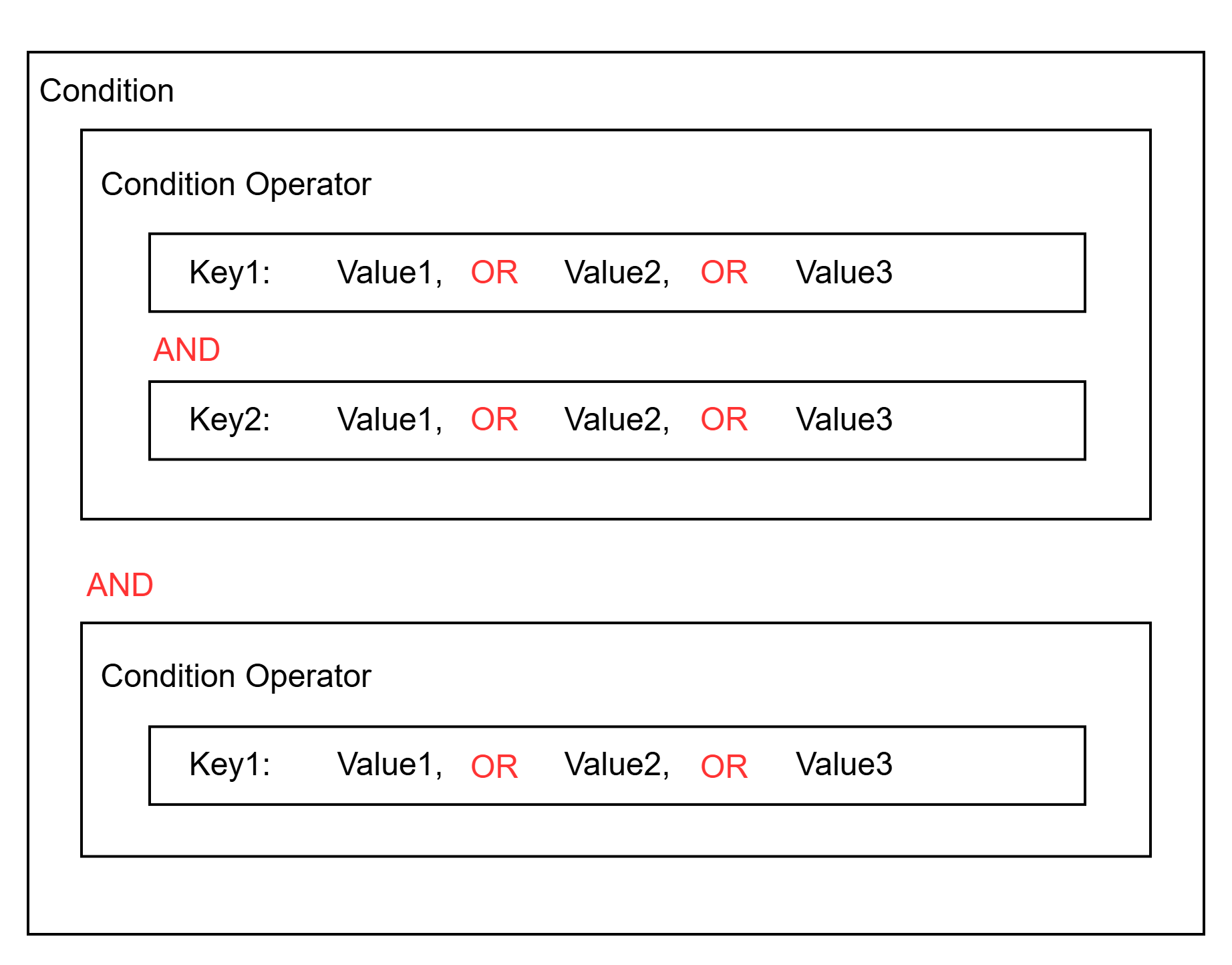
"Condition": {
   "StringEquals": {
      "iam:userName": [  # When the user's name is foo or bar
          "foo", "bar"
      ],
      "iam:userCompany": [  # when the user's company is Samsung
          Samsung
      ]
   }
 }
- 부정 연산자(Negative Operator) 유형 및 예시(IP가 1.1.1.1/24 와 2.2.2.2/24가 대역이 아닌 모든 IP)
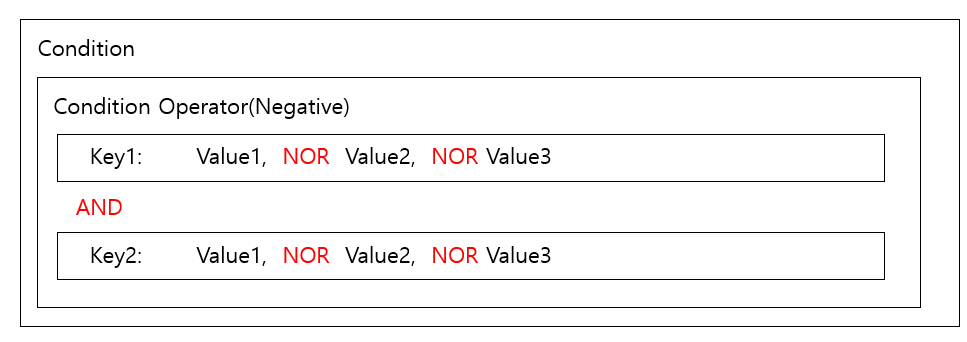
"Condition": {
   "NotIpAddress": {
      "scp:SourceIp": [  # when the request IP is neither 1.1.1.1 nor 2.2.2.2
          "1.1.1.1/24", "2.2.2.0/24"
      ]
   }
 }
조건 연산자(operator)
조건 연산자는 7가지(문자열, 숫자, 날짜, Bool, IP, SRN, Null) 연산자를 제공합니다.
문자열 연산자
conditional operator Operator type Explanation StringEquals positive operator Exact match, case-sensitive StringNotEquals negation operator mismatch StringEqualsIsIgnoreCase positive operator Exact match, case insensitive StringNotEqualsIsIgnoreCase negation operator Mismatch, case-insensitive StringLike positive operator Case-sensitive matching; multiple-character string matching (*) wildcard can be included in the value. StringNotLike negation operator Case sensitivity mismatch, wildcard that matches multiple characters (*) can be included in values Table. String operators숫자 연산자
conditional operator Operator Types description NumericEquals positive operator Match NumericNotEquals negation operator mismatch NumericLessThan positive operator Match less than NumericLessThanEquals positive operator as follows NumericGreaterThan positive operator overmatch NumericGreaterThanEquals positive operator Match above Table. Numeric operators날짜 연산자
conditional operator Operator type description DateEquals positive operator Match specific date DateNotEquals negation operator mismatch DateLessThan positive operator Match before a specific date/time DateLessThanEquals positive operator Match on a specific date/time or earlier DateGreaterThan positive operator Match after a specific date/time DateGreaterThanEquals positive operator Match on a specific date/time or later Table. Date operatorsBool 연산자
conditional operator Operator Types description Bool positive operator True, False match Table. Bool operatorIP 연산자
conditional operator Operator type description IpAddress positive operator specified IP address or range NotIpAddress negation operator All IP addresses except the specified IP address or range Table. IP operatorSRN 연산자
conditional operator Operator Types description SrnEquals, SrnLike positive operator SRN match SrnNotEquals, SrnNotLike negation operator SRN mismatch Table. SRN operatorNull 연산자
conditional operator Operator type description Null positive operator - If the key is missing or the value is null \→ True
- If the key exists and the value is not null \→ False
Table. Null operator
조건 키(condition-key)
조건 키는 전역 조건 키과 자원 속성 키로 구분됩니다.
Reference
조건 키는 대소문자를 구분하지 않습니다.
전역 조건 키(Global condition key)
Samsung Cloud Platform에 사전 정의된 조건 키로써 요청 정보, 자원 공통 정보(ex-tag), 네트워크 정보 등의 데이터를 정의합니다.
| condition key | Data type | singular/plural | description | example |
|---|---|---|---|---|
| scp:UserId | string | single | request user id | “scp:UserId” : [“efda56a968cd45b2873d9bf5fab58e95”] |
| scp:UserName | string | single | Request user name | “scp:UserName” : [“foo”] |
| scp:MultiFactorAuthPresent | bool | string | Request via MFA authentication | “scp:MultiFactorAuthPresent” : [“True”] |
| scp:RequestedRegion | string | single | request region | “scp:RequestedRegion” : [“kr-west1”] |
| scp:RequestAttribute/{AttributeKey} | string | single | request attribute value(AttributeKey)
| “scp:RequestAttribute/body[‘foo’]” : [“true”] |
| scp:TagKeys | string | single / multiple | request tag key | “scp:TagKeys” : [“tag-key”] |
| scp:RequestTag | string | single | Request tag key value | “scp:RequestTag/tag-key” : [“tag-value”] |
| scp:ResourceTag/{TagKey} | string | single | Resource tag key value | “scp:ResourceTag/foo” : [“bab”] |
| scp:SourceIp | ip_address | single | IP of the current requesting entity | “scp:SourceIp” : [“1.1.1.1/24”] |
| scp:CurrentTime | datetime | single | Request time (UTC, ISO 8601 format) | “scp:CurrentTime” : [“2025-11-06T16:10:38Z”] |
Table. Types and formats of supported global condition keys
자원 속성 키(Resource attribute key)
고유 자원에 대한 속성 키로써 자원의 속성값을 기준으로 조건값을 검사할 때 사용합니다.
{service}:{resource_type}{attribute_name}
Information
자원의 속성은
Resource definition에서 정의된 attributes에 abac:true인 대상의 속성에 한해서만 정의할 수 있으며 정의되지 않은 속성값을 입력할 경우, 해당 condition 정책은 무시됩니다(Not found).- 자원 속성명 사용 예시
"iam:userLastname"  (O) # attribute name defined in the resource (service: iam, resource: user, attribute_name : lastname)
"iam:userLASTNAME"  (O) # Property name defined in the resource (case-insensitive)
"iam:userLast_name" (X) # When it is not an attribute name defined in the resource ㅎ
"iam:userEmail"     (X) # when abac is false
"iam:state"         (X) # when the abac field is not defined
Color mode
kind: scp-resourcemanager:resource-definition
service_type: scp-iam
name: scp-iam:user
resources_uri: /v1/users
resource_type: user
display_name:
  ko: '사용자'
  en: 'User'
product_id: IAM
attributes:
  state:
    type: string
    uri: /v1/users/{resource_id}
    method: GET
    jsonpath: $.state
  firstname:
    type: string
    uri: /v1/users/{resource_id}
    method: GET
    jsonpath: $.first_name
    abac: true
  lastname:
    type: string
    uri: /v1/users/{resource_id}
    method: GET
    jsonpath: $.last_name
    abac: true
  email:
    type: string
    uri: /v1/users/{resource_id}
    method: GET
    jsonpath: $.email
    abac: false
kind: scp-resourcemanager:resource-definition
service_type: scp-iam
name: scp-iam:user
resources_uri: /v1/users
resource_type: user
display_name:
ko: '사용자'
en: 'User'
product_id: IAM
attributes:
state:
type: string
uri: /v1/users/{resource_id}
method: GET
jsonpath: $.state
firstname:
type: string
uri: /v1/users/{resource_id}
method: GET
jsonpath: $.first_name
abac: true
lastname:
type: string
uri: /v1/users/{resource_id}
method: GET
jsonpath: $.last_name
abac: true
email:
type: string
uri: /v1/users/{resource_id}
method: GET
jsonpath: $.email
abac: falseReference
- 자원의 속성명은
Resource definition에서 정의된attributes에 정의된 속성 데이터를 사용합니다. - Resource definition에 대한 자세한 내용은 Resource Definition 가이드를 참고하세요.
Condition Key 정의 예시
- 전역 조건 키(Global condition key) 예시: 특정 정책 자원 태그의 키(Environment)의 값이 “Local” 또는 “Dev"인 경우에만 그룹 상세 조회를 허용하는 정책
Color mode
{
  "Version": "2024-07-01",
  "Statement": [
    {
      "Sid": "statement1",
      "Action": ["iam:showPolicy"],
      "Effect": "Allow",
      "Resource": ["*"],
      "Condition": {
          "StringEquals": {
            "scp:ResourceTag/Environment": [  # 전역 조건 키(scp:ResourceTag)를 사용한 정의 형태
              "Local", "Dev"
            ]
          }
      }
    }
  ]
}
{
"Version": "2024-07-01",
"Statement": [
{
"Sid": "statement1",
"Action": ["iam:showPolicy"],
"Effect": "Allow",
"Resource": ["*"],
"Condition": {
"StringEquals": {
"scp:ResourceTag/Environment": [ # 전역 조건 키(scp:ResourceTag)를 사용한 정의 형태
"Local", "Dev"
]
}
}
}
]
}- 자원 속성 키(Resource attribute key) 예시Color mode
{
  "Version": "2024-07-01",
  "Statement": [
    {
      "Sid": "statement1",
      "Action": ["server:showInstance"],
      "Effect": "Allow",
      "Resource": ["*"],
      "Condition" : {
           "StringEquals" : {
               "virtual-servers:instanceFlavor" : ["m1.small"] # virtual-servers 서비스의 intance 리소스의 flavor 속성이 "m1.small"인 경우
            }
       }
    }
  ]
}
{ "Version": "2024-07-01", "Statement": [ { "Sid": "statement1", "Action": ["server:showInstance"], "Effect": "Allow", "Resource": ["*"], "Condition" : { "StringEquals" : { "virtual-servers:instanceFlavor" : ["m1.small"] # virtual-servers 서비스의 intance 리소스의 flavor 속성이 "m1.small"인 경우 } } } ] }Resource attribute key example
정책 조건값(condition-value)
조건 키에 대한 값을 정의합니다.
Reference
여러 개의 정책 조건값이 정의되어 있는 경우에는 각 조건값은 OR로 동작합니다.
"Condition" :  {
   "StringEquals" : {
        "scp:resourceTag/key1": ["value1", "value2", "value3"]    # If the resource's tag key is key1 and the value is value1, value2, or value3
 }
한정자(quailfier)
Condition key로부터 추출된 요청 컨텍스트값이 여러 개의 값을 가진인 경우에 동작 방법을 정의합니다.(요청 컨텍스트값이 1개일 경우에는 생략)한정자는 ForAnyValue, ForAllValues로 구분되며 한정자를 작성하지 않을 경우, ForAnyValue가 기본값으로 정의됩니다.
ForAnyValue: 요청 컨텍스트에 추출된 값들이 Condition에 정의된 Operand와 1개 이상 일치할 경우 TrueForAllValues: 요청 컨텍스트에 추출된 값들이 Condition에 정의된 Operand 리스트의 하위 집합일 경우 True
{

  "Condition" :  {
       "ForAllValues:StringEquals" : {
            "scp:TagKeys": ["key1", "key2", "key3"]
        }
  }
}
한정자 동작 예시
“scp:TagKeys”로 부터 추출되는 요청값이 1개인 경우: 한정자와 관계없이 Operand별로 OR로 동작“scp:TagKeys”로 부터 추출되는 요청값이 2개 이상인 경우: 한정자에 따라 결과 차이
Color mode
# 추출되는 요청 컨텍스트값이 ["key1", "key2", "key4"] 인 경우
Operand: ["key1", "key2", "key3"]
   # 요청 컨텍스트값 중 key1는 Operand에 포함되므로 True
   # 요청 컨텍스트값 중 key2는 Operand에 포함되므로 True
   # 요청 컨텍스트값 중 key4는 Operand에 포함되지 않으므로 False

ForAnyValue는 3개의 요청 컨텍스트 값 중 1개라도 일치할 경우엔 True로 판단
ForAllValues는 3개의 요청 컨텍스트 값이 모두 True 일 경우에만 최종 True로 판단
# 추출되는 요청 컨텍스트값이 ["key1", "key2", "key4"] 인 경우
Operand: ["key1", "key2", "key3"]
# 요청 컨텍스트값 중 key1는 Operand에 포함되므로 True
# 요청 컨텍스트값 중 key2는 Operand에 포함되므로 True
# 요청 컨텍스트값 중 key4는 Operand에 포함되지 않으므로 False
ForAnyValue는 3개의 요청 컨텍스트 값 중 1개라도 일치할 경우엔 True로 판단
ForAllValues는 3개의 요청 컨텍스트 값이 모두 True 일 경우에만 최종 True로 판단4.3 - API Reference
API Reference
4.4 - CLI Reference
CLI Reference
4.5 - Release Note
IAM
2026.05.21
FEATURE
Add user permission copy feature and improve CX- You can copy the permissions of another IAM user.
- When creating or modifying an IAM user, you can copy and import policies that are attached to another user’s group or directly attached.
- We have improved the CX-related functionality.
- You can manage IAM user access key creation records.
- You can configure the visibility of the AI recommendation floating guide displayed at the bottom of the screen.
- When viewing the IAM user list, you can click the user group to navigate to the detail page.
2026.03.19
FEATURE
Add automatic logout on password errors and other feature enhancements- If a password error occurs while using the console, you will be automatically logged out of the console.
- When password entry is required, such as changing the password or updating the mobile phone number, you will be automatically logged out after five or more incorrect attempts.
- We provide a guide on using the Json mode that can be referenced when creating policies.
2025.10.23
FEATURE
Add IP access control functionality and other feature enhancements- You can share related information via email when creating a user or changing a password.
- Virtual Server and Cloud Function have been added as the entities that perform role functions.
- When changing roles, you can check the session expiration time in My Menu.
- You can register and manage IPs that can access the console.
- Root users and IAM users with the same information (phone number, email) can switch between each other even after logging in.
2025.07.01
FEATURE
Provide role and credential provider functionality- The role feature has been added.
- Users can switch from their own account to a different role to access the Account.
- Credential provider functionality has been added.
- You can create a credential provider and access the Account resource in the Console through the created credential provider.
- You can directly associate users with policies.
- You can add conditions for attribute-based access control (ABAC) when creating a policy.
2025.04.28
FEATURE
My. info feature change- The mandatory requirements for creating a user password have been changed.
- When editing an authentication key, CIDR input is optional.
- A password reconfirmation step has been added when changing the user’s email or phone number.
2025.02.27
FEATURE
IAM user group, user, policy, and access key feature changes- IAM(Identity and Access Management) feature change
- Added user group and user functions, and policy creation functionality.
- We provide a unified authentication key by consolidating the app authentication key and the storage authentication key.
- Samsung Cloud Platform Common Feature Changes
- Implemented common CX changes, including Account, Service Home, and tags.
2024.07.02
NEW
Official release of IAM service- The IAM(Identity and Access Management) service has been released.
- Provide user authentication and authorization management.
- Access control policy management provided
2024.07.02
NEW
IAM Beta service launch- The IAM(Identity and Access Management) service has been launched.
- Provide user authentication and authorization management.
- Provides access control policy management
5 - ID Center
5.1 - Overview
Service Overview
ID Center is a service that enables easy centralized management of access permissions for resources by account on the Samsung Cloud Platform. You can create permission policies for each service and assign accounts and policies linked to the Organization service to users, enabling management of tasks according to each user’s permissions.
Features
- Easy Access Permission Management: Through SAML (Security Assertion Markup Language) based credential authentication, you can receive authentication and authorization from Samsung Cloud Platform and access resources of multiple accounts within the organization.
- Efficient Account Management: By integrating with the Organization service, you can centrally manage the costs and resource usage incurred by all Accounts within the organization.
- Account Security Enhancement: Instead of the Samsung Cloud Platform Console, you can strengthen security by using the separately provided Access Portal so that only authorized ID Center users can access. Through the Access Portal, you can fundamentally prevent users outside the customer organization from accessing the Account.
Configuration
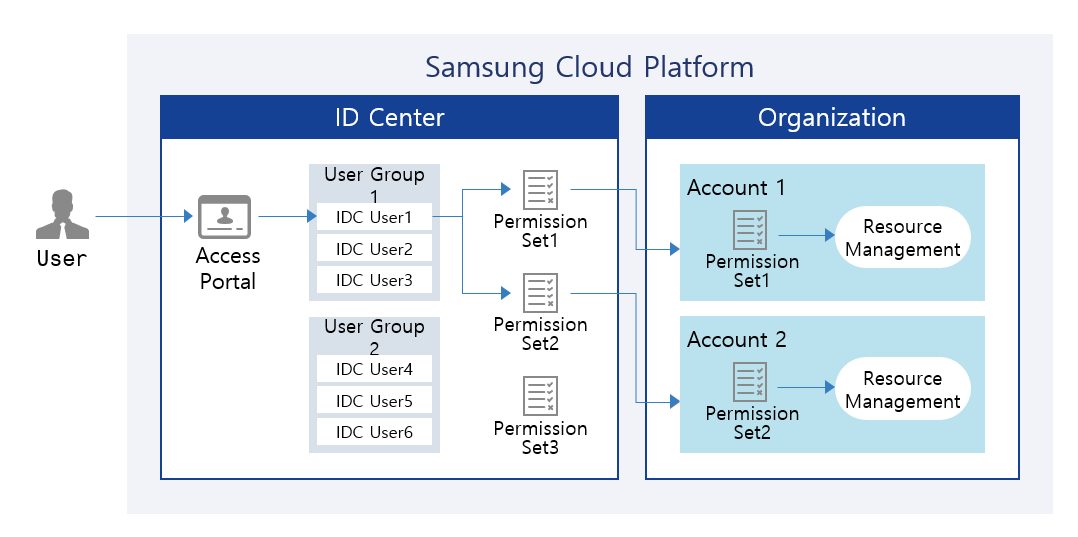
Provided features
ID Center provides the following functions.
- User and User Group Management: You can create users and user groups and configure service-specific permission management policies. Users are required to have MFA (Multi-Factor Authentication) applied, strengthening the management of Account access.
- Account Allocation Management: You can assign and manage Accounts corresponding to each user’s tasks.
- Permission Set Management: You can create and manage permission sets by using the default policies or custom policies that exist in each Account, or by configuring policies directly.
- Access Portal Provision: Provides an Access Portal that can be used instead of the Samsung Cloud Platform Console, allowing only ID Center users to access it.
Component
User
Administrators can create users and add them to user groups. They can generate passwords automatically or manually, and provide users with Access Portal login information. Additionally, users can be assigned to accounts according to their respective tasks.
Reference
For detailed information on user management, see How-to guides > User Management.
User Group
You can link users and Accounts through user groups. You can create user groups appropriate for each task, register users, and assign them to Accounts.
Reference
For detailed information about user groups, please refer to How-to guides > User Group Management.
Permission Set
You can create permission sets by using the default policies and custom policies that exist in the Account, or by configuring policies directly.
Reference
For detailed information about permission sets, refer to How-to guides > Permission Set Management.
Provision status by region
ID Center is available in the environments below.
| Region | Whether provided |
|---|---|
| Korea West (kr-west1) | Provide |
| Korea East (kr-east1) | Provide |
| South Korea South 1 (kr-south1) | Provide |
| South Korea South 2 (kr-south2) | Provide |
| South Korea 3 (kr-south3) | Not provided |
Table. ID Center regional availability status
Preceding Service
This is a list of services that must be pre-configured before creating the service. Please refer to the guide provided for each service for details and prepare in advance.
| Service Category | Service | Detailed description |
|---|---|---|
| Management | Organization | A service that organizes accounts by organizational units, manages them hierarchically, and controls resource access permissions. |
Table. ID Center Preceding Service
5.2 - How-to guides
Users can create the service by entering the required ID Center information and selecting detailed options through the Samsung Cloud Platform Console.
Create ID Center
You can create and use an ID Center in the Samsung Cloud Platform Console.
information
You can manage the ID Center only in the region where it was created.
Reference
Only the Organization’s Management Account can create an ID Center.
To create an ID Center, follow these steps.
Click the All Services > Management > ID Center menu. 1. Go to the Service Home page of ID Center.
Service Home on the page, click the ID Center Apply button. 2. Go to the ID Center Creation page.
ID Center Creation After entering the basic information on the page, click the Create button.
- In the Basic Information Input area, enter the name and description of the ID Center.
Category required statusDetailed description ID Center name Required Enter the ID Center name - using English letters, numbers, and special characters (
+=-_@,.) within 3 to 128 characters
Explanation Selection Enter a description of the organizational unit within 1,000 characters. Table. ID Center basic information items - using English letters, numbers, and special characters (
- In the Credential Source Selection area, select the credential source type and enter the required information.
Category required statusDetailed description ID Center’s own directory - Manage all users and user groups in the ID Center - Users log in via the Access Portal
AD (Active Directory) - 사용자가 직접 관리하는 Active Directory를 ID Center의 자격 증명 소스로 등록하여 사용 - 사용자는 Access Portal을 통해 로그인
- AD (Active Directory) 사용 시 상세 옵션 설정 필수
- LDAP Directory Service: LDAP Directory Service 서비스 유형(OpenLDAP, Microsoft AD, 389 Directory Server) 선택
- Connection URL: LDAP 서버 주소를 입력(예:
ldap://또는ldaps:)
- Bind DN: LDAP 서버에 접근할 때 사용하는 관리자 또는 서비스 계정의 DN (Distinguished Name)을 입력
- Bind credentials: Bind DN에 해당하는 계정의 비밀번호 입력
- User DN: 사용자 계정이 위치하는 디렉토리 경로 입력(예:
OU=Employees,OU=Accounts,DC=sub,DC=org)
- Username LDAP attribute: 사용자 계정 식별값 입력(예:
sAMAccountName,uid)
- RDN LDAP attribute: RDN (Relative Distinguished Name, 사용자 DN에서 최상위 속성) 입력
- User object classes: 사용자 객체를 정의하는 LDAP 클래스 목록 콤마(
,)로 구분하여 입력(예:persion,organizationPersion,usersAMAccount)
- 비밀번호 관리: 비밀번호 관리 방식 선택
- ID Center 관리 선택 시 사용자가 Access Portal에서 비밀번호 관리 가능
- 생성 시 자동으로 AD 정보를 동기화
Table. ID Center credential source selection item
- In the Basic Information Input area, enter the name and description of the ID Center.
When the popup notifying the creation of the ID Center opens, click the Confirm button.
On the Service Home page, check the ID Center dashboard.
구분 상세 설명 ID Center information Display the name, ID, and Access Portal URL of the ID Center - ID Center information When you click the ID Center settings item, you are taken to the ID Center configuration page where you can view detailed ID Center information
User Number of users created in ID Center - Clicking the user count navigates to the User List page
- Create item click navigates to the User Creation page. 사용자 생성하기 Reference
User group Number of user groups created in ID Center - Click the group count to go to the User Group List page
- Click the Create item to go to the User Group Creation page. 사용자 그룹 생성하기 Refer
Permission set Number of permission sets created in ID Center - Click the permission set count to navigate to the Permission Set List page
- Click the Add item to go to the Create Permission Set page. see 권한 세트 생성하기
Table. ID Center Service Home Dashboard Items
Check ID Center detailed information
You can view detailed information of the ID Center and manage permissions.
To view detailed information of the ID Center and manage permissions, follow these steps.
- Click the All Services > Management > ID Center menu. 1. Go to the Service Home page of ID Center.
- On the Service Home page, click the ID Center Settings menu. 2. Navigate to the ID Center Settings page.
Category Detailed description Delete ID Center Delete ID Center button - Not displayed on delegated Account
service Service name Resource Type Resource Type SRN Unique resource ID in Samsung Cloud Platform Resource Name Resource Name Resource ID Unique resource ID in the service Constructor User who created the service Creation Date/Time Service creation date and time Modifier User who edited the service information Modification date Date and time the service information was modified ID Center name ID Center name - Edit Click the button to change usage status
Region Region where the ID Center was created Explanation Description of ID Center - Edit button can be clicked to change usage status
Organization ID Organization’s ID Credential source Credential source type - Edit button can be clicked to change the credential source type
- ID Center native directory: Directory within ID Center
- AD (Active Directory): Active Directory managed directly by the user
- Last synchronization: Date and time of the last sync and its status
- Sync button can be clicked to perform a manual synchronization
- For details about Active Directory settings, see Change credential source type
Access Portal URL URL to access the Access Portal | Display the Account name, Account ID, Email, Delegation time information of the Account that delegated management authority in ID Center
- For delegated Accounts, the managing Account’s information is displayed, and delegation or cancellation of authority is not possible
- Permission delegation: Ability to delegate authority to an Account within ID Center
- Displayed when there is no delegation information
- When the button is clicked, you can select an Account on the Permission delegation page to set up delegation
- For more details, see 권한 위임하기
- Cancel delegation: Cancel the permission delegation
Table. ID Center configuration items
Managing Credential Sources
You can change the credential source type, or modify and manage the settings for the AD (Active Directory) type.
AD (Active Directory) Apply for Integration
If you want to use a user-managed AD (Active Directory) integration, you must first prepare the VPC and Load Balancer, then submit a request through SR. To apply for AD integration, follow the steps below.
Secure a VPC that integrates with the user’s AD.
- When a network connection is required, connect to the network where the user’s AD resides using the Direct Connect service.
- For more details, refer to Direct Connect 생성하기.
Configure the Load Balancer.
- Create a Load Balancer and an LB server group.
- Add the IP that will link AD as a member of the resources connected to the LB server group.
- Create a Listener from the Load Balancer’s connected resources and attach the LB server group.Information
- Through the Load Balancer service, call information for AD synchronization from ID Center can pass through the user’s VPC to invoke the user’s AD.
- For detailed information on creating and using the Load Balancer service, please refer to Load Balancer 서비스 이용하기.
Configure a PrivateLink Service in the user’s VPC.
- Create a PrivateLink Service for the user VPC that will be called from ID Center.
- When creating a PrivateLink Service, select the Load Balancer created in step 2 as the connection resource.
When the preparation work is complete, click the All Services > Management > Support Center menu. 4. Go to the Service Home page.
Service Home on the page, click the Service Request menu. 5. Service Request List page is accessed.
On the Service Request List page, select and enter the information required for the service request.
Category Required statusDetailed description Title Required Enter the title of the service request - using Korean, English, numbers, and special characters (
+=,.@-_) within 64 characters
Region Required Select the region to request the service service Required Management service group’s ID Center service selection Task classification Required ID Center AD Integration Request Select content Required Enter information for ID Center AD integration request Table. ID Center AD integration request items- using Korean, English, numbers, and special characters (
Check the input information and click the Request button.
- Once creation is complete, check the Service Request List page.
Information
After requesting the service, you cannot edit or delete the content you have written.
Changing the credential source type
You can change the credential source or modify the configuration values.
Caution
- Changing the credential source will delete all configuration information and resources, including previously configured users, user groups, account assignments, and permission sets.
- While resources are being deleted, you cannot access any screens in ID Center.
Follow these steps to change the credential source type.
All Services > Management > ID Center Click the menu. 1. Go to the Service Home page of ID Center.
On the Service Home page, click the ID Center Settings menu. 2. ID Center Details Go to the page.
On the ID Center Details page, click the Edit button of the Credential Source item. 3. Change Credential Source A popup window opens.
After selecting the credential source type to use, click the Confirm button. 4. A popup window notifying a credential source change opens.
Category Detailed description ID Center’s own directory Use directory within ID Center - No separate configuration items
AD (Active Directory) Use Active Directory managed directly by the user - LDAP Directory Service: Select LDAP Directory Service type (OpenLDAP, Microsoft AD, 389 Directory Server)
- Connection URL: Enter the LDAP server address (e.g.,
ldap://orldaps:)
- Bind DN: Enter the DN (Distinguished Name) of the administrator or service account used to access the LDAP server
- Bind credentials: Enter the password for the account corresponding to the Bind DN
- User DN: Enter the directory path where user accounts are located (e.g.,
OU=Employees,OU=Accounts,DC=sub,DC=org)
- Username LDAP attribute: Enter the user account identifier attribute (e.g.,
sAMAccountName,uid)
- RDN LDAP attribute: Enter the RDN (Relative Distinguished Name, the top-level attribute in the user DN)
- User object classes: Enter the list of LDAP classes that define user objects, separated by commas (
,) (e.g.,persion,organizationPersion,usersAMAccount)
- Password management: Select password management method
- ID Center management: If ID Center management is selected, users can manage passwords in the Access Portal
Table. Credential source type change itemsAfter reviewing the precautions for changes and checking the checkbox, click the Confirm button. 5. Go to the Service Home page and start changing the credential source type.
- The change time varies depending on the scale, and you can confirm it via a notification once the change is complete.
- You cannot navigate to other menu pages while changes are in progress.
AD (Active Directory) Synchronize Information
You can check the AD information and perform synchronization manually.
Reference
- AD information is automatically synchronized daily between 0:00 and 06:00 (Asia/Seoul, GMT +09:00).
- To connect new AD information, change the credential source, delete all ID Center resources, and then start synchronization anew.
To synchronize AD information, follow these steps.
- Click the All Services > Management > ID Center menu. 1. Go to the Service Home page of ID Center.
- On the Service Home page, click the ID Center Settings menu. 2. ID Center Details page will be opened.
- On the ID Center 상세 page, click the 동기화 button next to the sync time of the 자격 증명 소스 item. 3. AD Information Synchronization The popup window opens.
- After reviewing the synchronization notification, click the Confirm button. 4. AD information synchronization is starting.
- The change time varies depending on the scale.
Manage Permissions
You can delegate the ID Center’s administrative privileges to another account, or revoke previously delegated privileges.
Delegating Permissions
You can delegate the administrative rights of the ID Center to another account.
To delegate administrative privileges to another account, follow these steps.
- Click the All Services > Management > ID Center menu. 1. Go to the Service Home page of ID Center.
- On the Service Home page, click the ID Center Settings menu. 2. ID Center Details page is opened.
- On the ID Center Details page, click the Delegate Permissions button. 3. Go to the Permission Delegation page.
- Permission Delegation button is displayed only when there is no Account that has currently delegated the permission.
- Permission Delegation page, select the Account to delegate the permission to, then click the Complete button.
Category Detailed description Account name Account name Account ID Account ID email Account email Additional date/time Account creation or sign‑up time in the organization Additional type Method of adding an Account in Organization - Creation: Add Account page, create anew and add
- Sign-up: Add an already created Account
Table. ID Center Delegated Authority Account List
Reference
View Hierarchy button, when clicked, allows you to view the Account list in a hierarchical structure.
Cancel delegation
You can revoke the ID Center’s administrative privileges that were delegated to another account.
To cancel delegated administrative permissions, follow these steps.
- Click the All Services > Management > ID Center menu. 1. Go to the Service Home page of ID Center.
- On the Service Home page, click the ID Center Settings menu. 2. Navigate to the ID Center Details page.
- On the ID Center Details page, click the Cancel Permission Delegation button.
- When the popup notifying the revocation of delegation opens, click the Confirm button.
Delete ID Center
Caution
An account delegated to manage the ID Center cannot delete the ID Center.
Caution
When an ID Center is deleted, all users, user groups, and permission sets within the ID Center are removed, and all entries assigned to the Account are deleted.
To delete the ID Center, follow these steps.
- Click the All Services > Management > ID Center menu. 1. Navigate to the Service Home page of ID Center.
- On the Service Home page, click the ID Center Settings menu. 2. Go to the ID Center Settings page.
- On the ID Center Settings page, click the Delete ID Center button. 3. ID Center Delete popup window opens.
- In the ID Center Delete popup, after entering the name of the ID Center to delete, click the Confirm button. 4. Go to the Service Home page.
- The deletion time for the ID Center varies depending on the scale, and you can confirm completion through a notification.
- You cannot navigate to other menu pages while the ID Center is being deleted.
5.2.1 - ID Center User Management
You can view and manage ID Center users.
Create User
You can create a user and add it to the ID Center. Follow the steps below to create a user.
All Services > Management > ID Center click the menu. 1. Go to the Service Home page of ID Center.
On the Service Home page, click the User menu. 2. User List page is opened.
On the User List page, click the Create User button. 3. Navigate to the User Creation page.
On the User Creation page, after entering the basic and additional information, click the Create button.
Category whether requiredDetailed description username Required Enter the user’s name - English letters, numbers, special characters (
+=-_@,.) using
- within 128 characters
Explanation Selection 사용자에 대한 설명을 1,000자 이내로 입력 비밀번호 필수 비밀번호 생성 방법 선택 - 자동 생성: 비밀번호를 자동으로 생성하여 사용자 생성 완료 시 팝업창에서 제공
- 직접 입력: 비밀번호 생성 규칙을 참고하여 직접 입력
사용자 실명 필수 Enter the user’s full name as their real name Enter affiliation information Selection Enter the division, department, manager, and employee ID information, each within 128 characters. Select user group Selection Select the user group to add the user - To create a user group, see 사용자 그룹 생성하기
Table. User-generated informationPassword creation rules- It must contain at least one uppercase letter (English), one lowercase letter (English), one digit, and one special character (
!@#$%&*^). - The length is 9 to 20 characters.
- ID cannot be used.
- You cannot use the same character more than three times.
- Passwords that are easy to guess cannot be used.
- You cannot use a password that was recently used.
- Consecutive characters or numbers of four or more cannot be used.
- The password change interval is 90 days.
- English letters, numbers, special characters (
When the popup that notifies a user addition opens, click the Create button. 5. ID Center User Login Information The popup window opens.
After verifying the ID Center user login information, click the Confirm button.
Category Detailed description Access Portal URL URL information for accessing the Access Portal Username Generated user name Password Generated user’s password - View Click the icon to view the password
Excel download Download ID Center user login information as an Excel file Email sending Send an Excel file containing ID Center user login information via email - After clicking the button, enter the address to receive the email
Table. ID Center user login information item
Check user detailed information
You can view and manage detailed information about users, user groups, and Account information. To view detailed user information, follow the steps below.
- Click the All Services > Management > ID Center menu. 1. Navigate to the Service Home page of ID Center.
- On the Service Home page, click the User menu. 2. User List page is accessed.
- On the User List page, click the user name to view detailed information. 3. Navigate to the User Details page.
- User Details page displays basic information and consists of Basic Information, User Group, Account tabs.
Basic Information
View the user’s basic information, and modify the user’s description and options if needed.
| Category | Detailed description |
|---|---|
| Delete user | Delete user button
|
| Username | User’s name |
| User real name | User’s actual name
|
| Explanation | Description of the username
|
| Last login | The date and time the user last logged in |
| Password | Date and time of the last password change
|
| Password reuse restriction | Number of recent passwords that cannot be set as a password
|
Email verification status
| |
| mobile phone number | Mobile phone number verification status |
| Affiliation information | User’s division, department, manager, employee number information
|
Table. User's basic information tab items
Reference
Password and Password reuse restriction can be changed on the My info. page of Access Portal.
For more details, refer to the Access Portal’s My Info..
User group
The user can view the registered user groups and, if necessary, add or remove user groups.
Reference
For detailed information about User Group, refer to 사용자 그룹.
| Category | Detailed description |
|---|---|
| Exclude | Exclude the selected user group from the user group list
|
| Add user group | Add a user group to register users
|
| User group name | Name of the user group |
| Explanation | Description of the user group |
| Modification date | Date and time the user group was modified |
Table. User's user group tab item
Account
Verify the Account assigned to the user, and, if needed, add a permission set or assign an Account.
Reference
- For detailed information about Permission Set, please refer to 권한 세트.
- Account Assignment for detailed information, please refer to Account 할당.
| Category | Detailed description |
|---|---|
| Add a new permission set to the Account
- Activates when selecting an Account from the Account list
- For more details, see 권한 세트 추가하기
- If all permission sets are excluded, the Account assignment is cancelled
- For more information, see Account 할당하기
| Number of permission sets applied to the Account
- When the mouse cursor is placed over a permission set, a popup opens that allows you to exclude the permission set
- Direct: Policy directly attached to the Account
- Group: Policy attached via a user group
Table. User's Account tab items
Add User Group
You can add a new user group. To add a user group, follow these steps.
All Services > Management > ID Center Click the menu. 1. Navigate to the Service Home page of ID Center.
On the Service Home page, click the User menu. 2. User List navigate to the page.
On the User List page, click the user name to add to the user group. 3. Navigate to the User Details page.
On the User Details page, click the User Group tab. 4. The list of user groups is displayed.
Click the Add User Group button. 5. Go to the Add User Group page.
Add User Group page, select the user group you want to add from the list of user groups, then click the Complete button.
Category Required statusDetailed description Added user group - User-added user group name User group Required Select the user group to add the user - when selected, add to the Added user group item
Table. Add user group itemWhen the popup notifying the addition of a user group opens, click the Confirm button.
Add Permission Set
You can add a permission set to the Account. To add a permission set to an Account, follow these steps.
Click the All Services > Management > ID Center menu. 1. Go to the Service Home page of ID Center.
On the Service Home page, click the User menu. 2. User List page is opened.
On the User List page, click the user name to add a permission set. 3. Navigate to the User Details page.
On the User Details page, click the Account tab. 4. The Account list is displayed.
After selecting the Account to which you want to add a permission set from the Account list, click the Add Permission Set button. 5. Go to the Add Permission Set page.
On the Add Permission Set page, select the permission set you want to add from the permission set list, then click the Done button.
Category Required statusDetailed description Selected Account - | | Applied permission set | - | Name of the permission set applied to the selected Account | |
| Required | Select one or more permission sets to apply to the Account
- When selected, add to the Applied Permission Set item
Table. Add Permission Set ItemWhen the popup notifying that a permission set has been added opens, click the Confirm button.
Allocate Account
You can assign a new Account to the user. To assign a new Account, follow the steps below.
All Services > Management > ID Center click the menu. 1. Go to the Service Home page of ID Center.
On the Service Home page, click the User menu. 2. Go to the User List page.
On the User List page, click the user name to assign the Account. 3. Navigate to the User Details page.
On the User Details page, click the Account tab. 5. The account list is displayed.
Click the Account Assignment button. 6. Go to the Account allocation page.
On the Account Assignment page, after selecting the Account to assign and the permission set to apply to the Account, click the Complete button.
Category Required statusDetailed description Select Account Required Select the Account to assign to the user - View hierarchical structure: Display the Account in an organizational hierarchical structure
- View Account list: Display the Account in a list format
| required | Select the permission set to apply to the selected Account |
Table. User Account Assignment itemInformationIf there is no IAM policy name that matches the custom policy name of the selected permission set, you cannot assign the account.When the popup indicating that the account has been assigned to the user group opens, click the Confirm button.
Delete User
To delete a user, follow these steps.
- All Services > Management > ID Center Click the menu. 1. Go to the Service Home page of ID Center.
- On the Service Home page, click the User menu. 2. Go to the User List page.
- Select at least one user to delete from the user list.
- After reviewing the selected users, click the Delete button.
- You can also delete individually from the User Details page of the user to be deleted.
- When the popup notifying user deletion opens, click the Confirm button.
5.2.2 - Managing ID Center User Groups
You can view and manage user groups in ID Center.
Create User Group
You can create a user group and add it to the ID Center. To create a user group, follow these steps.
Click the All Services > Management > ID Center menu. Go to the Service Home page of ID Center.
On the Service Home page, click the User Group menu. You will be taken to the User Group List page.
Click the Create User Group button on the User Group List page. You will be taken to the Create User Group page.
On the User Group Creation page, after entering the basic and additional information, click the Create button.
Category Required statusDetailed description User group name Required Enter the user group name - using English letters, numbers, and special characters (
+=-_@,.) within 3 to 30 characters
description Selection Enter a description of the user group within 1,000 characters. Add user Select Select users to add to the user group - Display the list of users registered in the Account
- To create a new user, see Create User
- If the user you want to add does not exist when linking with AD, add the user in the AD provider and go to the ID Center Settings > Credential Source page to perform synchronization
Table. User Group Creation Information- using English letters, numbers, and special characters (
When the popup notifying the addition of a user group opens, click the Confirm button.
View detailed information of user group
You can view and manage detailed information about user groups, as well as user group and account information.
To view detailed information about a user group, follow these steps.
- Click the All Services > Management > ID Center menu. Go to the Service Home page of ID Center.
- On the Service Home page, click the User Group menu. You will be taken to the User Group List page.
- On the User Group List page, click the user group name whose details you want to view. You will be taken to the User Group Details page.
- The User Group Detail page displays basic information and consists of Basic Information, User, and Account tabs.
Basic Information
You can view the basic information of a user group and, if necessary, edit its description and options.
| Category | Detailed description |
|---|---|
| Delete user group | Button to delete a user group |
| User group name | Name of the user group |
| User Group ID | User group ID |
| constructor | User who created the service |
| Creation date and time | Service creation date and time |
| Editor | User who edited the service information |
| Modification date and time | Date and time the service information was modified |
| User group name | User group name
|
| Explanation | Description of the user group name
|
Table. User group basic information tab items
User
You can view the users registered in a user group and, if necessary, add or remove users.
Reference
For more details about User, refer to 사용자.
| Category | Detailed description |
|---|---|
| Exclude | Exclude the selected user(s) from the user list
|
| Add user | Add a user group to register
|
| Username | User’s name |
| User group | Number of user groups the user is registered in |
| Creation date and time | User creation timestamp |
Table. User tab entries for user groups
Account
Check the Account assigned to the user, and if necessary, you can add a permission set or assign an Account.
Reference
- For detailed information about Permission Set, see the 권한 세트.
- Account Allocation for detailed information, please refer to Account Allocation.
| Category | Detailed description |
|---|---|
| Add permission set | Add a new permission set to the Account
|
| More > Cancel Assignment | Cancel the assignment of the selected Account
|
| Account allocation | Assign a new Account to the user group
|
| Account name | Account name |
| Permission set | Number of permission sets applied to the Account
|
Table. Account tab items for user groups
Add User
You can add a new user to a user group. To add a user, follow these steps.
Click the All Services > Management > ID Center menu. Go to the Service Home page of ID Center.
On the Service Home page, click the User Group menu. You will be taken to the User Group List page.
User Group List page, click the user group name to which you want to add a user. You will be taken to the User Group Details page.
On the User Group Details page, click the User tab. The user list will be displayed.
Click the Add User button. You will be taken to the Add User page.
After selecting the user you want to add from the user list on the Add User page, click the Done button.
Category Required statusDetailed description Added user - Name of the user group added user Required User groups without added users - Display list of users registered in the Account
- When selected, add to Added User item
- To create a new user, see Create User
- If there is no user to add when linking with AD, add the user at the AD provider and go to ID Center Settings > Credential Source page to synchronize
Table. Add User ItemVerify that the added user appears in the list.
Add Permission Set
You can add a permission set to the Account. To add a permission set to an Account, follow these steps.
Click the All Services > Management > ID Center menu. Go to the Service Home page of ID Center.
On the Service Home page, click the User Group menu. You will be taken to the User Group List page.
Click the user group name to which you want to add a permission set on the User Group List page. You will be taken to the User Group Details page.
On the User Group Details page, click the Account tab. Account list will be displayed.
From the Account list, select the Account to which you want to add a permission set, then click the Add Permission Set button. You will be taken to the Add Permission Set page.
On the Add Permission Set page, select the permission set you want to add from the list, then click the Done button.
Category Required statusDetailed description Selected Account - Account name to add permission set Applied permission set - Name of the permission set applied to the selected account Permission set Required Select one or more permission sets to apply to the Account - When selected, add to the Applied Permission Set item
Table. Add permission set itemVerify that the added permission set has been applied to the Account.
Allocate Account
You can assign a new Account to a user group. To assign a new Account, follow the steps below.
Click the All Services > Management > ID Center menu. Go to the Service Home page of ID Center.
On the Service Home page, click the User Group menu. You will be taken to the User Group List page.
User Group List page, click the user group name to assign an Account. You will be taken to the User Group Details page.
On the User Group Details page, click the Account tab. The Account list will be displayed.
Click the Account Allocation button. You will be taken to the Account Allocation page.
On the Account Assignment page, after selecting the Account to assign and the permission set to apply to the Account, click the Complete button.
Category Required or notDetailed description Select Account Required Select Account to assign to user group - View hierarchy: Display Accounts in an organizational hierarchy
- View account list: Display Accounts in a list format
Select permission set Required Select the permission set to apply to the selected Account Table. Account Assignment ItemsinformationIf there is no IAM policy name that matches the custom policy name of the selected permission set, you cannot assign the Account.Verify that the added Account has been assigned to the user.
Delete user group
To delete a user group, follow the steps below.
- Click the All Services > Management > ID Center menu to go to the ID Center’s Service Home page.
- On the Service Home page, click the User Group menu. You will be taken to the User Group List page.
- Select at least one user group to delete from the user group list.
- After confirming the selected user group, click the Delete User Group button.
- You can also delete individually from the User Group Details page of the user group to be deleted.
- When the popup notifying that a user group has been deleted opens, click the Confirm button.
5.2.3 - Assigning ID Center Account
You can view the Account in ID Center and assign it to a user or user group.
Allocate Account
You can assign an Account to a user or a user group.
To assign an Account, follow these steps.
Click the All Services > Management > ID Center menu. Navigate to the Service Home page of ID Center.
On the Service Home page, click the Account Assignment menu. You will be taken to the Account List page.
On the Account List page, select the Account to assign, then click the Assign to User or Group button. You will be taken to the Assign to User or Group page.
Assign to Users or Groups on the Select Assignment Target area, after selecting the assignment target, click the Next button.
- You must select at least one user or user group to assign the account.
Category Requirement statusDetailed description Account to assign - Name of the Account to assign to a user or user group User Select Select the user to assign the account User group Select Select the user group to assign the Account Table. Account assignment target selection
- You must select at least one user or user group to assign the account.
In the Permission Set Selection area, select the permission set to apply to the Account, then click the Next button.
Category Required statusDetailed description Account to assign - Name of the Account to assign to a user or user group Permission set Required Select one or more permission sets to apply to the Account. Table. Account permission set selection itemsIn the Input Information Confirmation area, after verifying the assignment target and permission set, click the Complete button.
When the pop-up notifying the Account allocation opens, click the Confirm button.
Check account detailed information
You can view and manage detailed information about the account, its assignment targets, and permission sets.
To view the detailed information of the Account, follow these steps.
- Click the All Services > Management > ID Center menu. Navigate to the Service Home page of ID Center.
- On the Service Home page, click the Account Assignment menu. You will be taken to the Account Information page.
- Account Information page, click the Account for which you want to view detailed information. You will be taken to the Account Details page.
- Account Details page displays basic information, and consists of Basic Information, Assignment Target, Permission Set tabs.
Basic Information
You can view the basic information of the Account.
| Category | Detailed description |
|---|---|
| Account name | Account name |
| Account ID | Account ID |
| constructor | User who created the Account |
| Creation date | Account creation date and time |
| Editor | User who modified the Account |
| Modification date and time | Date and time the account was modified |
Table. Account Basic Information Tab Items
allocation target
You can view and manage the users and user groups assigned to an Account.
Reference
For more details about User, refer to 사용자.
| Category | Detailed description |
|---|---|
| Unassign | Cancel the Account assignment for the selected user or user group
|
| More > Add Permission Set | Add a permission set to the selected Account
|
| Assign to user or group | Assign the selected Account to a new user or user group
|
| Allocation target name | Name of the allocation target |
| Target type | Type of assignment target (user, user group) |
| Permission set | Number of permission sets applied to the Account
|
Table. Account assignment target tab items
Permission Set
You can check the permission sets applied to the Account and, if necessary, exclude them.
| Category | Detailed description |
|---|---|
| Exclude permission set | Exclude the selected permission set from the Account
|
| Permission set name | Name of the permission set |
| Explanation | Description of the permission set |
| Modification date and time | Date and time the permission set was last modified |
Table. Account permission set tab items
Add Permission Set
You can add a permission set to an account assigned to a user or user group.
To add a permission set to an Account, follow these steps.
Click the All Services > Management > ID Center menu. Go to the Service Home page of ID Center.
On the Service Home page, click the Account Assignment menu. You will be taken to the Account List page.
On the Account list page, click the Account to assign. You will be taken to the Account details page.
On the Account Details page, click the Allocation Target tab. The allocation target list will be displayed.
After selecting the assignment target to which you want to add a permission set from the assignment target list, click the More > Add Permission Set button. You will be taken to the Add Permission Set page.
Add Permission Set From the permission set list on the page, select the permission set you want to add, then click the Done button.
Category Required statusDetailed description allocation target - Name of the assignment target to add the permission set Applied permission set - Name of the permission set applied to the selected account Permission set Required Select one or more permission sets to apply to the Account - When selected, add to the Applied Permission Set item
Table. Add Permission Set ItemWhen the popup notifying that a permission set has been added opens, click the Confirm button.
Verify that the added permission set has been applied to the Account.
Add assignment to user or group
You can assign an additional Account to new users or user groups.
To assign an Account to a new user or user group, follow these steps.
Click the All Services > Management > ID Center menu. Go to the Service Home page of ID Center.
On the Service Home page, click the Account Assignment menu. You will be taken to the Account List page.
On the Account List page, click the Account to assign. You will be taken to the Account Details page.
On the Account Details page, click the Allocation Target tab.
In the Assignment Target tab, click the Assign to User or Group button. You will be taken to the Assign to User or Group page.
After selecting the allocation target in the Select Allocation Target area, click the Next button.
- You must select at least one user or user group to assign the Account to.
Category Whether requiredDetailed description Assigned user - Current user name assigned to the Account User Select Select the user to assign to the Account - When selected, add to the Assigned User field
- To create a new user, refer to Create User
- If the user you want to add does not exist when linking with AD, add the user in the AD provider and go to the ID Center Settings > Credential Source page to perform synchronization
Assigned user group - Current user group name assigned to the Account User group Select Select the user group to assign the Account - When selected, add to the Assigned User Group item
Table. Account assignment target selection
- You must select at least one user or user group to assign the Account to.
In the Permission Set Selection area, select the permission set to apply to the Account, then click the Next button.
Category Required statusDetailed description Permission set Required Select one or more permission sets to apply to the Account Table. Account permission set selection itemsIn the Input Information Confirmation area, after checking the assignment target and permission set, click the Complete button.
When the pop-up notifying the Account allocation opens, click the Confirm button.
Cancel Account Assignment
To cancel an Account assignment for a user or user group, follow these steps.
- Click the All Services > Management > ID Center menu. You will be taken to the Service Home page of ID Center.
- On the Service Home page, click the Account Assignment menu. You will be taken to the Account List page.
- On the Account List page, click the Account to assign. You will be taken to the Account Details page.
- On the Account Details page, click the Allocation Target tab. The allocation target list is displayed.
- After selecting the assignment target to cancel the Account assignment from the assignment target list, click the Cancel Assignment button.
- When the popup notifying that the Account allocation has been canceled opens, click the Confirm button.
5.2.4 - Managing ID Center Permission Sets
You can view and manage the permission sets of the ID Center.
Create Permission Set
You can create a permission set and add it to ID Center. To create a permission set, follow these steps.
Click the All Services > Management > ID Center menu. Go to the Service Home page of ID Center.
On the Service Home page, click the Permission Set menu. You will be taken to the Permission Set List page.
On the Permission Set List page, click the Create Permission Set button. You will be taken to the Create Permission Set page.
On the Create Permission Set page, after entering the basic information in the Basic Information Input area, click the Next button.
Category Required statusDetailed description Permission set name Required Enter the permission set name - using English letters, numbers, and special characters (
+=-_@,.) within 32 characters
description Select Enter a description of the permission set within 1,000 characters Maximum session duration Required Enter the session time allowed for the user when accessing the Console via the Access Portal - Select time: 1 hour, 2 hours, 4 hours, 8 hours, 12 hours
- Enter duration: can be entered in seconds ranging from 3,200 seconds (1 hour) to 43,200 seconds (12 hours)
Table. Permission set basic information items- using English letters, numbers, and special characters (
Permission Set Settings area, select the policy to use and configure the policy, then click the Next button.
Category Required statusDetailed description Default policy Selection Connect the default policies offered by the Samsung Cloud Platform Console - After selecting the Use item, select the default policy to associate with the permission set from the list
Custom policy Select Connect a custom policy created under the Account - Select the Use item, then directly enter the custom policy to attach to the permission set
- The permission set cannot be applied to Accounts that lack an IAM policy name matching the entered custom policy name
Inline policy Select Directly set the policies to apply to the permission set - Use after selecting the item, configure according to the policy setting mode
- Default mode: Configure using the mode provided by the Console. Refer to 인라인 정책 생성하기
- JSON mode: Directly configure using the JSON Editor
Table. Permission set configuration itemsguideA permission set can be linked with up to 20 policies in total, combining default and custom policies.In the Input Information Confirmation area, after reviewing the basic information and permission policies of the permission set, click the Create button.
When the popup notifying the creation of a permission set opens, click the Confirm button.
View permission set details
You can view and manage detailed information about permission sets, user groups, and account information. To view the detailed information of a permission set, follow these steps.
- Click the All Services > Management > ID Center menu. Go to the Service Home page of ID Center.
- On the Service Home page, click the Permission Set menu. You will be taken to the Permission Set List page.
- On the Permission Set List page, click the permission set whose details you want to view. You will be taken to the Permission Set Details page.
- The Permission Set Details page displays basic information and consists of Basic Information, Permissions, Account tabs.
Basic Information
You can view and edit the basic information of the permission set.
| Category | Detailed description |
|---|---|
| Delete permission set | Delete permission set button |
| Service | Service name |
| Resource Type | Resource Type |
| SRN | Unique resource ID in Samsung Cloud Platform |
| Resource name | resource name
|
| Resource ID | Unique Resource ID |
| constructor | User who created the service |
| Creation date | Service creation timestamp |
| Editor | User who edited the service information |
| Modification date and time | Date and time the service information was modified |
| Permission set name | Policy name |
| Maximum session duration | Session time allowed for users when entering the Console via Access Portal
|
| description | Description of the policy name
|
Table. Basic Information tab items of the permission set
Permission
You can view and manage policies attached to a permission set.
| Category | Detailed description |
|---|---|
| Default policy | Default policies attached to the permission set
|
| Custom policy | Custom policies attached to the permission set
|
| Inline policy | Service name of the inline policy attached to the permission set
|
Table. Permission information items of the permission set
Account
You can view and edit the Account information of a permission set.
| Category | Detailed description |
|---|---|
| Account name | Account name |
| Account ID | Account ID |
| Account email |
Table. Account tab items of the permission set
Connect the default policy
You can attach a new default policy to a permission set. To link the default policy, follow the steps below.
Click the All Services > Management > ID Center menu. Go to the Service Home page of ID Center.
On the Service Home page, click the Permission Set menu. You will be taken to the Permission Set List page.
On the Permission Set List page, click the permission set to which you want to attach the default policy. You will be taken to the Permission Set Details page.
On the Permission Set Details page, click the Permission tab.
In the Default Policy area, click the Policy Connection button. Navigate to the Default Policy Connection page.
On the Basic Policy Connection page, select the policy you want to link from the default policy list, then click the Complete button.
Category RequiredDetailed description Linked default policy - Default policy name attached to the permission set Default policy connection Required Select the default policy to attach to the permission set - When selected, add to the Connected Default Policy item
Table. Attach default policy to permission set itemWhen the popup notifying the policy connection opens, click the Confirm button.
Connecting a custom policy
You can attach a new custom policy to a permission set. To link a custom policy, follow these steps.
Click the All Services > Management > ID Center menu. Go to the Service Home page of ID Center.
On the Service Home page, click the Permission Set menu. You will be taken to the Permission Set page.
Permission Set List page, click the permission set to attach a custom policy. You will be taken to the Permission Set Details page.
On the Permission Set Details page, click the Permission tab.
In the Custom Policy area, click the Policy Connect button. You will be taken to the Custom Policy Connect page.
On the Custom Policy Connection page, select the policy you want to connect from the custom policy list, then click the Done button.
Category Whether requiredDetailed description Attached custom policy - Default policy name attached to the permission set Custom policy association Required Directly enter a custom policy to attach to the permission set - When selected, add to the Attached Custom Policy item
- Click the Add button to further enter custom policies to attach
Table. Attach a custom policy to a permission set itemWhen the popup notifying the policy connection opens, click the Confirm button.
Create Inline Policy
You can modify the inline policy attached to the permission set. To modify the inline policy, follow these steps.
Click the All Services > Management > ID Center menu. Go to the Service Home page of ID Center.
On the Service Home page, click the Permission Set menu. You will be taken to the Permission Set List page.
Permission Set List page, click the permission set to edit the inline policy. You will be taken to the Permission Set Details page.
On the Permission Set Details page, click the Permission tab.
In the Inline Policy area, click the Create Policy button. You will be taken to the Create Inline Policy page.
Inline Policy Creation page’s Permission Settings area, after selecting the policy configuration method and the service to apply, click the Next button.
Category Required statusDetailed description Basic mode/JSON mode Required Select the policy configuration method - Default mode: Configure using the mode provided by the Console
- JSON mode: Configure directly using the JSON Editor
Service Required Select the service to set the policy - Add Service: Add a service to configure the policy
Table. Inline policy creation - Service configurationCautionThe policy settings provide Basic Mode and JSON Mode.
- After writing in Basic Mode and entering JSON Mode or navigating the screen, services with duplicate control requirements are consolidated into one, and services that have not completed configuration are deleted.
- If the content written in JSON mode does not conform to JSON format, you cannot switch to basic mode.
After setting the permissions, click the Next button.
- To register an individual resource as an applied resource, refer to Register an individual resource as an applied resource and proceed.
Category Whether requiredDetailed description Control type Required Select policy control type - Allow policy: A policy that permits the defined permissions
- Deny policy: A policy that denies the defined permissions
Action Required Select actions provided for each service - Actions that can select individual resources are shown in purple
- Actions that target all resources are shown in black
- Add Action Directly: You can specify multiple actions at once using the wildcard
*
Applied resource Required Resources to which the action applies - All resources: Apply to all resources for the selected action
- Individual resources: Apply only to the specified resources for the selected action
- Individual resources are only available when selecting the purple action that allows individual resource selection
- Click the Add resource button to specify target resources by resource type
- For more details on Add resource, see Register individual resources as applicable resources
Authentication Type Required Authentication method of the user target to which the policy will be applied - All authentication: Applied regardless of authentication method
- Authentication key authentication: Applied to users authenticated with an authentication key
- Temporary key authentication, Console login: Applied to users with temporary key authentication or Console login
Applied IP Required IP allowed for policy application - Custom IP: User registers and manages the IP directly
- Applied IP: IP that the user registers directly, to which control policies are applied; can be registered as an IP address or range
- Excluded IP: IP to be excluded from Applied IP, can be registered as an IP address or range
- All IPs: No IP access restriction
- Access is allowed for all IPs, but if exceptions are needed, register Excluded IP to restrict access for the specified IPs
Additional condition Select Add conditions for attribute-based access control (ABAC) - Condition Key: Select from Global condition keys and service condition key list
- Qualifier: Default value, arbitrary value in the request, all values in the request
- Operator: Bool, Null
- Value: True, False
Table. Policy Creation - Permission Settings
- To register an individual resource as an applied resource, refer to Register an individual resource as an applied resource and proceed.
After reviewing the information entered on the Check Input Information page, click the Complete button.
When the popup notifying a policy change opens, click the Confirm button.
Register individual resources as applied resources
Permission Settings allows you to register individual resources as applied resources. To register individual resources as applied resources, follow these steps.
- In the action selection, select an action that can select individual resources.
- Actions that allow individual resource selection are displayed in purple.
- In Applied Resource, click Individual Resource.
- Click the Add Resource button. The Add Resource popup opens.
Category Whether requiredDetailed description Self-type Required Select the type of resource to add SRN - Unique resource ID in Samsung Cloud Platform - Automatically updated according to the input fields below
Account Required Account ID Settings - Current Account: Current Account ID is auto-filled and cannot be edited
- All Accounts: Add to all Accounts (not recommended)
- Manual Input: Manually enter the Account ID using lowercase English letters and numbers, up to 100 characters (wildcard input not allowed)
Region Select Enter the resource’s region information directly within 100 characters - Select All When checked, add resources from all regions
Resource ID Required Enter the resource ID to add directly, up to 100 characters - Select All when checked adds all resources of that resource type
Table. Policy creation - Register individual resources as applicable resources
Delete Permission Set
guide
If a permission set is applied to an Account, it cannot be deleted.
To delete a permission set, follow these steps.
- Click the All Services > Management > ID Center menu. Go to the Service Home page of ID Center.
- On the Service Home page, click the Permission Set menu. You will be taken to the Permission Set List page.
- Select at least one permission set to delete from the permission set list.
- After verifying the selected permission set, click the Delete button.
- You can also delete individually from the Permission Set Details page of the permission set to be deleted.
- When the popup notifying the deletion of the permission set opens, click the Confirm button.
5.2.5 - Using the ID Center Access Portal
You can access and use Account resources through the Access Portal.
information
- To use the Access Portal, you must be registered as a user in the ID Center of the Samsung Cloud Platform Console.
- For detailed information on user registration, see 사용자 생성하기.
Log in to Access Portal for the first time
To log in to Access Portal for the first time, follow these steps.
- Use the Access Portal URL to navigate to the login page.
Notice
- The Access Portal login URL is activated when applying for ID Center and can be found on the ID Center Settings page.
- A firewall request may be required depending on the user environment.
- On the login page, enter username and password.
Notice
Username and Password information, please contact the ID Center administrator.
Select the method to send the verification code, and click the Send Verification Code button.
Enter the received verification code and click the Next button. 4. Identity verification for multi-factor authentication (MFA) A popup window opens.
Identity verification for multi-factor authentication (MFA) After completing personal information entry and terms verification for MFA in the popup window, click the Confirm button. 5. Change Password popup window opens.
Item Required statusExplanation Auto-input prevention Required After entering the characters displayed in the image into the input field, click the Confirm button. mobile phone number Required Enter mobile phone number - Enter the mobile phone number and click the Authenticate button to issue a verification code
- Enter the verification code received on the mobile phone and click the Confirm button
- If the verification code is valid, identity verification is completed
email Required Enter an email to be used for identity verification, within 60 characters - For accounts whose credential source is linked as AD type, select Provide email information registered on the AD side as Read-Only
Region Required Select region for personal data collection Collection and Use of Personal Information Required After reviewing the terms for the collection and use of personal information, check I agree. Table. Identity verification items for multi-factor authentication (MFA)Password Change In the popup window, after entering the password change information, click the Confirm button. 6. The Access Portal terms of use popup window opens.
Item required statusExplanation Existing password Required Enter the password received from the ID Center administrator New password Required Enter manually by referring to the password creation rules. Confirm password Required Re-enter the password Table. Password change itemsPassword creation rules- It must contain at least one uppercase letter (English), one lowercase letter (English), one digit, and one special character (
!@#$%&*^) each. - The length is 9 to 20 characters.
- You cannot use the ID as a password.
- You cannot use the same character more than three times.
- Passwords that are easy to guess cannot be used.
- You cannot use a password that was recently used.
- You cannot use consecutive characters or numbers of four or more characters.
- The password change interval is 90 days.
- It must contain at least one uppercase letter (English), one lowercase letter (English), one digit, and one special character (
Access Portal After reviewing the terms of use, click the Confirm button. 7. Access Portal page.
Access Portal Log in
Information
- If you are accessing the Access Portal for the first time, refer to Access Portal 최초 접속하기, apply for the Access Portal URL first, and then log in.
To log in to the Access Portal, follow these steps.
- Enter the Access Portal access URL received via service request in the browser’s address bar. 1. Go to the Access Portal login page.
- On the login page, enter the username and password.
- Select the method to send the verification code, and click the Next button. 3. Navigate to the verification code confirmation page.
- If you did not receive the verification code or it has expired, click the Resend verification code button to request the code again.
- Enter the received verification code and click the Login button. 4. Go to the Access Portal page.
ID/Password Recovery
- If you lose your ID or password, click the Find Password button, then you can change it using the email or phone number registered in the Access Portal.
- For accounts whose credential source is linked as AD type, if Password Management is set to Customer AD Management, Password Recovery is restricted. * Contact the ID Center administrator.
Caution
- Please enter the password and verification code correctly. * If you enter the password or verification code incorrectly five or more times, the account will be locked for security.
- If the account is locked, provide the locked account information to the user.
Using Access Portal
When you log in to Access Portal, you will be taken to the Access Portal page. Access Portal page consists of Account tab and My Info tab.
Account
You can verify the Account and permission set assigned to the user, and access the Samsung Cloud Platform Console using the Account’s permission set.
Token issuance can be used to obtain a temporary token for accessing the Account.
| Category | Detailed description |
|---|---|
| Account list | The Account name and ID assigned to the user, and the Root user email information
|
| Permission Set List | Permission set applied to the Account
|
Table. Account tab items
My Info.
Verify the user’s basic information, and, if needed, modify the user’s description and options.
| Category | Detailed description |
|---|---|
| Username | User’s name |
| 이메일 | 본인 인증으로 사용할 이메일
|
| 휴대전화 번호 | 본인 인증으로 사용할 휴대전화 번호
|
| 마지막 로그인 | 사용자가 마지막으로 로그인한 일시 |
| 비밀번호 | Date and time of the last password change
|
| Password reuse restriction | Number of recent passwords that cannot be set as the password
|
| time zone | User time zone (Time Zone)
|
| Terms and Conditions | Agreement to terms
|
Table. My Info. Tab item
Password creation rules
- If you enter the password incorrectly 5 or more times, you will be automatically logged out.
- It must contain at least one uppercase letter (English), one lowercase letter (English), one digit, and one special character (
!@#$%&*^). - The length is 9 to 20 characters.
- You cannot use the ID as a password.
- You cannot use the same character more than three times.
- You cannot use passwords that are easy to guess.
- You cannot use a recently used password.
- Consecutive characters or numbers of four or more characters cannot be used.
- The password change interval is 90 days.
Account
You can verify the Account and permission set assigned to the user, and either access the Samsung Cloud Platform Console using the Account’s permission set or obtain a temporary token for access.
| Category | Detailed description |
|---|---|
| Account list | Account name and ID assigned to the user, and Root user email information
|
| Permission Set List | Permission set applied to the Account
|
Table. Account tab items
Issue temporary key
You can obtain a temporary key to access the Samsung Cloud Platform Console from the Access Portal. To obtain an API key, follow the steps below.
- Enter the Access Portal connection URL received via service request in the browser’s address bar. 1. Navigate to the Access Portal login page.
- Log in to the Access Portal. 2. Go to the Access Portal page.
- On the Access Portal page, click the Account tab. 3. Go to the Account tab.
- In the permission set list, click the Issue Token button for the permission set that will receive a token. 4. A popup window notifying the issuance of a temporary key opens.
- After checking the account name, click the Confirm button. 5. ID Center temporary key issuance A popup window opens.
- After checking the token issuance information, click the Confirm button.
Caution
- ID Center credential issuance Please note that the information in the popup cannot be reviewed again, so be careful.
- If you lose the token issuance information, you must reissue the token.
5.3 - Release Note
ID Center
2026.07.16
FEATURE
Provide password management option within AD (Active Directory) credential source- If you select AD (Active Directory) as the credential source, you can configure the password management method.
- Client AD Management: Manage passwords in the client AD
- ID Center Management: Users manage passwords directly in the Access Portal
2026.03.19
CHANGED
Access Portal automatic provision of access URL- When applying for the ID Center, we also provide the Access Portal access URL.
- We have changed the procedure so that the Access Portal URL, which was previously requested through a service request, is now provided together when applying for the ID Center.
- After completing the ID Center application, you can view the Access Portal connection URL on the ID Center settings screen.
2025.10.23
FEATURE
AD (Active Directory) credential integration provided- You can select AD (Active Directory) as the credential source.
- Using AD (Active Directory), users can directly manage credential sources.
2025.07.01
NEW
ID Center service official launch- We have officially launched the ID Center service.
- You can create permission policies for each service and assign accounts and policies linked to the Organization service to users, enabling management of tasks according to each user’s permissions.
- You can strengthen security so that only authorized ID Center users can access through the Access Portal.
6 - Logging&Audit
6.1 - Overview
Service Overview
Logging&Audit stores a record of all actions performed by users, enabling change tracking of cloud resources, troubleshooting, security audits, and more. Collected operation logs can be viewed for 90 days, and can be stored in the user’s Object Storage through Trail creation and management.
Provided Features
Logging&Audit provides the following features.
- Task History Log Collection: All generated logs are collected and stored in real time. * For the entire logs collected from multiple servers and services, you can search using various criteria such as resource type, resource name, time period, and operator name through the web-based console.
- Activity Log Audit: All recorded activity details are retained for 90 days and can be reviewed at any time through the Console.
- Log Management: The numerous logs generated while using cloud services can be stored in the user’s Object Storage by creating a Trail.
- Log Integrity Verification: After creating a Trail, you can confirm through the log file verification feature whether the log files stored in Object Storage have been changed, modified, or deleted.
- ServiceWatch Log Collection: When creating a Trail, using ServiceWatch Log Collection allows you to link Logging&Audit logs to a ServiceWatch log group for monitoring. * If needed, you can set ServiceWatch log patterns to receive notifications when specific logs occur through an alert policy.
Components
Activity History
All user activity logs are stored, enabling tracking of changes to cloud resources, troubleshooting, security audits, and related purposes. It stores activity logs for 90 days without any additional configuration, and you can analyze logs using various search functions, enabling effective log management.
Trail
Trail can store user activity logs generated through the Console and API calls in Object Storage for long-term retention. Additionally, you can select the services and accounts you wish to save and use them for change tracking, troubleshooting, security checks, and other purposes related to cloud resources.
Preceding Service
This is a list of services that must be pre-configured before creating the service. Please refer to the guide provided for each service and prepare in advance.
| Service Category | service | Detailed description |
|---|---|---|
| Storage | Object Storage | Object storage that simplifies data storage and retrieval |
Table. Logging&Audit pre-service
6.2 - How-to guides
Users can view activity logs through the Samsung Cloud Platform Console and store those logs using the Trail service without any time constraints. When issues such as security risks or resource changes occur, they can review the activity logs to determine the cause.
Reference
Activity logs are deleted after 90 days. If you need long-term retention, create a Trail and store it in Object Storage. For more details, see Create Trail.
View Activity History
To view the list of a user’s activity history, follow these steps.
- Click the All Services > Management > Logging&Audit menu. Go to the Service Home page of Logging&Audit.
- On the Service Home page, click the Activity History menu. You will be taken to the Activity History List page.
- Activity History List page, view the activity history.
Category Detailed description File download Save the activity log list in JSON or CSV file format Period filter Select list search period - All, Last 30 minutes, Last 1 hour, Last 12 hours, Custom input Select from
- Custom input: start and end date-times can be entered
time zone Select searchable time range Search input field Enter a keyword to search the list Advanced Search Enter a keyword or select information by category to search the list. Settings icon Configure columns to display in the list Table. Activity log list items
information
- The list refreshes automatically every minute.
- The list shows only the selected region’s entries.
Activity History Comparison
You can select up to five task histories from the activity log list to compare information.
If you check and select the work history you want to compare, it will be added to the Activity History Comparison page, where you can compare and review the information.
View detailed activity history information
You can view the list of all activity logs and detailed information. On the Activity Log Details page, it consists of Work History Details, Work Log Details tabs.
To view detailed information of the activity log, follow these steps.
- Click the All Services > Management > Logging&Audit menu. Then navigate to the Service Home page of Logging&Audit.
- On the Service Home page, click the Activity History menu. It navigates to the Activity History List page.
- Activity Log List page, click the activity entry you want to view details for. You will be taken to the Activity Log Details page.
- Activity Details page consists of Work History Details, Work Details tabs.
Task History Details
On the Work History Detail page, you can view detailed information about the work history.
| Category | Detailed description |
|---|---|
| Work date and time | Log occurrence time |
| Operator Information | Operator account |
| Service | Service name |
| Role Name | Role name of the user who entered as a role |
| Resource Name | Resource Name |
| Region | working region |
| Resource Type | Resource Type |
| Work history | Work details |
| Resource ID | Resource’s unique ID |
| Operation result | Result |
| Event topic | Event details |
Table. Work History Detail Tab Items
Task Details
Work History Details page lets you view detailed information of the work history.
| Category | Detailed description |
|---|---|
| Basic mode JSON mode | Select view mode for task history details |
| Copy code | Code copying is possible when JSON mode is selected |
| accountId | Account ID |
| productName | Service name |
| requestedBy | Requester ID |
| resourceName | Resource Name |
| resourceType | Service type |
| state | Result |
Table. Work History Detail Tab Items
6.2.1 - Trail management
Users can view activity logs through the Samsung Cloud Platform Console and store those logs using the Trail service without any time constraints. Activity logs are retained for 90 days, so for long-term retention you must create a Trail service and store them in Object Storage.
Create Trail
In the Samsung Cloud Platform Console, you can use the Logging&Audit Trail service to store activity logs without any time restrictions.
To create a Trail, follow these steps.
- Click the All Services > Management > Logging&Audit menu. 1. Navigate to the Service Home page of Logging&Audit.
- On the Service Home page, click the Trail menu. 2. Navigate to the Trail List page.
- Trail List page, click the Create Trail button. 3. Go to the Create Trail page.
- Enter or select the required information in the Service Information Input area.
Category required statusDetailed description Trail name Required Trail name - Enter using English letters, numbers, and the special character (-) with 5 to 26 characters
Target region Required Region where activity occurred - Services that are created without specifying a region select the target region as All
- If a specific region selection is required, select from the region list
- The target region can be changed after creation
Target resource type Required Resource type of activity logs to be stored in the Trail - Default: All
- If you want to change to specify only certain resource types, click the Select button to choose the resource types to store
- Refer to the List of resource types by service for selectable resource types
- The target resource type can be changed after creation
Target user Required User of activity logs to be stored in Trail - Default: All
- If you want to change to specify only certain users, click the Select button to choose the users to store
- The target users can be modified after creation
Storage bucket region Required Location (region) of the Object Storage bucket for storing activity logs - The storage bucket cannot be changed after creation
storage bucket Required Object Stroage bucket name for storing activity logs - The storage bucket cannot be changed after creation
Save format Required File type to save (JSON, CSV) - The save format can be changed after creation
Log file verification Selection 로그파일 검증 사용 여부 - If 사용 is selected, a Digest file is stored in the same bucket to verify changes and deletions of the Trail log file
- The log file verification setting can be changed after creation
ServiceWatch log collection Selection Send Trail logs to a ServiceWatch log group. By sending Trail logs to a ServiceWatch log group, you can monitor them via ServiceWatch and receive alerts when specific activities occur - Use to select, you can view the automatically generated ServiceWatch log group name. You can also select the IAM role required for ServiceWatch log collection
- The IAM role for ServiceWatch log collection requires the following configuration
- Set the Principal’s Type to Service, and select
loggingaudit.samsungsdscloud.comfor Value
- Attach a policy with the following permissions to the Policy
servicewatch:CreateBulkServiceLogEvents
servicewatch:CollectLogGroupLogStream
- For more details, see Setting up IAM role for ServiceWatch log collection.
- Set the Principal’s Type to Service, and select
- Enabling or disabling ServiceWatch log collection can be changed after creating the Trail
Table. Trail service information entry fields - In the Additional Information Input area, enter or select the required information.
Category required statusDetailed description Explanation Selection Enter additional information or description about the Trail. tag Selection Add Tag - Up to 50 per resource can be added
- After clicking the Add Tag button, input or select Key, Value values
Table. Trail additional information input fields
- Enter or select the required information in the Service Information Input area.
Reference
If the saved file type is CSV, open the log file in a text editor (e.g., Notepad++).
- Summary Check the detailed information and estimated charges generated in the panel, and click the Complete button.
- Once creation is complete, check the created resources on the Trail List page.
View Trail detailed information
The Trail service allows you to view the full list and detailed information, and edit them. The Trail Details page includes the Detail Information, Tags, Work History tabs.
To view detailed Trail information, follow these steps.
- Click the All Services > Management > Logging&Audit menu. 1. Go to the Service Home page of Logging&Audit.
- On the Service Home page, click the Trail menu. 2. Go to the Trail List page.
- On the Trail List page, click the resource to view detailed information. 3. Navigate to the Trail Details page.
- Trail Details page displays status information and additional feature information, and consists of Details, Tags, Activity History tabs.
Category Detailed description Trail status Status of the Trail created by the user - Active: Trail is running
- Stopped: Trail stopped
Trail Control Button to change the Trail status - Start: Starts a stopped Trail. Activity logs are saved again from the day the Trail is started.
- Stop: Stops a running Trail. Activity logging is halted, and previously saved activity logs are retained.
Delete Trail Button to delete the trail Table. Trail status information and additional features
- Trail Details page displays status information and additional feature information, and consists of Details, Tags, Activity History tabs.
Detailed Information
On the Trail List page, you can view detailed information of the selected resource and edit the information if needed.
| Category | Detailed description |
|---|---|
| service | Service name |
| Resource Type | Resource Type |
| SRN | Unique resource ID in Samsung Cloud Platform
|
| Resource name | Resource name
|
| Resource ID | Unique resource ID in the service |
| Constructor | User who created the service |
| Creation date and time | Service creation date and time |
| Modifier | User who edited the service information |
| Modification date | Date and time the service information was modified |
| Trail name | Trail name |
| Target region | The region where activity logs occur
|
| Target resource type | The resource type of activity logs stored in Trail
|
| Target user | If you want to change the user
|
| Storage bucket region | Region of the Object Storage bucket storing activity logs |
| storage bucket | Object Storage bucket name that stores activity logs |
| Save format | File types stored in the bucket (JSON, CSV)
|
| Explanation | Additional information or description about the Trail
|
| Log file verification | Log file verification usage
|
| ServiceWatch log collection | Send Trail logs to a ServiceWatch log group
|
| Initial collection date and time | The initial collection timestamp of activity logs stored in Trail |
| Final collection timestamp | The latest collection timestamp of activity logs stored in Trail |
| Final execution result | Final execution result of the activity log stored in Trail |
Table. Trail detailed information tab items
Tag
On the Trail list page, you can view the tag information of the selected resource and add, modify, or delete it.
| Category | Detailed description |
|---|---|
| Tag list | Tag list
|
Table. Trail tag tab item
Job History
Trail List page lets you view the operation history of the selected resource.
| Category | Detailed description |
|---|---|
| Task History List | Resource Change History
|
Table. Trail operation history tab detailed information items
Controlling Trail Resources
You can start or stop depending on the Trail’s state. To manage Trail’s resources, follow these steps.
Getting Started with Trail
You can start a Trail that is stopped (Stopped). Activity logs from the day you started the Trail will be saved again.
- Click the All Services > Management > Logging&Audit menu. 1. Navigate to the Service Home page of Logging&Audit.
- On the Service Home page, click the Trail menu. 2. Navigate to the Trail List page.
- On the Trail List page, click the resource (Trail) to restart the stopped Trail. 3. Navigate to the Trail Details page.
- On the Trail Details page, click the Start button at the top to start the server. 4. Check the status of the changed Trail in the Status Indicator field.
- When the trail start is complete, the status changes from Stopped to Active.
- For detailed information about the Trail status, please refer to View Trail detailed information.
Stop Trail
You can stop a Trail that is operating (Active). Stop recording activity history in Trail, and the previously saved activity history will be retained.
- Click the All Services > Management > Logging&Audit menu. 1. Go to the Service Home page of Logging&Audit.
- On the Service Home page, click the Trail menu. 2. Go to the Trail List page.
- On the Trail List page, click the resource (Trail) you want to stop. 3. Navigate to the Trail Details page.
- On the Trail Details page, click the Stop button at the top to stop the server. 4. Check the status of the modified Trail in the Status Indicator item.
- When the Trail stop is complete, the status changes from Active to Stopped.
- For detailed information about the Trail status, please refer to View Trail detailed information.
Managing Trail Resources
If you need control and management functions for the created Trail resource, you can perform actions on the Trail Details page.
Modify target region
You can modify the target region of the Trail. To modify the target region of a Trail, follow these steps.
- All Services > Management > Logging&Audit menu, click it. 1. Go to the Service Home page of Logging&Audit.
- On the Service Home page, click the Trail menu. 2. Go to the Trail List page.
- Trail List page, click the resource (Trail) for which you want to change the target region. 3. Navigate to the Trail Details page.
- On the Trail Details page, click the Edit button for the Target Region. 4. Edit Target Region Navigate to the popup window.
- Select the region to modify from the region list, and click the Confirm button. 5. Go to the Trail Details page.
- Check the changed Target Region on the Trail Details page.
Reference
Changes to event logs stored in Trail are applied from the time they are created or modified and are saved in one‑hour intervals.
Edit target resource type
You can modify the target resource type of the Trail. To modify the target resource type of a Trail, follow these steps.
- Click the All Services > Management > Logging&Audit menu. 1. Go to the Service Home page of Logging&Audit.
- On the Service Home page, click the Trail menu. 2. Trail List Navigate to the page.
- On the Trail List page, click the resource (Trail) whose target resource type you want to change. 3. Trail Details page is opened.
- On the Trail Details page, click the Edit button of the Target Resource Type. 4. Target Resource Type Edit Navigate to the popup window.
- Add or modify the target resource type, select it, and verify that the selected resource type appears in the Selection at the bottom.
- For selectable resource types, refer to the List of resource types by service.
- If you have completed adding or modifying the target resource type, click the Confirm button. 6. Trail Details navigate to the page.
- Check the changed target resource type on the Trail Details page.
Edit target user
You can modify the target users of the Trail. To modify the target users of Trail, follow these steps.
- All Services > Management > Logging&Audit menu, click it. 1. Go to the Service Home page of Logging&Audit.
- On the Service Home page, click the Trail menu. 2. Go to the Trail List page.
- On the Trail List page, click the resource (Trail) whose target user you want to change. 3. Navigate to the Trail Details page.
- On the Trail Details page, click the Edit button of the Target User. 4. Edit Target User the popup window opens.
- Add or modify the target user, select them, and verify that the selected user appears in the Selection Items at the bottom.
- If you have completed adding or modifying the target user, click the Confirm button. 6. Navigate to the Trail Details page.
- Check the changed Target Users on the Trail Details page.
Modify storage format
You can modify the log file format stored in the Trail bucket. To modify Trail’s storage format, follow these steps.
- Click the All Services > Management > Logging&Audit menu. 1. Navigate to the Service Home page of Logging&Audit.
- On the Service Home page, click the Trail menu. 2. Go to the Trail List page.
- On the Trail List page, click the resource (Trail) whose log file storage format you want to change. 3. Navigate to the Trail Details page.
- On the Trail Detail page, click the Edit button of Save Format. 4. Edit Save Format A popup window opens.
- Change the file format and click the Confirm button. 5. Go to the Trail Details page.
- Check the changed Save Format on the Trail Details page.
Edit Trail description
You can edit the description of the Trail. To modify the description of Trail, follow these steps.
- Click the All Services > Management > Logging&Audit menu. 1. Go to the Service Home page of Logging&Audit.
- On the Service Home page, click the Trail menu. 2. Go to the Trail List page.
- On the Trail List page, click the resource (Trail) whose description you want to edit. 3. Navigate to the Trail Details page.
- On the Trail Details page, click the Edit button of the Description. 4. Edit description The popup window opens.
- After completing the description edit, click the Confirm button. 5. Navigate to the Trail Details page.
- Check the changed description on the Trail Details page.
Modify log file verification
You can modify whether Trail’s log file verification is enabled. To change the setting for using Trail’s log file verification, follow these steps.
- All Services > Management > Logging&Audit menu, click. 1. Go to the Service Home page of Logging&Audit.
- On the Service Home page, click the Trail menu. 2. Navigate to the Trail List page.
- On the Trail List page, click the resource (Trail) for which you want to change the log file verification setting. 3. Go to the Trail Details page.
- On the Trail Details page, click the Edit button of Log File Verification. 4. Log File Verification Fix Navigate to the popup window.
- If you select Use, a Digest file is stored in the same bucket to verify whether the Trail log file has been modified or deleted. 5. Select whether to use it, and click the Confirm button. 5. Navigate to the Trail Details page.
- Check the changed Log File Verification on the Trail Details page.
Modify ServiceWatch log collection
You can modify whether ServiceWatch log collection is enabled. To modify whether Trail’s ServiceWatch log collection is enabled, follow these steps.
- Click the All Services > Management > Logging&Audit menu. 1. Go to the Service Home page of Logging&Audit.
- On the Service Home page, click the Trail menu. 2. Go to the Trail List page.
- Trail List page, click the resource (Trail) whose ServiceWatch log collection setting you want to change. 3. Navigate to the Trail Details page.
- On the Trail Details page, click the Edit button of ServiceWatch log collection. 4. ServiceWatch Log Collection Edit Navigate to the popup window.
- If you select Use, the ServiceWatch log group name that will receive the Trail logs is automatically generated and can be viewed. 5. Also, select the IAM role required for ServiceWatch log collection, and click the Confirm button. 5. Navigate to the Trail Details page.
- Select Service for the Category of Executor, and select
loggingaudit.samsungsdscloud.comfor Value. - Connect a policy configured with the following Permissions to the Policy.
servicewatch:CreateBulkServiceLogEventsservicewatch:CollectLogGroupLogStream
- For more details, please refer to Setting up IAM role for ServiceWatch log collection.
- Select Service for the Category of Executor, and select
- Check the changed ServiceWatch log collection on the Trail Details page.
Setting up IAM role for ServiceWatch log collection
- The IAM role for ServiceWatch log collection requires the following settings.
- Select Service for the Category of Executor, and choose
loggingaudit.samsungsdscloud.comfor Value. - Policy is connected to a policy set configured with the following permissions.
servicewatch:CreateBulkServiceLogEventsservicewatch:CollectLogGroupLogStreamIf you want to create the authentication type as all authentication, write it as follows.
Color mode{ "Statement": [ { "Action": [ servicewatch:CreateBulkServiceLogEvents servicewatch:CollectLogGroupLogStream ], "Effect": "Allow" "Resource": [ * ], "Sid": "VisualEditor0" } ], "Version": "2024-07-01" }{ "Statement": [ { "Action": [ servicewatch:CreateBulkServiceLogEvents servicewatch:CollectLogGroupLogStream ], "Effect": "Allow" "Resource": [ * ], "Sid": "VisualEditor0" } ], "Version": "2024-07-01" }Code block. IAM policy > Permissions (authentication type: all authentication) If you want to create the Authentication type as temporary key authentication, Console login, you need a Condition clause as shown below.
Color mode{ "Statement": [ { "Action": [ servicewatch:CreateBulkServiceLogEvents servicewatch:CollectLogGroupLogStream ], "Effect": "Allow" "Resource": [ * ], "Sid": "VisualEditor0" "Condition": { "Bool": { "scp:MultiFactorAuthPresent": [ "True" ] } } } ], "Version": "2024-07-01" }{ "Statement": [ { "Action": [ servicewatch:CreateBulkServiceLogEvents servicewatch:CollectLogGroupLogStream ], "Effect": "Allow" "Resource": [ * ], "Sid": "VisualEditor0" "Condition": { "Bool": { "scp:MultiFactorAuthPresent": [ "True" ] } } } ], "Version": "2024-07-01" }Code block. IAM policy > Permissions (authentication type: temporary key authentication, Console login)
- Select Service for the Category of Executor, and choose
Caution
When creating IAM policy permissions to enable ServiceWatch log collection, please note that Authentication Type of Access Key authentication is not supported.
Delete Trail
You can reduce operational costs by deleting an unused Trail. However, deleting the Trail may cause the running service to stop immediately, so you should proceed with the termination only after fully considering the impact of service interruption.
Caution
Please note that data cannot be recovered after deleting the trail.
To delete a trail, follow these steps.
- Click the All Services > Management > Logging&Audit menu. 1. Go to the Service Home page of Logging&Audit.
- On the Service Home page, click the Trail menu. 2. Navigate to the Trail List page.
- On the Trail List page, click the resource (Trail) you want to delete. 3. Navigate to the Trail Details page.
- On the Trail Detail page, click the Trail Delete button.
- Once deletion is complete, check on the Trail List page whether the resource has been deleted.
Caution
Deleting the trail will stop saving activity logs. Proceed with the deletion operation after fully considering the impact that may occur during service interruption.
List of resource types by service
List of resource types by service. When modifying Trail creation and target resource type, this is the list of selectable target resource types.
| Category | Target resource type | Scope |
|---|---|---|
| AI&MLOps Platform | aiml-brightix:aimlops-platform | Region |
| API Gateway | apigateway:api | Region |
| Archive Storage | archivestorage:bucket | Region |
| Backup | backup:backup | Region |
| Backup | backup:backup-agent | Region |
| Bare Metal Server | baremetal:baremetal | Region |
| Block Storage(BM) | baremetal-blockstorage:volume | Region |
| Block Storage(BM) | baremetal-blockstorage:volume-group | Region |
| CacheStore | cachestore:cache-store | Region |
| Certificate Manager | certificatemanager:certificate | Region |
| Cloud Functions | scf:cloud-function | Region |
| Cloud LAN-Campus | clancampus:campus-network | Region |
| Cloud LAN-Datacenter | clandc:cloud-lan-network | Region |
| Cloud LAN-Datacenter | clandc:interface | Region |
| Cloud LAN-Datacenter | clandc:vcable | Region |
| Cloud LAN-Datacenter | clandc:vdevice | Region |
| Cloud WAN | clanwan:attachment | Region |
| Cloud WAN | clanwan:network | Region |
| Cloud WAN | clanwan:segment | Region |
| Cloud WAN | clanwan:segment-location | Region |
| Cloud WAN | clanwan:segment-sharing | Region |
| CloudML | aiml-brightix:cloud-ml | Region |
| Config Inspection | configinspection:config-inspection | Region |
| Container Registry | scr:container-registry | Region |
| Cost Savings | billingplan:cost-savings | Region |
| Data Flow | dataanalytics-brightix:data-flow | Region |
| Data Flow Service | dataanalytics-brightix:data-flow-service | Region |
| Data Ops | dataanalytics-brightix:data-ops | Region |
| Data Ops Service | dataanalytics-brightix:data-ops-service | Region |
| DevOps Service | devopsservice:devops-service | Region |
| Direct Connect | direct-connect:direct-connect | Region |
| EPAS(DBaaS) | epas:epas | Region |
| Edge Server | edgeserver:edge-server | Region |
| Event Streams | eventstreams:event-streams | Region |
| File Storage | filestorage:volume | Region |
| Firewall | firewall:firewall | Region |
| GPU Server | gpuserver:image | Region |
| GPU Server | gpuserver:server | Region |
| GSLB | gslb:gslb | Region |
| Global CDN | cdn:cdn | Region |
| Hosted Zone | dns:hosted-zone | Region |
| Identity Access Management | iam:access-key | Region |
| Identity Access Management | iam:group | Region |
| Identity Access Management | iam:policy | Region |
| Identity Access Management | iam:role | Region |
| Identity Access Management | iam:user | Region |
| Key Management Service | kms:kms | Region |
| Kubernetes Engine | ske:cluster | Region |
| Kubernetes Engine | ske:nodepool | Region |
| LB Health Check | loadbalancer:lb-health-check | Region |
| LB Listener | loadbalancer:lb-listener | Region |
| LB Server Group | loadbalancer:lb-server-group | Region |
| Load Balancer Listener Old | loadbalancer-old:listener | Region |
| Load Balancer Old | loadbalancer-old:loadbalancer | Region |
| Load Balancer Pool | loadbalancer-old:pool | Region |
| Load Balancer | loadbalancer:loadbalancer | Region |
| Logging&Audit | loggingaudit:tral | Region |
| MariaDB(DBaaS) | mariadb:mariadb | Region |
| Marketplace | marketplace:product-service | Region |
| Microsoft SQL Server(DBaaS) | sqlserver:sqlserver | Region |
| Multi-node GPU Cluster | multinodegpucluster:gpu-node | Region |
| Multi-node GPU Cluster | multinodegpucluster:cluster-fabric | Region |
| MySQL(DBaaS) | mysql:mysql | Region |
| Network Logging | network-logging:network-logging | Region |
| Object Storage | objectstorage:bucket | Region |
| Organization | organization:delegation-policy | Region |
| Organization | organization:invitationi | Region |
| Organization | organization:organization | Region |
| Organization | organization:organization-account | Region |
| Organization | organization:ou | Region |
| Organization | organization:service-control-policy | Region |
| Planned Compute | billingplan:planned-compute | Region |
| PostgreSQL(DBaaS) | postgresql:postgresql | Region |
| Private 5G Cloud | private-fivegen-cloud:private-fivegen-cloud | Region |
| Private DNS | dns:private-dns | Region |
| Private NAT | vpc:private-nat | Region |
| Public Domain Name | dns:public-domain-name | Region |
| Public IP | vpc:publicip | Region |
| Quick Query | dataanalytics-brightix:quick-query | Region |
| Repository | scr:repository | Region |
| Search Engine | searchengine:search-engine | Region |
| Secret Vault | secretvault:secretvault | Region |
| Security Group | security-group:security-group | Region |
| SingleID | singleid:singleid | Region |
| Support Plan | billingplan:support-plan | Region |
| Trail | loggingaudit:trail | Region |
| Transit Gateway | vpc:trasit-gateway | Region |
| VPC | vpc:vpc | Region |
| VPC | vpc:internet-gateway | Region |
| VPC | vpc:vpc-endpoint | Region |
| VPC | vpc:vpc-peering | Region |
| VPC | vpc:nat-gateway | Region |
| VPC | vpc:port | Region |
| VPC | vpc:subnet | Region |
| VPC | vpc:private-nat | Region |
| VPC | vpc:privatelink-endpoint | Region |
| VPC | vpc:privatelink-service | Region |
| VPC | vpc:publicip | Region |
| VPC | vpc:transit-gateway | Region |
| VPN | vpn:vpn-gateway | Region |
| VPN | vpn:vpn-tunnel | Region |
| Vertica | vertica:vertica | Region |
| Virtual Server | virtualserver:server | Region |
| Virtual Server | virtualserver:auto-scaling-group | Region |
| Virtual Server | virtualserver:launch-configuration | Region |
| Virtual Server | virtualserver:image | Region |
| Virtual Server | virtualserver:keypair | Region |
| Virtual Server | virtualserver:server-group | Region |
| Virtual Server | virtualserver:volume | Region |
Table. List of resource types per service
6.3 - API Reference
API Reference
6.4 - CLI Reference
CLI Reference
6.5 - Release Note
Logging&Audit
2026.03.19
FEATURE
Logging&Audit ServiceWatch log collection integration- Logging&Audit ServiceWatch log collection integration
- Configure the Trail logs to be sent to a ServiceWatch log group, allowing you to monitor them through ServiceWatch and receive alerts when specific activities occur.
2025.07.01
FEATURE
Logging&Audit new release service addition integration- Logging & Audit: Add integration for newly launched service
- API Gateway, Archive Storage, Backup Agent, Cloud Functions, Cloud LAN-Datacenter, Cloud WAN, CloudML, Cost Savings, GSLB, Global CDN, IAM > role, Load Balancer > LB Health Check, Marketplace, Organization, Private DNS, Private NAT, Public Domain Name, Quick Query, Secret Vault, SingleID, Support Plan, Transit Gateway, VPC Peering, Vertica
- When viewing activity logs, we added a date-range filter/time zone and a comparison feature for activity logs.
2025.04.28
FEATURE
Logging&Audit new launch service addition integration- Logging & Audit: Add integration for newly launched service
- Data Flow, Data Ops
2025.02.27
FEATURE
Logging&Audit new service launch addition integration- Logging & Audit new service launch integration
- AI&MLOps Platform, Multi-node GPU Cluster, VPN, Cloud LAN-Campus, KMS, Event Streams, Serch Engine, EPAS, Microsoft SQL Server
- Samsung Cloud Platform Common Feature Changes
- Account, IAM, Service Home, tags, and other common CX changes have been reflected.
2024.10.01
NEW
Logging&Audit Service Official Release- Logging&Audit service has been launched. It stores and searches all activity logs performed by customers (Console, API, CLI) and provides features such as change tracking of cloud resources, troubleshooting, and security inspections.
2024.07.02
NEW
Beta version release- We have launched the Logging&Audit service. It stores and searches all activity logs performed by customers (Console, API, CLI), and provides functions such as change tracking of cloud resources, troubleshooting, and security inspection.
7 - Notification Manager
7.1 - Overview
Service Overview
The Notification Manager is a management service that provides notifications to users when alerts occur, according to the criteria set in the notification policy for each account.
Provided features
The Notification Manager provides the following features.
- Alert Group Management: You can create and manage alert groups. You can add or remove users from an alert group.
- Notification Policy Management: You can configure a notification policy to receive specific alerts generated within an Account. When creating a notification policy, if you associate a notification group, users in that group can receive the notifications set in the policy.
Component
Notification Manager provides notification groups and notification policies.
Notification Group
You can create and manage notification groups, and add or remove users from a notification group. The main features are as follows.
- Alert Group Creation: You can create an alert group and add users.
- Alert Group > Add User: You can add users to a created alert group.
- For instructions on creating and using notification groups, see How-to guides > Notification Groups.
Notification Policy
You can create and manage alert policies, and you can disable or re‑enable an alert policy. The main features are as follows.
- Alert Policy Creation: You can create an alert policy and attach an alert group.
- Disable Notification Policy: You can disable the notification policy you are using.
- Use Notification Policy: You can re-enable a notification policy that has been disabled.
- Refer to How-to guides > Notification Policy for how to create and use notification policies.
Preceding Service
Notification Manager has no prerequisite service.
7.2 - How-to Guides
Users can enter the required information for an alert group and select detailed options to create it through the Samsung Cloud Platform Console.
Create Notification Group
You can create and use an alert group in the Samsung Cloud Platform Console.
All Services > Management > Notification Manager Click the menu. 1. Go to the Notification Group List page of Notification Manager.
On the Notification Group List page, click the Create Notification Group button. 2. Go to the Create Notification Group page.
On the Create Notification Group page, enter the information required to create a service and select detailed options.
- Enter the required information in the Basic Information area.
Category Required statusDetailed description Notification group name Required Alert group name - Korean, English, numbers, special characters(
+=,.@-_) using
Explanation Selection Enter description for the notification group - Maximum length is 1,000 characters
Table. Notification group basic information items - Korean, English, numbers, special characters(
- In the Add User area, select the user to add to the notification group.
Category Required statusDetailed description Add user Selection User added to the notification group - Search for the desired user, then select that user to add
- Users in the notification group can be removed using the Delete button
- If the user you want to add does not exist, you need to create the user on the User Creation page
- IAM > 사용자 생성하기 see
External recipient Selection Enter the email address to receive notifications directly - When entering multiple email addresses, separate each email with a comma (,)
- Up to 500 entries can be entered
Table. Add notification group user itemCaution- Only users with a login history (users who have registered an email or mobile phone number) can be added to the notification group.
- For IAM users, those without any login history after account creation cannot receive notifications. * Therefore, the user cannot be added to the notification group.
- Enter the required information in the Basic Information area.
Click the Generate button when all inputs are finished.
When the popup notifying creation opens, click the Confirm button.
Check detailed information of the notification group
Notification groups can view and edit the full list and detailed information.
To view detailed information for the notification group, follow these steps.
- All Services > Management > Notification Manager Click the menu. 1. Go to the Notification Group List page of Notification Manager.
- On the Notification Group List page, click the notification group you want to view details for. 2. Navigate to the Notification Group Details page.
- Notification Group Details page provides detailed information about the notification group and edit and delete functions.
Category Detailed description Service Service Name Resource Type Resource Type SRN Unique resource ID in Samsung Cloud Platform - In Notification Manager, it refers to the Notification Manager SRN
Resource name Resource name - In the Notification Manager service, it refers to the Notification Manager name
Resource ID Unique resource ID in the service Constructor User who created the service Creation Date/Time Service creation date and time Modifier User who edited the service information Modification date Date and time the service information was modified Notification group name Notification group name Explanation Description of the notification group User List of users added to the notification group External recipient List of emails directly registered as external recipients Table. Notification Group Detailed Items
- Notification Group Details page provides detailed information about the notification group and edit and delete functions.
Add user to notification group
You can add users to the notification group.
To add a user to the notification group, follow these steps.
- All Services > Management > Notification Manager menu, click it. 1. Go to the Notification Group List page of Notification Manager.
- On the Notification Group List page, click the Add button next to the user of the notification group where you want to add a user. 2. Navigate to the Add User page.
- On the Add User page, select the user to add to the notification group, then click the Complete button.
- Only users with a login history (users who have registered an email or mobile phone number) can be added to the notification group.
- If there is no user to add, create the user on the user creation page. * IAM > Create User Please refer to it.
- When the popup indicating a user addition opens, click the Confirm button.
- On the Notification Group List page, click the Expand button at the far right of the relevant notification group to view the added users.
Caution
IAM users who have not logged in after account creation cannot receive notifications. Therefore, the user cannot be added to the notification group.
Edit Notification Group
You can modify the items set in the generated notification group.
To modify the notification group, follow these steps.
- All Services > Management > Notification Manager Click the menu. 1. Go to the Notification Group List page of Notification Manager.
- On the Notification Group List page, click the notification group you want to edit. 2. Navigate to the Notification Group Details page.
- On the Notification Group Details page, click the Edit button. 3. Go to the Alert Group Edit page.
- After editing the desired information on the Edit Notification Group page, click the Save button.
Category required statusDetailed description Notification group name Essential Enter the alert group name - using Korean, English, numbers, and special characters (
+=,.@-_) within 3 to 24 characters
Explanation Selection Enter description for the notification group - Maximum length is 1,000 characters
User Selection User added to the notification group - Search for the desired user, then select that user to add
- Users in the notification group can be removed using the Delete button
- If the user you want to add does not exist, you need to create the user on the User Creation page
- IAM > 사용자 생성하기 see
External recipient Selection Enter the email address to receive notifications directly - When entering multiple email addresses, separate each email with a comma (,)
- Up to 500 can be entered
Table. Notification group edit itemsCaution- Only users with a login history (users who have registered an email or mobile phone number) can be added to the notification group.
- For IAM users, those without any login history after account creation cannot receive notifications. * Therefore, the user cannot be added to the notification group.
- using Korean, English, numbers, and special characters (
Delete notification group
If you no longer use the created notification group, you can delete it.
Caution
If you delete a notification group, it cannot be recovered.
- All Services > Management > Notification Manager menu, click it. 1. Go to the Notification Group List page of Notification Manager.
- Notification Group List page, click the notification group you want to delete. 2. Navigate to the Notification Group Details page.
- On the Alert Group Details page, click the Delete button. 3. A popup notifying the deletion opens.
- Notification After reviewing the popup message, click the Confirm button.
- When deletion is complete, verify on the Alert Group List page that the alert group has been deleted.
7.2.1 - Notification Policy
Users can enter the required information for an alert policy and select detailed options to create it through the Samsung Cloud Platform Console.
Create Alert Policy
You can create and use notification policies in the Samsung Cloud Platform Console.
- Click the All Services > Management > Notification Manager menu. Navigate to the Alert Group page of Notification Manager.
- On the Alert Group page, click the Alert Policy menu. You will be taken to the Alert Policy List page.
- On the Alert Policy List page, click the Create Alert Policy button. You will be taken to the Create Alert Policy page.
- On the Create Notification Policy page, enter the information required to create a service and select detailed options.
Category Whether requiredDetailed description Whether to use Required Alert policy usage - ON: enabled
- OFF: disabled
Notification Policy Name Required Alert policy name - Enter within 30 characters
description Selection Enter description for notification policy - Enter within 1,000 characters
Notification item Required Select notification items - Select notification items that can be received
- To select or deselect a specific notification name among the chosen notification items, click the Expand button at the far right to select or deselect the notification name
- (Example) If you want to receive only notifications about Virtual Server creation failures, select Notification Item: Virtual Server > Notification Name: Virtual Server creation failure.
Notification target group Required Select the notification group to deliver the alert - When you select a notification group, the group name is displayed at the top
- Select or deselect the notification group name
Table. Notification policy creation items
Reference
If there is no notification group to connect to, create a notification group first and then connect. Refer to Create Notification Group.
- After setting the required information, click the Done button.
- Once creation is complete, check the created alert policy on the Alert Policy List page.
View detailed notification policy information
Notification policies can be viewed and edited, including the full list and detailed information.
To view detailed information for the alert policy, follow these steps.
- Click the All Services > Management > Notification Manager menu. Navigate to the Alert Group List page of Notification Manager.
- On the Alert Group List page, click the Alert Policy menu. You will be taken to the Alert Policy List page.
- On the Alert Policy List page, click the alert policy whose details you want to view. You will be taken to the Alert Policy Details page.
- Alert Policy Details page displays status information and additional feature information.
Category Detailed description Notification policy status Whether to use the notification policy Edit Edit Notification Policy Delete Delete notification policy Table. Notification policy status information and additional features - Notification Policy Details page displays the following detailed items.
Category Detailed description Notification Policy Name Alert policy name description Explanation of the alert policy constructor User who created the alert policy Creation date and time Alert policy creation time Editor User who modified the notification policy Modification date Date and time the notification policy was modified Notification item Notification items configured in the notification policy Notification target group Notification group linked in the alert policy Table. Notification Policy Detailed Items
- Alert Policy Details page displays status information and additional feature information.
Modify Notification Policy
You can edit the items configured in the generated alert policy.
To modify the alert policy, follow these steps.
- Click the All Services > Management > Notification Manager menu. Go to the Alert Group List page of Notification Manager.
- On the Alert Group List page, click the Alert Policy menu. You will be taken to the Alert Policy List page.
- On the Alert Policy List page, click the Edit button. You will be taken to the Edit Alert Policy page.
- Alert Policy Edit page allows you to edit the alert policy items.
Category Required statusDetailed description Whether to use Required Alert policy usage - ON: enabled
- OFF: disabled
Notification Policy Name Required Alert policy name - Enter within 30 characters
description Select Enter description for notification policy - Enter within 1,000 characters
Notification item Required Select notification items - Select the notification items you can receive
- To select or deselect a specific notification name among the chosen notification items, click the Expand button at the far right to select or deselect the notification name
- (Example) If you want to receive only the notification for Virtual Server creation failure, Notification Item: Virtual Server > Notification Name: Virtual Server creation failure
Notification target group Required Select the notification group to deliver the alert - When you select a notification group, the group name is displayed at the top
- Select or deselect the notification group name
Table. Notification policy edit items
Reference
If there is no notification group to connect to, create a notification group first and then connect. Refer to Create Notification Group.
- If the notification policy edit is complete, click the Save button.
Using Notification Policy
You can reuse a notification policy that is currently disabled.
To enable the alert policy, follow these steps.
- Click the All Services > Management > Notification Manager menu. Go to the Alert Group List page in Notification Manager.
- On the Alert Group List page, click the Alert Policy menu. You will be taken to the Alert Policy List page.
- Notification Policy List page, click the More button at the far right of the notification policy you want to set to active, then click the Use button. Verify the text in the Notification popup window and click the Confirm button.
- Check the status of notification policies on the Notification Policy List page.
Disable Notification Policy
You can change a notification policy that is currently disabled to “unused.”
To configure the alert policy as disabled, follow these steps.
- Click the All Services > Management > Notification Manager menu. Navigate to the Notification Group List page in Notification Manager.
- On the Alert Group List page, click the Alert Policy menu. You will be taken to the Alert Policy List page.
- Notification Policy List page, click the More button at the far right of the notification policy you want to set to active, then click the Unused button. Verify the text in the Notification popup window and click the Confirm button.
- On the Notification Policy List page, check the status of notification policies.
7.3 - Release Note
Notification Manager
2026.07.16
FEATURE
Add external recipient registration feature- You can directly enter and register an external recipient email to receive notifications.
- You can register up to 500 external recipient emails.
2024.10.01
NEW
Notification Manager release- We have launched the Notification Manager service. * Provides a feature that manages notifications presented to users when an alert occurs.
- You can create and manage notification policies and notification groups to receive alerts, and you can add users.
8 - Organization
8.1 - Overview
Service Overview
Organization is a service that organizes Accounts by organizational units, manages them hierarchically, and controls resource access permissions. Users can manage the resource usage of accounts belonging to an organization to optimize costs.
Features
- Hierarchical Project Management: You can invite an Account created within the organization to an Organization and configure it by organizational units for hierarchical management.
- Organizational Unit Governance: You can configure the required policies as control policies based on the organizational unit and apply them uniformly to all organizational units and Accounts under the organization.
- Efficient resource management and cost optimization: You can monitor the resource usage of all accounts within the organization to optimize costs.
Configuration diagram
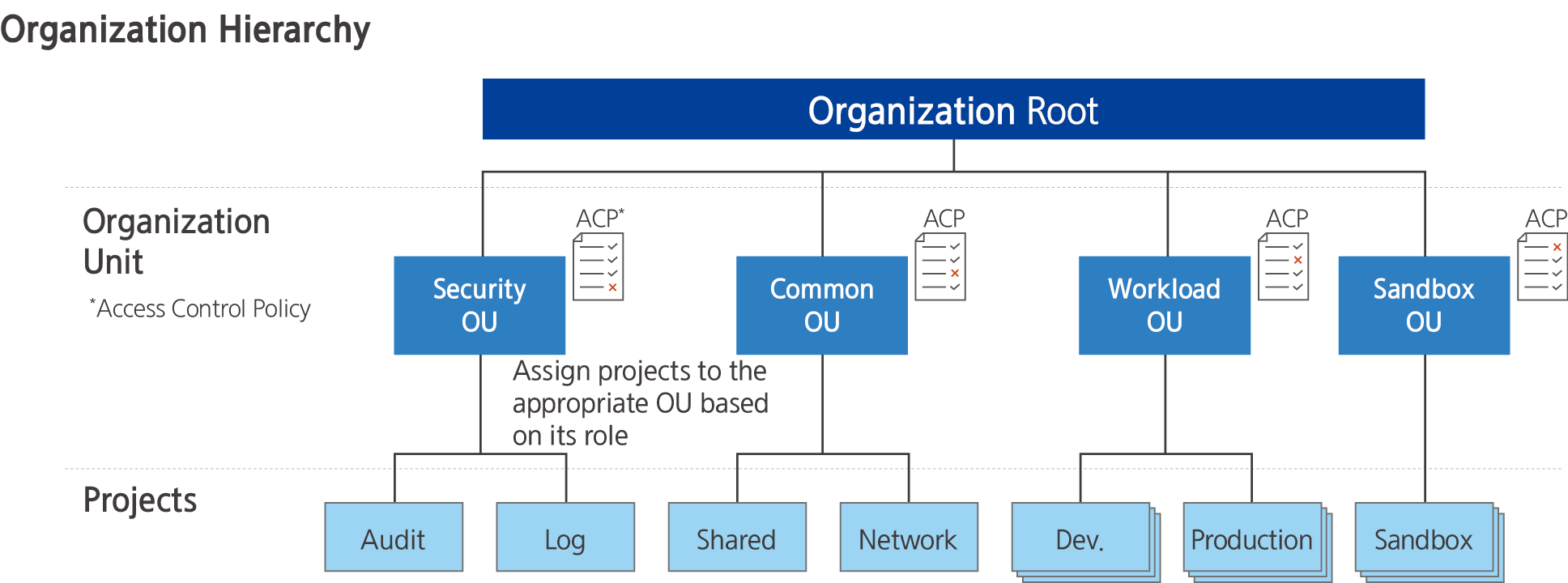
Provided features
Organization provides the following features.
- Account Management: You can create a new Account within the organization or invite an existing Account to manage.
- Organizational Unit Management: You can configure organizational units and manage them by creating subordinate organizational units or Accounts.
- Control Policy Management: Manage settings related to compliance as unified policies, and apply policies by organizational unit and by Account to proactively prevent or detect regulatory violations.
Preceding Service
Organization has no prior service.
8.2 - How-to guides
Users can enter the required information for an Organization and select detailed options to create a service through the Samsung Cloud Platform Console.
Create Organization
You can create an Organization in the Samsung Cloud Platform Console and use it. To create an Organization, follow these steps.
- Click the All Services > Management > Organization menu. Navigate to the Service Home page of Organization.
- On the Service Home page, click the Create Organization button. The Create Organization popup will open.
- Create Organization In the popup window, enter the Organization Name, then click the Create button.
- Write within 20 characters using Korean, English, numbers, spaces, and special characters (
+=,.@-_).
- Write within 20 characters using Korean, English, numbers, spaces, and special characters (
- When the popup notifying the creation of an Organization opens, click the Confirm button.
- Check the Organization’s dashboard on the Service Home page.
Category Detailed description Organization Information Display Management Account information - Click the Organization Information item to go to the Settings page where you can view detailed organization information
organizational unit Number of organizational units that make up the organization - Click the count to go to the Organization Structure page
Account Number of Accounts comprising the organization - Click the count to go to the Organization Structure page
- Click the Add item to go to the Add Account page
- For more details, see Add Account reference
Control Policy Number of control policies constituting the organization - Click the count to go to the Control Policy page
- Click the Add item to go to the Add Control Policy page
- For more details, refer to Create Control Policy
Table. Organization Service Home dashboard items
Organization Check detailed information
You can view detailed information of the Organization and manage permissions. To view detailed information of the Organization and manage permissions, follow these steps.
- Click the All Services > Management > Organization menu. Navigate to the Service Home page of Organization.
- On the Service Home page, click the Organization Settings menu. You will be taken to the Organization Settings page.
Category Detailed description Delete organization Delete organization button Organization name Organization name - Click the Edit button to modify
- Organization names distinguish between uppercase and lowercase English letters
Organization ID Organization ID constructor Name of the user who initially created the organization Creation date and time Organization creation date and time Editor Name of the user who last modified the organization information Modification date and time Last modified timestamp of organization information Management Account name Management Account name Management Account ID Management Account ID Management Account email Management Account email Control Policy Whether the control policy is enabled - Click the Edit button to change the status
- For more details, see Control Policy
Delegation of authority Organization Management Permission Delegation Information - Permission Delegation: Allows delegating permissions to accounts within the organization
- Displayed when no delegation information is available
- When the button is clicked, you can configure delegation at the Action level using the JSON Editor on the Permission Delegation page
- Permission Edit: Modify permission information
- Only the Management Account can be set
- When the button is clicked, you can configure delegation at the Action level using the JSON Editor on the Permission Delegation page
- Revoke Delegation: Delete delegated permission information
Table. Organization configuration items
guide
- If Control policy is disabled, the connection to the associated control policy is removed, and even authorized users cannot view the control policy.
- Permission Delegation information can only be managed in the Management Account.
Invite Account to Organization
You can manage the list of Accounts invited to the Organization.
Information
Only the Management Account can invite other Accounts.
Click the All Services > Management > Organization menu. Go to the Service Home page of Organization.
On the Service Home page, click the Invitation History menu. You will be taken to the Invitation History List page.
On the Invitation History List page, click the Account Invite button. Proceed to the Account Add page.
Category Detailed description email Account email Account name Account name Account ID Account ID Request date and time Account invitation date and time Completion Date and Time Invitation canceled, rejected, , expired, completion time Invitation status Invitation status Invitation canceled Cancel the invitation for the selected account - Enabled when selecting an account in the invitation list
- Multiple accounts can be canceled simultaneously
Account invitation Invite a new Account to the organization - When clicking the Account Invite button, navigate to the Add Account page
Table. Organization invitation list itemsOn the Add Account page, create and register a new Account, or add an existing Account.
- For detailed information about adding an Account, see Account 추가하기.
Join another Organization
If you are invited from another organization, you can review and approve the invitation information.
guide
Received invitations can be viewed in the Member Account.
- Click the All Services > Management > Organization menu. Navigate to the Service Home page of Organization.
- On the Service Home page, click the Received Invitations menu. You will be taken to the Received Invitations page.
Category Detailed description Invitation email Email information for organization invitation Organization name Organization name Organization ID Organization ID Management Account name Management Account name Management Account ID Management Account ID Management Account email Management Account email Invitation expiration date and time Invitation expiration date and time - Activated when selecting an account from the invitation list
- Multiple accounts can be canceled simultaneously
Invitation declined Decline invitation Accept invitation Accept the invitation and join the Organization Table. Organization Received Invitation Items
Reference
In the following cases, you cannot register even if you approve the invitation.
- When the number of accounts in the organization exceeds the limit.
- When the approval time is the expense settlement date (the 1st of each month, Asia/Seoul GMT +09:00)
- If the account has an outstanding balance.
Delete Organization
Information
You can delete the Organization after removing all Accounts belonging to it.
To delete the Organization, follow these steps.
- Click the All Services > Management > Organization menu. Go to the Service Home page of Organization.
- On the Service Home page, click the Organization Settings menu. You will be taken to the Organization Settings page.
- On the Organization Settings page, click the Delete Organization button. The Delete Organization popup window opens.
- Delete Organization in the popup, click the Confirm button.
8.2.1 - Organization Configuration Information
You can view the hierarchical structure of the Organization and verify and manage the organizational units and Accounts that are configured.
Check organization configuration information
You can view the configuration information of the Organization. Follow these steps to view the configuration information of the Organization.
- Click the All Services > Management > Organization menu. Navigate to the Service Home page of Organization.
- On the Service Home page, click the Organizational Structure menu. You will be taken to the Organizational Structure page.
- Select the view mode for the Organization unit and Account management area.
Category Detailed description View hierarchy Display organizational units in a hierarchical structure View Account List Display the list of Accounts within the organization Add Account Invite a new Account to the organization - When the Account Invite button is clicked, navigate to the Add Account page
- For more details, see Add Account
Table. Organization Organizational structure items
View hierarchy
On the Organization Configuration page, when you click the View Hierarchy button, you can view and manage the organizational units and Accounts that make up the Organization in a hierarchical structure.
| Category | Detailed description |
|---|---|
| Create a sub-organization unit | Add a new organizational unit under the selected organizational unit
|
| More > Delete organizational unit | Delete the selected organizational unit
|
| More > Move Account | Delete the selected organizational unit
|
| More > Exclude Account | Exclude the selected Account from the organization
|
| More > Delete Account | Delete the selected Account
|
| Organization unit/Account name | Display the names of organizational units and Accounts in a measurement structure format
|
| ID/Email | Organizational units display ID, and accounts display ID and email. |
| Creation/Join Date and Time | Organizational units display the creation date and time, while Accounts display the creation or registration date and time. |
Table. Organization hierarchy view items
View Account List
On the Organization Configuration page, clicking the View Account List button lets you view and manage the list of Accounts that compose the Organization.
| Category | Detailed description |
|---|---|
| Account Transfer | Move Account to another organization
|
| More > Exclude from organization | Exclude Account from organization
|
| Account name | Account name |
| Account ID | Account ID |
| Account user email | |
| Additional date/time | Account creation, addition timestamp |
| Additional type | Account addition method
|
Table. View Organization Account List Items
Manage Account
You can view and manage the list of Accounts that make up the Organization.
Add Account
You can create a new Account or add an existing Account to an Organization. To add an Account to an Organization, follow these steps.
Click the All Services > Management > Organization menu. Navigate to the Service Home page of Organization.
On the Service Home page, click the Organizational Structure menu. You will be taken to the Organizational Structure page.
On the Organization Structure page, click the Add Account button. You will be taken to the Add Account page.
On the Add Account page, enter the Account information to be added, then click the Complete button.
Category Required statusDetailed description Additional method Required Select the method to add an Account - Create New Account: Add by creating a new Account
- Invite Existing Account: Add by entering the Root user email of an already created Account
Account name Required Enter the Account name to create - using Korean, English, numbers, spaces, special characters(
+=-_@[](),.) within 3 to 30 characters
email Required Email to set as the Root user of the new Account - When clicking the Account Invite button, navigate to the Account Add page
Check email Required Reconfirm email information - When you click the Organization Info button, you are taken to the Settings page where you can view detailed organization information.
IAM role name Required Display organizational units in a hierarchical structure - English letters, numbers, special characters(
+=-_@,.) to input within 64 characters
Root user email Required Account’s Root user email - If Existing Account invitation is selected, only Root user email is entered
- Click the Add button to add up to 10 simultaneously
Table. Add Organization AccountWhen the popup notifying account creation and invitation opens, click the Confirm button.
Reference
- You can add up to 200 accounts.
- The newly created Account can be accessed by logging in directly with email or through an automatically generated role.
- When logging in directly with email, you must use the password recovery feature to reset your password.
Check Account Detailed Information
You can view and edit the detailed information of the Account. To view the detailed information of the Account, follow these steps.
- Click the All Services > Management > Organization menu. Navigate to the Service Home page of Organization.
- On the Service Home page, click the Organization Configuration menu. You will be taken to the Organization Configuration page.
- On the Organization Structure page, click the View Account List button.
- In the Account list, click the Account name of the Account whose details you want to view. You will be taken to the Account Details page.
- Account Details page consists of Basic Information tab and Control Policy tab.
Category Detailed description Exclude from organization Exclude the Account from the organization - When you click the button, a popup notifying the Account exclusion opens
- For more details, see Account Removal
Account Transfer Move the Account to another organizational unit - Click the button to go to the Account Move page
- For more information, see Account 이동하기
Basic Information Tab Display basic information about the Account Control Policy Display the control policies linked to the Account Table. Account detail page items
- Account Details page consists of Basic Information tab and Control Policy tab.
Detailed information
You can view detailed information of the organizational unit and edit the information if needed.
| Category | Detailed description |
|---|---|
| Account name | Account name |
| Account ID | Account ID |
| constructor | User who created the Account |
| Creation date and time | Date and time the account was created |
| Editor | User who modified the Account |
| Modification date and time | Date and time the account was modified |
| Account’s user email | |
| Additional type | Account addition method
|
| higher-level organization unit | Display the upper level of the current organizational unit in a hierarchical structure
|
Table. Account detailed information tab items
Control Policy
You can view the control policies linked to the Account and change their connection status.
| Category | Detailed description |
|---|---|
| Direct disconnect | Disconnect the selected control policy
|
| Control policy connection | Connect a new control policy
|
| Control Policy Name | Control Policy Name |
| type | Control Policy Types |
| Connection method | Control policy connection method
|
| Modification date and time | Last modified timestamp of the control policy |
Table. Account's Control Policy tab items
Move Account
You can move accounts between organizational units within an Organization.
Information
Accounts that are currently being worked on in Cloud Control cannot be moved.
Click the All Services > Management > Organization menu. Go to the Service Home page of Organization.
On the Service Home page, click the Organizational Structure menu. You will be taken to the Organizational Structure page.
On the Organization Structure page, click the View Account List button.
After selecting the Account to which you want to move the organization unit, click the Account Move button. You will be taken to the Account Move page.
On the Account Transfer page, select the organizational unit to which you want to move the Account, then click the Complete button.
Category Detailed description Select Account Enter the name of the organizational unit - Organizational names distinguish between uppercase and lowercase English letters
Organization unit to move Select the organizational unit to move the Account to Organizational unit name Name of the organizational unit Organization Unit ID Organization unit ID Organization creation date and time Creation date and time of the organizational unit Table. Organization: Create Organizational UnitWhen the popup notifying the Account transfer opens, review the transfer information, then click the Confirm button.
Reference
- The newly created Account can be accessed by logging in directly with email or through an automatically generated role.
- When logging in directly with email, you must use the password recovery feature to reset your password.
Exclude Account
You can exclude an Account from the Organization.
Information
In the following cases, the Account cannot be excluded.
- Account without a registered payment method
- When there is credit assigned to the account
- When the exclusion point is the cost settlement date (the 1st of each month, Asia/Seoul GMT +09:00)
- Click the All Services > Management > Organization menu. Go to the Service Home page of Organization.
- On the Service Home page, click the Organizational Structure menu. You will be taken to the Organizational Structure page.
- On the Organization Structure page, click the View Account List button.
- After selecting the Account to exclude from the Organization, click the More > Exclude Account button.
- When a popup notifying the account exclusion opens, click the Confirm button.
Delete Account
You can delete the account.
information
- When deleting from the Account list, you must select only one Account to delete.
- You cannot delete the Account in the following situations.
- If you want to delete on the expense settlement date (the 1st of each month)
- If there are resources in use
- When authority is delegated by the ID Center
- When credit is assigned to an account
- In the case of a Management Account or an account that was joined via invitation.
- If it is being registered in Cloud Control or already registered.
- Click the All Services > Management > Organization menu. Go to the Service Home page of Organization.
- On the Service Home page, click the Organization Configuration menu. You will be taken to the Organization Configuration page.
- On the Organization Structure page, click the View Account List button.
- From the Account list, select the Account to delete, then click the More > Delete Account button. The Delete Account popup window opens.
- After clicking the Account name of the Account to be deleted, you can also delete it by clicking the Account Details page’s Delete Account button.
- After entering the password for the Account to be deleted, click the Confirm button.
- After entering the Account name to delete, click the Confirm button.
Caution
If you enter the password incorrectly five or more times, you will be automatically logged out.
Reference
If you delete the Account, an Account deletion notification email will be sent to the next user.
- Administrator who created the Organization
- Root user of the created Account
- User who has delegation for the created Account
Manage Organizational Units
You can view and manage the organizational units and accounts that make up the Organization in a hierarchical structure.
Create an organization unit
You can create a new organizational unit. To create and add an organizational unit in Organization, follow these steps.
Click the All Services > Management > Organization menu. Go to the Service Home page of Organization.
On the Service Home page, click the Organization Configuration menu. You will be taken to the Organization Configuration page.
On the Organizational Structure page, click the View Hierarchy button.
After selecting the location in the hierarchical list where you want to add an organizational unit, click the Create Organizational Unit Under button. You will be taken to the Create Organizational Unit page.
- Root or you can select only one existing organizational unit.
- You can create organizational units up to five levels below Root.
On the Organization Unit Creation page, enter the information for the organization unit you want to add, then click the Create button.
Category Required statusDetailed description Organizational unit name Required Enter the name of the organizational unit - Organizational names distinguish between uppercase and lowercase English letters
description Select Enter a description of the organizational unit within 1,000 characters. Control policy connection Required Select a control policy to attach to the organizational unit - For details on creating a control policy, refer to Creating a Control Policy
Table. Organization: Create Organizational UnitWhen the popup notifying the creation of an organizational unit opens, click the Confirm button.
Reference
- You can add up to 200 accounts.
- The newly created Account can be accessed by logging in directly with email or through an automatically generated role.
- When logging in directly with email, you need to use the password recovery feature to reset your password.
View detailed information of an organizational unit
You can view and edit detailed information of an organizational unit. To view detailed information of an organizational unit, follow these steps.
- Click the All Services > Management > Organization menu. Navigate to the Service Home page of Organization.
- On the Service Home page, click the Organizational Structure menu. You will be taken to the Organizational Structure page.
- On the Organizational Structure page, click the View Hierarchy button.
- Click the Root/Account name of the organizational unit whose details you want to view in the hierarchical list. You will be taken to the Organizational Unit Details page.
- Organization Unit Detail page is composed of Basic Information tab, Sub Items tab, and Control Policy tab.
Category Detailed description Delete organization unit Button that deletes an organizational unit - When the button is clicked, a popup notifying the organization deletion opens
- For more details, see Delete Organizational Unit
Basic Information Tab Display basic information about the organization unit Sub-item Display sub-elements of an organizational unit Control Policy Display control policies attached to the organizational unit Table. Organization unit detail page items
- Organization Unit Detail page is composed of Basic Information tab, Sub Items tab, and Control Policy tab.
Detailed information
You can view detailed information of the organizational unit and edit the information if needed.
| Category | Detailed description |
|---|---|
| service | Service name |
| Resource Type | Service Type |
| SRN | Unique resource ID in Samsung Cloud Platform |
| Resource Name | Resource Name |
| Resource ID | Unique resource ID in the service |
| constructor | User who created the service |
| Creation date | Service creation timestamp |
| Editor | User who edited the service information |
| Modification date and time | Date and time the service information was modified |
| Organizational unit name | Organization unit name
|
| description | Description of the organizational unit
|
| higher-level organization unit | Display the upper level of the current organizational unit in a hierarchical structure
|
Table. Organization unit detailed information tab items
Reference
Root Details information page does not display Organization Unit Name, Description, Parent Organization Unit information.
Sub-item
You can view and manage the subordinate organization units and accounts of the current organization unit.
| Category | Detailed description |
|---|---|
| Create a sub-organization unit | Add a new organizational unit under the selected organizational unit
|
| More > Delete Organizational Unit | Delete selected organization unit
|
| Organization unit/Account name | Display the names of organizational units and Accounts in a measurement structure format
|
| ID/Email | Organizational units display ID, and Accounts display ID and email. |
| Creation/Join Date | Organization units display the creation timestamp, and accounts display the creation or sign‑up timestamp. |
Table. Organization Sub-item tab entries of the organization unit detail page
Control Policy
You can view the control policies attached to an organizational unit and change their connection status.
| Category | Detailed description |
|---|---|
| Direct disconnect | Disconnect the selected control policy
|
| Control policy connection | Connect a new control policy. Click the
|
| Control Policy Name | Control Policy Name |
| type | Control Policy Types |
| Connection method | Control policy connection method
|
| Modification date and time | Last modified date and time of the control policy |
Table. Organization Control Policy Tab Items on the Organization Unit Detail Page
Delete organization unit
You can delete an organizational unit in the Organization.
guide
To delete an organizational unit, it must have no subordinate elements.
- Click the All Services > Management > Organization menu. Navigate to the Service Home page of Organization.
- On the Service Home page, click the Organization Configuration menu. You will be taken to the Organization Configuration page.
- On the Organizational Structure page, click the View Hierarchy button.
- After selecting the organizational unit to delete from the hierarchical list, click the More > Delete Organizational Unit button.
- When the popup notifying the deletion of an organizational unit opens, click the Confirm button.
Connect control policy
You can attach control policies to an Organization’s organizational unit or Account. To attach a control policy, follow these steps.
Click the All Services > Management > Organization menu. Navigate to the Service Home page of Organization.
On the Service Home page, click the Organization Configuration menu. You will be taken to the Organization Configuration page.
On the Organization Structure page, click the View Hierarchy button.
Click the organizational unit or Account where you want to add the control policy from the hierarchical list. You will be taken to the detail page of that item.
- Root or you can select only one existing organizational unit.
- You can create organizational units up to five levels below Root.
On the detail page, click the Control Policy tab. You will be taken to the Control Policy Connection page.
After selecting the control policy to connect, click the Complete button.
Category Detailed description Linked control policy Enter the name of the organizational unit or the control policy linked to the current organizational unit or Account - Organizational names distinguish between uppercase and lowercase English letters
Control Policy Name Control Policy Name type Control Policy Types Modification date and time Control policy modification timestamp Control policy connection Required Table. Control policy linkage itemsWhen a popup notifying the connection of the control policy opens, click the Confirm button.
ReferenceTo create a new control policy, refer to Create Control Policy.
8.2.2 - Organization Control Policy
You can view and manage the Organization’s control policies.
Create Organization Control Policy
You can create control policies for the Organization.
To create a control policy, follow these steps.
Click the All Services > Management > Organization menu. Navigate to the Service Home page of Organization.
On the Service Home page, click the Control Policy menu. You will be taken to the Control Policy List page.
On the Control Policy List page, click the Create Control Policy button. You will be taken to the Create Control Policy page.
After entering items in the Basic Information area, click the Next button.
Category Required statusDetailed description Control Policy Name Required Enter the name of the control policy - English letters, numbers, special characters(
+=-_@,.) within 3 to 128 characters
Explanation Select Enter a description of the organizational unit within 1,000 characters. Table. Create organization control policy - set basic information- English letters, numbers, special characters(
In the Control Requirement Setting area, after selecting the control policy configuration method and the service to apply, click the Next button.
Category Required statusDetailed description Load control policy Select Enter the name of the control policy - When loading a policy, all previously entered content will be deleted
- For more details, see Load Policy
Basic mode/JSON mode Required Select the policy configuration method - Basic Mode: Configure using the mode provided by the Console
- JSON Mode: Configure directly using the JSON Editor
Service Required Select the service to set the control policy - Add Service: Add a service to configure the control policy
Table. Organization control policy creation - service configurationCautionIn the control policy settings, Basic Mode and JSON Mode are provided.
- After writing in Basic Mode and entering JSON Mode or navigating the screen, services with duplicate control requirements are merged into one, and services that have not completed configuration are deleted.
- If the content written in JSON mode does not conform to JSON format, you cannot switch to basic mode.
After setting the permissions, click the Next button.
Category RequiredDetailed description Control Type Required Select control policy type - Allow Policy: Control policy that allows the defined permissions
- Deny Policy: Control policy that denies the defined permissions
Action Required Select actions provided for each service - Actions that allow selection of individual resources are shown in purple
- Actions that target all resources are shown in black
- Add Action Directly: Use the wildcard
*to specify multiple actions at once
Applied resource Required Resources to which the action applies - All resources: Apply to all resources for the selected action
- Individual resources: Apply only to the specified resources for the selected action
- Individual resources are only available when selecting the purple action that allows individual resource selection
- Click the Add resource button to specify target resources by resource type
- For more details on Add resource, see Register individual resources as applicable resources
Authentication Type Required Authentication method of the user target to which the control policy will be applied - All authentication: Applies regardless of authentication method
- Authentication key authentication: Applies to users with authentication key authentication
- Temporary key authentication, Console login: Applies to users with temporary key authentication or Console login
Applied IP Required IP that allows the application of control policies - Custom IP: User registers and manages the IP directly
- Applied IP: User can directly register the IP address or range that the control policy applies to
- Excluded IP: IP addresses or ranges that can be registered as exclusions from the Applied IP
- All IPs: No IP access restriction
- Access is allowed for all IPs, but if exceptions are needed, register Excluded IP to restrict access for the registered IPs
Additional condition Select Add conditions for attribute-based access control (ABAC) - Condition Key: Select from Global condition keys and service condition keys list
- Qualifier: Default value, arbitrary value in the request, all values in the request
- Operator: Bool, Null
- Value: True, False
Table. Create organization control policy - set permissionsOn the Check Input Information page, after confirming the entered information, click the Create button.
When the popup notifying the creation of a control policy opens, click the Confirm button. You will be taken to the Integrated Policy List page.
Load control policy
When creating a control policy, you can generate it by modifying the policy requirements of an existing policy.
Reference
When you run Load Policy, all previously entered content will be deleted and replaced with the selected policy’s settings.
To load an existing policy and create a control policy, follow these steps.
Click the All Services > Management > Organization menu. Navigate to the Service Home page of Organization.
On the Service Home page, click the Control Policy menu. You will be taken to the Control Policy List page.
On the Control Policy List page, click the Create Control Policy button. You will be taken to the Create Control Policy page.
After entering items in the Basic Information area, click the Next button.
Category Required statusDetailed description Control Policy Name Required Enter the control policy name - English letters, numbers, and special characters (
+=-_@,.) within 3 to 128 characters
description Select Enter a description of the organizational unit within 1,000 characters. Table. Create organization control policy - set basic information- English letters, numbers, and special characters (
In the Control Requirement Setting area, click the Load Control Policy button. The Load Control Policy popup window opens.
Click the Load Policy button. The Load Control Policy popup opens.
After selecting the control policy to load from the control policy list, click the Confirm button. The loaded policy’s settings will be entered automatically.
After editing the information that needs to be changed, click the Next button.
Check Input Information page, verify the entered information and click the Complete button. You will be taken to the Integrated Policy List page.
Register individual resources as applied resources
Permission Settings allows you to register individual resources as applied resources. To register individual resources as applied resources, follow the steps below.
Click the All Services > Management > Organization menu. Navigate to the Service Home page of Organization.
On the Service Home page, click the Control Policy menu. You will be taken to the Control Policy List page.
On the Control Policy List page, click the Create Control Policy button. You will be taken to the Create Control Policy page.
After entering items in the Basic Information area, click the Next button.
Category Required statusDetailed description Control Policy Name Required Enter the control policy name - using English letters, numbers, special characters (
+=-_@,.) within 3~128 characters
description Selection Enter a description of the organizational unit within 1,000 characters. Table. Create organization control policy - set basic information- using English letters, numbers, special characters (
In the Control Requirement Setting area, after selecting the service to which the control policy will be applied, click the Next button.
Click the Load Policy button. The Load Control Policy popup opens.
After selecting the control policy to load from the control policy list, click the Confirm button. The loaded policy’s settings will be entered automatically.
After editing the information that needs to be changed, click the Next button.
On the Check Input Information page, verify the entered information and click the Complete button. You will be taken to the Integrated Policy List page.
Select an Action that allows selecting individual resources in the Action selection.
- Actions that allow individual resource selection are displayed in purple.
Click Individual Resource in Applied Resource.
Click the Add Resource button. The Add Resource popup window opens.
Category Whether requiredDetailed description Self type Required Select the resource type to add SRN - Unique resource ID in Samsung Cloud Platform - Automatically updated according to the input fields below
Account Required Account ID Settings - Current Account: Current Account ID is auto-filled and cannot be edited
- All Accounts: Add to all Accounts (not recommended)
- Manual Input: Manually enter the Account ID using lowercase English letters and numbers, up to 100 characters (wildcard input not allowed)
Region Select Enter the resource’s region information directly within 100 characters - Select All When checked, add resources from all regions
Resource ID Required Enter the resource ID to add directly, up to 100 characters - Select All when checked adds all resources of that resource type
Table. Create organization control policy - set basic informationAfter the settings are completed, click the Next button. You will be taken to the Check Input Information page.
After reviewing the entered information, click the Complete button. You will be taken to the Integrated Policy List page.
Check detailed information of control policy
On the Control Policy Details page, you can view and edit the detailed information of the control policy. To view detailed information of the control log, follow the steps below.
- All Services > Management > Organization Click the menu. Go to the Service Home page of Organization.
- On the Service Home page, click the Control Policy menu. You will be taken to the Control Policy List page.
- Control Policy List page, click the control policy you want to view detailed information for. You will be taken to the Control Policy Details page.
- The Policy Details page displays basic information and consists of the Basic Information tab, the Control Requirements tab, and the Connected Targets tab.
Basic Information
You can view the basic information of the control policy and, if necessary, edit the policy name and description.
| Category | Detailed description |
|---|---|
| service | Service name |
| Resource Type | Resource Type |
| SRN | Unique resource ID in Samsung Cloud Platform |
| Resource name | Resource Name
|
| Resource ID | Unique Resource ID |
| constructor | User who created the service |
| Creation date and time | Service creation date and time |
| Editor | User who edited the service information |
| Modification date and time | Date and time the service information was modified |
| Control Policy Name | Name of the control policy
|
| type | Types of control policies
|
| Explanation | Description of the control policy
|
Table. Basic Information Tab Items of Control Policy
Control Requirements
You can view the services with permissions configured in the current control policy.
- You can check in Basic mode and JSON mode.
- Click the arrow to the right of the service name to display the control requirements set for that service.
Reference
Click the Edit button to modify the control requirements. For detailed information about the edit items, please refer to Create Control Policy.
| Category | Detailed description |
|---|---|
| Control Type | Control Policy Types
|
| action | Features provided by each service that are subject to the control policy |
| Applied resource | Resources to which the action applies
|
| Authentication type | Authentication method for the user target to which the control policy will be applied
|
| Applied IP | IP that permits the application of control policies
|
Table. Control policy control requirements tab items
Connection target
You can view the organizational units and accounts directly linked to the control policy.
Reference
Policies attached to the root and organizational units are inherited by child items.
| Category | Detailed description |
|---|---|
| Root | The connection status of the Root and the number of control policies attached to the Root are displayed
|
| organizational unit | The organizational units currently linked to the control policy and the total number of control policies linked to those units
|
| Account | The Account currently linked to the control policy and the total number of control policies linked to that Account
|
Table. Policy's linked target tab items
Connect organization unit
You can associate an organizational unit with a control policy. To connect an organizational unit, follow the steps below.
Click the All Services > Management > Organization menu. Go to the Service Home page of Organization.
On the Service Home page, click the Control Policy menu. You will be taken to the Control Policy List page.
On the Control Policy List page, click the control policy to link the organizational unit. You will be taken to the Control Policy Details page.
On the Control Policy Details page, click the Connection Target tab.
Click the Organization Unit Connection button in the Organization Unit area. You will be taken to the Organization Unit Connection page.
After selecting the organization unit to connect, click the Complete button.
Category Detailed description Organization unit/Account name Display the names of organizational units and Accounts in a measurement structure format - Click the +, - button to expand or collapse the hierarchy
ID/Email Organizational units display ID, and accounts display ID and email. Creation date and time The creation date and time of the organizational unit is the creation timestamp, and for Account it displays the creation or registration timestamp. Table. Organization Unit Connection ItemsWhen the popup notifying the organization unit connection opens, click the Confirm button.
Connect Account
You can link an Account to a control policy. To connect the Account, follow these steps.
Click the All Services > Management > Organization menu. Go to the Service Home page of Organization.
On the Service Home page, click the Control Policy menu. You will be taken to the Control Policy List page.
On the Control Policy List page, click the control policy to link the Account. You will be taken to the Control Policy Details page.
On the Control Policy Details page, click the Connection Target tab.
Click the Account Connect button in the Account area. You will be taken to the Account Connect page.
After selecting the Account to connect, click the Done button.
Category Detailed description Organization unit/Account name Display the names of organizational units and Accounts in a measurement structure format - Click the +, - buttons to expand or collapse the hierarchy
ID/Email Organizational units display ID, and Accounts display ID and email. Creation date and time The creation date and time of the organizational unit is the creation date and time, and Account displays the creation or registration date and time. Table. Account linking itemsWhen a popup notifying the Account connection opens, click the Confirm button.
Delete control policy
You can delete the control policy.
Information
To delete a control policy, there must be no elements linked to the control policy.
- Click the All Services > Management > Organization menu. Navigate to the Service Home page of Organization.
- On the Service Home page, click the Control Policy menu. You will be taken to the Control Policy List page.
- On the Control Policy List page, click the control policy you want to delete. You will be taken to the Control Policy Details page.
- Click the Delete Control Policy button on the Control Policy Details page.
- When the popup informing you that the control policy will be deleted opens, click the Confirm button.
8.3 - API Reference
API Reference
8.4 - CLI Reference
CLI Reference
8.5 - Release Note
Organization
2025.10.23
FEATURE
Account deletion feature improvement- You can also delete an Account created in the Organization from the Member Account.
- Deletable Accounts are limited to those directly created in the Organization.
2025.07.01
NEW
Official launch of Organization service- The Organization service has been officially launched.
- You can organize accounts by organizational units, manage them hierarchically, and control resource access permissions.
- You can monitor the resource usage of all accounts within the organization to optimize costs.
9 - Resource Explorer
9.1 - Overview
Service Overview
Resource Explorer is a service that provides search for resources (assets) created on the Samsung Cloud Platform.
Features and Benefits
Resource Explorer provides the following features.
- Resource Search: You can search for resources across multiple regions and accounts using resource names, service names, resource types, etc.
- Multi-Region Search: You can find resources across multiple regions with a single search.
- Multiple Account Search: You can search resources across all accounts within Organizations. (Scheduled for release after July 2025)
- Integrated Search: You can search resources using the integrated search feature. (Planned for release after July 2025)
- Filtering feature: You can filter search results using resource name, region, tags, etc.
- Tag addition feature: You can add tags to multiple resources in bulk.
9.2 - How-to Guides
Users can use the Samsung Cloud Platform Console to perform integrated searches of resources for the account and region through the Resource Explorer service, add tags, and navigate to resource details.
Search resources with Resource Explorer
You can search for resources through the Resource Explorer in the Samsung Cloud Platform Console.
To search using Resource Explorer, follow these steps.
- All Services > Management > Resource Explorer Click the menu. Go to the Resource Explorer List page.
- On the Resource Explorer page, you can search for resources in various ways.
Category Detailed description Input box Enter text in the input box to select from the search results - Resource Name: Resource name
- Service Name: Service name of the resource
- Resource Type: Type of the resource
Advanced Search Advanced Search When the button is clicked, additional searchable items - Resource Name: resource name
- Service Name: service name (multiple selection possible, searchable)
- Resource Type: resource type (multiple selection, searchable)
- Region (multiple selection, searchable)
Table. Resource Explorer resource search
Add tags with Resource Explorer
You can add tags through Resource Explorer in the Samsung Cloud Platform Console.
To add tags using Resource Explorer, follow these steps.
Reference
If you select a resource that already has 50 or more tags, the add tag button is disabled.
- Click the All Services > Management > Resource Explorer menu. Go to the Resource Explorer List page.
- Resource Explorer List page: when you select a resource’s checkbox, the Add Tag button at the top of the list becomes active.
- Click the Add Tag button. You will be taken to the Add Tag page.
- After entering key and value, click the Done button to add the tag.
- Click the Add Tag button to add multiple tags.
guide
- You can add tags by selecting a key and value from the list or by entering them manually.
- The list icon within the input field is enabled when a selectable list is available, and the value list varies according to the key value.
- Tags can be added up to a maximum of 50 per selected resource.
- If a tag with the same key is already applied, it will be replaced with the value of the newly added tag.
Navigate to resource details with Resource Explorer
In the Samsung Cloud Platform Console, you can navigate to the resource detail page via the Resource Explorer screen and view the resource’s detailed information.
To navigate to the resource detail page via Resource Explorer, follow these steps.
- All Services > Management > Resource Explorer Click the menu. Navigate to the Resource Explorer List page.
- On the Resource Explorer List page, clicking a resource name takes you to that resource’s detail screen.
- Detailed screens are not provided for some resource types.
9.3 - Release Note
Resource Explorer
2025.02.27
NEW
Resource Explorer release- We have launched a search service for resources.
- You can view resources from multiple regions at once using Resource Explorer.
10 - Resource Groups
10.1 - Overview
Service Overview
Resource groups is a service that groups resources for management.
Provided features
Resource groups provide the following capabilities.
- Resource Grouping: You can logically group resources based on tags.
- Tag-based query: You can search and group resources using tags.
- Resource Search: You can search for resources that match the specified query.
10.2 - How-to Guides
You can create a resource group and configure it so that resources meeting the criteria are grouped together and displayed.
Create Resource Group
You can create and use the Resource Group service in the Samsung Cloud Platform Console.
To create a Resource Group, follow these steps.
Click the All Services > Management > Resource Group menu. Navigate to the Resource Group List page.
On the Resource Group List page, click the Create Resource Group button. You will be taken to the Create Resource Group page.
On the Create Resource Group page, enter the information required to create the service and select detailed options.
- Select the required information in the Service Information Input area.
Category Required statusDetailed description Resource Group name Required Enter group name Explanation Enter description Resource Type Required Multi-select from the full list or resource type list Group definition tag Required Set the grouping criteria tag - Key
- Value
Group target resource Use the resource preview button to verify and select the target resource for the tool. Table. Resource Group resource creation input information - In the Additional Information Input area, enter or select the required information.
Category Whether requiredDetailed description Lock Select Set Lock usage - Enabling Lock prevents actions such as server termination, start, and stop from being executed, preventing errors caused by mistakes.
Init script Select Script executed when the server starts - The init script must be written as a Batch script for Windows, a Shell script for Linux, or cloud‑init, depending on the image type.
- Up to 45,000 bytes can be entered.
tag Select Add Tag - Up to 50 can be added per resource
- After clicking the Add Tag button, enter or select Key and Value
Table. Resource Group additional information input fields
- Select the required information in the Service Information Input area.
Check the input information and click the Complete button.
- When creation is complete, check the created resources on the Resource Group List page.
View detailed information of Resource Group
The Resource Group service allows you to view and edit the list of resource groups and their details. Resource Group Details page consists of Basic Information, Group Resources, and Tags tabs.
To view detailed information about the Resource Group service, follow these steps.
- Click the All Services > Management > Resource Group menu. You will be taken to the Resource Group List page.
- On the Resource Group List page, click the resource you want to view details for. You will be taken to the Resource Group Details page.
- The Resource Group Details page displays status information and additional feature information, and consists of Basic Information, Group Resources, Tags tabs.
Basic Information
On the Resource Group List page, you can view detailed information of the selected resource and edit the information if needed.
| Category | Detailed description |
|---|---|
| Service | Service name |
| Resource Type | Resource Type |
| SRN | Unique resource ID in Samsung Cloud Platform |
| Resource name | Resource name |
| Resource ID | Unique resource ID in the service |
| constructor | Name of the constructor |
| Creation date and time | Created date and time |
| Editor | Editor’s name |
| Modification date and time | Modified date and time |
| Resource Group name | User-entered name |
| Explanation | User-written description |
Table. Resource Group Basic Information Tab Items
Group resources
On the Resource Group List page, you can view and modify the group resources of the selected resource.
| Category | Detailed description |
|---|---|
| Group Resources > Resource Type | Group resource type |
| Group Resources > Group Definition Tag | Tag added when creating a resource group |
| Group target resource | List of resources grouped by group definition tags
|
Table. Resource Group group resource tab items
tag
Resource Group List page lets you view the tag information of the selected resource, and you can add, modify, or delete it.
| Category | Detailed description |
|---|---|
| Tag list | Tag list
|
Table. Resource Group tag tab items
Managing Resource Group
Modify basic information of Resource Group
You can edit the description of a Resource Group. To edit the description of a Resource Group, follow these steps.
- Click the All Services > Management > Resource Group menu. You will be taken to the Resource Group list page.
- On the Resource Group list page, click the Resource Group name of the resource you want to edit. You will be taken to the Resource Group Details page.
- Click the Edit button for the description to the right of the Resource Group name. You will be taken to the Edit Description popup. After editing the description, click the Confirm button. On the Resource Group Details page, verify the updated description.
Modify Resource Group resources
You can modify the group resources of a Resource Group. To modify the group resources of a Resource Group, follow the steps below.
- Click the All Services > Management > Resource Group menu. You will be taken to the Resource Group list page.
- On the Resource Group list page, click the Resource Group name of the resource you want to edit. You will be taken to the Resource Group Details page. Click the Group Resources tab. You will be taken to the Group Resources tab.
- Click the Edit Resource Group button. You will be taken to the Edit Resource Group page.
- After modifying the information of resource type and group definition tag, click Save.
Category RequiredDetailed description Resource Type Required Multi-select from the full list or resource type list Group definition tag Required Set the grouping criteria tag - Key
- Value
Group target resource Use the resource preview button to verify and select the target resource for the tool. Table. Resource Group resource modification input information
- After modifying the information of resource type and group definition tag, click Save.
- On the Resource Group Details page, check the updated information.
Delete Resource Group
You can delete unused Resource Groups. However, once a Resource Group is deleted, it cannot be recovered.
To delete a Resource Group, follow these steps.
- All Services > Management > Resource Group Click the menu. You will be taken to the Resource Group List page.
- On the Resource Group List page, click the resource you want to delete. You will be taken to the Resource Group Details page.
- On the Resource Group Details page, click the Resource Group Delete button. Verify the message in the Notification popup and click the Confirm button.
- On the Resource Group List page, select multiple Resource Group check boxes, and click the Delete button at the top of the resource list.
10.3 - Release Note
Resource Groups
2025.02.27
NEW
Resource Groups release- We have launched a service that efficiently manages resources through grouping.
- You can logically group and manage resources based on tags.
11 - ServiceWatch
11.1 - Overview
Service Overview
ServiceWatch is a service that provides various tools to collect metrics, logs, events, and other data from resources created on the Samsung Cloud Platform for monitoring, offering observability of resources overall, including performance and operational status.
Features
We provide the following special features.
- Resource Monitoring: Collects and visualizes performance metrics of resources (CPU Usage, etc.). Also creates a dashboard that allows visual inspection of multiple metrics in one place for quick overview.
- Alert Policy Configuration and Automatic Notification: You can create alert policies by setting predefined conditions and thresholds, and when a threshold is exceeded, you receive notifications, allowing you to quickly check and respond to resource status.
- Log Analysis and Storage: Collect logs generated from resources for easy viewing and searching. Collected logs are stored in log groups for management, and log groups can be stored for free up to 5GB. Additionally, you can set a log retention policy to specify the retention period, and logs that exceed the retention period do not require separate management.
- Cost Efficiency: ServiceWatch offers a flexible pay-as-you-go pricing model, allowing cost‑effective usage. It also provides a free usage tier, so you can try it for free and then scale to a paid plan as needed.
Provided features
We provide the following features.
- Metric Monitoring
- Metrics: ServiceWatch receives metric data from services of the Samsung Cloud Platform, and ServiceWatch collects and stores the metric data to provide it to users.
- Dashboard: Visualizes metrics of a single region to provide an integrated view of resources. In ServiceWatch, dashboards are divided into automatically generated service dashboards for each service and user-created custom dashboards.
- Alert: Provides an alert feature that allows monitoring of metric changes based on user-defined thresholds and sends notifications when thresholds are exceeded.
- Log Monitoring
- ServiceWatch provides log management capabilities. Logs collected from Samsung Cloud Platform services are stored in log groups for management. You can set log retention policies to manage the retention period. Additionally, you can view and search log data through the console, and it offers the ability to store log groups in Object Storage.
- ServiceWatch Agent
- Through the ServiceWatch Agent, you can collect detailed metrics on processes, CPU, memory, disk usage, and network performance from Virtual Servers, GPU Servers, Bare Metal Servers, and other resources. GPU performance metrics can also be collected. Additionally, the Agent can collect logs generated by the resources. (Planned for December 2025)
- Event Monitoring
- ServiceWatch can create event rules from system events about changes to resources created in the Samsung Cloud Platform, allowing you to receive notifications under specific conditions.
Component
Metric
Metrics refer to system performance data. By default, we provide basic monitoring based on free metrics for resources of services integrated with ServiceWatch. Additionally, services such as Virtual Server can enable detailed monitoring to provide paid metrics.
Indicator data can be viewed for up to 15 months (455 days).
For detailed information related to metrics, please refer to Metrics.
log
You can collect, store, and view logs of systems, applications, and services used in Samsung Cloud Platform services such as Virtual Server resources and Kubernetes Engine.
For detailed information related to logs, refer to 로그.
event
An event represents a change in the environment in the Samsung Cloud Platform service. Below are examples of events.
- Generates an event when the status of a Virtual Server changes from Stopped to Running.
- Generates an event when a new bucket is created in Object Storage.
- An event is generated when an IAM user is removed from a user group.
For detailed information about events, refer to the Events.
Dashboard
ServiceWatch provides a pre-built service dashboard for each service automatically, and users can also create dashboards manually.
information
Pre-built dashboards for each service will be available starting March 2026.
ServiceWatch Agent
The ServiceWatch Agent is a software component that collects metrics and logs from Virtual Servers, GPU Servers, and on‑premises servers, among others. This enables monitoring of infrastructure and applications with greater granularity than the default monitoring provided out of the box.
Reference
Collecting custom metrics/logs via the ServiceWatch Agent is currently available only on Samsung Cloud Platform For Enterprise. It will be offered in other offerings in the future.
- For more details about the ServiceWatch Agent, see Custom Metrics and Logs.
Constraints
The limitations of ServiceWatch are as follows.
| Category | Explanation |
|---|---|
| Metric query period | Metric queries can be set up to a maximum of 455 days from the time of query
|
| Number of metric queries | You can select up to 500 indicators and view them in a graph. |
| Download indicator image file | Image download available for metric data of up to 100 metrics |
| Export Metrics to Object Storage | Up to 10 metrics, and exporting to Obect Storage is possible for metric data with a maximum query period of up to 2 months (63 days). |
| Number of widgets/metrics per dashboard |
|
| Number of alert policies | Account/per region 5,000 or fewer |
| Alarm History | Alert history is available for 30 days |
| Number of notification recipients per alert policy | 100 or fewer |
| Number of log groups | Account/10,000 or fewer per region |
| Log download | Excel download: up to 1 MB per log event, with a maximum of 10,000 log events can be downloaded
|
| Number of log group export tasks |
|
| Log event size | 1 MB or less |
| Number of event rules | Account/No more than 300 per region |
| Event pattern size | 2 MB or less |
| Number of notification recipients per event rule | 100 or fewer |
Table. ServiceWatch constraints
The following is ServiceWatch’s monthly free offering details.
| Category | Free offering |
|---|---|
| log | Up to 5 GB of storage per month |
| indicator |
|
| Dashboard | For dashboards referencing 50 or fewer metrics, up to 3 per month
|
| Alert Policy | 10 per month |
Table. ServiceWatch free offering scope
Provision status by region
ServiceWatch is available in the following environments.
| Region | Whether provided |
|---|---|
| Korea West (kr-west1) | Provide |
| Korea East (kr-east1) | Provide |
| South Korea 1 (kr-south1) | Provide |
| South Korea South 2 (kr-south2) | Provide |
| South Korea 3(kr-south3) | Provide |
Table. ServiceWatch regional availability status
Preliminary Service
There are no prerequisite services for ServiceWatch.
11.1.1 - Indicator
metric
Metrics are data about system performance. By default, many services provide free metrics for resources (e.g., Virtual Server, File Storage, etc.), and these are offered as basic monitoring through ServiceWatch. Detailed monitoring can be used for certain resources such as Virtual Server.
Indicator data is retained for 15 months (455 days), allowing you to view both the latest and historical data.
| term | Example | Explanation | |
|---|---|---|---|
| namespace | Virtual Server | Logical distinction for separating and grouping metrics
| |
| Metric(metric) | CPU usage | the name of the specific data you want to collect
| |
| Dimension (Dimensions) | resource_id | Unique identifier for the metric
| |
| Collection interval | 5 minutes | The collection period of metric data from each service that provides metrics
| |
| Statistics | average | How to aggregate metric data over a specified period
| |
| unit | % | Statistical measurement unit
| |
| Aggregation period | 5 minutes | The period that aggregates the collected metric data
| |
| Alert | CPU usage >= 80% | Occurs for 5 minutes | If CPU usage remains above 80% for 5 minutes, change to Alert state. |
Table. ServiceWatch metric terms
Namespace
A namespace is a logical separation used to distinguish and group ServiceWatch metrics. The namespace of Samsung Cloud Platform services is generally the same as the service name, and can be found in the ServiceWatch 연계 서비스 목록.
For custom metrics, users can define a namespace in ServiceWatch to distinguish them from other metrics, and it can be defined via the ServiceWatch Agent settings or through the OpenAPI. For detailed information on custom metrics and logs, you can find it at 사용자 정의 지표 및 로그.
Metric (Metric)
The metric represents a set of data points sorted chronologically as collected by ServiceWatch. A data point consists of a timestamp, the collected data, and the unit of the data.
For example, the CPU utilization of a specific Virtual Server is one of the basic monitoring metrics provided by Virtual Server. Data points themselves can arise from any application or activity that collects data.
By default, the Samsung Cloud Platform service integrated with ServiceWatch provides resource metrics for free. Detailed monitoring for certain resources is offered as a paid service and can be enabled in each service.
Metrics can only be accessed in the region where they were created. Indicators cannot be deleted arbitrarily by the user. However, if new data is not posted to ServiceWatch, it will automatically expire after 15 months. Data points older than 15 months (455 days) expire sequentially, and when new data points are added, data older than 15 months (455 days) are deleted.
Timestamp
The timestamp of a data point is the time information indicating when the data point was recorded. Each metric data point consists of a timestamp and data.
A timestamp consists of hours, minutes, seconds, and a date.
-->Metric retention period
Maintain ServiceWatch metric data as follows.
- Data points with a collection interval set to 60 seconds (1 minute) are available for up to 15 days.
- Data points with a collection interval of 300 seconds (5 minutes) are available for up to 63 days.
- Data points with a collection interval set to 3600 seconds (1 hour) are usable for up to 455 days (15 months).
Data points initially collected at short intervals are downsampled and stored for long-term retention.
For example, if data is collected at a 1‑minute interval, it is retained for 15 days at 1‑minute granularity. Even after 15 days have passed, this data remains, but it can only be queried in 5‑minute intervals. After 63 days, this data is re‑aggregated and provided on an hourly basis. If you need to retain metric data points longer than the metric retention period, you can store them separately using the File Download or Export to Object Storage feature.
Dimension(Dimensions)
A key-value pair that serves as a unique identifier for a metric, allowing you to classify and filter data points.
For example, you can identify metrics for a specific server by using the resource_id dimension of the Virtual Server’s metrics.
Collection period
It refers to the interval for collecting data points for each service’s metrics, and is provided according to the collection interval predefined by each service.
Refer to each service’s ServiceWatch metrics page for the metric collection interval of each service.
Reference
Please refer to the 지표와 로그 모니터링 for the metric page of the ServiceWatch integrated service.
For example, Virtual Server provides a collection interval of 5 minutes during basic monitoring, and provides a 1‑minute interval when detailed monitoring is enabled.
Statistics
Statistics is a method of aggregating metric data over a specified period. ServiceWatch provides data aggregated as statistics based on metric data points supplied to ServiceWatch from each service. Aggregation is performed using the namespace, metric name, dimensions, and data point units within the specified aggregation period.
The provided statistics are sum, average, minimum, maximum.
- Total: sum of all data point values collected during the period
- Average: During the specified period, (sum of all data pointer values during that period) / (number of data pointers during that period) value
- Minimum: the lowest value observed during the specified period
- Maximum: the highest value observed during the specified period
unit
Each statistic has a measurement unit. Examples of units include Bytes, Second, Count, Percent, etc.
aggregation period
Each statistic calculates the data pointer of the metric collected during the selected aggregation period. The aggregation period can be selected from 1 minute, 5 minutes, 15 minutes, 30 minutes, 1 hour, 3 hours, 6 hours, 12 hours, or 1 day, and the default is 5 minutes. The aggregation period is closely related to the collection interval of metric data points, and to obtain valid aggregation results, the aggregation period must be equal to or longer than the collection interval.
For example, if you select average, choose 5 minutes for the aggregation period, and select a metric with a 1‑minute collection interval, data points are collected at 1‑minute intervals, and the average is calculated over the data points collected during the 5‑minute period. Conversely, if the aggregation period is shorter than the collection interval, it means that a normal aggregation result cannot be obtained.
Downsampling is applied for long-term storage of indicator data. For example, if data is collected at a 1‑minute interval, after 15 days the data can only be queried in 5‑minute increments. If you set the aggregation period for such metrics from 5 minutes to 30 minutes, it may take up to 5 minutes to retrieve the downsampled data correctly. After 63 days have passed, this data will be aggregated again and provided on an hourly basis. If you select an aggregation period from 1 hour to 1 day, it may take up to one hour to retrieve the data correctly. This can cause aggregation delays because aggregating metric data requires downsampling, which takes time.
Reference
When querying metric data, the most recent data point may not be displayed due to aggregation delay. In this case, reduce the aggregation period to be smaller than the configured value, or query after a certain time (5 minutes or 1 hour) to view it correctly.
| Aggregation period | Aggregation delay |
|---|---|
| 1 minute | - |
| 5 minutes | Up to 5 minutes |
| 15 minutes | Up to 5 minutes |
| 30 minutes | Up to 5 minutes |
| 1 hour | Up to 1 hour |
| 3 hours | Up to 1 hour |
| 6 hours | Up to 1 hour |
| 12 hours | Up to 1 hour |
| 1 day | Up to 1 hour |
Table. Aggregation delay by ServiceWatch aggregation period
Alert
When creating an alarm policy, you evaluate a single metric over the specified assessment range, and if it meets the condition set based on the threshold, you can provide the user with an alarm notification.
The alarm status is categorized as Alert(Alert), Normal(Normal), Insufficient data(No data).
- Alert(Alert): When the indicator meets the configured condition
- Normal(Normal): when the indicator does not meet the configured conditions
- Insufficient data(No data): when the metric data does not exist, is missing, or has not yet arrived
When the alarm status is Alert, after evaluating the alarm, if it deviates from the condition, the alarm status changes back to Normal.
For detailed information about alerts, refer to the 경보 entry.
Basic monitoring and detailed monitoring
ServiceWatch provides two types of monitoring: basic monitoring and detailed monitoring.
The Samsung Cloud Platform service integrated with ServiceWatch provides basic monitoring by publishing a default set of metrics to ServiceWatch for free. By default, if you use even one of the services, basic monitoring is automatically enabled and can be viewed in ServiceWatch.
Reference
The services that provide basic monitoring are available in the ServiceWatch 연계 서비스 목록 and will be gradually expanded.
Detailed monitoring is available only for certain services and incurs a fee. To use detailed monitoring, you must enable it in the service details.
Detailed monitoring options vary depending on the service provided.
- The default monitoring for Virtual Server has a collection interval of 5 minutes. * When detailed monitoring is enabled, metrics provided by basic monitoring are collected at a 5 minute → 1 minute interval.
- Basic monitoring of Object Storage is provided for default metrics, and enabling replication metrics provides additional replication metrics.
The following includes services and guides that provide detailed monitoring.
| service | Guide |
|---|---|
| Virtual Server/GPU Server | Virtual Server Enable Detailed Monitoring |
| Object Storage | Activating Object Storage Replication Metrics |
Table. ServiceWatch detailed monitoring service
11.1.2 - Alert
Alert
You can create alerts that monitor metrics and send notifications. For example, you monitor the CPU usage and disk read/write of a Virtual Server, then send a notification to the user to handle the increased load.
Alert Policy
The alert policy can monitor metrics of the same Account and evaluate alerts for a single metric. This alert policy compares the specified threshold with metric conditions and sends a notification when the conditions are met.
If you disable the alert policy, its evaluation continues, but you can restrict sending alerts to the designated recipients. If you want to temporarily stop sending alerts for resources with an alarm policy configured, you can use alarm policy deactivation.
When you enable an alert policy, evaluation of the policy starts, and according to the configured conditions, the alert status changes to Alert, with a notification sent each time the alert status changes.
The alarm policy status indicates whether the alarm policy is enabled or disabled.
| Alert policy status | description |
|---|---|
| ● Active | In a state where the alert policy is enabled, notifications can be sent according to the configured conditions
|
| ● Inactive | Alert policy is disabled, and notification sending is restricted.
|
Table. Alarm Policy Status
You can set alert stages in the alert policy. Depending on the alert stage, the alert color (red/pink/purple) is displayed differently, allowing visual distinction of stages by color. You can filter alarm policies by their alarm level and view policies for each level.
| Alert Level | description |
|---|---|
| High | When you set the step for the alarm policy condition to High, the alarm level is displayed in red. |
| Midle | If you set the stage to Middel in the alarm policy condition, the alarm stage is displayed in pink. |
| Low | If you set the stage to Middel in the alert policy condition, the alert stage is displayed in purple. |
Table. Alert Policy Stages
Alert Status
The alarm state changes according to the alarm evaluation of the alarm policy. The alarm state is divided into three states: Normal (normal), Insufficient data (insufficient data), Alert (alert).
| Alarm status | description |
|---|---|
| ● Normal | Indicates a normal state that does not meet the conditions set in the alert policy
|
| ● Insufficient data | The alarm policy has just been created, the metric is unavailable, or there is insufficient data to determine the alarm state from the metric
|
| ● Alert | State that meets the conditions set in the alert policy
|
Table. Alarm Status
Reference
When an alarm policy is first created, the alarm state is initialized to Insufficient data. When metric data is later collected, the alarm state changes to Normal or Alert.
Alert Evaluation
| Term | description |
|---|---|
| Metric data point | Statistical data calculated from indicator data. Data points consist of a timestamp, collected statistical data, and the unit of the data
|
| Metric collection interval | Time interval for collecting metric data per service
|
| Alert evaluation cycle | The time interval for evaluating whether an alert meets the condition
|
| Alert Evaluation Scope | It is recommended to set the evaluation time range for alarm evaluation
|
| Alarm evaluation count / Alarm violation count | During the alarm evaluation interval, if the condition is satisfied for violation count out of evaluation count, the alarm state is switched to Alert
|
| Alert evaluation interval | Alarm evaluation range(seconds) X Alarm evaluation count |
Table. Alarm Evaluation Terms
For example, for a metric with a 1‑minute collection interval, if you set a 1‑minute evaluation window with 4 violations out of 5 evaluation attempts, the evaluation interval is 5 minutes. For a metric with a 5‑minute collection interval, if you set a 10‑minute evaluation window with 3 violations out of 3 evaluation attempts, the evaluation interval is 30 minutes.
| Category | Example 1 | Example 2 |
|---|---|---|
| Metric collection interval | 1 minute | 5 minutes |
| Alert evaluation cycle (fixed) | 1 minute | 1 minute |
| Alert Evaluation Scope | 1 minute | 10 minutes |
| Alarm evaluation count | 5 times | 3 times |
| Alarm violation count | 4th | 3 times |
| Alert evaluation interval (seconds) | 5 minutes (300 seconds) | 30 minutes (1,800 seconds) |
| Condition | If evaluated 5 times within 5 minutes and meets the condition 4 times, change the alarm state to Alert. | If evaluated three times within 30 minutes and the three-time condition is met, change the alarm state to Alert. |
Table. Alarm Evaluation Example
Evaluation Scope
The evaluation scope of an alert policy is the time range used for alert evaluation.
- It is recommended to set it as the indicator’s collection interval or a multiple of the collection interval.
- You can enter up to 604,800 (7 days) seconds.
Caution
If the evaluation range is set smaller than the collection interval or not a multiple of the collection interval, the alarm evaluation may not work properly.
| Evaluation scope | Configurable evaluation count |
|---|---|
| 7 days (604,800 seconds) | 1 |
| 1 day (86,400 seconds) | 7 or less |
| 6 hours (21,600 seconds) | 28 or less |
| 1 hour (3,600 seconds) | 168 or less |
| 15 minutes (900 seconds) | 96 or less |
| 5 minutes (300 seconds) | 288 or less |
| 1 minute (60 seconds) | 1,440 or less |
Table. Configurable number of evaluations by evaluation range
Guide
There are the following limitations on the evaluation scope and the number of evaluations:
- When the evaluation range is at least 1 hour (3,600 seconds), the evaluation interval (evaluation count × evaluation range) can be up to 7 days (604,800 seconds).
- When the evaluation range is less than 1 hour (3,600 seconds), the evaluation interval (evaluation count × evaluation range) can be up to 1 day (86,400 seconds).
condition
The conditions for alarm evaluation require a conditional operator and threshold setting.
| Term | description |
|---|---|
| Statistics | Method for calculating metric data over the evaluation period for alert assessment |
| conditional operator | For alarm evaluation, after calculating metric data over the evaluation period, select the conditional operator to compare the value with the threshold. |
| threshold | For alarm evaluation, calculate the metric data over the evaluation range and then define a threshold to compare the values using conditional operators. |
Table. Condition Terms
When the namespace is Virtual Server and the metric is CPU Usage (unit: %), the alarm evaluation condition is completed as follows.
| Category | Example 1 | Example 2 |
|---|---|---|
| Metric collection interval | 1 minute | 5 minutes |
| Alert evaluation cycle (fixed) | 1 minute | 1 minute |
| Alert Evaluation Scope | 1 minute | 10 minutes |
| Alarm evaluation count | 5 times | 3 times |
| Alarm violation count | Round 4 | 3 times |
| Alert evaluation interval (seconds) | 5 minutes (300 seconds) | 30 minutes (1,800 seconds) |
| Statistics | average | Total |
| conditional operator | >= | < |
| threshold | 80 | 20 |
| Condition | If the average CPU Usage >= 80% for 4 occurrences over 5 minutes, change the alert status to Alert. | Change to < 20% 이면, 경보 상태를 Alert if the average CPU usage occurs three times within 30 minutes. |
Table. Alarm Evaluation Example - Conditional Operators, Thresholds, Statistics Added
Alert Notification
If the alarm evaluation criteria are met, change the alarm status to Alert and send a notification to the recipients configured in the alarm policy.
Reference
- Only users with a login history (users who have registered an email or mobile phone number) can be added as alert recipients.
- The notification reception method (E-mail or SMS) can be set on the Notification Settings page by selecting the notification target as Service > Alert.
- You can add up to 100 notification recipients.
information
- Users without login history cannot be designated as notification recipients.
- On the Notification Settings page, if you select the notification target as Service > Alarm but do not configure a notification delivery method, you will not receive notifications.
Method for handling missing data during alarm evaluation
Some resources may be unable to send metric data to ServiceWatch under certain conditions. For example, if a resource is inactive or does not exist, it will not be sent to ServiceWatch. If metrics are not collected for a certain period, the alert evaluation will change the alert status to Insufficient data.
ServiceWatch provides a way to handle missing data during alert evaluation. The methods for handling missing data are as follows:
- Ignore: maintains the current alarm state. (default)
- Missing: Treat missing data points as missing. If all data points within the evaluation range are missing, the alert status changes to
Insufficient data. - Breaching: Process missing data points as satisfying the threshold condition.
- Not breaching: Treat missing data points as normal when they do not satisfy the threshold condition.
Reference
- For alert policies created before the December 2025 release, missing data is handled with the default Ignore, and starting with the December 2025 release, you can directly select how to handle missing data.
- In the alert policy, the method for handling missing data can be modified, and from the time of modification onward, missing data will be processed using the updated method.
Alert History
The change history of the alarm status is recorded in the alarm history. The alarm history can be viewed for 30 days.
11.1.3 - Log
Log
By using ServiceWatch logs, you can monitor, store, and access log files collected from the resources of the service that provides the logs.
| Log Group 1 | Log Group 1 | Log Group 1 | Log Group 2 | Log Group 2 | Log Group 2 |
|---|---|---|---|---|---|
| Log Stream1 | Log Stream2 | Log Stream3 | Log Stream A | Log Stream B | log stream |
| Log Event | Log Event | Log Event | Log Event | Log Event | Log Event |
| Log Event | Log Event | Log Event | Log Event | Log Event |
Table. Log Configuration - Log Group, Log Stream, Log Event
Reference
The following is an example of log configuration.
- 📂 Log Group: “WebApp-Logs”
- 📄 Log Stream 1: “Server-1”
- 📝 Log Event 1: “[2025-03-20 10:00:01] User logged in”
- 📝 Log Event 2: “[2025-03-20 10:05:34] Database connection error”
- 📄 Log Stream 1: “Server-1”
Log Group
Log groups are containers for log streams that share the same retention policy settings. Each log stream must belong to a single log group. For example, if there are separate log streams for the logs of each cluster in Kubernetes Engine, you can group the log streams into a single log group called /scp/ske/{cluster name}.
Log Retention Policy
The log retention policy allows you to set the period for retaining log events in ServiceWatch. Log events whose retention period has expired are automatically deleted. Log The retention period assigned to the group applies to the log streams and log events belonging to the log group.
The retention period can be selected from the following options and is set in days.
| Retention period |
|---|
|
Table. Log Group Retention Policy Period
Log stream
A log stream is a collection of log events ordered by the sequence in which they occurred from the same source. For example, all log events generated by a particular Kubernetes Engine cluster can form a single log stream.
Log Event
Log events are individual records that capture logs generated by a resource. A log event record includes two attributes: a timestamp of when the event occurred and a log message. Each message must be encoded in UTF-8.
log pattern
You can create log patterns to filter log data that matches the pattern. Log patterns define the words or patterns to search for in the log data collected by ServiceWatch, allow you to view the status of log occurrences as graphs, and serve as metrics for creating alert policies.
Log patterns are not applied retroactively to data. They are applied to log events collected after the log pattern is created.
Log pattern namespace
A namespace is a logical separation used to distinguish and group metrics. In ServiceWatch, it is divided into namespaces associated with services, namespaces for custom metrics, and namespaces for log patterns.
- Namespace associated with services such as Virtual Server
- A namespace consisting of custom metrics, i.e., the namespace of metrics collected through the custom metrics API or ServiceWatch Agent.
- Namespace of the metric generated by the log pattern
When creating metrics for a log pattern, you can either create a new namespace for the log pattern or select from existing log pattern namespaces.
Metric name
The monitored log information is the name of the metric generated by ServiceWatch. You must configure it so that the metric name does not duplicate within the namespace where the metric will exist.
Metric Value
It is the numeric value posted to the metric each time a log matching the pattern is found. For example, when counting occurrences of a specific word (e.g., Error), this value becomes 1 for each occurrence. When calculating transmitted bytes, it can be incremented by the actual number of bytes found in the log event.
default value
This is the value recorded in the log pattern for periods during log collection when no matching logs can be found. Setting the default to 0 prevents the metric from becoming irregular due to periods with no matching data.
When setting a dimension on a metric created from a log pattern, you cannot set a default value for that metric.
dimension
Dimensions are key-value pairs that further define a metric. You can add dimensions to metrics generated from log patterns. Since dimensions are part of a metric’s unique identifier, each time a unique name/value pair is extracted from logs, a new variant of that metric is created.
When you choose the log pattern format as either a whitespace-delimited pattern or a JSON format pattern, you can set the dimension, and it can be configured using one of the parameters defined in the pattern. You can assign up to three dimensions to an indicator. If a default value is set, you cannot configure dimensions. To set dimensions, you must disable the use of the default value.
Pattern format
This explains how ServiceWatch interprets data from each log event. The pattern format can be selected from three options as shown below.
- String Pattern: log containing a specific string
- Space-separated pattern: timestamps, IP addresses, strings, and other logs separated by spaces
- JSON format pattern: log containing specific JSON fields
Available regular expression syntax
When using regular expressions to search and filter log data, you must enclose the expression with %.
Patterns that contain regular expressions can only include the following.
- Alphanumeric - An alphanumeric character is a character that corresponds to a letter (A~Z or a~z) or a digit (0~9).
- It can be used with
A-Z,a-z,0-9.
- It can be used with
- The supported symbol characters are as follows.
:,_,#,=,@,/,;,,,-- For example,
%servicewatch!%cannot be used because!is not supported.
- The supported operators are as follows.
- It includes
^,$,?,[,],{,},|,\,*,+,.. (,)The operator is not supported.
- It includes
| operator | How to use |
|---|---|
^ | Fix the start position of the string to the matching item. For example, %^[ab]cd% matches acd and bcd, but does not match bcd. |
$ | Fix the end position of the string to the matching item. For example, %abc$% matches xyzabc and xyabc, but does not match abcd. |
? | ? matches when the preceding character appears 0 or 1 times. For example, %abc?d% matches both abcd and abd, while abc and abccd do not match. |
[] | Matches a list of characters or a range of characters enclosed in square brackets. For example, %[abc]% matches a, b, c, and %[a-z]% matches all lowercase letters from a to z, and %[abcx-z]% matches a, b, c, x, y, z. |
{m, n} | It matches when the preceding character is repeated m~n times. For example, %a{3,5}% matches only aaa, aaaa and aaaaa, and does not match a or aa. |
| |
\ | By using an escape character, you can treat this character literally instead of as a special operator. |
* | Matches the preceding character zero or more times. For example, %12*3% matches 13, 123, 122223. |
+ | Matches the preceding character one or more times. For example, %12+3% can match 123, 1223, 12223, but does not match 13. |
. | Matches any character. For example, %.ab% matches cab, dab, bab, 8ab, #ab, ab (including spaces), and ab which end with a three-character string. |
\d, \D | Matches digits and non-digit characters. For example, %\d% is equivalent to %[0-9]%, and %\D% matches all characters except digits, like %[^0-9]%. |
\s, \S | Matches whitespace characters and non-whitespace characters. Whitespace characters include tab (\t), space ( ), and line break (\n) characters. |
\w, \W | Matches alphanumeric and non-alphanumeric characters. For example, %\w% is equivalent to %[a-zA-Z_0-9]%, and %\W% is equivalent to %[^a-zA-Z_0-9]%. |
\xhh | Matches the ASCII mapping of a two‑digit hexadecimal character. \x is an escape sequence indicating that the following character is the hexadecimal value in ASCII. hh specifies a two‑digit hexadecimal (0–9 and A–F) that refers to a character in the ASCII table. |
Table. Regular expression syntax operators available for log patterns
Reference
To represent an IP address such as
123.123.123.1 with a regular expression, use %123\.123\.123\.1%.string pattern
String pattern using regular expressions
You can search for matching patterns in log events using a regex string pattern wrapped with %(percentage) at the beginning and end. Below is an example pattern that retrieves all log events containing the ERROR keyword. Please refer to Available regex syntax.
%ERROR%
The above pattern matches log event messages like the ones below.
[2026-02-13 14:22:01] ERROR 500 POST /api/v1/checkout (192.168.1.10) - NullPointerException at com.app.controller.CheckoutController.java:55[ERROR] Configuration file not found: /etc/app/config.yaml
String pattern in unstructured log events
It is a string pattern for searching strings in log events that are not in formats such as JSON. Below is an example of a log event message, and you can view log events that match various string pattern classifications.
ERROR CODE 400 BAD REQUEST
ERROR CODE 401 UNAUTHORIZED REQUEST
ERROR CODE 419 MISSING ARGUMENTS
ERROR CODE 420 INVALID ARGUMENTS
| Category | Pattern | Matching log event message |
|---|---|---|
| single string | ERROR CODE | ERRORlog event containing
|
| Multiple strings (AND condition) | ERROR REQUEST | log events containing the strings ERROR and REQUEST
|
| Multiple strings (Or condition) | ?ERROR ?400 | ERRORor 400log event containing the string
|
| Exact match string | “BAD REQUEST” | “BAD REQUEST”log event containing the exact phrase
|
| Exclude specific string | ERROR -400 | A pattern that includes some terms and excludes others. Enter - before the string you want to exclude. The following is a log event that includes the string ERROR and excludes the string 400:
|
Table. String patterns in unstructured log events
Space-separated pattern
Generate a pattern to search for matching strings in space-separated log events.
Whitespace-separated pattern example (1)
The following is an example of log events separated by spaces.
2023-10-27T10:00:01Z [INFO] 1234 login success 192.168.1.1
The above log event is a space‑separated log event that includes timestamp, logLevel, user_id, action, status, ip. Characters between brackets ([]) and double quotes ("") are considered a single field.
To create a pattern that searches for matching strings in space-separated log events, enclose the pattern in brackets ([]) and specify name-separated fields with commas (,). The following pattern parses six fields.
A pattern like [timestamp, logLevel, user_id, action, status = success, ip] can be used to find log events where the fifth field, status, is success.
Whitespace-separated pattern example (2)
abc xxx.log james 2023-10-27T10:00:01Z POST 400 1024
abc xxx.log name 2023-10-27T10:00:02Z POST 410 512
The above log event is a space‑separated log event that includes host, logName, user, timestamp, request, statusCode, and size.
A pattern like [host, logName, user, timestamp, request, statusCode=4*, size] can find log events where the sixth field, statusCode, starts with 4.
If you do not know the exact number of fields in a space-separated log event, you can use an ellipsis (…). A pattern such as […, statusCode=4*, size] represents the first five fields using an ellipsis.
AND(&&) operator and OR(||) operator can be used to create composite expressions. […, statusCode=400 || statusCode=410, size] can find log events where the sixth field, statusCode, is 400 or 410.
You can use regular expressions to provide conditions in a pattern. [host, logName, user, timestamp, request, statusCode=%4[0-9]{2}%, size] can find log events where the sixth field, statusCode, is a number that starts with 4.
JSON format pattern
You can create a pattern to search for matching strings or numeric values in JSON log events.
Patterns are enclosed in curly braces ({}).
String-based JSON format pattern
- Use
$.to represent JSON fields. - The operator can use
=or!=. - The string to compare with the field can be enclosed in double quotes (
""). Strings containing characters other than alphanumerics and the underscore must be enclosed in double quotes. Use an asterisk (*) as a wildcard to match text.
{ $.resourceType = "trail" }
{ $.resourceType = "%trail%" }
{ $.arrayKey[0] = "value" }
JSON format pattern that searches for numeric values
- Use
$.to represent JSON fields. - You can use numeric operators.
- greater than(
>), less than(<), equal to(=), not equal to(!=), greater than or equal to(>=), less than or equal to(<=)
- greater than(
- You can include addition(
+) or subtraction(-) symbols. An asterisk(*) can be used as a wildcard.
{ $.errorCode = 400}
{ $.errorCode >= 400}
{ $.errorCode != 500 }
{ $.sourceIPAddress != 123.123.* }
Export Log Group
You can export log data from a log group to Object Storage for log retention and analysis. You can also export log groups for log data that resides in the same account.
To start exporting a log group, you must create an Object Storage bucket to store the log data.
Exporting a log group can take a long time depending on the amount of logs. When exporting a log group, you can reduce the export duration by specifying particular streams within the log group or by defining a time range.
Log group export can only be executed one at a time per account. To start another log group export, the ongoing export task must be completed.
You can delete a log group’s export history after the export succeeds or after the export cancellation is completed. Canceling a log group export does not delete the saved file exported from the log group. To delete the saved file exported from the log group, delete the stored file directly in Object Storage.
| Log group export status | description |
|---|---|
| ● Success | The log group export operation completed successfully. |
| ● Pending | The log group export task is pending. |
| ● In progress | The log group export operation is in progress. |
| ● Failed | The log group export operation failed. |
| ● Canceling | Cancelling the log group export task. If the cancellation request fails, it will be set to a Failed state. |
| ● Canceled | The log group export task has been cancelled. |
Table. Log Group Export Status
11.1.4 - Event
An event represents a change in the environment in the Samsung Cloud Platform service.
ServiceWatch receives events generated by most Samsung Cloud Platform services. Events from each service can be viewed and processed in the ServiceWatch of the same Account.
Refer to the ServiceWatch Event Reference for the list of services that send events to ServiceWatch and the events they send.
Each service sends events to ServiceWatch based on Best Effort delivery. Best Effort delivery means that the service attempts to send all events to ServiceWatch, but occasionally some events may not be delivered.
When a valid event is delivered to ServiceWatch, ServiceWatch compares the event with the rules and then sends a notification to the alert recipients configured in the event rule.
Event Rules
You can specify the actions that ServiceWatch performs on events delivered from each service to ServiceWatch. To do this, create an event rule. An event rule defines which events are sent to which targets.
Event rules evaluate an event when it arrives. Each event rule checks whether the event matches the rule’s pattern. If the event matches, ServiceWatch processes the event.
Based on the event data criteria (called an event pattern), you can generate matching rules for incoming events. When an event matches the criteria defined in the event pattern, the event is delivered to the target specified in the rule.
- Event rules can, by default, designate the recipients who will receive notifications when an event occurs.
- The event rules are planned to be expanded to include multiple Samsung Cloud Platform services as recipients when events occur. (Planned for 2026)
To create an event rule, refer to How-to Guides > Create Event Rule.
Event source
In ServiceWatch, the event source can be selected as a Samsung Cloud Platform service name. You can select the service name of the event you want to receive as the event source.
| Service Category | service |
|---|---|
| Compute | Virtual Server |
| Compute | GPU Server |
| Compute | Bare Metal Server |
| Compute | Multi-node GPU Cluster |
| Compute | Cloud Functions |
| Storage | Block Storage(BM) |
| Storage | File Storage |
| Storage | Object Storage |
| Storage | Archive Storage |
| Storage | Backup |
| Container | Kubernetes Engine |
| Container | Container Registry |
| Networking | VPC |
| Networking | Security Group |
| Networking | Load Balancer |
| Networking | DNS |
| Networking | VPN |
| Networking | Firewall |
| Networking | Direct Connect |
| Networking | Cloud LAN-Campus |
| Networking | Cloud LAN-Datacenter |
| Networking | Cloud WAN |
| Networking | Global CDN |
| Networking | GSLB |
| Database | EPAS(DBaaS) |
| Database | PostreSQL(DBaaS) |
| Database | MariaDB(DBaaS) |
| Database | MySQL(DBaaS) |
| Database | Microsoft SQL Server(DBaaS) |
| Database | CacheStore(DBaaS) |
| Data Analytics | Event Streams |
| Data Analytics | Search Engine |
| Data Analytics | Vertica(DBaaS) |
| Data Analytics | Data Flow |
| Data Analytics | Data Ops |
| Data Analytics | Quick Query |
| Application Service | API Gateway |
| Security | Key Management Service |
| Security | Config Inspection |
| Security | Certificate Manager |
| Security | Secret Vault |
| Management | Cloud Control |
| Management | Identity and Access Management(IAM) |
| Management | ID Center |
| Management | Logging&Audit |
| Management | Organization |
| Management | Resource Groups |
| Management | ServiceWatch |
| Management | Support Center |
| AI-ML | CloudML |
| AI-ML | AI&MLOps Platform |
Table. ServiceWatch event source
Event Type
The Samsung Cloud Platform service has its own resource types. Event types are classified the same as resource types, and you select the type of events from the event source to use in an event rule.
The following are the event types of a Virtual Server.
| Service Category | Service | Subservice | Event type |
|---|---|---|---|
| Compute | Virtual Server | Virtual Server | Server |
| Compute | Virtual Server | Image | Image |
| Compute | Virtual Server | Keypair | Keypair |
| Compute | Vitual Server | Server Group | Server Group |
| Compute | Virtual Server | Launch Configuration | Launch Configuration |
| Compute | Virtual Server | Auto-Scaling Group | Auto-Scaling Group |
| Compute | Virtual Server | Block Storage | Volume |
| Compute | Virtual Server | Block Storage | Snapshot |
Table. ServiceWatch - Virtual Server Event Types
For other event types available in ServiceWatch, refer to ServiceWatch Event.
Event
Events can select either all events generated from an event source’s event type or specific events.
The following are some events of the Server event type for Virtual Server.
| Service Category | Service | Subservice | Event type | Event |
|---|---|---|---|---|
| Compute | Virtual Server | Virtual Server | Server | Compute Virtual Server Create Start |
| Compute | Virtual Server | Virtual Server | Server | Compute Virtual Server Create End |
| Compute | Virtual Server | Virtual Server | Server | Compute Virtual Server Create Error |
| Compute | Virtual Server | Virtual Server | Server | Compute Virtual Server Delete Start |
| Compute | Virtual Server | Virtual Server | Server | Compute Virtual Server Delete End |
| Compute | Virtual Server | Virtual Server | Server | Compute Virtual Server Delete Error |
| Compute | Virtual Server | Virtual Server | Server | Compute Virtual Server Lock End |
| Compute | Virtual Server | Virtual Server | Server | Compute Virtual Server Unlock End |
| Compute | Virtual Server | Virtual Server | Server | Compute Virtual Server Stop Start |
| Compute | Virtual Server | Virtual Server | Server | Compute Virtual Server Stop Success |
| Compute | Virtual Server | Virtual Server | Server | Compute Virtual Server Start Start |
| Compute | Virtual Server | Virtual Server | Server | Compute Virtual Server Start Success |
| Compute | Virtual Server | Virtual Server | Server | Compute Virtual Server Reboot Start |
| Compute | Virtual Server | Virtual Server | Server | Compute Virtual Server Reboot End |
| Compute | Virtual Server | Virtual Server | Server | Compute Virtual Server Reboot Error |
| Compute | Virtual Server | Virtual Server | Server | Compute Virtual Server Power On Start |
| Compute | Virtual Server | Virtual Server | Server | Compute Virtual Server Power On End |
| Compute | Virtual Server | Virtual Server | Server | Compute Virtual Server Power On Error |
Table. Some events of ServiceWatch - Virtual Server Server
For other events available in ServiceWatch, refer to ServiceWatch Event.
Applied Resources
Set an event pattern for the selected event on all resources or a specific resource.
event pattern
When you select the event source, event type, event, and target resource, the event pattern configuration for the event rule is completed.
The following is an example of an event pattern set in ServiceWatch’s event rule.
Color mode
{
	"source": [ // namespace
		"Virtual Server"
	],
	"detail-type": [ // event type
		Server
	],
	"detail": {
		"event": [ // individual event
			Compute Virtual Server Create End
		]
	},
	"resources": [ // individual resources
		"srn:{offerring}::{account_id}:{region}::virtualserver:server/{resource_id}"
	]
}
{
"source": [ // namespace
"Virtual Server"
],
"detail-type": [ // event type
Server
],
"detail": {
"event": [ // individual event
Compute Virtual Server Create End
]
},
"resources": [ // individual resources
"srn:{offerring}::{account_id}:{region}::virtualserver:server/{resource_id}"
]
}To create an event rule, refer to How-to Guides > Create Event Rule.
Event Notification
If the event matches the pattern, a notification is sent to the alert recipients configured in the event rule.
Reference
- It is possible to send notifications to users with a login history (users who have registered an email or mobile phone number).
- You can add up to 100 notification recipients.
- The notification reception method (E-mail or SMS) can be changed on the Notification Settings page after selecting the notification target as Service > ServiceWatch.
information
- Users without login history cannot be designated as notification recipients.
- If you select the notification target as Service > ServiceWatch on the Notification Settings page but do not configure a notification delivery method, you will not receive notifications.
11.1.5 - ServiceWatch integration service
You can check services that are linked with ServiceWatch.
Metrics and Log Monitoring
Below you can see the service that integrates ServiceWatch with metric and log monitoring.
Reference
Refer to ServiceWatch 기본 모니터링과 세부 모니터링 for information on basic monitoring and detailed monitoring.
| Service Category | service | namespace | Indicator Basic Monitoring | Metric Detailed Monitoring | Log monitoring | Guide |
|---|---|---|---|---|---|---|
| Compute | Virtual Server | Virtual Server | ○ | ○ | - | |
| Compute | GPU Server | Virtual Server | ○ | ○ | - |
|
| Compute | Block Storage | Block Storage | ○ | ○ | - | |
| Compute | Bare Metal Server | - | - | - | - |
|
| Compute | Multi-node GPU Cluster | - | - | - | - |
|
| Compute | Cloud Fuctions | Cloud Functions | ○ | - | ○ |
|
| Storage | Block Storage(BM) | Block Storage(BM) | ○ | ○ | - | |
| Storage | File Storage | File Storage | ○ | ○ | - | |
| Storage | Object Storage | Object Storage | ○ | - | - | |
| Storage | Archive Storage | Archive Storage | ○ | - | - | |
| Container | Kubernetes Engine | Kubernetes Engine | ○ | - | ○ | |
| Container | Container Registry | Container Registry | ○ | - | - | |
| Networking | VPC - Internet Gateway | Internet Gateway | ○ | - | - | |
| Networking | Load Balancer | Load Balancer | ○ | - | - | |
| Networking | DNS | DNS | ○ | - | - | |
| Networking | VPN | VPN | ○ | - | - | |
| Networking | Global CDN | Global CDN | ○ | - | - | |
| Networking | Direct Connect | Direct Connect | ○ | - | - | |
| Networking | Cloud WAN | Undecided | Scheduled for September 2026 | - | - | |
| Database | EPAS(DBaaS) | Undecided | ○ | - | ○ |
|
| Database | PostgreSQL(DBaaS) | Undecided | ○ | - | ○ |
|
| Database | MariaDB(DBaaS) | MariaDB | ○ | - | ○ |
|
| Database | MySQL(DBaaS) | MySQL | ○ | - | ○ |
|
| Database | Microsoft SQL Server(DBaaS) | Undecided | ○ | - | ○ |
|
| Database | Cachestore(DBaaS) | Undecided | ○ | - | ○ |
|
| Database | Scalable DB(DBaaS) | Scalable DB | ○ | - | ○ | |
| Data Analytics | Event Streams | Event Streams | ○ | - | ○ |
|
| Data Analytics | Search Engine | Undecided | ○ | - | ○ |
|
| Data Analytics | Vertica(DBaas) | Undecided | ○ | - | ○ |
|
| Data Analytics | Data Flow | Data Flow | ○ | - | ○ | |
| Data Analytics | Data Ops | Data Ops | ○ | - | ○ | |
| Data Analytics | Quick Query | Quick Query | ○ | - | ○ | |
| Data Analytics | Cloud Hadoop | Cloud Hadoop | ○ | - | ○ | |
| Application Service | API Gateway | API Gateway | ○ | - | ○ | |
| Application Service | Queue Service | Queue Service | ○ | - | - | |
| Management | Loggiing&Audit | Logging&Audit | - | - | ○ | |
| AI/ML | Simple AI Inference | Simple AI Inference | ○ | - | - | |
| AI/ML | Simple AI Training | Simple AI Training | ○ | - | - |
Table. ServiceWatch metrics and log integration services and guide
event
Below you can see the service that links ServiceWatch with events.
Reference
For information related to event rules, refer to 이벤트.
Refer to the list of Samsung Cloud Platform services that generate events and the events in ServiceWatch Event.
| Service Category | service | Subservice | Event source | Resource type (event type) |
|---|---|---|---|---|
| Compute | Virtual Server | Virtual Server | Virtual Server | Server |
| Compute | Virtual Server | Image | Virtual Server | Image |
| Compute | Virtual Server | Keypair | Virtual Server | Keypair |
| Compute | Vitual Server | Server Group | Virtual Server | Server Group |
| Compute | Virtual Server | Launch Configuration | Virtual Server | Launch Configuration |
| Compute | Virtual Server | Auto-Scaling Group | Virtual Server | Auto-Scaling Group |
| Compute | Virtual Server | Block Storage | Virtual Server | Volume |
| Compute | Virtual Server | Block Storage | Virtual Server | Snapshot |
| Compute | GPU Server | GPU Server | GPU Server | Server |
| Compute | GPU Server | GPU Server | GPU Server | Image |
| Compute | Bare Metal Server | Bare Metal Server | Bare Metal Server | Bare Metal Server |
| Compute | Multi-node GPU Cluster | GPU Node | Multi-node GPU Cluster | GPU Node |
| Compute | Multi-node GPU Cluster | Cluster Fabric | Multi-node GPU Cluster | Cluster Fabric |
| Compute | Cloud Functions | Function | Cloud Functions | Cloud Functions |
| Storage | Block Storage(BM) | Block Storage(BM) | Block Storage(BM) | Volume |
| Storage | Block Storage(BM) | Volume Group(BM) | Block Storage(BM) | Volume Group |
| Storage | File Storage | File Storage | File Storage | Volume |
| Storage | Object Storage | Object Storage | Object Storage | Bucket |
| Storage | Archive Storage | Archive Storage | Archive Storage | Bucket |
| Storage | Backup | Backup | Backup | Backup |
| Container | Kubernetes Engine | Cluster | Kubernetes Engine | Cluster |
| Container | Kubernetes Engine | node | Kubernetes Engine | Nodepool |
| Container | Container Registry | Registry | Container Registry | Container Registry |
| Container | Container Registry | Repository | Container Registry | Repository |
| Networking | VPC | VPC | VPC | VPC |
| Networking | VPC | Subnet | VPC | Subnet |
| Networking | VPC | Port | VPC | Port |
| Networking | VPC | Internet Gateway | VPC | Internet Gateway |
| Networking | VPC | NAT Gateway | VPC | NAT Gateway |
| Networking | VPC | Public IP | VPC | Public IP |
| Networking | VPC | Private NAT | VPC | Private NAT |
| Networking | VPC | VPC Endpoint | VPC | VPC Endpoint |
| Networking | VPC | VPC Peering | VPC | VPC Peering |
| Networking | VPC | Private Link Service | VPC | Private Link Service |
| Networking | VPC | Private Link Endpoint | VPC | Private Link Endpoint |
| Networking | VPC | Transit Gateway | VPC | Transit Gateway |
| Networking | Security Group | Security Group | Security Group | Security Group |
| Networking | Load Balancer | Load Balancer | Load Balancer | Load Balancer |
| Networking | Load Balancer | Load Balancer | Load Balancer | LB Listener |
| Networking | Load Balancer | LB server group | Load Balancer | LB Server Group |
| Networking | Load Balancer | LB health check | Load Balancer | LB Health Check |
| Networking | DNS | Private DNS | Private DNS | Private DNS |
| Networking | DNS | Hosted Zone | Hosted Zone | Hosted Zone |
| Networking | DNS | Public Domain Name | Public Domain Name | Public Domain Name |
| Networking | VPN | VPN | VPN | VPN Gateway |
| Networking | VPN | VPN Tunnel | VPN | VPN Tunnel |
| Networking | Firewall | Firewall | Firewall | Firewall |
| Networking | Direct Connect | Direct Connect | Direct Connect | Direct Connect |
| Networking | Cloud LAN-Campus | Campus Network | Cloud LAN - Campus (Network) | Cloud LAN - Campus (Network) |
| Networking | Cloud LAN-Datacenter | Cloud LAN Network | Cloud LAN Network | Cloud LAN Network |
| Networking | Cloud LAN-Datacenter | vDevice | Cloud LAN Network | vDevice |
| Networking | Cloud LAN-Datacenter | Interface | Cloud LAN Network | Interface |
| Networking | Cloud LAN-Datacenter | vCable | Cloud LAN Network | vCable |
| Networking | Cloud WAN | Cloud WAN Network | Cloud WAN | Network(WAN) |
| Networking | Cloud WAN | Segment | Cloud WAN | Segment |
| Networking | Cloud WAN | Segment | Cloud WAN | Segment Location |
| Networking | Cloud WAN | Segment | Cloud WAN | Segment Sharing |
| Networking | Cloud WAN | Attachment | Cloud WAN | Attachment |
| Networking | Global CDN | Global CDN | Global CDN | Global CDN |
| Networking | GSLB | GSLB | GSLB | GSLB |
| Database | EPAS(DBaaS) | EPAS(DBaaS) | EPAS | EPAS |
| Database | PostreSQL(DBaaS) | PostreSQL(DBaaS) | PostreSQL | PostreSQL |
| Database | MariaDB(DBaaS) | MariaDB(DBaaS) | MariaDB | MariaDB |
| Database | MySQL(DBaaS) | MySQL(DBaaS) | MySQL | MySQL |
| Database | Microsoft SQL Server(DBaaS) | Microsoft SQL Server(DBaaS) | Microsoft SQL Server | Microsoft SQL Server |
| Database | CacheStore(DBaaS) | CacheStore(DBaaS) | CacheStore | CacheStore |
| Database | Scalable DB(DBaaS) | Scalable DB(DBaaS) | Scalable DB | Scalable DB |
| Data Analytics | Event Streams | Event Streams | Event Streams | Event Streams |
| Data Analytics | Search Engine | Search Engine | Search Engine | Search Engine |
| Data Analytics | Vertica(DBaaS) | Vertica(DBaaS) | Vertica | Vertica |
| Data Analytics | Data Flow | Data Flow | Data Flow | Data Flow |
| Data Analytics | Data Flow | Data Flow Services | Data Flow | Data Flow Service |
| Data Analytics | Data Ops | Data Ops | Data Ops | Data Ops |
| Data Analytics | Data Ops | Data Ops Services | Data Ops | Data Ops Service |
| Data Analytics | Quick Query | Quick Query | Quick Query | Quick Query |
| Application Service | API Gateway | API Gateway | API Gateway | API Gateway |
| Application Service | Queue Service | Queue | Queue | Queue |
| Security | Key Management Service | Key Management Service | Key Management Service | Key |
| Security | Config Inspection | Config Inspection | Config Inspection | Config Inspection |
| Security | Certificate Manager | Certificate Manager | Certificate Manager | Certificate |
| Security | Secrets Manager | Secrets Manager | Secrets Manager | Secret |
| Security | Secret Vault | Secret Vault | Secret Vault | Secret |
| Management | Cloud Control | Cloud Control | Cloud Control | Landing zone |
| Management | Identity and Access Management(IAM) | User Group | Identity and Access Management | Group |
| Management | Identity and Access Management(IAM) | User | Identity and Access Management | User |
| Management | Identity and Access Management(IAM) | Policy | Identity and Access Management | Policy |
| Management | Identity and Access Management(IAM) | role | Identity and Access Management | role |
| Management | Identity and Access Management(IAM) | Credential Provider | Identity and Access Management | Credential Provider |
| Management | Identity and Access Management(IAM) | My Info. | Identity and Access Management | Access Key |
| Management | ID Center | ID Center | Identity Center | ID Center |
| Management | ID Center | Permission set | Identity Center | Permission set |
| Management | Logging&Audit | Trail | Logging&Audit | Trail |
| Management | Organization | Organizational Structure | Organization | organization |
| Management | Organization | Organizational Structure | Organization | Organization account |
| Management | Organization | Organizational Structure | Organization | Organization invitation |
| Management | Organization | Organizational Structure | Organization | Organizational unit |
| Management | Organization | Control Policy | Organization | Control Policy |
| Management | Organization | Organization Settings | Organization | Delegation Policy |
| Management | Resource Groups | Resource Groups | Resource Groups | Resource Group |
| Management | ServiceWatch | Dashboard | ServiceWatch | Dashboard |
| Management | ServiceWatch | Alert | ServiceWatch | Alert |
| Management | ServiceWatch | log | ServiceWatch | Log group |
| Management | ServiceWatch | Event Rules | ServiceWatch | Event Rules |
| Management | Support Center | Service request | Support | Service request |
| Management | Support Center | Contact | Support | Contact |
| AI-ML | CloudML | CloudML | Cloud ML | Cloud ML |
| AI-ML | AI&MLOps Platform | AI&MLOps Platform | AI&MLOps Platform | AI&MLOps Platform |
Table. ServiceWatch event service
11.1.6 - Custom metrics and logs
ServiceWatch can collect custom metrics defined by the user and can collect log files from resources created by the user.
There are two ways to collect custom metrics and logs.
The first method is to install the ServiceWatch Agent directly on the resource, configure the resources to be collected, and then collect them.
The second method allows you to collect custom metrics and logs via the OpenAPI/CLI provided by ServiceWatch.
Reference
Custom metric/log collection via the ServiceWatch Agent is currently available only on Samsung Cloud Platform For Enterprise. It will also be available in other offerings in the future.
Caution
The ServiceWatch metrics API incurs a cost per call. Collecting metrics via the ServiceWatch Agent also operates on an OpenAPI basis, so there is a cost associated with metric API calls.
Caution is required to avoid excessive API calls for metric and log collection. The billing target metric APIs are listed below.
| API | Explanation |
|---|---|
| ListMetricData | Retrieve metric data list.
|
| DownloadMetricDataImage | Indicator data widget image download.
|
| ListMetricInfos | Metric data retrieval.
|
| CreateCustomMetricMetas | Create custom metric metadata
|
| CreateCustomMetrics | Custom metric data creation (transmission)
|
| ShowDashboard | Dashboard view
|
| ListDashboards | Retrieve dashboard list
|
| CreateDashboard | Create dashboard
|
| SetDashboard | Dashboard edit
|
| DeleteBulkDashboards | Delete dashboard
|
표. 지표 API 과금 안내
Since logs incur charges based on the amount collected, there are no additional fees for API calls.
※ For detailed pricing information, refer to the ServiceWatch pricing details on the Samsung Cloud Platform Service Portal.
ServiceWatch Agent
You can install the ServiceWatch Agent on user resources such as Virtual Server, GPU Server, Bare Metal Server, etc., to collect custom metrics and logs.
ServiceWatch Agent Constraints
ServiceWatch Agent Network Environment
The ServiceWatch Agent is designed to collect data using OpenAPI by default, and therefore, to be installed and used on server resources, it must be able to communicate externally via the Internet. Please create an Internet Gateway in the VPC where the resources are located and configure a NAT IP for the server resources so they can communicate with the external network.
ServiceWatch Agent supported OS Image
The OS images available for the ServiceWatch Agent are as follows.
| OS Image version | EOS Date |
|---|---|
| Alma Linux 8.10 | 2029-05-31 |
| Alma Linux 9.6 | 2025-11-17 |
| Oracle Linux 8.10 | 2029-07-31 |
| Oracle Linux 9.6 | 2025-11-25 |
| RHEL 8.10 | 2029-05-31 |
| RHEL 9.4 | 2026-04-30 |
| RHEL 9.6 | 2027-05-31 |
| Rocky Linux 8.10 | 2029-05-31 |
| Rocky Linux 9.6 | 2025-11-30 |
| Ubuntu 22.04 | 2027-06-30 |
| Ubuntu 24.04 | 2029-06-30 |
| Windows 2019 | 2029-01-09 |
| Windows 2022 | 2031-10-14 |
Table. OS Images Supported by ServiceWatch Agent
It is provided identically to the OS image provided by the Virtual Server. Please refer to the Virtual Server > OS Image 제공 버전.
Quick Guide for Using ServiceWatch Agent
Below, we introduce a quick guide for collecting OS metrics and logs of a Virtual Server in a Linux environment.
Installing and Configuring Node Exporter
- Refer to Node Exporter 설치 to install Node Exporter on the server for collecting custom metrics.
- When you install Node Exporter, you can collect OS metrics through Node Exporter in addition to the metrics provided by ServiceWatch’s default monitoring.
- Refer to ServiceWatch Agent 설정, download the ServiceWatch_Agent archive, and then configure and run ServiceWatch Manager.
- By referring to the examples/os-metric-min-examples folder in the archive, you can run the ServiceWatch Agent by configuring at least two metrics.
Caution
Collecting metrics through the ServiceWatch Agent is classified as custom metrics, and unlike the default metrics gathered from each service, it incurs charges, so you should be careful not to configure unnecessary metric collection. Make sure to configure it so that only the metrics that need to be collected are collected.
- Free provision is available up to 10 per Account/region.
Reference
For detailed information on using the ServiceWatch Agent, refer to the How-to guides > ServiceWatch Agent 사용하기.
ServiceWatch custom metrics and logs API
You can collect custom metrics and logs using the OpenAPI/CLI provided by ServiceWatch.
You can deliver custom metric data and custom logs to ServiceWatch via the ServiceWatch OpenAPI/CLI, and view the visualized information in the Console.
Caution
Collecting metrics through ServiceWatch OpenAPI/CLI is classified as custom metrics, and unlike the default metrics gathered from each service, it incurs charges, so you should be careful not to configure unnecessary metric collection. Make sure to configure it so that only the metrics that need to be collected are collected.
- Free provision is available up to 10 per Account/region.
Create custom metric metadata
To collect metric data generated from a user’s resources or applications—not the metrics provided by Samsung Cloud Platform services (e.g., Virtual Server)—into ServiceWatch, you must create custom metric metadata.
| Parameter | Explanation |
|---|---|
| namespace | Users can define a namespace in ServiceWatch that distinguishes it from other metrics
|
| metricMetas > metricName | Set the name of the metric to be collected. The metric name must be 3 to 128 characters long, consisting of letters, numbers, and special characters (_), and must start with a letter.
|
| metricMetas > storageResolution | Set the collection interval for the relevant metric. The default is 60 (1 minute) and can be configured in seconds. |
| metricMetas > unit | Ability to set the unit of the metric
|
| metricMetas > dimensions | You can set dimensions to identify custom metric data and visualize it in the Console. When visualizing collected metrics in the Console, they are displayed in combinations based on the dimension (dimensions) settings. |
| metricMetas > descriptionKo | Korean description of the collected metrics |
| metricMetas > descriptionEn | English description of the metrics being collected |
표. 사용자 정의 지표 메타 데이터 파라미터 설명
For detailed information on creating custom metric metadata, see CreateCustomMetricMetas.
Create custom metric
After generating custom metric metadata, you can deliver the resulting metric data to ServiceWatch using the CreateCustomMetrics API.
The transmitted metric data can be queried, separated by the configured namespace.
For detailed information on generating custom metric data, see CreateCustomMetrics.
Indicator Data Query
Metric data, including custom metrics, can be retrieved using the Console and the ListMetricInfos, ListMetricInfos API.
For detailed information on retrieving metric data, refer to ListMetricInfos and ListMetricData.
Create log stream
A ServiceWatch log group is required for custom log collection. Log groups can only be created in the Console. You can create a log stream for delivery to ServiceWatch by first creating a log group and then using the log stream creation API.
For detailed information on creating a log stream, refer to CreateCustomLogStream.
Create log event
To collect custom logs, after creating a log group and log stream, we use the log event creation API to deliver individual log messages (log events) to ServiceWatch.
For detailed information on creating log events, refer to CreateCustomLogEvents.
11.2 - How-to guides
Users can monitor resources created on the Samsung Cloud Platform through ServiceWatch.
Using the Dashboard
You can monitor resources on the ServiceWatch dashboard detail screen.
Notice
- To use the dashboard, you must first create a dashboard and register the monitoring metrics as widgets.
- For detailed information on creating dashboards, see 대시보드 생성하기.
To monitor resources with the dashboard, follow these steps.
- Click the All Services > Management > ServiceWatch menu. 1. Go to the Service Home page.
- On the Service Home page, click the Dashboard > Dashboard List menu. 2. Go to the Dashboard List page.
- Dashboard List page, click the dashboard for the resource you want to monitor. 3. Go to the Dashboard Details page.
- Dashboard Details page, select the monitoring period and time zone, then monitor resources via the widget.
Category Detailed description Dashboard name Click the dashboard name - to select a different dashboard
Period setting area Period selection applied to widgets in the dashboard - Metric queries can be set from now up to a maximum of 455 days
Time Zone Settings Section Select the time zone applied to the period setting Reset button Reset all changes and settings made on the dashboard detail screen. Refresh Settings Area Select the refresh interval for widget information - Refresh button displays the information anew based on the current time
- Click the refresh interval to select the desired period: Off, 10 seconds, 1 minute, 2 minutes, 5 minutes, 15 minutes
Edit Edit the dashboard information - When the Edit button is clicked, go to the Dashboard Edit page
- For detailed information about dashboard editing, see Dashboard Management
More Display additional tasks for managing the dashboard - For detailed information on dashboard management items, 대시보드 관리하기 see
Alert Status Show the count of active alerts associated with recommended metrics on the service dashboard, broken down by stage - View All Alert Policies button click moves to Alert Policy List page
- Expand button click provides the widget format (up to 12)
- For detailed information on widget management, refer to 위젯 관리하기
- View Alert Policy: navigate to the Alert Policy Details page for the corresponding metric
Dashboard Status Display metric widgets for monitoring each resource - Widget Expand View button can be clicked to view detailed information about the metric
- For more details on metric information, see Widget Details
- More button can be clicked to manage widgets
- For detailed information on widget management, see Manage Widgets
- When the mouse cursor is placed on the graph, a popup displays the time, data value, and metric data for that point
- You can drag the mouse to zoom in on a specific area of the graph
- Clicking a resource name shown in the legend displays a popup with detailed information about that resource
Table. Dashboard detailed items
Reference
- Click the More > View Metrics button at the top right of the widget to view metric information for that widget on the Metrics page.
- For detailed information about the Metric page, please refer to 지표 보기.
Set dashboard favorites
You can bookmark frequently used dashboards and easily navigate to the dashboard from the Service Home page of ServiceWatch. To bookmark the dashboard, follow these steps.
- All Services > Management > ServiceWatch Click the menu. 1. Go to the Service Home page.
- On the Service Home page, click the Dashboard > Dashboard List menu. 2. Navigate to the Dashboard List page.
- Dashboard List page: check the favorite icon of the dashboard you want to bookmark. Click the dashboard to view its details. 3. Navigate to the Dashboard Details page.
- The bookmarked dashboard is added to the bottom of the Dashboard > Dashboard Favorites menu and the Dashboard Favorites area on the Service Home page.
Widget Details
You can enlarge widgets within the dashboard to view them individually. To enlarge an individual widget, follow these steps.
- All Services > Management > ServiceWatch Click the menu. 1. Go to the Service Home page.
- On the Service Home page, click the Dashboard > Dashboard List menu. 2. Navigate to the Dashboard List page.
- Dashboard List page, click the dashboard for the resource you want to monitor. 3. Navigate to the Dashboard Details page.
- On the Dashboard Details page, click the Widget Zoom button of the widget you want to enlarge for inspection. 4. The Metric Details popup for this widget opens.
Category Detailed description Widget name Display widget name Period setting area Period selection - Metric lookup can be set from now up to a maximum of 455 days
Time Zone Settings Area Select the time zone applied to the period setting Reset button Reset all actions and settings made on the dashboard detail screen. Statistics Select the statistical basis for the metric displayed in the widget - Click the statistical basis to select a criterion: average, minimum, maximum, sum
Aggregation Period Settings Area Select aggregation period for widget information - Click the aggregation period to select the desired interval: 1 minute, 5 minutes, 15 minutes, 30 minutes, 1 hour, 3 hours, 6 hours, 12 hours, 1 day
Refresh Settings Area Select refresh interval for widget information - Refresh button displays information anew based on the current time
- Click the refresh interval to select the desired interval: Off, 10 seconds, 1 minute, 2 minutes, 5 minutes, 15 minutes
Chart area Display monitoring results as a chart - When the mouse cursor is placed over the graph or legend area, a popup shows the time, data value, and metric data information for that point
- You can drag the graph area to zoom into the selected region
- Clicking the resource name displayed in the legend opens a popup with the alarm status for that resource
Table. Detailed indicator items
Check alarm history
You can view the alert history for metrics registered on the ServiceWatch dashboard. To view the alarm history, follow these steps.
- All Services > Management > ServiceWatch Click the menu. 1. Navigate to the Service Home page.
- Service Home page, click the Alarm > Alarm History menu. 2. Go to the Alarm History page.
- Check the alarm history on the Alarm History page.
Category Detailed description Alert filter and search area Filter or search alarm history - Overall Alarm Status: Filter by selecting an alarm status
- Enter the alarm policy name in the search field to search
- Advanced Search: Search by entering the alarm policy name, alarm status, or change timestamp
Alert Policy Name Name of the alert policy - When you click the alert policy name, you can view the detailed information of that alert policy
condition Alarm trigger conditions and total occurrence time - Stage display according to severity: High, Middle, Low
Category Distinguish between alarm creation and alarm status change information Alarm status Current alert status - Normal: when the metric does not meet the configured condition
- Insulfficient data: when the metric data cannot be retrieved (missing, nonexistent, not arrived)
- Alert: when the metric meets the configured condition
Alert level When the alarm status is Alert, display the alarm level - High, Middle, Low
Table. Alarm History Items
Reference
- You can view the recent alarm status through Copilot.
- Retrieve alarm by ‘Alarm name’ or ‘ID’: You can view the alarm status widget for the past three hours. * Click the Alert Policy Shortcut button to go to the detailed page of the corresponding alert policy.
- ‘Check recent alerts’: You can view up to five of the most recent alerts. * Click the Alert Policy List Shortcut button to go to the alert policy list page.
- You can create and manage new alert policies. * For detailed information about alert policies, see 경보 정책 확인하기.
Monitoring indicators
You can view and monitor the metrics available in ServiceWatch.
Compare by indicator
You can select one or multiple metrics and resources to monitor. To compare and monitor by indicator, follow these steps.
All Services > Management > ServiceWatch Click the menu. 1. Go to the Service Home page.
On the Service Home page, click the Metrics menu. 2. Navigate to the Indicator page.
On the Metric page, in metric view mode, click Metric Comparison.
Select the metric to monitor from the metric list on the Metric page. 4. The monitoring chart for the selected metric is displayed in the Selected Metric area at the bottom.
Category Detailed description Indicator List Area List of metrics that can be monitored in ServiceWatch - Click the + button in front of the namespace or dimension to view the sub-level list
- When you select a metric to monitor, it is displayed as a chart in the Selected Metrics area
Search Filter Area After setting the search items to filter, Apply Filter button click to filter the metric list - Namespace-Dimension Name: Search based on the sub-dimension names of the selected namespace
- Metric Name: Search by entering the exact metric name
- Resource Name: Search by entering the exact resource name
- Resource ID: Search by entering the exact resource ID
- Keyword: Search based on the selected top-level category and the entered keyword
- Proceed with item-specific searches excluding metric name, resource name, resource ID, and tag key
- Tag Key: Search using the selected tag key
Table. Indicator list itemIn the Selected metric area, view the monitoring chart.
Category Detailed description Period setting area Period selection applied to the chart - Metric query can be set from now up to a maximum of 455 days
Time Zone Settings Section Select the time zone applied to the chart Reset button Reset all manipulations and settings made in the chart Refresh Settings Area Select chart refresh interval - Refresh button updates information based on the current time
- Click the refresh interval to select the desired interval: Off, 10 seconds, 1 minute, 2 minutes, 5 minutes, 15 minutes
More Display additional tasks for managing charts - For detailed information on chart management, see 지표 차트 관리하기
graph area Data graph collected during the period applied to the chart - When the mouse cursor is placed on the graph, a popup displays the time, data value, and metric data information for that point
- You can drag the mouse to zoom in on a specific area of the graph
- Clicking a label name displayed in the legend shows detailed information about that legend in a popup
Table area View and edit labels, statistics, and aggregation periods per legend - Legend: Color per legend
- Click a legend color to change it to another color
- Label: Displays the namespace, resource name, and metric name of the selected metric
- Click the legend name to edit it
- Enter using English letters, numbers, and special characters, between 3 ~ 255 characters
- Statistics: Choose how to aggregate metric data
- Select from Average (default), Minimum, Maximum, Sum, Count of collected data
- Aggregation period: Select the time unit for aggregating metric values
- Choose from 1 minute, 5 minutes (default), 15 minutes, 30 minutes, 1 hour, 3 hours, 6 hours, 12 hours, 1 day
- More: Delete a legend or create an alert policy for the legend
- For details on creating an alert policy, see Create an Alert Policy reference
Table. Indicator comparison monitoring chart itemsReference- The statistical method is as follows.
- Total: the sum of all data point values collected during the period
- Average: the value obtained by dividing the sum over the specified period by the number of data pointers during that period.
- Minimum: the lowest value observed during the specified period
- Maximum: the highest value observed during the specified period
- For detailed explanations of the metrics, refer to Metric Overview.
Compare by date
You can monitor by comparing a metric and a resource across dates or periods. Follow these steps to monitor by comparing dates or periods.
All Services > Management > ServiceWatch menu, click it. 1. Go to the Service Home page.
On the Service Home page, click the Metrics menu. 2. Go to the Indicator page.
On the Metrics page, in view mode, click Date Comparison.
On the Metric page, select the metric to monitor from the list of metrics. 4. The monitoring chart for the selected metric is displayed in the Selected Metric area at the bottom.
Category Detailed description Indicator List Area List of metrics that can be monitored in ServiceWatch - Click the + button in front of the namespace or dimension to view the sub-level list
- When you select a metric to monitor, it is displayed as a chart in the Selected Metrics area
Search Filter Area After setting the search items to filter, click the Apply Filter button to filter the metric list - Namespace-Dimension Name: Search based on the sub-dimension names of the selected namespace
- Metric Name: Search by entering the exact metric name
- Resource Name: Search by entering the exact resource name
- Resource ID: Search by entering the exact resource ID
- Keyword: Search based on the selected top-level category and the entered keyword
- Proceed with item-specific searches excluding metric name, resource name, resource ID, and tag key
- Tag Key: Search using the selected tag key
Table. Indicator list itemIn the Selected metric area, view the monitoring chart.
Category Detailed description Date comparison / Period comparison Select criteria for comparing indicators - Date comparison: Compare by selecting a specific date
- Period comparison: Compare by selecting a specific period
Date and Period Setting Area Select date or period to compare - Date comparison: Select the date to view on the chart
- Period comparison: Select the period to view on the chart
- You can select up to four dates or periods within a maximum of 455 days from today
Time Zone Settings Area Select the time zone applied to the chart Reset button Reset all manipulations and settings made in the chart. Refresh Settings Area Select chart refresh interval - Refresh button updates the information based on the current time
- Click the refresh interval to select the desired interval: Off, 10 seconds, 1 minute, 2 minutes, 5 minutes, 15 minutes
More Display additional tasks for managing charts - For detailed information on chart management, 지표 차트 관리하기 see
graph area Data graph collected during the period applied to the chart - When the mouse cursor is placed on the graph, a popup displays the time, data value, and metric data information for that point
- You can drag the mouse to zoom in on a specific area of the graph
- Clicking a date or period shown in the legend displays detailed information for that legend in a popup
Table area View and edit labels, statistics, and aggregation periods for each legend - Legend: color per legend
- Click a legend color to change it to another color
- Period: period applied to the chart
- Metric: displays the selected metric’s namespace, resource name, and metric name
- Statistics: select how metric data is aggregated
- You can choose among Average (default), Minimum, Maximum, Sum, Data Point Count
- Refer to the green icon displayed to the right of a meaningful metric in the relevant metric
- Aggregation Period: select the aggregation period unit for metric values
- You can select 1 minute, 5 minutes (default), 15 minutes, 30 minutes, 1 hour, 3 hours, 6 hours, 12 hours, or 1 day
- More: you can delete a legend or create an alert policy for a legend
- For details on creating an alert policy, see Create Alert Policy
Table. Date comparison monitoring chart itemsReference- The statistical method is as follows.
- Total: the sum of all data point values collected during the period
- Average: the value obtained by dividing the sum over the specified period by the number of data pointers during that period.
- Minimum: the lowest value observed during the specified period
- Maximum: the highest value observed during the specified period
- For detailed explanations of the metrics, see the 지표 개요.
Log Monitoring
You can monitor logs collected from the Samsung Cloud Platform service.
Notice
To view log monitoring data, you must first create a log group and log stream. For detailed information about log groups, refer to 로그 모니터링하기.
To view the log monitoring data, follow these steps.
- All Services > Management > ServiceWatch Click the menu. 1. Go to the Service Home page.
- On the Service Home page, click the Log > Log Group menu. 2. Navigate to the Log Group List page.
- On the Log Group List page, click the log group name to view detailed information. 3. Navigate to the Log Group Details page.
- On the Log Group Details page, click the Log Stream tab. 4. Log Stream list is displayed.
- In the log stream list, click the log stream name to view detailed information. 5. Navigate to the Log Stream Details page.
- Clicking the View All Log Streams button at the top of the log stream list takes you to the All Log Streams Details page.
Category Detailed description Excel download Log stream history can be downloaded as an Excel file Timestamp list Message list by timestamp - Period selection, User time zone, filterable using message input
Table. Log Group Details - Log Stream Details Items
- Clicking the View All Log Streams button at the top of the log stream list takes you to the All Log Streams Details page.
Receive event notifications
You can create a system event rule for changes to resources generated in Samsung Cloud Platform and receive them as notifications.
Information
To receive event notifications, you must first create an event rule. For detailed information on creating event rules, refer to 이벤트 규칙 생성하기.
Install ServiceWatch Agent
You can install the ServiceWatch Agent to collect custom metrics and logs from the monitoring target.
Caution
Collecting metrics through the ServiceWatch Agent is classified as custom metrics, and unlike the default metrics collected from each service, it incurs charges, so you must be careful not to configure unnecessary metric collection. Configure it to ensure that only the metrics that need to be collected are collected.
To install the ServiceWatch Agent, follow these steps.
- Click the All Services > Management > ServiceWatch menu. 1. Navigate to the Service Home page.
- On the Service Home page, click the Agent Setup & Guideline button. 2. Agent Setup & Guideline A popup window opens.
- Agent Setup & Guideline Copy the installation file URL from the popup window and go to that address. 3. Agent, manager, can download the configuration file.
- For detailed information about installing the ServiceWatch Agent, refer to ServiceWatch Agent 사용하기.
Reference
Collecting custom metrics and logs via the ServiceWatch Agent is currently available only on Samsung Cloud Platform For Enterprise. It will also be available in other offerings in the future.
11.2.1 - Managing Dashboards and Widgets
In the Samsung Cloud Platform Console, you can create and manage dashboards to monitor the resources of the services you are using.
Create Dashboard
You can create a ServiceWatch dashboard.
Creating a dashboard by adding individual widgets
To create a dashboard, follow these steps.
All Services > Management > ServiceWatch menu, click it. You will be taken to the Service Home page.
Click the Dashboard > Dashboard List menu on the Service Home page. You will be taken to the Dashboard List page.
On the Dashboard List page, click the Create Dashboard button.
Please enter the dashboard name.
- Enter the dashboard name using English letters, numbers, and special characters (
-_) within 3 ~ 40 characters. - You cannot enter a name that is already in use on the service dashboard.
- Enter the dashboard name using English letters, numbers, and special characters (
Add a widget to configure the dashboard. A popup window appropriate to the widget addition method will open.
- Add Individual Widget: You can add a single widget that combines metrics and resources. Clicking the button opens the Add Individual Widget popup.
Category Required statusDetailed description Indicator classification Selection In ServiceWatch, filter the monitorable metrics as All or Key Metrics and display them in the metric list Indicator List Area Required List of metrics that can be monitored in ServiceWatch - Click the + button in front of the namespace and dimension to view the sub-level list
- When you select a metric to monitor, it is displayed as a chart in the Selected Metrics area
Search filter area - After setting the search items to filter, click the Apply Filter button to filter the metric list - Namespace-Dimension Name: Search based on the sub-dimension names of the selected namespace
- Metric Name: Enter the exact metric name to search
- Resource Name: Enter the exact resource name to search
- Resource ID: Enter the exact resource ID to search
- Keyword: Search based on the selected top-level category and the entered keyword
- Proceed with item-specific searches excluding metric name, resource name, resource ID, and tag key
- Tag Key: Search using the selected tag key
Selected metric area - Monitoring chart for the selected metric in the metric list area - Data graph collected during the period applied to the chart
- When the mouse cursor is placed on the graph, a popup displays the time, data value, and metric data information for that point
- You can drag the mouse to zoom in on a specific area of the graph
- Clicking the resource name shown in the legend displays detailed information about that resource in a popup
- Item values in the table area within the chart can be edited
- Label: Enter the legend name using English letters, numbers, or special characters, between 3 ~ 255 characters
- Statistics: Choose the method for aggregating metric data
- Options: average (default), minimum, maximum, sum
- Aggregation period: Select the aggregation period unit for metric values
- Options: 1 minute, 5 minutes (default), 15 minutes, 30 minutes, 1 hour, 3 hours, 6 hours, 12 hours
- Delete: Remove the legend
Table. Individual widget additional items
- Add Individual Widget: You can add a single widget that combines metrics and resources. Clicking the button opens the Add Individual Widget popup.
Click the Complete button in the widget addition popup. The widget will be added to the dashboard on the dashboard creation page.
After confirming the added widget, click the Create button. A popup indicating dashboard creation will appear.
Click the Confirm button. Dashboard creation is complete.
Creating a dashboard by adding multiple widgets
To create a dashboard, follow these steps.
Click the All Services > Management > ServiceWatch menu. You will be taken to the Service Home page.
On the Service Home page, click the Dashboard > Dashboard List menu. You will be taken to the Dashboard List page.
On the Dashboard List page, click the Create Dashboard button.
Enter the name of the dashboard.
- Enter the dashboard name using English letters, numbers, and special characters (
-_) within 3 ~ 40 characters. - You cannot enter a name that is already in use on the service dashboard.
- Enter the dashboard name using English letters, numbers, and special characters (
Add a widget to configure the dashboard. A corresponding popup window will open according to the widget addition method.
- Add Multiple Widgets: Select the desired resources by metric unit and add multiple widgets at once. Clicking the button opens the Add Multiple Widgets popup window.
Category Required or notDetailed description Indicator classification Select In ServiceWatch, filter the monitorable metrics as All or Key Metrics and display them in the metric list Indicator selection area Required Select the namespace and resources to add - Click the + button in front of the namespace and resources to view the list of sub-resources and metrics
- When you check the metrics to add to the widget from the metric list, the Selected Metrics and Selected Resources sections are displayed
- Multiple metrics can be selected
Selection indicator Required Display the list of selected metrics from the namespace and resource list - When a metric is clicked, the Selected Resources area shows the list of resources included in that metric
Selected resource Required Selected Indicator list, add resources to the selected indicator - After clicking the Select button, choose resources that can be added to the indicator, allowing up to five additions
- Resources must be added for all indicators in the Selected Indicator list
Statistics Required Select the statistical basis for the indicator value - You can choose from average (default), minimum, maximum, or sum
Aggregation period Required Select the aggregation period unit for metric values - Choose from 1 minute, 5 minutes (default), 15 minutes, 30 minutes, 1 hour, 3 hours, 6 hours, or 12 hours
Table: Additional items for multiple widgets
- Add Multiple Widgets: Select the desired resources by metric unit and add multiple widgets at once. Clicking the button opens the Add Multiple Widgets popup window.
Click the Complete button on the widget addition popup. The widget will be added to the dashboard on the dashboard creation page.
After confirming the added widget, click the Create button. A popup indicating dashboard creation will appear.
Click the Confirm button. The dashboard has been created.
Create a dashboard by loading a dashboard
To create a dashboard, follow these steps.
Click the All Services > Management > ServiceWatch menu. You will be taken to the Service Home page.
Click the Dashboard > Dashboard List menu on the Service Home page. You will be taken to the Dashboard List page.
On the Dashboard List page, click the Create Dashboard button.
Enter the name of the dashboard.
- Enter the dashboard name using English letters, numbers, and special characters (
-_) within 3 ~ 40 characters. - You cannot enter a name that is already in use on the service dashboard.
- Enter the dashboard name using English letters, numbers, and special characters (
Add a widget to configure the dashboard. A corresponding popup window will open according to the widget addition method.
- Dashboard Load: You can load widgets from dashboards registered in ServiceWatch. When you click the button, the Dashboard Load popup opens.
Category RequiredDetailed description Dashboard Required Display the list of dashboards registered in ServiceWatch - When a dashboard is selected, the widgets applied to the dashboard are displayed in the preview area
Preview Required Display widgets applied to the selected dashboard from the dashboard list - Check the widget name to select widgets to add to the dashboard to be created
- If you check the Select All item, all metrics of that dashboard are selected
Table. Load Dashboard Items
- Dashboard Load: You can load widgets from dashboards registered in ServiceWatch. When you click the button, the Dashboard Load popup opens.
Click the Complete button in the widget addition popup. The widget will be added to the dashboard on the dashboard creation page.
After confirming the added widget, click the Create button. A popup indicating dashboard creation will open.
Click the Confirm button. Dashboard creation is complete.
Check the dashboard
You can view the information of the selected dashboard on the Dashboard List page. To view the dashboard, follow the steps below.
- Click the All Services > Management > ServiceWatch menu. You will be taken to the Service Home page.
- On the Service Home page, click the Dashboard > Dashboard List menu. You will be taken to the Dashboard List page.
Category Detailed description Dashboard name Dashboard name - User dashboards are the dashboard names set by the user. Service dashboards are the Samsung Cloud Platform service name that matches the service namespace
Dashboard Category Dashboard classification - User: Dashboard created directly by the user
- Service: Dashboard automatically composed of pre-built key metrics for each service
Modification date and time Dashboard modification timestamp Creation date and time Dashboard creation date and time Favorites If bookmarked, it is displayed in yellow - Click the star icon to set or remove a bookmark
Table. Dashboard list items - On the Dashboard List page, click the dashboard whose details you want to view. You will be taken to the Dashboard Detail page.
Category Detailed description Dashboard name Display the dashboard name - Click the name to select another dashboard
Period setting area Period selection applied to widgets in the dashboard - Metric queries can be set from now up to a maximum of 455 days
Time zone setting area Select the time zone applied to the period setting Reset button Reset all actions and settings made on the dashboard detail screen Refresh Settings Area Select refresh interval for widget information - Refresh button updates the information based on the current time
- Click the refresh interval to choose the desired period: Off, 10 seconds, 1 minute, 2 minutes, 5 minutes, 15 minutes
Edit You can edit the dashboard name or manage widgets - When you click the Edit button, you are taken to the Dashboard Edit page
- For more details on editing the dashboard, see 대시보드 수정하기
More Display additional tasks for managing the dashboard - Dashboard duplication and deletion, view details, view source are possible
- For details on dashboard management items, refer to Dashboard Management
- For details on widget management items, refer to Widget Management
Widget area Display widgets for monitoring each resource - You can manage the widget by clicking the More button at the top right of the widget
- You can edit, duplicate, download files, view metrics, and view source of the widget
- For detailed information on widget management items, see Widget Management
Table. Dashboard detailed items
Dashboard Management
Dashboard Details page allows you to edit or manage dashboard information and widgets.
Edit Dashboard
You can modify the dashboard name and change the widget configuration.
Information
The service dashboard cannot be edited.
To modify the dashboard, follow these steps.
- Click the All Services > Management > ServiceWatch menu. You will be taken to the Service Home page.
- Click the Dashboard > Dashboard List menu on the Service Home page. You will be taken to the Dashboard List page.
- On the Dashboard List page, click the dashboard you want to view details for. You will be taken to the Dashboard Details page.
- Click the Edit button at the top right of the Dashboard Details page. You will be taken to the Dashboard Edit page.
- After modifying the dashboard’s information or widgets, click the Save button.
Category Detailed description Dashboard name Dashboard name cannot be edited - Enter within 34 characters using English letters, numbers, and special characters (
-_)
- Dashboard names that are currently in use cannot be used
Widget Name Widget name can be edited - English letters, numbers, spaces, special characters(
-_.\
Widget Management When you hover the mouse over a widget, a management button appears on the right side of the widget border - Edit: Widget Edit popup allows you to modify the widget’s metrics and resources
- For details on widget editing, see the Individual Widget Edit in 위젯 관리하기
- Duplicate: Duplicate the current widget and add it to the dashboard
- Delete: Remove the current widget from the dashboard
- Expand: Display the current widget with an expanded size
- Collapse: If the widget is expanded, clicking again reduces its size
Add widget Add a new widget to the dashboard - Add individual widget: Add a single widget that combines metrics and resources
- Add multiple widgets: Select desired resources per metric to add multiple widgets at once
- Load dashboard: Load and add widgets from another dashboard
- For detailed instructions on adding widgets, see Creating Widgets
Table. Dashboard edit items - Enter within 34 characters using English letters, numbers, and special characters (
View detailed dashboard information
You can view detailed information about the dashboard. To view detailed information of the dashboard, follow these steps.
- Click the All Services > Management > ServiceWatch menu. You will be taken to the Service Home page.
- Click the Dashboard > Dashboard List menu on the Service Home page. You will be taken to the Dashboard List page.
- On the Dashboard List page, click the dashboard you want to view details for. You will be taken to the Dashboard Details page.
- Dashboard Details page’s top right corner has a More > Details button. Click the button. The Dashboard Details popup opens.
Category Detailed description Dashboard name Dashboard name Dashboard Category Dashboard usage classification - User: dashboard created directly by the user
- Service: dashboard composed of automatically pre-built key metrics for each service
Service service name Resource Type dashboard SRN Unique resource ID in Samsung Cloud Platform - In ServiceWatch, it refers to the dashboard’s SRN
Resource name Resource Name - In ServiceWatch, the meaning of the dashboard name
Resource ID Unique resource ID in the service Constructor User who created the dashboard Creation date and time Dashboard creation date and time Editor User who edited the dashboard information Modification date and time Dashboard information modification timestamp Table. Dashboard Details - Detail Information Popup Items
Reference
When sorting dashboard names in the dashboard list, follow the sorting rules below.
- Whitespace and control characters
- Some special characters (
!"#$%&’()*+,-./) - Numbers (
0–9) - Some special characters (
;<=>?@) - English (
A–Z,a–z, case-insensitive) - Remaining special characters (
[\]^_`) - Other characters
Check the dashboard source code
You can view the dashboard’s source code. To view the source code of the dashboard, follow these steps.
- Click the All Services > Management > ServiceWatch menu. You will be taken to the Service Home page.
- Click the Dashboard > Dashboard List menu on the Service Home page. You will be taken to the Dashboard List page.
- On the Dashboard List page, click the dashboard you want to view details for. You will be taken to the Dashboard Details page.
- Dashboard Details on the top right of the page, click the More > View Source button. The Dashboard View Source popup opens.
Category Detailed description Source information Display the dashboard source code in JSON format Copy code Copy the source code to the clipboard Table. Dashboard Details - Dashboard Source View Popup Items
Duplicate Dashboard
You can duplicate a widget from the current dashboard and add it to another dashboard.
Information
User permission is required to duplicate the dashboard.
- User: {email}
- Action: iam:CreatGroup
- On resource: {SRN}
- Context: no identity-based policy allows the action
To duplicate the dashboard, follow these steps.
All Services > Management > ServiceWatch menu, click it. You will be taken to the Service Home page.
On the Service Home page, click the Dashboard > Dashboard List menu. You will be taken to the Dashboard List page.
On the Dashboard List page, click the dashboard you want to view details for. You will be taken to the Dashboard Details page.
Click the More > Duplicate button at the top right of the Dashboard Details page. The Dashboard Duplicate popup opens.
After selecting the dashboard duplication method, enter the required information. The required information varies depending on the duplication method.
Category RequiredDetailed description Replication target - Name of the dashboard to duplicate Cloning method Required After duplicating the dashboard widget, select the dashboard to add it to - New Dashboard: Create a new dashboard and generate it by duplicating the current dashboard’s widget
- Existing Dashboard: Duplicate the current dashboard’s widget and add it to an existing dashboard
Dashboard name Required Enter the name of the new dashboard - Displayed when the duplication method is set to New Dashboard
- Enter using English letters, numbers, and special characters (
-_) within 3 to 40 characters
Select Dashboard Required Select the dashboard to which the duplicated widget will be added from the existing dashboards - Displayed when the duplication method is selected as Existing dashboard
Table. Dashboard clone itemsAfter entering the required information, click the Complete button. A popup notifying that the dashboard is being duplicated will appear.
Click the Confirm button on the popup window. The dashboard duplication task is complete.
Reference
You can duplicate a service dashboard to add widgets to a user dashboard, or create a new dashboard.
Delete dashboard
You can delete unused dashboards.
Information
The service dashboard cannot be deleted.
To delete the dashboard, follow these steps.
- Click the All Services > Management > ServiceWatch menu. You will be taken to the Service Home page.
- On the Service Home page, click the Dashboard > Dashboard List menu. You will be taken to the Dashboard List page.
- On the Dashboard List page, select the checkbox of the dashboard you want to delete, then click the Delete button. A popup confirming the dashboard deletion will appear.
- You can delete multiple dashboards simultaneously.
- You can also delete individually by clicking the More > Delete button located at the top right of the Dashboard Details page.
- In the delete confirmation input field, type Delete and then click the Confirm button. The dashboard will be deleted.
Manage Widgets
Dashboard Details page lets you edit or manage widgets.
Edit Widget
You can modify the widget’s metrics and resources.
Information
Widgets on the service dashboard cannot be edited.
To modify the widget, follow these steps.
- Click the All Services > Management > ServiceWatch menu. You will be taken to the Service Home page.
- On the Service Home page, click the Dashboard > Dashboard List menu. You will be taken to the Dashboard List page.
- On the Dashboard List page, click the dashboard whose widget you want to edit. You will be taken to the Dashboard Details page.
- On the Dashboard Details page, click the More > Edit Widget button at the top right of the widget you want to edit. The Edit Widget popup will open.
- After modifying the widget’s metrics and resources, click the Confirm button. The widget modification is complete.
Category Required statusDetailed description Indicator classification Select In ServiceWatch, filter the monitorable metrics as All or Key Metrics and display them in the metric list Indicator List Area Required List of metrics that can be monitored in ServiceWatch - Click the + button in front of the namespace and dimension to view the sub-level list
- When you select a metric to monitor, it is displayed as a chart in the Selected Metrics area
Search filter area - After setting the search items to filter, click the Apply Filter button to filter the metric list - Namespace-Dimension Name: Search based on the sub-dimension names of the selected namespace
- Metric Name: Enter the exact metric name to search
- Resource Name: Enter the exact resource name to search
- Resource ID: Enter the exact resource ID to search
- Keyword: Search based on the selected top-level category and the entered keyword
- Proceed with item-specific searches excluding metric name, resource name, resource ID, and tag key
- Tag Key: Search using the selected tag key
Selected metric area - Monitoring chart for the selected metric in the metric list area - Data graph collected during the period applied to the chart
- When the mouse cursor is placed on the graph, a popup displays the time, data value, and metric data information for that point
- You can drag the mouse to zoom in on a specific area of the graph
- Clicking the label name displayed in the legend shows detailed information for that legend in a popup
- In the table area within the chart, you can view and edit legend labels, statistics, and aggregation periods
- Legend: color per legend
- Click a legend color to change it to another color
- Period: period applied to the chart
- Metric: displays the selected metric’s namespace, resource name, and metric name
- Statistics: select the method for aggregating metric data
- Choose among Average (default), Minimum, Maximum, Sum
- Aggregation period: select the aggregation period unit for metric values
- Choose among 1 minute, 5 minutes (default), 15 minutes, 30 minutes, 1 hour, 3 hours, 6 hours, 12 hours, 1 day
- Delete: remove the legend
- Legend: color per legend
Table. Individual widget additional items
Widget Replication
You can copy the widget and add it to another dashboard.
Information
User permission is required to duplicate the dashboard.
- User: {email}
- Action: iam:CreatGroup
- On resource: {SRN}
- Context: no identity-based policy allows the action
To duplicate a widget, follow these steps.
Click the All Services > Management > ServiceWatch menu. You will be taken to the Service Home page.
Service Home page, click the Dashboard > Dashboard List menu. You will be taken to the Dashboard List page.
On the Dashboard List page, click the dashboard you want to duplicate. You will be taken to the Dashboard Details page.
On the Dashboard Detail page, click the More > Widget Clone button located at the upper right of the widget to be duplicated. The Widget Clone popup window opens.
After selecting the widget duplication method, enter the required information. The required information varies depending on the duplication method.
Category Whether requiredDetailed description Replication target - Name of the dashboard to duplicate Cloning method Required After duplicating the widget, select the dashboard to add it to - Existing Dashboard: Add the widget to an existing dashboard
- New Dashboard: Create a new dashboard and add the widget
Select Dashboard Required Select the dashboard to which the duplicated widget will be added from the existing dashboards - When the duplication method is selected as Existing Dashboard, it is displayed
Dashboard name Required Enter the name of the new dashboard - Displayed when the duplication method is set to New Dashboard
- Enter using English letters, numbers, and special characters (
-_) within 3 to 40 characters
Widget name Required When adding a widget to the dashboard, enter the widget name - English letters, numbers, special characters(
-_.\
Table. Widget duplication itemsAfter entering the required information, click the Complete button. A popup window notifying the addition of the widget will open.
Click the Confirm button in the popup window. The widget will be duplicated and added to the dashboard.
Download widget file
You can download widget information as a file. To download widget information, follow these steps.
- Click the All Services > Management > ServiceWatch menu. You will be taken to the Service Home page.
- On the Service Home page, click the Dashboard > Dashboard List menu. You will be taken to the Dashboard List page.
- On the Dashboard List page, click the dashboard from which you want to download widget information. You will be taken to the Dashboard Detail page.
- Dashboard Details page, click the More > File Download button at the top right of the widget whose information you want to download. The File Download popup window opens.
- After selecting the file download method, click the Confirm button. The download will start.
- Download methods can be selected simultaneously.
Category Detailed description CSV Convert the widget’s metrics and monitoring data to an Excel (*.csv) file and download it. PNG Convert the widget chart to an image (*.png) file and download Table. Widget file download item
- Download methods can be selected simultaneously.
Check widget metrics
You can view the widget’s resource and metric information on the Metrics page. To view widget metrics on the metrics page, follow these steps.
- Click the All Services > Management > ServiceWatch menu. You will be taken to the Service Home page.
- Service Home page, click the Dashboard > Dashboard List menu. You will be taken to the Dashboard List page.
- On the Dashboard List page, click the dashboard you want to view widget metrics for. You will be taken to the Dashboard Details page.
- On the Dashboard Detail page, click the More > View Metrics button at the top right of the widget you will view on the Metrics page. You will be taken to the Metrics page.
- The resources and metric information of the selected widget are automatically configured and displayed on the Metrics page.
Reference
For detailed information about the Metric page, please refer to View Metrics.
Check widget source code
You can view the source code of the dashboard.
information
In the service dashboard, you cannot view the widget’s source information.
To check the dashboard’s source code, follow these steps.
- Click the All Services > Management > ServiceWatch menu. You will be taken to the Service Home page.
- Service Home page, click the Dashboard > Dashboard List menu. You will be taken to the Dashboard List page.
- On the Dashboard List page, click the dashboard you want to view details for. You will be taken to the Dashboard Detail page.
- On the Dashboard Details page, click the More > View Source button located at the top right of the widget to view its source code. The Widget Source View popup will open.
Category Detailed description Source information Display the widget source code in JSON format Copy code Copy the source code to the clipboard Table. Widget source view item
Download widget file
You can download widget information as a file. To download widget information, follow these steps.
- Click the All Services > Management > ServiceWatch menu. You will be taken to the Service Home page.
- Service Home page, click the Dashboard > Dashboard List menu. You will be taken to the Dashboard List page.
- Dashboard List page, click the dashboard to download widget information. You will be taken to the Dashboard Detail page.
- Dashboard Details page, click the More > File Download button at the top right of the widget whose information you want to download. The File Download popup window opens.
- After selecting the file download method, click the Confirm button. The download will start.
- Download methods can be selected simultaneously.
Category Detailed description CSV Convert the widget’s metrics and monitoring data to an Excel (*.csv) file and download it. PNG Convert the widget chart to an image (*.png) file and download Table. Widget file download item
- Download methods can be selected simultaneously.
Export to Object Storage
You can store widget information in Object Storage.
information
User permissions are required to store data in Object Storage.
- User: {email}
- Action: iam:CreatGroup
- On resource: {SRN}
- Context: no identity-based policy allows the action
To store widget information in Object Storage, follow these steps.
- Click the All Services > Management > ServiceWatch menu. You will be taken to the Service Home page.
- On the Service Home page, click the Dashboard > Dashboard List menu. You will be taken to the Dashboard List page.
- On the Dashboard List page, click the dashboard from which you want to download widget information. You will be taken to the Dashboard Detail page.
- On the Dashboard Details page, click the More > Export to Object Storage button located at the top right of the widget whose information you want to download. The Export to Object Storage popup will open.
- After selecting the bucket to store widget information, click the Done button. A popup confirming the save will appear.
- Click the Confirm button in the popup window. Data export will begin.
Information
- The limitations of metrics that can be exported to Object Storage are as follows.
- Number of indicators: up to 10
- Query period: within 2 months (63 days)
- If the query period exceeds 2 months (63 days), only data for up to 63 days will be stored.
Reference
- If there is no Object Storage to store metric data, create an Object Storage first, then proceed.
- Metric data is stored in the “metricname-yyyymmddhhmmss.json” file format and can be accessed in the ~/servicewatch/metric path of the Object Storage bucket.
11.2.2 - Alert
In ServiceWatch, you can set threshold criteria for the metrics to be monitored, and create and manage alert policies that generate alert notifications when the specified conditions are met.
Reference
The policy of the Auto-Scaling Group will be integrated with ServiceWatch starting March 25, 2026.
The policies of an Auto-Scaling Group are created in conjunction with ServiceWatch alarm policies, and alarm policies linked to an Auto-Scaling Group cannot be modified or deleted in ServiceWatch; they can only be managed through the Auto-Scaling Group.
Create Alert Policy
You can create an alert policy for a metric and set the criteria for triggering alerts. To create an alert policy, follow these steps.
Click the All Services > Management > ServiceWatch menu. 1. Navigate to the Service Home page.
Click the Alert > Alert Policy menu on the Service Home page. 2. Navigate to the Alert Policy List page.
on the Alert Policy List page, click the Create Alert Policy button. 3. Navigate to the Create Alert Policy page.
In the Basic Information Input area, after entering the name and description of the alert policy, click the Select Metric button. 4. Select Indicator popup window opens.
Metric Selection In the popup window, after selecting the metric to create an alert policy, click the Confirm button. 5. Indicator and Condition Settings area is displayed.
Category RequiredDetailed description Indicator classification Required Display the metrics that can be monitored in ServiceWatch, filtered as All or Key Metrics, in the metric list Indicator List Area Required List of metrics that can be monitored in ServiceWatch - Click the + button in front of the namespace and dimension to view the sub-level list
- When you select a metric to monitor, it is displayed as a chart in the Selected Metric area
- If the metric is associated with a namespace, the Service Dashboard is shown
- Clicking the Service Dashboard navigates to the detailed page of that dashboard
Search filter area - After setting the search items to filter, click the Apply Filter button to filter the metric list - Namespace-Dimension Name: Search based on the sub-dimension names of the selected namespace
- Metric Name: Search by entering the exact metric name
- Resource Name: Search by entering the exact resource name
- Resource ID: Search by entering the exact resource ID
- Keyword: Search based on the selected top-level category and the entered keyword
- Proceed with item-specific searches excluding metric name, resource name, resource ID, and tag-key
- Tag Key: Search using the selected tag key
Selected indicator area - Monitoring chart for the selected metric in the metric list area - Data graph collected during the period applied to the chart
- When the mouse cursor is placed on the graph, a popup displays the time, data value, and metric data information for that point
- You can drag the mouse to zoom in on a specific area of the graph
- Clicking the label displayed in the legend shows detailed information for that legend in a popup
- In the table area within the chart, you can view and edit legend labels, statistics, and aggregation periods
- Legend: color per legend
- You can click a legend color to change it to another color
- Period: period applied to the chart
- Metric: displays the selected metric’s namespace, resource name, and metric name
- Statistics: select the method for aggregating metric data
- You can choose among Average (default), Minimum, Maximum, Sum
- Aggregation period: select the aggregation period unit for the metric value
- You can select among 1 minute, 5 minutes (default), 15 minutes, 30 minutes, 1 hour, 3 hours, 6 hours, 12 hours, 1 day
- Delete: delete the legend
- Legend: color per legend
Table. Indicator selection popup itemsIndicator and Condition Settings area, set the threshold values for triggering alerts.
Category Required statusDetailed description namespace - Namespace of the selected metric Indicator name - Name of the selected metric unit - Data unit of the selected metric Evaluation scope Required Time (seconds) range for alarm evaluation - Input allowed up to a maximum of 604,800 seconds in multiples of 60, starting from 60
- If set to a value smaller than the collection interval or not a multiple of the collection interval, alarm evaluation may be applied abnormally
Statistics Required Select the method for calculating metric data over the evaluation period - Sum: the total of all data point values collected during the period
- Average: the value obtained by dividing the Sum over the specified period by the number of data points during that period
- Minimum: the lowest value observed during the specified period
- Maximum: the highest value observed during the specified period
Additional configuration Selection Setting evaluation count, violation count, and missing data handling method - If the additional configuration is set to Use, you can set the evaluation count and violation count used when evaluating alerts. If the number of violations meets the condition within the evaluation count during the evaluation period (seconds), the alert state changes to Alert
- Evaluation Count: Number of evaluations that trigger an alarm
- 1 ~ 8,640 can be entered
- Violation Count: Allowed number of violations up to alarm generation
- 1 ~ Evaluation Count can be entered
- Evaluation Count: Number of evaluations that trigger an alarm
- If the evaluation period is less than 1 hour (3,600 seconds), evaluation count/evaluation period can be set up to a maximum of 1 day (86,400 seconds)
- If the evaluation period is 1 hour (3,600 seconds) or more, evaluation count/evaluation period can be set up to a maximum of 7 days (604,800 seconds)
- If the additional configuration is set to Use, you can specify how to handle missing data during alert evaluation.
- Treat missing data as missing (Missing)
- Treat missing data as ignored to maintain the current alert state (Ignore)
- Treat missing data as satisfying the condition (Breaching)
- Treat missing data as normal, not satisfying the condition (Not breaching)
Condition setting Required - Condition Operator: Select a condition operator to compare the calculated metric value with the threshold after computing metric data over the evaluation period
- Threshold: Set a threshold to compare the calculated metric value with the condition operator after computing metric data over the evaluation period
- Input allowed up to 0 ~ 2,147,483,647
- Condition: Description of the alert state (Alert) change condition based on the configured Condition Operator and Threshold
Alert level Required Select alert level based on the importance of the alert policy Resource ID - Metric monitoring target resource ID Resource name - Metric monitoring target resource name Table. Indicator and Condition Setting ItemsIn the Notification Settings area, select the users who will receive notifications when an alarm occurs.
- Only users with a login history (users who have registered an email or mobile phone number) can be added as notification recipients.
- You can add up to 100 notification recipients.
Reference
- If there is no user to add, you can create a user on the IAM service’s User Creation page. * For detailed information on user creation, see 사용자 생성하기.
- The notification receipt method (E‑mail or SMS) can be changed on the Notification Settings page after selecting Service > Alerts as the notification target. * For detailed information about notification settings, see 알림 설정 확인하기.
- Add tag information in the Additional Information Input area.
- After reviewing the summary information, click the Generate button. 9. A popup window notifying the creation of an alert policy opens.
- Click the Confirm button. 10. Alert policy creation is complete.
Reference
Creating an alert policy can take several tens of minutes depending on its scale.
Check detailed alarm policy information
You can view and manage detailed information about alert policies. To view detailed information about the alert policy, follow these steps.
- All Services > Management > ServiceWatch Click the menu. 1. Navigate to the Service Home page.
- On the Service Home page, click the Alert > Alert Policy menu. 2. Go to the Alert Policy List page.
- Click the Alert Level button displayed in the Alert Policy menu to filter and view only the list of alert policies for that level.
- On the Alert Policy List page, click the alert policy name to view detailed information. 3. Navigate to the Alarm Policy Details page.
Category Detailed description Alert Policy Status Alert policy status - Active: The alert policy is active
- Inactive: The alert policy is inactive
- Activate or Deactivate button can be clicked to change
Delete alarm policy Delete the relevant alarm policy Alarm status Current alarm status - Normal: when the metric does not meet the configured condition
- Insulfficient data: when the metric data cannot be retrieved (missing, nonexistent, not arrived)
- Alert: when the metric meets the configured condition
- When the alarm status is Alert, display the alarm level (>High, Middle, Low) as well
Metric Monitoring Chart Metric monitoring chart for the configured period - For details on the monitoring chart, refer to 지표 모니터링하기
Information Classification Tab Information tabs for alarm policies - Details, alerts, alarm history, tags, operation history
- You can view the relevant information by clicking each tab
Table. Alarm detail items
Reference
When sorting alarm policy names in the alarm policy list, follow the sorting rules below.
- Whitespace and control characters
- Some special characters (
!"#$%&’()*+,-./) - Numbers (
0–9) - Some special characters (
;<=>?@) - English (
A–Z,a–z, case-insensitive) - other special characters (
[\]^_`) - Other characters
Detailed Information
On the Alert Policy List page, you can view the basic information and metric information of the selected alert policy.
| Category | Detailed description |
|---|---|
| Service | Service name |
| Resource Type | Resource Type |
| SRN | Unique resource ID in Samsung Cloud Platform
|
| Resource Name | Resource name
|
| Resource ID | Unique resource ID in the service |
| Constructor | User who created the service |
| Creation date and time | Service creation date and time |
| Modifier | User who edited the service information |
| Modification date and time | Date and time the service information was modified |
| Alert Policy Name | Name of the alert policy |
| Category | How to create alarm policies
|
| namespace | Metric namespace |
| Indicator name | Indicator Name |
| Evaluation scope | Time range for alert evaluation |
| unit | Unit of indicator data |
| Evaluation count | Alert policy evaluation count |
| Number of violations | Number of alarm policy violations |
| Statistics | Method for calculating metric data during the evaluation period |
| Evaluation interval | Evaluation interval: evaluation range (unit) x number of evaluations |
| Condition | Alert state (Alert) change condition based on the configured condition operator and threshold |
| Alert level | Alarm level when an alarm occurs |
| Target metric information area | Description of the alert policy target metric, resource ID, and resource name |
Table. Alarm Policy Details - Details Tab Items
Notification
Alert Policy List page allows you to view the notification recipients of the selected alert policy.
| Category | Detailed description |
|---|---|
| Notification Recipients List | User ID, creation date/time, last login, status information
|
| Delete | Delete all selected users from the notification recipient list
|
| More | Change the notification status (enable/disable) for the selected user in the notification recipient list
|
| Add notification recipient | Ability to add new notification recipients
|
Table. Alert Policy Details - Notification Tab Items
Reference
- Only users with a login history (users who have registered an email or mobile phone number) can be added as notification recipients.
- You can add up to 100 notification recipients.
- If there is no user to add, you can create a user on the IAM service’s User Creation page. * For detailed information on user creation, please refer to 사용자 생성하기.
- The notification reception method (E-mail or SMS) can be changed on the Notification Settings page after selecting the notification target as Service > Alert. * For detailed information about notification settings, refer to 알림 설정 확인하기.
Reference
Alert policies linked to an Auto-Scaling Group cannot add notification recipients.
Alert History
On the Alarm Policy List page, you can view the alarm status change history of the selected alarm policy.
| Category | Detailed description |
|---|---|
| Alarm History List | Alarm status change timestamp, change status classification information, alarm description
|
| View Details | You can view detailed alarm history information and source code in JSON format
|
Table. Alert Policy Details - Alert History Tab Items
Tag
On the Alert Policy List page, you can view the tag information of the selected alert policy and add, modify, or delete it.
| Category | Detailed description |
|---|---|
| Tag list | Tag key and value information |
| Edit tag | Modify or delete existing tag information, or add new tags
|
Table. Alarm Policy Details - Tag Tab Items
Job History
You can view the operation history of the selected alert policy on the Alert Policy List page.
| Category | Detailed description |
|---|---|
| Task History List | Resource Change History
|
Table. Alarm Policy Details - Work History Tab Items
Edit Alert Policy
You can modify the target metrics and policy settings of the alert policy. To modify the alert policy, follow these steps.
- All Services > Management > ServiceWatch Click the menu. 1. Navigate to the Service Home page.
- Service Home on the page, click the Alert > Alert Policy menu. 2. Navigate to the Alert Policy List page.
- On the Alert Policy List page, click the alert policy name to view its details. 3. Navigate to the Alert Policy Details page.
- Click the Edit button of Metric Information on the Detailed Information tab of the Alert Policy Details page. 4. 지표 정보 수정 The popup window opens.
- After modifying the indicator information and policy settings, click the Confirm button. 5. A popup window notifying the indicator modification opens.
- For detailed information on metric modification items, refer to 경보 정책 생성하기.
- Click the Confirm button. 6. The alert policy modification is complete.
Reference
Alarm policies associated with an Auto-Scaling Group can be modified through the Auto-Scaling Group.
Disable alert policy
You can disable the alarm policy to stop sending notifications when the alarm status changes. Even if the alert policy is disabled, alert evaluation continues, and alert history accumulates as the alert state changes. However, notifications are not sent.
If you want to block notifications for a specific period, you can disable the corresponding alert policy.
To disable the alert policy, follow these steps.
- Click the All Services > Management > ServiceWatch menu. 1. Go to the Service Home page.
- On the Service Home page, click the Alert > Alert Policy menu. 2. Navigate to the Alert Policy List page.
- Click the Deactivate button on the Alarm Policy Details page. 3. Alert Policy Deactivation Notification A popup window opens.
- Click the Confirm button. 4. Check the status of the alert policy.
Reference
The alarm policy associated with the Auto-Scaling Group cannot be enabled or disabled.
Activate alert policy
You can enable the alert policy to resume sending notifications when the alert status changes. To enable the alert policy, follow these steps.
- Click the All Services > Management > ServiceWatch menu. 1. Go to the Service Home page.
- On the Service Home page, click the 경보 > 경보 정책 menu. 2. Navigate to the Alert Policy List page.
- On the Alert Policy Details page, click the Enable button. 3. Alert Policy Activation Notification A popup window opens.
- Click the Confirm button. 4. Check the status of the alert policy.
Reference
The alarm policy associated with an Auto-Scaling Group cannot be enabled or disabled.
Delete Alert Policy
You can delete unused alarm policies. To delete an alert policy, follow these steps.
- All Services > Management > ServiceWatch Click the menu. 1. Go to the Service Home page.
- On the Service Home page, click the Alert > Alert Policy menu. 2. Go to the Alert Policy List page.
- On the Alert Policy List page, select the checkbox of the alert policy you want to delete, then click the Delete button. 3. A popup window appears to notify the deletion of the alarm policy.
- You can delete multiple alert policies simultaneously.
- You can also delete individually by clicking the Delete button at the far right of each alert policy, or by clicking the Delete Alert Policy button on the Alert Policy Details page.
- Click the Confirm button. 4. The alert policy will be deleted.
Reference
Alarm policies associated with an Auto-Scaling Group can be deleted through the Auto-Scaling Group.
Reference
Alarm policy deletion can take several tens of minutes depending on the scale.
11.2.3 - indicator
Users can monitor metrics of service resources in the Samsung Cloud Platform Console and use them for management.
Check Indicators
You can view the metrics available in ServiceWatch. To check the indicator, follow these steps.
- All Services > Management > ServiceWatch menu, click it. 1. Go to the Service Home page.
- On the Service Home page, click the Metrics menu. 2. Go to the Indicator page.
- Check the metrics in the metric list on the Metrics page.
| Category | Detailed description |
|---|---|
| Indicator Comparison Mode | Select the method for comparing indicators
|
| Indicator classification | Display the metrics that can be monitored in ServiceWatch, filtered and categorized as All or Key Metrics, in the metric list |
| Indicator List Area | List of metrics that can be monitored in ServiceWatch
|
| Search filter area | After setting the search items to filter, click the Apply Filter button to filter the metric list
|
| Selected indicator | Display monitoring information for the selected metric from the metric list
|
Table. Indicator list items
Manage Indicator Charts
You can add the metric monitoring result chart as a widget or manage the data.
Add as widget
You can add the selected metric as a widget to the dashboard.
information
You can add it as a widget only when you select the Metric Comparison mode.
To add a metric as a widget, follow these steps.
All Services > Management > ServiceWatch Click the menu. 1. Go to the Service Home page.
On the Service Home page, click the Metrics menu. 2. Navigate to the Indicator page.
Select the metric to monitor from the metric list on the Metric page. 3. The monitoring chart for the selected metric is displayed in the Selected Metric area at the bottom.
After configuring the table area in the monitoring chart of the Selected metric region, click the More > Add widget button. 4. Add Widget The popup window opens.
After selecting the method to add the widget, enter the required information. 5. The required information varies depending on the addition method.
Category Required statusDetailed description Replication Method Required After duplicating the widget, select the dashboard to add it to - Existing Dashboard: Add the widget to the existing dashboard
- New Dashboard: Create a new dashboard and add the widget
Select Dashboard Required Select the dashboard to which the duplicated widget will be added among the existing dashboards - Displayed when the duplication method is selected as Existing Dashboard
Dashboard name Required Enter the name of the new dashboard - Displayed when selecting the duplication method as New Dashboard
- Enter using English letters, numbers, and special characters (
-_) within 3 ~ 40 characters
Widget name Required When adding a widget to the dashboard, enter - English letters, numbers, special characters(
-_.\
Table. Widget additional itemsWhen you have finished entering the required information, click the Complete button. 6. A popup window notifying the addition of a widget opens.
Click the Confirm button on the popup window. 7. A widget will be added to the dashboard.
Share monitoring chart URL
You can download monitoring chart information as a file. To download the monitoring chart information, follow these steps.
- Click the All Services > Management > ServiceWatch menu. 1. Navigate to the Service Home page.
- On the Service Home page, click the Metrics menu. 2. Go to the Indicator page.
- Select the metric to monitor from the metric list on the Metrics page. 3. The monitoring chart for the selected metric is displayed in the Selected Metric area at the bottom.
- After setting the table area in the monitoring chart of the Selected metric region, click the More > URL Share button. 4. URL sharing A popup window opens.
- In the URL Share popup, click the Copy URL button. 5. The generated URL is copied.
- Information within the monitoring chart is provided as metadata links.
Download Monitoring Chart File
You can download monitoring chart information as a file. To download the monitoring chart information, follow these steps.
- All Services > Management > ServiceWatch menu, click it. 1. Go to the Service Home page.
- On the Service Home page, click the Metrics menu. 2. Navigate to the Indicator page.
- Select the metric to monitor from the metric list on the Metric page. 3. The monitoring chart for the selected metric is displayed in the Selected Metric area at the bottom.
- In the monitoring chart of the selected metric area, set the table region, then click the More > File Download button. 4. File Download popup window opens.
- After selecting the file download method, click the Confirm button. 5. The download will start.
- The download method can be selected simultaneously.
Category Detailed description CSV Convert chart metrics and monitoring data to an Excel (*.csv) file and download PNG Convert the chart to an image (*.png) file and download - Available only when the metric comparison mode is set to Metric Comparison
- Up to 100 metric data items can be downloaded
Table. Indicator monitoring file download item
- The download method can be selected simultaneously.
Export to Object Storage
You can store monitoring chart data in Object Storage.
information
User permission is required to store in Object Storage.
- User: {email}
- Action: iam:CreatGroup
- On resource: {SRN}
- Context: no identity-based policy allows the action
To store monitoring chart data in Object Storage, follow these steps.
- All Services > Management > ServiceWatch click the menu. 1. Go to the Service Home page.
- On the Service Home page, click the Metrics menu. 2. Go to the Indicator page.
- Select the metric to monitor from the metric list on the Metric page. 3. The monitoring chart for the selected metric is displayed in the Selected Metric area at the bottom.
- In the monitoring chart of the Selected metric area, after setting the table region, click the More > Export to Object Storage button. 4. Object Storage Export The popup window opens.
- After selecting the bucket to store the data, click the Done button. 5. A popup window notifying data saving opens.
- Click the Confirm button in the popup window. 6. Data export is starting.
information
- The limitations of metrics that can be exported to Object Stroage are as follows.
- Number of indicators: up to 10
- Query period: within 2 months (63 days)
- If the query period exceeds 2 months (63 days), only data for up to 63 days will be stored.
Reference
- If there is no Object Storage to store the metric data, create an Object Storage and then proceed.
- Metric data is stored in the “MetricName-yyyymmddhhmmss.json” file format and can be accessed in the ~/servicewatch/metric path of the Object Storage bucket.
View monitoring chart source
You can view the source code of the monitoring chart.
information
You can view the source code only when you select the metric comparison mode as Metric Comparison.
To view the source code of the monitoring chart, follow these steps.
- Click the All Services > Management > ServiceWatch menu. 1. Go to the Service Home page.
- On the Service Home page, click the Metrics menu. 2. Go to the Indicator page.
- Please select the metric to monitor from the metric list on the Metric page. 3. The monitoring chart for the selected metric is displayed in the Selected Metric area at the bottom.
- After setting the table area in the monitoring chart of the selected metric region, click the More > View Source button. 4. View Widget Source A popup window opens.
Category Detailed description Source information Display the source code of the monitoring chart in JSON format Copy code Copy the source code to the clipboard Table. Monitoring chart source view items
11.2.4 - Log
In ServiceWatch, you can set threshold criteria for the metrics you monitor, and when the specified conditions are met, you can create and manage log groups to generate alarm notifications.
Create Log Group
You can create a log group for the metric. To create a log group, follow these steps.
Click the All Services > Management > ServiceWatch menu. You will be taken to the Service Home page.
On the Service Home page, click the Log > Log Group menu. You will be taken to the Log Group List page.
Log Group List page, click the Create Log Group button. You will be taken to the Create Log Group page.
Enter the basic information and tag information required to create a log group.
Category Whether requiredDetailed description Log group name Required Enter the name of the log group to monitor in ServiceWatch - using English letters, numbers, and special characters (
-_./#) within 3 ~ 512 characters
Log retention policy Required Select the retention period for monitored log data Tag Select Add tag information - Up to 50 tags can be added per resource
- When adding a tag, entering the Key and Value allows selection from the list of previously created tag Keys and Values
Table. Log group creation items- using English letters, numbers, and special characters (
After reviewing the summary information, click the Create button. A popup notifying the creation of the log group will appear.
Click the Confirm button. Log group creation is complete.
Check log group details
You can view and manage detailed information about log groups.
To view detailed information about the log group, follow these steps.
- Click the All Services > Management > ServiceWatch menu. You will be taken to the Service Home page.
- On the Service Home page, click the Log > Log Group menu. You will be taken to the Log Group List page.
- On the Log Group List page, click the log group name to view detailed information. You will be taken to the Log Group Details page.
Category Detailed description Log group status Log group status - Active: The log group is in an active state
- Inactive: The log group is in an inactive state
Export Log Group Store log group log data in Object Storage - For detailed information on log group export, see Log Group Export
Delete log group Delete the corresponding log group Information Classification Tab Information tabs for log groups - Details, Log Streams, Tags, Activity History
- Click each tab to view the corresponding information
Table. Log Group DetailsReferenceOn the Log Group List page, click the More > Export Log Group button for the log group you want to store in Object Storage to export the data.
Reference
When sorting log group names in the log group list, follow the sorting rules below.
- Whitespace and control characters
- Some special characters (
!"#$%&’()*+,-./) - Numbers (
0–9) - Some special characters (
;<=>?@) - English (
A–Z,a–z, case-insensitive) - Remaining special characters (
[\]^_`) - Other characters
Detailed Information
Log Group List page allows you to view the basic information and details of the selected log group.
| Category | Detailed description |
|---|---|
| Service | Service name |
| Resource Type | Resource Type |
| SRN | Unique resource ID in Samsung Cloud Platform
|
| Resource Name | Resource name
|
| Resource ID | Unique resource ID in the service |
| Constructor | User who created the service |
| Creation date and time | Service creation date and time |
| Editor | User who edited the service information |
| Modification date and time | Date and time the service information was modified |
| Log group name | Name of the log group |
| Log retention policy | Retention period of log data
|
| Log data | Total stored log data size (bytes) |
Table. Log Group Details – Details Tab Items
Reference
Log data is the total stored log data (bytes). It may take time for the log aggregation capacity to be reflected.
Log Stream
Log Group List page allows you to view the log streams of the selected log group.
| Category | Detailed description |
|---|---|
| View all streams | Detailed information for all log streams in the log stream list can be viewed
|
| Create log stream | Create a new log stream
|
| Log stream list | Log stream name and log modification timestamp
|
Table. Log Group Details - Log Stream Tab Items
log pattern
Log Group List page allows you to view the log pattern of the selected log group.
| Category | Detailed description |
|---|---|
| Log pattern list | Log pattern name, pattern, log pattern namespace, metric name, alert policy name information
|
| Delete | Delete all selected log patterns from the log pattern list
|
| Generate log pattern | Create a new log pattern
|
Table. Log Group Details - Log Pattern Tab Items
tag
On the Log Group List page, you can view the tag information of the selected log group and add, modify, or delete it.
| Category | Detailed description |
|---|---|
| Tag list | Tag’s Key and Value information |
| Edit tag | You can modify, delete, or add new tags to existing tag information
|
Table. Log Group Details - Tag Tab Items
Job History
Log Group List page lets you view the operation history of the selected log group.
| Category | Detailed description |
|---|---|
| Task History List | Resource Change History
|
Table. Log Group Details - Work History Tab Items
Managing Log Streams
You can create and manage log streams.
Create Log Stream
You can create a new log stream in a log group. To create a Hog stream, follow the steps below.
- Click the All Services > Management > ServiceWatch menu. You will be taken to the Service Home page.
- On the Service Home page, click the Log > Log Group menu. You will be taken to the Log Group List page.
- On the Log Group List page, click the log group name for which you want to create a log stream. You will be taken to the Log Group Details page.
- Log Group Details page, click the Log Stream tab. The Log Stream list is displayed.
- Click the Create Log Stream button. The Create Log Stream popup opens.
- Enter the Log stream name, then click the Create button. Log stream creation is completed.
- Enter the name using English letters and numbers, within 3~512 characters.
Check detailed log stream information
You can view and manage detailed information about log streams. To view detailed information about the log stream, follow these steps.
- Click the All Services > Management > ServiceWatch menu. You will be taken to the Service Home page.
- On the Service Home page, click the Log > Log Group menu. You will be taken to the Log Group List page.
- Click the log group name on the Log Group List page to view detailed information. You will be taken to the Log Group Details page.
- On the Log Group Details page, click the Log Stream tab. The Log Stream list is displayed.
- Click the log stream name in the Log Stream list to view its details. You will be taken to the Log Stream Details page.
Category Detailed description Excel download Log stream history can be downloaded as an Excel file Timestamp list Message list by timestamp - Period selection, User time zone, can filter using message input
Table. Log group details - Log stream detail itemsReferenceWhen you click the View All Log Streams button at the top of the log stream list, you will be taken to the All Log Stream Details page.
Delete Log Stream
You can delete unused log streams. To delete a log stream, follow these steps.
- Click the All Services > Management > ServiceWatch menu. You will be taken to the Service Home page.
- On the Service Home page, click the Log > Log Group menu. You will be taken to the Log Group List page.
- On the Log Group List page, click the log group name whose log stream you want to delete. You will be taken to the Log Group Details page.
- Log Group Details page, click the Log Stream tab. The log stream list will be displayed.
- Select the checkbox of the log stream to delete in the log stream list, then click the More > Delete button. A popup notifying the log stream deletion will open.
- You can delete multiple log streams simultaneously.
- You can also delete each individually by clicking the Delete button at the right end of each log stream.
- Click the Confirm button. The log stream will be deleted.
Managing Log Patterns
Create Log Pattern
To create a log pattern, follow these steps.
Click the All Services > Management > ServiceWatch menu. You will be taken to the Service Home page.
On the Service Home page, click the Log > Log Group menu. You will be taken to the Log Group List page.
On the Log Group List page, click the log group name for which you want to create a log pattern. You will be taken to the Log Group Details page.
Log Group Details page, click the Log Pattern tab. The log pattern list will be displayed.
Click the Create Log Pattern button. You will be taken to the Create Log Pattern page.
Set the basic information and metric information required to create a log group.
- In the Basic Information area, enter and select the basic information for the log pattern.
Category RequiredDetailed description Log pattern name Required Enter the name of the log pattern - using English letters, numbers, and special characters (
-_./#) within 3 ~ 512 characters
Pattern format Required Select a pattern format or enter manually - Pattern format: Choose one of the string pattern, space-delimited pattern, or JSON format pattern provided as pattern formats
- Direct input: After selecting one of the string pattern, space-delimited pattern, or JSON format pattern, enter a value between 1 ~ 1,024
Pattern test Select Enter or select log data to verify using a pattern - Direct Input: Enter the log data to be used directly into the Log Event Message
- Separate log events using line breaks
- Up to 50 log events can be entered
- Each log event can be entered within 1 ~ 1,024 bytes
- Log Data Selection: Choose the log data to use
- When selecting log data, the corresponding log data is displayed in the Log Event Message
- Pattern Test: Conduct a test on the log event message
- If the test succeeds, the test result is displayed at the bottom
Table. Log Pattern Creation - Basic Information Items - using English letters, numbers, and special characters (
- Enter and select metric information in the Metric Information area.
Category Required statusDetailed description namespace Required Select a namespace for the log pattern - If there is no namespace for the log pattern, Create New to create one
- Namespace Name: When creating a new namespace, use English letters, numbers, spaces, and special characters(
-_\/#) to enter between 3 ~ 128 characters
Indicator Name Required Enter the name of the indicator - using English letters, numbers, and special characters(
_) within 3 ~ 128 characters
indicator value Required Enter the indicator value - a number greater than or equal to 0 or
$indetifier
default Select If you use the default value, enter - 0 or greater float value
- When using the default, dimension cannot be used
unit Required Select indicator unit dimension Selection Set the dimension of metrics generated by log patterns - Log pattern format is available only when it is a space-delimited pattern or a JSON format pattern
- Default value cannot be used when entered
- If Use is checked, you can add custom dimension fields
- After clicking the Add button, add by entering Field name and Field value
- You can add up to a maximum of 3
Table. Log pattern generation - metric information items
- In the Basic Information area, enter and select the basic information for the log pattern.
After reviewing the summary information, click the Create button. A popup indicating log pattern creation will appear.
Confirm click the button. Log pattern generation is complete.
Check detailed log pattern information
To view detailed information about the log pattern, follow these steps.
- Click the All Services > Management > ServiceWatch menu. You will be taken to the Service Home page.
- On the Service Home page, click the Log > Log Group menu. You will be taken to the Log Group List page.
- Click the log group name to view detailed information on the Log Group List page. You will be taken to the Log Group Details page.
- Log Group Details page, click the Log Pattern tab. The log pattern list will be displayed.
- Log pattern Click the log pattern name in the list to view its details. Log pattern details page will open.
Category Detailed description Create alert policy Alert policy creation available - When the button is clicked, navigate to the alert policy creation page
Delete log pattern Delete the log pattern currently being examined Log pattern name Log pattern name constructor User who created the log pattern Creation date and time Log pattern creation timestamp Editor User who modified the log pattern information Modification date Date and time the log pattern information was modified Pattern Pattern format Indicator Information Metric information of the pattern group - Namespace name, metric name, metric value, default value, unit, alarm policy name, dimension name
- Edit button allows modification of metric value, default value, unit information
Table. Log pattern detailed items
Delete log pattern
To delete a log pattern, follow these steps.
- Click the All Services > Management > ServiceWatch menu. You will be taken to the Service Home page.
- On the Service Home page, click the Log > Log Group menu. You will be taken to the Log Group List page.
- On the Log Group List page, click the log group name whose log pattern you want to delete. You will be taken to the Log Group Details page.
- On the Log Group Details page, click the Log Pattern tab. The log pattern list will be displayed.
- After selecting the checkbox of the log pattern to delete in the log pattern list, click the Delete button. A popup notifying the log pattern deletion will open.
- You can delete multiple log patterns simultaneously.
- You can also delete individually by clicking the More > Delete button at the far right of each log pattern, or by clicking the Delete Log Pattern button on the log pattern’s detail page.
- Click the Confirm button. The log pattern will be deleted.
Export Log Group
Log group data can be stored in Object Storage. To store log group data in Object Storage, follow these steps.
Click the All Services > Management > ServiceWatch menu. You will be taken to the Service Home page.
On the Service Home page, click the Log > Log Group Export menu. You will be taken to the Log Group Export List page.
Log Group Export List page, click the Log Group Export button. You will be taken to the Log Group Export page.
Category RequiredDetailed description Select log group Required Select the log group to store in Object Storage - If the log group contains log streams, you can click the Select button to choose the log stream to store
- If no log group is selected, the entire data of the log group will be stored
Select period Select Select the user time zone and data storage interval - In the Time Settings area, you can select the desired interval or click the Enter Manually button to set the start and end date and time
storage bucket Required Select the bucket to store data - Up to 50 tags can be added per resource
- When adding a tag, entering the Key and Value allows you to select from the list of existing tag Keys and Values
Table. Log group export itemsAfter selecting the bucket to store the data, click the Complete button. A popup notifying that the data has been saved will open.
In the popup window, click the Confirm button. Data export will begin.
- You can view the progress on the Log Group Export List page.
Reference
- If there is no Object Storage to store the log group data, create an Object Storage and then proceed.
- Exporting log group data may take tens of minutes or more, depending on its size.
- If there is an ongoing log group export task within the Account, you must first complete the ongoing task before proceeding with the export.
- On the Log Group Export List page, you can cancel an export operation for a log group that is in progress by clicking the More > Cancel Log Group Export button.
Delete Log Group
You can delete unused log groups.
Caution
- Log Group Export does not delete files stored in Object Storage. However, the Log Group Export history is deleted together.
- If you delete a log group while log group export is in progress, the export operation will not complete successfully.
To delete a log group, follow these steps.
- Click the All Services > Management > ServiceWatch menu. You will be taken to the Service Home page.
- On the Service Home page, click the Log > Log Group menu. You will be taken to the Log Group List page.
- On the Log Group List page, select the checkbox of the log group you want to delete, then click the Delete button. A popup notifying the log group deletion will appear.
- You can delete multiple log groups simultaneously.
- You can delete individually by clicking the Delete button at the far right of each log group, or by clicking the Delete Log Group button on the Log Group Details page.
- Click the Confirm button. The log group will be deleted.
11.2.5 - Event
You can view and handle events generated by the Samsung Cloud Platform service in ServiceWatch.
Create Event Rule
You can create an event rule to receive notifications when an event occurs. To create an event rule, follow these steps.
Click the All Services > Management > ServiceWatch menu. You will be taken to the Service Home page.
On the Service Home page, click the Event Rules menu. You will be taken to the Event Rules List page.
Event Rule List page, click the Create Event Rule button. You will be taken to the Create Event Rule page.
Enter the name and description of the event rule in the Basic Information Input area.
Set the required information in the Event Pattern Configuration area. The configured event pattern is entered in Event Pattern Configuration Status as JSON code.
Category Required statusDetailed description Event source Required Select the service name of the event you want to receive in ServiceWatch - Refer to the event source list Event Source
Event type Required Select the event type of the event source to use in the event rule - Classify the same as the resource type
Apply Event Required Select events to apply the event pattern from events generated by the event type - All events: Apply all events generated by the event type
- Individual events: Choose events from those generated by the event type to set as the event pattern
Applied resource Required Select the resource to apply the event pattern - All resources: Set the event pattern for events that occur in all resources
- Individual resource: Set the event pattern for the specific event that occurs in a particular resource
- When an individual resource is selected, display the event resource selection area
- Add resource button can be clicked to select resources
- Added resources can be removed by selecting the resource in the resource list and clicking the Delete button
Event Pattern Configuration Status - Convert and display in JSON code format according to the event pattern settings - Changing the event pattern settings will reset
- Copy code item can be clicked to copy the source code
Table. Event pattern configuration itemsIn the Notification Settings area, select the users who will receive notifications when an event occurs.
- Only users with a login history (users who have registered an email or mobile phone number) can be added as notification recipients.
- You can add up to 100 notification recipients.
Reference
- If there is no user to add, you can create a user on the User Creation page of the IAM service. For more details on creating users, see Create User.
- The notification delivery method (E-mail or SMS) can be changed on the Notification Settings page after selecting the notification target as Service > Event Rule. For detailed information about notification settings, refer to 알림 설정 확인하기.
- Add tag information in the Additional Information Input area.
- After checking the summary information, click the Create button. A popup notifying the creation of an event rule will open.
- Click the Confirm button. Event rule creation is complete.
Check detailed event rule information
You can view and manage detailed information about event rules. Follow the steps below to view detailed information about the event rules.
- Click the All Services > Management > ServiceWatch menu. You will be taken to the Service Home page.
- On the Service Home page, click the Event Rules menu. You will be taken to the Event Rules List page.
- Event Rules List page, click the event name to view detailed information. You will be taken to the Event Rules Detail page.
Category Detailed description Event rule status Event rule status - Active: The event rule is in an active state
- Inactive: The event rule is in an inactive state
- You can change it by clicking the Activate or Deactivate button
Delete event rule Delete the corresponding event rule Information Category Tab Information tabs for alert policies - Details, notifications, tags, activity history
- Click each tab to view the corresponding information.
Table. Event rule details
Detailed Information
Event Rule List page lets you view the basic information and event rule details of the selected rule.
| Category | Detailed description |
|---|---|
| Service | Service name |
| Resource Type | Resource Type |
| SRN | Unique resource ID in Samsung Cloud Platform
|
| Resource name | Resource name
|
| Resource ID | Unique resource ID in the service |
| constructor | User who created the service |
| Creation date and time | Service creation date and time |
| Editor | User who edited the service information |
| Modification date and time | Date and time the service information was modified |
| Event rule name | Event rule name |
| Event Pattern Configuration Status | Display event pattern settings in JSON code format
|
| description | Description of event rules
|
Table. Alert Policy Details – Details Tab Items
Notification
Event Rule List page allows you to view the notification recipients of the selected event rule.
| Category | Detailed description |
|---|---|
| Notification recipient list | User ID, creation date and time, last login, status information
|
| Delete | Delete all selected users from the notification recipient list
|
| More | Change the notification status (enable/disable) for the selected user in the notification recipient list
|
| Add notification recipient | Ability to add new notification recipients
|
Table. Event rule details - Notification tab items
Reference
- Only users with a login history (users who have registered an email or mobile phone number) can be added as notification recipients.
- You can add up to 100 notification recipients.
- If there is no user to add, you can create a user on the IAM service’s User Creation page. For detailed information on creating users, refer to Create User.
- The notification reception method (E-mail or SMS) can be changed on the Notification Settings page after selecting the notification target as Service > Event Rule. For detailed information about notification settings, refer to 알림 설정 확인하기.
tag
Event Rules page allows you to view the tag information of the selected event rule, and add, modify, or delete it.
| Category | Detailed description |
|---|---|
| Tag list | Tag’s Key and Value information |
| Edit tag | You can modify or delete existing tag information, or add new tags
|
Table. Event Rule Details – Tag Tab Items
Job History
You can view the operation history of the event rule selected on the Alert Policy List page.
| Category | Detailed description |
|---|---|
| Task History List | Resource Change History
|
Table. Event Rule Details - Work History Tab Items
Modify event pattern
You can modify the event pattern. To modify the event pattern, follow these steps.
- Click the All Services > Management > ServiceWatch menu. You will be taken to the Service Home page.
- On the Service Home page, click the Event Rules menu. You will be taken to the Event Rules List page.
- Event Rule List page, click the event name to edit the event pattern. You will be taken to the Event Rule Details page.
- Click the Edit button in the Event Pattern Configuration Status on the Event Rule Details page. The Edit Event Pattern popup opens.
- After modifying the event pattern settings, click the Confirm button. A popup notifying the event pattern modification will appear.
- For detailed information on the event pattern modification items, refer to Creating Event Rules.
- Click the Confirm button. The event pattern modification is complete.
Delete Event Rule
You can delete unused event rules. To delete an event rule, follow these steps.
- Click the All Services > Management > ServiceWatch menu. You will be taken to the Service Home page.
- On the Service Home page, click the Event Rules menu. You will be taken to the Event Rules List page.
- On the Event Rule List page, select the checkbox of the event rule you want to delete, then click the Delete button. A popup notifying the deletion of the event rule will appear.
- You can delete multiple event rules simultaneously.
- You can also delete individually by clicking the More > Delete button at the far right of each alert policy, or by clicking the Delete Event Rule button on the Event Rule Details page.
- Click the Confirm button. The event rule will be deleted.
11.2.6 - Using ServiceWatch Agent
Users can install the ServiceWatch Agent on Virtual Server, GPU Server, Bare Metal Server, and other platforms to collect custom metrics and logs.
Reference
Custom metric/log collection via the ServiceWatch Agent is currently available only on Samsung Cloud Platform For Enterprise. It will also be available in other offerings in the future.
Caution
Collecting metrics through the ServiceWatch Agent is classified as custom metrics, and unlike the default metrics collected from each service, it incurs charges, so you must be careful not to configure unnecessary metric collection. Make sure to configure it so that only the metrics that need to be collected are collected.
ServiceWatch Agent
The agents that need to be installed on the server to collect ServiceWatch’s custom metrics and logs can be divided into two main types. Prometheus Exporter and Open Telemetry Collector.
| Category | Detailed description | |
|---|---|---|
| Prometheus Exporter | Provide metrics of a specific application or service in a format that Prometheus can scrape
| |
| Open Telemetry Collector | Acts as a centralized collector that gathers telemetry data such as metrics and logs from distributed systems, processes it (filtering, sampling, etc.), and exports it to various backends (e.g., Prometheus, Jaeger, Elasticsearch, etc.)
|
Table. Explanation of Prometheus Exporter and Open Telemetry Collector
Reference
To link a server’s log files to ServiceWatch via the ServiceWatch Agent, you must first create a log group and a log stream within that log group.
- For detailed information on creating log groups and log streams, refer to the 로그.
Pre-configuration for ServiceWatch Agent
You need to add Security Group and Firewall rules to enable communication between the ServiceWatch Agent and ServiceWatch.
Reference
Bare Metal Server does not support Security Group.
Add Security Group rule
- To transmit the data collected by ServiceWatch from the ServiceWatch Agent installed on a Virtual Server/GPU Server to ServiceWatch, you need to add a rule to the Security Group as shown below.
Direction type Port Target address Outbound Custom TCP 443 ServiceWatch OpenAPI Endpoint IP address Table. Security Group rules for ServiceWatch Agent communication
- To transmit the data collected by ServiceWatch from the ServiceWatch Agent installed on a Virtual Server/GPU Server to ServiceWatch, you need to add a rule to the Security Group as shown below.
Add firewall rule
- If you configure the VPC’s Internet Gateway to use a firewall, you need to add a firewall rule as shown below.
Direction type Port Operation Origin address Destination address Outbound TCP 443 Allow When creating a Virtual Server, the assigned Private IP address. The Virtual Server Private IP address can be checked in Virtual Server 상세 정보 확인하기. ServiceWatch OpenAPI Endpoint IP address Table. Internet Gateway firewall rules for ServiceWatch Agent communication
- If you configure the VPC’s Internet Gateway to use a firewall, you need to add a firewall rule as shown below.
ServiceWatch OpenAPI Endpoint IP address
The Endpoint IP address required for the ServiceWatch Agent to send the data collected to ServiceWatch is as follows.
| Offering | Region | URL | IP address |
|---|---|---|---|
| For Enterprise | kr-west1 | https://servicewatch.kr-west1.e.samsungsdscloud.com | 112.107.105.24 |
| For Enterprise | kr-east1 | https://servicewatch.kr-east1.e.samsungsdscloud.com | 112.107.105.68 |
Table. ServiceWatch OpenAPI Endpoint Information
Open Telemetry Collector configuration for ServiceWatch
Install according to the steps below to use the Open Telemetry Collector on the server for collecting ServiceWatch metrics and logs.
- Download the Agent file from the URL that provides the Agent file for ServiceWatch.
Notice
The file download link for installing the Agent for ServiceWatch can be found in ServiceWatch’s Service Home > Start Widget.
It can also be verified via ServiceWatch’s ShowAgentDownloadLink API. For more details, see the ServiceWatch API Reference.
It can also be verified via ServiceWatch’s ShowAgentDownloadLink API. For more details, see the ServiceWatch API Reference.
Color mode
wget [ServiceWatch Agent file download URL]wget [ServiceWatch Agent file download URL]- The Open Telemetry Collector Agent file for ServiceWatch can be found as follows.
- Extract the Agent file for ServiceWatch.Color mode
unzip ServiceWatch_Agent.zipunzip ServiceWatch_Agent.zipCode block. Extract the Agent file for ServiceWatch - If the environment using the ServiceWatch Agent is Linux OS, you must grant execution permissions as follows.Color mode
chmod +x agent/otelcontribcol_linux_amd64
chmod +x agent/servicewatch-agent-manager-linux-amd64
chmod +x agent/otelcontribcol_linux_amd64 chmod +x agent/servicewatch-agent-manager-linux-amd64Code block. Grant execution permission to the Agent file for ServiceWatch Category Detailed description examples Example configuration file folder. Each folder contains example files agent.json,log.json,metric.jsonos-metrics-min-examples: Example of minimal metric configuration using Node Exporter
os-metrics-all-examples: Example of memory/filesystem Collector metric configuration using Node Exporter
gpu-metrics-min-examples: Example of minimal metric configuration using DCGM Exporter
gpu-metrics-all-examples: Example of major metric configuration using DCGM Exporter
otelcontribcol_linux_amd64 Open Telemetry Collector for Linux for ServiceWatch otelcontribcol_windows_amd64.exe Open Telemetry Collector for Windows for ServiceWatch servicewatch-agent-manager-linux-amd64 ServiceWatch Agent Manager for Linux servicewatch-agent-manager-windows-amd64.exe ServiceWatch Agent Manager for Windows Table. Agent file configuration for ServiceWatch
- Extract the Agent file for ServiceWatch.
Reference
ServiceWatch Agent Manager works with ServiceWatch as a tool that assists in configuring the Open Telemetry Collector to efficiently transmit custom metrics and logs. Through this, you can deliver various custom metrics and log data to ServiceWatch.
Define the Agent configuration file of ServiceWatch Agent Manager for the ServiceWatch Open Telemetry Collector.
Category Detailed description namespace Custom namespace for custom metrics - A namespace is a logical separation used to distinguish and group metrics, designated as a custom metric to differentiate custom metrics
- The namespace must be 3 to 128 characters long, consisting of letters, numbers, spaces, and special characters (
_-/), and must start with a letter.
accessKey IAM authentication key Access Key accessSecret IAM authentication key Secret Key resourceId Resource ID on the server’s Samsung Cloud Platform - Example: Resource ID of a Virtual Server
openApiEndpoint ServiceWatch OpenAPI Endpoint by region/offering - Example: https://servicewatch.
region.offering.samsungsdscloud.com
regionandofferinginformation can be found in the Samsung Cloud Platform Console access URL
telemetryPort Telemetry Port of ServiceWatch Agent - usually uses port 8888. If port 8888 is in use, it needs to be changed
Table. agent.json configuration file entriesColor mode{ "namespace": "swagent-windows", # User-defined namespace for custom metrics "accessKey": "testKey", # IAM authentication key Access Key "accessSecret": "testSecret", # IAM authentication key Secret Key "resourceId": "resourceID", # resource ID on the server's Samsung Cloud Platform "openApiEndpoint": "https://servicewatch.kr-west1.e.samsungsdscloud.com", # Region/Environment-specific ServiceWatch OpenAPI Endpoint "telemetryPort": 8889 # ServiceWatch Agent's Telemetry Port (usually uses port 8888. If port 8888 is in use, a change is required) }{ "namespace": "swagent-windows", # User-defined namespace for custom metrics "accessKey": "testKey", # IAM authentication key Access Key "accessSecret": "testSecret", # IAM authentication key Secret Key "resourceId": "resourceID", # resource ID on the server's Samsung Cloud Platform "openApiEndpoint": "https://servicewatch.kr-west1.e.samsungsdscloud.com", # Region/Environment-specific ServiceWatch OpenAPI Endpoint "telemetryPort": 8889 # ServiceWatch Agent's Telemetry Port (usually uses port 8888. If port 8888 is in use, a change is required) }Code block. agent.json configuration example Define a Metric configuration file for collecting metrics for ServiceWatch.
- If you want to collect metrics through the Agent, configure metric.json.
Category Detailed description prometheus > scrape_configs > targets Endpoint of the metric collection target - In the case of a server, since the Prometheus Exporter is installed on the same server, set it to that endpoint
- Example: localhost:9100
prometheus > scrape_configs > jobName Set the Job Name. Usually set to the type of Prometheus Exporter used for metric collection - Example: node-exporter
metricMetas > metricName Set the name of the metric to be collected. The metric name must be 3 to 128 characters, consisting of letters, numbers, and special characters ( _), and must start with a letter.- Example: node_cpu_seconds_total
metricMetas > dimensions Set the label among the Collector’s labels provided to identify the source of the Exporter’s metric data for visualization in the Console. When visualizing the collected metrics in the Console, they are displayed in combinations according to the dimensions setting. - Example: When there is no special label provided, as with the metrics of Node Exporter’s Memory Collector, set it to resource_id.
- Example: The metrics of Node Exporter’s Filesystem Collector can have the dimension set to mountpoint, which represents the path where the filesystem is mounted on the system.
metricMetas > unit Ability to set the unit of the metric - Example: Bytes, Count, etc
metricMetas > aggregationMethod Method to aggregate based on the specified dimensions - Example: select among SUM, MAX, MIN, COUNT
metricMetas > descriptionKo Korean description of the collected metrics metricMetas > descriptionEn English description of the metrics being collected Table. metric.json configuration file entriesColor mode{ "prometheus": { "scrape_configs": { "targets": [ "localhost:9100" # Endpoint of the Prometheus Exporter installed on the server ], "jobName": "node-exporter" # Usually set to the name of the installed Exporter } }, "metricMetas": [ { "metricName": "node_memory_MemTotal_bytes", # Set the metric name to be linked with ServiceWatch among the metrics collected from the Prometheus Exporter "dimensions": [ [ "resource_id" # Set the label used for visualizing on the Console among the Collector's labels that identify the source of Node Exporter's metric data # Set to resource_id when no special label is provided, such as for Memory-related metrics ] ], "unit": "Bytes", # unit of collected metric data "aggregationMethod": "SUM", # aggregation method "descriptionKo": "Total physical memory size of the server", # Korean description of the metric "descriptionEn": "node memory total bytes" # English description of the metric }, { "metricName": "node_filesystem_size_bytes", # Set the metric name to be linked with ServiceWatch among the metrics collected from the Prometheus Exporter "dimensions": [ [ "mountpoint" # Set the label used for visualizing in the Console among the Collector's labels provided to identify the source of Node Exporter's metric data # Set the dimension (dimensions) to the mountpoint, which represents the path where the filesystem is mounted on the system. ] ], "unit": "Bytes", "aggregationMethod": "SUM" "descriptionKo": "node filesystem size bytes" "descriptionEn": "node filesystem size bytes" }, { "metricName": "node_memory_MemAvailable_bytes", "dimensions": [ [ resource_id ] ], "unit": "Bytes", "aggregationMethod": "SUM" "descriptionKo": "node memory available bytes" "descriptionEn": "node memory available bytes" }, { "metricName": "node_filesystem_avail_bytes", "dimensions": [ [ mountpoint ] ], "unit": "Bytes", "aggregationMethod": "SUM" "descriptionKo": "node filesystem available bytes" "descriptionEn": "node filesystem available bytes" } ] }{ "prometheus": { "scrape_configs": { "targets": [ "localhost:9100" # Endpoint of the Prometheus Exporter installed on the server ], "jobName": "node-exporter" # Usually set to the name of the installed Exporter } }, "metricMetas": [ { "metricName": "node_memory_MemTotal_bytes", # Set the metric name to be linked with ServiceWatch among the metrics collected from the Prometheus Exporter "dimensions": [ [ "resource_id" # Set the label used for visualizing on the Console among the Collector's labels that identify the source of Node Exporter's metric data # Set to resource_id when no special label is provided, such as for Memory-related metrics ] ], "unit": "Bytes", # unit of collected metric data "aggregationMethod": "SUM", # aggregation method "descriptionKo": "Total physical memory size of the server", # Korean description of the metric "descriptionEn": "node memory total bytes" # English description of the metric }, { "metricName": "node_filesystem_size_bytes", # Set the metric name to be linked with ServiceWatch among the metrics collected from the Prometheus Exporter "dimensions": [ [ "mountpoint" # Set the label used for visualizing in the Console among the Collector's labels provided to identify the source of Node Exporter's metric data # Set the dimension (dimensions) to the mountpoint, which represents the path where the filesystem is mounted on the system. ] ], "unit": "Bytes", "aggregationMethod": "SUM" "descriptionKo": "node filesystem size bytes" "descriptionEn": "node filesystem size bytes" }, { "metricName": "node_memory_MemAvailable_bytes", "dimensions": [ [ resource_id ] ], "unit": "Bytes", "aggregationMethod": "SUM" "descriptionKo": "node memory available bytes" "descriptionEn": "node memory available bytes" }, { "metricName": "node_filesystem_avail_bytes", "dimensions": [ [ mountpoint ] ], "unit": "Bytes", "aggregationMethod": "SUM" "descriptionKo": "node filesystem available bytes" "descriptionEn": "node filesystem available bytes" } ] }Code block. metric.json configuration example - To display the resource name, set
resource_nameincommonLabelsas shown below, and also setresource_nameinmetricMetas.dimensions; then ServiceWatch can view the resource name together when querying metrics.Color mode... "commonLabels": { "resource_name": "ResourceName" # Resource name visible in the User Console }, "metricMetas": [ { "metricName": "metric_name", "dimensions": [ [ "resource_id" "resource_name" # Add the resource_name set in commonLabels to the dimensions of each metric ] ], "unit": "Bytes", "aggregationMethod": "SUM" "descriptionKo": "metric_name description" "descriptionEn": "metric_name description" }, ... ] ...... "commonLabels": { "resource_name": "ResourceName" # Resource name visible in the User Console }, "metricMetas": [ { "metricName": "metric_name", "dimensions": [ [ "resource_id" "resource_name" # Add the resource_name set in commonLabels to the dimensions of each metric ] ], "unit": "Bytes", "aggregationMethod": "SUM" "descriptionKo": "metric_name description" "descriptionEn": "metric_name description" }, ... ] ...Code block. metric.json - Resource name setting
- If you want to collect metrics through the Agent, configure metric.json.
Define a Log configuration file for collecting logs for ServiceWatch.
- If you want to collect logs, you need to configure log.json.
Category Detailed description fileLog > include Log file location to collect fileLog > operators Define parsing of log messages to be collected fileLog > operators > regex Express the log message format as a regular expression fileLog > operators > timestamp The format of the Time Stamp for log messages sent to ServiceWatch logMetas > log_group_value Log group name created for sending logs to ServiceWatch logMetas > log_stream_value Log stream name in ServiceWatch log group Table. log.json configuration file entriesColor mode{ "fileLog": { "include": [ "/var/log/syslog", # log file to be collected by ServiceWatch /var/log/auth.log ], "operators": { "regex": "^(?P<timestamp>\\S+)\\s+(?P<hostname>\\S+)\\s+(?P<process>[^:]+):\\s+(?P<message>.*)$", # Represent the log file format as a regular expression "timestamp": { # Set the format of the log message's Time Stamp "layout_type": "gotime", "layout": "2006-01-02T15:04:05.000000Z07:00" } } }, "logMetas": { "log_group_value": "custom-log-group", # Log group name of ServiceWatch created in advance "log_stream_value": "custom-log-stream" # Log stream name within the pre‑created ServiceWatch log group } }{ "fileLog": { "include": [ "/var/log/syslog", # log file to be collected by ServiceWatch /var/log/auth.log ], "operators": { "regex": "^(?P<timestamp>\\S+)\\s+(?P<hostname>\\S+)\\s+(?P<process>[^:]+):\\s+(?P<message>.*)$", # Represent the log file format as a regular expression "timestamp": { # Set the format of the log message's Time Stamp "layout_type": "gotime", "layout": "2006-01-02T15:04:05.000000Z07:00" } } }, "logMetas": { "log_group_value": "custom-log-group", # Log group name of ServiceWatch created in advance "log_stream_value": "custom-log-stream" # Log stream name within the pre‑created ServiceWatch log group } }Code block. log.json configuration example
- If you want to collect logs, you need to configure log.json.
Reference
To link a server’s log files to ServiceWatch via the ServiceWatch Agent, you must first create a log group and a log stream within that log group.
- For detailed information on creating log groups and log streams, refer to the 로그.
Running Open Telemetry Collector for ServiceWatch
How to Run ServiceWatch Agent
[SerivceWatch Agent executable] -action [run|stop] - dir [configuration file location] -collector [Open Telemetry Collector executable location]
| Execution options | Detailed description |
|---|---|
-action | Action setting (run or stop) |
-dir | agent.json, metric.json, log.json such as ServiceWatch Agent configuration file locations |
-collector | Open Telemetry Collector executable location |
Table. log.json configuration file entries
ServiceWatch Agent execution (for Linux)
Reference
Assuming the
agent.json, metric.json, and log.json files are in 현재위치/agent/examples/os-metrics-min-examples, and the otelcontribcol_linux_amd64 file is in 현재위치/agent, run as follows.Run the ServiceWatch Agent.
- Check the locations of the
agent.json,metric.json, andlog.jsonfiles, as well as theservicewatch-agent-manager-linux-amd64,otelcontribcol_linux_amd64files, and start the ServiceWatch Agent.Color mode./agent/servicewatch-agent-manager-linux-amd64 -action run -dir ./agent/examples/os-metrics-min-examples -collector ./agent/otelcontribcol_linux_amd64./agent/servicewatch-agent-manager-linux-amd64 -action run -dir ./agent/examples/os-metrics-min-examples -collector ./agent/otelcontribcol_linux_amd64code block. ServiceWatch Agent start - collect all metrics/logs - If you only want to collect metrics, rename the
log.jsonfile to a different name or move it so that it is not in the same directory asagent.json,metric.json, and then run as shown below.Color mode./agent/servicewatch-agent-manager-linux-amd64 -action run -dir ./agent/examples/os-metrics-min-examples -collector ./agent/otelcontribcol_linux_amd64./agent/servicewatch-agent-manager-linux-amd64 -action run -dir ./agent/examples/os-metrics-min-examples -collector ./agent/otelcontribcol_linux_amd64Code block. ServiceWatch Agent start - collect only metrics - If you only want to collect logs, rename the
metric.jsonfile to a different name or move it so that it is not in the same directory asagent.json,log.json, and then run as shown below.Color mode./agent/servicewatch-agent-manager-linux-amd64 -action run -dir ./agent/examples/os-metrics-min-examples -collector ./agent/otelcontribcol_linux_amd64./agent/servicewatch-agent-manager-linux-amd64 -action run -dir ./agent/examples/os-metrics-min-examples -collector ./agent/otelcontribcol_linux_amd64Code block. ServiceWatch Agent start - collect logs only
- Check the locations of the
Stop the ServiceWatch Agent.
Color mode./agent/servicewatch-agent-manager-linux-amd64 -action stop -dir ./agent/examples/os-metrics-min-examples./agent/servicewatch-agent-manager-linux-amd64 -action stop -dir ./agent/examples/os-metrics-min-examplesCode block. Stop ServiceWatch Agent
ServiceWatch Agent execution (for Windows)
Run the ServiceWatch Agent.
Color modeservicewatch-agent-manager-windows-amd64.exe -action run -dir ./examples -collector otelcontribcol_windows_amd64.exeservicewatch-agent-manager-windows-amd64.exe -action run -dir ./examples -collector otelcontribcol_windows_amd64.exeCode block. Start ServiceWatch Agent Stop the ServiceWatch Agent.
Color modeservicewatch-agent-manager-windows-amd64.exe -action stop -dir ./examplesservicewatch-agent-manager-windows-amd64.exe -action stop -dir ./examplesCode block. Stop ServiceWatch Agent
11.3 - API Reference
API Reference
11.4 - CLI Reference
CLI Reference
11.5 - ServiceWatch Event Reference
Events represent changes in the environment in the Samsung Cloud Platform service. Below are examples of events.
- Generates an event when the status of a Virtual Server changes from Stopped to Running.
- Generates an event when a new bucket is created in Object Storage.
- Generates an event when an IAM user is removed from a user group.
Reference
Refer to the list of Samsung Cloud Platform services that generate events and the events in ServiceWatch Event.
11.5.1 - ServiceWatch Event
Reference
The events of the Samsung Cloud Platform service may vary by region.
| Service Category | service | Event source |
|---|---|---|
| Compute | Virtual Server | Virtual Server |
| Compute | GPU Server | GPU Server |
| Compute | Bare Metal Server | Bare Metal Server |
| Compute | Multi-node GPU Cluster | Multi-node GPU Cluster |
| Compute | Cloud Functions | Cloud Functions |
| Storage | Block Storage(BM) | Block Storage(BM) |
| Storage | File Storage | fiFile Storagelestorage |
| Storage | Object Storage | Object Storage |
| Storage | Archive Storage | Archive Storage |
| Storage | Backup | Backup |
| Container | Kubernetes Engine | Kubernetes Engine |
| Container | Container Registry | Container Registry |
| Networking | VPC | VPC |
| Networking | Security Group | Security Group |
| Networking | Load Balancer | Load Balancer |
| Networking | DNS | Private DNS Hosted Zone Public Domain Name |
| Networking | VPN | VPN |
| Networking | Firewall | Firewall |
| Networking | Direct Connect | Direct Connect |
| Networking | Cloud LAN-Campus | Cloud LAN - Campus (Network) |
| Networking | Cloud LAN-Datacenter | Cloud LAN Network |
| Networking | Cloud WAN | Cloud WAN |
| Networking | Global CDN | Global CDN |
| Networking | GSLB | GSLB |
| Database | EPAS(DBaaS) | EPAS |
| Database | PostreSQL(DBaaS) | PostreSQL |
| Database | MariaDB(DBaaS) | MariaDB |
| Database | MySQL(DBaaS) | MySQL |
| Database | Microsoft SQL Server(DBaaS) | Microsoft SQL Server |
| Database | CacheStore(DBaaS) | CacheStore |
| Database | Scalable DB(DBaaS) | Scalable DB |
| Data Analytics | Event Streams | Event Streams |
| Data Analytics | Search Engine | Search Engine |
| Data Analytics | Vertica(DBaaS) | Vertica |
| Data Analytics | Data Flow | Data Flow |
| Data Analytics | Data Ops | Data Ops |
| Data Analytics | Quick Query | Quick Query |
| Application Service | API Gateway | API Gateway |
| Application Service | Queue Service | Queue |
| Security | Key Management Service | Key Management Service |
| Security | Config Inspection | Config Inspection |
| Security | Certificate Manager | Certificate Manager |
| Security | Secrets Manager | Secret |
| Security | Secret Vault | Secret Vault |
| Management | Cloud Control | Cloud Control |
| Management | IAM | Identity and Access Management |
| Management | ID Center | Identity Center |
| Management | Logging&Audit | Logging&Audit |
| Management | Organization | Organization |
| Management | Resource Groups | Resource Group |
| Management | ServiceWatch | ServiceWatch |
| Management | Support Center | Support |
| AI-ML | CloudML | Cloud ML |
| AI-ML | AI&MLOps Platform | AI&MLOps Platform |
| AI-ML | Simple AI Inference | Simple AI Inference |
| AI-ML | Simple AI Training | Simple AI Training |
Table. ServiceWatch event source
11.5.1.1 - Multi-node GPU Cluster
Multi-node GPU Cluster event
This is the list of events that the Multi-node GPU Cluster service sends to ServiceWatch.
| Service Category | Service | Subservice | Event source | Event type |
|---|---|---|---|---|
| Compute | Multi-node GPU Cluster | GPU Node | Multi-node GPU Cluster | GPU Node |
| Compute | Multi-node GPU Cluster | Cluster Fabric | Multi-node GPU Cluster | Cluster Fabric |
Table. Multi-node GPU Cluster Event Types
GPU Node
| Event source | Event type | Event |
|---|---|---|
| Multi-node GPU Cluster | GPU Node |
|
Table. Multi-node GPU Cluster - GPU Node event type events
Cluster Fabric
| Event source | Event type | event |
|---|---|---|
| Multi-node GPU Cluster | Cluster Fabric |
|
Table. Multi-node GPU Cluster – Cluster Fabric event type
11.5.1.2 - MySQL(DBaaS)
MySQL(DBaaS) event
This is the list of events that the MySQL (DBaaS) service sends to ServiceWatch.
| Service Category | service | Subservice | Event source | Event type |
|---|---|---|---|---|
| Database | MySQL(DBaaS) | MySQL(DBaaS) | MySQL | MySQL |
Table. MySQL(DBaaS) Event Types
MySQL
| Event source | Event type | event |
|---|---|---|
| MySQL | MySQL |
|
Table. MySQL - Event of MySQL event type
11.5.1.3 - Global CDN
Global CDN event
This is the list of events delivered from the Global CDN service to ServiceWatch.
| Service Category | Service | Subservice | Event source | Event type |
|---|---|---|---|---|
| Networking | Global CDN | Global CDN | Global CDN | Global CDN |
Table. Global CDN Event Types
Global CDN
| Event source | Event type | event |
|---|---|---|
| Global CDN | Global CDN |
|
Table. Global CDN - Event of Global CDN event type
11.5.1.4 - Data Flow
Data Flow event
This is the list of events delivered from the Data Flow service to ServiceWatch.
| Service Category | Service | Subservice | Event source | Event type |
|---|---|---|---|---|
| Data Analytics | Data Flow | Data Flow | Data Flow | Data Flow |
| Data Analytics | Data Flow | Data Flow Services | Data Flow | Data Flow Service |
Table. Data Flow Event Types
Data Flow
| Event source | Event type | event |
|---|---|---|
| Data Flow | Data Flow |
|
Table. Data Flow - Event of the Data Flow event type
Data Flow Service
| Event source | Event type | event |
|---|---|---|
| Data Flow Services | Data Flow Service |
|
Table. Data Flow - Event of type Data Flow Service
11.5.1.5 - GSLB
GSLB event
This is the list of events that the GSLB service delivers to ServiceWatch.
| Service Category | Service | Subservice | Event source | Event type |
|---|---|---|---|---|
| Networking | GSLB | GSLB | GSLB | GSLB |
Table. GSLB Event Types
GSLB
| Event source | Event type | event |
|---|---|---|
| GSLB | GSLB(cdn) |
|
Table. GSLB - Event of GSLB event type
11.5.1.6 - Cloud Control
Cloud Control event
This is the list of events delivered from the Cloud Control service to ServiceWatch.
| Service Category | Service | Subservice | Event source | Event type |
|---|---|---|---|---|
| Management | Cloud Control | Cloud Control | Cloud Control | Cloud Control |
Table. Cloud Control event types
Landing Zone
| Event source | Event type | event |
|---|---|---|
| Cloud Control | Landing zone |
|
Table. Cloud Control - Landing Zone event type events
11.5.1.7 - Cloud WAN
Cloud WAN event
This is the list of events delivered from the Cloud WAN service to ServiceWatch.
| Service Category | Service | Subservice | Event source | Event type |
|---|---|---|---|---|
| Networking | Cloud WAN | Cloud WAN Network | Cloud WAN | Network(WAN) |
| Networking | Cloud WAN | Segment | Cloud WAN | Segment |
| Networking | Cloud WAN | Segment | Cloud WAN | Segment Location |
| Networking | Cloud WAN | Segment | Cloud WAN | Segment Sharing |
| Networking | Cloud WAN | Attachment | Cloud WAN | Attachment |
Table. Cloud WAN Event Types
Network(WAN)
| Event source | Event type | event |
|---|---|---|
| Cloud WAN | Network(WAN) |
|
Table. Cloud WAN - Network (WAN) event type events
Segment
| Event source | Event type | event |
|---|---|---|
| Cloud WAN | Segment |
|
Table. Event of the Cloud WAN - Segment type
Segment Location
| Event source | Event type | Event |
|---|---|---|
| Cloud WAN | Segment Location |
|
Table. Cloud WAN - Segment Location event type event
Segment Sharing
| Event source | Event type | event |
|---|---|---|
| Cloud WAN | Segment Sharing |
|
Table. Cloud WAN - Segment Sharing event type event
Attachment
| Event source | Event type | Event |
|---|---|---|
| Cloud WAN | Attachment |
|
Table. Cloud WAN - Attachment event type events
11.5.1.8 - Object Storage
Object Storage event
This is the list of events delivered from the Object Storage service to ServiceWatch.
| Service Category | Service | Subservice | Event source | Event type |
|---|---|---|---|---|
| Storage | Object Storage | Object Storage | Object Storage | Bucket |
Table. Object Storage Event Types
Bucket
| Event source | Event type | event |
|---|---|---|
| Object Storage | Bucket |
|
Table. Object Storage - Bucket event type events
11.5.1.9 - VPC
VPC event
This is the list of events that the VPC service delivers to ServiceWatch.
| Service Category | Service | Subservice | Event source | Event type |
|---|---|---|---|---|
| Networking | VPC | VPC | VPC | VPC |
| Networking | VPC | Subnet | VPC | Subnet |
| Networking | VPC | Port | VPC | Port |
| Networking | VPC | Internet Gateway | VPC | Internet Gateway |
| Networking | VPC | NAT Gateway | VPC | NAT Gateway |
| Networking | VPC | Public IP | VPC | Public IP |
| Networking | VPC | Private NAT | VPC | Private NAT |
| Networking | VPC | VPC Endpoint | VPC | VPC Endpoint |
| Networking | VPC | VPC Peering | VPC | VPC Peering |
| Networking | VPC | Private Link Service | VPC | Private Link Service |
| Networking | VPC | Private Link Endpoint | VPC | Private Link Endpoint |
| Networking | VPC | Transit Gateway | VPC | Transit Gateway |
Table. VPC Event Types
VPC
| Event source | Event type | event |
|---|---|---|
| VPC | VPC |
|
Table. VPC - VPC event type events
Subnet
| Event source | Event type | event |
|---|---|---|
| VPC | Subnet |
|
Table. VPC - Subnet event type events
Port
| Event source | Event type | event |
|---|---|---|
| VPC | Port |
|
Table. VPC - Subnet event type events
Internet Gateway
| Event source | Event type | Event |
|---|---|---|
| VPC | Internet Gateway |
|
Table. VPC - Internet Gateway event type
NAT Gateway
| Event source | Event type | event |
|---|---|---|
| VPC | NAT Gateway |
|
Table. VPC - NAT Gateway event type events
Public IP
| Event source | Event type | Event |
|---|---|---|
| VPC | Public IP |
|
Table. Event of VPC - Public IP event type
Private NAT
| Event source | Event type | event |
|---|---|---|
| VPC | Private NAT |
|
Table. VPC - Private NAT event type events
VPC Endpoint
| Event source | Event type | event |
|---|---|---|
| VPC | VPC Endpoint |
|
Table. VPC - VPC Endpoint event type events
VPC Peering
| Event source | Event type | event |
|---|---|---|
| VPC | VPC Peering |
|
Table. VPC - VPC Peering event type
Private Link Service
| Event source | Event type | event |
|---|---|---|
| VPC | Private Link Service |
|
Table. VPC - Private Link Service event type events
Private Link Endpoint
| Event source | Event type | event |
|---|---|---|
| VPC | PrivateLink Endpoint |
|
Table. VPC - PrivateLink Endpoint event type events
Transit Gateway
| Event source | Event type | event |
|---|---|---|
| VPC | Transit Gateway |
|
Table. VPC - Transit Gateway event type events
11.5.1.10 - GPU Server
GPU Server Event
This is the list of events that the GPU Server service passes to ServiceWatch.
| Service Category | Service | Subservice | Event source | Event type |
|---|---|---|---|---|
| Compute | GPU Server | GPU Server | GPU Server | Server |
| Compute | GPU Server | Image | GPU Server |
Table. GPU Server Event Types
Server
| Service | Event type | event |
|---|---|---|
| GPU Server | Server(server) |
|
Table. GPU Server - Server event type events
Image
| Service | Event type | Event |
|---|---|---|
| GPU Server | Image |
|
Table. GPU Server - Image event type event
11.5.1.11 - Virtual Server
Virtual Server event
This is the list of events that the Virtual Server service passes to ServiceWatch.
| Service Category | Service | Subservice | Event source | Event type |
|---|---|---|---|---|
| Compute | Virtual Server | Virtual Server | Virtual Server | Server |
| Compute | Virtual Server | Image | Virtual Server | Image |
| Compute | Virtual Server | Keypair | Virtual Server | Keypair |
| Compute | Vitual Server | Server Group | Virtual Server | Server Group |
| Compute | Virtual Server | Launch Configuration | Virtual Server | Launch Configuration |
| Compute | Virtual Server | Auto-Scaling Group | Virtual Server | Auto-Scaling Group |
| Compute | Virtual Server | Block Storage | Virtual Server | Volume |
| Compute | Virtual Server | Block Storage | Virtual Server | Snapshot |
Table. Virtual Server Event Types
Server
| Event source | Event type | event |
|---|---|---|
| Virtual Server | Server |
|
Table. Virtual Server - Server event type events
Image
| Event source | Event type | event |
|---|---|---|
| Virtual Server | Image |
|
Table. Event of the Virtual Server - Image event type
Keypair
| Event source | Event type | event |
|---|---|---|
| Virtual Server | Keypair |
|
Table. Virtual Server - Keypair event type events
Server Group
| Event source | Event type | event |
|---|---|---|
| Virtual Server | Server Group |
|
Table. Virtual Server - Server Group event type.
Launch Configuration
| Event source | Event type | event |
|---|---|---|
| Virtual Server | Launch Configuration |
|
Table. Event of the Virtual Server - Launch Configuration event type
Auto-Scaling Group
| Event source | Event type | event |
|---|---|---|
| Virtual Server | Auto-Scaling Group |
|
Table. Virtual Server - Auto-Scaling Group event type
Volume
| Event source | Event type | event |
|---|---|---|
| Virtual Server | Volume |
|
Table. Events of the Virtual Server - Volume event type
Snapshot
| Event source | Event type | event |
|---|---|---|
| Virtual Server | Snapshot |
|
Table. Virtual Server - Snapshot event type
11.5.1.12 - Firewall
Firewall event
This is the list of events that the Firewall service passes to ServiceWatch.
| Service Category | Service | Subservice | Event source | Event type |
|---|---|---|---|---|
| Networking | Firewall | firewall | Firewall | Firewall |
Table. Firewall Event Types
Firewall
| Event source | Event type | event |
|---|---|---|
| Firewall | Firewall |
|
Table. Firewall - Event of firewall event type
11.5.1.13 - ID Center
ID Center Event
This is the list of events that the ID Center service sends to ServiceWatch.
| Service Category | Service | Subservice | Event source | Event type |
|---|---|---|---|---|
| Management | ID Center | ID Center | Identity Center | ID Center |
| Management | ID Center | Permission set | Identity Center | Permission Set |
Table. ID Center Event Types
ID Center
| Event source | Event type | event |
|---|---|---|
| Identity Center | ID Center |
|
Table. ID Center - ID Center event of the event type
Permission Set
| Event source | Event type | event |
|---|---|---|
| Identity Center | Permission set |
|
Table. ID Center - Permission Set Event Type Event
11.5.1.14 - Microsoft SQL Server(DBaaS)
Microsoft SQL Server(DBaaS) Event
This is the list of events that the Microsoft SQL Server (DBaaS) service sends to ServiceWatch.
| Service Category | Service | Subservice | Event source | Event type |
|---|---|---|---|---|
| Database | Microsoft SQL Server(DBaaS) | Microsoft SQL Server(DBaaS) | Microsoft SQL Server | Microsoft SQL Server |
Table. Microsoft SQL Server(DBaaS) Event Types
Microsoft SQL Server
| Event source | Event type | Event |
|---|---|---|
| Microsoft SQL Server | Microsoft SQL Server |
|
Table. Microsoft SQL Server - Event of Microsoft SQL Server event type
11.5.1.15 - Block Storage(BM)
Block Storage(BM) Event
List of events sent from the Block Storage (BM) service to ServiceWatch.
| Service Category | Service | Subservice | Event source | Event type |
|---|---|---|---|---|
| Storage | Block Storage(BM) | Block Storage(BM) | Block Storage(BM) | Volume |
| Storage | Block Storage(BM) | Volume Group(BM) | Block Storage(BM) | Volume Group |
Table. Block Storage(BM) Event Types
Volume
| Event source | Event type | event |
|---|---|---|
| Block Storage(BM) | Volume |
|
Table. Block Storage (BM) - Volume event type events
Volume Group
| Event source | Event type | event |
|---|---|---|
| Volume Group(BM) | Volume Group |
|
Table. Block Storage (BM) - Volume Group event type events
11.5.1.16 - Resource Groups
Resource Groups event
This is the list of events that the Resource Groups service delivers to ServiceWatch.
| Service Category | Service | Subservice | Event source | Event type |
|---|---|---|---|---|
| Management | Resource Groups | Resource Groups | Resource Groups | Resource Group |
Table. Resource Groups event types
Resource Group
| Event source | Event type | event |
|---|---|---|
| Resource Groups | Resource Group |
|
Table. Resource Groups - Resource Group event type
11.5.1.17 - Cloud Functions
Cloud Functions event
This is a list of events delivered from the Cloud Functions service to ServiceWatch.
| Service Category | Service | Subservice | Event source | Event type |
|---|---|---|---|---|
| Compute | Cloud Functions | Function | Cloud Functions | Cloud Functions |
Table. Cloud Functions event types
Cloud Functions
| Event source | Event type | event |
|---|---|---|
| Cloud Functions | Cloud Functions |
|
Table. Cloud Functions - Event of the Cloud Functions event type
11.5.1.18 - AI&MLOps Platform
AI&MLOps Platform event
This is the list of events delivered from the AI&MLOps Platform service to ServiceWatch.
| Service Category | Service | Subservice | Event source | Event type |
|---|---|---|---|---|
| AI-ML | AI&MLOps Platform | AI&MLOps Platform | AI&MLOps Platform | AI&MLOps Platform |
Table. AI&MLOps Platform Event Types
AI&MLOps Platform
| Event source | Event type | event |
|---|---|---|
| AI&MLOps Platform | AI&MLOps Platform |
|
Table. AI&MLOps Platform – Event of the AI&MLOps Platform event type
11.5.1.19 - Event Streams
Event Streams event
This is the list of events delivered from the Event Streams service to ServiceWatch.
| Service Category | Service | Subservice | Event source | Event type |
|---|---|---|---|---|
| Data Analytics | Event Streams | Event Streams | Event Streams | Event Streams |
Table. Event Streams Event Types
Event Streams
| Event source | Event type | Event |
|---|---|---|
| Event Streams | Event Streams |
|
Table. Event Streams - Event type events
11.5.1.20 - Security Group
Security Group event
This is the list of events that the Security Group service delivers to ServiceWatch.
| Service Category | Service | Subservice | Event source | Event type |
|---|---|---|---|---|
| Networking | Security Group | Security Group | Security Group | Security Group |
Table. Security Group event types
Security Group
| Event source | Event type | event |
|---|---|---|
| Security Group | Security Group |
|
Table. Security Group – Security Group event type events
11.5.1.21 - Archive Storage
Archive Storage event
This is the list of events delivered from the Archive Storage service to ServiceWatch.
| Service Category | Service | Subservice | Event source | Event type |
|---|---|---|---|---|
| Compute | Archive Storage | Archive Storage | Archive Storage | Bucket |
Table. Archive Storage Event Types
Bucket
| Event source | Event type | Event |
|---|---|---|
| Archive Storage | Bucket |
|
Table. Archive Storage - Bucket event type event
11.5.1.22 - API Gateway
API Gateway event
This is the list of events that the API Gateway service passes to ServiceWatch.
| Service Category | service | Subservice | Event source | Event type |
|---|---|---|---|---|
| Application Service | API Gateway | API Gateway | API Gateway | API Gateway |
Table. API Gateway event types
API Gateway
| Event source | Event type | event |
|---|---|---|
| API Gateway | API Gateway |
|
Table. API Gateway - Event of API Gateway event type
11.5.1.23 - Simple AI Inference
Simple AI Inference event
List of events delivered from Simple AI Inference service to ServiceWatch.
| Service Category | service | Subservice | Event source | Event type |
|---|---|---|---|---|
| AI-ML | Simple AI Inference | Simple AI Inference | Simple AI Inference | Serverless Inference |
표. Simple AI Inference 이벤트 유형
Serverless Inference
| Event source | Event type | event |
|---|---|---|
| Simple AI Inference | Serverless Inference |
|
Table. Simple AI Inference - Serverless Inference event type event
11.5.1.24 - Load Balancer
Load Balancer event
This is the list of events delivered from the Load Balancer service to ServiceWatch.
| Service Category | Service | Subservice | Event source | Event type |
|---|---|---|---|---|
| Networking | Load Balancer | Load Balancer | Load Balancer | Load Balancer |
| Networking | Load Balancer | Load Balancer | Load Balancer | LB Listener |
| Networking | Load Balancer | LB server group | Load Balancer | LB Server Group |
| Networking | Load Balancer | LB health check | Load Balancer | LB Health Check |
Table. Load Balancer Event Types
Load Balancer
| Event source | Event type | event |
|---|---|---|
| Load Balancer | Load Balancer(security-group) |
|
Table. Load Balancer - Load Balancer event type events
LB Listener
| Event source | Event type | event |
|---|---|---|
| LB Listener | LB Listener |
|
Table. Load Balancer - LB Listener event type events
LB Server Group
| Event source | Event type | event |
|---|---|---|
| LB Server Group | LB Server Group |
|
Table. Load Balancer - LB Server Group event type events
LB Health Check
| Event source | Event type | event |
|---|---|---|
| LB Health Check | LB Health Check |
|
Table. Load Balancer - LB Health Check event type event
11.5.1.25 - Data Ops
Data Ops event
This is the list of events that the Data Ops service sends to ServiceWatch.
| Service Category | Service | Subservice | Event source | Event type |
|---|---|---|---|---|
| Data Analytics | Data Ops | Data Ops | Data Ops | Data Ops |
| Data Analytics | Data Ops | Data Ops Services | Data Ops | Data Ops Service |
Table. Data Ops Event Types
Data Ops
| Event source | Event type | event |
|---|---|---|
| Data Ops | Data Ops |
|
Table. Data Ops - Event of the Data Ops event type
Data Ops Service
| Event source | Event type | event |
|---|---|---|
| Data Ops Services | Data Ops Service |
|
Table. Data Ops - Data Ops Service event type events
11.5.1.26 - Scalable DB(DBaaS)
Scalable DB event
This is the list of events that the Scalable DB (DBaaS) service sends to ServiceWatch.
| Service Category | Service | Subservice | Event source | Event type |
|---|---|---|---|---|
| Data Analytics | Scalable DB(DBaaS) | Scalable DB(DBaaS) | Scalable DB | Scalable DB |
Table. Scalable DB Event Types
Scalable DB
| Event source | Event type | event |
|---|---|---|
| Scalable DB | Scalable DB |
|
Table. Scalable DB - Queue event type events
11.5.1.27 - Cloud LAN-Campus
Cloud LAN-Campus event
This is the list of events that the Cloud LAN-Campus service delivers to ServiceWatch.
| Service Category | service | Subservice | Event source | Event type |
|---|---|---|---|---|
| Networking | Cloud LAN-Campus | Cloud LAN-Campus | Cloud LAN - Campus (Network) | Cloud LAN - Campus (Network) |
Table. Cloud LAN-Campus Event Types
Cloud LAN - Campus (Network)
| Event source | Event type | event |
|---|---|---|
| Cloud LAN - Campus (Network) | Cloud LAN - Campus (Network) |
|
Table. Cloud LAN-Campus - Cloud LAN - Campus (Network) event type
11.5.1.28 - EPAS(DBaaS)
EPAS(DBaaS) event
List of events sent from the EPAS (DBaaS) service to ServiceWatch.
| Service Category | Service | Subservice | Event source | Event type |
|---|---|---|---|---|
| Database | EPAS(DBaaS) | EPAS(DBaaS) | EPAS | EPAS |
Table. EPAS(DBaaS) Event Types
EPAS
| Event source | Event type | event |
|---|---|---|
| EPAS | EPAS |
|
Table. EPAS – Event of EPAS event type
11.5.1.29 - PostreSQL(DBaaS)
PostreSQL(DBaaS) event
This is the list of events that the PostreSQL (DBaaS) service sends to ServiceWatch.
| Service Category | Service | Subservice | Event source | Event type |
|---|---|---|---|---|
| Database | PostreSQL(DBaaS) | PostreSQL(DBaaS) | PostreSQL | PostgreSQL |
Table. PostreSQL(DBaaS) Event Types
PostreSQL
| Event source | Event type | Event |
|---|---|---|
| PostreSQL | PostgreSQL |
|
Table. PostgreSQL - Event of PostgreSQL event type
11.5.1.30 - Logging&Audit
Logging&Audit event
This is the list of events that the Logging&Audit service delivers to ServiceWatch.
| Service Category | Service | Subservice | Event source | Event type |
|---|---|---|---|---|
| Management | Logging&Audit | Trail | Logging&Audit | Trail |
Table. Logging&Audit event types
Trail
| Event source | Event type | event |
|---|---|---|
| Logging&Audit | Trail |
|
Table. Logging&Audit - Trail event type event
11.5.1.31 - Search Engine
Search Engine event
This is the list of events passed from the Search Engine service to ServiceWatch.
| Service Category | Service | Subservice | Event source | Event type |
|---|---|---|---|---|
| Data Analytics | Search Engine | Search Engine | Search Engine | Search Engine |
Table. Search Engine Event Types
Search Engine
| Event source | Event type | event |
|---|---|---|
| Search Engine | Search Engine |
|
Table. Search Engine - Event of the Search Engine event type
11.5.1.32 - DNS
DNS event
This is the list of events passed from the DNS service to ServiceWatch.
| Service Category | Service | Subservice | Event source | Event type |
|---|---|---|---|---|
| Networking | DNS | Private DNS | Private DNS | Private DNS |
| Networking | DNS | Hosted DNS | Hosted DNS | Hosted DNS |
| Networking | DNS | Public Domain Name | Public Domain Name | Public Domain Name |
Table. DNS Event Types
Private DNS
| Event source | Event type | Event |
|---|---|---|
| Private DNS | Private DNS |
|
Table. Private DNS - Event of Private DNS event type
Hosted DNS
| Event source | Event type | Event |
|---|---|---|
| Hosted DNS | Hosted DNS |
|
Table. Hosted DNS - Event of Hosted DNS event type
Public Domain Name
| Event source | Event type | event |
|---|---|---|
| Public Domain Name | Public Domain Name |
|
Table. Public Domain Name - Public Domain Name event of the event type
11.5.1.33 - VPN
VPN Event
This is the list of events transmitted from the VPN service to ServiceWatch.
| Service Category | Service | Subservice | Event source | Event type |
|---|---|---|---|---|
| Networking | VPN | VPN | VPN | VPN Gateway |
| Networking | VPN | VPN | VPN | VPN Tunnel |
Table. VPN Event Types
VPN Gateway
| Event source | Event type | event |
|---|---|---|
| VPN | VPN Gateway |
|
Table. VPN - VPN Gateway event type events
VPN Tunnel
| Event source | Event type | Event |
|---|---|---|
| VPN | VPN Tunnel |
|
Table. Events of the VPN - VPN Tunnel event type
11.5.1.34 - Secrets Manager
Secret event
This is the list of events that the Secrets Manager service delivers to ServiceWatch.
| Service Category | Service | Subservice | Event source | Event type |
|---|---|---|---|---|
| Data Analytics | Secrets Manager | Secrets Manager | Secrets Manager | Secret |
Table. Secret event type
Secret
| Event source | Event type | Event |
|---|---|---|
| Secrets Manager | Secret |
|
Table. Secrets Manager - Secret event type event
11.5.1.35 - Quick Query
Quick Query event
This is the list of events that the Quick Query service delivers to ServiceWatch.
| Service Category | Service | Subservice | Event source | Event type |
|---|---|---|---|---|
| Data Analytics | Quick Query | Quick Query | Quick Query | Quick Query |
Table. Quick Query Event Types
Quick Query
| Event source | Event type | event |
|---|---|---|
| Quick Query | Quick Query |
|
Table. Quick Query - Event of type Quick Query
11.5.1.36 - File Storage
File Storage Event
This is the list of events delivered from the File Storage service to ServiceWatch.
| Service Category | Service | Subservice | Event source | Event type |
|---|---|---|---|---|
| Storage | File Storage | File Storage | File Storage | Volume |
Table. File Storage event types
Volume
| Event source | Event type | event |
|---|---|---|
| File Storage | Volume |
|
Table. File Storage - Volume event type events
11.5.1.37 - CacheStore(DBaaS)
CacheStore (DBaaS) event
This is the list of events delivered from the CacheStore (DBaaS) service to ServiceWatch.
| Service Category | service | Subservice | Event source | Event type |
|---|---|---|---|---|
| Database | CacheStore(DBaaS) | CacheStore(DBaaS) | CacheStore | CacheStore |
Table. CacheStore(DBaaS) Event Types
CacheStore
| Event source | Event type | event |
|---|---|---|
| CacheStore(DBaaS) | CacheStore |
|
Table. CacheStore (DBaaS) - Event of CacheStore event type
11.5.1.38 - Secret Vault
Secret Vault event
This is the list of events that the Secret Vault service delivers to ServiceWatch.
| Service Category | Service | Subservice | Event source | Event type |
|---|---|---|---|---|
| Security | Secret Vault | Secret Vault | Secret Vault | Secret Vault |
Table. Secret Vault event types
Secret Vault
| Event source | Event type | Event |
|---|---|---|
| Secret Vault | Secret Vault |
|
Table. Secret Vault - Event of type Secret Vault
11.5.1.39 - Queue Service
Queue Service event
This is the list of events that the Queue Service delivers to ServiceWatch.
| Service Category | Service | Subservice | Event source | Event type |
|---|---|---|---|---|
| Data Analytics | Queue Service | Queue | Queue | Queue |
Table. Queue Service Event Types
Queue
| Event source | Event type | event |
|---|---|---|
| Queue | Queue |
|
Table. Queue Service - Queue event type events
11.5.1.40 - Kubernetes Engine
Kubernetes Engine event
List of events passed from the Kubernetes Engine service to ServiceWatch.
| Service Category | Service | Subservice | Event source | Event type |
|---|---|---|---|---|
| Container | Kubernetes Engine | Cluster | Kubernetes Engine | Cluster |
| Container | Kubernetes Engine | Node | Kubernetes Engine | Nodepool |
Table. Kubernetes Engine Event Types
Cluster
| Event source | Event type | Event |
|---|---|---|
| Kubernetes Engine | Cluster |
|
Table. Kubernetes Engine - Cluster event type events
Nodepool
| Event source | Event type | Event |
|---|---|---|
| Kubernetes Engine | Nodepool |
|
Table. Kubernetes Engine - Nodepool event type
11.5.1.41 - Config Inspection
Config Inspection event
This is the list of events that the Config Inspection service delivers to ServiceWatch.
| Service Category | Service | Subservice | Event source | Event type |
|---|---|---|---|---|
| Security | Config Inspection | Config Inspection | Config Inspection | Config Inspection |
Table. Config Inspection Event Types
Config Inspection
| Event source | Event type | event |
|---|---|---|
| Config Inspection | Config Inspection |
|
Table. Config Inspection - Event of the Config Inspection event type
11.5.1.42 - Cloud LAN-Datacenter
Cloud LAN-Datacenter event
This is the list of events that the Cloud LAN-Datacenter service delivers to ServiceWatch.
| Service Category | Service | Subservice | Event source | Event type |
|---|---|---|---|---|
| Networking | Cloud LAN-Datacenter | Cloud LAN Network | Cloud LAN Network | Cloud LAN Network |
| Networking | Cloud LAN-Datacenter | Interface | Cloud LAN Network | Interface |
| Networking | Cloud LAN-Datacenter | vCable | Cloud LAN Network | vCable |
| Networking | Cloud LAN-Datacenter | vDevice | Cloud LAN Network | vDevice |
Table. Cloud LAN Network Event Types
Cloud LAN Network
| Event source | Event type | event |
|---|---|---|
| Cloud LAN Network | Cloud LAN Network(cloud-lan-network) |
|
Table. Cloud LAN Network – Event of type Cloud LAN Network
Interface
| Event source | Event type | event |
|---|---|---|
| Cloud LAN Network | Interface(interface) |
|
Table. Cloud LAN Network - Interface event type events
vCable
| Event source | Event type | Event |
|---|---|---|
| Cloud LAN Network | vCable(vcable) |
|
Table. Cloud LAN Network - vCable event type events
vDevice
| Event source | Event type | Event |
|---|---|---|
| Cloud LAN Network | vDevice(vdevice) |
|
Table. Cloud LAN Network - vDevice event type events
11.5.1.43 - Identity Access Management
Identity Access Management event
This is the list of events that the Identity Access Management service delivers to ServiceWatch.
| Service Category | service | Subservice | Event source | Event type |
|---|---|---|---|---|
| Management | Identity Access Management(IAM) | User group | Identity Access Management | Group |
| Management | Identity Access Management(IAM) | User | Identity Access Management | User |
| Management | Identity Access Management(IAM) | policy | Identity Access Management | Policy |
| Management | Identity Access Management(IAM) | role | Identity Access Management | role |
| Management | Identity Access Management(IAM) | Credential Provider | Identity Access Management | Credential Provider |
| Management | Identity Access Management(IAM) | My Info. | Identity Access Management | Access Key |
Table. Identity Access Management Event Types
Group
| Event source | Event type | event |
|---|---|---|
| Identity Access Management | Group |
|
Table. Identity Access Management - Group Event Type Events
User
| Event source | Event type | event |
|---|---|---|
| Identity Access Management | User |
|
Table. Identity Access Management – User Event Type Events
Policy
| Event source | Event type | event |
|---|---|---|
| Identity Access Management | policy |
|
Table. Identity Access Management - Policy Event Type Events
role
| Event source | Event type | Event |
|---|---|---|
| Identity Access Management | role |
|
Table. Identity Access Management - Role Event Type Events
Credential Provider
| Event source | Event type | event |
|---|---|---|
| Identity Access Management | Credential Provider |
|
Table. Identity Access Management - Events of Credential Provider Event Types
Access Key
| Event source | Event type | Event |
|---|---|---|
| Identity Access Management | Access Key |
|
Table. Identity Access Management - Access Key event type events
11.5.1.44 - Simple AI Training
Simple AI Training event
List of events delivered from Simple AI Training service to ServiceWatch.
| Service Category | Service | Subservice | Event source | Event type |
|---|---|---|---|---|
| AI-ML | Simple AI Training | Simple AI Training | Simple AI Training | Training Job |
표. Simple AI Training 이벤트 유형
Training Job
| Event source | Event type | event |
|---|---|---|
| Simple AI Training | Training Job |
|
Table. Simple AI Training - Training Job event type event
11.5.1.45 - Bare Metal Server
Bare Metal Server Event
This is the list of events that the Bare Metal Server service delivers to ServiceWatch.
| Service Category | Service | Subservice | Event source | Event type |
|---|---|---|---|---|
| Compute | Bare Metal Server | Bare Metal Server | Bare Metal Server | Bare Metal Server |
Table. GPU Server Event Types
Bare Metal Server
| Event source | Event type | event |
|---|---|---|
| Bare Metal Server | Bare Metal Server |
|
Table. Bare Metal Server - Bare Metal Server event type
11.5.1.46 - ServiceWatch
ServiceWatch event
This is a list of events delivered from the ServiceWatch service to ServiceWatch.
| Service Category | Service | Subservice | Event source | Event type |
|---|---|---|---|---|
| Management | ServiceWatch | Dashboard | ServiceWatch | Dashboard |
| Management | ServiceWatch | Alert | ServiceWatch | Alert |
| Management | ServiceWatch | Log | ServiceWatch | Log Group |
| Management | ServiceWatch | Event Rules | ServiceWatch | Event Rules |
Table. ServiceWatch Event Types
Dashboard
| Event source | Event type | Event |
|---|---|---|
| ServiceWatch | Dashboard |
|
Table. ServiceWatch - Dashboard event type events
Alert
| Event source | Event type | Event |
|---|---|---|
| ServiceWatch | Alert |
|
Table. ServiceWatch - event of alarm event type
Log group
| Event source | Event type | Event |
|---|---|---|
| ServiceWatch | Log group |
|
Table. ServiceWatch - Event of log group event type
Event Rules
| Event source | Event type | Event |
|---|---|---|
| ServiceWatch | Event Rules |
|
Table. ServiceWatch - Event rule events of the event type
11.5.1.47 - MariaDB(DBaaS)
MariaDB(DBaaS) Event
List of events sent from the MariaDB (DBaaS) service to ServiceWatch.
| Service Category | Service | Subservice | Event source | Event type |
|---|---|---|---|---|
| Database | MariaDB(DBaaS) | MariaDB(DBaaS) | MariaDB | MariaDB |
Table. MariaDB(DBaaS) Event Types
MariaDB
| Event source | Event type | Event |
|---|---|---|
| MariaDB | MariaDB |
|
Table. MariaDB - Event of MariaDB event type
11.5.1.48 - Container Registry
Container Registry event
This is the list of events passed from the Container Registry service to ServiceWatch.
| Service Category | Service | Subservice | Event source | Event type |
|---|---|---|---|---|
| Container | Container Registry | Registry | Container Registry | Container Registry |
| Container | Container Registry | Node | Container Registry | Repository |
Table. Container Registry event types
Container Registry
| Event source | Event type | event |
|---|---|---|
| Container Registry | Container Registry |
|
Table. Container Registry – events of the Container Registry event type
Repository
| Event source | Event type | event |
|---|---|---|
| Container Registry | Repository |
|
Table. Container Registry - Repository event type events
11.5.1.49 - Vertica(DBaaS)
Vertica(DBaaS) Event
This is the list of events that the Vertica (DBaaS) service delivers to ServiceWatch.
| Service Category | Service | Subservice | Event source | Event type |
|---|---|---|---|---|
| Database | Vertica(DBaaS) | Vertica(DBaaS) | Vertica | Vertica |
Table. Vertica(DBaaS) Event Types
Vertica
| Event source | Event type | event |
|---|---|---|
| Vertica | Vertica |
|
Table. Vertica - Event of Vertica event type
11.5.1.50 - Backup
Backup event
This is the list of events that the Backup service sends to ServiceWatch.
| Service Category | Service | Subservice | Event source | Event type |
|---|---|---|---|---|
| Storage | Backup | Backup | Backup | Backup |
Table. Backup Event Types
Backup
| Event source | Event type | Event |
|---|---|---|
| Backup | Bucket |
|
Table. Backup - Event of type Backup
11.5.1.51 - Organization
Organization event
List of events delivered from the Organization service to ServiceWatch.
| Service Category | Service | Subservice | Event source | Event type |
|---|---|---|---|---|
| Management | Organization | Organizational Structure | Organization | organization |
| Management | Organization | Organizational Structure | Organization | Organization Account |
| Management | Organization | Organizational Structure | Organization | Organization Invitation |
| Management | Organization | Organizational Structure | Organization | Organizational Unit |
| Management | Organization | Control Policy | Organization | Control Policy |
| Management | Organization | Organization Settings | Organization | Delegation Policy |
Table. Organization Event Types
organization
| Event source | Event type | event |
|---|---|---|
| Organization | organization |
|
Table. Organization - Event of organization event type
Organization account
| Event source | Event type | event |
|---|---|---|
| Organization | Organization account |
|
Table. Organization - Event of organization account event type
Organization Invitation
| Event source | Event type | Event |
|---|---|---|
| Organization | Organization invitation |
|
Table. Organization - Event of organization invitation type
organizational unit
| Event source | Event type | Event |
|---|---|---|
| Organization | organizational unit |
|
Table. Organization - Event of organization unit event type
Control Policy
| Event source | Event type | event |
|---|---|---|
| Organization | Control Policy |
|
Table. Organization - Event of control policy event type
Delegation Policy
| Event source | Event type | event |
|---|---|---|
| Organization | Delegation Policy |
|
Table. Organization - Delegated policy event type events
11.5.1.52 - Cloud ML
Cloud ML Event
This is the list of events sent from the Cloud ML service to ServiceWatch.
| Service Category | Service | Subservice | Event source | Event type |
|---|---|---|---|---|
| AI-ML | CloudML | CloudML | Cloud ML | Cloud ML |
Table. Cloud ML Event Types
Cloud ML
| Event source | Event type | event |
|---|---|---|
| Cloud ML | Cloud ML |
|
Table. Cloud ML - Event of Cloud ML event type
11.5.1.53 - Certificate Manager
Certificate Manager event
This is the list of events that the Certificate Manager service passes to ServiceWatch.
| Service Category | Service | Subservice | Event source | Event type |
|---|---|---|---|---|
| Security | Certificate Manager | Certificate Manager | Certificate Manager | Certificate Manager |
Table. Certificate Manager Event Types
Certificate Manager
| Event source | Event type | event |
|---|---|---|
| Certificate Manager | Certificate Manager |
|
Table. Certificate Manager - Event of the Certificate Manager event type
11.5.1.54 - Key Management Service
Key Management Service event
This is the list of events that the Key Management Service delivers to ServiceWatch.
| Service Category | service | Subservice | Event source | Event type |
|---|---|---|---|---|
| Security | Key Management Service | Key Management Service | Key Management Service | Key |
Table. Key Management Service event types
Key
| Event source | Event type | event |
|---|---|---|
| Key Management Service | Key |
|
Table. Key Management Service – Key event type events
11.5.1.55 - Direct Connect
Direct Connect event
This is the list of events delivered from the Direct Connect service to ServiceWatch.
| Service Category | Service | Subservice | Event source | Event type |
|---|---|---|---|---|
| Networking | Direct Connect | Direct Connect | Direct Connect | Direct Connect |
Table. Direct Connect event types
Direct Connect
| Event source | Event type | Event |
|---|---|---|
| Direct Connect | Direct Connect |
|
Table. Direct Connect - Direct Connect event type event
11.5.1.56 - Support Center
Support Center event
This is a list of events that the Support Center service forwards to the Support Center.
| Service Category | Service | Subservice | Event source | Event type |
|---|---|---|---|---|
| Management | Support Center | Service request | Support | Service Request |
| Management | Support Center | Contact | Support | Contact |
Table. Support Center Event Types
Service Request
| Event source | Event type | event |
|---|---|---|
| Support Center | Service request |
|
Table. Support Center – Service Request Event Type Event
Contact
| Event source | Event type | Event |
|---|---|---|
| Support Center | Contact |
|
Table. Support Center - Inquiry event type
11.6 - Release Note
ServiceWatch
2026.07.16
FEATURE
Metric service integration and other functionality improvements- You can select the Number of Collected Data statistic when monitoring indicators.
- Alarm policies can be distinguished as managed and user based on the entity that creates them.
- Managed: Alarm policies generated by other services such as Auto-Scaling Group
- User: Alert policy created directly by the user
2026.05.21
CHANGED
Improved date-wise metric comparison feature and Copliot alert search improvement- When comparing metrics by date, you can select a period for comparison.
- You can select a specific period to compare when viewing the chart of metric comparison results by date.
- You can easily view the alarm occurrence status through Copilot.
- You can enter a specific alarm name (or ID) or view the list of recent alarms.
2026.03.19
FEATURE
Release of new ServiceWatch features and improvement of existing functions- ServiceWatch Service Dashboard Release
- We provide a service dashboard composed of key metrics for each service.
- When the service’s resources are created and metric data is collected by ServiceWatch, the service dashboard is automatically generated and can be viewed.
- ServiceWatch metric search feature improvement
- Improve the indicator search to allow checking results even when the search term is included.
- When searching for an indicator, you can specify a period for a specific indicator to see how the indicator’s data changes over multiple periods.
- ServiceWatch log pattern feature release
- You can create a log pattern to filter the log data collected in ServiceWatch that matches the pattern.
- For more details, see the 로그 패턴.
2025.12.16
FEATURE
ServiceWatch Custom Metric Feature Release- ServiceWatch Custom Metrics Feature Release
- Collecting custom metrics via ServiceWatch Agent
- Collecting custom metrics via the ServiceWatch API
- Release of ServiceWatch custom log feature
- Collecting custom metrics via ServiceWatch Agent
- Provide a feature to select the method for handling missing data during alarm evaluation.
- For more details, see 경보 평가 시 누락 데이터 처리 방법.
2025.10.23
NEW
ServiceWatch service official version release- The official version of ServiceWatch has been released.
- You can collect and monitor metrics, logs, events, and other data for resources created on the Samsung Cloud Platform.
- Dashboard: You can check the status of resources through various dashboards provided by ServiceWatch.
- Notification: You can receive a notification if certain conditions are met.
- Log: You can view logs collected by ServiceWatch.
- Event: By using ServiceWatch, you can analyze resource events to quickly identify and resolve issues.
- The Samsung Cloud Platform services that integrate with ServiceWatch are as follows.
- Metric Monitoring: Virtual Server, GPU Server, File Storage, Kubernetes Engine, Container Registry, VPC - Internet Gateway, Direct Connect
- Log monitoring: Kubernetes Engine
- Event: multiple services such as Virtual Server
- For more details, see ServiceWatch 연계 서비스.
- You can collect and monitor metrics, logs, events, and other data for resources created on the Samsung Cloud Platform.
12 - Support Center
12.1 - Overview
Service Overview
The Support Center is a service that provides technical support, standard architecture, incident response, and service inquiries/answers needed when using the Samsung Cloud Platform.
Provided features
The Support Center provides the following features.
Service Request: You can view the service request history and register a new request.
- Typical situations that require service request are as follows.
- Create some services in the Security service category
- Request for additional features for some services in the Networking service category
- Typical situations that require service request are as follows.
Contact: You can view the 1:1 inquiry history and register a new inquiry.
- The typical situations that require Contact are as follows.
- Questions about how to use the service and inquiries regarding errors that occur during use
- Inquiries about questions regarding the use of Samsung Cloud Platform Console outside the service and errors that occur during use.
- The typical situations that require Contact are as follows.
Knowledge Center: You can view frequently asked questions and their answers for each service.
Support Plan: Service tier that provides technical support, standard architecture provision, and incident response support required when using the Samsung Cloud Platform.
- The typical situations that require a Support Plan are as follows.
- When experimenting or testing
- If there is a production workload
- Support Plan can be used by selecting a level such as Standard or Proserv Plan according to the user’s situation.
- The typical situations that require a Support Plan are as follows.
12.2 - How-to Guides
In the Support Center, you can view service requests, inquiries, and frequently asked questions for each service along with their answers in the Knowledge Center.
information
The Support Center can be accessed after logging into the ID Center.
Request Service
You can request services through the Support Center on Samsung Cloud Platform.
To request a service, follow the steps below.
Click the All Services > Management > Support Center menu. 1. Go to the Service Home page.
On the Service Home page, click the Service Request menu. 2. Navigate to the Service Request List page.
On the Service Request List page, click the Service Request button.
- Select and enter the information required for the service request.
Category required statusDetailed description Title Required Title of the service request - Enter within 64 characters using Korean, English, numbers, and special characters(
+=,.@-_)
Region Essential Select the region for the service request Service Required Select service group - Select services available for that service group
Task classification Required Select the type of operation you want to request content Required Write the content according to the template for requesting the selected task - You can attach up to 5 files, each not exceeding 5 MB, and only the file types listed below are allowed.
- (doc, docx, xls, xlsx, ppt, pptx, hwp, txt, pdf, jpg, jpeg, png, gif, tif)
Table. Service request items - Enter within 64 characters using Korean, English, numbers, and special characters(
- Select and enter the information required for the service request.
Check the input information and click the Request button.
- When creation is complete, check the Service Request List page.
information
- After submitting a service request, the content you entered cannot be edited or deleted.
Check service request details
In service requests, you can view the complete list, see detailed information, and check the progress.
To view the detailed service request information, follow these steps.
- All Services > Management > Support Center menu, please click. 1. Service Home page is accessed.
- On the Service Home page, click the Service Request menu. 2. Navigate to the Service Request List page.
- Service Request List page, click the request for which you want to view detailed information. 3. Go to the Service Request Details page.
Category Detailed description status Service request status - Requesting: initial request state
- Assignment Completed: state assigned to a worker
- In Progress: state where the worker is processing
- Completed: work completed state
Inquiry code Unique identifier code for the service request Task classification Task classification of the selected service when requesting a service Inquiry target The service group and service name selected during a service request Region Region selected during service request Author User who requested the service request Request date and time Service request creation date and time Title Service Request Title content Content entered when requesting a service Attachment File attached with the service request Table. Service request detail page items
Reference
- Service requests may take about 5~10 days depending on the requested work.
12.2.1 - Contact Us
Users can ask questions about the Samsung Cloud Platform through inquiries and view the responses.
Create Inquiry
You can create an inquiry through the Support Center on Samsung Cloud Platform.
information
- Technical support may vary depending on the inquiry, based on the Support Plan tier.
- For detailed information about Support Plan tiers, see Support Plan.
To create an inquiry, follow these steps.
- All Services > Management > Support Center Click the menu. 1. Go to the Service Home page.
- On the Service Home page, click the Contact Us menu. 2. Navigate to the Contact List page.
- On the Inquiry List page, click the Contact button.
- Select and enter the information required for the inquiry.
Category Required statusDetailed description Title Essential Title of the inquiry - Enter within 64 characters
Inquiry Type Required Select inquiry type - Feature Inquiry: For questions about usage and utilization of a feature, additional selection or entry of Region, Inquiry Target (service group/service), Resource Name is required
- Resource Error Inquiry: For error inquiries about a resource, additional selection or entry of Region, Inquiry Target (service group/service), Resource Name is required
- Service Inquiry: For service-related inquiries such as feature improvement requests, additional selection or entry of Region, Inquiry Target (service group/service), Resource Name is required
- General Inquiry: For account or usage fee related inquiries, Region selection is required
- Incident Inquiry: For inquiries about incident situations, for usage and utilization questions, additional selection or entry of Region, Inquiry Target (service group/service), Resource Name is required
Inquiry Type Required Select the inquiry type - Depending on the inquiry type, you must additionally enter/select Region, Inquiry Target, and Resource Name.
Region Required Region to inquire Inquiry target Required First, select a service group - You can then additionally select the available services that belong to that service group.
Resource name Required Name of the resource to query Severity Required The level at which the inquiry affects the service - No impact on the current service
- Development/Test environment request
- Production environment request
content Required Write your inquiry - You can attach up to 5 files, each not exceeding 5 MB, and only the following file types are allowed.
- (doc, docx, xls, xlsx, ppt, pptx, hwp, txt, pdf, jpg, jpeg, png, gif, tif)
Table. Contact item
- Select and enter the information required for the inquiry.
Information
For incident inquiry types, this refers to inquiries about Samsung Cloud Platform incidents where certain functions in the production environment are unavailable, or functions in non‑production environments such as development or testing are unavailable.
- Check the input information and click the Request button.
- When creation is complete, check the Inquiry List page.
Check detailed inquiry information
In the Inquiry section, you can view the full list of inquiries, see detailed information, and check the progress.
To view the detailed inquiry information, follow these steps.
- Click the All Services > Management > Support Center menu. 1. Go to the Service Home page.
- On the Service Home page, click the Contact Us menu. 2. Go to the Inquiry List page.
- On the Inquiry List page, click the request to view detailed information. 3. Navigate to the Inquiry Details page.
Category Detailed description status Inquiry status - Inquiry Received: Initial inquiry receipt status
- Awaiting Response: The responsible person is reviewing the inquiry
- Pending Customer Action: Waiting after requesting additional information from the customer regarding the inquiry
- Response Completed: The response has been completed
Inquiry code Unique identifier code for inquiry Inquiry target The service group and service name selected when making an inquiry Resource name Resource name entered when making an inquiry Region Region selected when making an inquiry Severity Severity selected when making an inquiry Author User who requested an inquiry Request date and time Date and time the inquiry was created Title Contact Title content Content entered when submitting an inquiry Attachment File attached when making an inquiry Table. Inquiry detail page items
12.2.2 - Support Plan
The Support Plan is a service that provides technical support, standard architecture provision, and incident response support needed when using the Samsung Cloud Platform, categorized into stages. Since service operating hours, technical support, and incident response service types differ by service tier, users can select an efficient service tier based on the applicable workload, such as testing, routine tasks, or critical operations.
information
Samsung Cloud Platform strives to respond and take action within the specified time after an initial request occurs, through the Support Plan.
Learn about Support Plan
Samsung Cloud Platform offers Support Plans in Standard and Proserv Plan tiers.
To check the Support Plan you are currently using, follow these steps.
- All Services > Management > Support Center. Click the menu to go to the Service Home page.
- On the Service Home page, click the Support Plan menu. You will be taken to the Support Plan page.
Category Detailed description Support Plan application status Current application status of the Support Plan - Active: Properly applied. No changes planned.
- In Progress: Scheduled for change.
Plan change Button to change the applied Support Plan - For more details, see Support Plan Change
Support Plan Types Support Plan names and descriptions by tier - Current Plan: The Support Plan tier currently applied
- Future Plan: The Support Plan tier to be applied after the plan change
Table. Support Plan page items
Reference
- On the Service Home page, you can view the currently used Support Plan and the list of Support Plans per Account.
- The list of Support Plans for each Account can only be viewed in the organization management Account.
Standard grade
The Standard tier is the recommended level for handling tasks that are experimental or require testing.
| Category | Detailed description |
|---|---|
| Service target | Recommended for experimental or testing purposes |
| Response time |
|
| Operating Hours | 9H * 5D Biz Hour |
| Request / Response Method | On-line (Console) |
| Support Service |
|
| Incident response | Receipt (action and notification) |
| Fee | Free |
Table. Standard tier service details
Proserv Plan Level
The Proserv Plan tier is the minimum tier recommended when there is a production workload.
| Category | Detailed description |
|---|---|
| Service Target | Recommended for production workloads |
| Response time |
|
| Operating Hours | 24H * 7D |
| Request / Response Method | Assign dedicated TAM (phone, email, On-line (Console)) |
| Support Service |
|
| Incident response |
|
| Fee | Monthly usage fee per customer * Apply tiered rates (differential)
|
Table. Proserv Plan tier service details
Change Support Plan
You can apply changes to the Support Plan as needed.
Information
Requests to enroll, cancel, or modify a Support Plan are applied on the 1st of each month.
To change the Support Plan you are using, follow the steps below.
- All Services > Management > Support Center menu, click it. You will be taken to the Service Home page.
- On the Service Home page, click the Support Plan menu. You will be taken to the Support Plan page.
- From the My Support Plan widget, you can click the Plan Upgrade or Plan Change button to navigate to the Support Plan Change page.
- On the Support Plan page, click the Change Plan button. You will be taken to the Support Plan Change page.
- On the Support Plan Change page, select the Support Plan you want to change, then click the Change Plan button.
- When the popup notifying a Support Plan change request opens, click the Confirm button. You will be taken to the Support Plan page.
- Check that the Support Plan’s applied status changes to In Progress and that the plan to be changed item is displayed in the Support Plan to be modified.
- Cancel Plan Change button, when clicked, cancels the change request and keeps the current Support Plan.
Reference
- You can view the application, cancellation, and modification history of the Support Plan on the logging&Audit > Activity Log page.
- Change history is provided free of charge for up to 90 days.
12.2.3 - Knowledge Center
Users can search for and view service-specific FAQs and their answers in the Knowledge Center.
Using the Knowledge Center
You can view the list of frequently asked questions for each service and see the answers.
To use the Knowlegde Center, follow these steps.
- Click the All Services > Management > Support Center menu. Navigate to the Service Home page.
- On the Service Home page, click the Knowledge Center menu. You will be taken to the Knowledge Center List page.
- Select the Category you want to check and view the list. If there is an item whose detailed information you want to view, select it. You can view the detailed information on that page. You can expand or collapse the content using the Expand, Collapse buttons at the far right.
12.3 - Release Note
Support Center
2025.10.23
FEATURE
Add Support Plan widget- Added a Support Plan widget to the Service Home page.
- Now you can view the Support Plan you are currently using on the Service Home page.
2025.07.01
FEATURE
Add Support Plan- Added a Support Plan. Users can receive technical support, standard architecture provision, incident response support, and more, categorized by stage, while using the Samsung Cloud Platform.
- Depending on the user’s situation, you can select and use the Standard, Proserv Plan tier.
2024.02.27
NEW
Support Center launch- We have launched the Support Center. It is a system for users of the Samsung Cloud Platform to receive necessary technical support, standard architecture, incident response, and service inquiries/answers.
- You can manually request services that cannot be applied through the system from the Console.
- You can ask questions about any issues while using it, and receive technical support if problems arise.
13 - Quota Service
13.1 - Overview
Service Overview
Quota Service is a service that manages the maximum number of resources, tasks, or items (quotas) set for each service within an account. Quota is a limit set to ensure high availability and stability for customers and to prevent unintended overuse. For example, the number of Virtual Server instances, the number of buckets, and similar resources fall under this. Through the Quota Service, you can view these quotas in one place and request an increase when needed.
Types of quotas:
- Default Quota (Default Quota): The initial value set by Samsung Cloud Platform for each service.
- Applied Quota: the increased value requested by the user (applied upon approval).
- Adjustability (Adjustable): Some quotas can be increased upon request, while others are fixed.
Features
We provide the following special features.
- Centralized Management: You can manage more than 100 service quota items from a single console (e.g., Virtual Server, VPC, Firewall, etc.).
- Integration with other services: You can smoothly request and process quota increase requests through Support (some are auto-approved).
- Scalability and Flexibility: You can manage quotas finely from account-level quotas to region-level quotas, and adjustable quotas can scale with business growth.
- Cost Efficiency: Quota Service has no additional cost, and by managing quotas in advance, it can prevent cost increases caused by unintended excessive resource usage.
Provided features
We provide the following features.
- Quota lookup and detailed information provision: Check each service’s default quota, applied quota, and whether it can be adjusted, and display quotas separately for region-level and account-level.
- Quota Increase Request: Through the Console, you can process quota increase requests in a single interface, and track and manage request statuses (Pending, Approved, Denied).
- History and Analysis: You can review past quota increase request records and usage trends to inform resource planning and optimization.
Prerequisite product
There are no services that need to be pre-configured before creating this service.
13.2 - How-to guides
Check Quota Service details
To view detailed information of the Quota Service, follow these steps.
- Click the All Services > Management > Quota Service menu. Go to the Service Home page of Quota Service.
- On the Service Home page, click the Quota Service menu. You will be taken to the Quota Service List page.
- Click the Quota Item name to view detailed information on the Quota Service List page. You will be taken to the Quota Service Details page.
- Quota Service Details page consists of the Basic Information, Request History, Tag tabs.
Basic Information
On the Quota Service List page, you can view detailed information of the selected resource and, if necessary, edit the information.
| Category | Detailed description |
|---|---|
| Service | Service name |
| Resource Type | Resource Type |
| SRN | Unique resource ID in Samsung Cloud Platform |
| Resource name | Resource Name |
| Resource ID | Unique resource ID in the service |
| Quota Item name | Quota Item name |
| Applicable target | Applicable Target Classification
|
| description | Quota Item description |
| Adjustability | Whether a quota change request is possible |
| Current allocation value | Current allocated capacity
|
| default allocation value | Allocated capacity by default
|
Table. Quota Service Basic Information Tab Items
Request History
You can view the change request history of the selected resource on the Quota Service List page.
| Category | Detailed description |
|---|---|
| Request date and time | Date and time of the change request |
| requester | Requested user name |
| request value | The value requested by the user |
| applied value | Values that are automatically approved or approved and entered by the administrator
|
| Completion date and time | Date and time the change request was approved |
| status | Current status of change request
|
Table. Quota Service request history tab items
tag
Quota Service List page lets you view the tag information of the selected resource, and you can add, modify, or delete it.
| Category | Detailed description |
|---|---|
| Tag list | Tag list
|
Table. Quota Service tag tab items
Request quota change
To request a quota change, follow these steps.
Click the All Services > Management > Quota Service menu. Navigate to the Service Home page of Quota Service.
On the Service Home page, click the Quota Service menu. You will be taken to the Quota Service List page.
On the Quota Service List page, select the Quota Service to change, then click the Quota Change Request button. The Quota Change Request popup window opens.
Quota Change Request In the popup window, after entering Requested Value and Requested Message, click the Confirm button.
Category Required statusDetailed description request value Required Enter the value the user wants to change - When reducing: automatically approved and applied
- When expanding: applied after manager confirmation
Request message Required Explanation of the purpose of change and usage Table. Product name resource list itemReferenceIf the requested resource has the automatic scaling policy applied, see the following.
- The quota will be automatically adjusted based on usage after one month of request approval.
- If the amount of resources in use exceeds the resource margin setting value (%), the quota is automatically reduced, leaving only the setting value.
When a popup notifying a change request opens, click the Confirm button.
Check quota change request history
You can view the quota change request details and current status. To view the quota change request details, follow these steps.
- Click the All Services > Management > Quota Service menu. Go to the Service Home page of Quota Service.
- On the Service Home page, click the Request History menu. You will be taken to the Request History List page.
Category Detailed description Service Service name Quota Item name Quota Item name Applicable target Applicable Target Classification - Region or Account
Resource ID Unique resource ID in the service request value The value requested by the user applied value Values that are automatically approved or approved and entered by the administrator - before approval is completed, display
-
Auto scaling policy Whether automatic reduction policy is applied - When not applied, display Not Applied
- When applied, display Margin(%)
Request date and time Date and time of the change request Completion Date/Time Date and time the change request was approved status Current status of change request - Pending: before approver processes
- On hold: approver puts on hold
- Approved: automatically approved or approver completed
- Partially approved: approved after applying less than requested
- Auto reduction: reduced according to auto-reduction policy
- Request rejected: approval denied
- When in this state, the request detail popup opens
Table. List of change request items
Reference
If the requested resource has the automatic scaling policy applied, see the following.
- The quota will be automatically adjusted based on usage after one month of request approval.
- If the amount of resources in use meets or exceeds the resource margin setting value (%), the quota is automatically reduced, leaving only the setting value.
13.2.1 - Organization Quota Template
By using an organization quota template, when a new Account is created in the organization, you can automatically request the Quota service for the new Account based on the template created by the admin Account.
guide
Organization quota templates can only be viewed in the organization’s Management Account and can only be managed in the region where the organization was created.
The automatically requested quota service can be reviewed by the responsible person, who can accept or reject it, or adjust the quota.
Using organization quota template
To use the organization quota template of the Quota Service, follow these steps.
- Click the All Services > Management > Quota Service menu. Navigate to the Service Home page of Quota Service.
- On the Service Home page, click the Organization Quota Template menu. You will be taken to the Organization Quota Template page.
Category Detailed description Whether to use Set whether to use the organization allocation template - When Enabled, apply the service’s default allocation values to newly created Accounts in the organization
- When Disabled, automatically request a change to the quota of newly created Accounts in the organization
- Click the Edit button to change the usage setting
Organization Assignment Template List of registered organization allocation templates - Applicable target, region, service, Quota Item name, request value can be checked
Add quota New quotas can be registered - Up to 10 can be registered
- For details, see Add Quota
Delete Delete the selected quota from the organization assignment template list - See Delete Quota for details
Table. Organization quota template items
Caution
- If no additional quota is added, setting the organization allocation template to use will not automatically apply the template.
- Even if the template is set to unused, the added quota will not be deleted.
Add quota
You can set a new quota and add it to the template.
Caution
You can register up to 10 quotas.
Click the All Services > Management > Quota Service menu. Navigate to the Service Home page of Quota Service.
On the Service Home page, click the Organization Quota Template menu. You will be taken to the Organization Quota Template page.
On the Organization Quota Template page, click the Add Quota button. You will be taken to the Add Quota page.
After entering the required quota information, click the Complete button.
Category Required Detailed description Region Required Select the region to use for the organization quota Service Required Select services available in the selected region - Activates when Region is selected
Quota Item name Required Select Quita Item included in the selected service - Service activation upon selection
- Quota Items currently used in other quotas cannot be selected
- If needed, delete the quota and then register
request value Required Enter request value for the selected Quita Item - Quita Item name Activates when selected
- Can be entered up to the value set by the administrator
Table. Additional quota itemsWhen the pop-up notifying the addition opens, click the Confirm button. The quota will be added to the organization quota template list.
Delete organization quota
You can delete the quota added to the template. To delete a quota, follow these steps.
- Click the All Services > Management > Quota Service menu. Go to the Service Home page of Quota Service.
- On the Service Home page, click the Organization Quota Template menu. You will be taken to the Organization Quota Template page.
- On the Organization quota template page, select the quota to delete from the list, then click the Delete button.
- You can delete one or multiple quotas simultaneously.
- When a pop-up notifying deletion opens, click the Confirm button. The quota will be removed from the list.
13.3 - Release Note
Quota Service
2026.03.19
FEATURE
Add tag and organization quota template feature- A tag tab has been added in the detailed information.
- You can set tags on the Quota Service to use it.
- Organization quota template feature has been added.
- By using the organization quota template, you can automatically request a quota change when creating a new account in the organization.
- The organization quota template feature is available only in the Management Account.
2025.07.01
NEW
Quota Service official version release- We have launched the Quota Service.
- You can manage the maximum number of resources, tasks, or items (quotas) set for each service within an account.