Overview
Service Overview
The Dedicated Cloud service is a service that provides cloud infrastructure built exclusively for the customer at the customer’s own facilities, using the cloud services offered by Samsung Cloud Platform. It is a service that configures both the cloud management area and the customer resource area on-premises, making it suitable for customers who require a high level of security controls and regulatory compliance.
- When using the Dedicated Cloud air-gap service, some products and features may be restricted, and a dedicated operations service is required.
- Dedicated Cloud service is built directly on infrastructure by SDS, so it cannot be configured on customer equipment.
Features
- Customer-dedicated cloud environment setup: We provide cloud services by building a customer-dedicated infrastructure with the same architecture as the Samsung Cloud Platform at the facility (on-premises) designated by the customer. * Depending on the customer’s security requirements, the cloud management platform can be offered as a dedicated environment for the client and can address regulatory and security constraints.
- The customer provides the floor space, power, and network connectivity required for cloud infrastructure setup at the designated facility, and SDS configures the Samsung Cloud Platform, including hardware and software, to deliver a fully managed service.
- Dedicated Cloud air-gap service provision If complete isolation from external (Internet and Samsung Cloud Platform) is required due to data sovereignty and high-level regulatory requirements, you can build a Dedicated Cloud service by applying an Air‑gap option that does not require a connection to external (SDS, Internet). At this stage, dedicated operational staff are dispatched to support operations within the client’s organization.
- Service operation and operation support system connection: To ensure continuous maintenance and upgrades of cloud services, SDS operational staff operate by continuously monitoring the infrastructure and services built at the customer’s facilities.
Service diagram
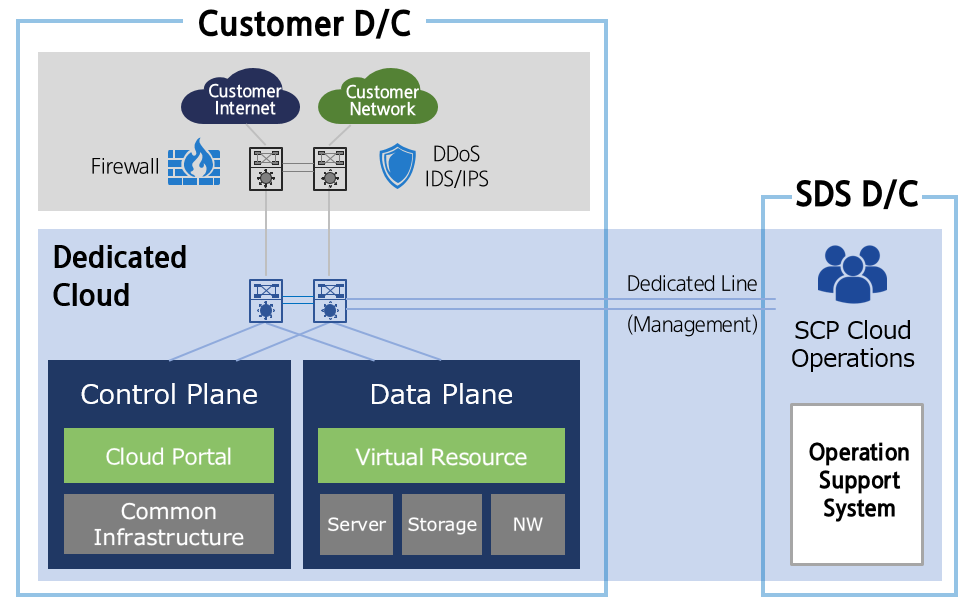
Provided Features
Dedicated Cloud provides the following features.
- Dedicated Physical Resource Provision: We configure and provide the cloud management area (console and common infrastructure) and the customer resource area (servers, storage, NW, etc., infrastructure for virtual resource deployment) exclusively for each client.
- Dedicated Internet and Customer Network Connection: It can connect to the internet and internal network of the customer environment where Dedicated Cloud is installed.
- Cloud Platform Operations and Upgrades: Regular feature upgrades and patches for services provided by Samsung Cloud Platform are offered. * However, a management line connection is required for platform operation, upgrades, and patches, and additional costs will be incurred.
- Resource provisioning and management: Provides creation, modification, deletion, and retrieval (CRUD) functions for cloud resources such as virtual servers, storage, and networks via API or console.
- Resource Central Management: virtual instances (Virtual Server), virtual networks (VPC), databases, storage (Block Storage, Object Storage, etc.) manages the deployment and configuration of infrastructure resources centrally.
- User Authentication, Authorization Management: Provides authentication (Authentication), authorization (Authorization), and access control (Access Control) functions for users and services.
- Centralized Security Policy Management: Manages security-related policies such as network security, data encryption, and vulnerability management centrally.
- Automation and Orchestration: Provides users by automating complex tasks such as resource deployment, scaling, shrinking, and updating.
- Supports lifecycle management of infrastructure and cloud services, and workflow orchestration.
- Provides automation and management functions for IaaS services, PaaS services (DB, Container, security, etc.), and common platform services.
- Monitoring and Performance Management: Collects the status, performance, logs, usage, etc. of cloud resources in real time for monitoring and provides alerts to users. * Provides operational visibility such as event management and operational status dashboards.
- Policy and Governance: provides cost management, tagging, alerts, usage tracking, and other cost and resource governance features. * You can manage users by organization and centrally set and apply security, compliance, and risk management policies in bulk.
- User and Service Interface Provision: Support users to directly manage cloud resources through various interfaces such as self-service portal, API, CLI, etc.
Component
Dedicated Cloud consists of the cloud management area (Control Plane) and the customer resource area (Data Plane).
Cloud Management Plane (Control Plane)
It is a core area responsible for centralized management and control of cloud infrastructure and services, handling virtual resource provisioning and automation, user authentication and authorization, monitoring, and policy configuration. The cloud management domain is physically separated from the customer resource domain and operates independently.
- The cloud infrastructure of Dedicated Cloud is installed separately at the client site, but it is connected to the SDS Center via a dedicated line for common service maintenance and integrated management (however, it is not connected in the case of Dedicated Cloud air-gap).
- Users can deploy resources to the customer resource domain and store user data by using the various services and features provided by the Samsung Cloud Platform through the Console.
- Even if a problem occurs in the cloud management domain, the resources and data deployed in the customer resource domain are not affected; however, constraints may arise for some services provided in the cloud management domain.
Customer Resource Area (Data Plane)
This is the area where virtual resources (virtual servers, virtual networks, storage, databases, etc.) required to configure the customer’s system are created and where customer data is stored.
- Compute: Virtual Server, Bare Metal Server(option), GPU Server(option) etc
- Storage: Block Storage, File Storage, Object Storage, Backup, etc.
- Network: VPC, Security Group, Load Balancer, Firewall etc.
- Database: PostgreSQL, MySQL, MariaDB, EPAS etc.
- By default, this is the area where IaaS and PaaS services are created and deployed, and to use certain specialized services (GPU Server, Multi-node GPU Cluster, high‑performance File Storage, etc.), you must select the extension option.
- In the public version, some Network services may not be available.
Rack configuration
The Dedicated Cloud service consists of a cloud management area and a customer resource area, and each area requires 11 dedicated racks.
| Category | Rack configuration | Power capacity per rack |
|---|---|---|
| Cloud Management Area | 7 items |
|
| Customer Resource Area | 4
|
|
- When configuring GPU servers and large-scale VMs, the power capacity per rack may vary, and separate consultation is required.
Provided specifications
During the consultation process for adopting Dedicated Cloud, resources can be configured according to the customer’s desired setup, and the default specifications provided are as follows. (Additional configuration options require discussion)
| Category | Basic specifications | Explanation |
|---|---|---|
| Computing(Total vCPU) |
|
|
| Bare Metal Server | Additional configuration | Configure the Bare Metal Server by selecting the required detailed specifications and quantity according to the customer’s requirements. |
| GPU Server | Additional configuration | Configure the GPU Server by selecting the GPU specifications (H100/B300) and the number of servers according to the customer’s requirements
|
| Block Storage | 60 TB | SSD is provided as standard, and capacity can be added in 20 TB increments (up to 500 TB for the default rack configuration). |
| File Storage | 15 TB | Provided as an HDD type, capacity can be added in 15 TB increments (up to 285 TB with the rack’s default configuration). |
| Object Storage | 1,300 TB | Provided as an HDD type, capacity can be added in 350 TB increments (up to 2,700 TB with the default rack configuration). |
| Backup | - | Backup service required |
Provision status by region
Dedicated Cloud can be provided in the environments below.
| Region | Whether provided |
|---|---|
| Korea West (kr-west1) | Provide |
| Korea East (kr-east1) | Provide |
| South Korea South 1 (kr-south1) | Not provided |
| South Korea South 2 (kr-south2) | Not provided |
| South Korea South 3 (kr-south3) | Not provided |
Constraints
Since the Samsung Cloud Platform continuously upgrades its services and features, the regulations and requirements for platform deployment and service maintenance must be met to keep the service running smoothly.
- For the Dedicated Cloud air-gap option service, a deployment system configuration and dedicated operations staff service are required for service maintenance and upgrades.
- The floor space, power and HVAC, and infrastructure for connecting the customer’s network required for Dedicated Cloud installation must be provided by the customer according to the specified standards.
- Platform updates and upgrades
- Software upgrades for Dedicated Cloud and Dedicated Cloud Air-gap services include the entire stack, encompassing related device drivers, firmware, operating system, platform software, cloud service additions, and feature upgrades.
- To use the added services and features, additional hardware and software may be required beyond the existing installed infrastructure, and additional costs may be incurred at that time.
- Upgrades and patches for the Samsung Cloud Platform are a shared responsibility between cloud service operators and users.
- Dedicated resources configured for the client must be connected to the SDS Center via a dedicated line for service delivery and operational management (dedicated line costs are billed separately).
- If external connections are unavailable due to security and regulatory requirements, you can choose the Air‑gap option; however, some services and features will be limited (metering/billing, SMS sending, etc.).
Preceding Service
There are no services that need to be pre-configured before creating this service.