Overview
Service Overview
MySQL (DBaaS) is an open-source relational database management system (RDBMS). The Samsung Cloud Platform provides an environment that automates MySQL installation and performs management functions for operations through a web-based console.
MySQL (DBaaS) is designed with a high-availability architecture that performs storage-based data replication and minimizes failover time. To prevent data loss, changes to the Active server are synchronously replicated to the Standby server. Additionally, up to five read-only Replica servers are provided for read load balancing and disaster recovery (DR). Additionally, it provides an automatic backup feature at user-specified times to prepare for issues with the DB server or data, enabling data recovery at the desired point in time.
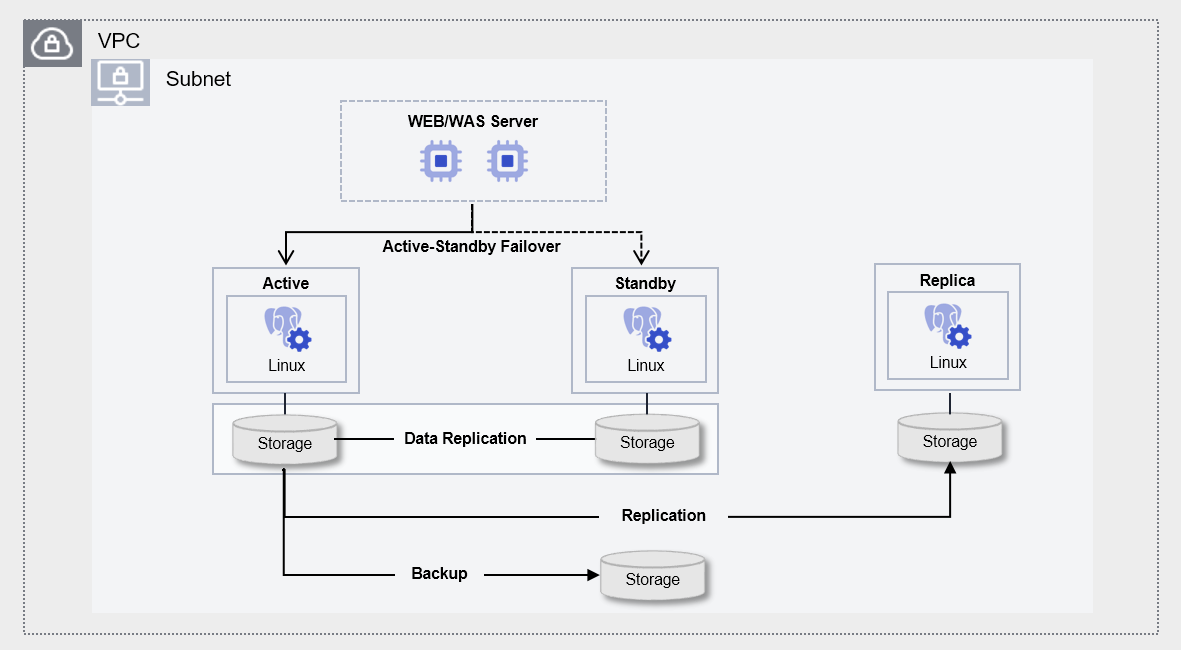
Features
MySQL (DBaaS) provides the following features.
- Auto Provisioning: You can install and configure the database (DB) through the UI, and it provides an active-standby high-availability configuration based on storage replication. * If the Active server fails, it automatically fails over to the Standby server.
- Operational Control Management: Provides functionality to control the status of running servers. * In addition to start and stop, you can restart the service to address database issues or apply configuration changes. * When high availability (HA) is configured, you can manually perform node failover between the active and standby nodes by using switch-over.
- Backup and Recovery: Provides a data backup feature based on a proprietary backup command. * Users can configure the backup time zone and retention period, and additional fees apply based on the backup capacity. * It also provides a data restoration feature. When a user initiates a restore, a separate database is created, and the restoration proceeds to the user-selected point in time (either the backup storage time or a custom time). * When restoring to a user-specified point in time, the restore point can be set up to 5 minutes, 10 minutes, 30 minutes, or 1 hour before the time, based on the stored backup and archive files.
- Version Management: Provides Major and Minor version upgrade capabilities for specific feature enhancements and security patches.
- Replica Configuration: Up to five read replicas can be configured in the same or different regions for read load balancing and disaster recovery (DR).
- Parameter management: You can modify DB configuration parameters related to performance improvements and security.
- Service Status Check: Retrieves the final status of the current DB service.
- Monitoring: You can view CPU, memory, and performance monitoring information through Cloud Monitoring and Servicewatch.
- DB User Management: Query and manage DB account (user) information registered in the DB.
- DB Access Control Management: You can register and deregister allowed access IPs based on DB accounts registered in the DB.
- Archive Management: You can configure the retention period for archive files on the DB server (1 to 35 days) and set the archive mode (On/Off).
- Export DB Logs: You can export logs stored through audit settings to the user’s Object Storage.
- Migration: Synchronizes data in real time with the running database and supports migration using the Replication method without service interruption.
- OS Kernel Upgrade: You can upgrade the OS kernel to apply certain feature improvements and security patches.
Components
MySQL (DBaaS) provides pre-validated engine versions and various server types in accordance with its open-source support policy. Users can select and use the appropriate option based on the scale of the service they want to configure.
Engine version
The following engine versions are supported in MySQL (DBaaS).
Technical support is available until the supplier’s End of Technical Service (EoTS) date. The End of Sale (EOS) date, when new creation is discontinued, is set six months before the EoTS date.
Because EOS and EoTS dates may change depending on the vendor’s policies, please refer to the vendor’s license management policy page for details.
- MySQL (Community): https://www.mysql.com/support/eol-notice.html
| Service | Provided version | EOS Date (Date of new creation suspension for Samsung Cloud Platform) | EoTS Date (Community Technical Support End Date) |
|---|---|---|---|
| MySQL (Community) | 8.0.28 | 2026-03-19 | 2026-04-30 |
| 8.0.30 | 2026-03-19 | 2026-04-30 | |
| 8.0.32 | 2026-03-19 | 2026-04-30 | |
| 8.0.33 | 2026-03-19 | 2026-04-30 | |
| 8.0.34 | 2026-03-19 | 2026-04-30 | |
| 8.0.35 | 2026-03-19 | 2026-04-30 | |
| 8.0.36 | 2026-03-19 | 2026-04-30 | |
| 8.0.37 | 2026-03-19 | 2026-04-30 | |
| 8.0.41 | 2026-03-19 | 2026-04-30 | |
| 8.0.42 | 2026-03-19 | 2026-04-30 | |
| 8.4.5 | 2031-12 (Planned) | 2032-04-30 | |
| 8.4.7 | 2031-12 (Planned) | 2032-04-30 | |
| 8.4.8 | 2031-12 (Planned) | 2032-04-30 |
The next version of MySQL is scheduled to be available after November 2026. The actual service schedule is subject to change.
- MySQL 8.4.9
Server type
The server types supported by MySQL (DBaaS) are as follows.
For details on the server types provided by MySQL (DBaaS), see MySQL (DBaaS) server types.
Standard db1v2m4
| Category | Example | Detailed Description |
|---|---|---|
| Server Type | Standard | Server types provided: |
Standard: Standard specifications (vCPU, Memory) commonly used
High Capacity: High-capacity server specifications with 24 vCores or more | | Server Specifications | db1 | Server specifications provided: db1: Standard specifications (vCPU, Memory) configuration commonly used dbh2: Large-capacity server specifications Provides servers with 24 vCores or more | | Server Specifications | v2 | Number of vCores
- v2: 2 virtual cores
- m4: 4GB Memory
Prior Service
A list of services that must be configured before creating the specified service. For details, refer to the guides provided for each service and prepare in advance.
| Service Category | Service | Detailed Description |
|---|---|---|
| Networking | VPC | A service that provides an isolated virtual network in a cloud environment |