This is the multi-page printable view of this section. Click here to print.

Return to the regular view of this page.

How-to guides

The user can enter the required information for Microsoft SQL Server (DBaaS) through the Samsung Cloud Platform Console, select detailed options, and create the service.

Microsoft SQL Server(DBaaS) Create

You can create and use the Microsoft SQL Server (DBaaS) service from the Samsung Cloud Platform Console.

Notice

Before creating the service, please configure the VPC’s Subnet type as General.

  • If the Subnet type is Local, the creation of the corresponding Database service is not possible.

To create Microsoft SQL Server (DBaaS), follow the steps below.

  1. All Services > Database > Microsoft SQL Server(DBaaS) Click the menu. Navigate to the Service Home page of Microsoft SQL Server(DBaaS).
  2. Click the Microsoft SQL Server(DBaaS) Create button on the Service Home page. You will be taken to the Microsoft SQL Server(DBaaS) Create page.
  3. Microsoft SQL Server(DBaaS) Creation On the page, enter the information required to create the service, and select detailed options.
    • Image and version selection Select the required information in the area.
      Category
      Required or not
      Detailed description
      Image VersionRequiredProvide version list of Microsoft SQL Server (DBaaS)
      Table. Microsoft SQL Server (DBaaS) Image and version selection items
    • Service Information Input Enter or select the required information in the area.
      Category
      Required
      Detailed description
      Server Name PrefixRequiredServer name where DB will be installed
      • Start with a lowercase English letter, and use lowercase letters, numbers, and the special character (-) to input 3 to 13 characters
      • Based on the server name, a postfix such as 001, 002 is attached to create the actual server name
      Cluster NameRequiredCluster name composed of DB servers
      • Enter using English letters, 3 to 20 characters
      • A cluster is a unit that groups multiple servers
      Service Type > Server TypeRequiredServer type where DB will be installed
      • Standard: Standard specifications commonly used
      • High Capacity: Large-capacity server with 24 vCore or more
      Service Type > Planned ComputeSelectStatus of resources with Planned Compute set
      • In Use: Number of resources with Planned Compute set that are currently in use
      • Configured: Number of resources with Planned Compute set
      • Coverage Preview: Amount applied by Planned Compute per resource
      • Create Planned Compute Service: Go to the Planned Compute service application page
      Service Type > Block StorageRequiredBlock Storage settings used by DB according to purpose
      • Basic OS: Area where the DB engine is installed
      • DATA: Storage area for table data, archive files, etc.
        • Select the storage type and then enter the capacity (refer to Block Storage Creation for details on each Block Storage type)
          • SSD: High-performance general volume
          • HDD: General volume
          • SSD_KMS, HDD_KMS: Additional encrypted volumes using Samsung Cloud Platform KMS (Key Management System) encryption keys
          • The configured storage type is applied identically to additional storage
          • Capacity must be entered as a multiple of 8 within the range 16 ~ 5,120
          Additional: Data storage area
          • After selecting Use, enter the storage’s purpose and capacity
          Click the + button to add storage, and the x button to delete
        • Capacity can be entered as a multiple of 8 within the range 16 ~ 5,120, and up to 9 can be created
      Redundancy ConfigurationSelectRedundancy Configuration Status
      • If redundancy configuration is used, the DB instance is configured as Active DB and Standby DB
      Network > Common SettingsRequiredNetwork settings where servers generated by the service are installed
      • Select if you want to apply the same settings to all servers being installed
      • Select a pre‑created VPC, Subnet, IP, and Public NAT
        • IP can only be auto‑generated
        • The Public NAT feature is available only when the VPC is connected to an Internet Gateway. If you check Use, you can select from reserved IPs in the VPC product’s Public IP. For more information, see Create Public IP
      Network > Server-specific SettingsRequiredNetwork settings where servers generated by the service are deployed
      • Select if you want to apply different settings per installed server
      • Select a pre‑created VPC, Subnet, IP, and Public NAT
        • Enter each server’s IP
        • The Public NAT feature is available only when the VPC is connected to an Internet Gateway. If Use is checked, you can select from reserved IPs in the VPC product’s Public IP. For more information, see Create Public IP.
      IP Access ControlSelectService Access Policy Settings
      • Since the access policy is set for the IP entered on the page, a separate Security Group policy setting is not required
      • Enter in IP format (e.g., 192.168.10.1) or CIDR format (e.g., 192.168.10.0/24, 192.168.10.1/32) and click the Add button
      • To delete an entered IP, click the x button next to the entered IP
      Maintenance PeriodSelectDB Maintenance Period
      • Use to set day of week, start time, and duration
      • It is recommended to set a maintenance period for stable DB management. Patch work will be performed at the set time, causing service interruption.
      • If set to not use, Samsung SDS is not responsible for issues arising from patches not being applied.
      Table. Microsoft SQL Server (DBaaS) Service Configuration Items
    • Database configuration required information input Enter or select the required information in the area.
      Category
      Required or not
      Detailed description
      Database Service NameRequiredDatabase Management Unit Name
      • Start with an uppercase English letter and use English characters, input 1~15
      Database name > DefaultRequiredServer name applied when installing DB
      • Starts with an English letter, and using English letters, numbers, and special characters (.,_) input 3 ~ 20 characters
      Database name > AddRequiredServer name applied when installing DB
      • Select Use, then enter the name of the Database to install. It must start with an English letter, and be entered using English letters, numbers, and special characters (., _) for 3 - 20 characters
      • For each Database, the drive where data is stored can be selected from the drives added in Service Type > Block Storage
      • Adding Databases is only possible in the Enterprise version, up to a maximum of 100
      Database usernameRequiredDB user name
      • An account with the same name is also created on the OS
      • Enter using lowercase English letters, 2 to 20 characters
      • The following names cannot be used as a Database username
        • root, user, sdscmpif, hacluster, adm, games, nobody, sshd, system, mail, postfix, sa, maxigent_cl
      Database passwordRequiredDB connection password
      • Enter 8-30 characters including letters, numbers, and special characters ( excluded)
      Database password verificationRequiredDB connection password verification
      • Re-enter the DB connection password identically
      Database Port numberRequiredDB connection port number
      • Enter DB port within the range 1200 - 65535
      LicenseRequiredSQL Server License Key
      • Enter the issued license key
      • If the entered license key is not valid, the service may not be created
      Backup > UseSelectBackup usage status
      • Use select to set backup file retention period, backup start time, Full backup schedule (day of week), Archive backup cycle
      Backup > Retention PeriodSelectBackup Retention Period
      • Select the backup retention period. File retention period can be set from 7 days to 35 days.
      • Backup files incur additional charges based on size.
      Backup > Backup Start PeriodSelectBackup Start Time
      • Select backup start time
      • The minutes during which the backup is performed are set randomly, and the backup end time cannot be set
      Backup > Full Backup Schedule(Day of Week)SelectFull Backup Schedule
      • Select the day of week for Full backup execution
      • Full backup is performed every week
      Backup > Archive backup frequencySelectArchive backup frequency
      • Select the Archive backup frequency
      • Archive backup frequency is recommended at 1 hour. Selecting 5 minutes, 10 minutes, or 30 minutes may affect DB performance
      Audit Log SettingsSelectWhether to save Audit Log
      • Select Use to configure the Audit Log feature
      • DDL and user connection information records are saved
      • Enabling Audit may degrade DB performance
      ParameterRequiredDB configuration parameters
      • Search button can be clicked to view detailed information of the parameter
      • Parameters can be modified after the service creation is completed, and a DB restart is required after modification
      DB CollationSelectData sorting method
      • A command that specifies the data sorting and comparison method, and the result of the operation may differ depending on the setting.
      Time zoneRequiredStandard time zone to be used by the Database
      Table. Microsoft SQL Server(DBaaS) Database configuration items
  • Additional Information Input area, please enter or select the required information.
    Category
    Required or not
    Detailed description
    TagSelectAdd Tag
    • Up to 50 can be added per resource
    • After clicking the Add Tag button, enter or select Key, Value values
    Table. Microsoft SQL Server (DBaaS) Additional Information Input Items
  1. Summary Check the detailed information and estimated billing amount generated in the panel, and click the Generate button.
    • When creation is complete, check the created resource on the Resource List page.

Microsoft SQL Server(DBaaS) Check detailed information

Microsoft SQL Server(DBaaS) service allows you to view and edit the full resource list and detailed information. Microsoft SQL Server(DBaaS) Details page consists of Details, Tags, Operation History tabs, and for databases with a configured Replica, a Replica Information tab is additionally provided.

Microsoft SQL Server(DBaaS) To view detailed information, follow the steps below.

  1. All Services > Database > Microsoft SQL Server(DBaaS) Click the menu. Navigate to the Service Home page of Microsoft SQL Server(DBaaS).
  2. Click the Microsoft SQL Server(DBaaS) menu on the Service Home page. You will be taken to the Microsoft SQL Server(DBaaS) List page.
  3. Microsoft SQL Server(DBaaS) List Click the resource to view detailed information on the page. Microsoft SQL Server(DBaaS) Details It navigates to the page.
  • Microsoft SQL Server(DBaaS) Details At the top of the page, status information and information about additional features are displayed.
    CategoryDetailed description
    Cluster StatusCluster status with DB installed
    • Creating: Cluster is being created
    • Editing: Cluster is changing to operation execution state
    • Error: Cluster encountered a failure while performing tasks
      • If it occurs continuously, contact the administrator
    • Failed: Cluster failed during creation
    • Restarting: Cluster is being restarted
    • Running: Cluster is operating normally
    • Starting: Cluster is being started
    • Stopped: Cluster is stopped
    • Stopping: Cluster is being stopped
    • Synchronizing: Cluster is being synchronized
    • Terminating: Cluster is being deleted
    • Unknown: Cluster status is unknown
      • If it occurs continuously, contact the administrator
    • Upgrading: Cluster is changing to upgrade execution state
    Cluster ControlButton to change cluster state
    • Start: Start a stopped cluster
    • Stop: Stop a running cluster
    • Restart: Restart a running cluster
    • Switch-Over: Switch a standby cluster to Active
    More additional featuresCluster-related management button
    • Service status synchronization: Query real-time DB service status
    • Backup history: If backup is configured, check whether backup runs correctly and view history
    • Database recovery: Recover DB based on a specific point in time
    • Parameter management: View and modify DB configuration parameters
    • Add secondary: Configure a read-only cluster Replica
    • DB user management: View and manage DB accounts (users) registered in the DB
    • Export DB Log: Logs stored via Audit settings can be exported to the user’s Object Storage
    Service terminationButton to cancel the service
    Table. Microsoft SQL Server (DBaaS) status information and additional features

Detailed Information

Microsoft SQL Server(DBaaS) List On the page, you can view detailed information of the selected resource and, if necessary, edit the information.

CategoryDetailed description
Server InformationServer information configured in the respective cluster
  • Category: Server type (Primary, Secondary)
  • Server name: Server name
  • IP:Port: Server IP and port
  • Status: Server status
ServiceService Name
Resource TypeResource Type
SRNUnique resource ID in Samsung Cloud Platform
  • In DB service, it means cluster SRN
ResourceResource Name
  • In DB service, it means the cluster name
Resource IDUnique resource ID in the service
CreatorUser who created the service
Creation Date/TimeService creation date/time
EditorUser who modified the service information
Modification DateDate and time when service information was modified
Image VersionInstalled DB Image and Version Information
  • If a version upgrade is needed, click the Edit icon to set
Cluster NameName of the cluster where the servers are configured
Databse service nameDatabase management unit name
Database usernameDB user name
Database name > default DatabaseServer name applied when installing DB
Database name > Add DatabaseServer name applied when installing DB
  • When adding a Database, click the **Add** button to add. Refer to [Add Database](/userguide/database/mssql/how_to_guides/managing.md#database-추가하기)
  • If you want to delete an added Database, click the **Edit** icon to add. Refer to [Delete Database](/userguide/database/mssql/how_to_guides/managing.md#database-삭제하기)
| | Planned Compute | Resource status with Planned Compute set
  • For more details, refer to [Planned Compute Apply](/userguide/financial_management/planned_compute/how_to_guides/)
| | Maintenance Period | DB Maintenance Period Status
  • If maintenance period setting is required, click the **Edit** icon to set
| | Backup | Backup configuration status
  • If backup configuration is needed, **Edit** icon to set
  • For details, refer to [Microsoft SQL Server(DBaas) Backup](/userguide/database/mssql/how_to_guides/backupandrestore.md#microsoft-sql-serverdbaas-백업하기)
| | Audit Log Settings | Audit Log Settings Status
  • If Audit Log settings are needed, click the **Edit** icon to configure
  • For details, refer to [Edit Audit Settings](/userguide/database/mssql/how_to_guides/managing.md#audit-설정-수정하기)
| | Time zone | Standard time zone used by the Database | | DB Collation | Data Sorting Method | | VIP | Virtual IP information
  • Can be checked only when high availability is configured
| | Network | Network information where DB is installed (VPC, Subnet) | | IP Access Control | Service Access Policy Settings
  • If you need to add or delete an IP, click the **Edit** icon to set
| | Primary & Secondary | Primary/Secondary server type, default OS, additional Disk information
  • If you need to modify the server type, click the **Edit** icon next to the server type to set it. Refer to [Change Server Type](#서버-타입-변경하기) for the server type modification procedure
    • Modifying the server type requires a server reboot
  • If you need to expand storage, click the **Edit** icon next to the storage capacity to expand. Refer to [Expand Storage](#스토리지-증설하기) for the storage expansion procedure
  • If you need to add storage, click the **Add Disk** button next to Additional Disk to add. Refer to [Add Storage](#스토리지-추가하기) for the storage addition procedure
|
Table. Microsoft SQL Server(DBaaS) Database detailed information items

Tag

Microsoft SQL Server(DBaaS) List page allows you to view the tag information of the selected resource, and you can add, modify, or delete it.

CategoryDetailed description
Tag ListTag List
  • Can check the tag’s Key and Value information
  • Up to 50 tags can be added per resource
  • When entering tags, search and select from the existing list of Keys and Values
Table. Microsoft SQL Server(DBaaS) Tag Tab Items

Work History

Microsoft SQL Server(DBaaS) List page allows you to view the operation history of the selected resource.

CategoryDetailed description
Work History ListResource Change History
  • Work date/time, Resource ID, Resource name, Work details, Event topic, Work result, Verify worker information
Table. Microsoft SQL Server (DBaaS) Job History Tab Detailed Information Items

Microsoft SQL Server(DBaaS) Managing Resources

If you need to change the existing configuration options of a created Microsoft SQL Server (DBaaS) resource, or recover it, or manage parameters, you can perform the work on the Microsoft SQL Server (DBaaS) Details page.

Operating Control

If changes occur to a running Microsoft SQL Server (DBaaS) resource, you can start, stop, or restart it. Also, if HA is configured, you can switch the Primary-Secondary servers via a switch-over.

To control the operation of Microsoft SQL Server (DBaaS), follow the steps below.

  1. Click the All Services > Database > Microsoft SQL Server(DBaaS) menu. Navigate to the Service Home page of Microsoft SQL Server(DBaaS).
  2. Click the Microsoft SQL Server(DBaaS) menu on the Service Home page. Navigate to the Microsoft SQL Server(DBaaS) List page.
  3. Microsoft SQL Server(DBaaS) List page, click the resource to control operation. It moves to the Microsoft SQL Server(DBaaS) Details page.
  4. Microsoft SQL Server(DBaaS) Check the status and complete the change using the control button below.
    • Start: The server where the DB service is installed and the DB service is running.
    • Stop: The server where the DB service is installed and the DB service are stopped (Stopped).
    • Restart: Only the DB service will be restarted.
    • Switch Over: You can switch the DB’s Primary server and Secondary server.

Synchronize Service Status

You can synchronize the real-time service status of Microsoft SQL Server (DBaaS).

To check the service status of Microsoft SQL Server (DBaaS), follow the steps below.

  1. All Services > Database > Microsoft SQL Server(DBaaS) Click the menu. Navigate to the Service Home page of Microsoft SQL Server(DBaaS).
  2. Click the Microsoft SQL Server(DBaaS) menu on the Service Home page. Navigate to the Microsoft SQL Server(DBaaS) List page.
  3. Click the resource to view the service status on the Microsoft SQL Server(DBaaS) List page. It moves to the Microsoft SQL Server(DBaaS) Details page.
  4. Service Status Synchronization Click the button. While it is being queried, the cluster will change to Synchronizing state.
  5. When the query is completed, the status is updated in the server information item, and the cluster changes to Running status.

Change Server Type

You can change the configured server type.

To change the server type, follow the steps below.

Caution
  • If you modify the server type, a server restart is required. Please separately verify any SW license changes or SW settings and reflections due to server specification changes.
  1. Click the All Services > Database > Microsoft SQL Server(DBaaS) menu. Go to the Service Home page of Microsoft SQL Server(DBaaS).
  2. Click the Microsoft SQL Server(DBaaS) menu on the Service Home page. Go to the Microsoft SQL Server(DBaaS) List page.
  3. Microsoft SQL Server(DBaaS) List Click the resource to change the server type on the page. Microsoft SQL Server(DBaaS) Detail Navigate to the page.
  4. Click the Edit icon of the server type you want to change at the bottom of the detailed information. Server Type Edit popup window opens.
  5. Edit Server Type In the popup window, after selecting the server type, click the Confirm button.

Add Storage

If you need more than 5 TB of data storage space, you can add storage. In the case of a redundant DB configuration, all redundant servers are added simultaneously.

To add storage capacity, follow the steps below.

Caution
  • It is applied the same as the selected Storage type when creating a service.
  • For a high‑availability configured DB, adding storage is applied simultaneously to the storage of the Primary DB and the Secondary DB.
  1. Click the All Services > Database > Microsoft SQL Server(DBaaS) menu. Go to the Service Home page of Microsoft SQL Server(DBaaS).
  2. Click the Microsoft SQL Server(DBaaS) menu on the Service Home page. Navigate to the Microsoft SQL Server(DBaaS) list page.
  3. Microsoft SQL Server(DBaaS) List page, click the resource to add storage. Microsoft SQL Server(DBaaS) Details page will be opened.
  4. Click the Add Disk button at the bottom of the detailed information. The Add Storage Request popup window opens.
  5. Additional Storage Request In the popup window, after entering the purpose and capacity, click the Confirm button.

Expanding storage

You can expand the storage added to the data area up to a maximum of 5 TB based on the initially allocated capacity. In the case of a redundant DB configuration, all redundant servers are expanded simultaneously.

To increase storage capacity, follow the steps below.

  1. Click the All Services > Database > Microsoft SQL Server(DBaaS) menu. Navigate to the Service Home page of Microsoft SQL Server(DBaaS).
  2. Click the Microsoft SQL Server(DBaaS) menu on the Service Home page. Go to the Microsoft SQL Server(DBaaS) List page.
  3. Microsoft SQL Server(DBaaS) List Click the resource to change the server type on the page. Microsoft SQL Server(DBaaS) Details Navigate to the page.
  4. Click the Edit icon of the additional Disk you want to add at the bottom of the detailed information. The Edit Additional Storage popup window opens.
  5. Add Storage Modification After entering the expansion capacity in the popup window, click the Confirm button.

Microsoft SQL Server(DBaaS) Cancel

You can cancel unused Microsoft SQL Server (DBaaS) to reduce operating costs. However, if you cancel the service, the running service may be stopped immediately, so you should consider the impact of service interruption sufficiently before proceeding with the cancellation.

Caution
If you terminate the DB, all stored data and any backup data will be deleted.

To cancel Microsoft SQL Server (DBaaS), follow the steps below.

  1. Click the All Services > Database > Microsoft SQL Server(DBaaS) menu. Go to the Service Home page of Microsoft SQL Server(DBaaS).
  2. Click the Microsoft SQL Server(DBaaS) menu on the Service Home page. Navigate to the Microsoft SQL Server(DBaaS) List page.
  3. Microsoft SQL Server(DBaaS) List page, select the resource to cancel, and click the Cancel Service button.
  4. Once the termination is complete, check whether the resource has been terminated on the Microsoft SQL Server(DBaaS) list page.

1 - Managing DB Service

Users can manage Microsoft SQL Server(DBaaS) through the Samsung Cloud Platform Console.

Managing Database

For Microsoft SQL Server Enterprise version, you can add new Databases. You can add up to 100 per cluster.

Adding Database

Follow these steps to add Database.

  1. Click the All Services > Database > Microsoft SQL Server(DBaaS) menu. You will move to the Microsoft SQL Server(DBaaS)’s Service Home page.
  2. On the Service Home page, click the Microsoft SQL Server(DBaaS) menu. You will move to the Microsoft SQL Server(DBaaS) List page.
  3. On the Microsoft SQL Server(DBaaS) List page, click the resource to add storage. You will move to the Microsoft SQL Server(DBaaS) Detail page.
  4. Click the Add button in the Database name item. The Add Database popup window will open.
  5. In the Add Database popup window, click the + button to enter Database name and select drive, then click the Confirm button.

Deleting Database

Follow these steps to delete Database.

  1. Click the All Services > Database > Microsoft SQL Server(DBaaS) menu. You will move to the Microsoft SQL Server(DBaaS)’s Service Home page.
  2. On the Service Home page, click the Microsoft SQL Server(DBaaS) menu. You will move to the Microsoft SQL Server(DBaaS) List page.
  3. On the Microsoft SQL Server(DBaaS) List page, click the resource to add storage. You will move to the Microsoft SQL Server(DBaaS) Detail page.
  4. Click the Modify button in the Database name item. The Delete Added Database popup window will open.
  5. In the Delete Added Database Request popup window, check the Database to delete and click the Delete button. The Delete Database popup window will open.
  6. In the Delete Database popup window, enter the Database name to delete and then click the Confirm button.

Managing Parameters

Provides functionality to easily view and modify database configuration parameters.

Viewing Parameters

Follow these steps to view configuration parameters.

  1. Click the All Services > Database > Microsoft SQL Server(DBaaS) menu. You will move to the Microsoft SQL Server(DBaaS)’s Service Home page.
  2. On the Service Home page, click the Microsoft SQL Server(DBaaS) menu. You will move to the Microsoft SQL Server(DBaaS) List page.
  3. On the Microsoft SQL Server(DBaaS) List page, click the resource for which you want to view and modify parameters. You will move to the Microsoft SQL Server(DBaaS) Detail page.
  4. Click the More button and click the Parameter Management button. The Parameter Management popup window will open.
  5. In the Parameter Management popup window, click the View button. The View Notification popup window will open.
  6. When the View Notification popup window opens, click the Confirm button. Viewing may take some time.

Modifying Parameters

Follow these steps to modify configuration parameters.

  1. Click the All Services > Database > Microsoft SQL Server(DBaaS) menu. You will move to the Microsoft SQL Server(DBaaS)’s Service Home page.
  2. On the Service Home page, click the Microsoft SQL Server(DBaaS) menu. You will move to the Microsoft SQL Server(DBaaS) List page.
  3. On the Microsoft SQL Server(DBaaS) List page, click the resource for which you want to view and modify parameters. You will move to the Microsoft SQL Server(DBaaS) Detail page.
  4. Click the More button and click the Parameter Management button. The Parameter Management popup window will open.
  5. In the Parameter Management popup window, click the View button. The View Notification popup window will open.
  6. When the View Notification popup window opens, click the Confirm button. Viewing may take some time.
  7. If modification is needed, click the Modify button and enter the modification in the custom value area of the Parameter to be modified.
  8. When input is complete, click the Complete button.

Managing DB Users

Provides functionality to view and manage DB user information.

Viewing DB Users

Follow these steps to view DB users.

  1. Click the All Services > Database > Microsoft SQL Server(DBaaS) menu. You will move to the Microsoft SQL Server(DBaaS)’s Service Home page.
  2. On the Service Home page, click the Microsoft SQL Server(DBaaS) menu. You will move to the Microsoft SQL Server(DBaaS) List page.
  3. On the Microsoft SQL Server(DBaaS) List page, click the resource for which you want to view DB users. You will move to the Microsoft SQL Server(DBaaS) Detail page.
  4. Click the More button and click the DB User Management button. You will move to the DB User Management page.
  5. On the DB User Management page, click the View button. Viewing may take some time.

Changing DB User Status

Follow these steps to change the status of viewed DB users.

  1. Click the All Services > Database > Microsoft SQL Server(DBaaS) menu. You will move to the Microsoft SQL Server(DBaaS)’s Service Home page.
  2. On the Service Home page, click the Microsoft SQL Server(DBaaS) menu. You will move to the Microsoft SQL Server(DBaaS) List page.
  3. On the Microsoft SQL Server(DBaaS) List page, click the resource for which you want to modify DB users. You will move to the Microsoft SQL Server(DBaaS) Detail page.
  4. Click the More button and click the DB User Management button. You will move to the DB User Management page.
  5. On the DB User Management page, click the View button. Viewing may take some time.
  6. If modification is needed, click the Modify button and change the status area value or enter remarks.
  7. When input is complete, click the Complete button.

Modifying Audit Settings

You can change the Audit log storage settings for Microsoft SQL Server(DBaaS).

Follow these steps to change the Audit log storage settings for Microsoft SQL Server(DBaaS).

  1. Click the All Services > Database > Microsoft SQL Server(DBaaS) menu. You will move to the Microsoft SQL Server(DBaaS)’s Service Home page.
  2. On the Service Home page, click the Microsoft SQL Server(DBaaS) menu. You will move to the Microsoft SQL Server(DBaaS) List page.
  3. On the Microsoft SQL Server(DBaaS) List page, click the resource for which you want to view the service status. You will move to the Microsoft SQL Server(DBaaS) Detail page.
  4. Click the Modify icon in Audit Settings at the bottom of the detailed information. The Modify Audit Settings popup window will open.
  5. In the Modify Audit Settings popup window, modify the usage and then click the Confirm button.
    • Selecting Use sets the Audit log function. Setting Audit logs may degrade DB performance.
    • Disabling Use deletes the Audit log storage file. Please back up the Audit log file separately before disabling use.

Exporting DB Log

Supports exporting audit(Audit) log data that requires long-term retention to Object Storage. Users can directly set the log type to be saved, the destination Bucket to export to, and the cycle for exporting logs. Logs are copied and stored to the specified Object Storage according to the set criteria. Additionally, to efficiently manage disk space, provides an option to automatically delete original log files while exporting logs to Object Storage. Using this option allows you to effectively secure storage capacity while safely storing necessary log data for long-term retention.

Notice
  • To use the DB Log Export function, Object Storage creation is required. For Object Storage creation, please refer to the Object Storage User Guide.
  • Please check the expiration date of the authentication key. If the authentication key expires, logs will not be saved to the Bucket.
  • Please be careful not to expose authentication key information externally.

Setting DB Log Export Mode

Follow these steps to set DB Log export mode.

  1. Click the All Services > Database > Microsoft SQL Server(DBaaS) menu. You will move to the Microsoft SQL Server(DBaaS)’s Service Home page.
  2. On the Service Home page, click the Microsoft SQL Server(DBaaS) menu. You will move to the Microsoft SQL Server(DBaaS) List page.
  3. On the Microsoft SQL Server(DBaaS) List page, click the resource for which you want to export DB Log. You will move to the Microsoft SQL Server(DBaaS) Detail page.
  4. Click the More button and click the DB Log Export button. You will move to the DB Log Export page.
  5. On the DB Log Export page, click the Register button. You will move to the Register DB Log Export page.
  6. On the Register DB Log Export page, enter the corresponding information and then click the Complete button.
    CategoryRequired
    Detailed Description
    Log TypeRequiredLog type to save
    Storage Bucket NameRequiredObject Storage Bucket name to save
    Authentication Key > Access keyRequiredAccess key to access the Object Storage to save
    Authentication Key > Secret keyRequiredSecret key to access the Object Storage to save
    File Creation CycleRequiredCycle for creating files in Object Storage
    Delete Original LogOptionalWhether to delete original logs while exporting to Object Storage
    Table. Microsoft SQL Server(DBaaS) DB Log Export Configuration Items

Managing DB Log Export

Follow these steps to modify, cancel, or immediately export DB Log export settings.

  1. Click the All Services > Database > Microsoft SQL Server(DBaaS) menu. You will move to the Microsoft SQL Server(DBaaS)’s Service Home page.
  2. On the Service Home page, click the Microsoft SQL Server(DBaaS) menu. You will move to the Microsoft SQL Server(DBaaS) List page.
  3. On the Microsoft SQL Server(DBaaS) List page, click the resource for which you want to manage DB Log export. You will move to the Microsoft SQL Server(DBaaS) Detail page.
  4. Click the More button and click the DB Log Export button. You will move to the DB Log Export page.
  5. On the DB Log Export page, click the More button according to the log type you want to manage and click the Immediate Export, Modify, or Cancel button.
    • Immediate Export: The selected log is exported to the Bucket of the previously set Object Storage.
    • Modify: Modifies the DB Log export mode settings.
    • Cancel: Cancels the DB Log export mode settings.

Upgrading Minor Version

Provides version upgrade functionality for some feature improvements and security patches. Only Minor version upgrades within the same Major version are supported.

Caution
  • Please check the service status first through service status synchronization before performing version upgrade.
  • Please proceed with version upgrade after setting up backup. If backup is not set, some data may not be recoverable when problems occur during upgrade.
  • Backed up data is automatically deleted after version upgrade is complete.

Follow these steps to upgrade Minor Version.

  1. Click the All Services > Database > Microsoft SQL Server(DBaaS) menu. You will move to the Microsoft SQL Server(DBaaS)’s Service Home page.
  2. On the Service Home page, click the Microsoft SQL Server(DBaaS) menu. You will move to the Microsoft SQL Server(DBaaS) List page.
  3. On the Microsoft SQL Server(DBaaS) List page, click the resource to upgrade the version. You will move to the Microsoft SQL Server(DBaaS) Detail page.
  4. Click the Modify button in the Image version item. The Version Upgrade popup window will open.
  5. In the Version Upgrade popup window, select the modified version and backup setting, then click the Confirm button.
  6. In the Version Upgrade Notification popup window, click the Confirm button.

2 - DB Backup and Recovery

The user can set up a backup of Microsoft SQL Server(DBaaS) through the Samsung Cloud Platform Console and restore it with the backed-up file.

Microsoft SQL Server(DBaaS) backup

Microsoft SQL Server(DBaaS) provides a data backup feature based on its own backup command, and also provides an optimized backup environment for data protection and management through backup history checking and backup file deletion functions.

Setting up backup

The method for configuring a backup for Microsoft SQL Server(DBaaS) is described in the Microsoft SQL Server(DBaaS) creation guide; please refer to it.

To modify the backup settings of the generated resource, follow these steps.

Caution

If backup is set, backup is performed at the specified time after the set time, and additional fees are incurred depending on the backup capacity.

  • If the backup setting is changed to unset, the backup operation will be stopped immediately, and the saved backup data will be deleted and can no longer be used.
  1. All services > Database > Microsoft SQL Server(DBaaS) menu, click. It moves to the Service Home page of Microsoft SQL Server(DBaaS).
  2. On the Service Home page, click the Microsoft SQL Server(DBaaS) menu. It moves to the Microsoft SQL Server(DBaaS) list page.
  3. Click the resource to set up backup on the Microsoft SQL Server(DBaaS) list page. It moves to the Microsoft SQL Server(DBaaS) details page.
  4. Click the Edit button of the backup item. The Backup Settings popup window opens.
  5. If you set up a backup, click Use in the Backup Settings popup window, select the retention period, backup start time, and Archive backup cycle, and then click the OK button.
    • If you want to stop the backup setting, uncheck Use in the Backup Settings popup window and click the OK button.

Check Backup History

Notice
To set up notifications for backup success and failure, you can set them up through the Notification Manager product. For a detailed usage guide on setting up notification policies, please refer to Creating a Notification Policy.

To view the backup history, follow these steps.

  1. Click All Services > Database > Microsoft SQL Server(DBaaS) menu. It moves to the Service Home page of Microsoft SQL Server(DBaaS).
  2. Service Home page, click the Microsoft SQL Server(DBaaS) menu. It moves to the Microsoft SQL Server(DBaaS) list page.
  3. Microsoft SQL Server(DBaaS) list page, click the resource to check the backup history. It moves to the Microsoft SQL Server(DBaaS) details page.
  4. Click the Backup History button. The Backup History popup window opens.
  5. Backup History popup window where you can check the backup status, version, backup start time, backup completion time, and capacity.

Deleting backup files

To delete the backup history, follow these steps.

Caution
Backup files cannot be restored after deletion. Please make sure to check if the data is unnecessary before deleting it.
  1. Click All Services > Database > Microsoft SQL Server(DBaaS) menu. It moves to the Service Home page of Microsoft SQL Server(DBaaS).
  2. Service Home page, click the Microsoft SQL Server(DBaaS) menu. It moves to the Microsoft SQL Server(DBaaS) list page.
  3. Microsoft SQL Server(DBaaS) list page, click the resource to check the backup history. It moves to the Microsoft SQL Server(DBaaS) details page.
  4. Click the Backup History button. The Backup History popup window opens.
  5. Backup History popup window, check the file you want to delete, and then click the Delete button.

Microsoft SQL Server(DBaaS) Recovery

In the event of a disability or data loss that requires restoration with a backup file, recovery is possible based on a specific point in time through the recovery function. When performing Microsoft SQL Server (DBaaS) recovery, a new server is created with the OS image at the initial provisioning time, and the DB is installed with the version at the backup point, and the recovery proceeds with the DB configuration information and data.

To restore Microsoft SQL Server(DBaaS), follow these procedures.

  1. Click All Services > Database > Microsoft SQL Server(DBaaS) menu. It moves to the Service Home page of Microsoft SQL Server(DBaaS).
  2. Service Home page, click the Microsoft SQL Server(DBaaS) menu. Move to the Microsoft SQL Server(DBaaS) list page.
  3. Microsoft SQL Server(DBaaS) resource list page, click the resource you want to restore. Move to the Microsoft SQL Server(DBaaS) details page.
  4. Click the Database Recovery button. Go to the Database Recovery page.
  5. Database Recovery Configuration area, enter the corresponding information and click the Complete button.
Classification
Necessity
Detailed Description
Recovery TypeRequiredSet the point in time to recover
  • Backup Point (Recommended): Recover based on the backup file. Select from the list of backup file timestamps displayed in the list
  • Custom Point: Recover to the desired point in time within the range where backup is possible. The recoverable period is from the initial backup start time to 1 hour/30 minutes/10 minutes/5 minutes before the current time, based on the Archive backup cycle setting value. Select the date and time you want to back up
Server name prefixRequiredRecovery DB server name
  • Start with lowercase English letters, using lowercase letters, numbers, and special characters (-) to input 3-16 characters
  • A postfix such as 001, 002 is attached based on the server name, and the actual server name is created
Cluster NameRequiredRecovery DB Cluster Name
  • Enter in English, 3-20 characters
  • A cluster is a unit that bundles multiple servers
Service Type > Server TypeRequiredRecovery DB Server Type
  • Standard: Generally used standard specification
  • High Capacity: High-capacity server with 24vCore or more
Service Type > Planned ComputeSelectionCurrent status of resources with Planned Compute set
  • In Use: Number of resources with Planned Compute set that are in use
  • Setting: Number of resources with Planned Compute set
  • Coverage Preview: Amount applied by resource-based Planned Compute
  • Create Planned Compute Service: Move to the Planned Compute service application page
Service Type > Block StorageRequiredRecovery DB uses Block Storage settings
  • Basic OS: Area where the DB engine is installed
  • DATA: Data storage area
    • The storage type set in the original cluster is applied in the same way
    • Capacity can be entered in multiples of 8 in the range of 16 to 5,120
  • Additional: Data storage area
    • The storage type set in the original cluster is applied in the same way
    • Only DATA and TEMP purposes can be added in the recovery DB
    • Select Use and enter the purpose and capacity of the storage
    • To add storage, click the + button, and to delete, click the x button
    • Capacity can be entered in multiples of 8 in the range of 16 to 5,120, and up to 9 can be created
Database usernamerequiredDatabase username
  • Applied identically to the username set in the original cluster
Database Port numberrequiredDatabase Port number
  • Apply the same port number set in the original cluster
IP Access ControlSelectSet service access policy
  • Set access policy for IP entered on the page, so Security Group policy setting is not required separately
  • Enter in IP format (e.g., 192.168.10.1) or CIDR format (e.g., 192.168.10.0/24, 192.168.10.1/32) and click the Add button
  • To delete the entered IP, click the x button next to the entered IP
Maintenance periodSelectDB maintenance period
  • Use is selected, set the day of the week, start time, and duration
  • It is recommended to set the maintenance period for stable management of the DB. Patch work is performed at the set time and service interruption occurs
  • If not used, Samsung SDS is not responsible for the problems that occur due to non-application of patches.
TagSelectAdd Tag
  • Click the Add Tag button and enter or select Key, Value
Fig. Microsoft SQL Server(DBaaS) Recovery Configuration Items

3 - Adding Secondary

Users can enter required information for Secondary through the Samsung Cloud Platform Console and create the service through detailed options.

Adding Secondary

Through Secondary configuration, you can create read-only replica servers. To configure Secondary additionally, it must be created with HA (High Availability) and Enterprise Edition, and the backup function must be enabled.

Follow these steps to configure Secondary.

  1. Click the All Services > Database > Microsoft SQL Server(DBaaS) menu. You will move to the Microsoft SQL Server(DBaaS)’s Service Home page.
  2. On the Service Home page, click the Microsoft SQL Server(DBaaS) menu. You will move to the Microsoft SQL Server(DBaaS) List page.
  3. On the Microsoft SQL Server(DBaaS) List page, click the resource to configure Secondary. You will move to the Microsoft SQL Server(DBaaS) Detail page.
  4. Click the Add Secondary button. You will move to the Add Secondary page.
  5. Enter information in the Secondary Configuration area and then click the Create button.
    Category
    Required
    Detailed Description
    Secondary CountRequiredNumber of Secondaries to configure
    • Can configure only 1 per cluster
    Secondary NameRequiredSecondary server name
    • Enter 3 ~ 15 characters starting with lowercase English letters, using lowercase letters, numbers, and special characters(-)
    • The entered Secondary name is displayed as cluster name in the list
    Service Type > Server TypeRequiredSecondary server type
    • Applied identically according to the server type set in the original DB
    Service Type > Planned ComputeOptionalStatus of resources with Planned Compute set
    • In Use: Number of resources with Planned Compute set that are currently in use
    • Set: Number of resources with Planned Compute set
    • Coverage Preview: Amount applied by Planned Compute per resource
    Network > Common SettingsRequiredNetwork settings where servers created in the service are installed
    • Applied identically with network settings set in original DB
    Network > Per-Server SettingsRequiredNetwork settings where servers created in the service are installed
    • Select when applying different settings for each server being installed
    • Applied identically with network settings set in original DB
    • When setting per server, enter IP address within 10.10.10.0/24 range
    LicenseRequiredSQL Server License Key
    • Enter the issued license key
    • If the entered license key is invalid, the service may not be created
    Table. Microsoft SQL Server(DBaaS) Secondary Configuration Items

4 - Microsoft SQL Server(DBaaS) server connection

Scenario Overview

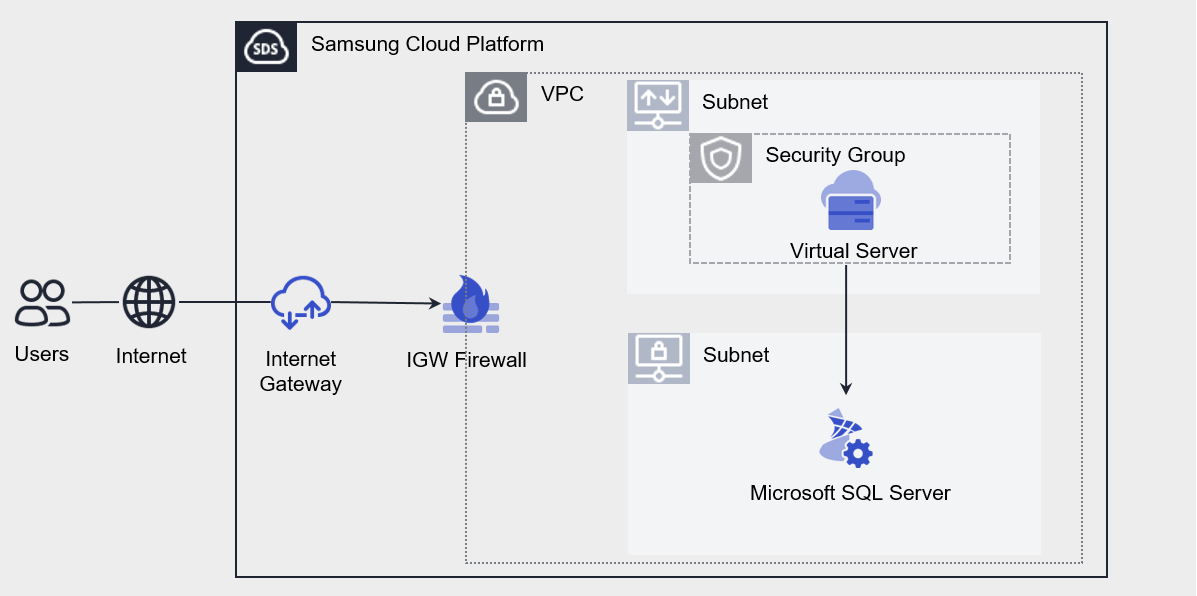
The Microsoft SQL Server(DBaaS) server connection scenario is a scenario where a Bastion host (Virtual Server) and a Database service are created, and the DB service is accessed through the Bastion host. To securely access Microsoft SQL Server (DBaaS) in the Samsung Cloud Platform environment, it is necessary to create a Bastion host and use it for network connection. To maintain a stable and high level of security, it is recommended to configure the Database service in a Private Subnet environment and configure the Bastion host in a limited Public Subnet environment.

This scenario largely describes the process of creating a Bastion host and Database service, and configuring the network environment for Bastion host and Database connection, and accessing it through a DB connection client.

Architecture
Figure. Microsoft SQL Server(DBaaS) server connection architecture

Scenario Components

You can configure the scenario using the following services.

Service Group
Service
Detailed Description
NetworkingVPCA service that provides an independent virtual network in a cloud environment
NetworkingVPC > SubnetA service that allows users to subdivide the network into smaller segments according to purpose/size within the VPC
NetworkingVPC > Public IPA service that reserves public IP and assigns and returns it to Compute resources
NetworkingVPC > Internet GatewayA service that connects VPC resources to the internet
NetworkingSecurity GroupA virtual firewall that controls the server’s traffic
DatabaseMicrosoft SQL Server(DBaaS)A service that easily creates and manages Microsoft SQL Server in a web environment
ComputeVirtual ServerVirtual server optimized for cloud computing
ComputeVirtual Server > KeypairEncryption file used to connect to the Virtual Server
Table. Scenario Component List
Note
  • The default policy of Security Group is Deny All, so only allowed IPs must be registered.
  • In/Outbound’s All Open(Any IP, Any Port) policy can expose cloud resources to external threats.
    • By specifying the necessary IP and Port to set the policy, you can enhance security.

Scenario composition method

To configure the scenario, create the necessary services through the following procedure.

1. Configuring the Network

This describes the process of configuring the network environment for connecting to the Bastion Host and Database services.

1-1. Creating a VPC

For detailed creation methods, please refer to the Networking > VPC > How-to guides guide.
  1. Click All services > Networking > VPC menu. It moves to the Service Home page of VPC.
  2. On the Service Home page, click the Create VPC button. It moves to the Create VPC page.
  3. VPC Creation page, please enter the information required for service creation.
    • IP range should be entered as 192.168.x.0/16.
  4. In the Summary panel, review the detailed information and estimated charges, and click the Complete button.
    • Once creation is complete, check the resource you created on the VPC list page.

1-2. Creating a Subnet

For detailed creation methods, please refer to the Networking > VPC > How-to guides > Subnet guide.
  1. Click All services > Networking > VPC menu. It moves to the Service Home page of VPC.
  2. Service Home page, click the Subnet menu. It moves to the Subnet list page.
  3. Click the Subnet Creation button. It moves to the Subnet Creation page.
  4. Subnet Creation page where you enter the information needed to create a service.
    • Subnet type should be selected as General.
    • Please select a pre-created VPC.
    • IP range should be entered as 192.168.x.0/24.
  5. In the Summary panel, review the detailed information and estimated charges, and click the Complete button.
    • Once creation is complete, check the created resource on the Subnet list page.

1-3. Creating an Internet Gateway

For detailed creation methods, please refer to the Networking > VPC > How-to guides > Internet Gateway guide.
  1. Click All services > Networking > VPC menu. It moves to the Service Home page of VPC.
  2. On the Service Home page, click the Internet Gateway menu. It moves to the Internet Gateway list page.
  3. Click the Create Internet Gateway button. It moves to the Create Internet Gateway page.
  4. Internet Gateway Creation page, please enter the required information necessary for service creation.
    • Please select a pre-created VPC.
    • Select Use in the Firewall usage item.
  5. In the Summary panel, review the detailed information and estimated charges, and then click the Complete button.
    • Once the creation is complete, check the created resource on the Internet Gateway list page.

1-4. Creating a Public IP

For detailed creation methods, please refer to the Networking > VPC > How-to guides > Public IP guide.
  1. Click All services > Networking > VPC menu. It moves to the Service Home page of VPC.
  2. Service Home page, click the Public IP menu. It moves to the Public IP list page.
  3. Public IP Reservation button, click. Move to the Public IP Reservation page.
  4. Public IP Reservation page where you enter the required information necessary for service reservation.
  5. In the Summary panel, review the detailed information and estimated billing amount, and click the Complete button.
    • Once creation is complete, check the created resource on the Public IP list page.

1-5. Creating a Security Group

For detailed creation methods, please refer to the Networking > Security Group > How-to guides guide.
  1. Click All services > Networking > Security Group menu. It moves to the Service Home page of Security Group.
  2. Service Home page, click the Create Security Group button. Move to the Create Security Group page.
  3. Security Group Creation page, please enter the required information necessary for service creation.
  4. Check the input information and click the Complete button.
    • Once creation is complete, check the created resource on the Security Group list page

2. Creating a Bastion host

This describes the process of configuring the Bastion Host where the database connection client should be installed.

2-1. Creating Server Keypair

For detailed creation methods, please refer to the Compute > Virtual Server > How-to guides > Keypair guide.
  1. Click All Services > Compute > Virtual Server menu. It moves to the Service Home page of Virtual Server.
  2. Service Home page, click the Keypair menu. It moves to the Keypair list page.
  3. Create Keypair button will be clicked. It moves to the Create Keypair page.
  4. Keypair creation page where you enter the required information necessary for service creation.
  5. Check the creation information and click the Complete button.
    • The key can only be downloaded for the first time, and re-issuance is not provided.
    • Please make sure to store the downloaded key in a safe place.

2-2. Creating a Bastion Host

For detailed creation methods, please refer to the Compute > Virtual Server > How-to guides guide.
  1. Click All Services > Compute > Virtual Server menu. It moves to the Service Home page of Virtual Server.
  2. Service Home page, click the Virtual Server creation button. Move to the Virtual Server creation page.
  3. Virtual Server Creation page, please enter the required information necessary for service creation.
  4. Summary panel, check the detailed information generated and the expected billing amount, and click the Complete button.
    • After creation is complete, check the created resource on the Virtual Server list page.

2-3. Check Bastion host connection ID and PW

  1. Click All Services > Compute > Virtual Server menu. It moves to the Service Home page of Virtual Server.
  2. Service Home page, click the Virtual Server menu. Move to the Virtual Server list page.
  3. Virtual Serve list page, click on the resource created in 2-2. Bastion host creation. It moves to the detailed information page of the corresponding resource.
  4. In the detailed information page, click the RDP password inquiry button in the Keypair name item. The RDP password inquiry pop-up window opens.
  5. RDP password inquiry popup window, attach the keypair file downloaded from 2-1. Server Keypair creation.
  6. After attaching, click the Password check button. The ID and password required to access the resource will be displayed.

3. Creating a Database

It describes the process of creating a Database service.

3-1. Creating Microsoft SQL Server (DBaaS) Service

For detailed creation methods, please refer to the Database > Microsoft SQL Server(DBaaS) > How-to guides guide.
  1. Click on the menu for all services > Database > Microsoft SQL Server(DBaaS). It moves to the Service Home page of Microsoft SQL Server(DBaaS).
  2. On the Service Home page, click the Create Microsoft SQL Server(DBaaS) button. It moves to the Create Microsoft SQL Server(DBaaS) page.
  3. Microsoft SQL Server(DBaaS) creation page, please enter the required information needed for service creation.
    • Select and connect to the pre-created VPC and Subnet.
    • Enter Database related creation information on the required information input screen.
    • Add the Bastion host IP in the IP access control item.
    • Database Port is 2866 by default, but users can also specify it.
  4. In the Summary panel, review the detailed information and estimated charges, and then click the Complete button.
    • Once creation is complete, check the created resource from the Microsoft SQL Server(DBaaS) list page.

4. Setting Rules

This describes the process of setting rules for users to connect to the Bastion host and rules for the Bastion host to connect to the Database.

4-1. Security Group Add Security Rules

For detailed creation methods, please refer to the Networking > Security Group > How-to guides guide.
  1. Click All Services > Networking > Security Group menu. It moves to the Service Home page of Security Group.
  2. Service Home page, click the Security Group menu. Move to the Security Group list page.
  3. 1-5. Creating a Security Group Select the Security Group resource created from 1-5. Creating a Security Group. It moves to the detailed information page of the corresponding resource.
  4. Click the Rules tab on the detailed information page. It moves to the Rules tab.
  5. Rule tab where you click the Add Rule button. Move to the Add Rule popup window.
  6. In the Add Rule popup window, enter the rules below and click the OK button
DirectionRemoteDestination AddressProtocolPortDescription
InboundCIDRUser PC IPTCP3389 (RDP)Bastion connection PC → Bastion host
OutboundCIDRDB IPTCPDatabase Port (direct input)Bastion host → Database
Fig. Security Group security rules to be added

4-2. Adding IGW Firewall Rules

For detailed creation methods, please refer to the Networking > Firewall > How-to guides guide.
  1. Click All services > Networking > Firewall menu. It moves to the Service Home page of Firewall.
  2. Service Home page, click the Firewall menu. It moves to the Firewall list page.
  3. Firewall list page, select the Internet Gateway resource name created in 1-3. Creating Internet Gateway. It moves to the detailed information page of the corresponding resource.
  4. Click the Rules tab on the detailed information page. It moves to the Rules tab.
  5. Rule tab, click the Add Rule button. Move to the Add Rule popup window.
  6. Add Rule In the popup window, enter the following rules and click the OK button.
Departure AddressDestination AddressProtocolPortActionDirectionDescription
Bastion connection PC IPBastion host IPTCP3389(RDP)AllowInboundUser PC → Bastion host
Table. Internet Gateway Firewall rules to be added

5. Connect to Database

This describes the process of a user accessing the Database through a DB connection client program.

This guide provides instructions on how to connect using SSMS (Microsoft SQL Server Management Studio). Since there are various database client programs and CLI utilities, you can also install and use the tools that are suitable for you.

5-1. Connect to the Bastion host

  1. Run Remote Desktop Connection in the Windows environment of the PC that wants to access the Bastion host, enter the NAT IP of the Bastion Host, and click the Connect button.
  2. When the remote desktop connection is successful, the User Credential Input Window opens. Enter the ID and Password confirmed in 2-3. Check Bastion host access ID and PW and click the Confirm button.

5-2. Install DB connection client program (SSMS) on Bastion host

  1. Go to the official Microsoft SQL Server page and download the SSMS program.
  2. Connect the hard drive of the user PC to upload the file to the Bastion host.
  3. Click the Details button for local devices and resources entries in the Local Resources tab of Remote Desktop Connection.
  4. Select the local disk where the file was downloaded to the drive and click the Confirm button.
  5. Download the file, copy it to the Bastion Host, and upload it, then click the SSMS (Microsoft SQL Server Management Studio) installation file to install it.

5-3. Using DB Connection Client Program (SSMS) to Connect to Database

  1. Run SSMS (Microsoft SQL Server Management Studio). The Connect to Server popup window will appear.
  2. Connect to Server popup window, enter the database server information created in 3-1. Microsoft SQL Server(DBaaS) service creation and click the Connect button.
    Required Input Element ItemsInput Value
    Server typeDatabase Engine
    Server nameDatabase server IP, Database Port (ex. 192.168.10.1,2866)
    AuthenticationSQL Server Authentication
    LoginDatabase username
    PasswordDatabase password
    EncryptionOptional
    DB Connection Client Program Input Items
  3. Once the connection is complete, the Database will be connected. After connection, you can try performing simple queries, etc.