This is the multi-page printable view of this section. Click here to print.

Return to the regular view of this page.

Overview

Service Overview

MariaDB (DBaaS) is an open-source relational database (RDBMS) with high compatibility with MySQL. Samsung Cloud Platform provides an environment that can automate MariaDB installation and perform management functions for operation through a web-based Console.

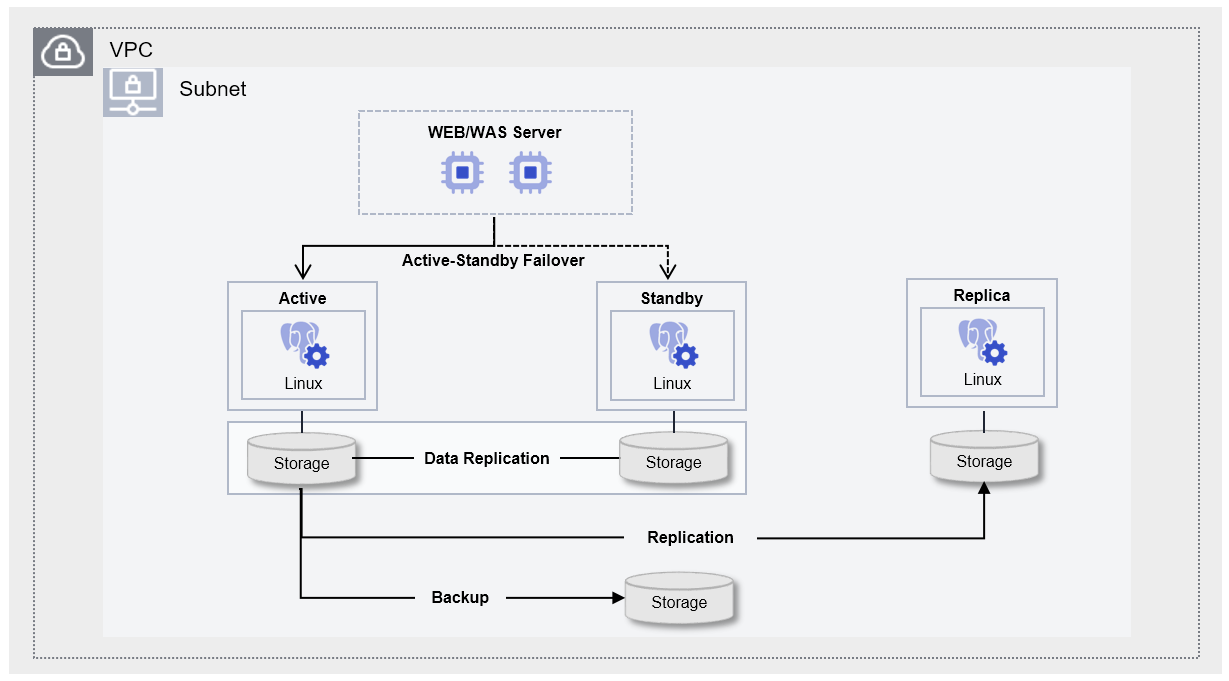
MariaDB (DBaaS) is designed as a high‑availability architecture that performs storage‑based data replication and minimizes failover time. To prevent data loss, when the contents of the Active server change, they are synchronously replicated to the Standby server, and up to five read‑only Replica servers for read load balancing and disaster recovery (DR) are provided. Additionally, it provides an automatic backup feature at user-specified times to prepare for issues with the DB server or data, enabling recovery of data at the desired point in time.

Architecture
Figure. MariaDB (DBaaS) Architecture

Provided Features

MariaDB (DBaaS) provides the following features.

  • Auto Provisioning (Auto Provisioning): Allows installation and configuration of Database(DB) via UI, and provides an Active-standby redundancy configuration based on storage replication. * When the active server fails, it automatically fails over to standby.
  • Operation Control Management: Provides a function to control the status of running servers. * In addition to start and stop, you can restart if there is a DB issue or to apply configuration changes. * When high availability (HA) is configured, the user can manually perform node switching between Active and Standby via a switch‑over.
  • Backup and Recovery: Provides data backup functionality based on its own backup commands. * Backup time windows and storage locations can be set by the user, and additional fees are incurred based on the backup size. * It also provides a recovery function for backed‑up data, so when the user performs a recovery, a separate database is created and the recovery proceeds to the point in time selected by the user (the backup save point or a user‑specified point). * When restoring to a user-specified point in time, the restore point can be set up to 5 minutes, 10 minutes, 30 minutes, or 1 hour earlier, based on the stored backup and archive files.
  • Version Management: Provides a version upgrade (Minor) feature based on some functionality improvements and security patches. * Whether to perform a backup for a version upgrade can be selected by the user, and if a backup is performed, the data is backed up before applying the patch, after which the DB engine is updated.
  • Replica configuration: Up to five Read Replicas can be configured in the same or different regions for read load balancing and disaster recovery (DR).
  • Audit configuration: Provides an Audit configuration feature that can monitor users’ DB access and the results of DDL (Data Definition Language)/DML (Data Manipulation Language) operations.
  • Parameter management: Performance improvements and security-related DB configuration parameters can be modified.
  • Service Status Query: Retrieves the final status of the current DB service.
  • Monitoring: CPU, memory, performance monitoring information can be viewed through Cloud Monitoring and Servicewatch.
  • DB User Management: Query and manage the DB account (user) information registered in the DB.
  • DB Access Control Management: Based on DB accounts registered in the DB, you can register and revoke allowed IPs for access.
  • Archive Management: You can set the Archive file retention period (1 to 35 days) on the DB server and configure the Archive mode (On/Off).
  • DB Log Export: Through Audit settings, you can export stored logs to the user’s Object Storage.
  • Migration: Synchronize data in real time with the operational database and support migration using replication without service interruption.
  • OS Kernel Upgrade: You can upgrade the OS Kernel to apply some feature improvements and security patches.

Component

MariaDB(DBaaS) provides pre‑validated engine versions and various server types in accordance with its open‑source support policy. Users can select and use it based on the scale of the service they wish to configure.

Engine version

The engine versions supported by MariaDB (DBaaS) are as follows.

Technical support can be used until the supplier’s EoTS (End of Technical Service) date, and the EOS date when new creation is stopped is set to six months before the EoTS date.

Since the EOS and EoTS dates may change according to the supplier’s policy, please refer to the supplier’s license management policy page for details.

serviceProvided versionEOS Date (Samsung Cloud Platform new creation stop date)EoTS Date (Community technical support end date)
MariaDB (Community)10.6.52026-03-192026-07-06
10.6.92026-03-192026-07-06
10.6.102026-03-192026-07-06
10.6.122026-03-192026-07-06
10.6.142026-03-192026-07-06
10.6.152026-03-192026-07-06
10.6.162026-03-192026-07-06
10.6.172026-03-192026-07-06
10.6.192026-03-192026-07-06
10.6.222026-03-192026-07-06
10.11.82027-09 (planned)2028-02-16
10.11.92027-09 (planned)2028-02-16
10.11.132027-09 (planned)2028-02-16
11.4.72028-12 (planned)2029-05-29
Table. Engine versions offered for MariaDB (DBaaS)
information

The next version of MariaDB is scheduled to be available after July 2026. The actual service delivery schedule is subject to change.

  • MariaDB 10.11.15
  • MariaDB 11.4.10

Server type

The server types supported by MariaDB (DBaaS) are as follows.

For detailed information about the server types offered by MariaDB (DBaaS), refer to MariaDB(DBaaS) Server Types.

Standard db1v2m4
CategoryExampleDetailed description
Server typeStandardProvided server types
  • Standard: Standard configuration (vCPU, Memory) commonly used
  • High Capacity: Large server specifications of 24 vCores or more
Server specificationsdb1Provided server specifications
  • db1: Standard specifications (vCPU, Memory) commonly used
  • dbh2: Large-scale server specifications
    • Provides servers with 24 vCores or more
Server specificationsv2vCore count
  • v2: 2 virtual cores
Server specificationsm4Memory capacity
  • m4: 4GB Memory
Table. MariaDB (DBaaS) server type components

Preceding Service

This is a list of services that must be pre-configured before creating the service. Please refer to the guide provided for each service and prepare in advance.

Service CategoryserviceDetailed description
NetworkingVPCA service that provides an isolated virtual network in a cloud environment
Table. MariaDB (DBaaS) Pre-service

1 - Server Types

MariaDB(DBaaS) server type

MariaDB(DBaaS) provides server types composed of various combinations of CPU, memory, and network bandwidth. When creating a MariaDB(DBaaS), the Database Engine is installed according to the server type selected for the intended use.

The server types supported by MariaDB (DBaaS) are as follows.

Standard db1v2m4
Category
exampleDetailed description
Server typeStandardProvided server type classifications
  • Standard: Configured with commonly used standard specifications (vCPU, Memory)
  • High Capacity: Large-capacity server specifications exceeding Standard
Server specificationsdb1Provided server type classification and generation
  • db1: indicates a standard specification, and 1 denotes the generation
  • dbh2: h indicates a high-capacity server specification, and 2 denotes the generation
Server specificationsv2Number of vCores
  • v2: 2 virtual cores
Server specificationsm4Memory capacity
  • m4: 4GB Memory
Table. MariaDB (DBaaS) server type format

db1 server type

The db1 server type of MariaDB(DBaaS) is offered with standard specifications (vCPU, Memory) and is suitable for various database workloads.

  • Intel 3rd‑generation (Ice Lake) Xeon Gold 6342 Processor up to 3.3 GHz
  • Supports up to 16 vCPUs and 256 GB of memory
  • Maximum networking speed of 12.5 Gbps
CategoryServer typevCPUMemoryNetwork Bandwidth
Standarddb1v1m21 vCore2 GBUp to 10 Gbps
Standarddb1v2m42 vCore4 GBUp to 10 Gbps
Standarddb1v2m82 vCore8 GBUp to 10 Gbps
Standarddb1v2m162 vCore16 GBUp to 10 Gbps
Standarddb1v2m242 vCore24 GBUp to 10 Gbps
Standarddb1v2m322 vCore32 GBUp to 10 Gbps
Standarddb1v4m84 vCore8 GBUp to 10 Gbps
Standarddb1v4m164 vCore16 GBUp to 10 Gbps
Standarddb1v4m324 vCore32 GBUp to 10 Gbps
Standarddb1v4m484 vCore48 GBUp to 10 Gbps
Standarddb1v4m644 vCore64 GBUp to 10 Gbps
Standarddb1v6m126 vCore12 GBUp to 10 Gbps
Standarddb1v6m246 vCore24 GBUp to 10 Gbps
Standarddb1v6m486 vCore48 GBUp to 10 Gbps
Standarddb1v6m726 vCore72 GBUp to 10 Gbps
Standarddb1v6m966 vCore96 GBUp to 10 Gbps
Standarddb1v8m168 vCore16 GBUp to 10 Gbps
Standarddb1v8m328 vCore32 GBUp to 10 Gbps
Standarddb1v8m648 vCore64 GBUp to 10 Gbps
Standarddb1v8m968 vCore96 GBUp to 10 Gbps
Standarddb1v8m1288 vCore128 GBUp to 10 Gbps
Standarddb1v10m2010 vCore20 GBUp to 10 Gbps
Standarddb1v10m4010 vCore40 GBUp to 10 Gbps
Standarddb1v10m8010 vCore80 GBUp to 10 Gbps
Standarddb1v10m12010 vCore120 GBUp to 10 Gbps
Standarddb1v10m16010 vCore160 GBUp to 10 Gbps
Standarddb1v12m2412 vCore24 GBUp to 12.5 Gbps
Standarddb1v12m4812 vCore48 GBUp to 12.5 Gbps
Standarddb1v12m9612 vCore96 GBUp to 12.5 Gbps
Standarddb1v12m14412 vCore144 GBUp to 12.5 Gbps
Standarddb1v12m19212 vCore192 GBUp to 12.5 Gbps
Standarddb1v14m2814 vCore28 GBUp to 12.5 Gbps
Standarddb1v14m5614 vCore56 GBUp to 12.5 Gbps
Standarddb1v14m11214 vCore112 GBUp to 12.5 Gbps
Standarddb1v14m16814 vCore168 GBUp to 12.5 Gbps
Standarddb1v14m22414 vCore224 GBUp to 12.5 Gbps
Standarddb1v16m3216 vCore32 GBUp to 12.5 Gbps
Standarddb1v16m6416 vCore64 GBUp to 12.5 Gbps
Standarddb1v16m12816 vCore128 GBUp to 12.5 Gbps
Standarddb1v16m19216 vCore192 GBUp to 12.5 Gbps
Standarddb1v16m25616 vCore256 GBUp to 12.5 Gbps
Table. MariaDB (DBaaS) server type specifications - db1 server type

db2 server type

The db2 server type of MariaDB (DBaaS) is offered with standard specifications (vCPU, Memory) and is suitable for various database workloads.

  • Intel 4th‑generation (Sapphire Rapids) Xeon Gold 6448H Processor up to 3.2 GHz
  • Supports up to 16 vCPUs and 256 GB of memory
  • Maximum networking speed of 12.5 Gbps
CategoryServer typevCPUMemoryNetwork Bandwidth
Standarddb2v1m21 vCore2 GBUp to 10 Gbps
Standarddb2v2m42 vCore4 GBUp to 10 Gbps
Standarddb2v2m82 vCore8 GBUp to 10 Gbps
Standarddb2v2m162 vCore16 GBUp to 10 Gbps
Standarddb2v2m242 vCore24 GBUp to 10 Gbps
Standarddb2v2m322 vCore32 GBUp to 10 Gbps
Standarddb2v4m84 vCore8 GBUp to 10 Gbps
Standarddb2v4m164 vCore16 GBUp to 10 Gbps
Standarddb2v4m324 vCore32 GBUp to 10 Gbps
Standarddb2v4m484 vCore48 GBUp to 10 Gbps
Standarddb2v4m644 vCore64 GBUp to 10 Gbps
Standarddb2v6m126 vCore12 GBUp to 10 Gbps
Standarddb2v6m246 vCore24 GBUp to 10 Gbps
Standarddb2v6m486 vCore48 GBUp to 10 Gbps
Standarddb2v6m726 vCore72 GBUp to 10 Gbps
Standarddb2v6m966 vCore96 GBUp to 10 Gbps
Standarddb2v8m168 vCore16 GBUp to 10 Gbps
Standarddb2v8m328 vCore32 GBUp to 10 Gbps
Standarddb2v8m648 vCore64 GBUp to 10 Gbps
Standarddb2v8m968 vCore96 GBUp to 10 Gbps
Standarddb2v8m1288 vCore128 GBUp to 10 Gbps
Standarddb2v10m2010 vCore20 GBUp to 10 Gbps
Standarddb2v10m4010 vCore40 GBUp to 10 Gbps
Standarddb2v10m8010 vCore80 GBUp to 10 Gbps
Standarddb2v10m12010 vCore120 GBUp to 10 Gbps
Standarddb2v10m16010 vCore160 GBUp to 10 Gbps
Standarddb2v12m2412 vCore24 GBUp to 12.5 Gbps
Standarddb2v12m4812 vCore48 GBUp to 12.5 Gbps
Standarddb2v12m9612 vCore96 GBUp to 12.5 Gbps
Standarddb2v12m14412 vCore144 GBUp to 12.5 Gbps
Standarddb2v12m19212 vCore192 GBUp to 12.5 Gbps
Standarddb2v14m2814 vCore28 GBUp to 12.5 Gbps
Standarddb2v14m5614 vCore56 GBUp to 12.5 Gbps
Standarddb2v14m11214 vCore112 GBUp to 12.5 Gbps
Standarddb2v14m16814 vCore168 GBUp to 12.5 Gbps
Standarddb2v14m22414 vCore224 GBUp to 12.5 Gbps
Standarddb2v16m3216 vCore32 GBUp to 12.5 Gbps
Standarddb2v16m6416 vCore64 GBUp to 12.5 Gbps
Standarddb2v16m12816 vCore128 GBUp to 12.5 Gbps
Standarddb2v16m19216 vCore192 GBUp to 12.5 Gbps
Standarddb2v16m25616 vCore256 GBUp to 12.5 Gbps
Table. MariaDB (DBaaS) server type specifications - db2 server type

dbh2 server type

The dbh2 server type of MariaDB (DBaaS) is offered with high-capacity server specifications and is suitable for database workloads that require large-scale data processing.

  • Intel 4th‑generation (Sapphire Rapids) Xeon Gold 6448H Processor up to 3.2 GHz
  • Supports up to 128 vCPUs and 1,536 GB of memory
  • Networking speed up to 25 Gbps
CategoryServer typevCPUMemoryNetwork Bandwidth
High Capacitydbh2v24m4824 vCore48 GBMaximum 25 Gbps
High Capacitydbh2v24m9624 vCore96 GBMaximum 25 Gbps
High Capacitydbh2v24m19224 vCore192 GBMaximum 25 Gbps
High Capacitydbh2v24m28824 vCore288 GBMaximum 25 Gbps
High Capacitydbh2v32m6432 vCore64 GBUp to 25 Gbps
High Capacitydbh2v32m12832 vCore128 GBMaximum 25 Gbps
High Capacitydbh2v32m25632 vCore256 GBMaximum 25 Gbps
High Capacitydbh2v32m38432 vCore384 GBMaximum 25 Gbps
High Capacitydbh2v48m19248 vCore192 GBMaximum 25 Gbps
High Capacitydbh2v48m57648 vCore576 GBMaximum 25 Gbps
High Capacitydbh2v64m25664 vCore256 GBUp to 25 Gbps
High Capacitydbh2v64m76864 vCore768 GBUp to 25 Gbps
High Capacitydbh2v72m28872 vCore288 GBUp to 25 Gbps
High Capacitydbh2v72m86472 vCore864 GBMaximum 25 Gbps
High Capacitydbh2v96m38496 vCore384 GBUp to 25 Gbps
High Capacitydbh2v96m115296 vCore1152 GBUp to 25 Gbps
High Capacitydbh2v128m512128 vCore512 GBMaximum 25 Gbps
High Capacitydbh2v128m1536128 vCore1536 GBMaximum 25 Gbps
Table. MariaDB (DBaaS) server type specifications - dbh2 server type

2 - Monitoring Metrics

Cloud Monitoring service termination notice

According to Samsung Cloud Platform’s policy, the Cloud Monitoring service is scheduled to be terminated.

Accordingly, services whose monitoring metrics are linked in Cloud Monitoring will no longer be able to monitor resources through Cloud Monitoring after the service improvement work in November 2026.
After that, resource monitoring can be continuously performed through the ServiceWatch service released in October 2025.

To ensure smooth service usage, proceed with the migration work according to the service termination schedule below.

  1. Guide to Applying Monitoring Service by Resource

    • New Resources: Resources created after the service improvement work in March 2026 are monitored by default using the ServiceWatch service.
    • Existing resources: After the service improvement work in September 2026 We provide concurrent monitoring through Cloud Monitoring and ServiceWatch services.
    • During the parallel operation period, we must prepare for the Servicewatch transition. *
      Performance and log data backup, settings configured by users linked with existing Cloud Monitoring (ex. You need to review the event policies, etc., perform tasks such as resetting the ServiceWatch service, and complete them.
  2. Notice of the phased termination schedule for the Cloud Monitoring service

    • Console menu termination (September 2026 service improvement work)
      • You cannot access the Cloud Monitoring Console through the Console menu; you can only connect via the separate URLs for each region listed below.
* Service termination (November 2026 service improvement work)
  * All services of Cloud Monitoring, including the API, will be permanently discontinued.
	  * **After the service ends in November, Cloud Monitoring data cannot be accessed.**     	  * Be sure to complete the ServiceWatch migration within the parallel operation period**.

Detailed information about ServiceWatch can be found in the ServiceWatch Overview.

MariaDB(DBaaS) Monitoring Metrics

The table below shows the performance monitoring metrics for MariaDB (DBaaS) that can be viewed through Cloud Monitoring. For detailed usage of Cloud Monitoring, refer to the Cloud Monitoring guide.

The server monitoring metrics for MariaDB (DBaaS) can be found in the Virtual Server Monitoring Metrics guide.

Performance itemsDetailed descriptionunit
Active LocksNumber of Active Lockscnt
Active SessionsNumber of Active Sessionscnt
Connection Usage [Total]DB connection session usage rate%
ConnectionsNumber of connectionscnt
Connections [MAX]max connected threads countcnt
Binary Log Used [MB]binary log usageMB
Data Directory Used [MB]data directory usageMB
Open FilesNumber of open DB filescnt
Open Files [MAX]Number of DB files that can be openedcnt
Open Files UsageDB file maximum count usage rate%
Relay Log Used [MB]relay log usageMB
Instance Status [PID]mariadbd processpid
Safe PIDmariadbd_safe processpid
Slave Behind Master secondsData time difference between Master and Slave (run only on slave)sec
Tablespace UsedTablespace usageMB
Tablespace Used [Total]Total tablespace usageMB
Running Threadsrunning thread countcnt
SlowqueriesNumber of SQL queries running for a long time (over 5 minutes) (by DB)cnt
Slowqueries [Total]Number of long-running (5 minutes or more) SQL queries (total)cnt
Transaction Time [Long]Maximum transaction execution timesec
Wait LocksNumber of sessions blocked for more than 60 seconds by lockcnt
Table. MariaDB(DBaaS) Monitoring Metrics

3 - ServiceWatch Metrics

MariaDB sends metrics to ServiceWatch. The metrics provided by default monitoring are data collected at a 1‑minute interval.

Reference
For how to view metrics in ServiceWatch, refer to the ServiceWatch guide.

Basic Metrics

The following are the basic metrics for the namespace MariaDB(DBaaS).

The indicators whose names are shown in bold below are the key indicators selected among the basic metrics provided by MariaDB(DBaaS). The key metrics are used to configure the service dashboards that are automatically built for each service in ServiceWatch.

Each metric guides users, through the user guide, on which statistical values are meaningful when querying that metric, and among the meaningful statistics, the values displayed in bold are the primary statistics. In the service dashboard, you can view key metrics using these primary statistical values.

OS Basic Metrics

Category
Performance itemsunitDetailed descriptionmeaningful statistics
CPUCPU UsagePercentCPU usage
  • Maximum
DiskDisk UsagePercentDisk usage
  • Maximum
DiskDisk Write BytesBytes/SecondWrite bandwidth (bytes/second) on block device
  • average
  • maximum
  • minimum
DiskDisk Read BytesBytes/SecondRead throughput from block device (bytes/second)
  • average
  • maximum
  • minimum
DiskDisk Write RequestsCount/SecondNumber of write requests on block device (requests per second)
  • average
  • maximum
  • minimum
DiskDisk Read RequestsCount/SecondNumber of read requests on block device (requests per second)
  • average
  • maximum
  • minimum
DiskAverage Disk I/O Queue SizeNoneAverage queue length of requests issued to the block device
  • average
  • maximum
  • minimum
DiskDisk I/O UtilizationPercentThe proportion of time the block device actually spent handling I/O operations
  • average
  • maximum
  • minimum
MemoryMemory UsagePercentMemory usage
  • Maximum
NetworkNetwork In BytesBytes/SecondReceived data rate (bytes/second) on the network interface
  • average
  • maximum
  • minimum
NetworkNetwork Out BytesBytes/SecondTransmitted capacity (bytes/second) on the network interface
  • average
  • maximum
  • minimum
NetworkTCP ConnectionsCount/SecondCurrent total number of successfully established TCP connections
  • average
  • maximum
  • minimum
NetworkNetwork In PacketsCountNumber of packets received on the network interface
  • average
  • maximum
  • minimum
NetworkNetwork Out PacketsCountNumber of packets transmitted on the network interface
  • average
  • maximum
  • minimum
NetworkNetwork In DroppedCountNumber of packet drops received on the network interface
  • average
  • maximum
  • minimum
NetworkNetwork Out DroppedCountNumber of packet drops transmitted from the network interface
  • average
  • maximum
  • minimum
NetworkNetwork In ErrorsCountNumber of packet errors received on the network interface
  • average
  • maximum
  • minimum
NetworkNetwork Out ErrorsCountNumber of packet errors transmitted on the network interface
  • average
  • maximum
  • minimum
Table. OS basic metrics

MariaDB basic metrics

Category
Performance itemsunit
Detailed description
meaningful statistics
ActivelockActive locksCountNumber of transactions in the InnoDB storage engine that have been in lock wait state for 1 minute (60 seconds) or longer.
  • Total
  • Average
  • Maximum
  • Minimum
ActivesessionActive sessionsCountNumber of active sessions
  • Total
  • Average
  • Maximum
  • Minimum
ActivesessionConnection usagePercentDB connection session usage rate
  • Total
  • Average
  • Maximum
  • Minimum
ActivesessionConnectionsCountDB connection session
  • Total
  • Average
  • Maximum
  • Minimum
ActivesessionAborted ConnectionsCount/MinuteNumber of abnormal terminated connections
  • Total
  • Average
  • Maximum
  • Minimum
DatafileCurrent open filesCountNumber of file descriptors opened by the DB
  • Total
  • Average
  • Maximum
  • Minimum
DatafileMax open filesCountMaximum number of file descriptors the DB can open
  • Total
  • Average
  • Maximum
  • Minimum
DatafileOpen files usagePercentDB file maximum count utilization
  • Total
  • Average
  • Maximum
  • Minimum
InnoDBInnoDB buffer pool hit ratioPercentThe ratio of data read directly from memory without accessing the disk
  • Total
  • Average
  • Maximum
  • Minimum
InnoDBInnodb row lock wait transactionsCountCurrent number of InnoDB transactions waiting for a row lock
  • Total
  • Average
  • Maximum
  • Minimum
InnoDBInnoDB row lock timeMillisecondsTotal time waited due to InnoDB row locks (in milliseconds)
  • Total
  • Average
  • Maximum
  • Minimum
InnoDBInnoDB deadlocksCount/MinuteNumber of transactions rolled back due to deadlock
  • Total
  • Average
  • Maximum
  • Minimum
InnoDBTable lock waitsCount/MinuteNumber of waits that occurred to acquire a table lock
  • Total
  • Average
  • Maximum
  • Minimum
InnoDBTemp disk tablesCount/MinuteNumber of Temp Tables created on disk
  • Total
  • Average
  • Maximum
  • Minimum
InnoDBInnodb log waitsCountNumber of times waited to write the redo log to disk
  • Total
  • Average
  • Maximum
  • Minimum
StateInstance stateNoneCheck Scalable DB up/down status
  • 1 - Up
  • 0 - Down
-
StateSlave behind master secondsSecondsReplica latency (unit: seconds)
  • Total
  • Average
  • Maximum
  • Minimum
StateSlave io thread running (Replica Only)NoneI/O Thread status
  • 1 - Running
  • 0 - Down
-
StateSlave SQL thread running (Replica Only)NoneSQL Thread status
  • 1 - Running
  • 0 - Down
-
TablespaceTablespace usedMegabytesTablespace usage
  • Total
  • Average
  • Maximum
  • Minimum
TablespaceTablespace used(TOTAL)MegabytesTablespace usage (total)
  • Total
  • Average
  • Maximum
  • Minimum
TransactionsSlow queriesCountNumber of queries running longer than 10 seconds
  • Total
  • Average
  • Maximum
  • Minimum
TransactionsLong transaction timeSecondsLong Transaction time
  • Total
  • Average
  • Maximum
  • Minimum
TransactionsWait locksCountNumber of sessions waiting for lock
  • Total
  • Average
  • Maximum
  • Minimum
TransactionsSQL Queries/MinuteCount/MinuteQueries executed per minute
  • Total
  • Average
  • Maximum
  • Minimum
Table. MariaDB basic metrics