Overview
Service Overview
Kubernetes Engine is a service that provides lightweight virtual computing and containers, as well as a Kubernetes cluster to manage them. Users can utilize the Kubernetes environment without complex preparation by installing, operating, and maintaining the Kubernetes Control Plane.
Features
Standard Kubernetes Environment Configuration: The standard Kubernetes environment can be used without separate configuration through the default Kubernetes Control Plane provided. It is compatible with applications in other standard Kubernetes environments, so you can use standard Kubernetes applications without modifying the code.
Easy Kubernetes Deployment: Provides secure communication between worker nodes and managed control planes, and quickly provisions worker nodes, allowing users to focus on building applications on the provided container environment.
Convenient Kubernetes Management: Provides various management features to conveniently use the created Kubernetes cluster, such as cluster information inquiry and cluster management, namespace management, and workload management through the dashboard for enterprise environments.
Service Composition Diagram
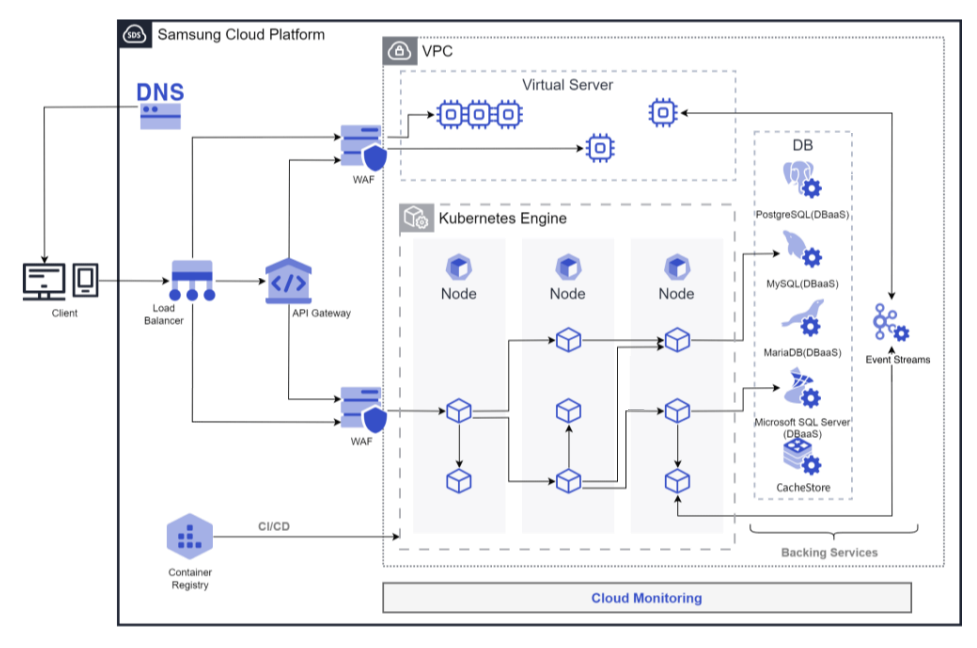
Provided Features
Kubernetes Engine provides the following features.
- Cluster Management: You can create and manage clusters to use the Kubernetes Engine service. After creating a cluster, you can add services necessary for operation, such as nodes, namespaces, and workloads.
- Node Management: A node is a set of machines that run containerized applications. Every cluster must have at least one worker node to deploy applications. Nodes can be defined and used by defining a node pool. Nodes belonging to a node pool must have the same server type, size, and OS image, and multiple node pools can be created to establish a flexible deployment strategy.
- Namespace Management: Namespace is a logical separation unit within a Kubernetes cluster, and is used to specify access permissions or resource usage limits by namespace.
- Workload Management: Workload is an application running on Kubernetes Engine. You can create a namespace, then add or delete workloads. Workloads are created and managed item by item, such as deployments, pods, stateful sets, daemon sets, jobs, and cron jobs.
- Service and Ingress Management: Service is an abstraction method that exposes applications running in a set of pods as a network service, and Ingress is used to expose HTTP and HTTPS paths from outside the cluster to the inside. After creating a namespace, you can create or delete services, endpoints, ingresses, and ingress classes.
- Storage Management: When using Kubernetes Engine, you can create and manage the storage to be used. Storage is created and managed by items such as PVC, PV, and storage class.
- Configuration Management: When there is a need to manage values that change inside a container according to multiple environments such as Dev/Prod, managing them with separate images due to environment variables is inconvenient and causes significant cost waste. In Kubernetes, you can manage environment variables or configuration values as variables from the outside so that they can be inserted when a Pod is created, and at this time, ConfigMap and Secret can be used.
- Access Control: In cases where multiple users access a Kubernetes cluster, you can grant permissions for specific APIs or namespaces to restrict access. You can apply Kubernetes’ role-based access control (RBAC) feature to set permissions for clusters or namespaces. You can create and manage cluster roles, cluster role bindings, roles, and role bindings.
Component
Control Plane
The Control Plane is the master node role in the Kubernetes Engine service. The master node is the management node of the cluster, and it plays a role in managing other nodes in the cluster. The cluster is the basic creation unit of the Kubernetes Engine service, and it is used to manage node pools, objects, controllers, and other components within it. Users set up the cluster name, control plane, network, File Storage, and other settings, and then create a node pool within the cluster to use it. The master node assigns tasks to the cluster, monitors the status of the nodes, and plays a role in data communication between nodes.
The cluster name creation rule is as follows.
- It starts with English and can be set within 3-30 characters using English, numbers, and special characters (
-). - The cluster name must not be duplicated with the existing one.
Worker Node
The Worker Node is a work node in the cluster, playing a role in performing the cluster’s tasks. The Worker Node receives tasks from the cluster’s master node, performs them, and reports the task results to the cluster’s master node. All nodes created within the node pool and namespace play the role of a worker node.
The creation rule of the node pool, which is a collection of worker nodes, is as follows.
- A node pool must have at least one node to be created for application deployment to be possible.
- Up to 100 nodes can be created in a node pool.
- Since the maximum number of nodes is 100, if there are 100 node pools, 1 node per node pool, and if there are 50 node pools, 2 nodes per node pool, the total number of nodes can be created freely within 100 nodes.
- It is possible to set up Block Storage connected to the node pool.
- It is possible to set the server type, size, and OS image for nodes belonging to the node pool, and all must be the same.
- Auto-Scaling service allows you to set automatic node pool expansion/reduction according to the requirements of the deployed application.
Preceding Service
This is a list of services that must be pre-configured before creating this service. Please refer to the guide provided for each service and prepare in advance for more details.
| Service Category | Service | Detailed Description |
|---|---|---|
| Networking | VPC | A service that provides an independent virtual network in a cloud environment |
| Networking | Security Group | A virtual firewall that controls the server’s traffic |
| Storage | File Storage | A storage that allows multiple clients to share files over the network
|