Service Overview
Virtual Server can be allocated freely as needed at the time needed without having to purchase infrastructure resources such as CPU, Memory provided by the server individually, and it is a virtual server optimized for cloud computing. In a cloud environment, you can use resources with optimized performance according to the user’s computing usage purpose such as development, testing, and application execution.
Features
Easy and convenient computing environment configuration: Through a web-based console, users can easily use self-service from Virtual Server provisioning to resource management and cost management. If capacity changes of major resources such as CPU or Memory are needed while using Virtual Server, they can be easily scaled up or down without operator intervention.
Providing various types of services: Provides virtualized vCore/Memory resources according to predefined server types (1~128 vCore).
- General Virtual Server: Provides commonly used Computing Spec (up to 16 vCore, 256 GB)
- Large-capacity Virtual Server: Provided when large-capacity resources beyond the standard Virtual Server Spec are needed
Strong Security Implementation: Through the Security Group service, it controls inbound/outbound traffic communicating with external internet or other VPC (Virtual Private Cloud) to safely protect the server. Additionally, real-time monitoring enables stable operation of computing resources.
Service Architecture Diagram
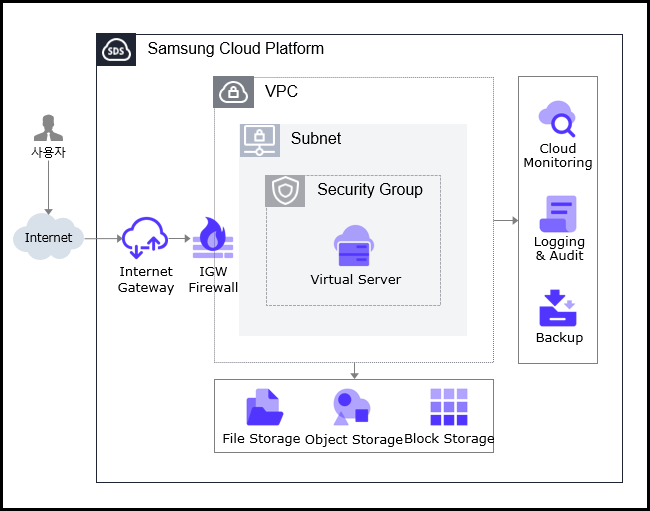
Provided Features
Virtual Server provides the following functions.
- Auto Provisioning and Management: Provides functions from Virtual Server provisioning to resource management and cost management through a web-based console. If you need to change the capacity of major resources such as CPU or Memory while using Virtual Server, you can change it immediately using the server type modification feature.
- Standard server type and Image provision: Provides virtualized vCore/Memory resources according to the standard server type, and provides a standard OS Image.
- Storage Connection: Provides additional connected storage besides the OS disk. Block Storage, File Storage, and Object Storage can be added and used.
- Network Connection: You can connect the Virtual Server’s general subnet/IP settings and Public NAT IP. Provides a local subnet connection for inter-server communication. This operation can be modified on the detail page.
- Security Group applied: Through the Security Group service, it controls inbound/outbound traffic communicating with external internet or other VPCs, safely protecting the server.
- Monitoring: You can check monitoring information such as CPU, Memory, Disk that correspond to computing resources through the Cloud Monitoring service.
- Backup and Recovery: You can backup and recover Virtual Server Image through the Backup service.
- Cost Management: You can create, stop, or terminate servers as needed, and since billing is based on actual usage time, you can check costs according to usage.
- ServiceWatch service integration provision: You can monitor data through the ServiceWatch service.
Components
Virtual Server provides standard server types and standard OS images. Users can select and use them according to the desired service scale.
Image
You can create and manage images. The main features are as follows.
- Image creation: You can create an Image from the configuration of the Virtual Server you are using, and you can create an Image by uploading the user’s Image file to Object Storage.
- Create Shared Image: You can create an Image with Visibility set to Private as a Shared Image that can be shared.
- Share with another Account: You can share the Image with another Account.
- Image creation and usage methods, please refer to the How-to guides > Image document.
Keypair
To provide a safer OS access, we enhance security by offering a Key Pair instead of the ID/Password entry method. The main features are as follows.
- Keypair creation: Create user credentials to connect to the Virtual Server.
- Get Public Key: You can retrieve the public key by loading a file or entering the public key directly.
- For creating and using Keypair, refer to the How-to guides > Keypair document.
Server Group
Through Server Group settings, you can place the Block Storage added when creating a Virtual Server near or distributed across racks and hosts. The main features are as follows.
- Server Group creation: You can set Virtual Servers belonging to the same Server Group to Anti-Affinity (distributed placement), Affinity (proximate placement), Partition (distributed placement of Virtual Server and Block Storage).
- For how to create and use Server Group, refer to the How-to guides > Server Group document.
OS Image Provided Version
The OS Image provided by Virtual Server are as follows
| OS Image Version | EoS Date |
|---|---|
| Alma Linux 8.10 | 2029-05-31 |
| Alma Linux 9.6 | 2025-11-17 |
| Oracle Linux 8.10 | 2029-07-31 |
| Oracle Linux 9.6 | 2025-11-25 |
| RHEL 8.10 | 2029-05-31 |
| RHEL 9.4 | 2026-04-30 |
| RHEL 9.6 | 2027-05-31 |
| Rocky Linux 8.10 | 2029-05-31 |
| Rocky Linux 9.6 | 2025-11-30 |
| Ubuntu 22.04 | 2027-06-30 |
| Ubuntu 24.04 | 2029-06-30 |
| Windows 2019 | 2029-01-09 |
| Windows 2022 | 2031-10-14 |
- Linux operating systems such as Alma Linux and Rocky Linux provide only even Minor versions, except for the very last release of a Major version. This is a policy to ensure the stability and consistency of the SCP system. We recommend checking the EOS (End of Support) and EOL (End of Life) dates for the operating system, and if necessary, applying new or additional individual packages to maintain a stable environment.
Server Type
The server types supported by Virtual Server are as follows. For more details about server types, refer to Virtual Server Server Type.
Standard s1v2m4
Category | Example | Detailed description |
|---|---|---|
| Server Type | Standard | Provided server type categories
|
| Server Specification | s1 | Provided server type classification and generation
|
| Server specifications | v2 | Number of vCores
|
| Server Specifications | m4 | Memory Capacity
|
Constraints
- If you create a Virtual Server with Rocky Linux or Oracle Linux, additional settings are required for time synchronization (NTP: Network Time Protocol). If you create it with another image, it is set automatically and no separate configuration is needed.
For more details, please refer to Linux NTP Setup. - If RHEL and Windows Server were created before August 2025, RHEL Repository and WKMS (Windows Key Management Service) settings need to be modified.
For more details, see RHEL Repo and WKMS Setting.
Preceding Service
This is a list of services that need to be pre-configured before creating the service. Please refer to the guide provided for each service for details and prepare in advance.
| Service Category | Service | Detailed Description |
|---|---|---|
| Networking | VPC | A service that provides an independent virtual network in a cloud environment |
| Networking | Security Group | Virtual firewall that controls server traffic |