Overview
Service Overview
Block Storage is a high-performance storage that stores data in block units arranged in a fixed size and order.
Suitable for large-scale, high-performance requirements such as databases and mail servers, and users can directly allocate volumes to the server.
Features
- Large Volume Provisioning: OS configuration volumes are created with at least the minimum size per image and can be expanded up to 12TB, and data storage volumes outside the OS can be created and expanded from a minimum of 8GB to a maximum of 12TB. * Capacity expansion is carried out reliably while online.
- Full SSD-based high performance: Provides high durability and availability based on redundant Controllers and Disk Array RAID. * Full SSD disks are provided by default, making them suitable for high‑speed data processing tasks such as database workloads.
- Snapshot Backup: Image snapshot functionality allows recovery of changed and deleted data. * The user selects the snapshot created at the desired recovery point from the list and performs the recovery.
Service architecture diagram
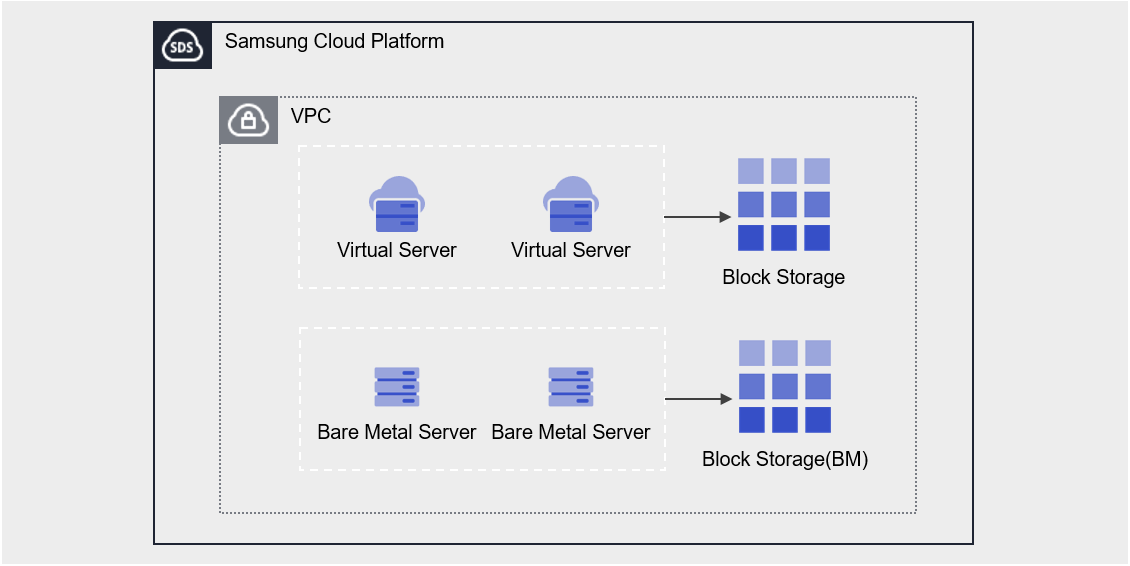
Provided features
Block Storage provides the following features.
- Volume Name: Users can set or edit the name for each volume.
- Capacity: Volumes can be created with capacities ranging from a minimum of 8 GB up to a maximum of 12 TB, and can be expanded while in use. * The default OS volume can be created with a size no less than the minimum required for each image.
- Connection Server: You can select a Virtual Server to connect or disconnect.
- Multi-Server Connection (Multi Attach): Connects to two or more servers, with no limit on the number of servers per volume, and a Virtual Server can connect up to 26 volumes
- Encryption: All volumes of Block Storage have AES-256 algorithm encryption applied by default, and when a volume is of HDD/SSD_KMS disk type, additional in‑transit encryption is provided for the Block Storage segment connected to the instance.
- snapshot: Through the image snapshot feature, recovery of modified and deleted data is possible. * The user selects a snapshot created at the desired recovery point from the list and restores it.
- Volume Transfer: Using the volume transfer feature, you can transfer a volume to another Account.
- Monitoring: IOPS, Latency, Throughput, etc. monitoring information can be viewed through the ServiceWatch service.
Components
You can create a volume by entering the capacity and selecting the disk type according to the user’s service scale and performance requirements. When using the snapshot feature, you can restore data to the desired point in time.
Volume
A volume (Volume) is the basic creation unit of the Block Storage service and is used as data storage space. The user selects a name, size, and disk type to create a volume, then attaches it to a Virtual Server for use.
The volume name creation rules are as follows.
-, _) within 255 characters.Snapshot
A snapshot (Snapshot) is an image backup of a volume at a specific point in time. The user can view the snapshot name and creation time in the snapshot list, select the snapshot they wish to restore, and recover data that was modified or deleted using that snapshot.
The following are considerations when using snapshots.
- The snapshot creation time is based on Asia/Seoul (GMT +09:00).
- Select the snapshot recovery button to restore the Block Storage volume to the latest snapshot.
- If you select a specific snapshot from the snapshot list, you can recover by creating a new volume based on that snapshot.
- Snapshots are billed based on the size of the original Block Storage, so please delete any unnecessary snapshots.
Preceding Service
This is a list of services that must be pre-configured before creating the service. Refer to the guide provided for each service for detailed information and prepare in advance.
| Service Category | service | Detailed description |
|---|---|---|
| Compute | Virtual Server | Virtual server optimized for cloud computing |