This is the multi-page printable view of this section. Click here to print.

Return to the regular view of this page.

How-to guides

Users can create the Block Storage service by entering required information through the Samsung Cloud Platform Console and selecting detailed options.

Creating Block Storage

You can create and use the Block Storage service through the Samsung Cloud Platform Console.

To create Block Storage, follow these steps:

  1. Click the All Services > Compute > Virtual Server menu. This will take you to the Virtual Server Service Home page.

  2. Click the Block Storage menu. This will take you to the Block Storage List page.

  3. Click the Create Service button on the Block Storage page. This will take you to the Create Block Storage page.

  4. Enter the required information for creating the service on the Create Block Storage page and select detailed options.

    Item
    Required
    Description
    Volume NameRequiredVolume name
    • Enter 255 characters using English letters, numbers, spaces, and special characters (-, _)
    SnapshotOptionalSelect snapshot to use when creating volume through snapshot
    • After checking the Use item, you can select a snapshot
    • When creating service through snapshot recovery volume, provides recovery snapshot name
    • If not selected, an empty volume is created
    Disk TypeRequiredSelect disk type
    • SSD_Provisioned: SSD volume where IOPS and Throughput can be set
    • SSD/HDD: General SSD/HDD volume
    • SSD/HDD_KMS: Additional encryption volume
    • SSD/HDD_MultiAttach: Volume that can be connected to 2 or more servers
    • Cannot modify after service creation
    • When creating service through snapshot recovery volume, it is set the same as the original and cannot be modified
    CapacityOptionalSet capacity
    • Can create within 8~12,228GB
    • Enter number of Units provided in 8GB increments
    • When creating service through snapshot recovery volume, enter capacity equal to or larger than the original
    Max IOPSRequiredEnter maximum IOPS value between 5,000~20,000
    • Can only set when Disk Type is SSD_Provisioned
    Max ThroughputRequiredEnter maximum Throughput value between 250~1,000
    • Can only set when Disk Type is SSD_Provisioned
    Table. Block Storage service information input items

  5. Review the detailed information and estimated charges in the Summary panel, then click the Create button.

    • Once creation is complete, verify the created resource on the Block Storage List page.
Note
  • AES-256 algorithm encryption is applied by default to all volumes of Block Storage.
  • Windows-based Virtual Server cannot use MultiAttach disks. Please use a separate replication method or solution.
  • When the volume is HDD/SSD_KMS disk type, it additionally provides transfer encryption between the instance and the Block Storage section connected to the instance.
Warning
When using HDD/SSD_KMS disk type, approximately 60% performance degradation may occur.

Viewing Block Storage Details

Block Storage service allows you to view and modify the complete resource list and detailed information. The Block Storage Details page consists of Details, Snapshot List, Tags, and Operation History tabs.

To view detailed information of Block Storage service, follow these steps:

  1. Click the All Services > Compute > Virtual Server menu. This will take you to the Virtual Server Service Home page.
  2. Click the Block Storage menu. This will take you to the Block Storage List page.
  3. Click the resource for which you want to view detailed information on the Block Storage List page. This will take you to the Block Storage Details page.
    • The Block Storage Details page displays status information and additional feature information, and consists of Details, Snapshot List, Tags, and Operation History tabs.
      ItemDescription
      Volume StatusStatus of the volume
      • Creating: Being created
      • Downloading: Being created (OS image being applied)
      • Available: Creation complete, can connect to server
      • Reserved: Waiting for server connection
      • Attaching: Connecting to server
      • Detaching: Disconnecting from server
      • In Use: Server connection complete
      • Deleting: Service being terminated
      • Awaiting Transfer: Waiting for volume transfer
      • Extending: Capacity expansion
      • Error Extending: Abnormal state during capacity expansion
      • Backing Up: Volume being backed up
      • Restoring Backup: Volume backup being recovered
      • Error Backing Up: Volume backup abnormal state
      • Error Restoring: Volume backup recovery abnormal state
      • Error Deleting: Abnormal state during deletion
      • Error Managing: Abnormal state
      • Error: Abnormal state
      • Maintenance: Temporary maintenance state
      • Reverting: Recovering from snapshot
      Volume TransferTransfer volume to another Account
      Create SnapshotImmediately create a snapshot at the creation point
      Snapshot RecoveryRecover volume to the latest snapshot in Available state
      Service TerminationButton to terminate the service
      Table. Status information and additional features

Details

On the Block Storage List page, you can view detailed information of the selected resource and modify information if necessary.

ItemDescription
ServiceService group
Resource TypeResource type
SRNUnique resource ID in Samsung Cloud Platform
  • In Block Storage service, means volume SRN
Resource NameResource name
  • In Block Storage service, means volume name
Resource IDUnique resource ID of the service
CreatorUser who created the service
Creation DateDate and time when the service was created
ModifierUser who modified the service
Modification DateDate and time when the service was modified
Volume NameVolume name
  • If volume name modification is needed, click the Modify button
Volume IDUnique volume ID
Disk TypeDisk type
TypeClassification according to volume creation method and usage
CapacityVolume capacity
  • Can expand to capacity that is a multiple of 8 within 12,288GB
  • Cannot reduce capacity
  • If capacity expansion is needed, click the Modify button
Max IOPSRequired
Max ThroughputRequired
Connected ServerConnected Virtual Server
  • Server ID: Unique server ID
  • Server Name: Server name
  • Status: Server status
  • Connection Information: Connection information of the volume for server connection
  • When adding Virtual Server connection, click the Add button
  • When removing Virtual Server connection, click the Disconnect button
Table. Block Storage details items
Note
Volumes containing the name vProtect are temporary volumes created when using the Backup service and are not charged.

Snapshot List

On the Block Storage List page, you can view snapshots of the selected resource.

ItemDescription
Snapshot NameSnapshot name
DescriptionSnapshot description
Volume CapacityCapacity of the Block Storage original volume that is the snapshot target
  • If the original volume capacity and the snapshot volume capacity are different, only recovery by creating a recovery volume is possible
Creation DateSnapshot creation date/time
StatusStatus of the snapshot
  • Available: Creation complete, can recover
  • Creating: Being created
  • Error: Abnormal state
  • Deleting: Being deleted
  • Error Deleting: Abnormal state during deletion
  • Restoring: Recovering
  • Backing Up: Being backed up
Additional Features > MoreSnapshot management buttons
  • Modify: Modify snapshot name and description
DeleteCan delete by selecting snapshot to delete from snapshot list
Table. Snapshot list tab detailed information items
Warning
  • Snapshots can affect volume capacity management. Please delete unnecessary snapshots after use.
  • Snapshot recovery is possible when not connected to a server.
Note
  • Snapshot creation date/time is based on Asia/Seoul (GMT +09:00).
  • When clicking the snapshot recovery button, the volume is recovered to the latest snapshot in Available status.
  • When selecting create recovery volume on the snapshot list page, a new snapshot-based volume is created without changing the existing volume.
  • Snapshots containing the name vProtect are temporary snapshots created when using the Backup service and are not charged.

Tags

On the Block Storage List page, you can view tag information of the selected resource, and add, modify, or delete tags.

ItemDescription
Tag ListTag list
  • Can view Key, Value information of tags
  • Can add up to 50 tags per resource
  • When entering tags, search and select from existing Key and Value lists
Table. Block Storage tag tab items

Operation History

On the Block Storage List page, you can view the operation history of the selected resource.

ItemDescription
Operation History ListResource change history
  • View operation date/time, resource type, resource ID, resource name, operation details, event topic, operation result, operator information
  • To perform detailed search, click the detailed search button
Table. Operation history tab detailed information items

Managing Block Storage Resources

If you need to modify settings of created Block Storage or add or delete connected servers, you can perform tasks on the Block Storage Details page.

Modifying Volume Name

You can modify the name of a volume. To modify the volume name, follow these steps:

  1. Click the All Services > Compute > Virtual Server menu. This will take you to the Virtual Server Service Home page.
  2. Click the Block Storage menu. This will take you to the Block Storage List page.
  3. Click the resource for which you want to modify the volume name on the Block Storage List page. This will take you to the Block Storage Details page.
  4. Click the Modify button of Volume Name. The Modify Volume Name popup window opens.
  5. Enter the volume name and click the Confirm button.
Note
Enter within 255 characters using English letters, numbers, spaces, and special characters (-, _).

Expanding Capacity

You can expand the capacity of a volume. To expand capacity, follow these steps:

  1. Click the All Services > Compute > Virtual Server menu. This will take you to the Virtual Server Service Home page.
  2. Click the Block Storage menu. This will take you to the Block Storage List page.
  3. Click the resource for which you want to expand capacity on the Block Storage List page. This will take you to the Block Storage Details page.
  4. Click the Modify button of Capacity. The Modify Capacity popup window opens.
  5. Enter the capacity and click the Confirm button.
Warning
  • Capacity reduction is not provided.
  • After capacity expansion, recovery to snapshots before expansion is not possible.
  • Only recovery by creating a new volume is possible with snapshots created before capacity expansion.
Note
  • Can expand to capacity larger than existing capacity within 8~12,228GB.
  • Enter the number of Units provided in 8GB increments.

Modifying Connected Server

You can connect or disconnect servers. To modify connected server, follow these steps:

  1. Click the All Services > Compute > Virtual Server menu. This will take you to the Virtual Server Service Home page.
  2. Click the Block Storage menu. This will take you to the Block Storage List page.
  3. Click the resource for which you want to modify connected server on the Block Storage List page. This will take you to the Block Storage Details page.
  4. When adding Virtual Server connection, click the Add button in the Connected Server item. The Add Connected Server popup window opens.
  5. Select the Virtual Server you want to connect and click the Confirm button.
  6. When disconnecting Virtual Server connection, click the Disconnect button in the Connected Server item.
    • Be sure to perform disconnection work (Umount, Disk Offline) from the server before disconnecting.
Warning
Be sure to perform disconnection work (Umount, Disk Offline) from the server before disconnecting the connected server. If disconnected without OS work, a status error (Hang) may occur on the connected server. For details on server disconnection, see Disconnecting Server.
Note
  • You can connect Virtual Servers created in the same location as Block Storage.
  • Virtual Servers using Partition with Server Group policy cannot be connected.
  • For HDD/SSD_MultiAttach disk type, can connect with 2 or more Virtual Servers and there is no limit on the number of connections.
    • Windows-based Virtual Server cannot use MultiAttach disks and must use a separate replication method or solution.
  • Virtual Server can connect up to 26 volumes including OS basic.
  • OS basic volume cannot modify connected server and cannot terminate service.
  • When adding connected server, can use after performing connection work (Mount, Disk Online) from the server. For details on server connection, see Connecting Server.

Terminating Block Storage

You can reduce operating costs by terminating unused Block Storage. However, since terminating a service may immediately stop the operating service, you should proceed with termination after fully considering the impact of service interruption.

Warning
  • Be careful as data cannot be recovered after termination.
  • Block Storage volumes cannot be terminated in the following cases.
    • While connected to server
    • OS basic volume
    • Connected to Custom Image of Virtual Server
    • When volume status is not Available, Error, Error Extending, Error Restoring, Error Managing
  • When terminating by selecting 2 or more volumes, only volumes that can be terminated will be terminated.

To terminate Block Storage, follow these steps:

  1. Click the All Services > Compute > Virtual Server menu. This will take you to the Virtual Server Service Home page.
  2. Click the Block Storage menu. This will take you to the Block Storage List page.
  3. Select the resource to terminate on the Block Storage List page and click the Terminate Service button.
  4. When termination is complete, verify that the resource has been terminated on the Block Storage List page.

1 - Connecting to the Server

When using a volume on a server, connection or disconnection work is required.
From the Block Storage Details page, add the connection server and then connect to the server to perform the connection work (Mount, Disk Online). After use, perform the disconnection work (Umount, Disk Offline) and then remove the connection server.

Connecting to the Server (Mount, Disk Online)

To use the volume added to the connection server, you must connect to the server and perform the connection work (Mount, Disk Online). Follow the procedure below.

Linux Operating System

Server Connection Example Configuration
  • Server OS: LINUX
  • Mount location: /data
  • Volume capacity: 24 GB
  • File system: ext3, ext4, xfs etc
  • Additional allocated disk: /dev/vdb
  1. Click the All Services > Compute > Virtual Server menu. Move to the Service Home page of Virtual Server.
  2. Click the Block Storage menu. Move to the Block Storage List page.
  3. On the Block Storage List page, click the resource to be used by the connection server. Move to the Block Storage Details page.
  4. Check the server in the Connection Server section and connect to it.
  5. Refer to the procedure below to connect (Mount) the volume.
  • Switch to root privileges

    $ sudo -i
    
  • Check the disk

    # lsblk
    NAME    MAJ:MIN  RM   SIZE RO TYPE MOUNTPOINT
    vda       252:0   0    24G  0 disk
    ├─vda1    252:1   0  23.9G  0 part [SWAP]
    └─vda14   252:14  0     4M  0 part /
    └─vda15   252:15  0   106M  0 part /boot/efi
    vdb       252:16  0    24G  0 disk
    
  • Create a partition

    # fdisk /dev/vdb
    Command (m for help): n
    
    Partition type:
       p   primary (0 primary, 0 extended, 4 free)
       e   extended
    Select (default p): p
    Partition number (1-4, default 1): 1
    First sector (2048-50331646, default 2048):
    Last sector, +/-sectors or +/-size{K,M,G,T,P} (2048-50331646, default 50331646):
    
    Created a new partition 1 of type 'Linux' and of size 24 GiB.
    
    Command (m for help): w
    The partition table has been altered!
    Calling ioctl() to re-read partition table.
    Syncing disks.
    
  • Set the partition format (e.g., ext4)

    # lsblk
    NAME    MAJ:MIN  RM   SIZE RO TYPE MOUNTPOINT
    vda       252:0   0    24G  0 disk
    ├─vda1    252:1   0  23.9G  0 part [SWAP]
    └─vda14   252:14  0     4M  0 part /
    └─vda15   252:15  0   106M  0 part /boot/efi
    vdb       252:16  0    24G  0 disk
    └─vdb1    252:17  0    24G  0 part
    
    # mkfs.ext4 /dev/vdb1
    mke2fs 1.46.5 (30-Dec-2021)
    ...
    Writing superblocks and filesystem accounting information: done
    
  • Mount the volume

    # mkdir /data
    
    # mount /dev/vdb1 /data
    
    # lsblk
    NAME    MAJ:MIN  RM   SIZE RO TYPE MOUNTPOINT
    vda       252:0   0    24G  0 disk
    ├─vda1    252:1   0  23.9G  0 part [SWAP]
    └─vda14   252:14  0     4M  0 part /
    └─vda15   252:15  0   106M  0 part /boot/efi
    vdb       252:16  0    24G  0 disk
    └─vdb1    252:17  0    24G  0 part /data
    
    # vi /etc/fstab
    (add) /dev/vdb1     /data       ext4     defaults   0 0
    
ItemDescription
cat /etc/fstabFile system information file
  • Used when the server starts
df -hCheck the total disk usage of the mounted disk
fdisk -lCheck partition information
  • Physical disks are displayed with letters such as /dev/sda, /dev/sdb, /dev/sdc
  • Disk partitions are displayed with numbers such as /dev/sda1, /dev/sda2, /dev/sda3
Table. Mount Command Reference
CommandDescription
mCheck the usage of the fdisk command
nCreate a new partition
pCheck the changed partition information
tChange the system ID of the partition
wSave the partition information and exit the fdisk settings
Table. Partition Creation Command (fdisk) Reference

Windows Operating System

  1. Click the All Services > Compute > Virtual Server menu. Move to the Service Home page of Virtual Server.
  2. Click the Block Storage menu. Move to the Block Storage List page.
  3. On the Block Storage List page, click the resource to be used by the connection server. Move to the Block Storage Details page.
  4. Check the server in the Connection Server section and connect to it.
  5. Refer to the procedure below to connect (Disk Online) the volume.
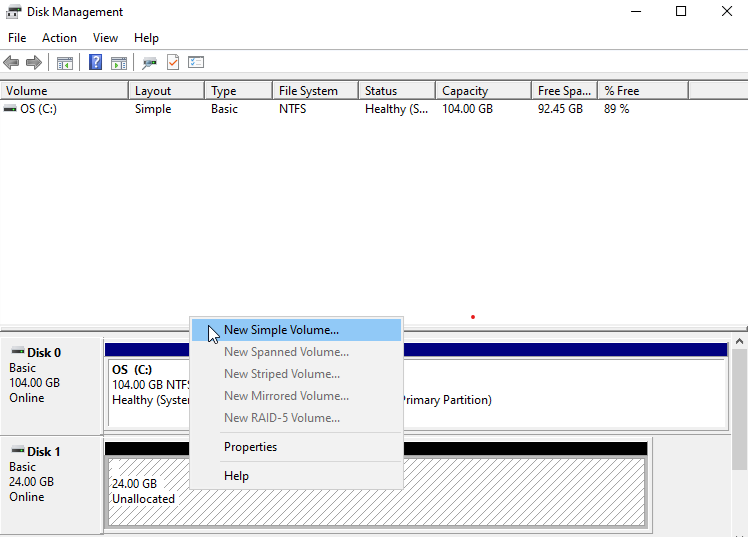
    • Right-click the Windows start icon and run Computer Management

    • In the Computer Management tree structure, select Storage > Disk Management

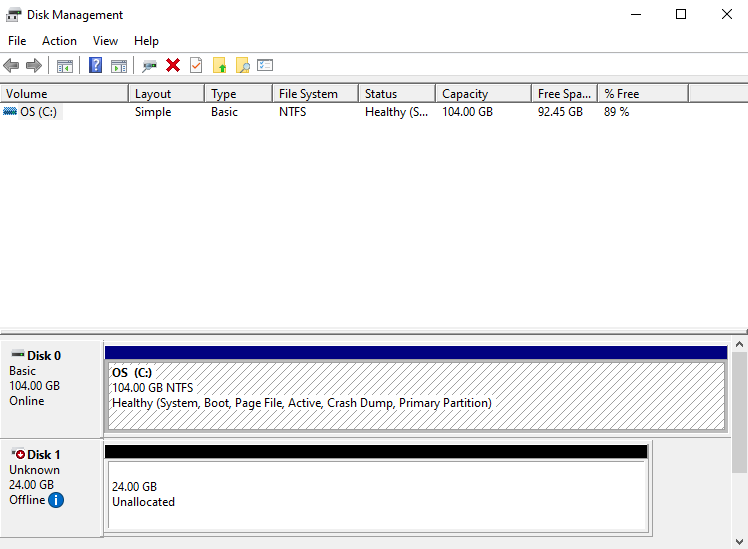
    • Check the disk

      Mount

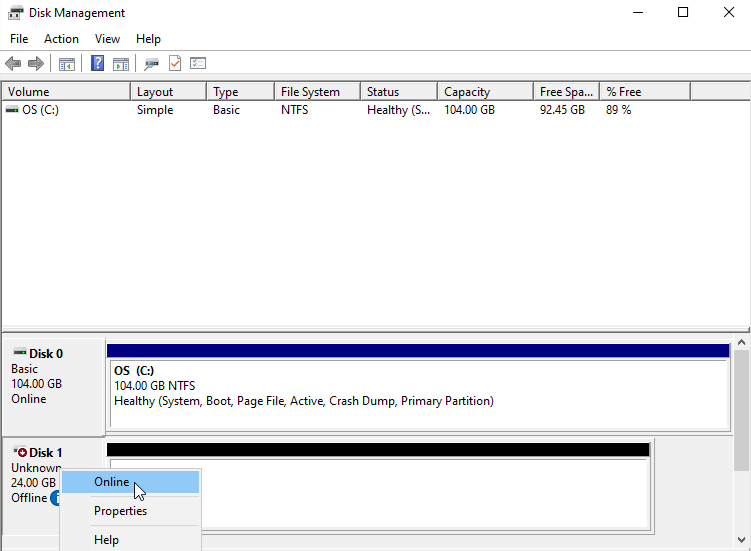
    • Bring the disk online

      Mount

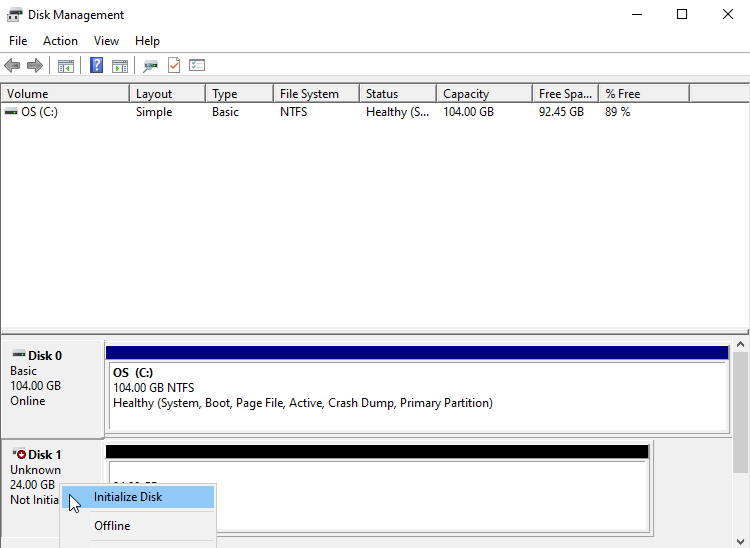
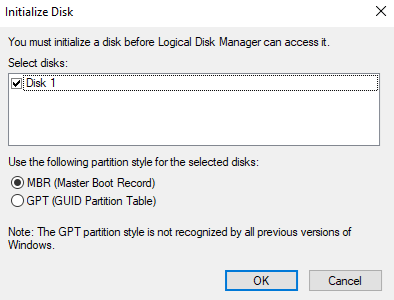
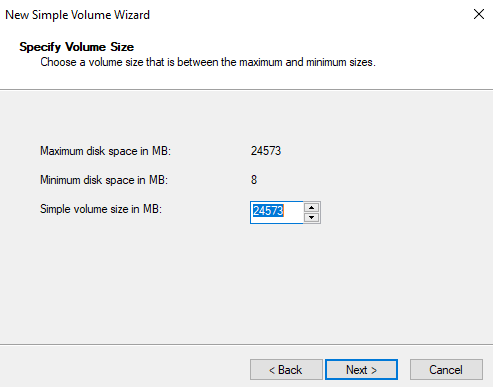
    • Initialize the disk

      Mount

      Mount
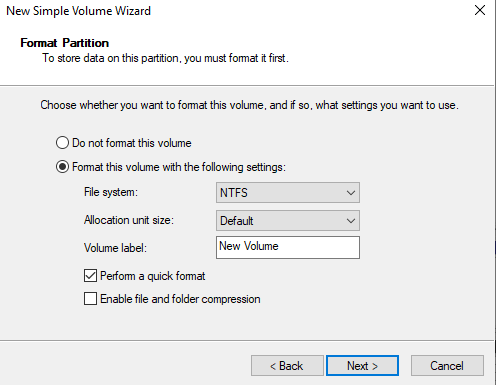
    • Format the partition

      Mount

      Mount
      Mount
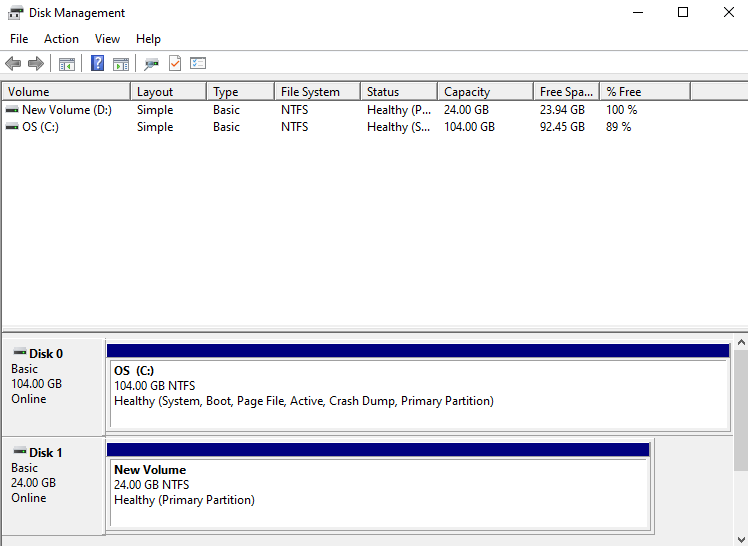
    • Check the volume

      Mount

Disconnecting from the Server (Umount, Disk Offline)

Connect to the server and perform the disconnection work (Umount, Disk Offline), and then remove the connection server from the console.

Follow the procedure below.

Note
  • If you disconnect the server from the console without performing the disconnection work (Umount, Disk Offline) on the server, a server status error (Hang) may occur.
    • Be sure to perform the OS work first.
  • For the OS basic volume, connection server modification and service termination are not allowed.

Linux Operating System

  1. Click the All Services > Compute > Virtual Server menu. Move to the Service Home page of Virtual Server.
  2. Click the Block Storage menu. Move to the Block Storage List page.
  3. On the Block Storage List page, click the resource to be disconnected from the connection server. Move to the Block Storage Details page.
  4. Check the server in the Connection Server section and connect to it.
  5. Refer to the procedure below to disconnect (Umount) the volume.
    • Umount the volume
  # umount /dev/vdb1 /data
   
  # lsblk
  NAME    MAJ:MIN  RM   SIZE RO TYPE MOUNTPOINT
  vda       252:0   0    24G  0 disk
  ├─vda1    252:1   0  23.9G  0 part [SWAP]
  └─vda14   252:14  0     4M  0 part /
  └─vda15   252:15  0   106M  0 part /boot/efi
  vdb       252:16  0    24G  0 disk
  └─vdb1    252:17  0    24G  0 part
   
  # vi /etc/fstab
  (delete) /dev/vdb1     /data       ext4     defaults   0 0

Windows Operating System

  1. Click the All Services > Compute > Virtual Server menu. Move to the Service Home page of Virtual Server.

  2. Click the Block Storage menu. Move to the Block Storage List page.

  3. On the Block Storage List page, click the resource to be disconnected from the connection server. Move to the Block Storage Details page.

  4. Check the server in the Connection Server section and connect to it.

  5. Unmount the file system.

  6. Refer to the procedure below to disconnect (Disk Offline) the volume.

    • Right-click the Windows start icon and run Computer Management

    • In the Computer Management tree structure, select Storage > Disk Management

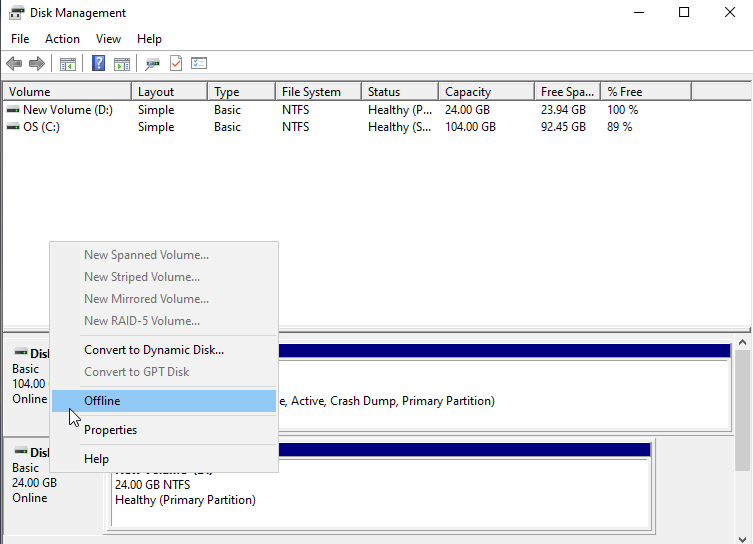
    • Right-click the disk to be removed and run Offline

      Umount
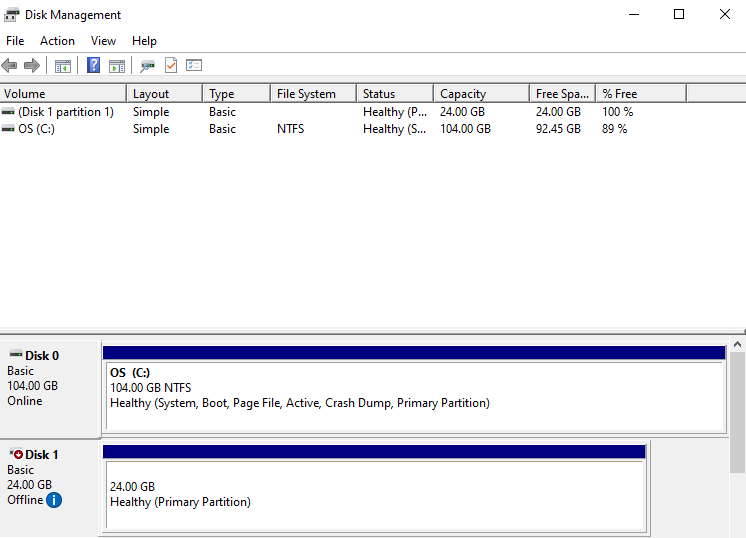
    • Check the disk status

      Umount

2 - Using Snapshots

You can create, delete, or restore snapshots of the created Block Storage using snapshots. You can perform actions on the Block Storage Details page and Snapshot List page.

Create Snapshot

You can create a snapshot of the current point in time. To create a snapshot, follow these steps.

  1. All Services > Compute > Virtual Server Click the menu. Navigate to the Service Home page of Virtual Server.
  2. Click the Block Storage menu. Go to the Block Storage List page.
  3. Block Storage List On the page, click the resource to create a snapshot. Block Storage Details Go to the page.
  4. Click the Create Snapshot button. The Create Snapshot popup window opens.
  5. Enter Snapshot Name and Description, then click the Confirm button. It creates a snapshot of the current point in time.
  6. Snapshot List Click the button. Block Storage Snapshot List Navigate to the page.
  7. Check the generated snapshot.
Caution
Snapshots are charged based on the size of the original Block Storage, so please delete unnecessary snapshots.
Reference
The snapshot creation time is based on Asia/Seoul (GMT +09:00).

Edit Snapshot

You can edit snapshot information. To edit the snapshot name or description, follow the steps below.

  1. All Services > Compute > Virtual Server Click the menu. Navigate to the Service Home page of Virtual Server.
  2. Block Storage Click the menu. Navigate to the Block Storage List page.
  3. Block Storage List page, click the resource to edit the snapshot information. You will be taken to the Block Storage Details page.
  4. Snapshot List Click the button. Block Storage Snapshot List Navigate to the page.
  5. After confirming the snapshot to edit, click the More button.
  6. Click the Edit button. The Edit Snapshot popup opens.
  7. Enter Snapshot name or Description and click the Confirm button.

Recover Snapshot

You can restore a Block Storage volume to the latest snapshot in Available state. To perform snapshot restoration, follow the steps below.

  1. All Services > Compute > Virtual Server Click the menu. Navigate to Virtual Server’s Service Home page.
  2. Click the Block Storage menu. Navigate to the Block Storage List page.
  3. Click the resource to recover from a snapshot on the Block Storage List page. You will be taken to the Block Storage Details page.
  4. Connection Server If there is a server added in the item, after connecting to the server, perform the disconnect operation (Umount, Disk Offline).
  • For detailed information about server disconnection, please refer to Disconnect Server.
  1. Block Storage Details page, click the Disconnect button in the Connected Server item to remove the server. The connected server will be removed.
  2. Snapshot List Click the button. Block Storage Snapshot List Navigate to the page.
  3. Check the latest snapshot in Available state. The volume will be restored with that snapshot.
  4. Click the Snapshot Recovery button. The Snapshot Recovery popup opens.
  5. After checking the Snapshot name and creation date/time, click the Confirm button.
    • When recovery starts, it becomes Reverting, and when completed, it becomes Available.
  6. Detailed Information Click the page button. Block Storage Detailed Page will navigate to.
  7. Click the Add button of the Connected Server. Reconnect the Virtual Server.
  8. After connecting to the added server, perform the connection tasks (Mount, Disk Online) according to the operating system.
Caution
  • Snapshot recovery is possible when not connected to the server.
  • If you want to recover using a snapshot that is not the latest snapshot, recovery is possible by creating a recovery volume.
  • In the situation below, recovery is not possible.
    • Block Storage when the volume is not in Available state
    • Block Storage if there is a server connected to the volume
    • If there are no recoverable snapshots
    • If the latest snapshot changes during recovery creation
    • If the latest snapshot is not in Available state
    • If the snapshot’s volume size differs from the Block Storage volume size (when the volume has been expanded)

Create snapshot recovery volume

You can create a volume using a snapshot. To create a snapshot recovery volume, follow the steps below.

  1. All Services > Compute > Virtual Server Click the menu. Navigate to the Service Home page of Virtual Server.
  2. Click the Block Storage menu. You will be taken to the Block Storage list page.
  3. Click the resource to create a snapshot recovery volume on the Block Storage List page. You will be taken to the Block Storage Details page.
  4. Snapshot List Click the button. Block Storage Snapshot List Navigate to the page.
  5. After checking Snapshot name, description and Creation date/time, click the More button of the snapshot you want to restore.
  6. Click Create Recovery Volume. The Create Snapshot Recovery Volume popup opens.
  7. Click the Confirm button. You will be taken to the Create Block Storage page.
  8. Block Storage creation On the page, enter the information required to create the service, and select detailed options.
    • Please enter the volume name and size. You can enter a size that is greater than or equal to the original volume.
    • Disk type is set the same as the original and cannot be modified.
      Category
      Required
      Detailed description
      Volume NameRequiredVolume Name
      • Enter up to 255 characters using English letters, numbers, spaces, and special characters (-, _)
      Disk TypeRequiredSelect Disk Type
      • HDD: Standard volume
      • SSD: High-performance standard volume
      • HDD/SSD_KMS: Volume that additionally provides transmission encryption between the instance and Block Storage
      • HDD/SSD_MultiAttach: Volume that can be attached to more than one server
      • Cannot be modified after service creation
      • When creating a service via snapshot recovery volume creation, it is set identical to the original and cannot be modified
      CapacitySelectCapacity Setting
      • Can be created within 8~12,228GB
      • Enter the number of units provided in 8GB increments
      • When creating a service via snapshot recovery volume creation, input a capacity equal to or larger than the original
      Recovery Snapshot NameOptionalName of the recovery snapshot used when creating the volume
      • Provides the recovery snapshot name when creating a service through snapshot recovery volume creation
      Table. Block Storage Service Information Input Items
  9. Summary Check the detailed information and estimated billing amount generated in the panel, and click the Complete button.
    • Once creation is complete, check the created resource on the Block Storage List page.

Delete Snapshot

You can select a snapshot to delete. To delete a snapshot, follow these steps.

  1. All Services > Compute > Virtual Server Click the menu. Go to the Service Home page of Virtual Server.
  2. Click the Block Storage menu. Go to the Block Storage List page.
  3. Block Storage List on the page, click the resource to delete the snapshot. Block Storage Details navigate to the page.
  4. Snapshot List button, click it. Block Storage Snapshot List page, navigate to it.
  5. After checking the snapshot name, description and creation date/time, click the more button of the snapshot you want to delete.
  6. Delete Click the button. Snapshot List page, the snapshot will be removed.

3 - Move Volume

You can move the volume to a different Account, and if you move it, the volume will be removed from the existing location. You can perform volume migration from the Block Storage list or Block Storage detail page.

Volume previous

You can move a volume to a different account within the region. To move a volume, follow these steps.

  1. Click All services > Compute > Virtual Server menu. It moves to the Service Home page of Virtual Server.
  2. Block Storage menu is clicked. It moves to the Block Storage list page.
  3. Block Storage list page, select the resource to be moved, and then click the More > Move Volume button at the top left of the list.
    • or click the Volume Migration button at the top of the Block Storage details page of the resource to be migrated.
  4. When the pop-up window for volume migration appears, check the volume name you want to migrate and click the Confirm button.
  5. When the popup window for previous completion opens, click the Confirm button. The Volume Transfer ID and Approval Key information will be downloaded as a text file.
  6. The volume will be changed to Awaiting Transfer status.
Caution
  • Volume migration is possible within the same region.
  • Volume migration is only possible when the volume is in the Available state. If it is in the In Use state, release all connected servers.

Volume rollback cancel

The volume move can be cancelled after it is created. To cancel the volume move, follow these steps.

  1. Click All services > Compute > Virtual Server menu. It moves to the Service Home page of Virtual Server.
  2. Block Storage menu is clicked. It moves to the Block Storage list page.
  3. Block Storage list page, click the resource to cancel the volume move. It moves to the Block Storage detail page.
    • You can cancel if the volume is in the Awaiting Transfer state.
  4. Click the Volume Move Cancel button. The Volume Move Cancel popup window will open.
  5. Check the volume name you want to cancel the volume move and click the Confirm button.
  6. The volume will be changed to Available status.

Get previous volume

You can receive volumes from other accounts within the region. To receive a volume, follow these steps.

  1. Click All Services > Compute > Virtual Server menu. It moves to the Service Home page of Virtual Server.
  2. Block Storage menu is clicked. It moves to the Block Storage list page.
  3. On the Block Storage list page, click the More > Receive Volume Transfer button in the upper left corner of the list. The Receive Volume Transfer popup window opens.4. Volume Migration Enter the Volume Migration ID and Approval Key provided when creating the volume migration.
  4. Block Storage list page will have the volume created.
Notice
  • It may take some time for the changes to be reflected.
  • The account that created the volume transfer will have the transferred volume removed.