This is the multi-page printable view of this section. Click here to print.
Data Ops
- 1: Overview
- 1.1: ServiceWatch metric
- 2: How-to guides
- 2.1: Data Ops Services
- 3: API Reference
- 4: CLI Reference
- 5: Release Note
1 - Overview
Service Overview
Data Ops is a managed workflow orchestration service based on Apache Airflow that creates workflows for data processing tasks that occur periodically or repeatedly and automates job scheduling. Users can automate the process of delivering useful data to the right place at the required time and monitor the configuration and progress of data pipelines.
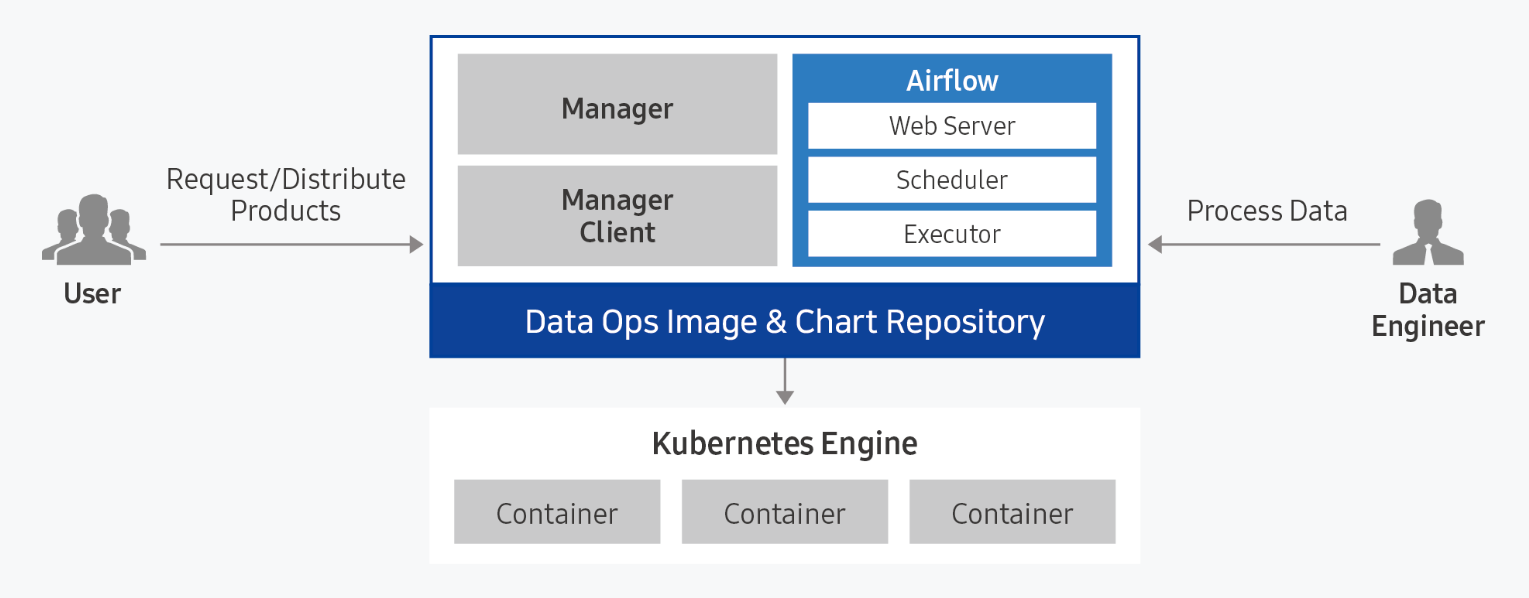
Provided features
Data Ops provides the following features.
- Convenient Installation and Management: Data Ops can be easily installed through a web-based Console in a standard Kubernetes cluster environment. * Apache Airflow and the management module are installed automatically, and integrated monitoring of the web server and scheduler execution status is available through the unified dashboard.
- Dynamic pipeline configuration: Pipeline configuration for data tasks is possible based on Python code. * Since tasks are generated dynamically in conjunction with data job scheduling, you can freely configure the desired workflow structure and scheduling.
- Convenient workflow management: DAG (Direct Acyclic Graph: directed acyclic graph) configuration is visualized and managed through a web-based UI, allowing easy understanding of the sequence and parallel relationships of data flow. * You can also easily manage each task’s timeout, retry count, and priority definitions.
Component
Data Ops is composed of Manager and Service modules, and provides Apache Airflow as a packaged solution.
Data Ops Manager
Data Ops Manager provides various managing features to enable more efficient use of Airflow.
- You can upload Plugin Files, Shared Files, and Python Library Files for use in Ops Service through Ops Manager.
- You can easily provision configuration information for Airflow components within the cluster.
- You can manage other service configuration information within the Airflow cluster and provision it easily.
Data Ops Service
- We provide a managed workflow orchestration service based on Apache Airflow.
- When providing Airflow, you can set Description, required resource size, DAGs GitSync, and Host Alias.
- After creating the service, you can modify the Description, resource size used, DAGs GitSync, and Host Alias to reflect changes to the service.
Server spec type
When creating a Data Ops service, check the following.
- Recommended Service Installation Specifications: CPU KubernetesExecutor 43 cores, CPU CeleryExecutor 25 cores, Memory 50 GB, storage at least 100 GB
Provision status by region
Data Ops is available in the environments below.
| Region | Provision status |
|---|---|
| Korea West (kr-west1) | Provide |
| Korea East (kr-east1) | Provide |
| South Korea South 1 (kr-south1) | Not provided |
| South Korea 2 (kr-south2) | Not provided |
| South Korea South 3 (kr-south3) | Not provided |
Preliminary Service
This is a list of services that must be pre‑configured before creating the service. Please refer to the guide provided for each service and prepare in advance.
| Service Category | Service | Details |
|---|---|---|
| Storage | File Storage | Storage where multiple client servers share files via a network connection |
| Container | Kubernetes Engine | Kubernetes container orchestration service |
1.1 - ServiceWatch metric
In ServiceWatch, you can view Kubernetes Engine metrics for the Kubernetes Engine created by Data Ops. As with Kubernetes Engine, the metrics provided by default monitoring are data collected at one‑minute intervals.
Basic Metrics
The following are the default metrics for the Kubernetes Engine namespace.
The metrics whose names are displayed in bold below are the key metrics selected from the default metrics provided by Kubernetes Engine. Key metrics are used to build service dashboards that are automatically created for each service in ServiceWatch.
Each metric provides guidance in the user guide on which statistical values are meaningful when querying that metric, and among the meaningful statistics, the values shown in bold are the primary statistics. In the service dashboard, you can view key metrics using primary statistical values.
| Indicator name | Detailed description | unit | meaningful statistics |
|---|---|---|---|
| cluster_up | Cluster up | Count |
|
| cluster_node_count | Number of cluster nodes | Count |
|
| cluster_failed_node_count | Number of failed nodes in the cluster | Count |
|
| cluster_namespace_phase_count | Number of cluster namespace phases | Count |
|
| cluster_pod_phase_count | Cluster pod phase count | Count |
|
| node_cpu_allocatable | Node CPU allocatable amount | - |
|
| node_cpu_capacity | Node CPU capacity | - |
|
| node_cpu_usage | Node CPU usage | - |
|
| node_cpu_utilization | Node CPU usage | - |
|
| node_memory_allocatable | Node memory allocatable amount | Bytes |
|
| node_memory_capacity | Node memory capacity | Bytes |
|
| node_memory_usage | Node memory usage | Bytes |
|
| node_memory_utilization | Node memory utilization | - |
|
| node_network_rx_bytes | Node network received bytes | Bytes/Second |
|
| node_network_tx_bytes | Node network transmitted bytes | Bytes/Second |
|
| node_network_total_bytes | Total bytes of the node network | Bytes/Second |
|
| node_number_of_running_pods | Number of pods running on the node | Count |
|
| namespace_number_of_running_pods | Number of running pods in the namespace | Count |
|
| namespace_deployment_pod_count | Namespace deployment pod count | Count |
|
| namespace_statefulset_pod_count | Namespace StatefulSet pod count | Count |
|
| namespace_daemonset_pod_count | Namespace daemonset pod count | Count |
|
| namespace_job_active_count | Active namespace job count | Count |
|
| namespace_cronjob_active_count | Number of active namespace cronjobs | Count |
|
| pod_cpu_usage | Pod CPU usage | - |
|
| pod_memory_usage | Pod memory usage | Bytes |
|
| pod_network_rx_bytes | Pod network received bytes | Bytes/Second |
|
| pod_network_tx_bytes | Pod network transmitted bytes | Bytes/Second |
|
| pod_network_total_bytes | Pod network total bytes | Count |
|
| container_cpu_usage | Container CPU usage | - |
|
| container_cpu_limit | Container CPU limit | - |
|
| container_cpu_utilization | Container CPU usage | - |
|
| container_memory_usage | Container memory usage | Bytes |
|
| container_memory_limit | Container memory limit | Bytes |
|
| container_memory_utilization | Container memory usage | - |
|
| node_gpu_count | Node GPU count | Count |
|
| gpu_temp | GPU temperature | - |
|
| gpu_power_usage | GPU power usage | - |
|
| gpu_util | GPU utilization | Percent |
|
| gpu_sm_clock | GPU SM clock | - |
|
| gpu_fb_used | GPU FB usage | Megabytes |
|
| gpu_tensor_active | GPU Tensor Utilization | - |
|
| pod_gpu_util | Pod GPU utilization | Percent |
|
| pod_gpu_tensor_active | Pod GPU Tensor Utilization Rate | - |
|
2 - How-to guides
Users can create the service by entering the required Data Ops information and selecting detailed options through the Samsung Cloud Platform Console.
Create Data Ops
You can create and use the Data Ops service in the Samsung Cloud Platform Console.
To create a Data Ops, follow these steps.
All Services > Data Analytics > Data Ops Click the menu. 1. Navigate to the Service Home page of Data Ops.
On the Service Home page, click the Create Data Ops button. 2. Navigate to the Create Data Ops page.
On the Data Ops creation page, enter the information required to create the service and select detailed options.
- Select the required information in the Version selection area.
Category RequiredDetailed description Data Ops version Required Select version of the selected image - Provide version list of the provided server image
Table. Data Ops version selection item - In the Cluster Selection area, enter or select the required information. * To install Data Ops, you first need to create nodes for the Kubernetes cluster and the work environment.
Category RequiredDetailed description Cluster name Required Select cluster to use Table. Data Ops cluster selection item - Service Information Input area: enter or select the required information.
Category RequiredDetailed description Data Ops name Required Enter Data Ops name - must start with a lowercase English letter and must not end with a special character (HTML_TAG_PROTECTED_0-HTML_TAG_PROTECTED_1), use lowercase letters, numbers, and special characters (HTML_TAG_PROTECTED_0-HTML_TAG_PROTECTED_1) to enter 3 to 30 characters
Storage Class Required Select the storage class used by the chosen cluster Explanation Select Enter additional information or description about Data Ops within 150 characters. Domain Settings Required Enter Data Ops domain - must start with a lowercase English letter and must not end with a special character (
-), use lowercase letters, numbers, and special characters (-) to enter 3 to 50 characters
- {Data Ops name}.{configured domain} becomes the Data Ops access URL.
Node Selector Required To install on a specific node, enter a distinguishable label among the node’s labels - If you enter the node label incorrectly, an installation error may occur, so verify the node label in advance
- The node label can be checked in the node’s yaml file
Account Required Enter Data Ops Manager account - ID: Enter a value between 6 and 30 characters, starting with a lowercase English letter and using lowercase letters and numbers
- Password: Enter 8 to 50 characters, including uppercase letters, lowercase letters, numbers, and special characters (
!@#$%^&*)
- Confirm Password: Enter the same password again
Host Alias Select Add host information to be connected with Data Ops (up to 20 total, including defaults) - After selecting Use, click the + button
- Hostname: Enter 3~63 characters in host name or domain format, using lowercase letters, numbers, and special characters (
-)
- IP: Enter in IP format
- To delete, click the X button
- The added host information can be used only if the firewall between the cluster and the server is open
Table. Data Ops Service Information Input Items - must start with a lowercase English letter and must not end with a special character (HTML_TAG_PROTECTED_0-HTML_TAG_PROTECTED_1), use lowercase letters, numbers, and special characters (HTML_TAG_PROTECTED_0-HTML_TAG_PROTECTED_1) to enter 3 to 30 characters
- In the Additional Information Input area, enter or select the required information.
Category Required statusDetailed description tag Selection Tag addition - Tag addition Click the button to create and add tags, or add existing tags
- Up to 50 tags can be added
- Newly added tags are applied after the service creation is completed
Table. Data Ops additional information input fields
- Select the required information in the Version selection area.
Summary Check the detailed information and estimated charges generated in the panel, and click the Complete button.
- When creation is complete, verify the created resources on the Data Ops List page.
View detailed information of Data Ops
You can view and edit the complete list of resources and detailed information in Data Ops. Data Ops Details page consists of Details, Tags, Job History tabs.
To view detailed information of Data Ops, follow the steps below.
- All Services > Data Analytics > Data Ops Click the menu. 1. Navigate to the Service Home page of Data Ops.
- On the Service Home page, click the Data Ops menu. 2. Go to the Data Ops List page.
- On the Data Ops List page, click the resource to view detailed information. 3. Navigate to the Data Ops Details page.
- Data Ops Details At the top of the page, status information and details about additional features are displayed.
Category Detailed description Status display Data Ops status - Creating: Creating
- Running: Running, Data Ops Services can be created
- Updating: Updating settings
- Terminating: Service termination
- Error: Error occurred during creation or service abnormal state
Hosts file setting information Button to view and copy host file information for accessing Data Ops Service termination Button to cancel the service Table. Data Ops status information and additional features
- Data Ops Details At the top of the page, status information and details about additional features are displayed.
Detailed Information
Data Ops List page lets you view detailed information of the selected resource and edit it if needed.
| Category | Detailed description |
|---|---|
| service | Service name |
| Resource Type | Resource Type |
| SRN | Unique resource ID in Samsung Cloud Platform
|
| Resource name | Resource name
|
| Resource ID | Unique resource ID in the service |
| Constructor | User who created the service |
| Creation Date/Time | Service creation date and time |
| Modifier | User who edited the service information |
| Modification date and time | Date and time the service information was modified |
| Cluster name | Cluster name of the configured servers |
| Storage Class | The storage class used by the selected cluster |
| Explanation | Additional information or explanation about Data Ops |
| Domain Settings | Data Ops domain name |
| Node Selector | Node Lable |
| Web Url | Data Ops URL |
| Account | Data Ops Manager account |
| Host Alias | Host information to be connected to Data Ops |
tag
Data Ops List page lets you view the tag information of the selected resource, and add, modify, or delete it.
| Category | Detailed description |
|---|---|
| Tag List | Tag list
|
Job History
On the Data Ops List page, you can view the operation history of the selected resource.
| Category | Detailed description |
|---|---|
| Task History List | Resource change history
|
Data Ops Terminate
You can cancel unused Data Ops to reduce operating costs. However, if you terminate the service, the currently operating service may be discontinued immediately, so you should proceed with the termination only after fully considering the impact that may arise from the service interruption.
To cancel Data Ops, follow these steps.
- All Services > Data Analytics > Data Ops Click the menu. 1. Navigate to the Service Home page of Data Ops.
- On the Service Home page, click the Data Ops menu. Data Ops 목록 페이지로 이동합니다. Data Ops 목록 페이지에서 해지할 자원을 선택하고, 서비스 해지 버튼을 클릭하세요. 해지가 완료되면, Data Ops 목록 페이지에서 자원이 해지되었는지 확인하세요.
2.1 - Data Ops Services
Users can create the service by entering the required information for Data Ops Services within the Data Ops service through the Samsung Cloud Platform Console and selecting detailed options.
Create Data Ops Services
Users can add a service by selecting detailed options of Data Ops or by entering configuration values.
To create Data Ops Services, follow these steps.
Click the All Services > Data Analytics > Data Ops menu. Navigate to the Service Home page of Data Ops.
On the Service Home page, click Data Ops Servies. You will be taken to the Data Ops Services list page.
On the Data Ops Services List page, click the Create Data Ops Services button. You will be taken to the Create Data Ops Services page.
On the Data Ops Services Creation page, enter the information required to create the service and select detailed options.
- Enter or select the required information in the Service Information Input area.
Category Required statusDetailed description Data Ops name Required Select Data Ops Ops Service name Required Enter the Data Ops Services name - starting with a lowercase English letter and not ending with a special character (
-), using lowercase letters, numbers, and special characters (-) for 3 to 30 characters
Storage Class Required Select the storage class used by the selected cluster Explanation Selection Enter additional information or description about Data Ops Services within 150 characters. Domain Settings Required Data Ops Services domain entry - Enter 3 to 50 characters, starting with a lowercase English letter, not ending with special characters (
-), using lowercase letters, numbers, and special characters (-)
- {Data Ops Services name}.{configured domain} becomes the Data Ops Services access address.
Node Selector Required To install on a specific node, enter a distinguishable label among the node’s Labels - If you enter an incorrect node label, installation errors may occur, so verify the node label in advance
- The node label can be checked in the node’s yaml file
Service Workload Required - Web Server: Provides visualization of DAG components and status, and serves as the Airflow configuration management module
- Scheculer: Manages DAG scheduling and execution to orchestrate various DAGs and their tasks
- Worker: Executes actual orchestration and data processing tasks
- Worker(Kubernetes): When the Worker operates, pods are dynamically created, allowing efficient resource usage. When Kubernetes is selected, the Replica text box is disabled.
- Worker(Celery): When the Worker operates, a static pod is created and maintained, enabling faster handling of a large number of requests. When Celery is selected, the Replica text box is enabled and user input is allowed.
- The selected executor type cannot be changed once chosen
account Required Airflow account input - ID: Start with a lowercase English letter and use lowercase letters and numbers, entering a value between 6 and 30 characters
- Password: Include uppercase (English), lowercase (English), numbers, and special characters (
!@#$%^&*) and enter 8 to 50 characters
- Confirm Password: Re-enter the password identically
Table. Data Ops Services service information input items - starting with a lowercase English letter and not ending with a special character (
- Additional Information Input area, enter or select the required information.
Category required or notDetailed description Host Alias Select Add host information to be linked with Data Ops (up to 20 total, including defaults) - Select Use, then click the + button
- Hostname: Enter the host name or domain format using lowercase letters, numbers, and special characters (
-) with a length of 3 to 63 characters
- IP: Enter in IP format
- Click the X button to delete
- The firewall between the cluster and the server must be open to use the added host information
tag Selection Add Tag - Add Tag Click the button to create and add a tag, or add an existing tag.
- You can add up to 50 tags.
- The newly added tags will be applied after the service creation is completed.
Table. Data Ops additional information input fields
- Enter or select the required information in the Service Information Input area.
Summary Check the detailed information and estimated billing amount generated in the panel, and click the Complete button.
- Once creation is complete, check the created resources on the Data Ops Services List page.
Data Ops Services View detailed information
You can view and edit the full list of resources and detailed information for Data Ops Services. The Data Ops Services Details page consists of Details, Tags, Activity History tabs.
Follow these steps to view detailed information about Data Ops Services.
- Click the All Services > Data Analytics > Data Ops menu. You will be taken to the Service Home page of Data Ops.
- On the Service Home page, click the Data Ops Services menu. You will be taken to the Data Ops Services list page.
- On the Data Ops Services List page, click the resource to view detailed information. You will be taken to the Data Ops Services Details page.
- Data Ops Services Details At the top of the page, status information and additional feature information are displayed.
Category Detailed description Status display Data Ops Services status - Creating: Creating
- Running: Running
- Updating: Updating configuration
- Terminating: Terminating service
- Error: Creation failed or service unavailable
Hosts file configuration information Button to view and copy host file information for accessing Data Ops Services Delete Data Ops Services Cancel service button Table. Data Ops Services status information and additional features
- Data Ops Services Details At the top of the page, status information and additional feature information are displayed.
Detailed Information
Data Ops Services List page lets you view detailed information of the selected resource and modify the information if necessary.
| Category | Detailed description |
|---|---|
| service | Service name |
| Resource Type | Resource Type |
| SRN | Unique resource ID in Samsung Cloud Platform
|
| Resource name | Resource name
|
| Resource ID | Unique resource ID in the service |
| constructor | User who created the service |
| Creation date and time | Service creation date and time |
| editor | User who edited the service information |
| Modification date | Date and time the service information was modified |
| Data Ops name | Data Ops name |
| Storage Class | Storage class used by the selected cluster |
| description | Additional information or explanation about Data Ops Services |
| Domain Settings | Data Ops Services domain name |
| Node Selector | Node Lable |
| Web Url | Data Ops Services URL |
| account | Airflow account |
| Host Alias | Host information to be connected to Data Ops Services |
tag
Data Ops Services List page allows you to view the tag information of the selected resource, and to add, modify, or delete it.
| Category | Detailed description |
|---|---|
| Tag list | Tag list
|
Job History
You can view the operation history of the selected resource on the Data Ops Services List page.
| Category | Detailed description |
|---|---|
| Task History List | Resource Change History
|
Data Ops Services Terminate
You can cancel unused Data Ops Services to reduce operating costs. However, canceling a service may cause the running service to stop immediately, so you should fully consider the impact of any service interruption before proceeding with the cancellation.
To cancel Data Ops Services, follow the steps below.
- Click the All Services > Data Analytics > Data Ops menu. Go to the Service Home page of Data Ops.
- From the Service Home page, click the Data Ops Services menu. You will be taken to the Data Ops Services list page.
- On the Data Ops Services List page, select the resource to cancel and click the Data Ops Services Delete button.
- When termination is complete, verify on the Data Ops Services List page whether the resource has been terminated.
3 - API Reference
4 - CLI Reference
5 - Release Note
Data Ops
- A Data Ops service that creates workflows for data processing tasks that occur periodically or repeatedly and automates job scheduling has been launched.
- It is a managed workflow orchestration service based on Apache Airflow.