1 - Chat Playground
Goal
This tutorial introduces how to create and utilize a web-based Playground to easily test the APIs of various AI models provided by AIOS using Streamlit in an SCP for Enterprise environment.
Environment
To proceed with this tutorial, the following environment must be prepared:
System Environment
Required installation packages
Code Block. Install streamlit package Note
Streamlit
Python-based open-source web application framework, it is a very suitable tool for visually expressing and sharing data science, machine learning, and data analysis results. Without complex web development knowledge, you can quickly create a web interface by writing just a few lines of code.
Implementation
Pre-check
The application checks if the model call is normal with curl in the environment where it is running. Here, AIOS_LLM_Private_Endpoint refers to the LLM usage guide please refer to it.
- Example: {AIOS LLM Private Endpoint}/{API}
curl -H "Content-Type: application/json" \
-d '{"model": "meta-llama/Llama-3.3-70B-Instruct"
, "prompt" : "Hello, I am jihye, who are you"
, "temperature": 0
, "max_tokens": 100
, "stream": false}' -L AIOS_LLM_Private_Endpoint
curl -H "Content-Type: application/json" \
-d '{"model": "meta-llama/Llama-3.3-70B-Instruct"
, "prompt" : "Hello, I am jihye, who are you"
, "temperature": 0
, "max_tokens": 100
, "stream": false}' -L AIOS_LLM_Private_Endpoint
choices’s text field contains the model’s answer, which can be confirmed.
{"id":"cmpl-4ac698a99c014d758300a3ec5583d73b","object":"text_completion","created":1750140201,"model":"meta-llama/Llama-3.3-70B-Instruct","choices":[{"index":0,"text":"?\nI am a student who is studying English.\nI am interested in learning about different cultures and making friends from around the world.\nI like to watch movies, listen to music, and read books in my free time.\nI am looking forward to chatting with you and learning more about your culture and way of life.\nNice to meet you, jihye! I'm happy to chat with you and learn more about culture. What kind of movies, music, and books do you enjoy? Do","logprobs":null,"finish_reason":"length","stop_reason":null,"prompt_logprobs":null}],"usage":{"prompt_tokens":11,"total_tokens":111,"completion_tokens":100}}
Project Structure
chat-playground
├── app.py          # streamlit main web app file
├── endpoints.json  # AIOS model's call type definition
├── img
│   └── aios.png
└── models.json     # AIOS model list
Chat Playground code
Reference
- models.json, endpoints.json files must exist and be configured in the appropriate format, please refer to the code below.
- 코드 내 BASE_URL 은 LLM 이용 가이드를 참고하여 AIOS LLM Private Endpoint 주소로 수정해야 합니다 should be translated to: - The BASE_URL in the code must be modified to the AIOS LLM Private Endpoint address, referring to the LLM usage guide.
- This Playground is designed with a one-time request-based structure, so users can provide input values, press a button, send a request once, and check the result in this way, which allows for quick testing and response verification without complex session management.
- The parameters of Model, Type, Temperature, Max Tokens configured in the sidebar are an interface configured through st.sidebar, and can be freely extended or modified as needed.
- st.file_uploader() uploaded images (files) exist as temporary BytesIO objects on the server memory and are not automatically saved to disk.
app.py
streamlit main web app file. here, the BASE_URL, AIOS_LLM_Private_Endpoint, please refer to the LLM usage guide
import streamlit as st
import base64
import json
import requests
from urllib.parse import urljoin

BASE_URL = "AIOS_LLM_Private_Endpoint"

# ===== Setting =====
st.set_page_config(page_title="AIOS Chat Playground", layout="wide")
st.title("🤖 AIOS Chat Playground")

# ===== Common Functions =====
def load_models():
    with open("models.json", "r") as f:
        return json.load(f)

def load_endpoints():
    with open("endpoints.json", "r") as f:
        return json.load(f)

models = load_models()
endpoints_config = load_endpoints()

# ===== Sidebar Settings =====
st.sidebar.title('Hello!')
st.sidebar.image("img/aios.png")
st.sidebar.header("⚙️ Setting")
model = st.sidebar.selectbox("Model", models)
endpoint_labels = [ep["label"] for ep in endpoints_config]
endpoint_label = st.sidebar.selectbox("Type", endpoint_labels)
selected_endpoint = next(ep for ep in endpoints_config if ep["label"] == endpoint_label)

temperature = st.sidebar.slider("🔥 Temperature", 0.0, 1.0, 0.7)
max_tokens = st.sidebar.number_input("🧮 Max Tokens", min_value=1, max_value=5000, value=100)

base_url = BASE_URL
path = selected_endpoint["path"]
endpoint_type = selected_endpoint["type"]
api_style = selected_endpoint.get("style", "openai")  # openai or cohere

# ===== Input UI =====
prompt = ""
docs = []
image_base64 = None

if endpoint_type == "image":
    prompt = st.text_area("✍️ Enter your question:", "Explain this image.")
    uploaded_image = st.file_uploader("🖼️ Upload an image", type=["png", "jpg", "jpeg"])
    if uploaded_image:
        st.image(uploaded_image, caption="Uploaded image", use_container_width=300)
        image_bytes = uploaded_image.read()
        image_base64 = base64.b64encode(image_bytes).decode("utf-8")

elif endpoint_type == "rerank":
    prompt = st.text_area("✍️ Enter your query:", "What is the capital of France?")
    raw_docs = st.text_area("📄 Documents (one per line)", "The capital of France is Paris.\nFrance capital city is known for the Eiffel Tower.\nParis is located in the north-central part of France.")
    docs = raw_docs.strip().splitlines()

elif endpoint_type == "reasoning":
    prompt = st.text_area("✍️ Enter prompt:", "9.11 and 9.8, which is greater?")

elif endpoint_type == "embedding":
    prompt = st.text_area("✍️ Enter prompt:", "What is the capital of France?")

else:
    prompt = st.text_area("✍️ Enter prompt:", "Hello, who are you?")
    uploaded_image = st.file_uploader("🖼️ Upload an image (Optional)", type=["png", "jpg", "jpeg"])
    if uploaded_image:
        image_bytes = uploaded_image.read()
        image_base64 = base64.b64encode(image_bytes).decode("utf-8")

# ===== Call Button =====
if st.button("🚀 Invoke model"):
    headers = {
        "Content-Type": "application/json",
        "Authorization": "Bearer EMPTY_KEY"
    }

    try:
        if endpoint_type == "chat":
            url = urljoin(base_url, "v1/chat/completions")
            payload = {
                "model": model,
                "messages": [
                    {"role": "system", "content": "You are a helpful assistant."},
                    {"role": "user", "content": prompt}
                ],
                "temperature": temperature,
                "max_tokens": max_tokens
            }

        elif endpoint_type == "completion":
            url = urljoin(base_url, "v1/completions")
            payload = {
                "model": model,
                "prompt": prompt,
                "temperature": temperature,
                "max_tokens": max_tokens
            }

        elif endpoint_type == "embedding":
            url = urljoin(base_url, "v1/embeddings")
            payload = {
                "model": model,
                "input": prompt
            }

        elif endpoint_type == "reasoning":
            url = urljoin(BASE_URL, "v1/chat/completions")
            payload = {
                "model": model,
                "messages": [
                    {"role": "user", "content": prompt}
                ],
                "temperature": temperature,
                "max_tokens": max_tokens
            }

        elif endpoint_type == "image":
            url = urljoin(base_url, "v1/chat/completions")
            if not image_base64:
                st.warning("🖼️ Upload an image")
                st.stop()

            payload = {
                "model": model,
                "messages": [
                    {
                        "role": "user",
                        "content": [
                            {"type": "text", "text": prompt},
                            {"type": "image_url", "image_url": {"url": f"data:image/jpeg;base64,{image_base64}"}}
                        ]
                    }
                ]
            }

        elif endpoint_type == "rerank":
            url = urljoin(base_url, "v2/rerank")
            payload = {
                "model": model,
                "query": prompt,
                "documents": docs,
                "top_n": len(docs)
            }

        else:
            st.error("❌ Unknown endpoint type")
            st.stop()

        st.expander("📤 Request payload").code(json.dumps(payload, indent=2), language="json")
        response = requests.post(url, headers=headers, json=payload)
        response.raise_for_status()
        res = response.json()

# ===== Response Parsing =====
        if endpoint_type == "chat" or endpoint_type == "image":
            output = res["choices"][0]["message"]["content"]

        elif endpoint_type == "completion":
            output = res["choices"][0]["text"]

        elif endpoint_type == "embedding":
            vec = res["data"][0]["embedding"]
            output = f"🔢 Vector dimensions: {len(vec)}"
            st.expander("📐 Vector preview").code(vec[:20])

        elif endpoint_type == "rerank":
            results = res["results"]
            output = "\n\n".join(
[f"{i+1}. The document text (score: {r['relevance_score']:.3f})" for i, r in enumerate(results)]
)

        elif endpoint_type == "reasoning":
            message = res.get("choices", [{}])[0].get("message", {})
reasoning = message.get("reasoning_content", "❌ No reasoning_content")
content = message.get("content", "❌ No content")
            output = f"""📘 <b>response:</b><br>{content}<br><br>🧠 <b>Reasoning:</b><br>{reasoning}"""

        st.success("✅ Model response:")
        st.markdown(f"<div style='padding:1rem;background:#f0f0f0;border-radius:8px'>{output}</div>", unsafe_allow_html=True)

        st.expander("📦 View full response").json(res)

    except requests.RequestException as e:
        st.error("❌ Request failed")
        st.code(str(e))
import streamlit as st
import base64
import json
import requests
from urllib.parse import urljoin

BASE_URL = "AIOS_LLM_Private_Endpoint"

# ===== Setting =====
st.set_page_config(page_title="AIOS Chat Playground", layout="wide")
st.title("🤖 AIOS Chat Playground")

# ===== Common Functions =====
def load_models():
    with open("models.json", "r") as f:
        return json.load(f)

def load_endpoints():
    with open("endpoints.json", "r") as f:
        return json.load(f)

models = load_models()
endpoints_config = load_endpoints()

# ===== Sidebar Settings =====
st.sidebar.title('Hello!')
st.sidebar.image("img/aios.png")
st.sidebar.header("⚙️ Setting")
model = st.sidebar.selectbox("Model", models)
endpoint_labels = [ep["label"] for ep in endpoints_config]
endpoint_label = st.sidebar.selectbox("Type", endpoint_labels)
selected_endpoint = next(ep for ep in endpoints_config if ep["label"] == endpoint_label)

temperature = st.sidebar.slider("🔥 Temperature", 0.0, 1.0, 0.7)
max_tokens = st.sidebar.number_input("🧮 Max Tokens", min_value=1, max_value=5000, value=100)

base_url = BASE_URL
path = selected_endpoint["path"]
endpoint_type = selected_endpoint["type"]
api_style = selected_endpoint.get("style", "openai")  # openai or cohere

# ===== Input UI =====
prompt = ""
docs = []
image_base64 = None

if endpoint_type == "image":
    prompt = st.text_area("✍️ Enter your question:", "Explain this image.")
    uploaded_image = st.file_uploader("🖼️ Upload an image", type=["png", "jpg", "jpeg"])
    if uploaded_image:
        st.image(uploaded_image, caption="Uploaded image", use_container_width=300)
        image_bytes = uploaded_image.read()
        image_base64 = base64.b64encode(image_bytes).decode("utf-8")

elif endpoint_type == "rerank":
    prompt = st.text_area("✍️ Enter your query:", "What is the capital of France?")
    raw_docs = st.text_area("📄 Documents (one per line)", "The capital of France is Paris.\nFrance capital city is known for the Eiffel Tower.\nParis is located in the north-central part of France.")
    docs = raw_docs.strip().splitlines()

elif endpoint_type == "reasoning":
    prompt = st.text_area("✍️ Enter prompt:", "9.11 and 9.8, which is greater?")

elif endpoint_type == "embedding":
    prompt = st.text_area("✍️ Enter prompt:", "What is the capital of France?")

else:
    prompt = st.text_area("✍️ Enter prompt:", "Hello, who are you?")
    uploaded_image = st.file_uploader("🖼️ Upload an image (Optional)", type=["png", "jpg", "jpeg"])
    if uploaded_image:
        image_bytes = uploaded_image.read()
        image_base64 = base64.b64encode(image_bytes).decode("utf-8")

# ===== Call Button =====
if st.button("🚀 Invoke model"):
    headers = {
        "Content-Type": "application/json",
        "Authorization": "Bearer EMPTY_KEY"
    }

    try:
        if endpoint_type == "chat":
            url = urljoin(base_url, "v1/chat/completions")
            payload = {
                "model": model,
                "messages": [
                    {"role": "system", "content": "You are a helpful assistant."},
                    {"role": "user", "content": prompt}
                ],
                "temperature": temperature,
                "max_tokens": max_tokens
            }

        elif endpoint_type == "completion":
            url = urljoin(base_url, "v1/completions")
            payload = {
                "model": model,
                "prompt": prompt,
                "temperature": temperature,
                "max_tokens": max_tokens
            }

        elif endpoint_type == "embedding":
            url = urljoin(base_url, "v1/embeddings")
            payload = {
                "model": model,
                "input": prompt
            }

        elif endpoint_type == "reasoning":
            url = urljoin(BASE_URL, "v1/chat/completions")
            payload = {
                "model": model,
                "messages": [
                    {"role": "user", "content": prompt}
                ],
                "temperature": temperature,
                "max_tokens": max_tokens
            }

        elif endpoint_type == "image":
            url = urljoin(base_url, "v1/chat/completions")
            if not image_base64:
                st.warning("🖼️ Upload an image")
                st.stop()

            payload = {
                "model": model,
                "messages": [
                    {
                        "role": "user",
                        "content": [
                            {"type": "text", "text": prompt},
                            {"type": "image_url", "image_url": {"url": f"data:image/jpeg;base64,{image_base64}"}}
                        ]
                    }
                ]
            }

        elif endpoint_type == "rerank":
            url = urljoin(base_url, "v2/rerank")
            payload = {
                "model": model,
                "query": prompt,
                "documents": docs,
                "top_n": len(docs)
            }

        else:
            st.error("❌ Unknown endpoint type")
            st.stop()

        st.expander("📤 Request payload").code(json.dumps(payload, indent=2), language="json")
        response = requests.post(url, headers=headers, json=payload)
        response.raise_for_status()
        res = response.json()

# ===== Response Parsing =====
        if endpoint_type == "chat" or endpoint_type == "image":
            output = res["choices"][0]["message"]["content"]

        elif endpoint_type == "completion":
            output = res["choices"][0]["text"]

        elif endpoint_type == "embedding":
            vec = res["data"][0]["embedding"]
            output = f"🔢 Vector dimensions: {len(vec)}"
            st.expander("📐 Vector preview").code(vec[:20])

        elif endpoint_type == "rerank":
            results = res["results"]
            output = "\n\n".join(
[f"{i+1}. The document text (score: {r['relevance_score']:.3f})" for i, r in enumerate(results)]
)

        elif endpoint_type == "reasoning":
            message = res.get("choices", [{}])[0].get("message", {})
reasoning = message.get("reasoning_content", "❌ No reasoning_content")
content = message.get("content", "❌ No content")
            output = f"""📘 <b>response:</b><br>{content}<br><br>🧠 <b>Reasoning:</b><br>{reasoning}"""

        st.success("✅ Model response:")
        st.markdown(f"<div style='padding:1rem;background:#f0f0f0;border-radius:8px'>{output}</div>", unsafe_allow_html=True)

        st.expander("📦 View full response").json(res)

    except requests.RequestException as e:
        st.error("❌ Request failed")
        st.code(str(e))
models.json
AIOS model list. Refer to the LLM usage guide to set the model to be used.
[
  "meta-llama/Llama-3.3-70B-Instruct",
  "qwen/Qwen3-30B-A3B",
  "qwen/QwQ-32B",
  "google/gemma-3-27b-it",
  "meta-llama/Llama-4-Scout",
  "meta-llama/Llama-Guard-4-12B",
  "sds/bge-m3",
  "sds/bge-reranker-v2-m3"
There is no Korean text to translate.
[
  "meta-llama/Llama-3.3-70B-Instruct",
  "qwen/Qwen3-30B-A3B",
  "qwen/QwQ-32B",
  "google/gemma-3-27b-it",
  "meta-llama/Llama-4-Scout",
  "meta-llama/Llama-Guard-4-12B",
  "sds/bge-m3",
  "sds/bge-reranker-v2-m3"
There is no Korean text to translate.
endpoints.json
The call type of the AIOS model is defined, and the input screen and result are output differently according to the type.
[
  {
    "label": "Chat Model",
    "path": "/v1/chat/completions",
    "type": "chat"
  },
  {
    "label": "Completion Model",
    "path": "/v1/completions",
    "type": "completion"
  },
  {
    "label": "Embedding Model",
    "path": "/v1/embeddings",
    "type": "embedding"
  },
  {
    "label": "Image Chat Model",
    "path": "/v1/chat/completions",
    "type": "image"
  },
  {
    "label": "Rerank Model",
    "path": "/v2/rerank",
    "type": "rerank"
  },
  {
    "label": "Reasoning Model",
    "path": "/v1/chat/completions",
    "type": "reasoning"
}
There is no Korean text to translate.
[
  {
    "label": "Chat Model",
    "path": "/v1/chat/completions",
    "type": "chat"
  },
  {
    "label": "Completion Model",
    "path": "/v1/completions",
    "type": "completion"
  },
  {
    "label": "Embedding Model",
    "path": "/v1/embeddings",
    "type": "embedding"
  },
  {
    "label": "Image Chat Model",
    "path": "/v1/chat/completions",
    "type": "image"
  },
  {
    "label": "Rerank Model",
    "path": "/v2/rerank",
    "type": "rerank"
  },
  {
    "label": "Reasoning Model",
    "path": "/v1/chat/completions",
    "type": "reasoning"
}
There is no Korean text to translate.
Playground usage method
This document covers two ways to run Playground.
Run on Virtual Server
1. Running Streamlit on a Virtual Server
streamlit run app.py --server.port 8501 --server.address 0.0.0.0
streamlit run app.py --server.port 8501 --server.address 0.0.0.0
You can now view your Streamlit app in your browser.

URL: http://0.0.0.0:8501
Access from http://{your_server_ip}:8501 in the browser or after setting up server SSH tunneling http://localhost:8501. Refer to the following for SSH tunneling:
2. Accessing Virtual Server through tunneling on a local PC (when accessing http://localhost:8501)
ssh -i {your_pemkey.pem} -L 8501:localhost:8501 ubuntu@{your_server_ip}
ssh -i {your_pemkey.pem} -L 8501:localhost:8501 ubuntu@{your_server_ip}
Running on SCP Kubernetes Engine
1. Deployment and Service startup
The following YAML is executed to start the Deployment and Service. It provides a container image packaged with code and Python library files to run the Chat Playground tutorial.
Reference
Image address : aios-zcavifox.scr.private.kr-west1.e.samsungsdscloud.com/tutorial/chat-playground:v1.0
apiVersion: apps/v1
kind: Deployment
metadata:
  name: streamlit-deployment
spec:
  replicas: 1
  selector:
    matchLabels:
      app: streamlit
  template:
    metadata:
      labels:
        app: streamlit
    spec:
      containers:
        - name: streamlit-app
          image: aios-zcavifox.scr.private.kr-west1.e.samsungsdscloud.com/tutorial/chat-playground:v1.0
          ports:
            - containerPort: 8501
---
apiVersion: v1
kind: Service
metadata:
  name: streamlit-service
spec:
  type: NodePort
  selector:
    app: streamlit
  ports:
    - protocol: TCP
      port: 80
      targetPort: 8501
      nodePort: 30081
apiVersion: apps/v1
kind: Deployment
metadata:
  name: streamlit-deployment
spec:
  replicas: 1
  selector:
    matchLabels:
      app: streamlit
  template:
    metadata:
      labels:
        app: streamlit
    spec:
      containers:
        - name: streamlit-app
          image: aios-zcavifox.scr.private.kr-west1.e.samsungsdscloud.com/tutorial/chat-playground:v1.0
          ports:
            - containerPort: 8501
---
apiVersion: v1
kind: Service
metadata:
  name: streamlit-service
spec:
  type: NodePort
  selector:
    app: streamlit
  ports:
    - protocol: TCP
      port: 80
      targetPort: 8501
      nodePort: 30081
kubectl apply -f run.yaml
kubectl apply -f run.yaml
$ kubectl get pod
NAME                                   READY   STATUS    RESTARTS   AGE
streamlit-deployment-8bfcd5959-6xpx9   1/1     Running   0          17s

$ kubectl logs streamlit-deployment-8bfcd5959-6xpx9

Collecting usage statistics. To deactivate, set browser.gatherUsageStats to false.


  You can now view your Streamlit app in your browser.

  URL: http://0.0.0.0:8501

$ kubectl get svc
NAME                TYPE        CLUSTER-IP      EXTERNAL-IP   PORT(S)        AGE
kubernetes          ClusterIP   172.20.0.1      <none>        443/TCP        46h
streamlit-service   NodePort    172.20.95.192   <none>        80:30081/TCP   130m
You can access it from the browser at http://{worker_node_ip}:30081 or after setting up the server SSH tunneling at http://localhost:8501. Please refer to the following for SSH tunneling.
2. Accessing worker nodes through tunneling on a local PC (when accessing http://localhost:8501)
ssh -i {your_pemkey.pem} -L 8501:{worker_node_ip}:30081 ubuntu@{worker_node_ip}
ssh -i {your_pemkey.pem} -L 8501:{worker_node_ip}:30081 ubuntu@{worker_node_ip}
3. Accessing worker nodes through a relay server by tunneling from a local PC (when accessing http://localhost:8501)
ssh -i {your_pemkey.pem} -L 8501:{worker_node_ip}:30081 ubuntu@{your_server_ip}
ssh -i {your_pemkey.pem} -L 8501:{worker_node_ip}:30081 ubuntu@{your_server_ip}
Usage example
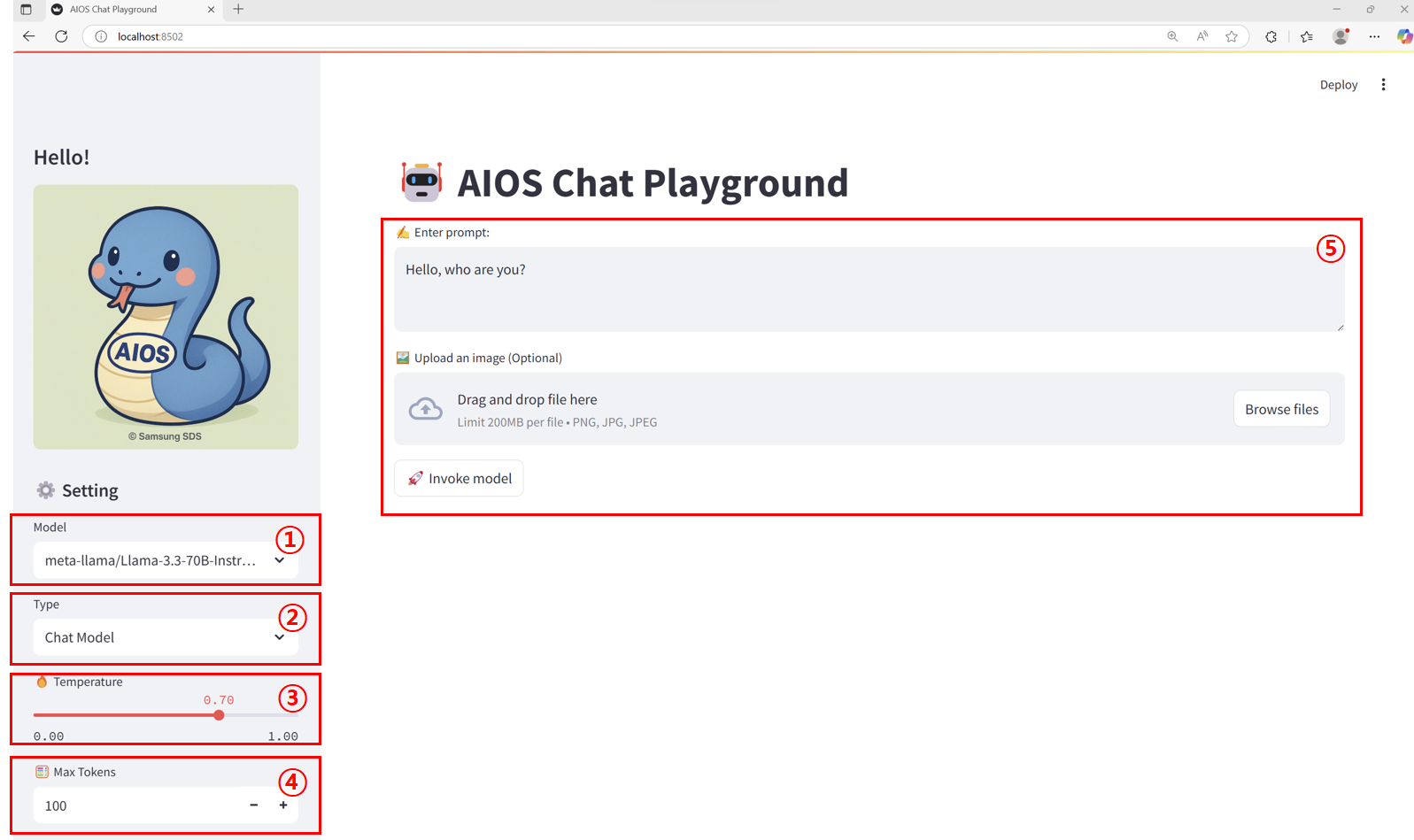
Main screen composition
| Item | Description |
|---|
| 1 | Model | This is a list of callable models set in the models.json file. |
| 2 | Endpoint type | must be selected according to the model call type set in the endpoints.json file to match the model |
| 3 | Temperature | The parameter that controls the degree of “randomness” or “creativity” of the model output. In this tutorial, it is specified in the range of 0.00 ~ 1.00.- 0.0 : Only the most likely token is selected → Accurate and consistent response, lack of diversity
- 0.7 : Moderate randomness → Balance between creativity and consistency
- 1.0 : High randomness → Diverse and creative responses, possible quality variation
|
| 4 | Max Tokens | Sets the maximum number of tokens that can be generated in the response text as an output length limit parameter. In this tutorial, it is specified in the range of 1 to 5000. |
| 5 | Input Area | The way to receive prompts, images, etc. varies depending on the endpoint type.- Chat, Completion, Embedding. Reasoning : general text input
- Image : text + image upload
- Rerank : query + document list (in this tutorial, line-by-line text is recognized as a document)
|
Fig. Main screen composition
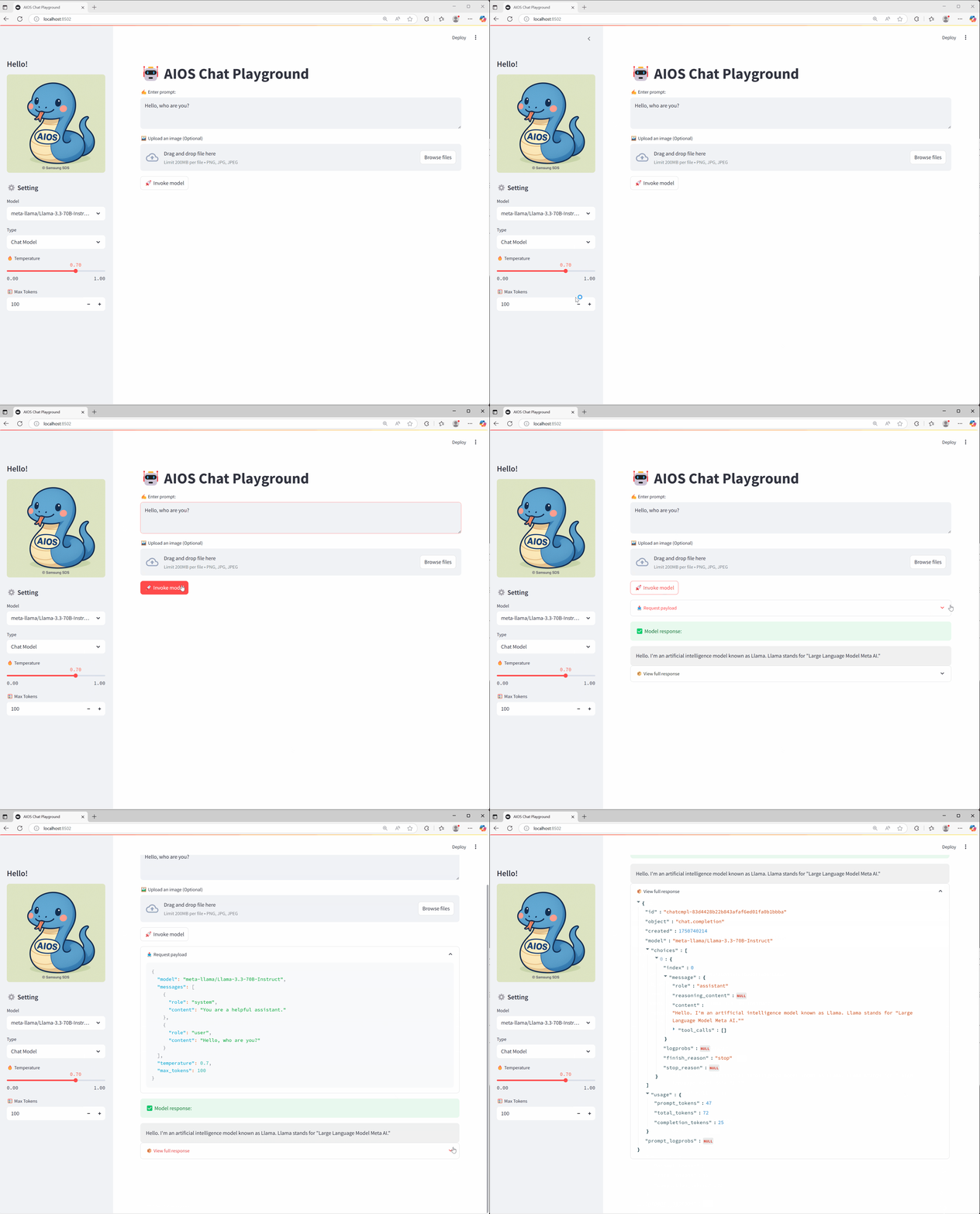
Calling the Chat Model
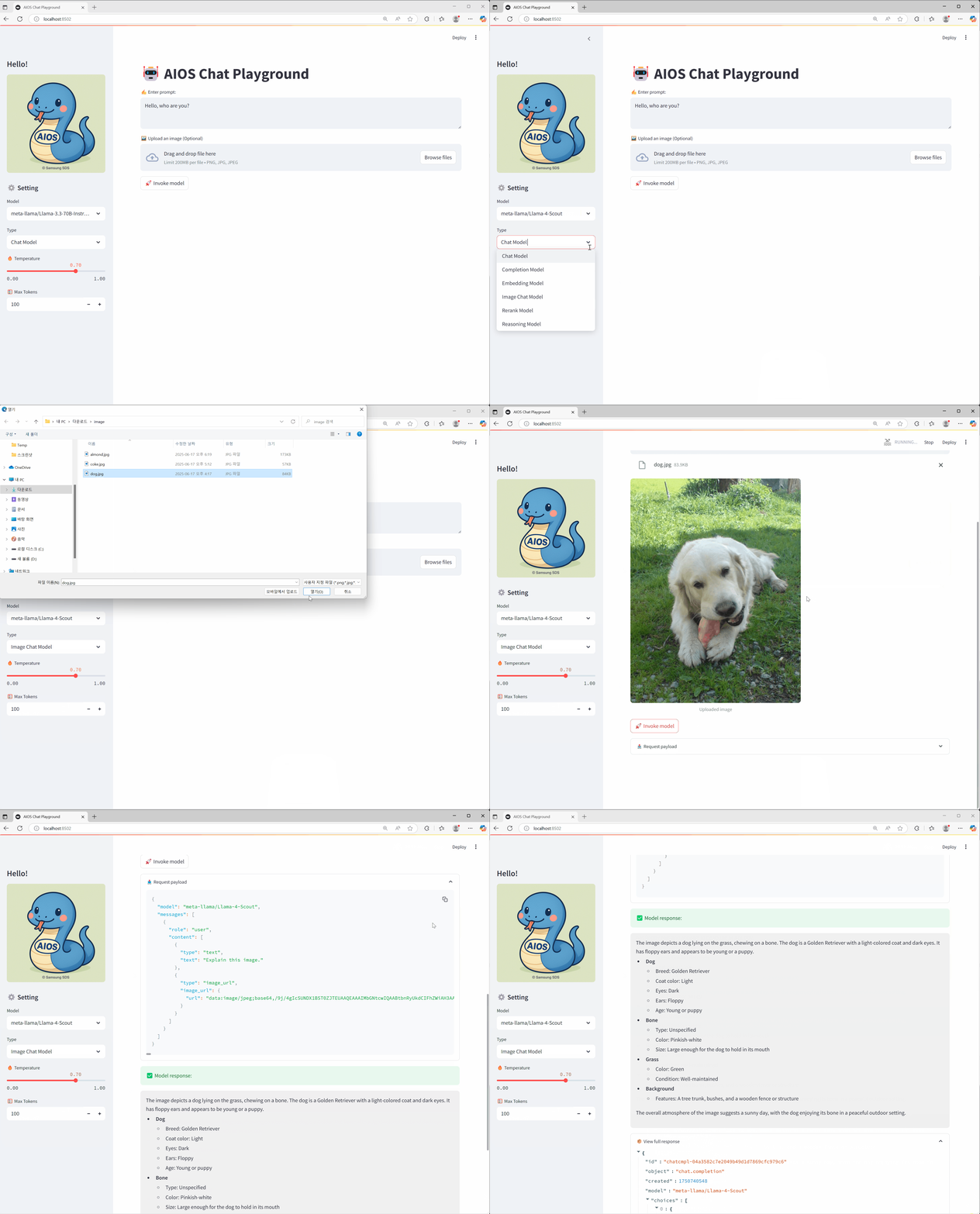
Image model calling
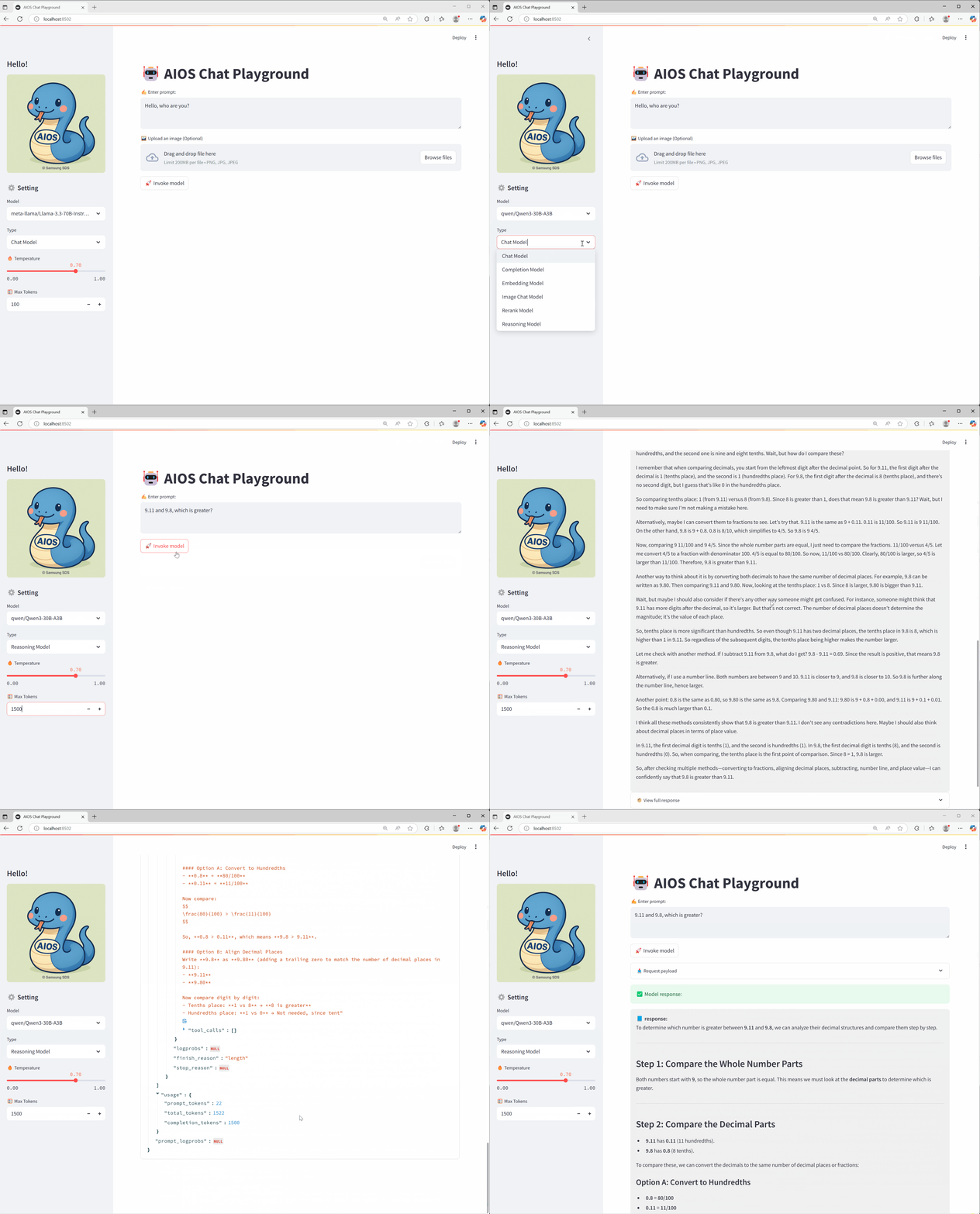
Reasoning model calling
Conclusion
Through this tutorial, I hope you have learned how to build and utilize a Playground UI that can easily test various AI model APIs provided by AIOS, and you can flexibly customize it to fit your desired model and endpoint structure for actual service purposes.
Reference link
https://docs.streamlit.io/
3 - Autogen
Goal
Using the AI model provided by AIOS, create an Autogen AI Agent application.
Note
Autogen
Autogen is an open-source framework that can easily build and manage LLM-based multi-agent collaboration and event-driven automation workflows.
environment
To proceed with this tutorial, the following environment must be prepared.
System Environment
Required packages for installation
pip install autogen-agentchat==0.6.1 autogen-ext[openai,mcp]==0.6.1 mcp-server-time==0.6.2
pip install autogen-agentchat==0.6.1 autogen-ext[openai,mcp]==0.6.1 mcp-server-time==0.6.2
System Architecture
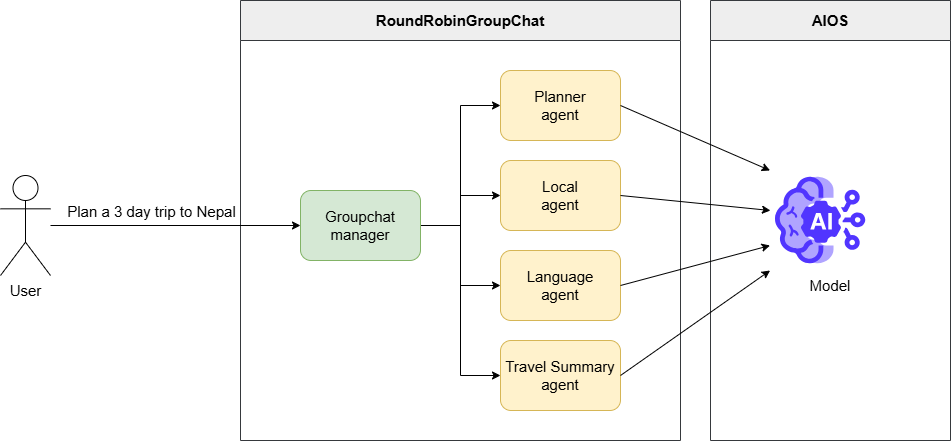
Shows the entire flow of the agent architecture using multi AI agent architecture and MCP.
Travel Planning Agent Flow
- The user requests to set up a 3-day Nepal travel plan
- Groupchat manger adjusts the execution order of registered agents (travel plan, local information, travel conversation, comprehensive summary)
- Each agent performs the given tasks collaboratively according to its respective role
- Once the final travel plan result is derived, deliver it to the user
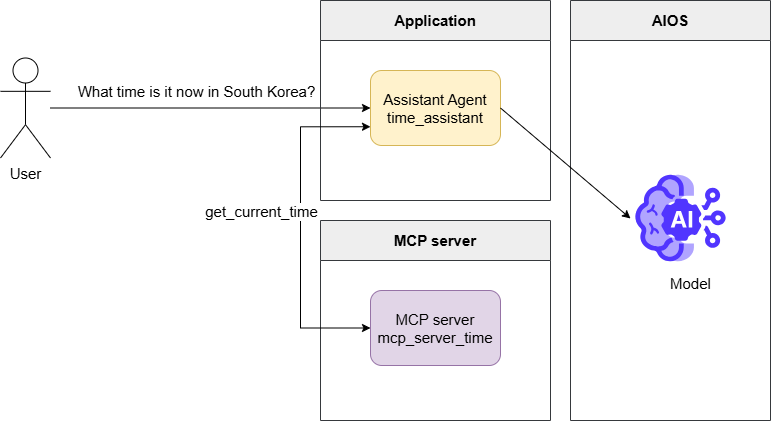
MCP Flow
Note
MCP
MCP(Model Context Protocol) is an open standard protocol that coordinates interactions between the model and external data or tools.
The MCP server is a server that implements this, using tool metadata to mediate and execute function calls.
- User queries about the current time in Korea
- mcp_server_time model request including metadata of a tool that can retrieve the current time via the server
get_current_time calling the function tool calls message generation- Through the MCP server, by executing the
get_current_time function and passing the result to the model request, generate the final response and deliver it to the user.
Implementation
Travel Planning Agent
Reference
- Please refer to the LLM usage guide for the AIOS_BASE_URL AIOS_LLM_Private_Endpoint and the MODEL_ID of the MODEL.
autogen_travel_planning.py
from urllib.parse import urljoin

from autogen_agentchat.agents import AssistantAgent
from autogen_agentchat.conditions import TextMentionTermination
from autogen_agentchat.teams import RoundRobinGroupChat
from autogen_agentchat.ui import Console
from autogen_ext.models.openai import OpenAIChatCompletionClient
from autogen_core.models import ModelFamily


# Set the API URL and model name for model access.
AIOS_BASE_URL = "AIOS_LLM_Private_Endpoint"
MODEL = "MODEL_ID"

# Create a model client using OpenAIChatCompletionClient.
model_client = OpenAIChatCompletionClient(
    model=MODEL,
    base_url=urljoin(AIOS_BASE_URL, "v1"),
    api_key="EMPTY_KEY",
    model_info={
        # Set to True if images are supported.
        "vision": False,
        # Set to True if function calls are supported.
        "function_calling": True,
        # Set to True if JSON output is supported.
        "json_output": True,
        # If the model you want to use is not provided by ModelFamily, use UNKNOWN.
        # "family": ModelFamily.UNKNOWN,
        "family": ModelFamily.LLAMA_3_3_70B,
        # Set to True if supporting structured output.
        "structured_output": True,
    },
)

# Create multiple agents.
# Each agent performs roles such as travel planning, local activity recommendations, providing language tips, and summarizing travel plans.
planner_agent = AssistantAgent(
    "planner_agent",
    model_client=model_client,
    description="A helpful assistant that can plan trips.",
    system_message=("You are a helpful assistant that can suggest a travel plan "
                    "for a user based on their request."),
)

local_agent = AssistantAgent(
    "local_agent",
    model_client=model_client,
    description="A local assistant that can suggest local activities or places to visit.",
    system_message=("You are a helpful assistant that can suggest authentic and ""
                    "interesting local activities or places to visit for a user "
                    "and can utilize any context information provided."),
)

language_agent = AssistantAgent(
    "language_agent",
    model_client=model_client,
    description="A helpful assistant that can provide language tips for a given destination.",
    system_message=("You are a helpful assistant that can review travel plans, "
                    "providing feedback on important/critical tips about how best to address ""
                    "language or communication challenges for the given destination. ""
                    "If the plan already includes language tips, "
                    "you can mention that the plan is satisfactory, with rationale."),
)

travel_summary_agent = AssistantAgent(
    "travel_summary_agent",
    model_client=model_client,
    description="A helpful assistant that can summarize the travel plan.",
    system_message=("You are a helpful assistant that can take in all of the suggestions "
                    "and advice from the other agents and provide a detailed final travel plan. ""
                    "You must ensure that the final plan is integrated and complete. "
                    "YOUR FINAL RESPONSE MUST BE THE COMPLETE PLAN. "
                    "When the plan is complete and all perspectives are integrated, "
                    "you can respond with TERMINATE."),
)

# Group the agents and create a RoundRobinGroupChat.
# RoundRobinGroupChat adjusts so that agents perform tasks in the order they are registered, taking turns.
# This group enables agents to interact and make travel plans.
# The termination condition uses TextMentionTermination to end the group chat when the text "TERMINATE" is mentioned.
termination = TextMentionTermination("TERMINATE")
group_chat = RoundRobinGroupChat(
    [planner_agent, local_agent, language_agent, travel_summary_agent],
    termination_condition=termination,
)

async def main():
    """Main function, runs group chat and makes travel plans."""
    # Run a group chat to make travel plans.
    # User requests the task "Plan a 3 day trip to Nepal."
    # Print the results using the console.
    await Console(group_chat.run_stream(task="Plan a 3 day trip to Nepal."))
    await model_client.close()


if __name__ == "__main__":
    import asyncio

    asyncio.run(main())
from urllib.parse import urljoin

from autogen_agentchat.agents import AssistantAgent
from autogen_agentchat.conditions import TextMentionTermination
from autogen_agentchat.teams import RoundRobinGroupChat
from autogen_agentchat.ui import Console
from autogen_ext.models.openai import OpenAIChatCompletionClient
from autogen_core.models import ModelFamily


# Set the API URL and model name for model access.
AIOS_BASE_URL = "AIOS_LLM_Private_Endpoint"
MODEL = "MODEL_ID"

# Create a model client using OpenAIChatCompletionClient.
model_client = OpenAIChatCompletionClient(
    model=MODEL,
    base_url=urljoin(AIOS_BASE_URL, "v1"),
    api_key="EMPTY_KEY",
    model_info={
        # Set to True if images are supported.
        "vision": False,
        # Set to True if function calls are supported.
        "function_calling": True,
        # Set to True if JSON output is supported.
        "json_output": True,
        # If the model you want to use is not provided by ModelFamily, use UNKNOWN.
        # "family": ModelFamily.UNKNOWN,
        "family": ModelFamily.LLAMA_3_3_70B,
        # Set to True if supporting structured output.
        "structured_output": True,
    },
)

# Create multiple agents.
# Each agent performs roles such as travel planning, local activity recommendations, providing language tips, and summarizing travel plans.
planner_agent = AssistantAgent(
    "planner_agent",
    model_client=model_client,
    description="A helpful assistant that can plan trips.",
    system_message=("You are a helpful assistant that can suggest a travel plan "
                    "for a user based on their request."),
)

local_agent = AssistantAgent(
    "local_agent",
    model_client=model_client,
    description="A local assistant that can suggest local activities or places to visit.",
    system_message=("You are a helpful assistant that can suggest authentic and ""
                    "interesting local activities or places to visit for a user "
                    "and can utilize any context information provided."),
)

language_agent = AssistantAgent(
    "language_agent",
    model_client=model_client,
    description="A helpful assistant that can provide language tips for a given destination.",
    system_message=("You are a helpful assistant that can review travel plans, "
                    "providing feedback on important/critical tips about how best to address ""
                    "language or communication challenges for the given destination. ""
                    "If the plan already includes language tips, "
                    "you can mention that the plan is satisfactory, with rationale."),
)

travel_summary_agent = AssistantAgent(
    "travel_summary_agent",
    model_client=model_client,
    description="A helpful assistant that can summarize the travel plan.",
    system_message=("You are a helpful assistant that can take in all of the suggestions "
                    "and advice from the other agents and provide a detailed final travel plan. ""
                    "You must ensure that the final plan is integrated and complete. "
                    "YOUR FINAL RESPONSE MUST BE THE COMPLETE PLAN. "
                    "When the plan is complete and all perspectives are integrated, "
                    "you can respond with TERMINATE."),
)

# Group the agents and create a RoundRobinGroupChat.
# RoundRobinGroupChat adjusts so that agents perform tasks in the order they are registered, taking turns.
# This group enables agents to interact and make travel plans.
# The termination condition uses TextMentionTermination to end the group chat when the text "TERMINATE" is mentioned.
termination = TextMentionTermination("TERMINATE")
group_chat = RoundRobinGroupChat(
    [planner_agent, local_agent, language_agent, travel_summary_agent],
    termination_condition=termination,
)

async def main():
    """Main function, runs group chat and makes travel plans."""
    # Run a group chat to make travel plans.
    # User requests the task "Plan a 3 day trip to Nepal."
    # Print the results using the console.
    await Console(group_chat.run_stream(task="Plan a 3 day trip to Nepal."))
    await model_client.close()


if __name__ == "__main__":
    import asyncio

    asyncio.run(main())
When you run a file using python, you can see multiple agents working together, each performing its role for a single task.
python autogen_travel_planning.py
python autogen_travel_planning.py
Execution Result
---------- TextMessage (user) ----------
Plan a 3 day trip to Nepal.
---------- TextMessage (planner_agent) ----------
Nepal! A country with a rich cultural heritage, breathtaking natural beauty, and warm hospitality. Here's a suggested 3-day itinerary for your trip to Nepal:

**Day 1: Arrival in Kathmandu and Exploration of the City**

* Arrive at Tribhuvan International Airport in Kathmandu, the capital city of Nepal.
* Check-in to your hotel and freshen up.
* Visit the famous **Boudhanath Stupa**, one of the largest Buddhist stupas in the world.
* Explore the **Thamel** area, a popular tourist hub known for its narrow streets, shops, and restaurants.
* In the evening, enjoy a traditional Nepali dinner and watch a cultural performance at a local restaurant.

**Day 2: Kathmandu Valley Tour**

* Start the day with a visit to the **Pashupatinath Temple**, a sacred Hindu temple dedicated to Lord Shiva.
* Next, head to the **Kathmandu Durbar Square**, a UNESCO World Heritage Site and the former royal palace of the Malla kings.
* Visit the **Swayambhunath Stupa**, also known as the Monkey Temple, which offers stunning views of the city.
* In the afternoon, take a short drive to the **Patan City**, known for its rich cultural heritage and traditional crafts.
* Explore the **Patan Durbar Square** and visit the **Krishna Temple**, a beautiful example of Nepali architecture.

**Day 3: Bhaktapur and Nagarkot**

* Drive to **Bhaktapur**, a medieval town and a UNESCO World Heritage Site (approximately 1 hour).
* Explore the **Bhaktapur Durbar Square**, which features stunning architecture, temples, and palaces.
* Visit the **Pottery Square**, where you can see traditional pottery-making techniques.
* In the afternoon, drive to **Nagarkot**, a scenic hill station with breathtaking views of the Himalayas (approximately 1.5 hours).
* Watch the sunset over the Himalayas and enjoy the peaceful atmosphere.

**Additional Tips:**

* Make sure to try some local Nepali cuisine, such as momos, dal bhat, and gorkhali lamb.
* Bargain while shopping in the markets, as it's a common practice in Nepal.
* Respect local customs and traditions, especially when visiting temples and cultural sites.
* Stay hydrated and bring sunscreen, as the sun can be strong in Nepal.

**Accommodation:**

Kathmandu has a wide range of accommodation options, from budget-friendly guesthouses to luxury hotels. Some popular areas to stay include Thamel, Lazimpat, and Boudha.

**Transportation:**

You can hire a taxi or a private vehicle for the day to travel between destinations. Alternatively, you can use public transportation, such as buses or microbuses, which are affordable and convenient.

**Budget:**

The budget for a 3-day trip to Nepal can vary depending on your accommodation choices, transportation, and activities. However, here's a rough estimate:

* Accommodation: $20-50 per night
* Transportation: $10-20 per day
* Food: $10-20 per meal
* Activities: $10-20 per person

Total estimated budget for 3 days: $200-500 per person

I hope this helps, and you have a wonderful trip to Nepal!
---------- TextMessage (local_agent) ----------
Your 3-day itinerary for Nepal is well-planned and covers many of the country's cultural and natural highlights. Here are a few additional suggestions and tips to enhance your trip:

**Day 1:**

* After visiting the Boudhanath Stupa, consider exploring the surrounding streets, which are filled with Tibetan shops, restaurants, and monasteries.
* In the Thamel area, be sure to try some of the local street food, such as momos or sel roti.
* For dinner, consider trying a traditional Nepali restaurant, such as the Kathmandu Guest House or the Northfield Cafe.

**Day 2:**

* At the Pashupatinath Temple, be respectful of the Hindu rituals and customs. You can also take a stroll along the Bagmati River, which runs through the temple complex.
* At the Kathmandu Durbar Square, consider hiring a guide to provide more insight into the history and significance of the temples and palaces.
* In the afternoon, visit the Patan Museum, which showcases the art and culture of the Kathmandu Valley.

**Day 3:**

* In Bhaktapur, be sure to try some of the local pottery and handicrafts. You can also visit the Bhaktapur National Art Gallery, which features traditional Nepali art.
* At Nagarkot, consider taking a short hike to the nearby villages, which offer stunning views of the Himalayas.
* For sunset, find a spot with a clear view of the mountains, and enjoy the peaceful atmosphere.

**Additional Tips:**

* Nepal is a relatively conservative country, so dress modestly and respect local customs.
* Try to learn some basic Nepali phrases, such as "namaste" (hello) and "dhanyabaad" (thank you).
* Be prepared for crowds and chaos in the cities, especially in Thamel and Kathmandu Durbar Square.
* Consider purchasing a local SIM card or portable Wi-Fi hotspot to stay connected during your trip.

**Accommodation:**

* Consider staying in a hotel or guesthouse that is centrally located and has good reviews.
* Look for accommodations that offer amenities such as free Wi-Fi, hot water, and a restaurant or cafe.

**Transportation:**

* Consider hiring a private vehicle or taxi for the day, as this will give you more flexibility and convenience.
* Be sure to negotiate the price and agree on the itinerary before setting off.

**Budget:**

* Be prepared for variable prices and exchange rates, and have some local currency (Nepali rupees) on hand.
* Consider budgeting extra for unexpected expenses, such as transportation or food.

Overall, your itinerary provides a good balance of culture, history, and natural beauty, and with these additional tips and suggestions, you'll be well-prepared for an unforgettable trip to Nepal!
---------- TextMessage (language_agent) ----------
Your 3-day itinerary for Nepal is well-planned and covers many of the country's cultural and natural highlights. The additional suggestions and tips you provided are excellent and will help enhance the trip experience.

One aspect that is well-covered in your plan is the cultural and historical significance of the destinations. You have included a mix of temples, stupas, and cultural sites, which will give visitors a good understanding of Nepal's rich heritage.

Regarding language and communication challenges, your tip to "try to learn some basic Nepali phrases, such as 'namaste' (hello) and 'dhanyabaad' (thank you)" is excellent. This will help visitors show respect for the local culture and people, and can also facilitate interactions with locals.

Additionally, your suggestion to "consider purchasing a local SIM card or portable Wi-Fi hotspot to stay connected during your trip" is practical and will help visitors stay in touch with family and friends back home, as well as navigate the local area.

Your plan is satisfactory, and with the additional tips and suggestions, visitors will be well-prepared for an unforgettable trip to Nepal. The itinerary provides a good balance of culture, history, and natural beauty, and the tips on language, communication, and logistics will help ensure a smooth and enjoyable journey.

Overall, your plan is well-thought-out, and the additional suggestions and tips will help visitors make the most of their trip to Nepal. Well done!

However, one minor suggestion I might make is to consider including a few phrases in the local language for emergency situations, such as "where is the hospital?" or "how do I get to the airport?" This can help visitors in case of an unexpected situation, and can also give them more confidence when navigating unfamiliar areas.

But overall, your plan is excellent, and with these minor suggestions, it can be even more comprehensive and helpful for visitors to Nepal.
---------- TextMessage (travel_summary_agent) ----------
TERMINATE

Here is the complete and integrated 3-day travel plan to Nepal:

**Day 1: Arrival in Kathmandu and Exploration of the City**

* Arrive at Tribhuvan International Airport in Kathmandu, the capital city of Nepal.
* Check-in to your hotel and freshen up.
* Visit the famous **Boudhanath Stupa**, one of the largest Buddhist stupas in the world.
* Explore the surrounding streets, which are filled with Tibetan shops, restaurants, and monasteries.
* Explore the **Thamel** area, a popular tourist hub known for its narrow streets, shops, and restaurants. Be sure to try some of the local street food, such as momos or sel roti.
* In the evening, enjoy a traditional Nepali dinner and watch a cultural performance at a local restaurant, such as the Kathmandu Guest House or the Northfield Cafe.

**Day 2: Kathmandu Valley Tour**

* Start the day with a visit to the **Pashupatinath Temple**, a sacred Hindu temple dedicated to Lord Shiva. Be respectful of the Hindu rituals and customs, and take a stroll along the Bagmati River, which runs through the temple complex.
* Next, head to the **Kathmandu Durbar Square**, a UNESCO World Heritage Site and the former royal palace of the Malla kings. Consider hiring a guide to provide more insight into the history and significance of the temples and palaces.
* Visit the **Swayambhunath Stupa**, also known as the Monkey Temple, which offers stunning views of the city.
* In the afternoon, visit the **Patan City**, known for its rich cultural heritage and traditional crafts. Explore the **Patan Durbar Square** and visit the **Krishna Temple**, a beautiful example of Nepali architecture. Also, visit the Patan Museum, which showcases the art and culture of the Kathmandu Valley.

**Day 3: Bhaktapur and Nagarkot**

* Drive to **Bhaktapur**, a medieval town and a UNESCO World Heritage Site (approximately 1 hour). Explore the **Bhaktapur Durbar Square**, which features stunning architecture, temples, and palaces. Be sure to try some of the local pottery and handicrafts, and visit the Bhaktapur National Art Gallery, which features traditional Nepali art.
* In the afternoon, drive to **Nagarkot**, a scenic hill station with breathtaking views of the Himalayas (approximately 1.5 hours). Consider taking a short hike to the nearby villages, which offer stunning views of the Himalayas. Find a spot with a clear view of the mountains, and enjoy the peaceful atmosphere during sunset.

**Additional Tips:**

* Make sure to try some local Nepali cuisine, such as momos, dal bhat, and gorkhali lamb.
* Bargain while shopping in the markets, as it's a common practice in Nepal.
* Respect local customs and traditions, especially when visiting temples and cultural sites.
* Stay hydrated and bring sunscreen, as the sun can be strong in Nepal.
* Dress modestly and respect local customs, as Nepal is a relatively conservative country.
* Try to learn some basic Nepali phrases, such as "namaste" (hello), "dhanyabaad" (thank you), "where is the hospital?" and "how do I get to the airport?".
* Consider purchasing a local SIM card or portable Wi-Fi hotspot to stay connected during your trip.
* Be prepared for crowds and chaos in the cities, especially in Thamel and Kathmandu Durbar Square.

**Accommodation:**

* Consider staying in a hotel or guesthouse that is centrally located and has good reviews.
* Look for accommodations that offer amenities such as free Wi-Fi, hot water, and a restaurant or cafe.

**Transportation:**

* Consider hiring a private vehicle or taxi for the day, as this will give you more flexibility and convenience.
* Be sure to negotiate the price and agree on the itinerary before setting off.

**Budget:**

* The budget for a 3-day trip to Nepal can vary depending on your accommodation choices, transportation, and activities. However, here's a rough estimate:
        + Accommodation: $20-50 per night
        + Transportation: $10-20 per day
        + Food: $10-20 per meal
        + Activities: $10-20 per person
* Total estimated budget for 3 days: $200-500 per person
* Be prepared for variable prices and exchange rates, and have some local currency (Nepali rupees) on hand.
* Consider budgeting extra for unexpected expenses, such as transportation or food.
Agent-specific conversation summary
| Agent | Conversation summary |
|---|
| planner_agent | I propose a 3-day travel itinerary for Nepal.
Day 1: Arrival in Kathmandu and city exploration
Day 2: Kathmandu valley tour
Day 3: Visit Pokhara and Nagarkot
Additional tips: Respect local customs, try local food, choose transportation options, etc |
| local_agent | Based on planner_agent’s 3-day travel itinerary, we provide additional suggestions and tips.
Day 1: Explore around Budhanath Stupa,
Day 2: Respect Hindu rituals at Pashupatinath Temple
Day 3: Try pottery and handicrafts of Bhaktapur
Additional tips: Respect local customs, learn basic Nepali, use local facilities, etc |
| language_agent | Travel itinerary evaluation and provide additional suggestions.
Basic Nepali learning, use of local facilities, language preparation for emergency situations, etc. |
| travel_summary_agent | Summarizes the overall 3-day travel plan.
Day 1: Arrival in Kathmandu and city exploration
Day 2: Kathmandu valley tour
Day 3: Visit Pokhara and Nagarkot
Additional tips: Respect local customs, try local food, choose transportation options, etc. |
MCP Utilization Agent
Note
- Please refer to the LLM usage guide for the AIOS_BASE_URL AIOS_LLM_Private_Endpoint and the MODEL_ID of the MODEL.
autogen_mcp.py
from urllib.parse import urljoin

from autogen_core.models import ModelFamily
from autogen_ext.models.openai import OpenAIChatCompletionClient
from autogen_ext.tools.mcp import McpWorkbench, StdioServerParams
from autogen_agentchat.agents import AssistantAgent
from autogen_agentchat.ui import Console

# Set the API URL and model name for model access.
AIOS_BASE_URL = "AIOS_LLM_Private_Endpoint"
MODEL = "MODEL_ID"

# Create a model client using OpenAIChatCompletionClient.
model_client = OpenAIChatCompletionClient(
    model=MODEL,
    base_url=urljoin(AIOS_BASE_URL, "v1"),
    api_key="EMPTY_KEY",
    model_info={
        # Set to True if images are supported.
        "vision": False,
        # Set to True if function calls are supported.
        "function_calling": True,
        # Set to True if JSON output is supported.
        "json_output": True,
        # If the model you want to use is not provided by ModelFamily, use UNKNOWN.
        # "family": ModelFamily.UNKNOWN,
        "family": ModelFamily.LLAMA_3_3_70B,
        # Set to True if supporting structured output.
        "structured_output": True,
    }
")"


# Set MCP server parameters.
# mcp_server_time is an MCP server implemented in python,
# It includes the get_current_time function that provides the current time internally, and the convert_time function that converts time zones.
# This parameter sets the MCP server to the local timezone so that the time can be checked.
# For example, if you set it to "Asia/Seoul", you can check the time according to the Korean time zone.
mcp_server_params = StdioServerParams(
    command="python",
    args=["-m", "mcp_server_time", "--local-timezone", "Asia/Seoul"],
)

async def main():
    """Runs the agent that checks the time using the MCP workbench as the main function."""
    # Create and run an agent that checks the time using the MCP workbench.
    # The agent performs the task "What time is it now in South Korea?"
    # Print the results using the console.
    # while the MCP Workbench is running, the agent checks the time
    # Output the results in streaming mode.
    # If MCP Workbench terminates, the agent also terminates.
    async with McpWorkbench(mcp_server_params) as workbench:
        time_agent = AssistantAgent(
            "time_assistant",
            model_client=model_client,
            workbench=workbench,
            reflect_on_tool_use=True,
        )
        await Console(time_agent.run_stream(task="What time is it now in South Korea?"))
    await model_client.close()


if __name__ == "__main__":
    import asyncio
    asyncio.run(main())
from urllib.parse import urljoin

from autogen_core.models import ModelFamily
from autogen_ext.models.openai import OpenAIChatCompletionClient
from autogen_ext.tools.mcp import McpWorkbench, StdioServerParams
from autogen_agentchat.agents import AssistantAgent
from autogen_agentchat.ui import Console

# Set the API URL and model name for model access.
AIOS_BASE_URL = "AIOS_LLM_Private_Endpoint"
MODEL = "MODEL_ID"

# Create a model client using OpenAIChatCompletionClient.
model_client = OpenAIChatCompletionClient(
    model=MODEL,
    base_url=urljoin(AIOS_BASE_URL, "v1"),
    api_key="EMPTY_KEY",
    model_info={
        # Set to True if images are supported.
        "vision": False,
        # Set to True if function calls are supported.
        "function_calling": True,
        # Set to True if JSON output is supported.
        "json_output": True,
        # If the model you want to use is not provided by ModelFamily, use UNKNOWN.
        # "family": ModelFamily.UNKNOWN,
        "family": ModelFamily.LLAMA_3_3_70B,
        # Set to True if supporting structured output.
        "structured_output": True,
    }
")"


# Set MCP server parameters.
# mcp_server_time is an MCP server implemented in python,
# It includes the get_current_time function that provides the current time internally, and the convert_time function that converts time zones.
# This parameter sets the MCP server to the local timezone so that the time can be checked.
# For example, if you set it to "Asia/Seoul", you can check the time according to the Korean time zone.
mcp_server_params = StdioServerParams(
    command="python",
    args=["-m", "mcp_server_time", "--local-timezone", "Asia/Seoul"],
)

async def main():
    """Runs the agent that checks the time using the MCP workbench as the main function."""
    # Create and run an agent that checks the time using the MCP workbench.
    # The agent performs the task "What time is it now in South Korea?"
    # Print the results using the console.
    # while the MCP Workbench is running, the agent checks the time
    # Output the results in streaming mode.
    # If MCP Workbench terminates, the agent also terminates.
    async with McpWorkbench(mcp_server_params) as workbench:
        time_agent = AssistantAgent(
            "time_assistant",
            model_client=model_client,
            workbench=workbench,
            reflect_on_tool_use=True,
        )
        await Console(time_agent.run_stream(task="What time is it now in South Korea?"))
    await model_client.close()


if __name__ == "__main__":
    import asyncio
    asyncio.run(main())
When you run the file using python, it fetches the tool’s metadata from the MCP server, calls the model, and when the model generates a tool calls message
You can see that the get_current_time function is executed to retrieve the current time.
Code block. autogen MCP utilization agent execution Execution result
# TextMessage (user): Input message given by the user
---------- TextMessage (user) ----------
What time is it now in South Korea?
# Query metadata of tools that can be used on the MCP server
INFO:mcp.server.lowlevel.server:Processing request of type ListToolsRequest
...omission...
INFO:autogen_core.events:{
  # Metadata of tools available on the MCP server
  "tools": [
    {
      "type": "function",
      "function": {
        "name": "get_current_time",
        "description": "Get current time in a specific timezones",
        "parameters": {
          "type": "object",
          "properties": {
            "timezone": {
              "type": "string",
              "description": "IANA timezone name (e.g., 'America/New_York', 'Europe/London'). Use 'Asia/Seoul' as local timezone if no timezone provided by the user."
            }
          },
          "required": ["

            "timezone
          ],
          "additionalProperties": false
        },
        "strict": false
      }
    },
    {
      "type": "function",
      "function": {
        "name": "convert_time",
        "description": "Convert time between timezones",
        "parameters": {
          "type": "object",
          "properties": {
            "source_timezone": {
              "type": "string",
              "description": "Source IANA timezone name (e.g., 'America/New_York', 'Europe/London'). Use 'Asia/Seoul' as local timezone if no source timezone provided by the user."
            },
            "time": {
              "type": "string",
              "description": "Time to convert in 24-hour format (HH:MM)"
            },
            "target_timezone": {
              "type": "string",
              "description": "Target IANA timezone name (e.g., 'Asia/Tokyo', 'America/San_Francisco'). Use 'Asia/Seoul' as local timezone if no target timezone provided by the user."
            }
          },
          "required": [
            "source_timezone",
            "time",
            "target_timezone"
          ],
          "additionalProperties": false
        },
        "strict": false
      }
    }
  ],
  "type": "LLMCall",
  # input message
  "messages": [
    {
      "content": "You are a helpful AI assistant. Solve tasks using your tools. Reply with TERMINATE when the task has been completed.",
      "role": "system"
    },
    {
      "role": "user",
      "name": "user",
      "content": "What time is it now in South Korea?"
    }
  ],
  # Model Response
  "response": {
    "id": "chatcmpl-xxxxxxxxxxxxxxxxxxxxxxxxxxxxxxxx",
    "choices": [
      {
        "finish_reason": "tool_calls",
        "index": 0,
        "logprobs": null,
        "message": {
          "content": null,
          "refusal": null,
          "role": "assistant",
          "annotations": null,
          "audio": null,
          "function_call": null,
          "tool_calls": ["

            {
              "id": "chatcmpl-tool-xxxxxxxxxxxxxxxxxxxxxxxxxxxxxxxx",
              "function": {
                "arguments": "{\"timezone\": \"Asia/Seoul\"}",
                "name": "get_current_time"
              },
              "type": "function"
            }
          ],
          "reasoning_content": null
        },
        "stop_reason": 128008
      }
    ],
    "created": 1751278737,
    "model": "MODEL_ID",
    "object": "chat.completion",
    "service_tier": null,
    "system_fingerprint": null,
    "usage": {
      "completion_tokens": 21,
      "prompt_tokens": 508,
      "total_tokens": 529,
      "completion_tokens_details": null,
      "prompt_tokens_details": null
    },
    "prompt_logprobs": null
  },
  "prompt_tokens": 508,
  "completion_tokens": 21,
  "agent_id": null
}
# ToolCallRequestEvent: Receiving a tool call message from the model
---------- ToolCallRequestEvent (time_assistant) ----------
[FunctionCall(id='chatcmpl-tool-xxxxxxxxxxxxxxxxxxxxxxxxxxxxxxxx', arguments='{"timezone": "Asia/Seoul"}', name='get_current_time')]
INFO:mcp.server.lowlevel.server:Processing request of type ListToolsRequest
# Execute function of tool call message via MCP server
INFO:mcp.server.lowlevel.server:Processing request of type CallToolRequest
# ToolCallExecutionEvent: Deliver the function execution result to the model
---------- ToolCallExecutionEvent (time_assistant) ----------
[FunctionExecutionResult(content='{
  "timezone": "Asia/Seoul",
  "datetime": "2025-06-30T19:18:58+09:00",
  "is_dst": false
}', name='get_current_time', call_id='chatcmpl-tool-xxxxxxxxxxxxxxxxxxxxxxxxxxxxxxxx', is_error=False)]
...omission...
# TextMessage (time_assistant): Final answer generated by the model
---------- TextMessage (time_assistant) ----------
The current time in South Korea is 19:18:58 KST.
TERMINATE
MCP Server Time Query System Log Analysis Result
MCP(Model Control Protocol) server-based time query system execution process log analysis result.
Request Information
| Item | Content |
|---|
| User request | What time is it now in South Korea? |
| Request Time | 2025-06-30 19:18:58 KST |
| Processing method | MCP server tool call |
Available tools
| Tool Name | Description | Parameter | Default Value |
|---|
get_current_time | Retrieve current time of a specific timezone | timezone (IANA timezone name) | Asia/Seoul |
convert_time | Time conversion between time zones | source_timezone, time, target_timezone | Asia/Seoul |
Processing steps
| Step | Action | Details |
|---|
| 1 | Tool metadata lookup | Verify the list of tools available on the MCP server |
| 2 | AI model response | get_current_time function called in the Asia/Seoul timezone |
| 3 | Function execution | MCP server runs time lookup tool |
| 4 | Return result | Provide time information in structured JSON format |
| 5 | Final Answer | Deliver time to the user in an easy-to-read format |
Function Call Details
| Item | Value |
|---|
| function name | get_current_time |
| Parameter | {"timezone": "Asia/Seoul"} |
| Call ID | chatcmpl-tool-xxxxxxxxxxxxxxxxxxxxxxxxxxxxxxxx |
| type | function |
Execution result
| Field | Value | Description |
|---|
timezone | Asia/Seoul | Time zone |
datetime | 2025-06-30T19:18:58+09:00 | ISO 8601 format time |
is_dst | false | Daylight saving time applied |
final response
| Item | Content |
|---|
| Response Message | The current time in South Korea is 19:18:58 KST. |
| Completion mark | TERMINATE |
| Response Time | 19:18:58 KST |
Usage metric table
| indicator | value |
|---|
| Prompt Token | 508 |
| completion token | 21 |
| Total token usage | 529 |
| Processing time | Immediate (real-time) |
Main features
| Feature | Description |
|---|
| MCP protocol utilization | Smooth integration with external tools |
| Korean time zone default setting | Asia/Seoul used as default |
| Structured response | Clear data return in JSON format |
| Auto-complete display | Work completion notification with TERMINATE |
| Real-time information provision | Accurate current time lookup |
Technical significance
This is an example of a modern architecture where an AI assistant integrates with external systems to provide real-time information. Through MCP, the AI model can access various external tools and services, enabling more practical and dynamic responses.
Conclusion
In this tutorial, we implemented an application that creates travel itineraries using multiple agents by leveraging the AI model provided by AIOS and autogen, and an agent application that can use external tools by utilizing the MCP server. Through this, we learned that problems can be solved from multiple angles using several agents with different perspectives, and external tools can be utilized. This system can be expanded and customized to fit user environments in the following ways.
- Agent flow control: Various techniques can be used when selecting the agent to perform the task. For reliable results, you can fix the order of agents and implement it, or you can let the AI model choose the agents for flexible processing. Additionally, you can use event techniques to implement multiple agents processing tasks in parallel.
- Introduction of various MCP servers: In addition to mcp_server_time, various MCP servers that have already been implemented exist. By utilizing these, the AI model can flexibly use various external tools to implement useful applications.
Based on this tutorial, we hope you will directly build a suitable AIOS-based collaborative assistant according to the actual service purpose.
Reference link
https://microsoft.github.io/autogen
https://modelcontextprotocol.io/
https://github.com/modelcontextprotocol/servers