networking Design
Understanding Traffic Requirements
Designing performance efficiency for cloud-based information systems begins with identifying the end user’s location and selecting the region where the information system will be deployed.
This is because the geographic distance between the end user and the data center closely affects the latency of user requests.
When determining the data center region, consider the following factors.
Legal Regulation
Legal regulations regarding the geographic location where end users’ personal and sensitive data are stored must be considered.
For example, public institutions may be required to use a public cloud that has received CSAP certification.
Latency
The time it takes for data to be delivered from the source to the end user must be minimized.
It is advisable to identify the services that users frequently use and to build the system in a data center that is geographically close to those users.
When providing a global service, you need to evaluate whether to distribute the system across each country or minimize latency using a Global CDN.
You must evaluate network requirements to determine the appropriate workload services and configurations.
Identify the data transmission requirements and network request frequency required by the information system.
Understand the bandwidth requirements. Analyze the workload to calculate network traffic based on the number of service requests per unit time and the size of request data, and secure bandwidth that can accommodate the traffic. Generally, traffic and bandwidth are expressed in bps(bit per second).
Establish a strategy to minimize network latency. When delivering web content over the public Internet, you can reduce latency by using a Global CDN. If a private network connection is required, you can configure a private connection using VPN, Direct Connect, Transit Gateway, etc., and you can also select the bandwidth of VPN or Direct Connect to meet the application’s required transmission speed.
- Understand throughput. Consider whether to configure a single VM or multiple VMs based on the throughput required by the workload. By using a Load Balancer, you can distribute load across multiple VMs, and by applying GSLB, you can route request load to multiple Regions (IP addresses).
Establishing measures to reduce latency
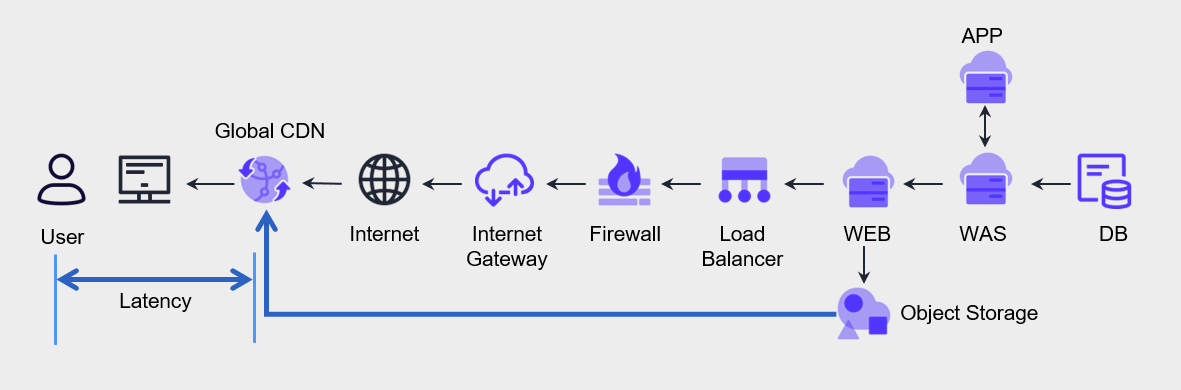
The user goes through various component processing steps when making a service request to a web application and receiving a response.
Earlier, we examined performance improvement measures from the perspective of computing and data storage.
If we look at the diagram below, the user and the web Application are connected via the Internet, and the speed of this segment varies in latency depending on geographic distance, more precisely the number of network hops.
Generally, the farther the geographic distance, the longer the time required for data transmission.
We use a Global CDN service to reduce this latency.
Global CDN utilizes numerous edge servers distributed across a global network to deliver static content stored in web servers or object storage to users more quickly and securely.
Additionally, even when traffic spikes, it distributes the load on the origin server to prevent overload, and end users can download content from the nearest edge server to enjoy fast and reliable web services.