FinOps Strategy Establishment and Execution
FinOps Strategy Establishment and Execution
“FinOps is an operational framework and cultural practice which maximizes the business value of cloud, enables timely data-driven decision making, and creates financial accountability through collaboration between engineering, finance, and business teams.” (FinOps Foundation)
FinOps is an operating framework and cultural practice that establishes financial transparency and accountability, and maximizes the value of cloud business by making timely data-driven decisions through collaboration between engineers, finance, and business teams.
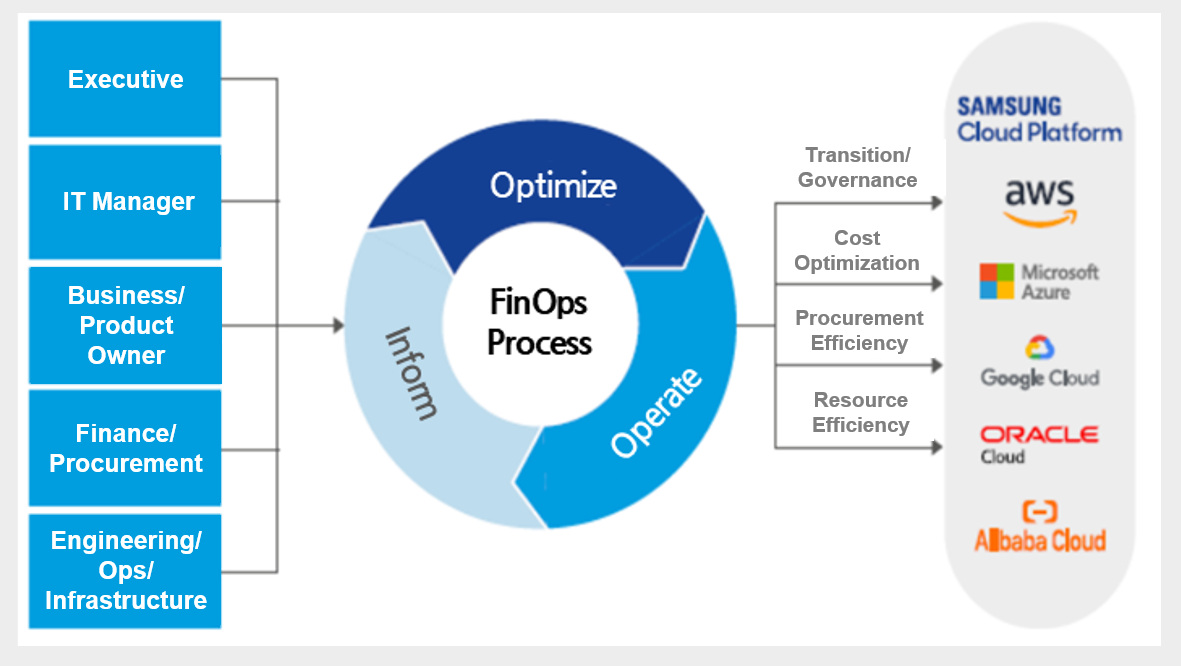
Cost Optimization Process Establishment
FinOps Foundation presents the FinOps Framework, which presents the principles, domains, capabilities, personas, and phases for performing cost optimization as follows in the figure below.
To understand the core concepts and processes of cloud cost optimization, let’s take a look at the elements of the FinOps Framework.
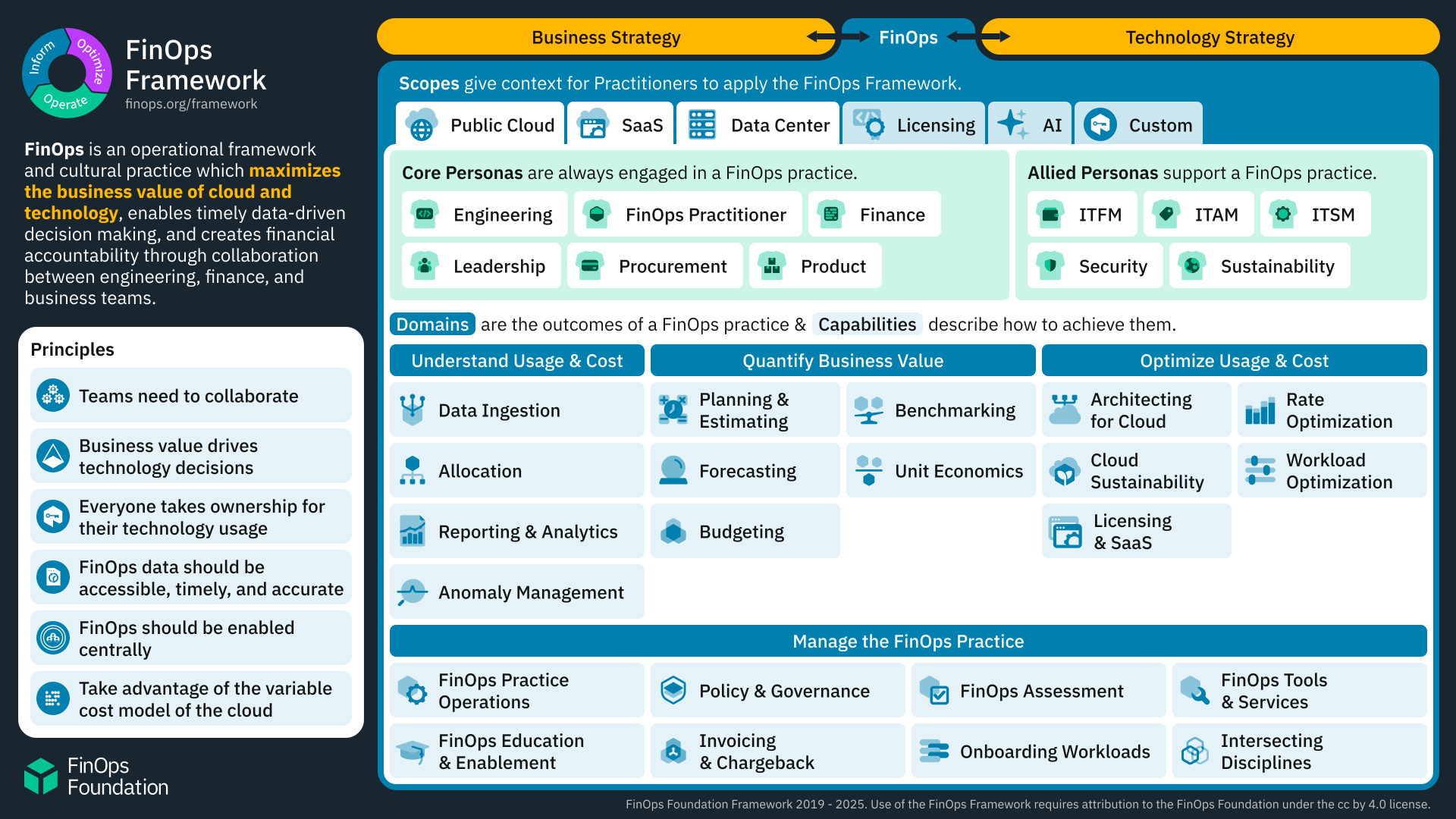
FinOps Framework: Principles
The principles presented in the FinOps Framework are as follows.
- Team Collaboration
- Clouds incur costs per resource, per hour, so finance, engineering, product/service, and business teams must collaborate on a regular basis.
- Each team collaborates continuously to improve efficiency and innovate.
- Based on the business value of the cloud to make decisions
- It represents the impact on the business better than the total expenditure in terms of cost-effectiveness per unit.
- It considers the trade-offs between cost, quality, and speed.
- We think of the cloud as the driving force behind innovation.
- Assign responsibility for cloud usage to all subjects
- The responsibility for usage and cost extends to lower-level organizations or businesses, and engineers take responsibility for costs from architecture design to current operations.
- Each functional team and product team manages cloud usage within the budget scope of each department.
- It distributes decision-making on cost-effective architecture, resource utilization, and optimization to each department.
- The technical team should consider the cost as a new efficiency indicator from the early stages of the software development life cycle.
- Real-time verifiable FinOps Data
- Cost data is processed and shared immediately after creation.
- Ensuring real-time data visibility increases cloud utilization.
- Fast continuous feedback on data contributes to efficient results.
- Information on cloud expenditure costs is provided in real-time to all departments of the organization.
- It creates, monitors, and improves real-time financial forecasts and plans.
- To understand the cause of the cost increase, trend and fluctuation analysis are conducted.
- We foster best practices and celebrate accomplishments through internal team benchmarking.
- It evaluates the company’s performance through benchmarking with industry-level organizations.
- Dedicated team leads FinOps
- Each department has its own area of responsibility, and the dedicated team plays a role in promoting, disseminating, and supporting best practices.
- The management supports FinOps and its practices and processes.
- To utilize the economy of scale, it integrates optimal management of fees, contracts, and discounts.
- Engineers and operations teams focus on optimizing usage in their respective environments and do not participate in discount rate negotiations.
- Using the cloud’s variable cost model
- We view the cloud’s variable cost model as an opportunity to provide greater value, not a risk.
- predicts, plans, and purchases capacity when needed (just-in-time).
- It establishes an agile iterative plan rather than a static long-term plan.
- Do not tidy up the system by being pushed irregularly, but achieve cloud optimization through proactive system design and continuous adjustment.
FinOps Framework: Person
To implement FinOps, various stakeholders, namely personas, within the organization must work with the FinOps team in collaboration.
FinOps activities are not performed by the FinOps team only.
All parties involved in the use, tracking, management, or direction of cloud usage are the subjects of FinOps, and they benefit from it through collaboration within the FinOps Framework.
The following table shows the FinOps core entities and associated organizations and roles.
| FinOps entity | role | entity classification |
|---|---|---|
| FinOps Practice | FinOps practice plays a role in connecting business, engineering, and finance teams, optimizing cloud usage and maximizing business value through data-driven decision-making. It focuses on establishing a FinOps culture and supporting stakeholder teams, presenting best practices based on practical knowledge of the principles and functions of the FinOps framework. It also performs the central FinOps function within the organization. | Key |
| Management Team | CTO/CIO and other management teams focus on strengthening responsibility, securing transparency, improving team efficiency, and preventing budget overruns. | Key Point |
| Product/Service | Product managers (PM) and others focus on the value that IT provides to customers and members, and manage the organization’s business and products/services. The business department operates and collaborates with the engineering team to develop applications and systems that create cloud-based digital value. | Core |
| Engineer | Considers efficient use of resources when designing and building IT systems in a cloud environment, and takes responsibility for cloud usage rates. Performs activities such as selecting the appropriate resource location, resizing, workload management, removing unused resources, and monitoring expense anomalies. The engineering team that introduced FinOps uses cost and resource usage as performance metrics. | Core |
| Finance | The finance person collaborates with FinOps practitioners to analyze past billing data and establish plans and budgets based on accurate predictive models. They are also heavily involved in cloud provider reports, payments, volume discount purchases, and invoice management. | Core |
| Purchase | The purchasing person in charge utilizes the insights provided by the FinOps team to source and purchase products and services from cloud platform vendors. They manage and collaborate with FinOps to ensure that contract terms are fulfilled and proceed with the purchasing process. | Core |
| ITSM / ITIL | The IT service management team collaborates with FinOps practices to standardize and simplify IT service operations. It improves service quality and stability, and ensures that service levels and performance goals are balanced with cloud cost management priorities. | Associated Organizations |
| ITAM | The IT asset management team collaborates with FinOps practices to manage IT assets that impact cloud usage. Their expertise and data are utilized to optimize costs, ensure compliance, and support strategic business objectives. | Associated Organizations |
| Continuous Management (ESG) | Manages to minimize the impact of cloud usage on the environment, promote responsible usage, and maintain a balance between cost management priorities and sustainability goals. | Associated Organization |
| Security | Leveraging FinOps expertise and insights to optimize cloud security spend, improve IT security financial governance, and strengthen the organization’s cloud security posture. | Related Organizations |
| ITFM | IT financial management ensures transparency of IT spending and supports information-based decision making. It ensures that cloud and existing IT investments align with business priorities, are cost-effective, and provide tangible value to the organization. | Associated Organizations |
FinOps Framework: Phase
FinOps performs framework tasks by iteratively performing the three stages of Inform (notification), Optimize (optimization), and Operate (operation).
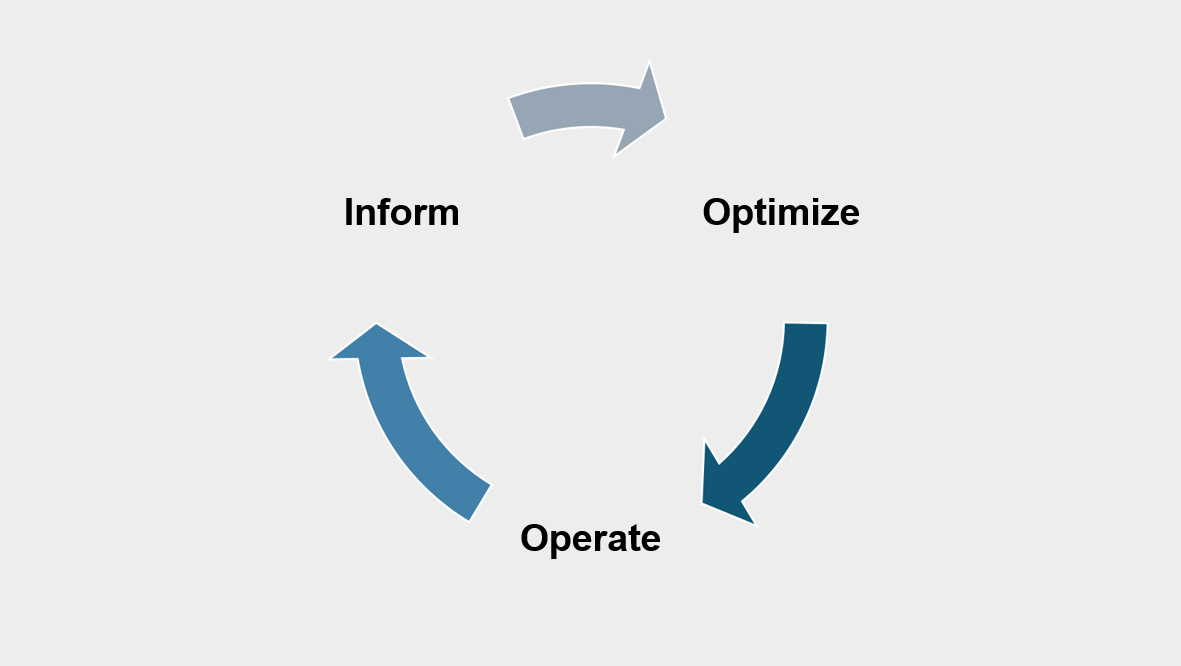
Inform: Visibility and Assignment
Inform stage includes activities to collect and analyze data on cloud costs, usage, and efficiency.
This step includes identifying the data source, assigning and analyzing the data, and then creating a report.
Through this, each team can secure the ability to develop indicators that can explain the business value of budget setting, trend prediction, KPI construction, and cloud spending.
When cloud spend is accurately assigned by tags, users, or business rules, accurate reporting becomes possible, and business and finance teams can increase ROI within budget and predict spend and carbon costs.
Benchmarking between teams provides useful indicators for evaluating the operational efficiency of an organization.
Additionally, linking cloud cost data with sustainability, efficiency, utilization, and performance benchmarks can help derive key performance indicators (KPIs) and unit metrics for an organization’s cloud usage.
The cloud has characteristics such as on-demand, elasticity, and various price discounts, and based on this, organizations must continuously convey business goals to each department by establishing a data-driven decision-making system and checking the expenditure details in real-time.
Optimize: Fees and Usage
Optimize 단계에서는 Inform 단계에서 수집된 데이터와 역량을 활용하여 클라우드 효율성을 개선할 수 있는 기회를 식별합니다 becomes Optimize step identifies opportunities to improve cloud efficiency by leveraging data and capabilities collected during the Inform step.
In this step, the resource optimization tools provided by the cloud provider are utilized to adjust the underutilized resources to the appropriate size, apply the latest architecture, manage the workload, and remove unnecessary resource waste.
Additionally, it also includes visibility, analytics, and reporting features to enhance the purchase and management of pricing models such as contract discounts, cost savings, etc.
In this stage, areas where cloud performance does not align with the organization’s value objectives are identified, and inter-team collaboration is carried out to optimize reporting and management processes based on unit metrics.
Conflicts may occur between optimization directions, but the ultimate goal is for the organization to create more value through cloud investment.
Operate: continuous improvement and usage
Operate 단계에서는 Inform 및 Optimize 단계에서 확보한 데이터와 역량을 기반으로 FinOps를 조직 내에 정착시키기 위한 변화를 구현합니다 becomes Operate stage implements changes to establish FinOps within the organization based on the data and capabilities secured in the Inform and Optimize stages.
This step includes establishing cloud governance policies, compliance monitoring, developing training programs tailored to organizational goals, setting team guidelines and automation policies, and granting individual permissions.
For FinOps to be successful, engineering, finance, and business teams must take continuous and incremental actions together based on the data created in the Inform stage.
Additionally, in the Optimize stage, the best opportunities identified should be selected, and a culture of accountability for actions taken across the organization must be built.
Operate 단계에서는 반복적으로 전략을 개발하고 워크플로를 개선하는 목표를 설정하며, 필요 시 Inform 및 Optimize 단계로 되돌아가 활동을 성숙시키고 새로운 역량을 도입합니다 becomes Operate stage repeatedly sets goals to develop strategies and improve workflows, and when necessary, returns to Inform and Optimize stages to mature activities and introduce new capabilities.
Through this, you can continuously develop the FinOps operation of the organization.
FinOps domain and activities
FinOps Framework’s domain is the basic business performance that an organization must achieve through FinOps, and FinOps activities mean the work performed in each domain.
The first domain is about understanding cloud usage and costs.
In this area, we collect and analyze cost-related data, detect abnormal signs, and manage them.
| Activity | Description |
|---|---|
| Data Collection Data Ingestion | collects, transfers, stores, and normalizes data from various sources to create context-based data sets that can be fully analyzed for cloud usage and costs. |
| Allocation Allocation | Use users, tags, labels, and other metadata to allocate and charge cloud costs to teams and projects within your organization. |
| 보고서 및 분석 Reporting & Analytics | Analyze cloud data and generate reports to gain insights into usage and spending patterns, identify improvement opportunities, and support cloud resource information-based decision-making. |
| Anomaly Management Anomaly Management | Detects, identifies, alerts, and manages cloud cost and usage irregularities that are unexpected or unpredictable in a timely manner to reduce cost risks in cloud operations. |
The following domain is business value quantification.
In this area, activities are performed to quantify the potential costs and values of the business and analyze the economy through benchmarking.
| Activity | Description |
|---|---|
| Planning & Estimating Planning & Estimating | In a specific model or model, it estimates and explores the potential cost and value of the workload when implementing the organization’s cloud environment. |
| Prediction Forecasting | Creates a model of the expected future costs and value of the cloud system by leveraging statistical methods, past expenditure patterns, planned changes, and related metrics. |
| Budget Budgeting | a strategic and ongoing process to set limits in line with business objectives, monitor and manage cloud spending to ensure accountability and predictable financial outcomes for cloud-based systems. |
| Benchmaking Benchmarking | uses efficiency metrics to evaluate value by comparing cloud optimization and each department within the organization or with similar companies, and informs decision-making and adjusts FinOps to fit business goals. |
| Unit Economics Unit Economics | develops and tracks metrics to understand how an organization’s cloud usage and cloud management practices impact the value of the organization’s products, services, or activities. |
The third is the domain of cloud usage and cost optimization.
In this area, we measure the usage of cloud workloads being performed and establish and execute measures to optimize costs.
| Activity | Description |
|---|---|
| Cloud Architecture Design Architecting for Cloud | Designing and modernizing solutions with cost awareness and efficiency to maximize business value while achieving performance, scalability, and operational goals. |
| Rate Optimization Rate Optimization | Through agreements, Cost Savings, etc., it increases the efficiency of cloud rates to achieve the organization’s operational and budget goals. |
| 워크로드 최적화 Workload Optimization | Analyzes and optimizes cloud resources to match specific usage patterns while ensuring workloads operate efficiently and create sufficient business value relative to costs. |
| Cloud Sustainability Cloud Sustainability | Integrates sustainability standards and metrics into cloud optimization to ensure environmental efficiency is balanced with financial value and cloud optimization decisions align with the organization’s goals. |
| Licensing & SaaS Licensing & SaaS | Understand licensing terms, usage rights, and pricing options by vendor, and plan appropriate usage to avoid over or under licensing. Understand the impact of SaaS adoption on an organization’s cloud cost structure and value, and optimize it. |
The last one is FinOps execution management.
FinOps strategy and process build a culture and organization within the organization to execute cloud strategy.
| Activity | Description |
|---|---|
| FinOps Execution Operations FinOps Practice Operations | Through the continuous implementation of FinOps strategy and process, we operate an effective FinOps team to strengthen FinOps practice, fostering a responsible culture. |
| Cloud Policy & Governance Cloud Policy & Governance | Establish and evolve policy, control, and governance mechanisms to ensure cloud usage aligns with business objectives, complies with regulatory requirements, and optimizes cloud resources efficiently. |
| FinOps 평가 FinOps Assessment | To gain insights into the strengths and areas for improvement of FinOps activities, FinOps maturity is repeatedly measured and analyzed in the context of the FinOps framework. |
| FinOps Tools & Services FinOps Tools & Services | Develops standards and methodologies to effectively integrate FinOps tools and services that match framework features to strengthen FinOps cases |
| FinOps 교육 FinOps Education & Enablement | Through education, technical development, and practical activities, teams across the organization can adopt and deliver FinOps practices. |
| Financial Management Invoicing & Chargeback | The finance team collaborates with product/service and engineering teams to develop a cloud billing model, adjusting cloud cost data and reports to meet budget and accounting requirements. |
| 워크로드 전환 Onboarding Workloads | Provide transparency on costs, usage, and impact in a way that orchestrates system migration between cloud environments or cloud environments, supporting operational objectives. |
| Related Department Collaboration Intersecting Disciplines | It should be managed in coordination with related departments (ITAM, ITFM, sustainability, security, etc.) to manage responsibilities wider than the cloud, and it should be integrated into the organization’s cloud strategy through collaboration with FinOps. |
FinOps Maturity
FinOps activities are performed iteratively, through which the maturity of processes, domains, and activities is improved.
FinOps maturity approach starts small and gradually expands in scale, scope, and complexity.
In a small, limited scope, take necessary measures quickly, perform FinOps, and then expand FinOps activities in a larger, faster, and more detailed way based on the results of the measures.
The following table shows the maturity of FinOps.
| Maturity | Characteristics | KPI Examples |
|---|---|---|
| Crawl | - There are almost no reports and tools - Measurement results only provide insights into activities - Basic KPIs to measure the degree of success - Basic procedures and policies are defined around activities - Key departments within the organization have an understanding of activities but are not actively engaged - Plan-centric with easily achievable goals | - At least 50% allocation - 60% application rate of resource commitment - The difference between predicted and actual expenditures is within 20% |
| Walk | - some departments within the organization perform activities - difficult practical situations occur, but those cases are exceptions for decision-making - all activities are automated and processed - practical cases that threaten the organization’s financial stability are identified and attempted to be solved - setting mid-to-high level success goals/KPI | - at least 80% allocation - 70% application rate of resource commitment - the difference between predicted and actual expenses is within 15% |
| Run | - all teams within the organization perform activities - solve difficult practical cases - top-level success goals/KPI - prefer automation | - at least 90% allocation - 80% application rate of resource commitment - the difference between predicted and actual expenditure is within 12% |
Cost Requirement Analysis
As previously reviewed, tasks for cost requirements can be derived by FinOps execution stages.
The ultimate goal is to reduce the total cost through cost optimization, but for this purpose, tasks and task goals can be set step by step for each execution stage.
The table below presents the requirements by execution step.
Inform Stage
| Requirements | Description |
|---|---|
| Map expense data to business | Link expense data to organizational structure to meet the analysis requirements of finance, business, and engineering teams |
| Showback and Chargeback management | Assigns expense responsibility to each department and connects to internal systems. |
| Budget and predicted cost determination | It should be possible to predict the cloud usage of multiple projects using available data and control the budget. |
| Establishing tag rules and compliance measures | Establishes tag rules quickly to prevent arbitrary tagging and applies them to resources. |
| Allocate shared costs fairly | Allocate the costs of services or support services used in common by each team in an appropriate ratio. |
| Customized rate/depreciation dynamic calculation | The contract and discount must be reflected in various cost data. |
| Trend and variance analysis | To distinguish the causes of expenditure, costs should be verifiable at the level of time, resource, and project level from the level of time and resource to the project level. |
| Creation of evaluation table and benchmarking | Create an evaluation table in terms of cost, speed, and quality optimization and perform benchmarking between project teams |
Optimize step
| Requirements | Description |
|---|---|
| Abnormal symptom check | It should be able to detect an abnormal surge in usage, including checking the cost threshold. |
| Low usage service check and report | You should be able to identify unused or low usage resources. |
| Contract VM Central Management | centrally manages the cloud portfolio across the organization to maximize the effect of contract discounts. |
| Cost and workload placement comparison | Reviews infrastructure requirements to help save cloud costs through workload placement |
Operate step
| Requirements | Description |
|---|---|
| Provide expenditure data to stakeholders | Provide periodic cost data so that all departments can understand cloud expenditure, and automate report creation and utilization |
| Cultural change aligned with goals | You can be trained and empowered to understand, describe, and collaborate with multiple teams to drive innovation. |
| An appropriate size of server type | The engineer applies the recommendations derived in the Optimize phase. |
| Cloud usage governance and control | Continuously evaluates the agreed-upon criteria for what types of cloud services to use. |
| Continuously improving efficiency and innovation | We drive a process of continuous and repetitive improvement of purpose and goals to achieve better business performance. |
| Resource Optimization Automation | A trained team provides the functionality to programmatically detect and utilize the necessary changes to incorrectly sized resources and automatically tidy up underutilized resources. |
| Integrate recommendations into workflow | Allow application owners to check recommendations through FinOps management tools without having to log in every time to check recommendations |
| Policy-based tag cleanup, storage modification cycle policy | Through tag policy, tags are organized. Policy-based storage lifecycle is created to automatically save data in cheap storage. |
Showback
The process by which an organization tracks cloud costs and bills them to internal departments or business units. It is used for the purpose of providing transparency and increasing awareness of how many resources or services are being consumed in various departments without actually billing the costs.Chargeback
It is a process of assigning and billing the actual cloud costs to the relevant internal department or business unit. Issues the cloud cost invoice that the department consumes based on a predetermined rate or cost model.
Cost modeling
In an on-premises environment, demand is anticipated, and fixed costs are invested in the initial stages to build an information system.
On the other hand, in a cloud environment, resource costs are incurred based on actual demand, and costs can also fluctuate on a monthly, daily, or hourly basis.
Therefore, using the cloud improves efficiency and agility, but the fluctuation range of costs and usage also increases.
When customer demand increases, resources are also expanded, increasing costs, but if efficiency is improved, the increase in costs can be reduced.
The flexible nature of the cloud also affects costs and predictions.
To reflect changing business requirements and demands, plans must be established, and the existing organization’s budget process needs to reflect these fluctuations.
To predict the cost of new workloads, cost modeling should be considered.
Cost modeling is a process of setting goals with FinOps stakeholders through financial analysis based on understanding of cloud costs, and identifying cost optimization opportunities.
There are Business Practice approach and Data Analytics approach for understanding volatility for prediction, and the things to be checked for each approach are as follows.
- Business Practice Approach
- peak season, holidays, etc., understanding the period of periodic increase in users
- Project, marketing events, etc., future plans that can increase users
- Data collection cycle for forecasting
- Data Analytics approach
- Check if past data of periodic user increase is reflected
- Check if past data of business events is reflected
- Analysis of the gap between prediction and actual results
- long-term trend forecast
Next, the data must be granulated in order to define the cost.
The level of granularity may vary depending on the organization’s structure and internal processes, and specific requirements and The level of granularity will be determined according to the organization’s situation.
Through this, cost modeling can be performed based on the following examples.
All expenses are grouped according to the classification criteria.
It calculates the average value of the expenditure for the last 3 months by group.
It calculates the average value of the motive 1 year ago.
Compare the two average values to understand the trend and reflect the growth rate for each group.
It reflects all subsequent plans.
FinOps stakeholders share and adjust opinions.
CiO based cost management
CiO is Samsung SDS’s collaboration platform to support FinOps’ process.
This platform supports real-time information sharing, team communication/collaboration, and immediate execution.
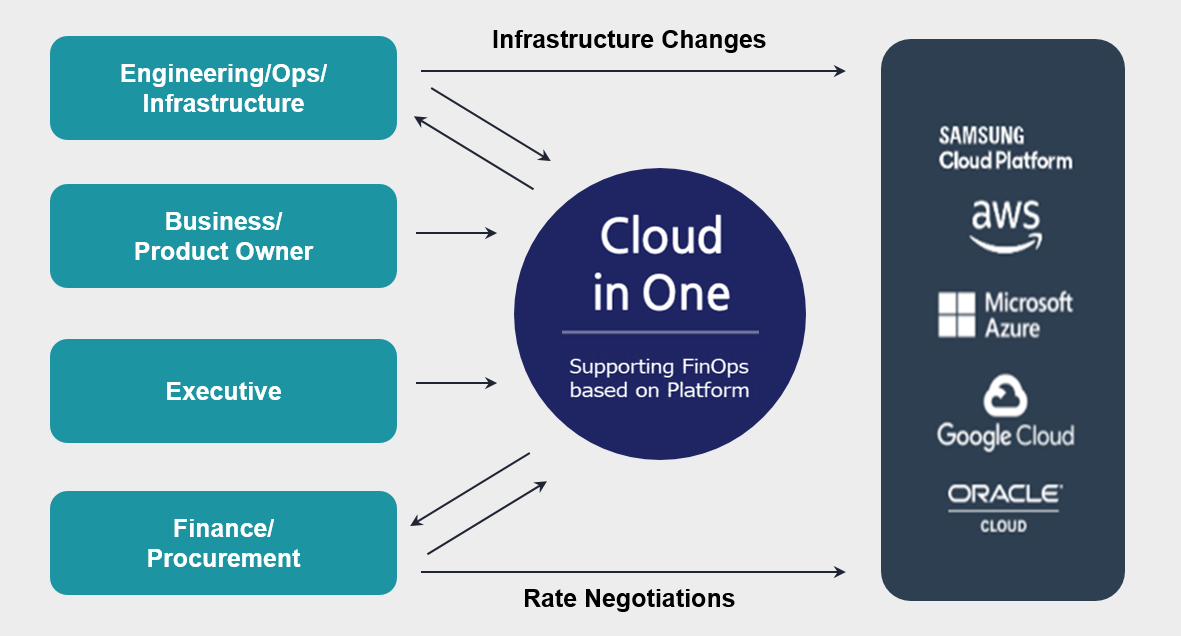
Platform for Establishing FinOps Across the Enterprise Dimension Hybrid, Multi Cloud execution/operation information/execution guide/process provision
Real-time cloud information sharing and communication-based collaboration activation Verify what resources are being used for what purpose, how, and on what scale To check how much the development/operation department is working to optimize resources Check how much cloud costs are being reduced from a warrior dimension
Providing platform value for fare discounts/resource optimization Usage pattern-based fee discount and resource optimization recommendation/execution (Short-term) Integrated resource management through Enterprise Discount Program additional benefit sharing(Long-term)
Providing and continuously updating the FinOps standard process and execution base Traditional resource management process → Optimal collaboration process settlement for cloud environment
CiO provides a specific execution strategy and collaboration platform to advance FinOps to the ’execution’ stage.
Providing actual usage and fee information alone poses many difficulties in running FinOps.
To this, the CiO defines and performs management indicators and processes for performing FinOps and supports the performance.
| Question | Description |
|---|---|
| How effectively are resources being used? | - Is the right amount of resources being used? (Rightsizing execution) - Are long unused resources being managed? (Unused resource identification execution) - Are resources used only at specific times being managed? (Scheduling execution) |
| How well is resource optimization being executed? | - Is resource optimization being executed according to established criteria? - Are resource optimization targets being reviewed and executed in a timely manner? |
| How aggressively have you set cost efficiency? | - How much are you applying the discount service provided by CSP? (Reserved Instance or Savings Plans, etc.) |
| How well is cost efficiency being executed? | - Is the compliance rate of the contractual discount service provided by CSP well managed? (Reserved Instance or Savings Plans, etc.) |
Through FinOps management indicators, you can intuitively and quantitatively grasp the current status of cloud resource or cost management.
The results of each indicator item are linked to improvement activities, enabling continuous governance performance.
The organization’s current status should be reflected to define the management level and it is necessary to systematically carry out change management.
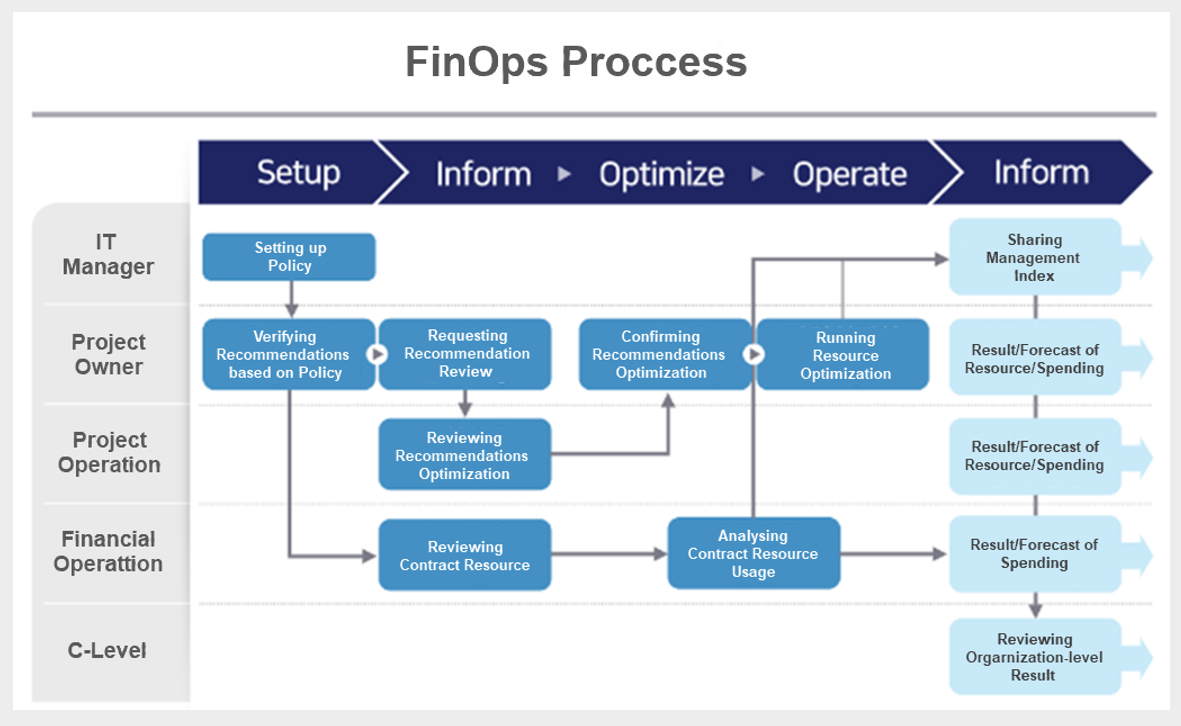
For efficient decision-making, a collaboration process between FinOps participants is essential.
The above figure shows the process established by applying the basic process of FinOps, Inform → Optimize → Operate.
In order for the process defined in this way to be continuously executed and managed, systematic systematization is necessary.
Samsung Cloud Platform’s CiO is one of Samsung SDS’s Managed Service offerings, and for more information, please refer to Samsung SDS Cloud in One.