
Cloud-Based High Availability DBMS Configuration
Cloud-Based High Availability DBMS Configuration
Overview
Even in cloud environments, database stability is a critical factor. To ensure stable data management and service continuity, Samsung Cloud Platform DBaaS provides a synchronous replication‑based Database Redundant High Availability configuration that can guarantee availability even in enterprise settings.
Samsung Cloud Platform provides Database services based on an optimal high‑availability architecture, derived from technical analysis of various Database high‑availability configurations. Depending on the type of Database (RDBMS, NoSQL, etc.), you can select the optimal configuration, and this document explains the high‑availability setups for the representative services MySQL and PostgreSQL families.
Architecture Diagram
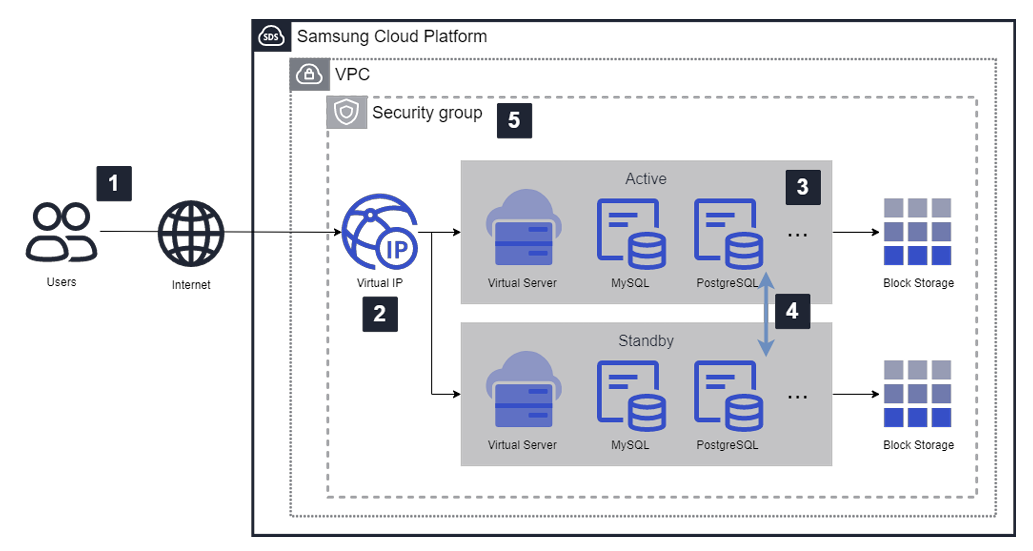
Architecture composition and operation
Client Access
- The client accesses the Database service via VIP(Virtual IP) or DNS query.
- Before creating a Database service, the user must configure a VPC in advance, and the Database will be created based on that VPC.
Specify Active Node
- VIP or DNS holds the current Active Node information in a redundant database configuration and forwards user requests to the Active Node.
Data synchronization
- Data created or modified in the Active Database is recorded on Block Storage, and the data is synchronized to the Standby Node for storage.
Service continuity in the event of a failure
- Even if an Active or Standby Node encounters a problem, the synchronized Block Storage data ensures that the service is continuously provided without data loss.
Security Settings
- To access the created database, set the DB port and target IP in the Security Group.
Use Cases
Utilization in various enterprise solutions
- You can utilize MySQL (DBaaS) and PostgreSQL (DBaaS) based databases in various business solutions such as logistics, RPA, and workflow automation.
- We provide uninterrupted service through infrastructure redundancy and high‑availability configuration.
- When physical or logical failures (e.g., hangs, data loss, etc.) occur, service continuity is ensured through high-availability-based failover.
Ensuring continuity during infrastructure and DB failures
- Even when infrastructure failures such as virtual machines, OS, network, storage, or database failures (e.g., Hang, DB process errors) occur, ensure service continuity with failover within 1~2 minutes.
Prerequisites
None
Constraints
- High-availability databases provide automatic Failover functionality, but when a Failover occurs after a fault, a separate check is required to verify the system’s normal operation.
Considerations
- Depending on the service importance, you can select either a single Virtual Server‑based configuration or a redundant high‑availability Database configuration.
- A redundant database utilizes two Virtual Servers and storage space, resulting in higher costs compared to a single configuration, and data synchronization replication may cause some performance degradation.
- We recommend selecting options optimized for the service by conducting tests and performance verification before using the database.
Related service
This is a list of Samsung Cloud Platform services that are associated with the features or configurations described in this guide. Refer to it when selecting and designing services.
| service group | service | Detailed description |
|---|---|---|
| Database | EPAS(DBaaS) | A service that easily creates and manages EPAS in a web environment |
| Database | PostgreSQL(DBaaS) | A service that easily creates and manages open-source PostgreSQL in a web environment |
| Database | MariaDB(DBaaS) | A service that easily creates and manages MariaDB with high compatibility with MySQL. |
| Database | MySQL(DBaaS) | A small yet powerful open-source relational database service that makes creating and managing MySQL easy. |