
Microservice with Kubernetes
Microservice with Kubernetes
Overview
Microservice Architecture (MSA) refers to an approach that develops business applications by combining small services (microservices). Using MSA enables rapid development of business requirements, relatively free immediate deployment of changes to the operational environment, easy maintenance, and the advantage of minimizing the impact of partial failures on the entire system.
Samsung Cloud Platform provides cloud services such as Kubernetes Engine, API Gateway, and Event Streams for developing MSA-based cloud-native applications, enabling response to recent rapid business and technology changes.
Architecture Diagram
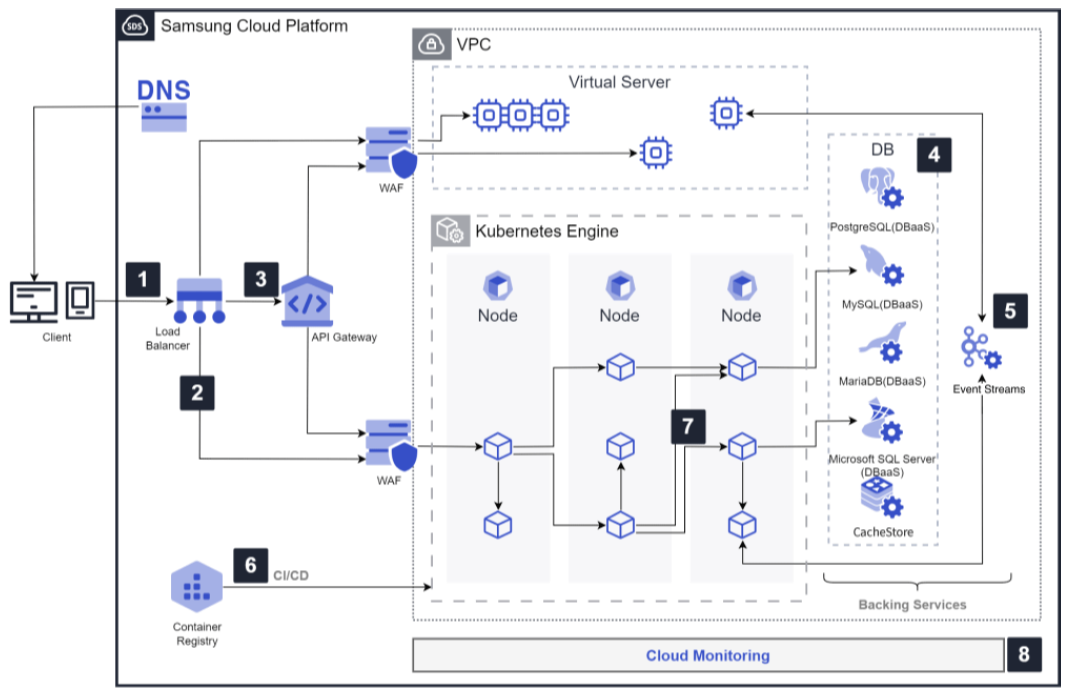
- The client’s request is delivered to the VM/Container workload and API Gateway service through the Load Balancer.
- Client requests, except for API requests, are forwarded to the ingress provided by Kubernetes Engine. 2. Kubernetes Engine routes requests received through ingress to the service Pods they are mapped to.
- To handle client API requests, the API Gateway is positioned at the frontmost layer and performs authentication and service routing for all incoming API calls from external sources.
- Microservice Architecture configures a database separated by structured service units.
- Backing Service refers to back-end services that microservices can use over the network, providing DBMS services such as PostgreSQL (DBaaS), in-memory cache services such as CacheStore (DBaaS), and queue services such as Event Streams for asynchronous processing of microservice messages.
- Through DevOps-based CI/CD services, we support the development and operation of Microservice applications seamlessly.
- You can use Service Mesh technology to control the network between microservice components. 7. Through Service Mesh technology, it is possible to manage and trace various network configurations and data flows between segmented applications.
- In MSA, because multiple Microservice operate in a distributed environment, monitoring of service status is required. 8. Telemetry services such as Monitoring, Logging, and Tracing serve to monitor services and configure an environment that allows responding to issues that occur for each service.
Use Cases
Applying Microservice to Logistics System
For the logistics system, we implemented a container‑based MSA architecture when developing new applications to achieve lightweight applications, ensure availability, and provide a flexible response as the business expands.
The detailed systems that compose the logistics system—such as the warehouse management system, shipping system, and multimodal transportation system—are built with containers, and Samsung Cloud Platform uses a standard Kubernetes Engine service to provide easy and rapid deployment of microservices, independent execution environments, scalability, and resilience in a container-based environment.
Case Study of a Global Manufacturer’s Development Platform
The platform that supports application development for global manufacturers provides an API Gateway, DevOps, and Kubernetes-based container services for microservice-based application development. Through this, we support DevOps-based Canary deployments for individual built services, and by using the API Gateway to catalog each service’s API, we increase the reusability of the services. We plan to secure flow control and visibility for microservices through Service Mesh capabilities in the future.
Prerequisites
None
Constraints
Some features, such as Service Mesh, need to be configured using open-source software.
Considerations
None
Related service
This is a list of Samsung Cloud Platform services that are related to the features or configurations described in this guide. Refer to this when selecting and designing services.
| Service group | service | Detailed description |
|---|---|---|
| Compute | Virtual Server | Virtual server optimized for cloud computing |
| Container | Kubernetes Engine | Kubernetes container orchestration service |
| Container | Container Registry | A service that provides a registry for storing and managing container images and OCI (Open Container Initiative) standard artifacts. |
| Networking | Load Balancer | A service that automatically distributes server traffic load. |
| Networking | DNS | Convert the domain name into a numeric IP address so the system can identify it and provide the service. |
| Database | MariaDB(DBaaS) | A service that easily creates and manages open-source MariaDB. |
| Database | PostgreSQL(DBaaS) | A service that easily creates and manages open-source PostgreSQL |
| Database | MySQL(DBaaS) | A service that easily creates and manages open-source MySQL |
| Database | Microsoft SQL Server(DBaaS) | A service that easily creates and manages Microsoft SQL Server |
| Database | CacheStore(DBaaS) | A service that easily creates and manages services offering the in‑memory data stores Redis OSS and Valkey. |
| Data Analytics | Event Streams | A service that easily creates and manages the open-source Apache Kafka |
| Application Service | API Gateway | A service that easily creates, manages, and monitors APIs. |
| DevOps Tools | DevOps Service | A service that provides standardized development tools, development templates based on code frameworks, and integrated management features for development, deployment, and operation. |