
Building a Reverse Proxy Using API Gateway
Building a Reverse Proxy Using API Gateway
Overview
A reverse proxy (Reverse Proxy) is positioned behind the Internet and in front of the server, acting as an intermediary that forwards client requests to the appropriate server. API Gateway can act as a reverse proxy because it routes requests to multiple servers based on paths and handles and manages user authentication, thereby controlling access to endpoints, which enhances security and optimizes performance.
Architecture Diagram
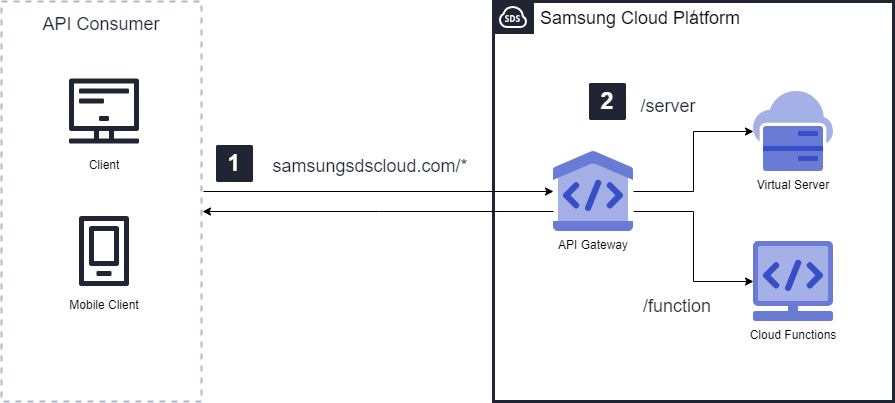
Invoke the single domain provided by API Gateway.
Authenticate the client request and verify that the user has server access permissions.
Depending on the path name, route to Virtual Server and Cloud Functions respectively.
Use Cases
Server security
By hiding the actual server IP address of the service provided to users, it becomes more difficult for hackers to launch targeted attacks such as DDoS. This allows you to protect the server from DDoS attacks. Additionally, you can enhance security by controlling access to the server through user authentication and authorization.
Distributed Processing
Handling millions of requests on a single server is difficult, but you can distribute traffic across multiple servers using API Gateway. By distributing traffic, you can prevent overload on a single server and ensure that, even if a specific server goes down, other servers can handle the workload. Through this, you can optimize server performance and reduce server response time.
Prerequisites
N/A
Constraints
All components must use the same API name.
Considerations
N/A
Related service
This is a list of Samsung Cloud Platform services associated with the features or configurations described in this guide. Refer to this when selecting and designing services.
| service group | service | Detailed description |
|---|---|---|
| Compute | Virtual Server | Virtual server optimized for cloud computing |
| Compute | Cloud Functions | A service that runs application code in a serverless computing environment |