Building a Reverse Proxy using API Gateway
Building a Reverse Proxy using API Gateway
Overview
A reverse proxy is an intermediary that sits between the internet and a server, forwarding client requests to the server. API Gateway can act as a reverse proxy by routing to multiple servers based on paths and handling user authentication and access control to endpoints, thereby enhancing security and optimizing performance.
Architecture Diagram
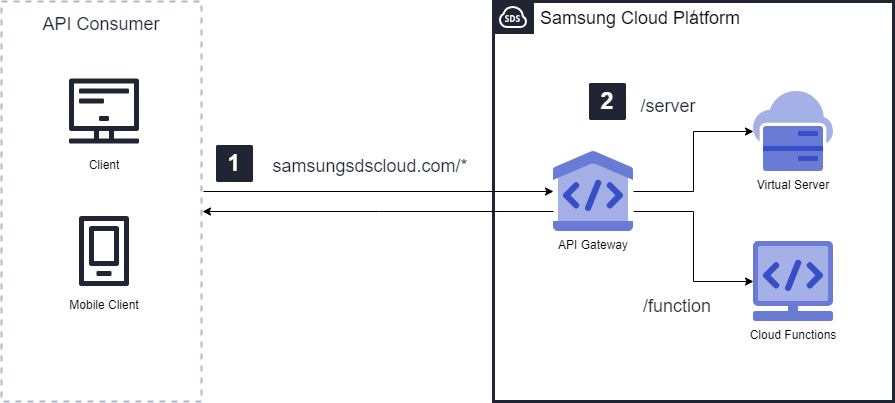
The single domain provided by API Gateway is called.
Client requests are authenticated, and access to the server is granted to authorized users.
Based on the path name, requests are routed to Virtual Server and Cloud Functions, respectively.
Use Cases
Server Security
By hiding the actual server IP address from users, it becomes more difficult for hackers to launch targeted attacks like DDoS. This protects the server from DDoS attacks and enhances security by controlling access to the server through user authentication and authorization.
Distributed Processing
While it’s challenging for a single server to handle millions of requests, API Gateway can distribute traffic across multiple servers. By doing so, it prevents single-server overload and ensures that other servers can handle requests even if one server goes down, optimizing server performance and reducing response time.
Pre-requisites
N/A
Limitations
All components must use the same API name.
Considerations
N/A
Related Services
This section lists Samsung Cloud Platform services related to the features or configurations described in this guide. Refer to these services when selecting and designing your services.
| Service Group | Service | Detailed Description |
|---|---|---|
| Compute | Virtual Server | Virtual servers optimized for cloud computing |
| Compute | Cloud Functions | A service that runs application code in a serverless computing environment |